
Crossover design, Placebo, and Blinding techniques
Presented By
Dinesh M Gangoda
M. Pharm (Pharmacology) Sem- III
A.R College of Pharmacy & G.H Patel Institute of Pharmacy
Subject: Research Methodology and Biostatistics (MRM303T)
2
CROSS OVER DESIGN
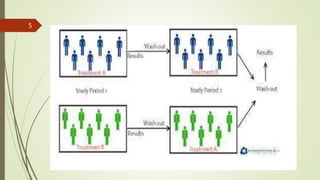
 A crossover design is a modified randomized block design in which
each block receives more than one treatment at different dosing
periods.
 A block can be a patient or a group of patients.
 Patients in each block receive different sequences of treatments.
 A crossover design is called a complete crossover design if each
sequence contains all treatments under investigation.
Crossover designs may be used in clinical trials in the following
situations where:
 The Measurement and interpretable data for both efficacy and
safety are obtained.
Chronic (relatively stable) disease is under study.
The disease is not curable with the treatment.
Relatively short treatment periods are considered.
Cross over design….
3
Cross over design….
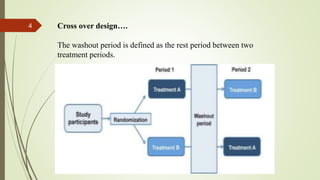
The washout period is defined as the rest period between two
treatment periods.
4
5
 A crossover design has the following advantages:
1. It allows a within-patient comparison between treatments, since
each patient serves as his or her own control.
2. It removes the inter-patient variability from the comparison
between treatments.
3. With a proper randomization of patients to the treatment
sequences, it provides the best unbiased estimates for the
differences between treatments.
6
Disadvantages:
1. Carry-over effects: The residual influence of treatments on
subsequent treatment periods. Avoided by wash out period.
2. Period effects: The diff. between the study periods.
3. Drop-outs can be higher.
7
Placebo
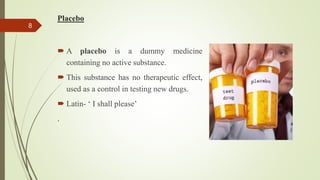
 A placebo is a dummy medicine
containing no active substance.
 This substance has no therapeutic effect,
used as a control in testing new drugs.
 Latin- ‘ I shall please’
.
8
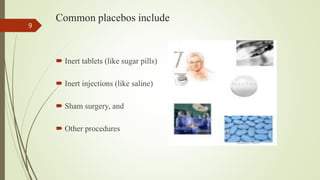
Common placebos include
 Inert tablets (like sugar pills)
 Inert injections (like saline)
 Sham surgery, and
 Other procedures
9
Types of Placebo
 Inert or pure placebo
 Substances that could have no conceivable pharmacologic effect
on the patient.
 Examples- Dummy pill or capsules containing lactose
 Active or Impure Placebo
 Have a potential pharmacological effects, though not
necessarily any specific activity for the condition under
treatment.
 Examples- Vitamin B12 or Iron in the absence of anemia
10
Blinding
 Blinding represents an important, distinct aspect of randomized
controlled trials.
 The term blinding refers to keeping trial participants, investigators
(usually healthcare providers), or assessors (those collecting
outcome data) unaware of an assigned intervention, so that they are
not influenced by that knowledge.
 Blinding prevents bias at several stages of a trial, although its
relevance varies according to circumstance.
11
1. Single blinding or single-masked:
• In single blinding, only a single stakeholder i.e. either the participant
or the investigator is not informed of the nature of treatment the
participant is receiving.
• A trial is called single-blind if only one party is blinded. Usually, the
participant is blinded and is unaware of the treatment they
receive.
12
2. Double-blinding or double-masked:
• Double-blinded study is defined as a study, in which both study
population/participant and data collectors/investigators/researchers
are not aware of the kind or nature of the treatment given and who
receive the treatment.
• If both ‘the participants’ and ‘the study staffs’ are blinded, it is
known as a double- blind study.
13
3. Triple blinding
• A clinical trial or experiment in which neither the subject nor the
person governing treatment nor an individual measuring the response
to the treatment is aware of the particular treatment received by the
subject is known as triple blind.
• In triple blinding, the study participant, the data investigator or
data collector and the data analyzer- all are blinded.
• Only the Principle Investigator of the research might know about
the trial– may it be treatment, drugs or so on.
14
4. Unblinded or open-label
• It is the exact opposite of blinding, where all the participant,
clinicians, data collectors, specialists are well known about the
treatment/intervention they receive.
15
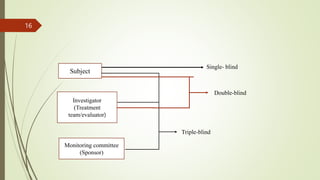
Subject
Investigator
(Treatment
team/evaluator)
Monitoring committee
(Sponsor)
Single- blind
Double-blind
Triple-blind
16
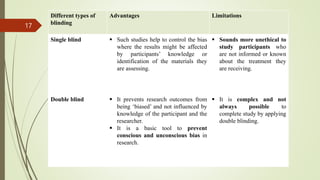
Different types of
blinding
Advantages Limitations
Single blind  Such studies help to control the bias
where the results might be affected
by participants’ knowledge or
identification of the materials they
are assessing.
 Sounds more unethical to
study participants who
are not informed or known
about the treatment they
are receiving.
Double blind  It prevents research outcomes from
being ‘biased’ and not influenced by
knowledge of the participant and the
researcher.
 It is a basic tool to prevent
conscious and unconscious bias in
research.
 It is complex and not
always possible to
complete study by applying
double blinding.
17
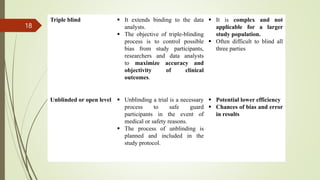
Triple blind  It extends binding to the data
analysts.
 The objective of triple-blinding
process is to control possible
bias from study participants,
researchers and data analysts
to maximize accuracy and
objectivity of clinical
outcomes.
 It is complex and not
applicable for a larger
study population.
 Often difficult to blind all
three parties
Unblinded or open level  Unblinding a trial is a necessary
process to safe guard
participants in the event of
medical or safety reasons.
 The process of unblinding is
planned and included in the
study protocol.
 Potential lower efficiency
 Chances of bias and error
in results
18
19

Cross over design, Placebo and blinding techniques

  • 1.
    Crossover design, Placebo,and Blinding techniques Presented By Dinesh M Gangoda M. Pharm (Pharmacology) Sem- III A.R College of Pharmacy & G.H Patel Institute of Pharmacy Subject: Research Methodology and Biostatistics (MRM303T)
  • 2.
    2 CROSS OVER DESIGN A crossover design is a modified randomized block design in which each block receives more than one treatment at different dosing periods.  A block can be a patient or a group of patients.  Patients in each block receive different sequences of treatments.  A crossover design is called a complete crossover design if each sequence contains all treatments under investigation.
  • 3.
    Crossover designs maybe used in clinical trials in the following situations where:  The Measurement and interpretable data for both efficacy and safety are obtained. Chronic (relatively stable) disease is under study. The disease is not curable with the treatment. Relatively short treatment periods are considered. Cross over design…. 3
  • 4.
    Cross over design…. Thewashout period is defined as the rest period between two treatment periods. 4
  • 5.
  • 6.
     A crossoverdesign has the following advantages: 1. It allows a within-patient comparison between treatments, since each patient serves as his or her own control. 2. It removes the inter-patient variability from the comparison between treatments. 3. With a proper randomization of patients to the treatment sequences, it provides the best unbiased estimates for the differences between treatments. 6
  • 7.
    Disadvantages: 1. Carry-over effects:The residual influence of treatments on subsequent treatment periods. Avoided by wash out period. 2. Period effects: The diff. between the study periods. 3. Drop-outs can be higher. 7
  • 8.
    Placebo  A placebois a dummy medicine containing no active substance.  This substance has no therapeutic effect, used as a control in testing new drugs.  Latin- ‘ I shall please’ . 8
  • 9.
    Common placebos include Inert tablets (like sugar pills)  Inert injections (like saline)  Sham surgery, and  Other procedures 9
  • 10.
    Types of Placebo Inert or pure placebo  Substances that could have no conceivable pharmacologic effect on the patient.  Examples- Dummy pill or capsules containing lactose  Active or Impure Placebo  Have a potential pharmacological effects, though not necessarily any specific activity for the condition under treatment.  Examples- Vitamin B12 or Iron in the absence of anemia 10
  • 11.
    Blinding  Blinding representsan important, distinct aspect of randomized controlled trials.  The term blinding refers to keeping trial participants, investigators (usually healthcare providers), or assessors (those collecting outcome data) unaware of an assigned intervention, so that they are not influenced by that knowledge.  Blinding prevents bias at several stages of a trial, although its relevance varies according to circumstance. 11
  • 12.
    1. Single blindingor single-masked: • In single blinding, only a single stakeholder i.e. either the participant or the investigator is not informed of the nature of treatment the participant is receiving. • A trial is called single-blind if only one party is blinded. Usually, the participant is blinded and is unaware of the treatment they receive. 12
  • 13.
    2. Double-blinding ordouble-masked: • Double-blinded study is defined as a study, in which both study population/participant and data collectors/investigators/researchers are not aware of the kind or nature of the treatment given and who receive the treatment. • If both ‘the participants’ and ‘the study staffs’ are blinded, it is known as a double- blind study. 13
  • 14.
    3. Triple blinding •A clinical trial or experiment in which neither the subject nor the person governing treatment nor an individual measuring the response to the treatment is aware of the particular treatment received by the subject is known as triple blind. • In triple blinding, the study participant, the data investigator or data collector and the data analyzer- all are blinded. • Only the Principle Investigator of the research might know about the trial– may it be treatment, drugs or so on. 14
  • 15.
    4. Unblinded oropen-label • It is the exact opposite of blinding, where all the participant, clinicians, data collectors, specialists are well known about the treatment/intervention they receive. 15
  • 16.
  • 17.
    Different types of blinding AdvantagesLimitations Single blind  Such studies help to control the bias where the results might be affected by participants’ knowledge or identification of the materials they are assessing.  Sounds more unethical to study participants who are not informed or known about the treatment they are receiving. Double blind  It prevents research outcomes from being ‘biased’ and not influenced by knowledge of the participant and the researcher.  It is a basic tool to prevent conscious and unconscious bias in research.  It is complex and not always possible to complete study by applying double blinding. 17
  • 18.
    Triple blind It extends binding to the data analysts.  The objective of triple-blinding process is to control possible bias from study participants, researchers and data analysts to maximize accuracy and objectivity of clinical outcomes.  It is complex and not applicable for a larger study population.  Often difficult to blind all three parties Unblinded or open level  Unblinding a trial is a necessary process to safe guard participants in the event of medical or safety reasons.  The process of unblinding is planned and included in the study protocol.  Potential lower efficiency  Chances of bias and error in results 18
  • 19.