Clinical spinal anatomy
Mr. Daniel Chan FRCSEd FRCSOrth
Consultant Orthopaedic Spinal Surgeon
PEOC/RD and E
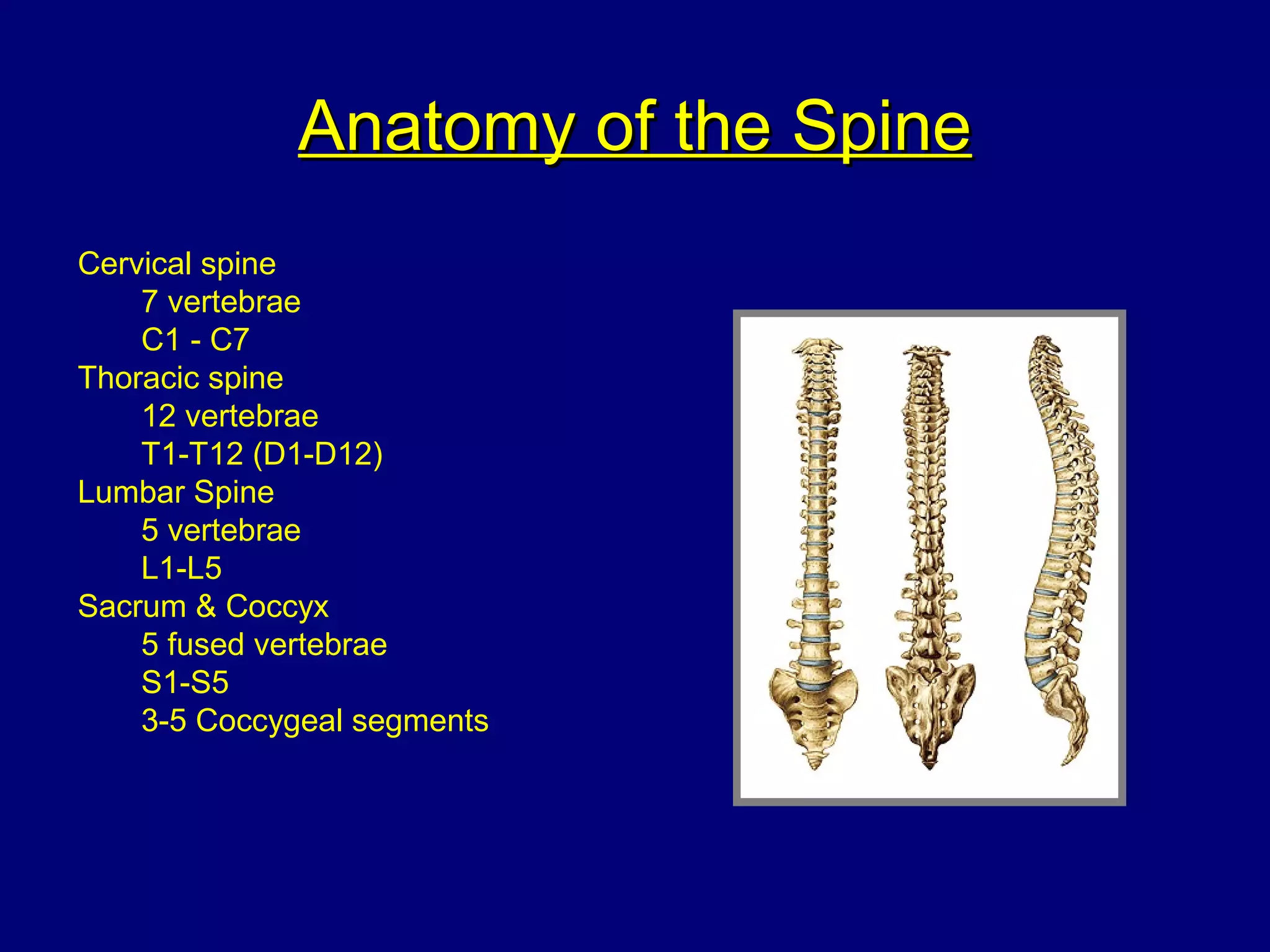
Anatomy of the Spine
Cervical spine
7 vertebrae
C1 - C7
Thoracic spine
12 vertebrae
T1-T12 (D1-D12)
Lumbar Spine
5 vertebrae
L1-L5
Sacrum & Coccyx
5 fused vertebrae
S1-S5
3-5 Coccygeal segments
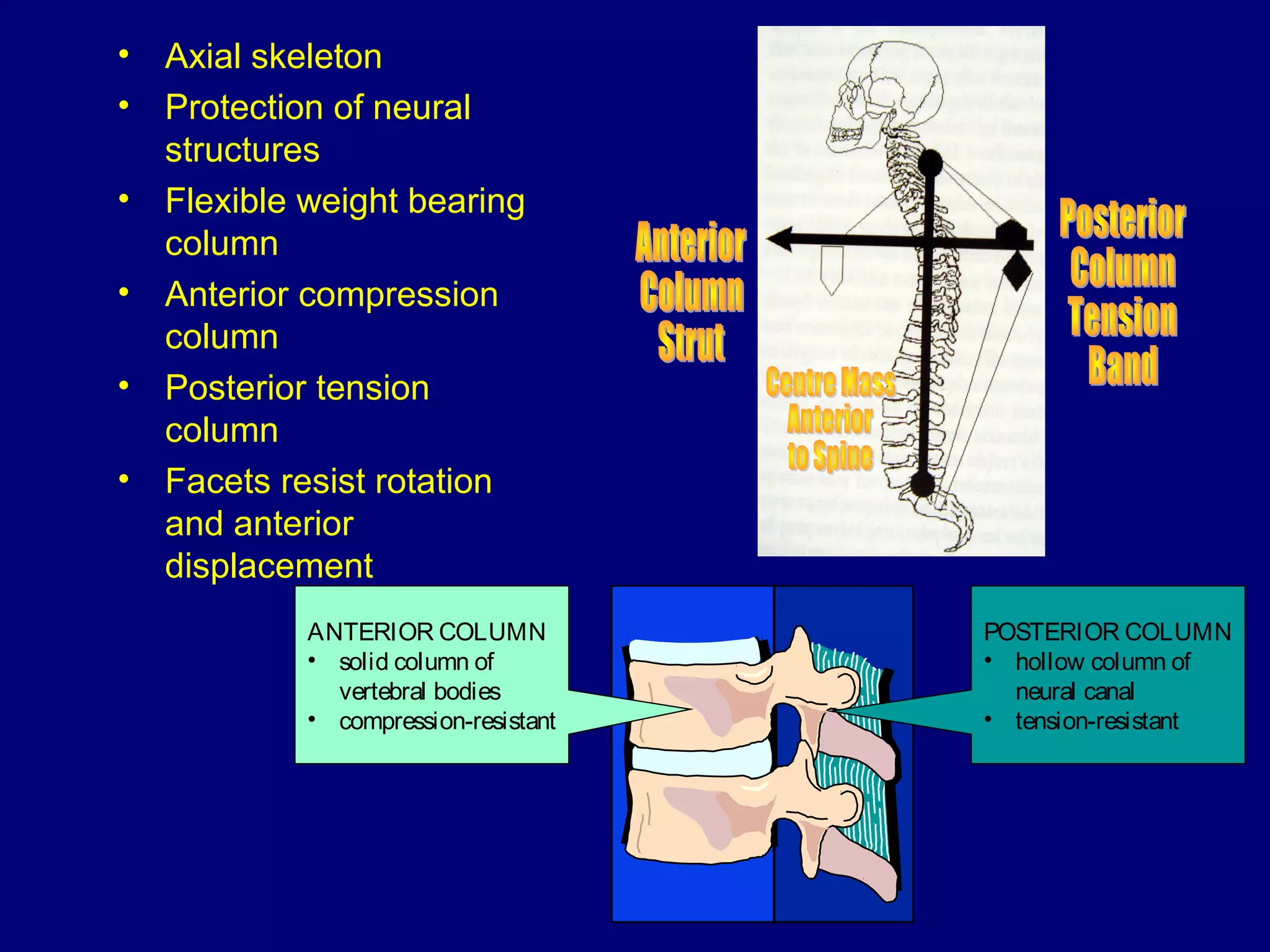
• Axial skeleton
• Protection of neural
structures
• Flexible weight bearing
column
• Anterior compression
column
• Posterior tension
column
• Facets resist rotation
and anterior
displacement
ANTERIOR COLUMN
• solid column of
vertebral bodies
• compression-resistant

POSTERIOR COLUMN
• hollow column of
neural canal
• tension-resistant
Sagittal profile
• To maintain upright
balance
• Cervical and lumbar
lordosis
• Thoracic and sacral
kyphosis
0
1
2
3
4
5
6
7

upper cervical spine - Axial

lower cervical spine – Sub-Axial
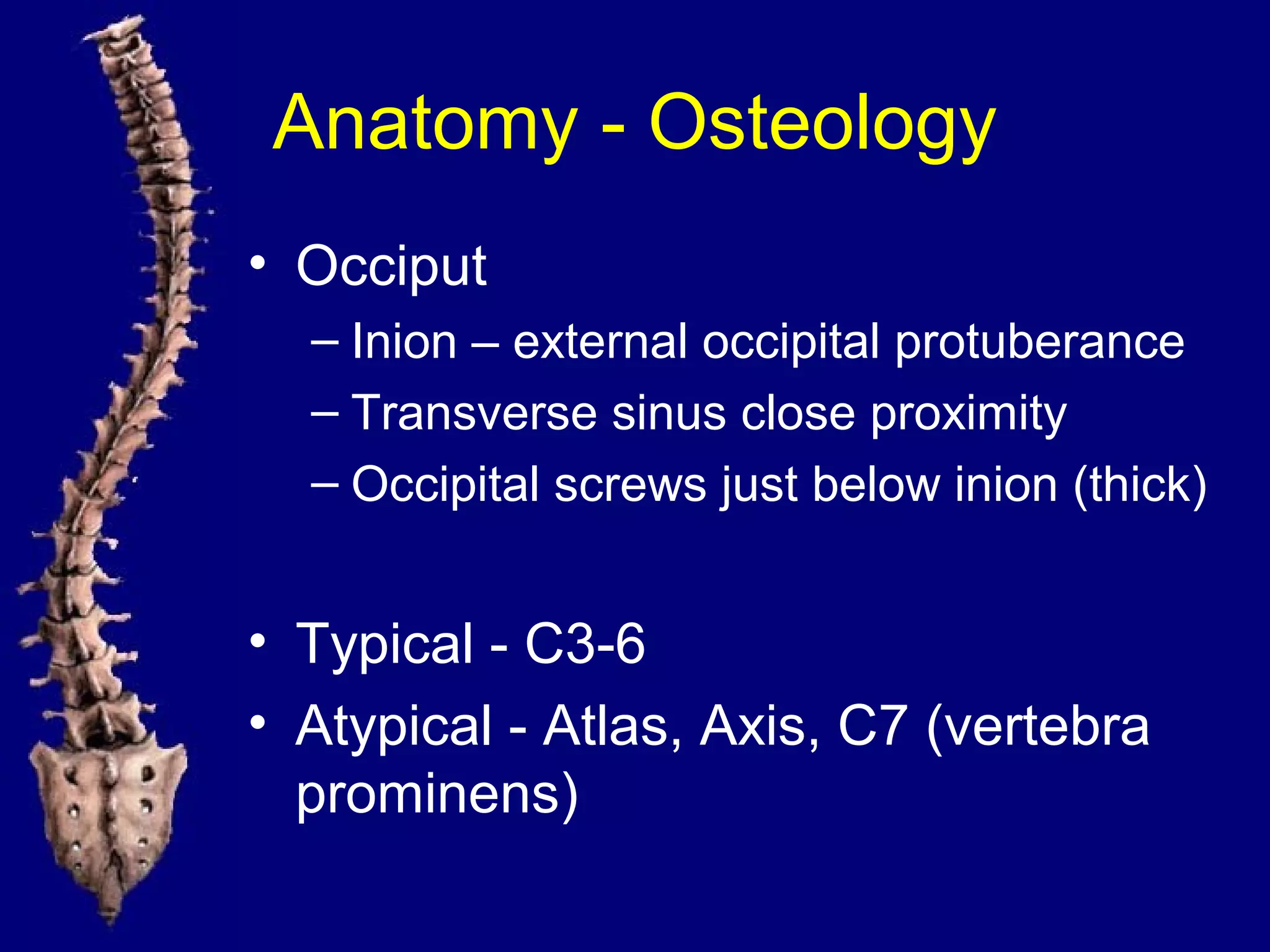
Anatomy - Osteology
• Occiput
– Inion – external occipital protuberance
– Transverse sinus close proximity
– Occipital screws just below inion (thick)

• Typical - C3-6
• Atypical - Atlas, Axis, C7 (vertebra
prominens)
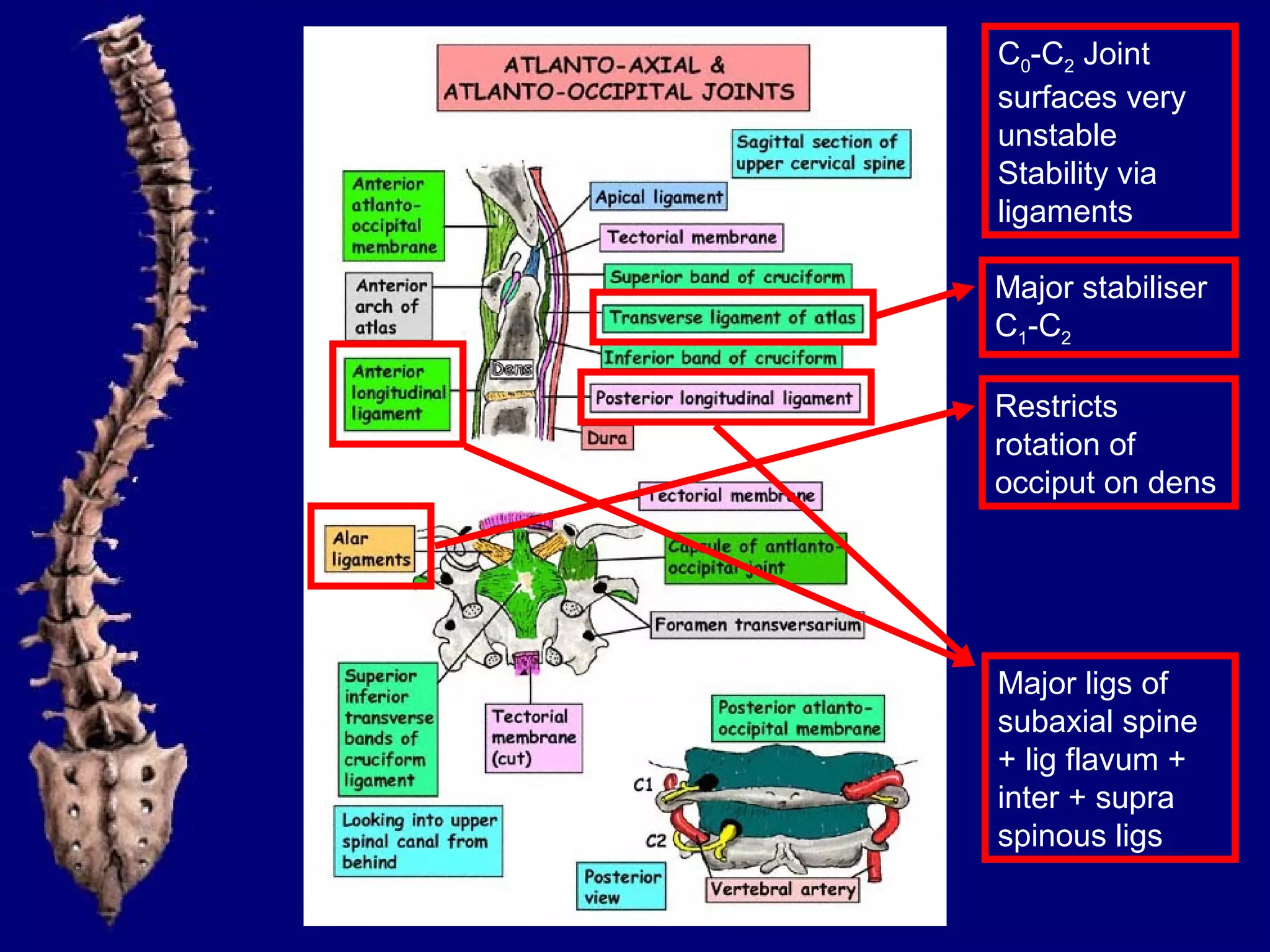
C0-C2 Joint
surfaces very
unstable
Stability via
ligaments
Major stabiliser
C1-C2
Restricts
rotation of
occiput on dens

Major ligs of
subaxial spine
+ lig flavum +
inter + supra
spinous ligs
Steel’s Rule
of Thirds
1/3 Dens
1/3 Cord
1/3 Space
Feel your own!
For feeling
the pulse!

Tripod =
VB +
2 Facets /
Lateral
masses

Scalenes
ant + med
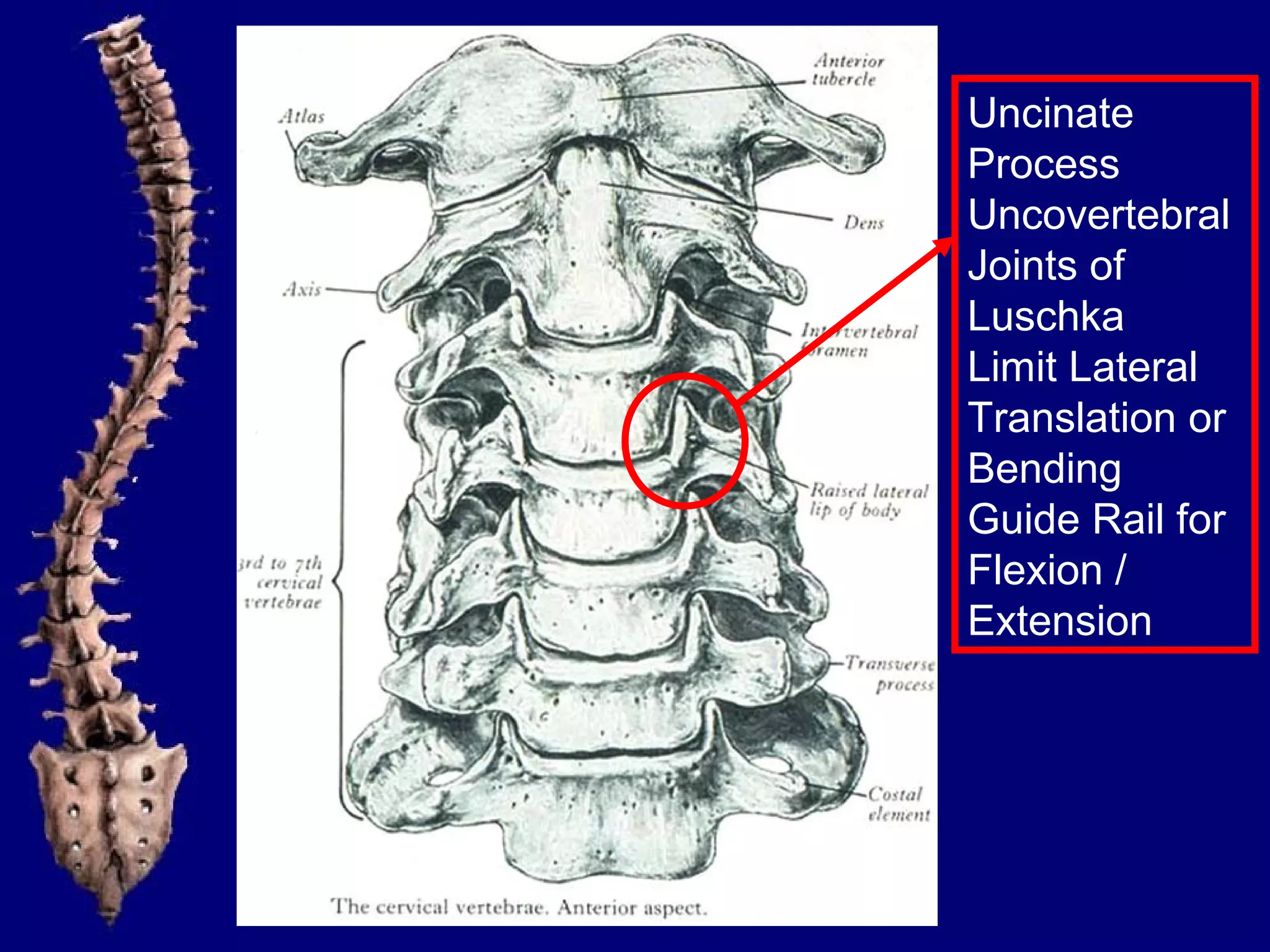
Uncinate
Process
Uncovertebral
Joints of
Luschka
Limit Lateral
Translation or
Bending
Guide Rail for
Flexion /
Extension
Anatomy - Articulations
• Arc of motion:
• Flexion/Extension

145°

• Axial rotation

180°

• Lateral flexion

90°
Anatomy - Articulations
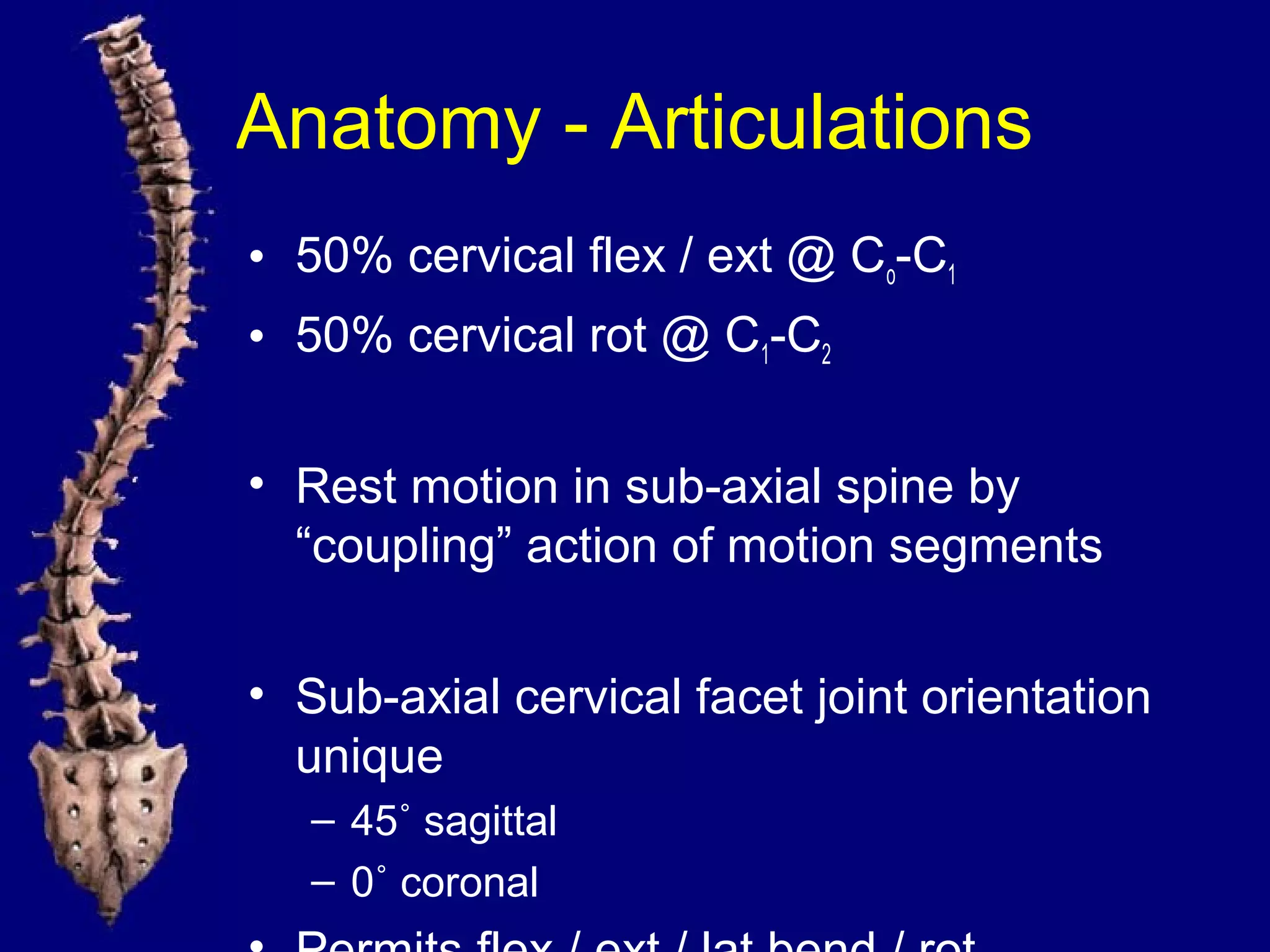
• 50% cervical flex / ext @ Co-C1
• 50% cervical rot @ C1-C2
• Rest motion in sub-axial spine by
“coupling” action of motion segments
• Sub-axial cervical facet joint orientation
unique
– 45˚ sagittal
– 0˚ coronal
Anatomy - Neural
•
•

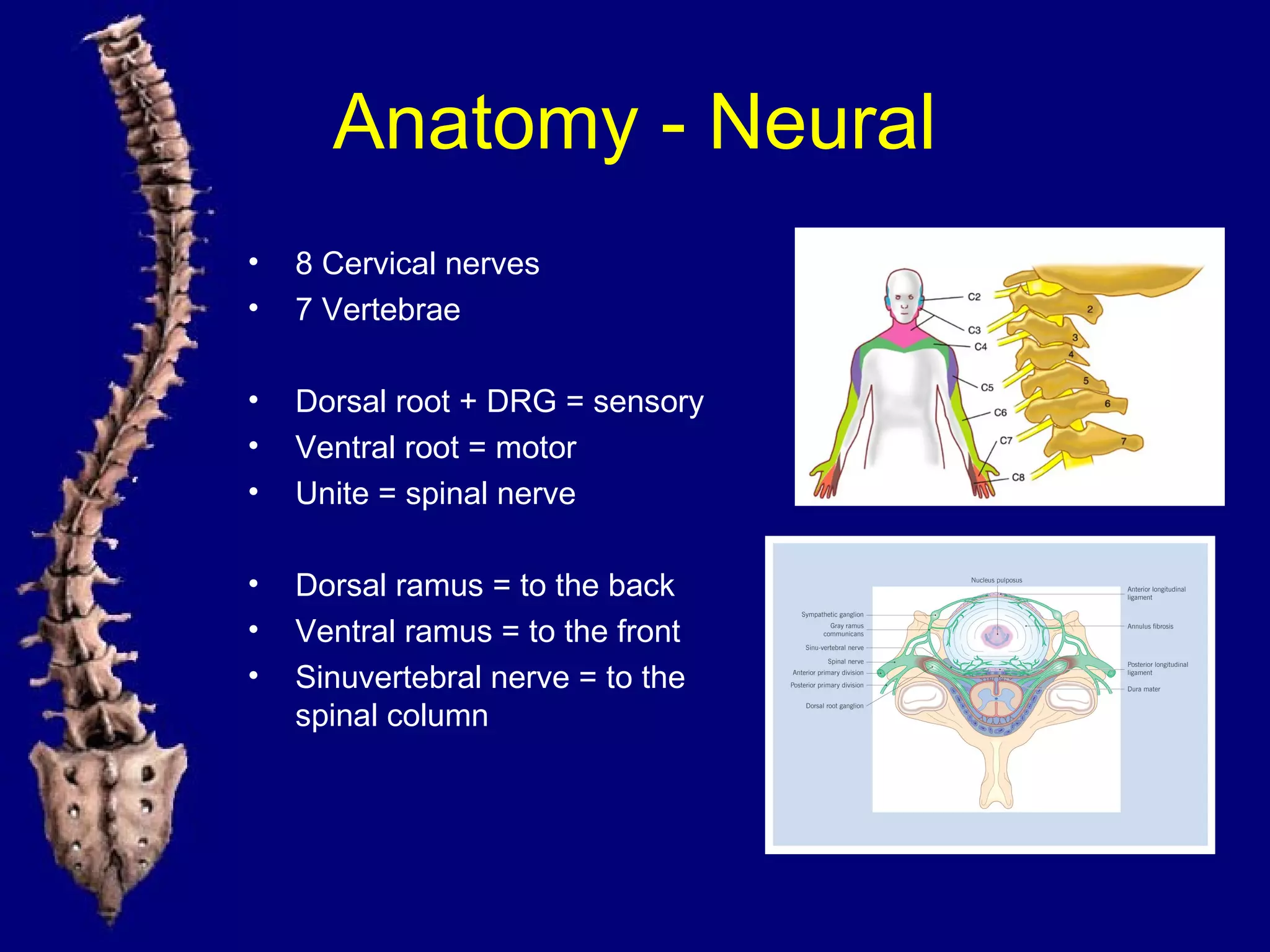
8 Cervical nerves
7 Vertebrae

•
•
•

Dorsal root + DRG = sensory
Ventral root = motor
Unite = spinal nerve

•
•
•

Dorsal ramus = to the back
Ventral ramus = to the front
Sinuvertebral nerve = to the
spinal column
Anatomy - Neural
Pedicles small and highly variable
Therefore – lateral mass screws

1mm

15o

Starting point 1mm Vertebral artery
medial to centre of anterior to entry
lateral mass
point
Place a flat probe in
the facet joint of the
level to be fused to
indicate the cephalad
angulation of the drill
or ‘K’ wire
posterior
atlanto
occipital
membrane

spinal cord

suboccipital
nerve
atlas
atlanto
-axial
joint
axis

vertebral
artery
greater
occipital
nerve
Atlanto-axial dislocationssurgical stabilisation
• Magerl transarticular screw fixation
Atlanto-axial dislocationssurgical stabilisation

• Gallie C1/2 wiring
Atlanto-axial dislocation
Surgical stabilisation
• Brook
Jenkins
C1/2
fusion
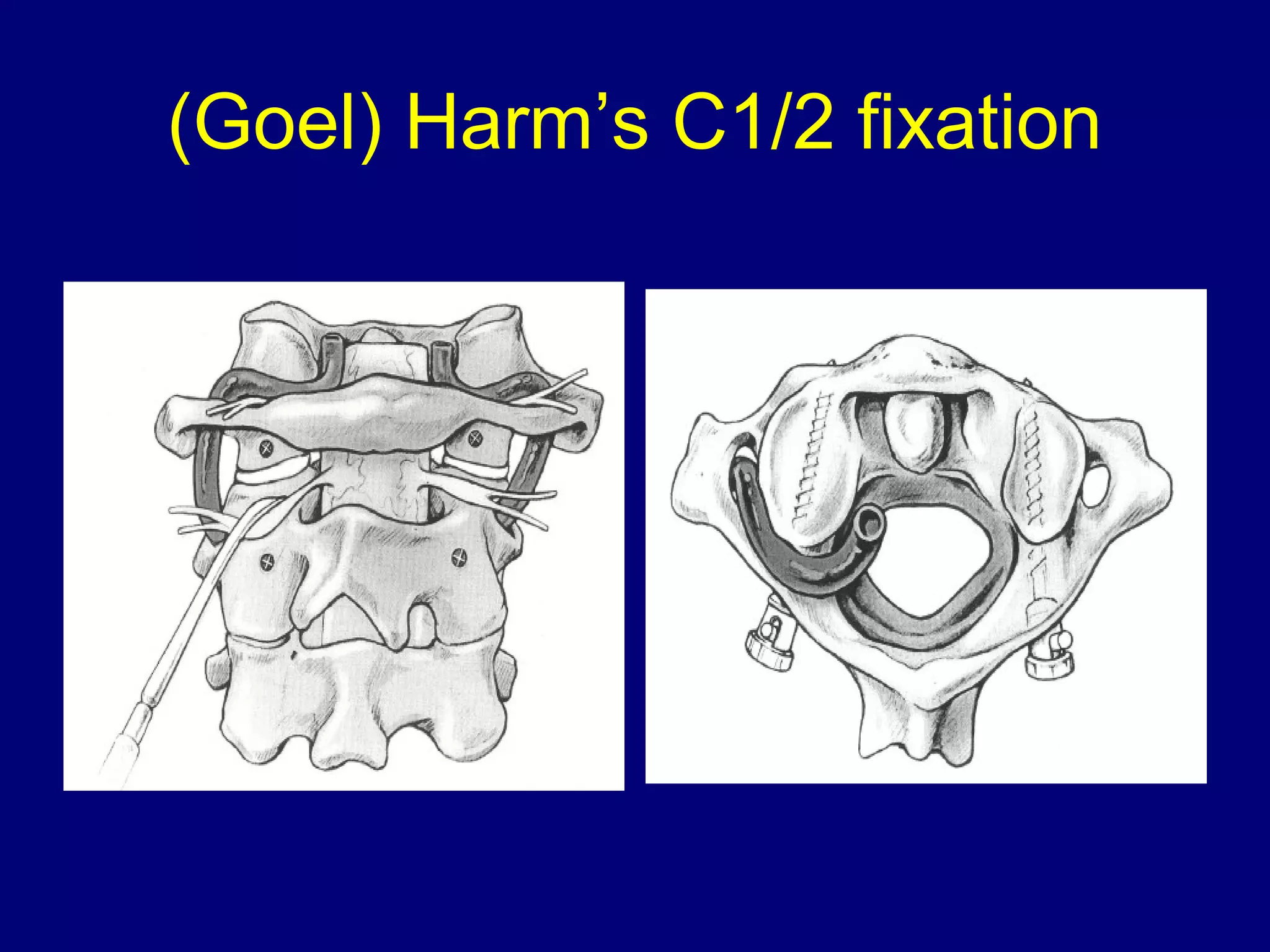
(Goel) Harm’s C1/2 fixation
DF injury
• example
DF injury
• Reduction of unifacet dislocation
DF injury - redisplacement
• Roger’s wiring
• Bohlman’s triple wiring
Posterior stabilisation
Lateral mass fixation
Thoracic Anatomy

12 Vertebrae, Smaller than Lumbar

Facets Frontally Orientated in A-P View

Spinous Processes Longer, Distally Orientated

Transition at Thoracolumbar Junction T9-12
Anatomy – general considerations
•transverse processes short
but thick,
orientated postero-laterally,
articulate with ribs
•Pedicles smaller
•Spinal Canal smaller
diameter
•Ribs articulate with
vertebral bodies
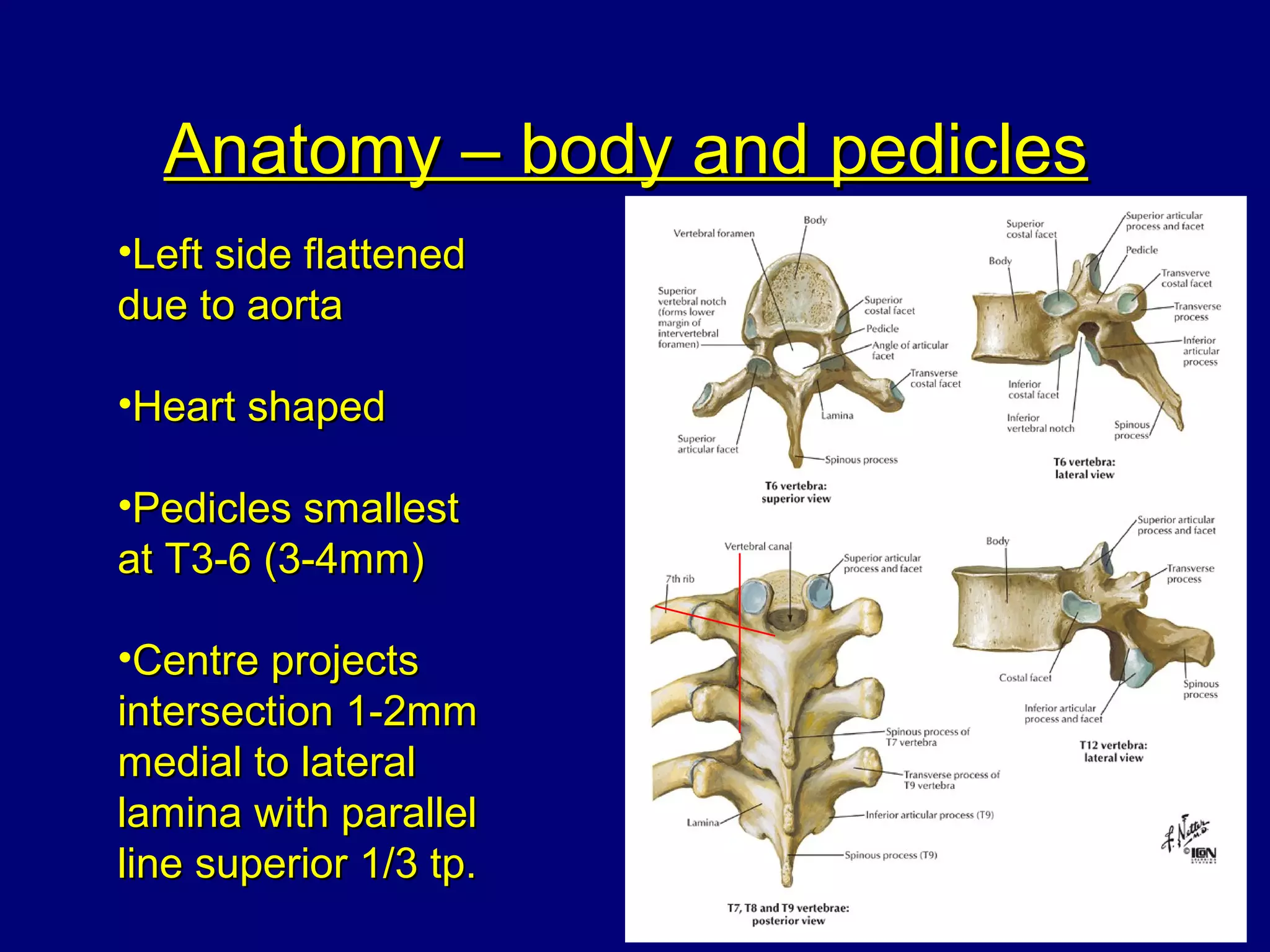
Anatomy – body and pedicles
•Left side flattened
due to aorta
•Heart shaped
•Pedicles smallest
at T3-6 (3-4mm)
•Centre projects
intersection 1-2mm
medial to lateral
lamina with parallel
line superior 1/3 tp.
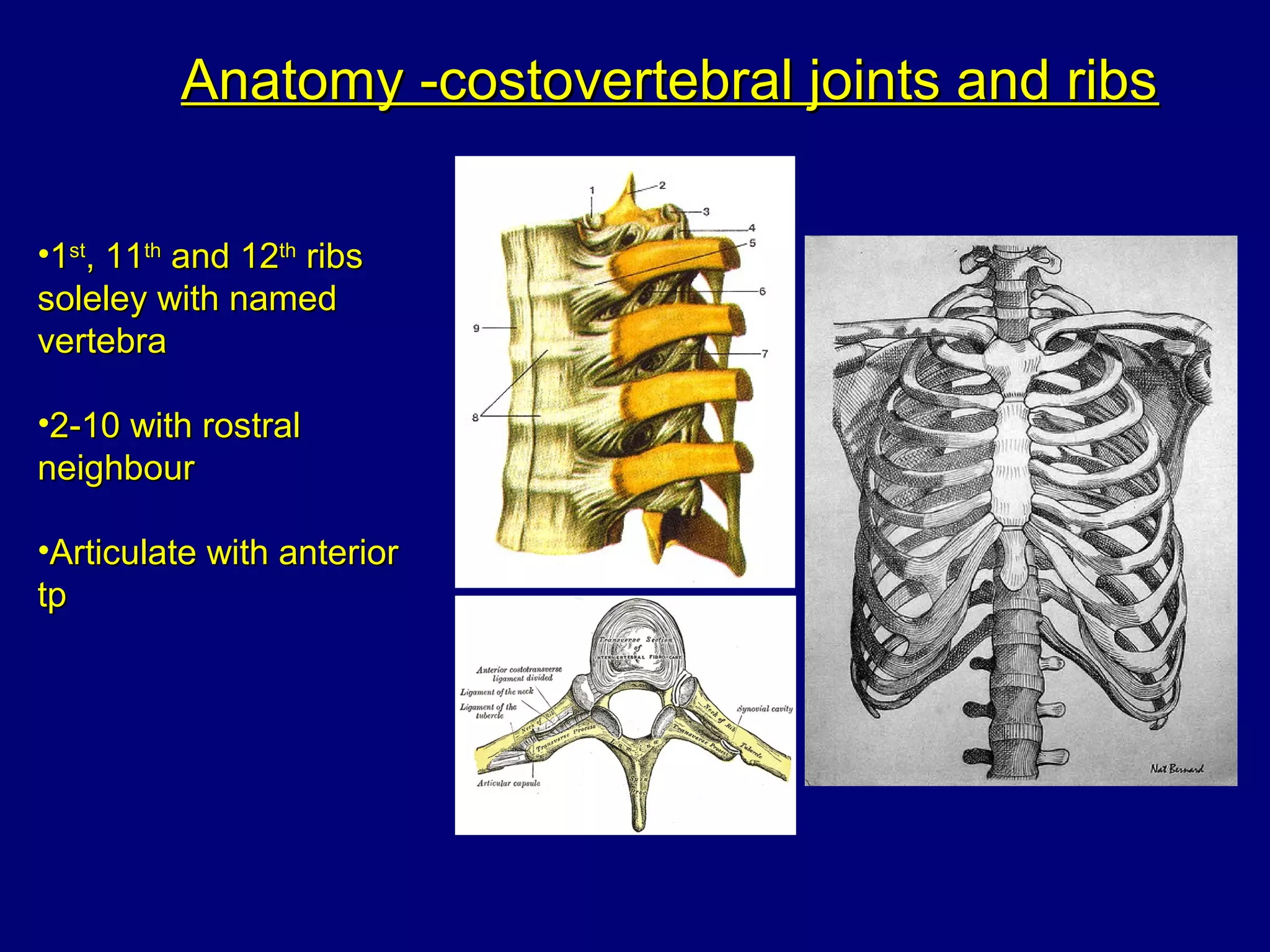
Anatomy -costovertebral joints and ribs
•1st, 11th and 12th ribs
soleley with named
vertebra
•2-10 with rostral
neighbour
•Articulate with anterior
tp
Structures anterior to thoracic spine
Tomita Procedure
• 55/M(AM)
• Back pain+
paraparesis
• T7 Mets
• Tokuhashi Score-12
• Hypernephroma
primary
Tomita procedure
(Spine 1997; 22: 324-333)
3 months

28 months
No recurrence
Lumbar Spine
•

L1 to L4 ‘Typical’
Lumbar Vertebrae

-

wide strong kidney
shaped bodies with
parallel endplates;

-

a wide posterior arch
fusing to form a
horizontally projecting
spinous process

-

Superior facets face
posteromedially, Inferior
facets face
anterolaterally and
therefore allow
flexion/extension but
limit rotation
Anterior
longitudinal
ligament
Posterior
longitudinal
ligament
Intervertebral
disc

Ligamentum
flavum
Interspinous
ligament
Supraspinous
ligament
Pars interarticularis
Spondylolysis: The Scotty Dog
Spondylolytic spondylolisthesis
• NUCLEUS PULPOSUS
– GAGS. Hydrated
Aggrecans
– Hydrostatic
structure
• ANNULUS FIBROSUS
– fibrocartilagenous
structure with
different “meshtype” layers
Cauda equina and Nerves roots

L4

L5
Degenerative
• Disc herniations
Anatomy
•
•
•

Thoracolumbar fascia
Cluneal nerves

Sacrospinalis
– Iliocostalis
– Longissimus
– Spinalis

•
•
•

multifidus
rotators
intertransversarii
Anatomy
• crest on pars
• crest on TP
• converge on
superior facet
Sacral anatomy
• lateral sacral crest
• junction with
superior facet
Sacral anatomy
• converge to
promontary
• diverge to ala
Plan screw trajectory

MRI

Plain X rays
Anterior relations
Cross section anatomy - L4 L5
• root medial and inferior to pedicle
• great vessels anterior

L4

L5
Cross section anatomy - S1
• “bare” area
• L5 root

S1
L4/5 exposure

L5S1 exposure
May the force be with you
Clinical Instability
The loss of the ability of the spine under
physiological loads to maintain its pattern
of displacement so that there is no initial or
additional neurological deficit, no major
deformity, and no incapacitating pain
White and Panjabi Clin Orthopaedics 1975

Clinical spinal anatomy for students v2