Mr Alasdair Barrie
CT1 Trauma and Orthopaedics
24/3/15
Content
 Torsion
 Exomphalos
 Gastroschisis
 Oesophageal atresia
 Pyloric stenosis
 Intussusception
 Hischprung’s
 Muconeum ileus
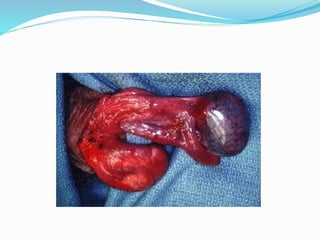
Testicular Torsion
 Testicular torsion can occur at any age, but is most
common in the neonatal and peripubertal periods.
 Presents with severe testicular pain / abdominal pain.
 Testicular viability is reduced with increasing time
from the onset of symptoms.
 Following reduction of a torsion 3-point fixation with
an non-absorbable suture should be performed.
 The contralateral testis should also be fixed.
Exomphalos
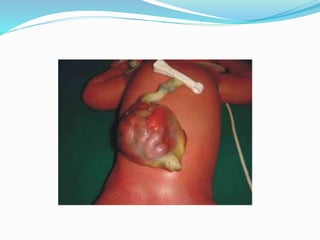
 An exomphalos (ompalocele) has a sac formed by
perietal peritoneum protruding through a defect in the
abdominal wall.
 The sac contains intestinal loops, liver and spleen.
 It is associated with major congenital anomalies and
the prognosis depends on these associated lesions.
Gastroschisis
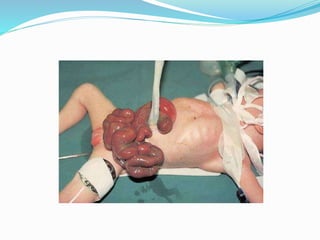
 A gastroschisi never has a sac and the umilical cord
arises from the normal site on the abdominal wall.
 It is rarely associated with other congenital anomalies
and the prognosis is better than for exomphalos.
Oesophageal atresia
 Suspected in a newborn with excessive drooling and in
that is frequently accompanied by choking, coughing
and sneezing.
 When fed, these infants swallow normally but begin to
cough and struggle as the fluid returns through the
nose and mouth.
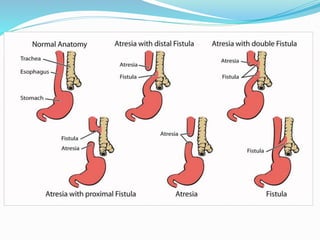
 Oesophageal atresia is often associated with tracheo-
oesophageal fistula (90%).
 Diagnosis my be confirmed by the inability to pass a
nasogastric tube more than 10 cm.
Pyloric stenosis
 Infantile hypertrophic pyloric stenosis present most
commonly at approximately 6 weeks of age.
 Patients present with projectile vomiting that is not bile-
stained.
 It is more common in boys with a male : female ratio of 4:1.
 There is a strong familial predisposition with 5% of affected
infants having a mother who also developed the problem.
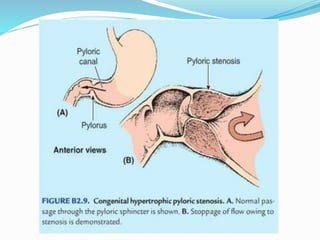
 Caused by hypertrophy the circular muscle layer in the
pylorus.
 “Olive shaped mass”
 Following resuscitation and correction of any electrolyte
abnormality, surgical treatment is by pyloromyotomy
(Ramstedt's Operation).
Intussusception
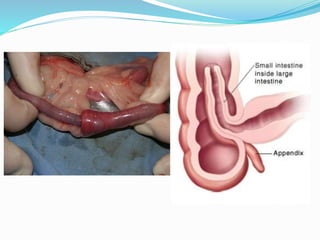
 Intussusception is the commonest cause of intestinal
obstruction in the 6 to 18 month age group.
 The infants usually present with severe intermittent
colic, bile-stained vomiting.
 ‘Redcurrent jelly’ stool.
 'sausage-shaped' abdominal mass.
 Diagnosis can often be confirmed by a 'doughnut'
appearance on ultrasound.
Hirschsprung's
 Hirschsprung's disease is a common cause of neonatal large
bowel obstruction.
 Green or brown vomit, explosive stools after a doctor inserts
a finger into the rectum.
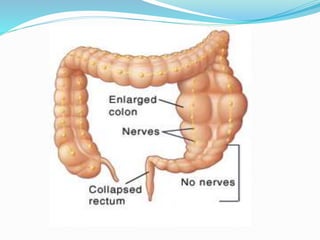
 Failure of migration of ganglion cells to the affected
segment of bowel.
 This always involves the distal colon but the proximal
extent of the involvement is variable.
 The segment lacking neurons (aganglionic) becomes
constricted, causing the normal, proximal section of bowel
to become distended with feaces.
 Diagnosed with biopsy.
 Treated with resection of affected bowel.
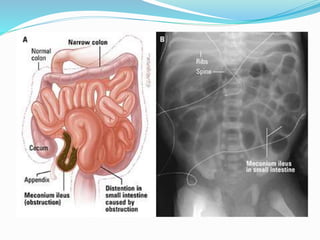
Muconeum ileus
 Common cause of neonatal intraluminal intestinal
obstruction.
 90% of babies pass their first meconium within 24 hours,
and 99% within 48 hours.
 Over 80% of cases are associated with cystic fibrosis.
 In these patients, pancreatic secretions are abnormally
viscid and the meconium becomes inspissated in the
distal ileum.
 Bile-stained vomiting.
 A plain abdominal x-ray will show dilated ileal loops and
intraluminal 'ground glass' appearance.
 Treat with enemas / surgery.
Questions?

Exeter Surgical Society: Paediatric surgery

  • 1.
    Mr Alasdair Barrie CT1Trauma and Orthopaedics 24/3/15
  • 2.
    Content  Torsion  Exomphalos Gastroschisis  Oesophageal atresia  Pyloric stenosis  Intussusception  Hischprung’s  Muconeum ileus
  • 3.
    Testicular Torsion  Testiculartorsion can occur at any age, but is most common in the neonatal and peripubertal periods.  Presents with severe testicular pain / abdominal pain.  Testicular viability is reduced with increasing time from the onset of symptoms.  Following reduction of a torsion 3-point fixation with an non-absorbable suture should be performed.  The contralateral testis should also be fixed.
  • 5.
    Exomphalos  An exomphalos(ompalocele) has a sac formed by perietal peritoneum protruding through a defect in the abdominal wall.  The sac contains intestinal loops, liver and spleen.  It is associated with major congenital anomalies and the prognosis depends on these associated lesions.
  • 7.
    Gastroschisis  A gastroschisinever has a sac and the umilical cord arises from the normal site on the abdominal wall.  It is rarely associated with other congenital anomalies and the prognosis is better than for exomphalos.
  • 9.
    Oesophageal atresia  Suspectedin a newborn with excessive drooling and in that is frequently accompanied by choking, coughing and sneezing.  When fed, these infants swallow normally but begin to cough and struggle as the fluid returns through the nose and mouth.  Oesophageal atresia is often associated with tracheo- oesophageal fistula (90%).  Diagnosis my be confirmed by the inability to pass a nasogastric tube more than 10 cm.
  • 11.
    Pyloric stenosis  Infantilehypertrophic pyloric stenosis present most commonly at approximately 6 weeks of age.  Patients present with projectile vomiting that is not bile- stained.  It is more common in boys with a male : female ratio of 4:1.  There is a strong familial predisposition with 5% of affected infants having a mother who also developed the problem.  Caused by hypertrophy the circular muscle layer in the pylorus.  “Olive shaped mass”  Following resuscitation and correction of any electrolyte abnormality, surgical treatment is by pyloromyotomy (Ramstedt's Operation).
  • 13.
    Intussusception  Intussusception isthe commonest cause of intestinal obstruction in the 6 to 18 month age group.  The infants usually present with severe intermittent colic, bile-stained vomiting.  ‘Redcurrent jelly’ stool.  'sausage-shaped' abdominal mass.  Diagnosis can often be confirmed by a 'doughnut' appearance on ultrasound.
  • 15.
    Hirschsprung's  Hirschsprung's diseaseis a common cause of neonatal large bowel obstruction.  Green or brown vomit, explosive stools after a doctor inserts a finger into the rectum.  Failure of migration of ganglion cells to the affected segment of bowel.  This always involves the distal colon but the proximal extent of the involvement is variable.  The segment lacking neurons (aganglionic) becomes constricted, causing the normal, proximal section of bowel to become distended with feaces.  Diagnosed with biopsy.  Treated with resection of affected bowel.
  • 17.
    Muconeum ileus  Commoncause of neonatal intraluminal intestinal obstruction.  90% of babies pass their first meconium within 24 hours, and 99% within 48 hours.  Over 80% of cases are associated with cystic fibrosis.  In these patients, pancreatic secretions are abnormally viscid and the meconium becomes inspissated in the distal ileum.  Bile-stained vomiting.  A plain abdominal x-ray will show dilated ileal loops and intraluminal 'ground glass' appearance.  Treat with enemas / surgery.
  • 19.