Blood:Blood:
A ConversationA Conversation
about Conservationabout Conservation
(aka Patient Blood Management)(aka Patient Blood Management)
Dr Biddy RidlerDr Biddy Ridler
Blood Conservation Specialty DoctorBlood Conservation Specialty Doctor
Exeter Surgical SocietyExeter Surgical Society
3rd October 20133rd October 2013
Blood Conservation:Blood Conservation:
[‘[‘Preservation, protection…preventionPreservation, protection…prevention
of wasteful use of a resource’ OED]of wasteful use of a resource’ OED]
• Why conserve bloodWhy conserve blood
• Current laws / guidelinesCurrent laws / guidelines
• Strategies - presentStrategies - present
• Strategies - futureStrategies - future
Patient Blood Management (PBM)Patient Blood Management (PBM)
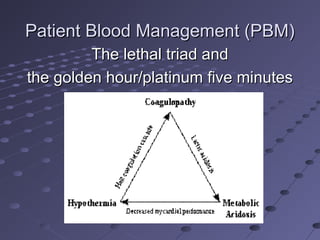
Donor Blood Transfusion isDonor Blood Transfusion is
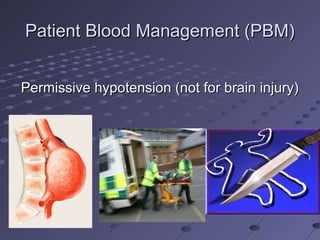
no longer the default optionno longer the default option
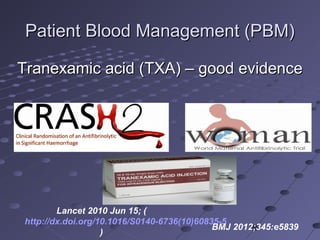
Stock Level on 08 Oct 2013 Total
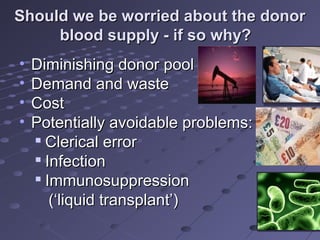
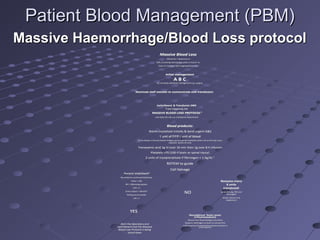
Should we be worried about the donorShould we be worried about the donor
blood supply - if so why?blood supply - if so why?
• Diminishing donor poolDiminishing donor pool
• Demand and wDemand and wasteaste
• CostCost
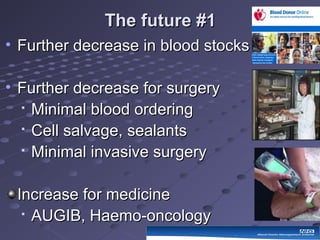
• Potentially avoidable problems:Potentially avoidable problems:
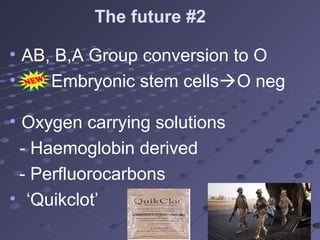

Clerical errorClerical error

InfectionInfection

ImmunosuppressionImmunosuppression
(‘liquid transplant’)(‘liquid transplant’)
Why is there a shortage of blood?Why is there a shortage of blood?
Supply:Supply:
• Volunteer donorsVolunteer donors
Recruiting and retaining:Recruiting and retaining:
• 4% of adults currently donors4% of adults currently donors
• 50% give 75% of donations50% give 75% of donations
• 15% turnover of donors annually15% turnover of donors annually
• 250,000250,000 newnew donors/yr requireddonors/yr required
http://www.blood.co.uk/
Are there concerns about infectedAre there concerns about infected
blood – if so why?blood – if so why?
Donors lost – safety and testingDonors lost – safety and testing
• HIV, hepatitis, syphilis and moreHIV, hepatitis, syphilis and more
• vCJDvCJD

exclusion if previous transfusion (> 3.5%)exclusion if previous transfusion (> 3.5%)

screening test for vCJD announced 3.2.11screening test for vCJD announced 3.2.11

donors may fear the implications of adonors may fear the implications of a
positive testpositive test
• Malaria, West Nile virusMalaria, West Nile virus
• What else is out there?What else is out there?
Why conserve blood –Why conserve blood –
are there any national references?are there any national references?
• Blood conservation / shortageBlood conservation / shortage
• Patient Blood ManagementPatient Blood Management
• Clinical care / changing perceptionsClinical care / changing perceptions
• Consensus conferencesConsensus conferences
• Serious Hazards Of Transfusion (SHOT)Serious Hazards Of Transfusion (SHOT)
• UK Government edictsUK Government edicts

BBT3 HSC 2007-01 (transfusion practice)BBT3 HSC 2007-01 (transfusion practice)

EU Directive 2005 (traceability)EU Directive 2005 (traceability)
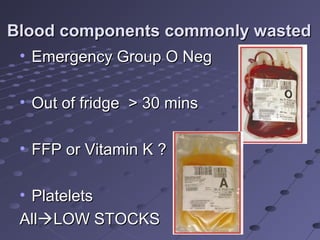
Blood components commonly wastedBlood components commonly wasted
• Emergency Group O NegEmergency Group O Neg
• Out of fridge > 30 minsOut of fridge > 30 mins
• FFP or Vitamin K ?FFP or Vitamin K ?
• PlateletsPlatelets
AllAllLOW STOCKSLOW STOCKS
Cost of blood products 2012/2013
Red cells
Platelets
FFP (UK)
FFP (US)
[for U16s,
soon for All]
£123.31
£209.30
£27.46
£171.54
Current Guidelines: red cellsCurrent Guidelines: red cells
BCSH guidelines & endorsed by NBTCBCSH guidelines & endorsed by NBTC
(NICE consultation 2013 )(NICE consultation 2013 )
• Acute blood lossAcute blood loss

up to 30% blood loss – crystalloid/colloidup to 30% blood loss – crystalloid/colloid

≥≥30% loss - RBC usually required30% loss - RBC usually required
• Peri-operative – assuming normovolaemiaPeri-operative – assuming normovolaemia

Hb < 7g/dlHb < 7g/dl

Hb < 8g/dl if known CVD/risk factors for CVDHb < 8g/dl if known CVD/risk factors for CVD
Upper GI haemorrhage
• 1/1000 adults per year
• High mortality (10-30%)
• Increasing incidence: Alcohol related
• Uses 14% of all donated blood supply
• Potential problem for blood management
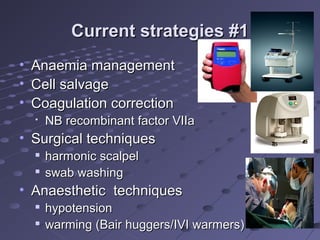
Current strategies #1Current strategies #1
• Anaemia managementAnaemia management
• Cell salvageCell salvage
• Coagulation correctionCoagulation correction

NB recombinant factor VIIaNB recombinant factor VIIa
• Surgical techniquesSurgical techniques

harmonic scalpelharmonic scalpel

swab washingswab washing
• Anaesthetic techniquesAnaesthetic techniques

hypotensionhypotension

warming (Bair huggers/IVI warmers)warming (Bair huggers/IVI warmers)
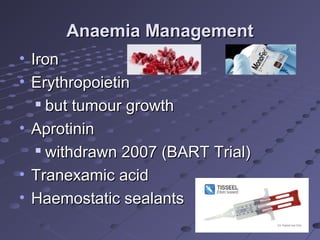
Anaemia ManagementAnaemia Management
• IronIron
• ErythropoietinErythropoietin

but tumour growthbut tumour growth
• AprotininAprotinin

withdrawn 2007 (BART Trial)withdrawn 2007 (BART Trial)
• Tranexamic acidTranexamic acid
• Haemostatic sealantsHaemostatic sealants
New UK TrialNew UK Trial
• Randomised double blind phase IIIRandomised double blind phase III
• Major abdominal surgeryMajor abdominal surgery
• Preop clinic/endoscopyPreop clinic/endoscopy
• One dose iv Ferinject vs placeboOne dose iv Ferinject vs placebo
• Primary endpoint - ? Reduction transfusionPrimary endpoint - ? Reduction transfusion
• Secondary endpoints - health related qualitySecondary endpoints - health related quality
of life, post-operative morbidity, safety andof life, post-operative morbidity, safety and
length of hospital staylength of hospital stay
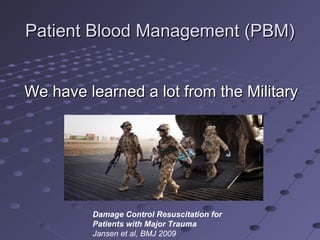
Patient Blood Management (PBM)Patient Blood Management (PBM)
We have learned a lot from the MilitaryWe have learned a lot from the Military
Damage Control Resuscitation for
Patients with Major Trauma
Jansen et al, BMJ 2009
Patient Blood Management (PBM)Patient Blood Management (PBM)
The lethal triad andThe lethal triad and
the golden hour/platinum five minutesthe golden hour/platinum five minutes
Patient Blood Management (PBM)Patient Blood Management (PBM)
Permissive hypotension (not for brain injury)Permissive hypotension (not for brain injury)
Patient Blood Management (PBM)Patient Blood Management (PBM)
Tranexamic acid (TXA) – good evidenceTranexamic acid (TXA) – good evidence
Lancet 2010 Jun 15; (
http://dx.doi.org/10.1016/S0140-6736(10)60835-5
)
BMJ 2012;345:e5839
Patient Blood Management (PBM)Patient Blood Management (PBM)
Massive Haemorrhage/Blood Loss protocolMassive Haemorrhage/Blood Loss protocol
Blood products:
Warm crystalloid initially & Send urgent G&S
1 unit of FFP / unit of blood
( O -ve blood in ED and theatre fridges, group specific available within 10 min & fully cross-
matched within 45 min)
Tranexamic acid 1g IV over 10 min then 1g over 8 h infusion
Platelets >75 (100 if brain or spinal injury)
2 units of cryoprecipitate if fibrinogen < 1.5g/dL-1
ROTEM to guide
Cell Salvage
Blood products:
Warm crystalloid initially & Send urgent G&S
1 unit of FFP / unit of blood
( O -ve blood in ED and theatre fridges, group specific available within 10 min & fully cross-
matched within 45 min)
Tranexamic acid 1g IV over 10 min then 1g over 8 h infusion
Platelets >75 (100 if brain or spinal injury)
2 units of cryoprecipitate if fibrinogen < 1.5g/dL-1
ROTEM to guide
Cell Salvage
Reassess every
6 units
transfused:
Send clotting, FBC and
fibrinogen
Check calcium and
magnesium
Reassess every
6 units
transfused:
Send clotting, FBC and
fibrinogen
Check calcium and
magnesium
NONO
Patient stabilised?
No evidence continued blood loss
Pulse < 100
BP > 100mmHg systolic
CVP > 5
Urine output > 30ml/hr-
Falling serum lactate
HB > 7
Patient stabilised?
No evidence continued blood loss
Pulse < 100
BP > 100mmHg systolic
CVP > 5
Urine output > 30ml/hr-
Falling serum lactate
HB > 7
YESYES
Recombinant factor seven
(rVIIa/novoseven)
Discuss with haematology consultant
Requires fibrinogen to work so correct first
1:30 incidence of arterial thrombosis (caution in
arteriopaths)
Recombinant factor seven
(rVIIa/novoseven)
Discuss with haematology consultant
Requires fibrinogen to work so correct first
1:30 incidence of arterial thrombosis (caution in
arteriopaths)
Alert the laboratory and
switchboard that the Massive
Blood Loss Protocol is being
stood down
Alert the laboratory and
switchboard that the Massive
Blood Loss Protocol is being
stood down
Massive Blood Loss
150ml/min-1 blood loss or
50% circulating volume loss within 3 hours* or
Class III / IV shock with ongoing blood loss
Massive Blood Loss
150ml/min-1 blood loss or
50% circulating volume loss within 3 hours* or
Class III / IV shock with ongoing blood loss
Switchboard & Transfusion 2466
“I am triggering the
MASSIVE BLOOD LOSS PROTOCOL”
and state the site e.g. Emergency Department
Switchboard & Transfusion 2466
“I am triggering the
MASSIVE BLOOD LOSS PROTOCOL”
and state the site e.g. Emergency Department
Initial management
A B C
Do not delay definitive management e.g. surgery
Initial management
A B C
Do not delay definitive management e.g. surgery
Nominate staff member to communicate with transfusionNominate staff member to communicate with transfusion
Patient Blood Management (PBM)Patient Blood Management (PBM)
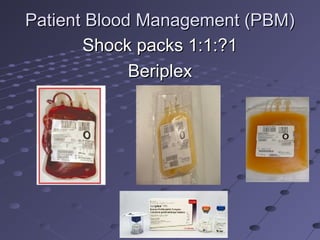
Shock packs 1:1:?1Shock packs 1:1:?1
BeriplexBeriplex
Patient Blood Management (PBM)Patient Blood Management (PBM)
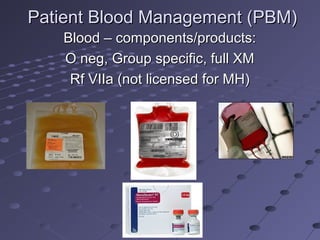
Blood – components/products:Blood – components/products:
O neg, Group specific, full XMO neg, Group specific, full XM
Rf VIIa (not licensed for MH)Rf VIIa (not licensed for MH)
Current strategies #2 PeopleCurrent strategies #2 People
• Transfusion Practitioners (TPs)Transfusion Practitioners (TPs)
• Hospital Transfusion TeamsHospital Transfusion Teams
• Hospital Transfusion CommitteesHospital Transfusion Committees
• Regional Transfusion CommitteesRegional Transfusion Committees
• Regional TP GroupsRegional TP Groups
• National Blood Transfusion CommitteeNational Blood Transfusion Committee
• International SocietiesInternational Societies
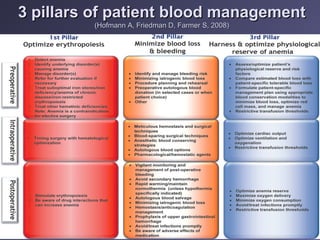
3 pillars of patient blood management3 pillars of patient blood management
(Hofmann A, Friedman D, Farmer S, 2008)(Hofmann A, Friedman D, Farmer S, 2008)
The future #1The future #1
• Further decrease in blood stocksFurther decrease in blood stocks
• Further decrease for surgeryFurther decrease for surgery

Minimal blood orderingMinimal blood ordering

Cell salvage, sealantsCell salvage, sealants

Minimal invasive surgeryMinimal invasive surgery
Increase for medicineIncrease for medicine

AUGIB, Haemo-oncologyAUGIB, Haemo-oncology
The future #2
• AB, B,A Group conversion to O
• Embryonic stem cellsO neg
• Oxygen carrying solutions
- Haemoglobin derived
- Perfluorocarbons
• ‘Quikclot’
International concernsInternational concerns
about blood transfusionabout blood transfusion
• Availability
• Economics
• Obsession with safety but not efficacy
• Preoperative anaemia carries risks……
• …….But so does transfusion
• PBM is emotional rather than rational
• PBM should be pre-emptive
• Increase for AUGIB and Haem-oncology
How canHow can youyou can help?can help?
• Consider the need for blood productsConsider the need for blood products
• Be aware of the problemsBe aware of the problems

training, competencies, policiestraining, competencies, policies
• Optimise patients earlyOptimise patients early – on referral– on referral
• Use blood wiselyUse blood wisely

Clinical indicationsClinical indications

Current HbCurrent Hb

Risks/benefitsRisks/benefits

Consider alternativesConsider alternatives
• Audit your blood useAudit your blood use
Patient Blood Management (PBM)Patient Blood Management (PBM)
A multidisciplinary, evidence-based
approach to optimising the care of
patients who might need
blood transfusion.
Patient Blood Management:Patient Blood Management:
The ReferenceThe Reference
Transfusing blood safely andTransfusing blood safely and
appropriately Murphy M et alappropriately Murphy M et al
BMJ 2013;347:f4303BMJ 2013;347:f4303
Take Home MessageTake Home Message
Patient Blood ManagementPatient Blood Management
““The optimal use of this scarce,The optimal use of this scarce,
expensive and potentiallyexpensive and potentially
infectious resource is ofinfectious resource is of
international importance”international importance”
McGill N et alMcGill N et al BMJ 2002;324(7439):1299BMJ 2002;324(7439):1299

Blood a conversation about conservation ex ss 1010113

  • 1.
    Blood:Blood: A ConversationA Conversation aboutConservationabout Conservation (aka Patient Blood Management)(aka Patient Blood Management) Dr Biddy RidlerDr Biddy Ridler Blood Conservation Specialty DoctorBlood Conservation Specialty Doctor Exeter Surgical SocietyExeter Surgical Society 3rd October 20133rd October 2013
  • 2.
    Blood Conservation:Blood Conservation: [‘[‘Preservation,protection…preventionPreservation, protection…prevention of wasteful use of a resource’ OED]of wasteful use of a resource’ OED] • Why conserve bloodWhy conserve blood • Current laws / guidelinesCurrent laws / guidelines • Strategies - presentStrategies - present • Strategies - futureStrategies - future
  • 3.
    Patient Blood Management(PBM)Patient Blood Management (PBM) Donor Blood Transfusion isDonor Blood Transfusion is no longer the default optionno longer the default option Stock Level on 08 Oct 2013 Total
  • 4.
    Should we beworried about the donorShould we be worried about the donor blood supply - if so why?blood supply - if so why? • Diminishing donor poolDiminishing donor pool • Demand and wDemand and wasteaste • CostCost • Potentially avoidable problems:Potentially avoidable problems:  Clerical errorClerical error  InfectionInfection  ImmunosuppressionImmunosuppression (‘liquid transplant’)(‘liquid transplant’)
  • 5.
    Why is therea shortage of blood?Why is there a shortage of blood? Supply:Supply: • Volunteer donorsVolunteer donors Recruiting and retaining:Recruiting and retaining: • 4% of adults currently donors4% of adults currently donors • 50% give 75% of donations50% give 75% of donations • 15% turnover of donors annually15% turnover of donors annually • 250,000250,000 newnew donors/yr requireddonors/yr required http://www.blood.co.uk/
  • 6.
    Are there concernsabout infectedAre there concerns about infected blood – if so why?blood – if so why? Donors lost – safety and testingDonors lost – safety and testing • HIV, hepatitis, syphilis and moreHIV, hepatitis, syphilis and more • vCJDvCJD  exclusion if previous transfusion (> 3.5%)exclusion if previous transfusion (> 3.5%)  screening test for vCJD announced 3.2.11screening test for vCJD announced 3.2.11  donors may fear the implications of adonors may fear the implications of a positive testpositive test • Malaria, West Nile virusMalaria, West Nile virus • What else is out there?What else is out there?
  • 7.
    Why conserve blood–Why conserve blood – are there any national references?are there any national references? • Blood conservation / shortageBlood conservation / shortage • Patient Blood ManagementPatient Blood Management • Clinical care / changing perceptionsClinical care / changing perceptions • Consensus conferencesConsensus conferences • Serious Hazards Of Transfusion (SHOT)Serious Hazards Of Transfusion (SHOT) • UK Government edictsUK Government edicts  BBT3 HSC 2007-01 (transfusion practice)BBT3 HSC 2007-01 (transfusion practice)  EU Directive 2005 (traceability)EU Directive 2005 (traceability)
  • 8.
    Blood components commonlywastedBlood components commonly wasted • Emergency Group O NegEmergency Group O Neg • Out of fridge > 30 minsOut of fridge > 30 mins • FFP or Vitamin K ?FFP or Vitamin K ? • PlateletsPlatelets AllAllLOW STOCKSLOW STOCKS
  • 9.
    Cost of bloodproducts 2012/2013 Red cells Platelets FFP (UK) FFP (US) [for U16s, soon for All] £123.31 £209.30 £27.46 £171.54
  • 10.
    Current Guidelines: redcellsCurrent Guidelines: red cells BCSH guidelines & endorsed by NBTCBCSH guidelines & endorsed by NBTC (NICE consultation 2013 )(NICE consultation 2013 ) • Acute blood lossAcute blood loss  up to 30% blood loss – crystalloid/colloidup to 30% blood loss – crystalloid/colloid  ≥≥30% loss - RBC usually required30% loss - RBC usually required • Peri-operative – assuming normovolaemiaPeri-operative – assuming normovolaemia  Hb < 7g/dlHb < 7g/dl  Hb < 8g/dl if known CVD/risk factors for CVDHb < 8g/dl if known CVD/risk factors for CVD
  • 11.
    Upper GI haemorrhage •1/1000 adults per year • High mortality (10-30%) • Increasing incidence: Alcohol related • Uses 14% of all donated blood supply • Potential problem for blood management
  • 12.
    Current strategies #1Currentstrategies #1 • Anaemia managementAnaemia management • Cell salvageCell salvage • Coagulation correctionCoagulation correction  NB recombinant factor VIIaNB recombinant factor VIIa • Surgical techniquesSurgical techniques  harmonic scalpelharmonic scalpel  swab washingswab washing • Anaesthetic techniquesAnaesthetic techniques  hypotensionhypotension  warming (Bair huggers/IVI warmers)warming (Bair huggers/IVI warmers)
  • 13.
    Anaemia ManagementAnaemia Management •IronIron • ErythropoietinErythropoietin  but tumour growthbut tumour growth • AprotininAprotinin  withdrawn 2007 (BART Trial)withdrawn 2007 (BART Trial) • Tranexamic acidTranexamic acid • Haemostatic sealantsHaemostatic sealants
  • 14.
    New UK TrialNewUK Trial • Randomised double blind phase IIIRandomised double blind phase III • Major abdominal surgeryMajor abdominal surgery • Preop clinic/endoscopyPreop clinic/endoscopy • One dose iv Ferinject vs placeboOne dose iv Ferinject vs placebo • Primary endpoint - ? Reduction transfusionPrimary endpoint - ? Reduction transfusion • Secondary endpoints - health related qualitySecondary endpoints - health related quality of life, post-operative morbidity, safety andof life, post-operative morbidity, safety and length of hospital staylength of hospital stay
  • 15.
    Patient Blood Management(PBM)Patient Blood Management (PBM) We have learned a lot from the MilitaryWe have learned a lot from the Military Damage Control Resuscitation for Patients with Major Trauma Jansen et al, BMJ 2009
  • 16.
    Patient Blood Management(PBM)Patient Blood Management (PBM) The lethal triad andThe lethal triad and the golden hour/platinum five minutesthe golden hour/platinum five minutes
  • 17.
    Patient Blood Management(PBM)Patient Blood Management (PBM) Permissive hypotension (not for brain injury)Permissive hypotension (not for brain injury)
  • 18.
    Patient Blood Management(PBM)Patient Blood Management (PBM) Tranexamic acid (TXA) – good evidenceTranexamic acid (TXA) – good evidence Lancet 2010 Jun 15; ( http://dx.doi.org/10.1016/S0140-6736(10)60835-5 ) BMJ 2012;345:e5839
  • 19.
    Patient Blood Management(PBM)Patient Blood Management (PBM) Massive Haemorrhage/Blood Loss protocolMassive Haemorrhage/Blood Loss protocol Blood products: Warm crystalloid initially & Send urgent G&S 1 unit of FFP / unit of blood ( O -ve blood in ED and theatre fridges, group specific available within 10 min & fully cross- matched within 45 min) Tranexamic acid 1g IV over 10 min then 1g over 8 h infusion Platelets >75 (100 if brain or spinal injury) 2 units of cryoprecipitate if fibrinogen < 1.5g/dL-1 ROTEM to guide Cell Salvage Blood products: Warm crystalloid initially & Send urgent G&S 1 unit of FFP / unit of blood ( O -ve blood in ED and theatre fridges, group specific available within 10 min & fully cross- matched within 45 min) Tranexamic acid 1g IV over 10 min then 1g over 8 h infusion Platelets >75 (100 if brain or spinal injury) 2 units of cryoprecipitate if fibrinogen < 1.5g/dL-1 ROTEM to guide Cell Salvage Reassess every 6 units transfused: Send clotting, FBC and fibrinogen Check calcium and magnesium Reassess every 6 units transfused: Send clotting, FBC and fibrinogen Check calcium and magnesium NONO Patient stabilised? No evidence continued blood loss Pulse < 100 BP > 100mmHg systolic CVP > 5 Urine output > 30ml/hr- Falling serum lactate HB > 7 Patient stabilised? No evidence continued blood loss Pulse < 100 BP > 100mmHg systolic CVP > 5 Urine output > 30ml/hr- Falling serum lactate HB > 7 YESYES Recombinant factor seven (rVIIa/novoseven) Discuss with haematology consultant Requires fibrinogen to work so correct first 1:30 incidence of arterial thrombosis (caution in arteriopaths) Recombinant factor seven (rVIIa/novoseven) Discuss with haematology consultant Requires fibrinogen to work so correct first 1:30 incidence of arterial thrombosis (caution in arteriopaths) Alert the laboratory and switchboard that the Massive Blood Loss Protocol is being stood down Alert the laboratory and switchboard that the Massive Blood Loss Protocol is being stood down Massive Blood Loss 150ml/min-1 blood loss or 50% circulating volume loss within 3 hours* or Class III / IV shock with ongoing blood loss Massive Blood Loss 150ml/min-1 blood loss or 50% circulating volume loss within 3 hours* or Class III / IV shock with ongoing blood loss Switchboard & Transfusion 2466 “I am triggering the MASSIVE BLOOD LOSS PROTOCOL” and state the site e.g. Emergency Department Switchboard & Transfusion 2466 “I am triggering the MASSIVE BLOOD LOSS PROTOCOL” and state the site e.g. Emergency Department Initial management A B C Do not delay definitive management e.g. surgery Initial management A B C Do not delay definitive management e.g. surgery Nominate staff member to communicate with transfusionNominate staff member to communicate with transfusion
  • 20.
    Patient Blood Management(PBM)Patient Blood Management (PBM) Shock packs 1:1:?1Shock packs 1:1:?1 BeriplexBeriplex
  • 21.
    Patient Blood Management(PBM)Patient Blood Management (PBM) Blood – components/products:Blood – components/products: O neg, Group specific, full XMO neg, Group specific, full XM Rf VIIa (not licensed for MH)Rf VIIa (not licensed for MH)
  • 22.
    Current strategies #2PeopleCurrent strategies #2 People • Transfusion Practitioners (TPs)Transfusion Practitioners (TPs) • Hospital Transfusion TeamsHospital Transfusion Teams • Hospital Transfusion CommitteesHospital Transfusion Committees • Regional Transfusion CommitteesRegional Transfusion Committees • Regional TP GroupsRegional TP Groups • National Blood Transfusion CommitteeNational Blood Transfusion Committee • International SocietiesInternational Societies
  • 23.
    3 pillars ofpatient blood management3 pillars of patient blood management (Hofmann A, Friedman D, Farmer S, 2008)(Hofmann A, Friedman D, Farmer S, 2008)
  • 24.
    The future #1Thefuture #1 • Further decrease in blood stocksFurther decrease in blood stocks • Further decrease for surgeryFurther decrease for surgery  Minimal blood orderingMinimal blood ordering  Cell salvage, sealantsCell salvage, sealants  Minimal invasive surgeryMinimal invasive surgery Increase for medicineIncrease for medicine  AUGIB, Haemo-oncologyAUGIB, Haemo-oncology
  • 25.
    The future #2 •AB, B,A Group conversion to O • Embryonic stem cellsO neg • Oxygen carrying solutions - Haemoglobin derived - Perfluorocarbons • ‘Quikclot’
  • 26.
    International concernsInternational concerns aboutblood transfusionabout blood transfusion • Availability • Economics • Obsession with safety but not efficacy • Preoperative anaemia carries risks…… • …….But so does transfusion • PBM is emotional rather than rational • PBM should be pre-emptive • Increase for AUGIB and Haem-oncology
  • 27.
    How canHow canyouyou can help?can help? • Consider the need for blood productsConsider the need for blood products • Be aware of the problemsBe aware of the problems  training, competencies, policiestraining, competencies, policies • Optimise patients earlyOptimise patients early – on referral– on referral • Use blood wiselyUse blood wisely  Clinical indicationsClinical indications  Current HbCurrent Hb  Risks/benefitsRisks/benefits  Consider alternativesConsider alternatives • Audit your blood useAudit your blood use
  • 28.
    Patient Blood Management(PBM)Patient Blood Management (PBM) A multidisciplinary, evidence-based approach to optimising the care of patients who might need blood transfusion.
  • 29.
    Patient Blood Management:PatientBlood Management: The ReferenceThe Reference Transfusing blood safely andTransfusing blood safely and appropriately Murphy M et alappropriately Murphy M et al BMJ 2013;347:f4303BMJ 2013;347:f4303
  • 30.
    Take Home MessageTakeHome Message Patient Blood ManagementPatient Blood Management ““The optimal use of this scarce,The optimal use of this scarce, expensive and potentiallyexpensive and potentially infectious resource is ofinfectious resource is of international importance”international importance” McGill N et alMcGill N et al BMJ 2002;324(7439):1299BMJ 2002;324(7439):1299

Editor's Notes

  • #6 Lets look at shortage now ----- General decline in responsiveness of population now reached a point where NBS is struggling to maintain sufficient donor numbers and hence stocks. Methods used previously to promote collection are less effective and plans are to change opening times, venues etc and try new forms of advertising e.g cinema and call donors to remind them of their appointment.
  • #7 Read slide