OPLL
Mohamed Wael Samir, MD
Prof. of Neurosurgery
Ain Shams University
Cairo, Egypt
ILOs
 Pathology of OPLL
 Clinical presentation
 Diagnosis of OPLL
 Management of OPLL
Pathology
 1) Cell of origin & pathogenesis
 2) Epidemiology
 3) Macroscopic features
 4) Microscopic features
 5) Immunohistochemistry
 6) Genetic features
 7) Radiological features
 8) Growth pattern & spread
 9) Grading & behavior
 10) Prognosis
Pathogenesis
 ligament cells from patients with OPLL have osteoblast-like
characteristics
Factors that intiate these cells to form calcification & ossification are:
 Genetic factors: Genetic locus for OPLL is thought to be located close to
the HLA region, on chromosome 6p
 Hormonal factors: non–insulin dependent D.M., hypoparathyroidism and
hypophosphatemic
 Environmental factors: Mechanical stress in ligaments of the spine
 Life style
Pathogenesis Of Neural Injury In OPLL
 A) Mechanical:
 1) Static compression:
 Occupying ratio greater than 60% indicates high risk of the
development of myelopathy
 SAC < 6 mm
 2) Dynamic compression:
 Degenerative spondylolithesis
 Threshold of SAC
 Normal= 13mm
Myelopathy
 with SAC < 6 mm = Static compression
 Myelopathy with SAC 6-13 = Dynamic
 B) Vascular:
Pathology
 1) Cell of origin & pathogenesis
 2) Epidemiology
 3) Macroscopic features
 4) Microscopic features
 5) Immunohistochemistry
 6) Genetic features
 7) Radiological features
 8) Growth pattern & spread
 9) Grading & behavior
 10) Prognosis
Epidemiology
 Incidence:
 In Japanese >30 ys up to 4%.
 In the United States and Europe, up to 1.7%.
 Gender:
 Cervical: Male > Female (2 : 1)
 Dorsal: Female > Male
 Race:
 More in Japanese
 Age:
 Started in 40s and became symptomatic in 50s
 Risk factors:
 Genetic: genetic locus for OPLL is thought to be located close to the HLA
region, on chromosome 6p
 DM
Pathology
 1) Cell of origin & pathogenesis
 2) Epidemiology
 3) Macroscopic features
 4) Microscopic features
 5) Immunohistochemistry
 6) Genetic features
 7) Radiological features
 8) Growth pattern & spread
 9) Grading & behavior
 10) Prognosis
Pathology
 Site:
 Cervical (C2-C4): 70%,
 Dorsal (T1-T4): 15%
 Lumbar (L1-L3):15%
 There is high frequency with which cervical OPLL is associated with
thoracolumbar OPLL and OLF
 Character:
 Early: PLL hypertrophy
 Then: Punctate calcification within PLL
 Then: Actual ossification

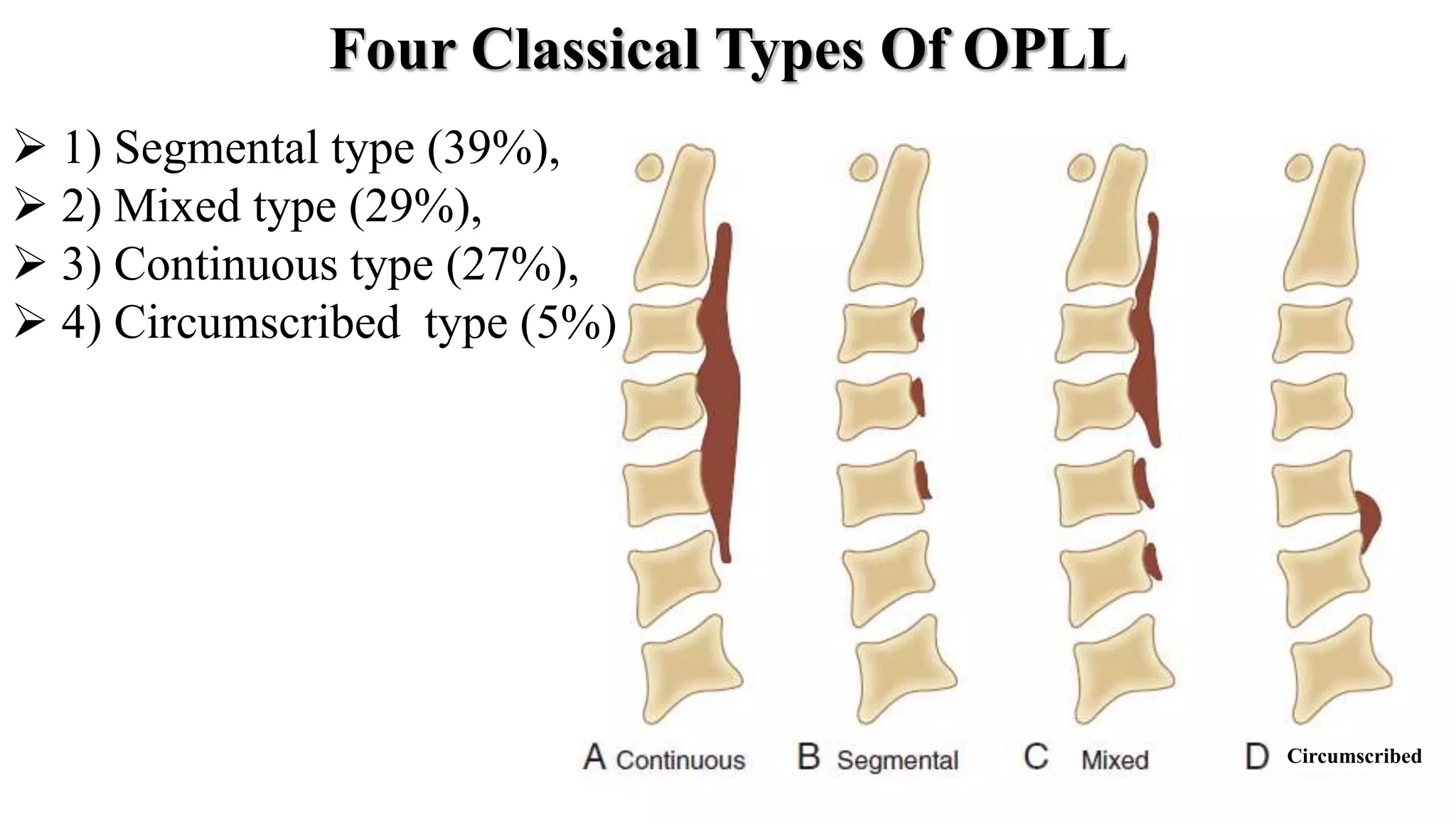
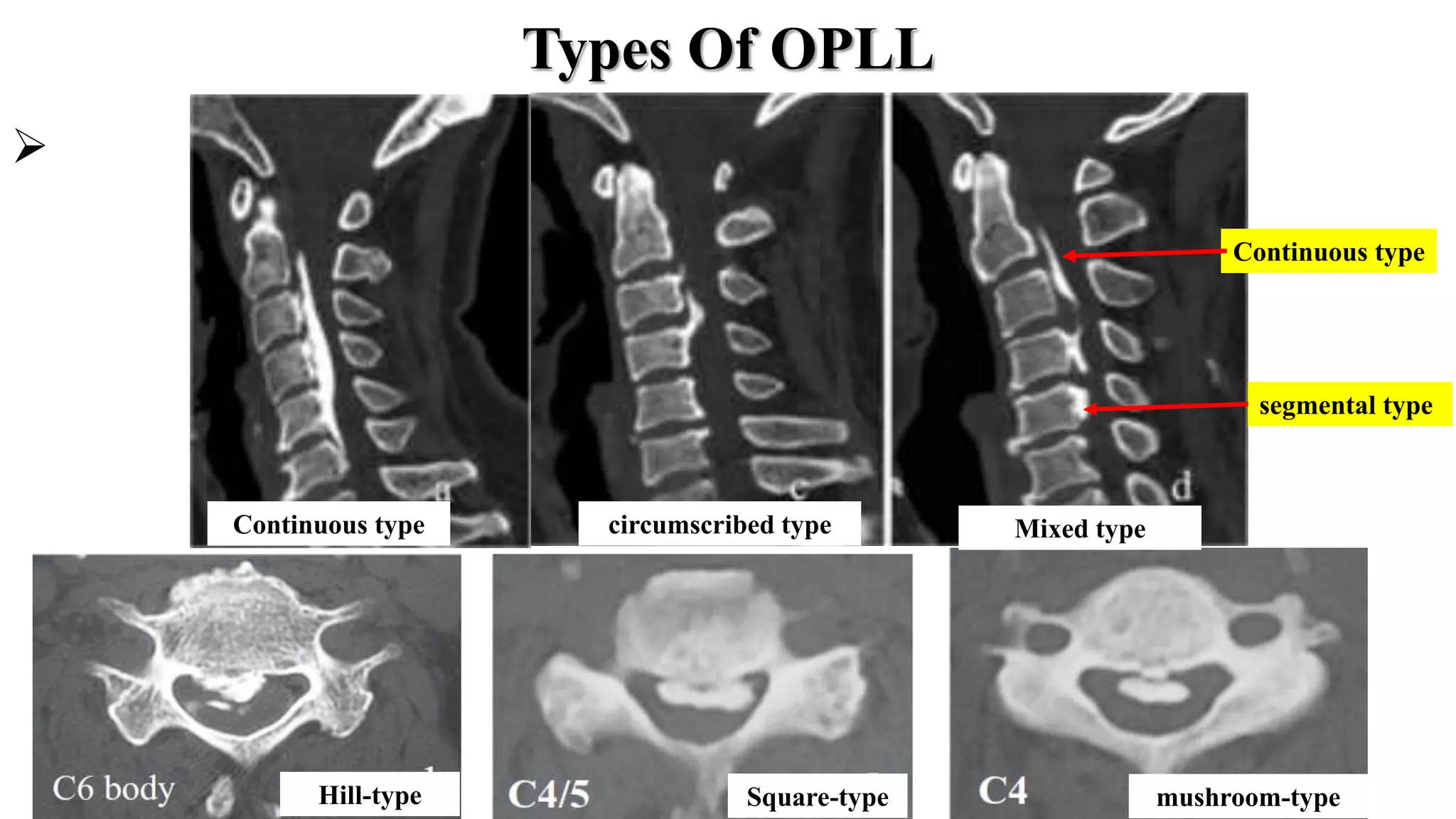
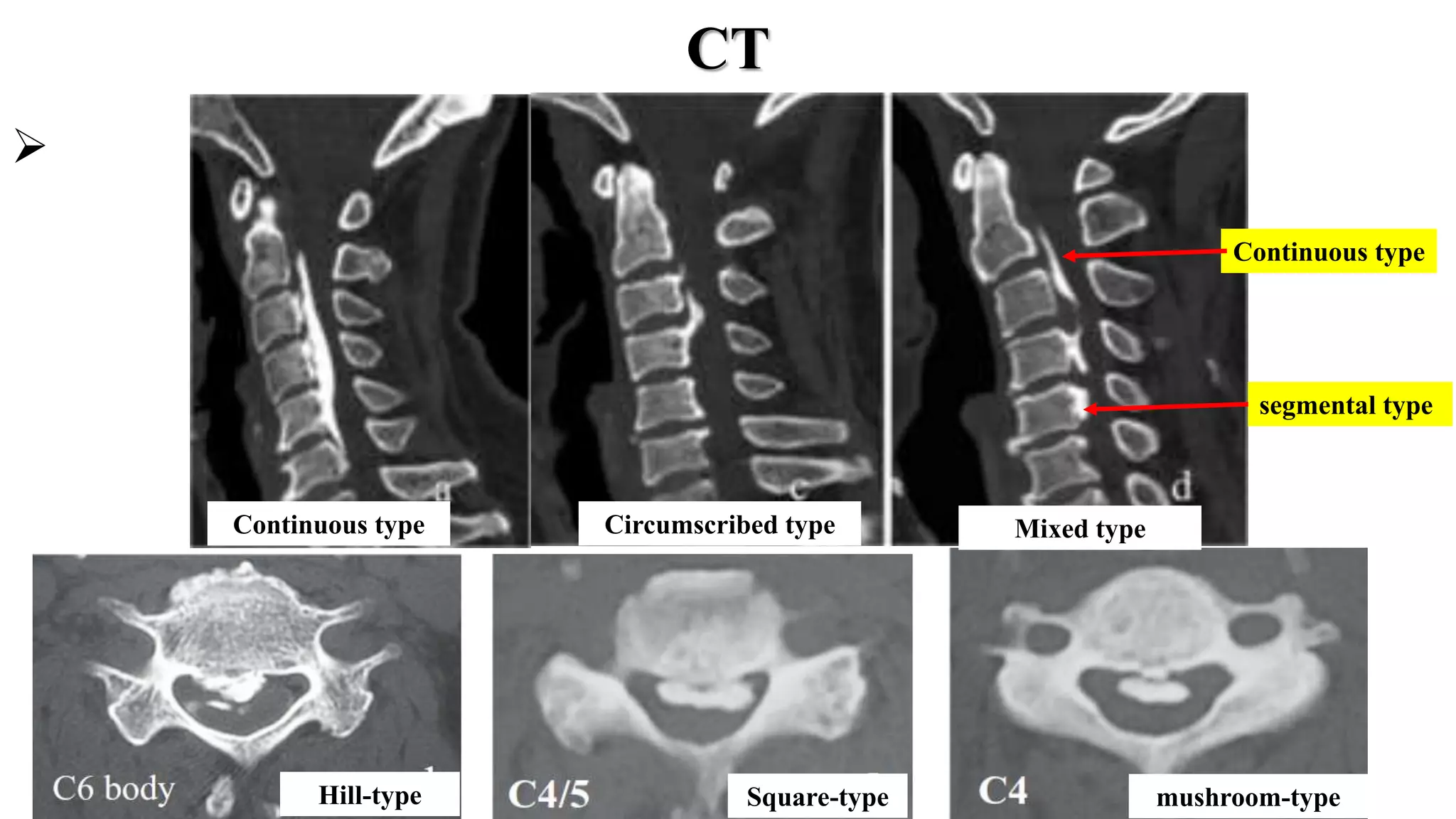
Four Classical Types Of OPLL
Circumscribed
 1) Segmental type (39%),
 2) Mixed type (29%),
 3) Continuous type (27%),
 4) Circumscribed type (5%)
Types Of OPLL

Hill-type Square-type mushroom-type
Continuous type circumscribed type
segmental type
Continuous type
Mixed type
Pathology
 1) Cell of origin & pathogenesis
 2) Epidemiology
 3) Macroscopic features
 4) Microscopic features
 5) Immunohistochemistry
 6) Genetic features
 7) Radiological features
 8) Growth pattern & spread
 9) Grading & behavior
 10) Prognosis
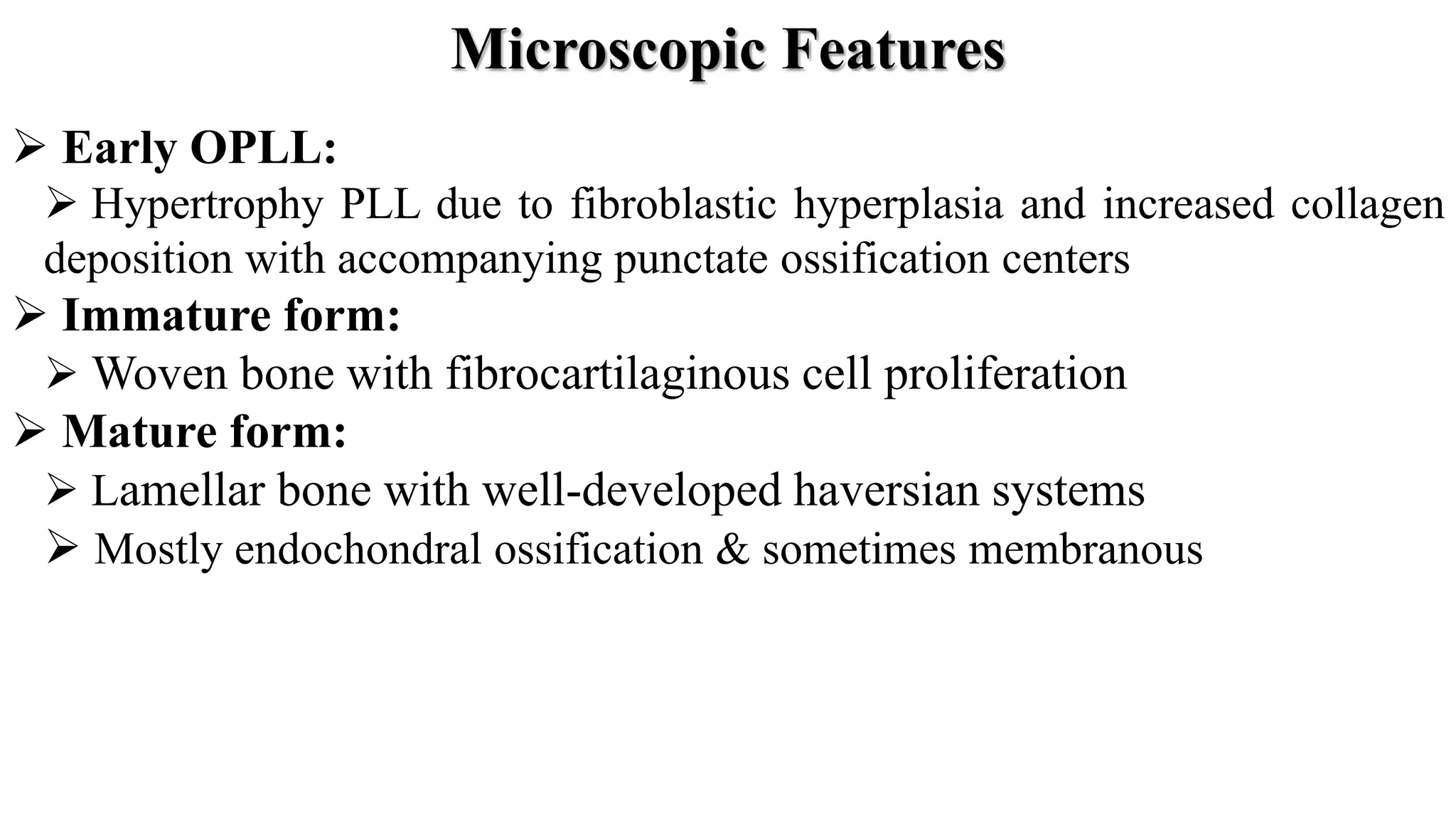
Microscopic Features
 Early OPLL:
 Hypertrophy PLL due to fibroblastic hyperplasia and increased collagen
deposition with accompanying punctate ossification centers
 Immature form:
 Woven bone with fibrocartilaginous cell proliferation
 Mature form:
 Lamellar bone with well-developed haversian systems
 Mostly endochondral ossification & sometimes membranous
Microscopic Features Of Pathological Changes Of Cord
 Demyelination and loss of axon always found in the posterior and
posterolateral part of the cord (so posterior decompression may insult
the cord whis is alredy insulted posteriorly)
Pathology
 1) Cell of origin & pathogenesis
 2) Epidemiology
 3) Macroscopic features
 4) Microscopic features
 5) Immunohistochemistry
 6) Genetic features
 7) Radiological features
 8) Growth pattern & spread
 9) Grading & behavior
 10) Prognosis
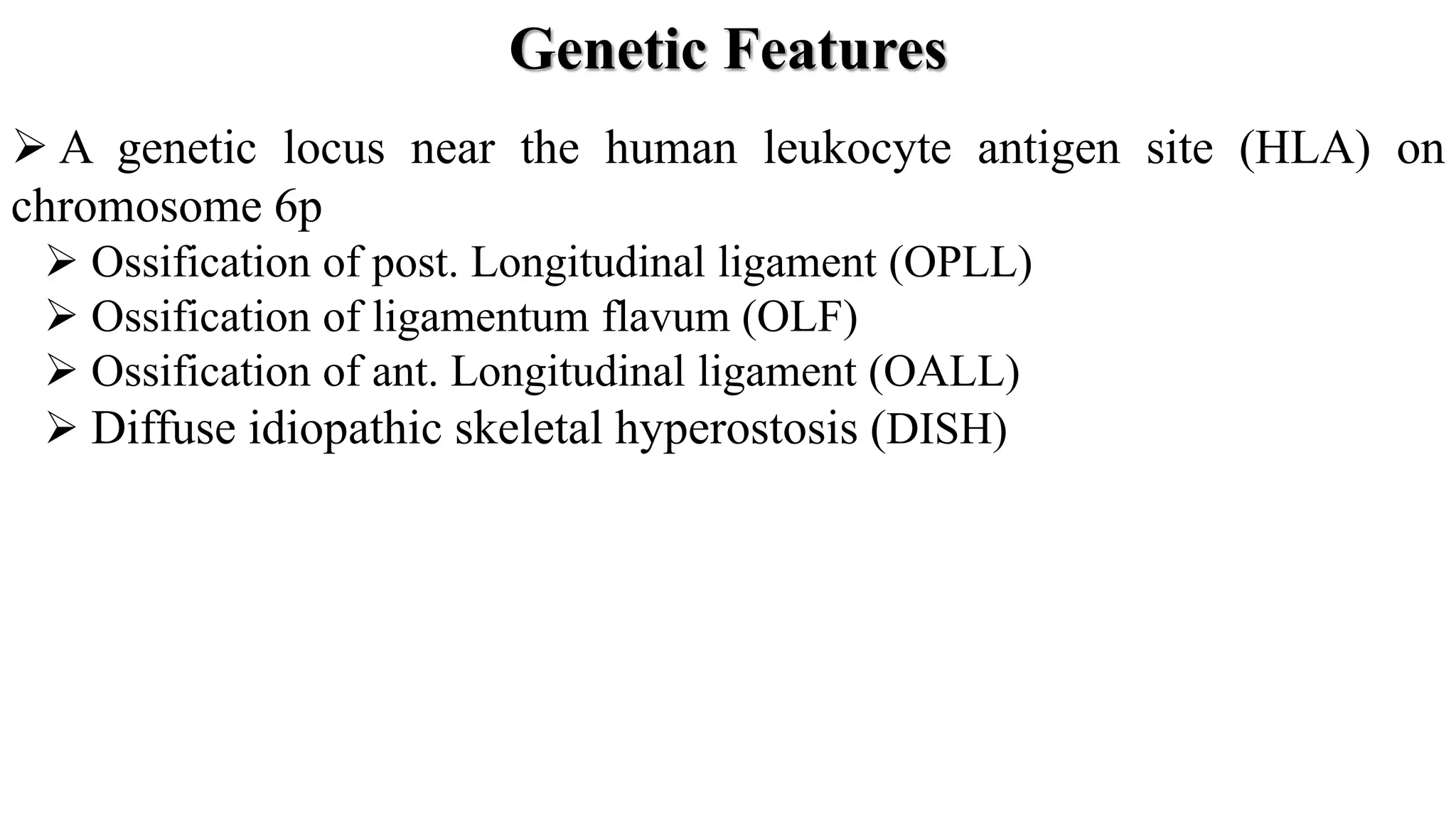
Genetic Features
 A genetic locus near the human leukocyte antigen site (HLA) on
chromosome 6p
 Ossification of post. Longitudinal ligament (OPLL)
 Ossification of ligamentum flavum (OLF)
 Ossification of ant. Longitudinal ligament (OALL)
 Diffuse idiopathic skeletal hyperostosis (DISH)
Pathology
 1) Cell of origin & pathogenesis
 2) Epidemiology
 3) Macroscopic features
 4) Microscopic features
 5) Immunohistochemistry
 6) Genetic features
 7) Radiological features
 8) Growth pattern & spread
 9) Grading & behavior
 10) Prognosis
Types Of OPLL

Hill-type Square-type mushroom-type
Continuous type circumscribed type
segmental type
Continuous type
Mixed type
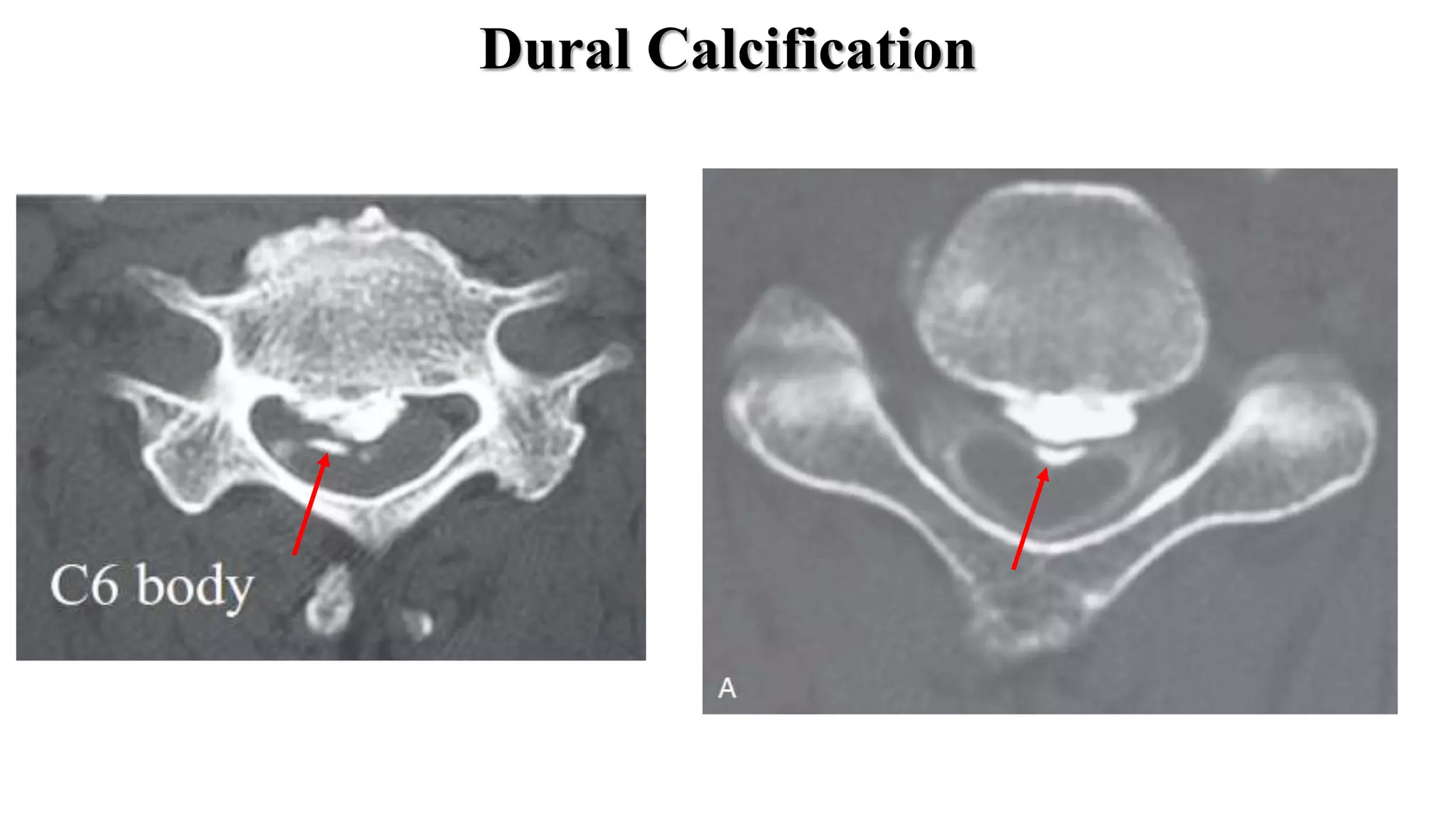
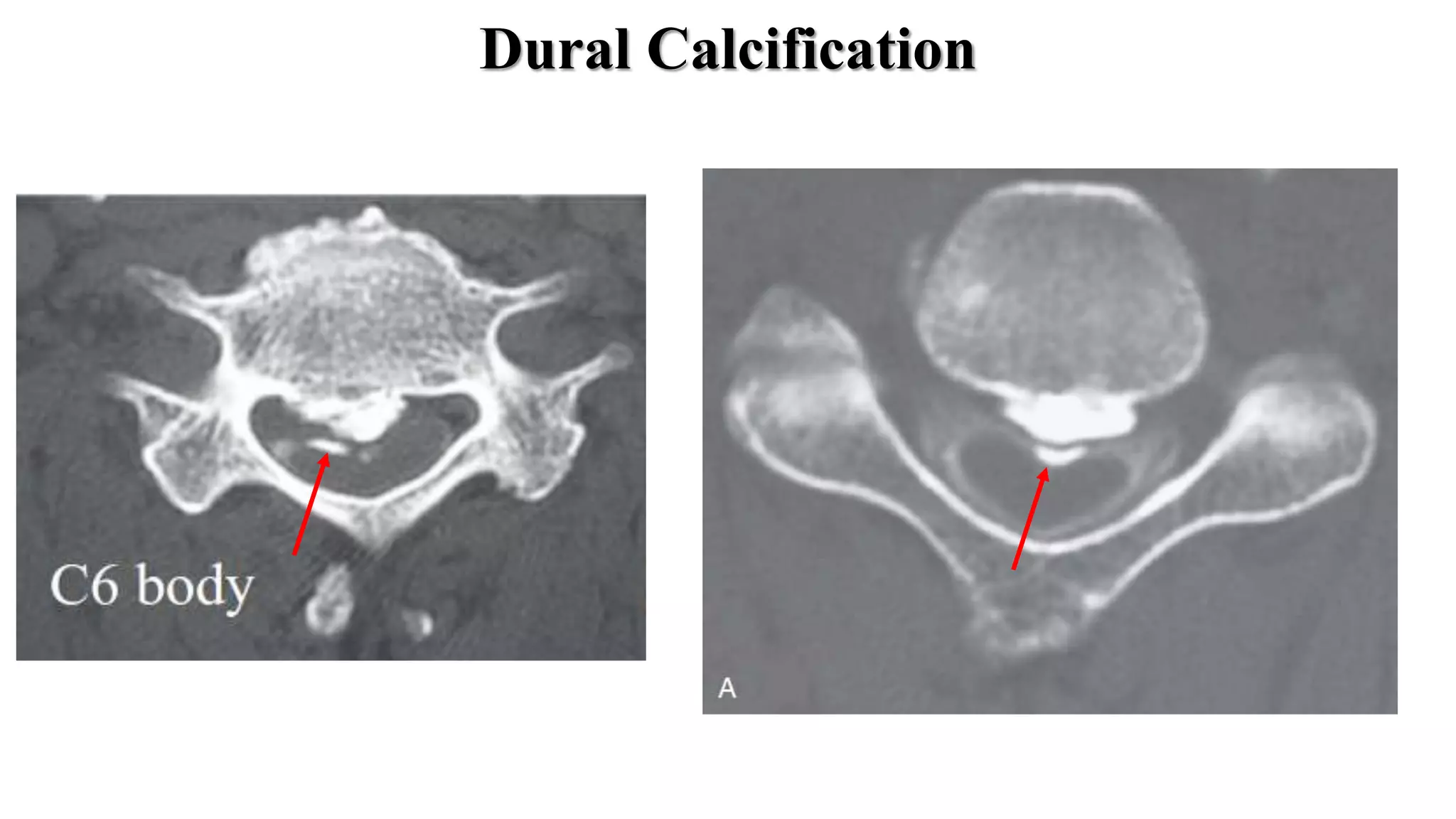
Dural Calcification
Pathology
 1) Cell of origin & pathogenesis
 2) Epidemiology
 3) Macroscopic features
 4) Microscopic features
 5) Immunohistochemistry
 6) Genetic features
 7) Radiological features
 8) Growth pattern & spread
 9) Grading & behavior
 10) Prognosis
Natural History Of OPLL
 OPLL ↑ in thickness 0.4mm/y & in longitudinal expansion 0.67mm/y
 It is more with continuous- or mixed-type OPLL
 A rapid progression in the 4th decade then gradually decreases in the
5th or 6th decade.
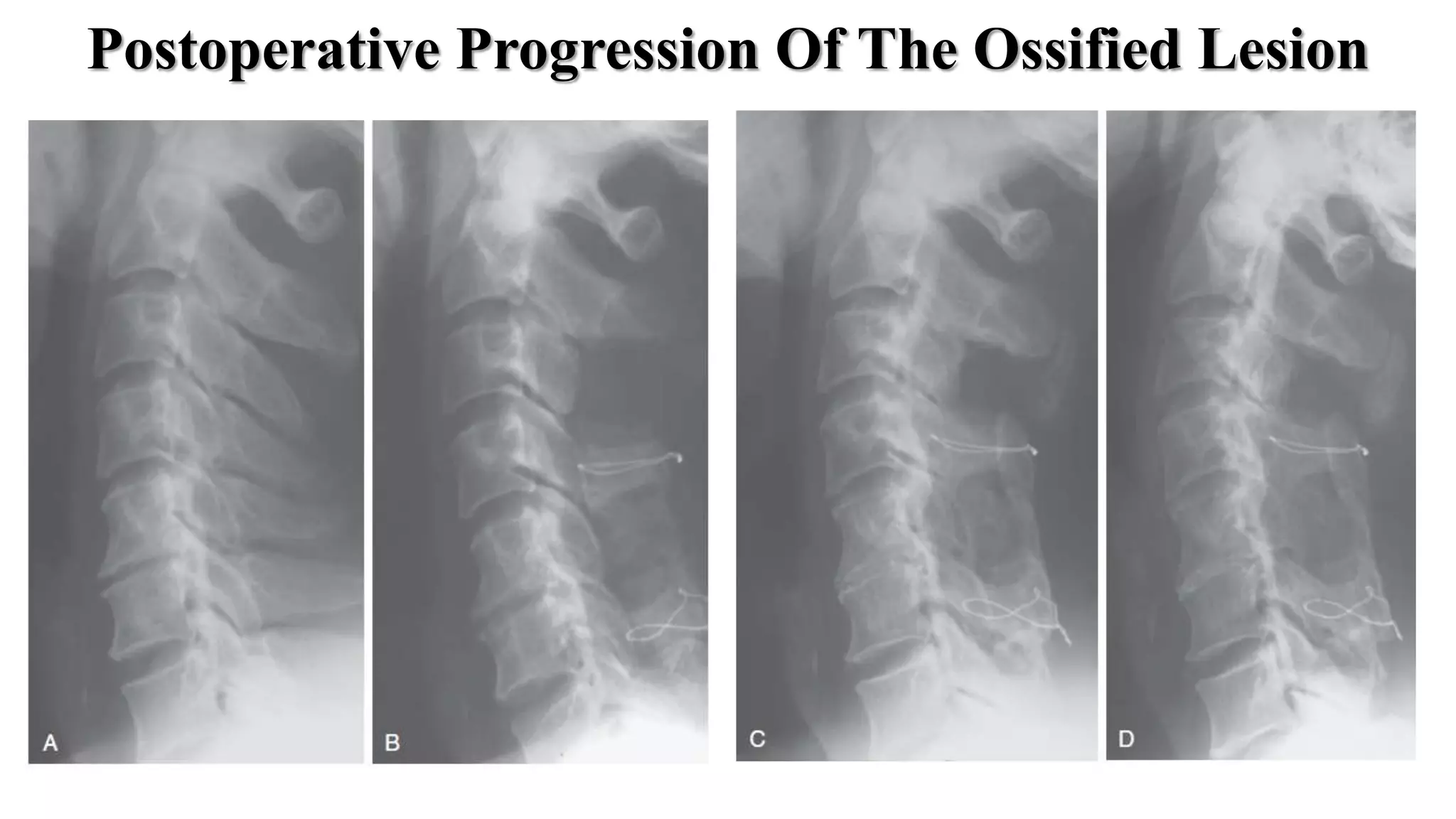
 It occurs also postoperative
 In 60- 70 % after posterior decompression
 In 36-64 % after anterior decompression and fusion
Do These mean prophylactic surgery is
indicated?
Postoperative Progression Of The Ossified Lesion
Causes Of Late Deterioration
 Postoperative progression of OPLL,
 Progressive deformity and instability
 Thoracic myelopathy secondary to OPLL or OLF or both,
 Degenerative lumbar stenosis,
Pathology
 1) Cell of origin & pathogenesis
 2) Epidemiology
 3) Macroscopic features
 4) Microscopic features
 5) Immunohistochemistry
 6) Genetic features
 7) Radiological features
 8) Growth pattern & spread
 9) Grading & behavior
 10) Prognosis
Prognosis
 Patient’s factors:
 Old age
 Preoperative neurological stat & duration of symptoms
 History of trauma causing acute presentation
 Disease’s factors:
 Occupying ratio of OPLL or SAC
 Sagittal shape of ossification (hill-shaped) especially with posterior
decompression
 Management’s factors:
 Progression may be more with posterior decompression
Clinical Picture
 Accidental discovery
 Onset: Usually gradual progressive but may be acute (after trauma)
 Pain:
 Axial pain
 Radicular
 Neurological deficits:
 Myelopathy or myeloradiculopathy rather than radiculopathy alone
 Associated coexisting conditions:
 Diabetic
 Hypoparathyroidism,
 Myotonic muscular dystrophy
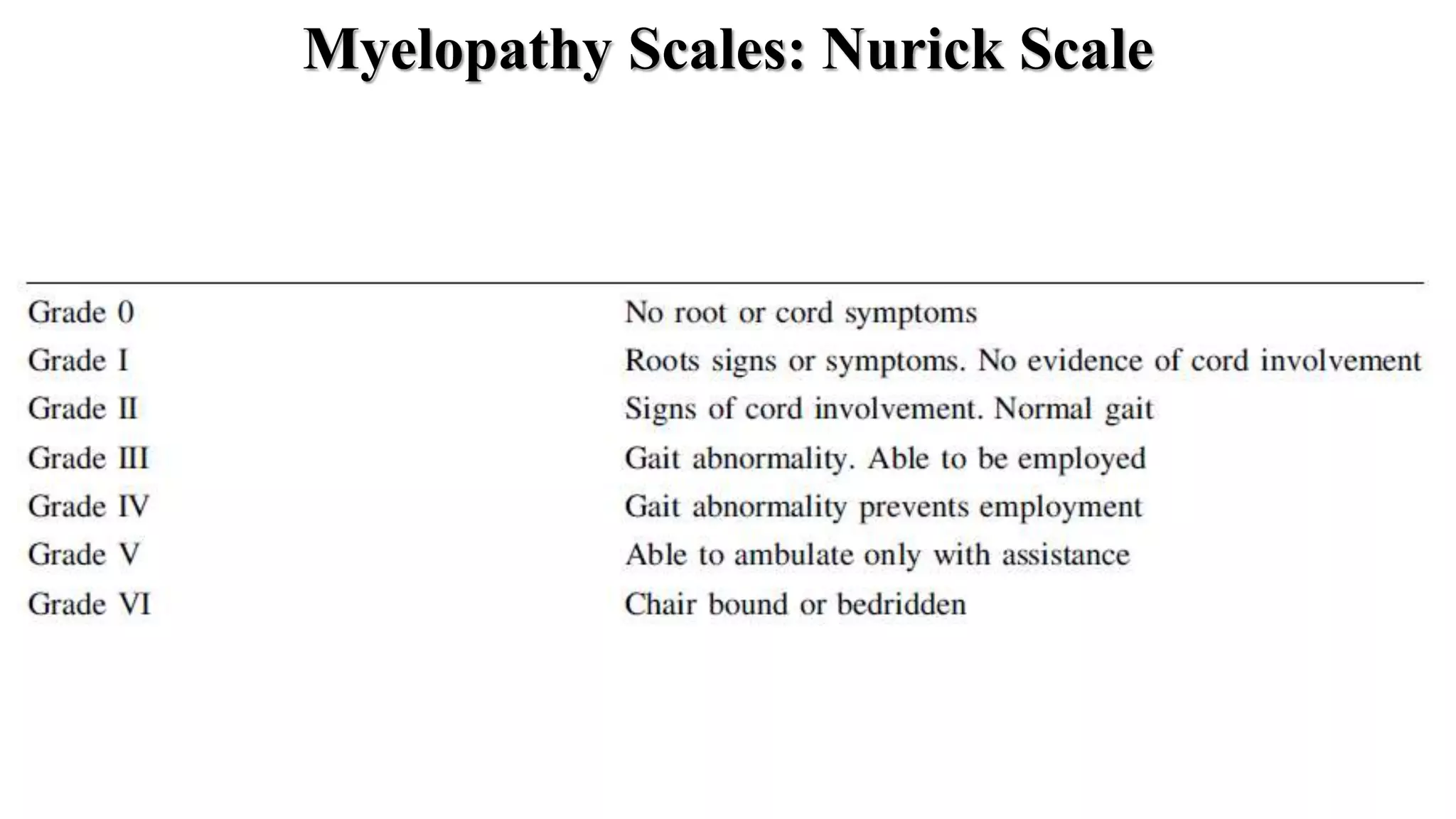
Myelopathy Scales: Nurick Scale
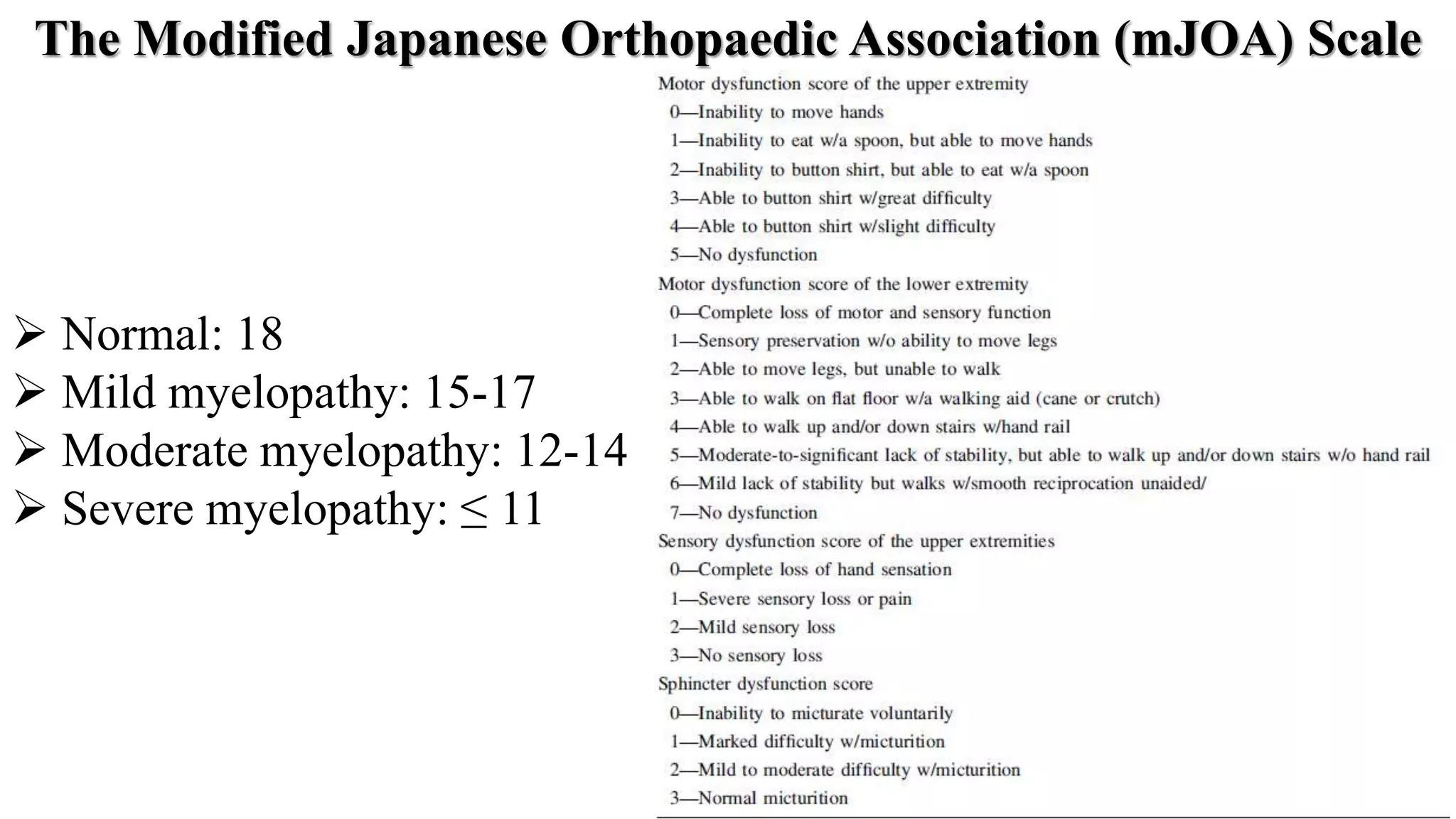
The Modified Japanese Orthopaedic Association (mJOA) Scale
 Normal: 18
 Mild myelopathy: 15-17
 Moderate myelopathy: 12-14
 Severe myelopathy: ≤ 11
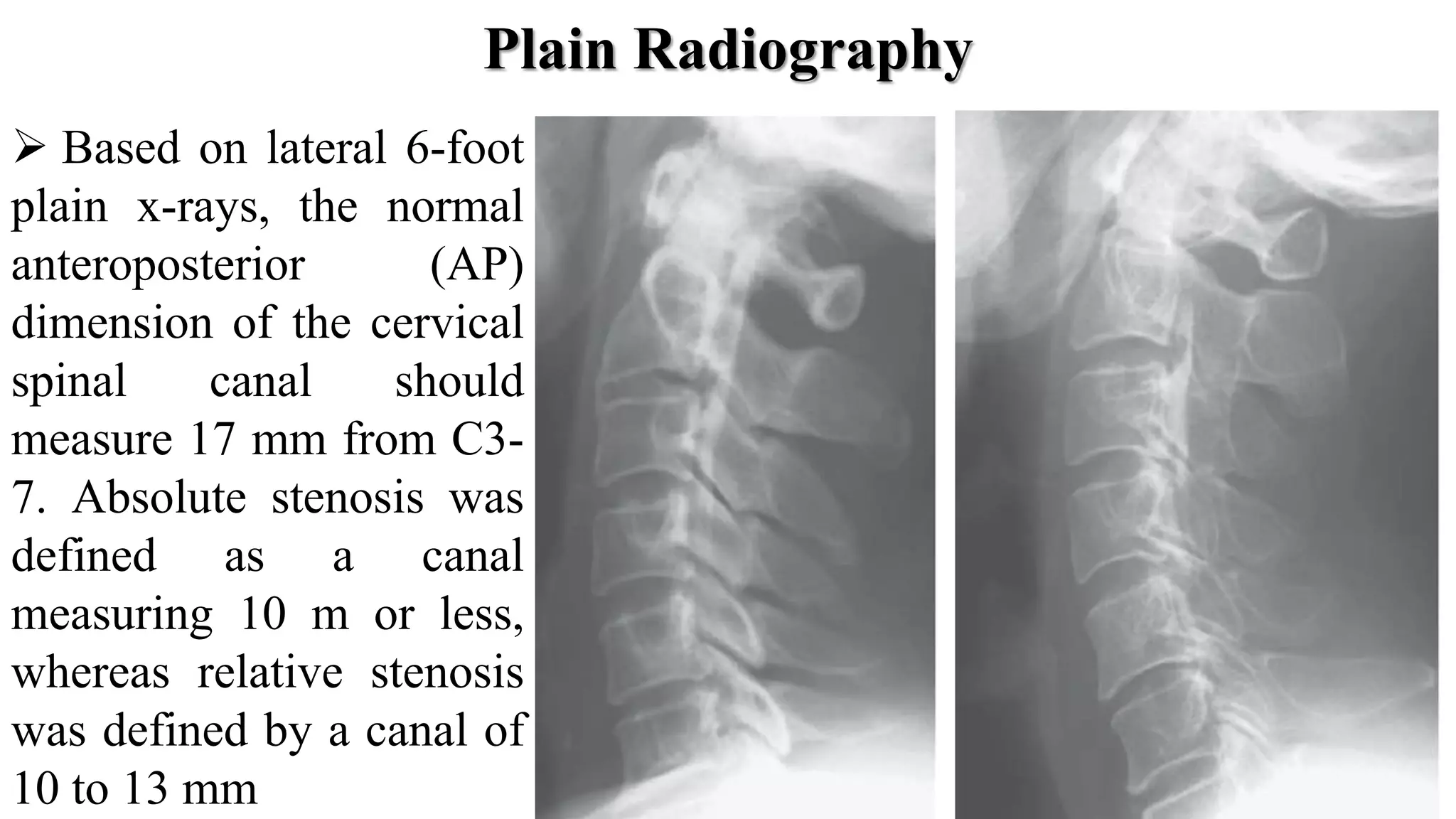
Plain Radiography
 Based on lateral 6-foot
plain x-rays, the normal
anteroposterior (AP)
dimension of the cervical
spinal canal should
measure 17 mm from C3-
7. Absolute stenosis was
defined as a canal
measuring 10 m or less,
whereas relative stenosis
was defined by a canal of
10 to 13 mm
Types Of OPLL
Continuous type
Plateau-shaped
Circumscribed type
hill-shaped
CT
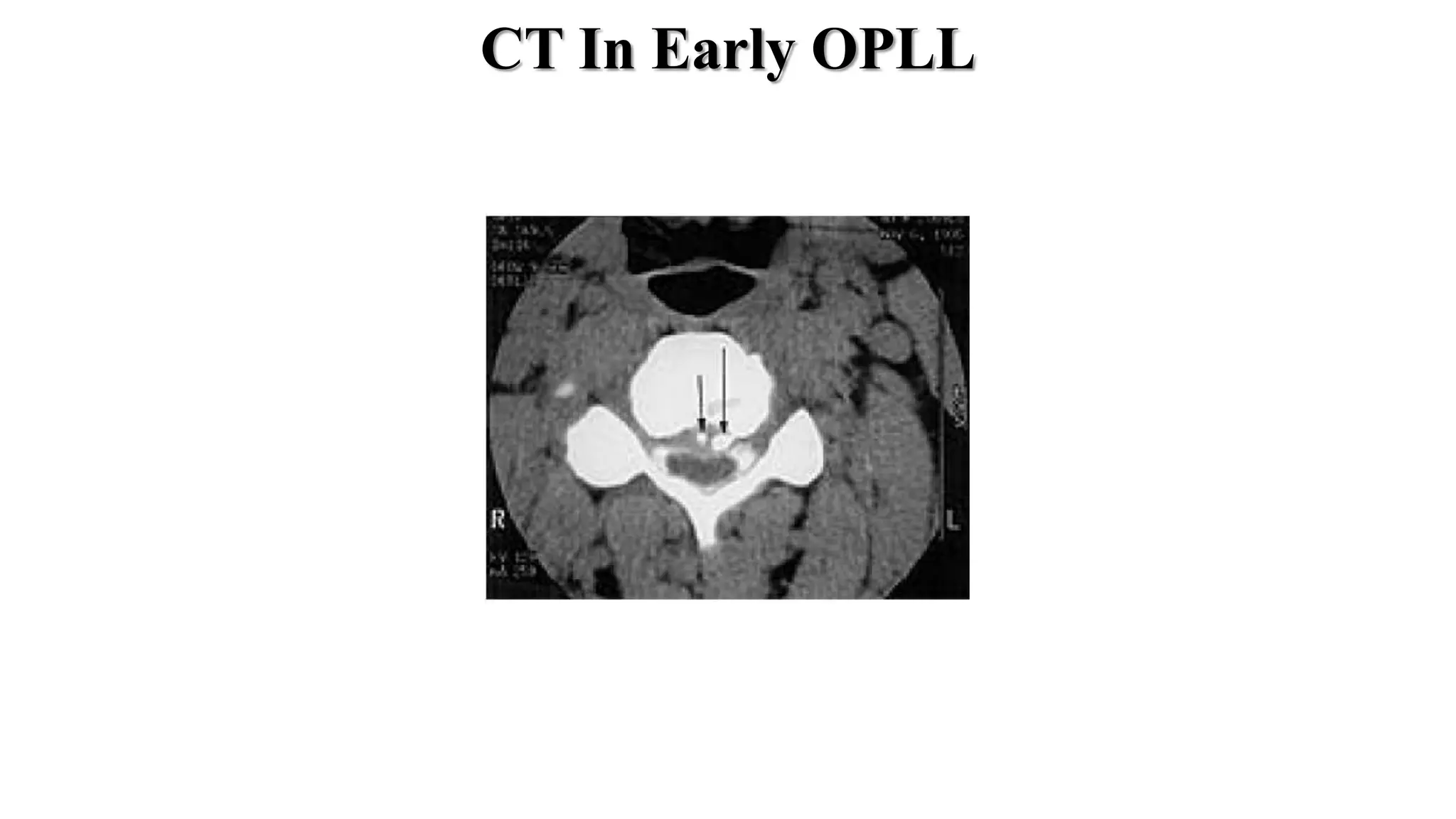
 Thin axial
 Reconstructed 2D- and 3D-CT,
 Myelo-CT scans
CT In Early OPLL
CT

Hill-type Square-type mushroom-type
Continuous type Circumscribed type
segmental type
Continuous type
Mixed type
Dural Calcification
CT Signs of Dural Penetrance (Single-layer & Double-layer
Signs)
Double-layerSingle-layer (large
central mass with
unilateral “C” signs)
Single-layer (large
central mass with
bilateral “C” signs)
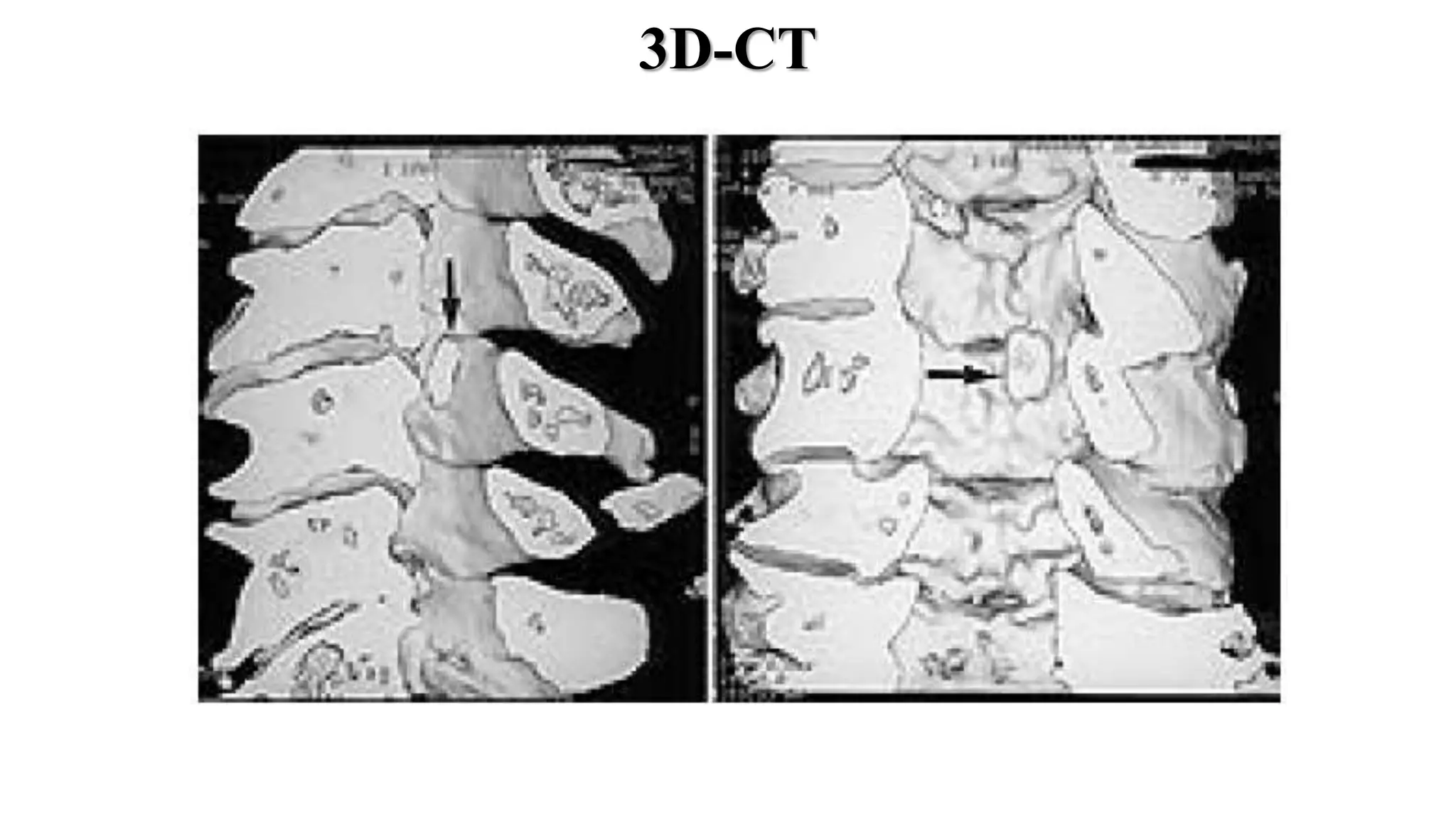
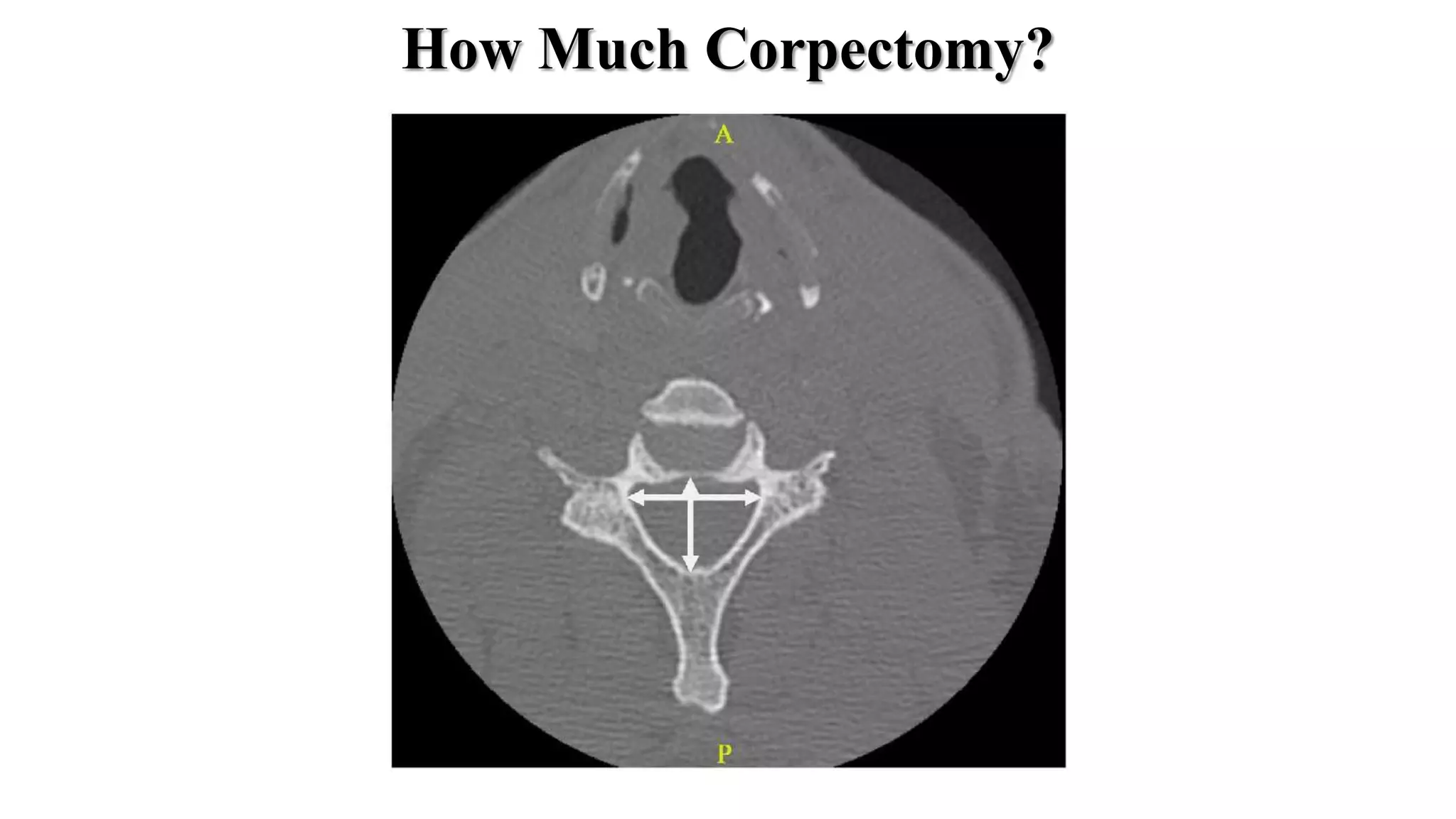
How Much Corpectomy?
3D-CT
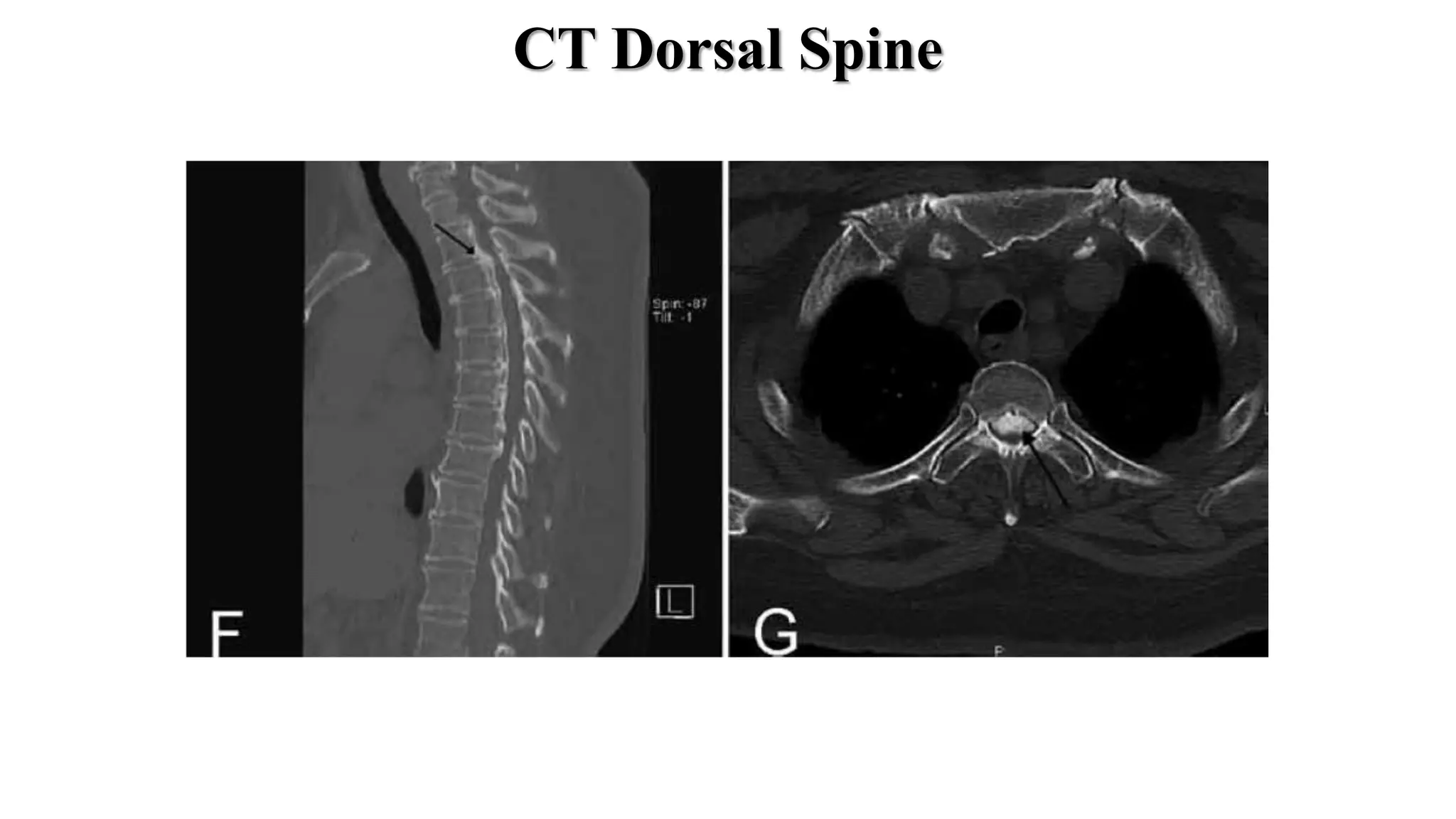
CT Dorsal Spine
Radiological Signs Help In Choosing Approach
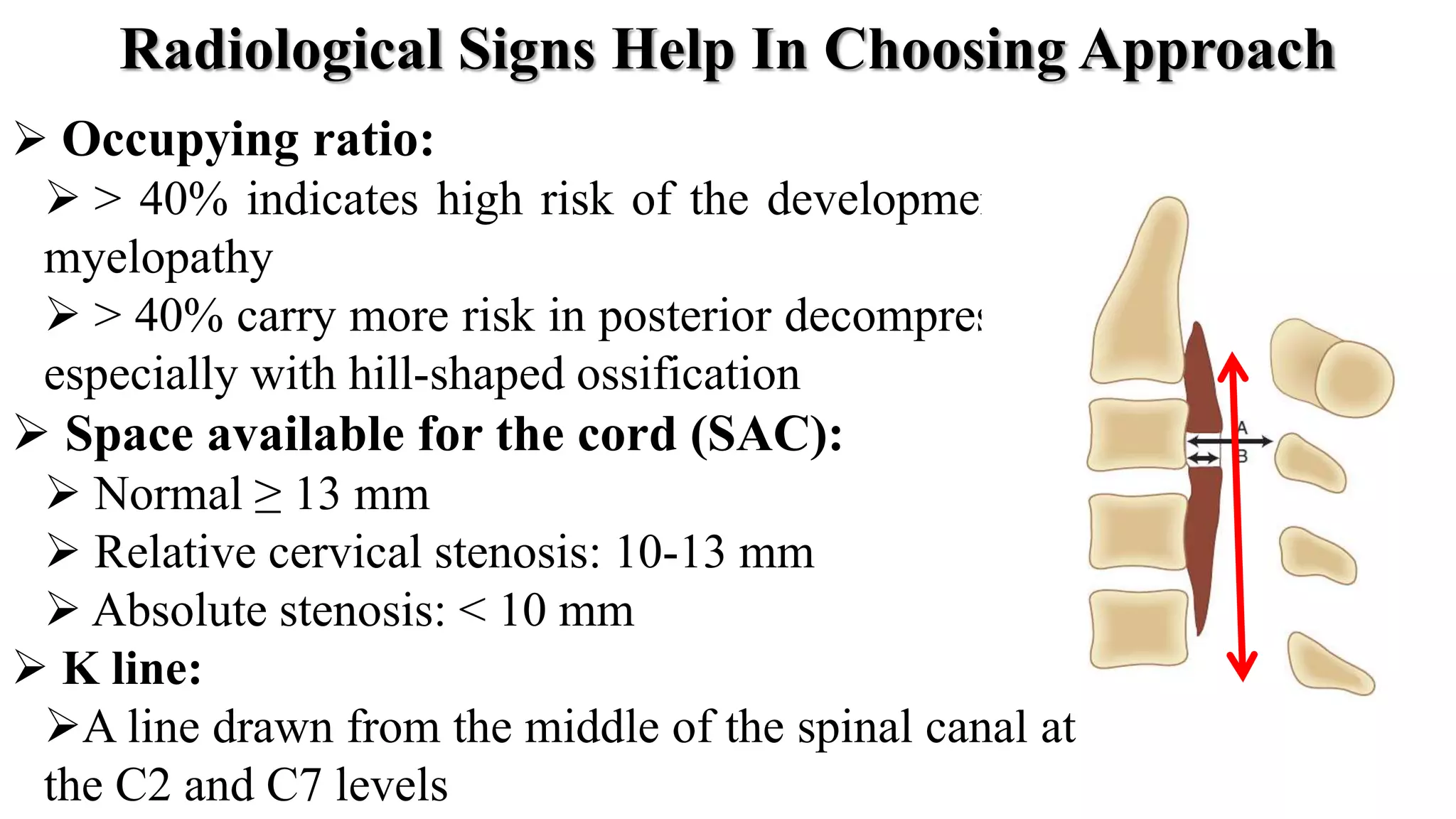
 Occupying ratio:
 > 40% indicates high risk of the development of
myelopathy
 > 40% carry more risk in posterior decompression
especially with hill-shaped ossification
 Space available for the cord (SAC):
 Normal ≥ 13 mm
 Relative cervical stenosis: 10-13 mm
 Absolute stenosis: < 10 mm
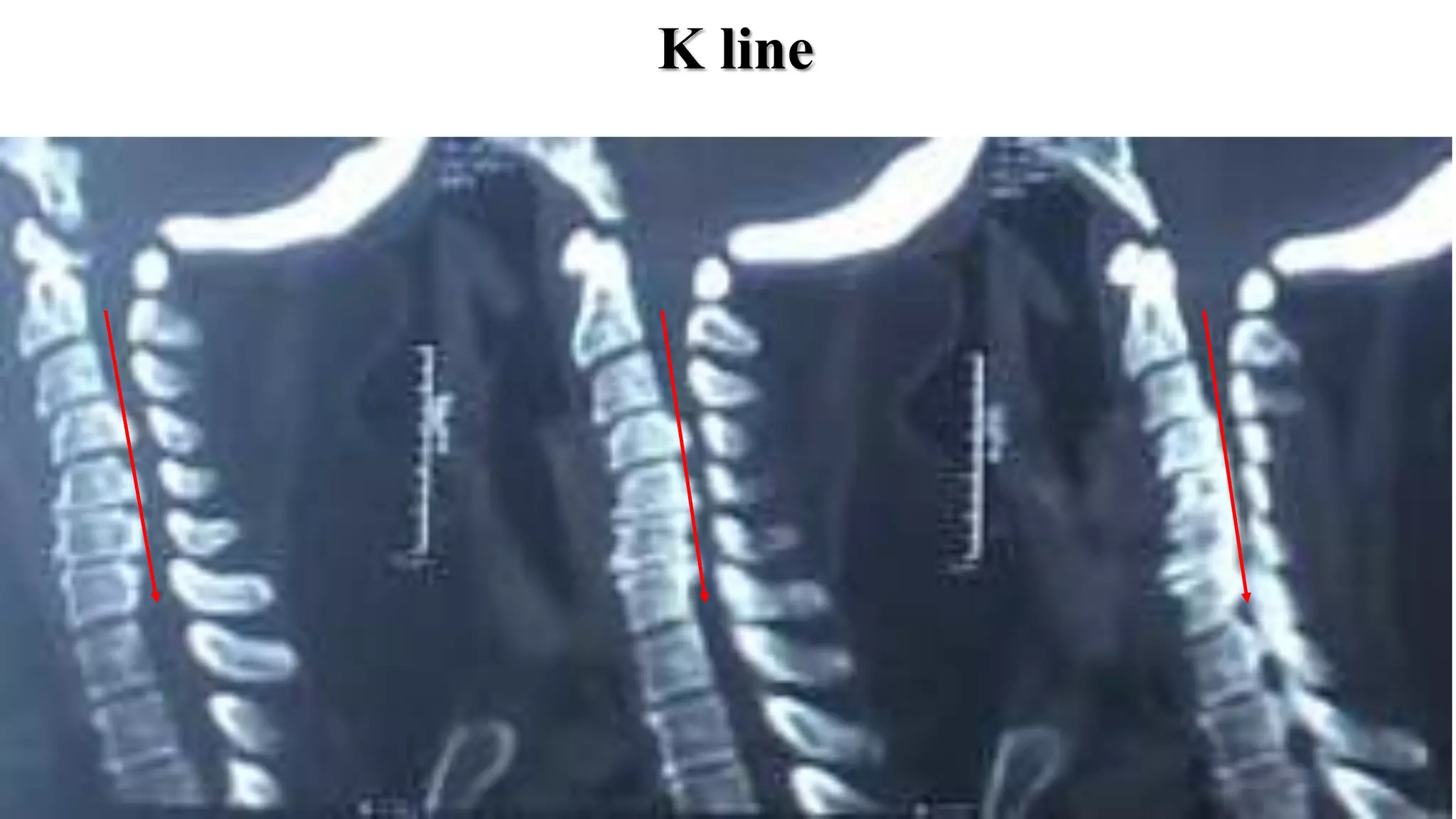
 K line:
A line drawn from the middle of the spinal canal at
the C2 and C7 levels
K line
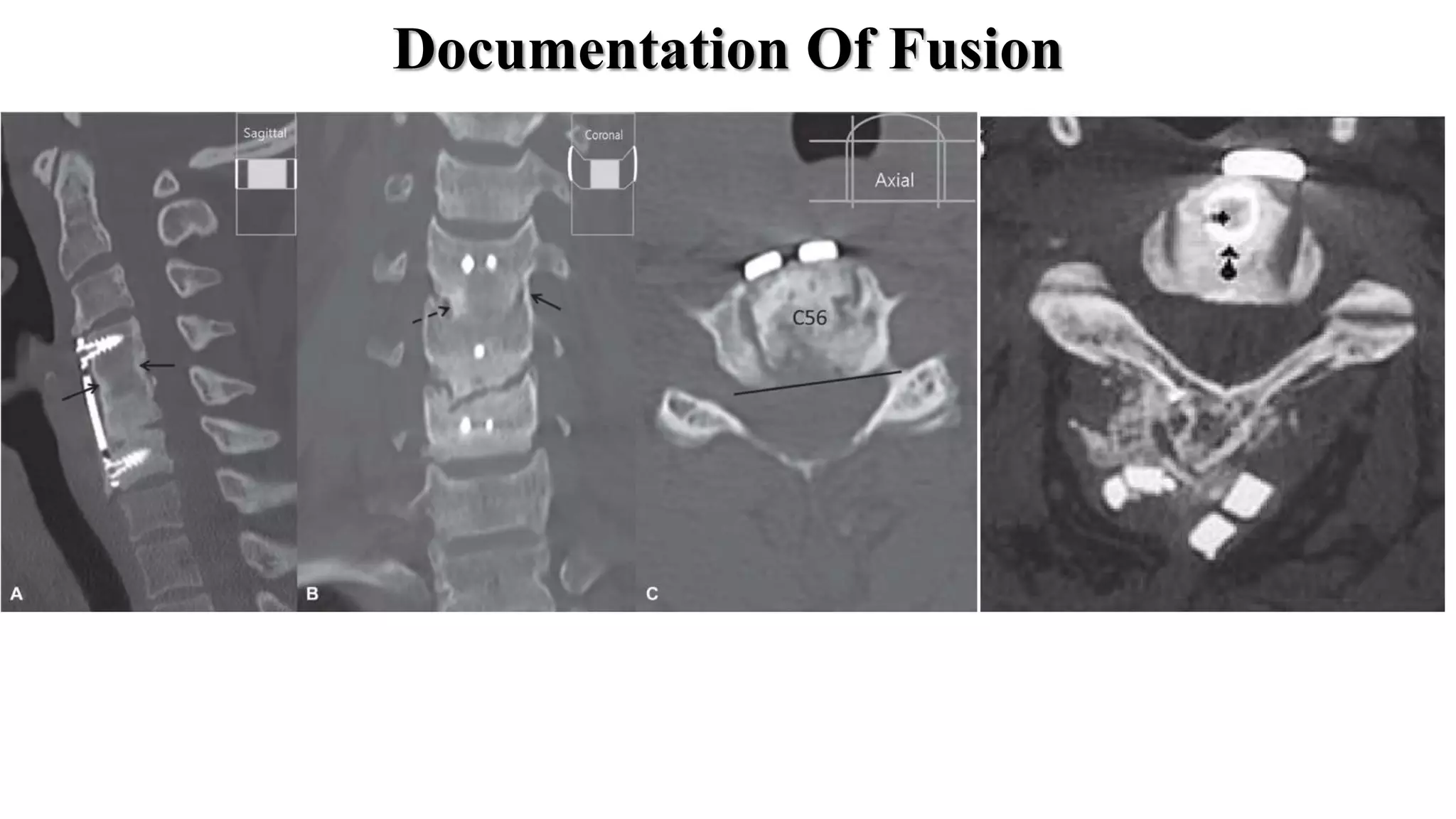
Documentation Of Fusion
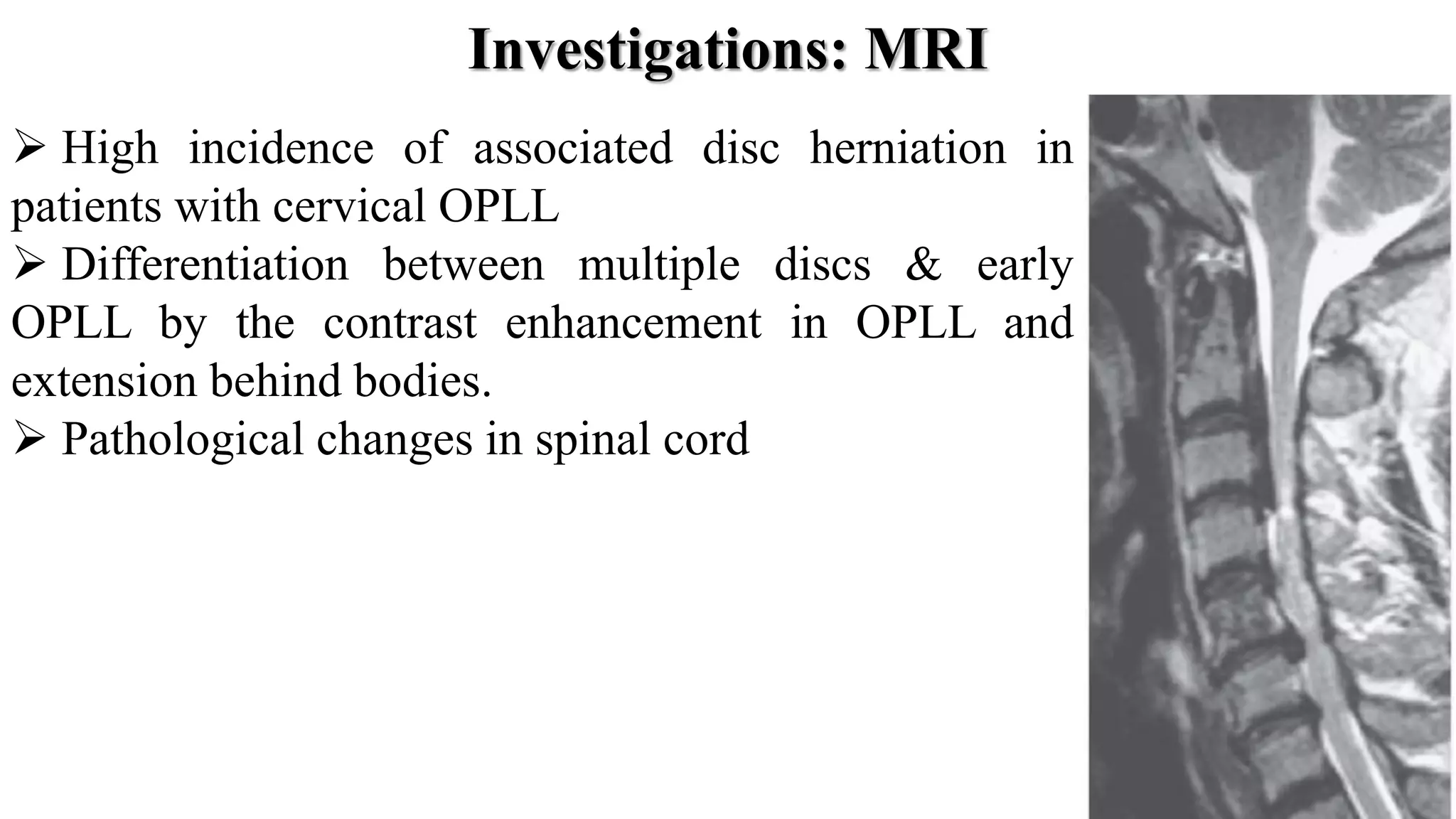
Investigations: MRI
 High incidence of associated disc herniation in
patients with cervical OPLL
 Differentiation between multiple discs & early
OPLL by the contrast enhancement in OPLL and
extension behind bodies.
 Pathological changes in spinal cord
Treatment
 Conservative management:
 Surgical management:
Conservative Management
 Indications:
 Axial pain without or with subclinical myelopathy (e.g. only extensor
planter)
 Main insult is dynamic compression (less than 60% stenosis or 6-13 mm
SAC
 Sever comorbidity
 Measures:
 Collar
 Traction
 Carful life stile
Surgery: Indications
Is there a rule for prophylactic surgery?
 Myelopathy or radiculo-myelopathy with predominant myelopathy
 Role of prophylactic surgery in asymptomatic patient
 Sever canal compromise:
 SAC less than 6mm or
 Occupational ratio more than 60%
 Presence of cord signal in MRI
 SSEP is affected
 Young age (less than 65ys)

Surgical Procedures
Anterior surgery: Single/multilevel (up to 4)
 Corpectomy with removal of calcified mass
 Corpectomy without removal of calcified mass (ant. floating method)
 Open Window Corpectomy (removal of post1/2 of body leaving the ant.
One)
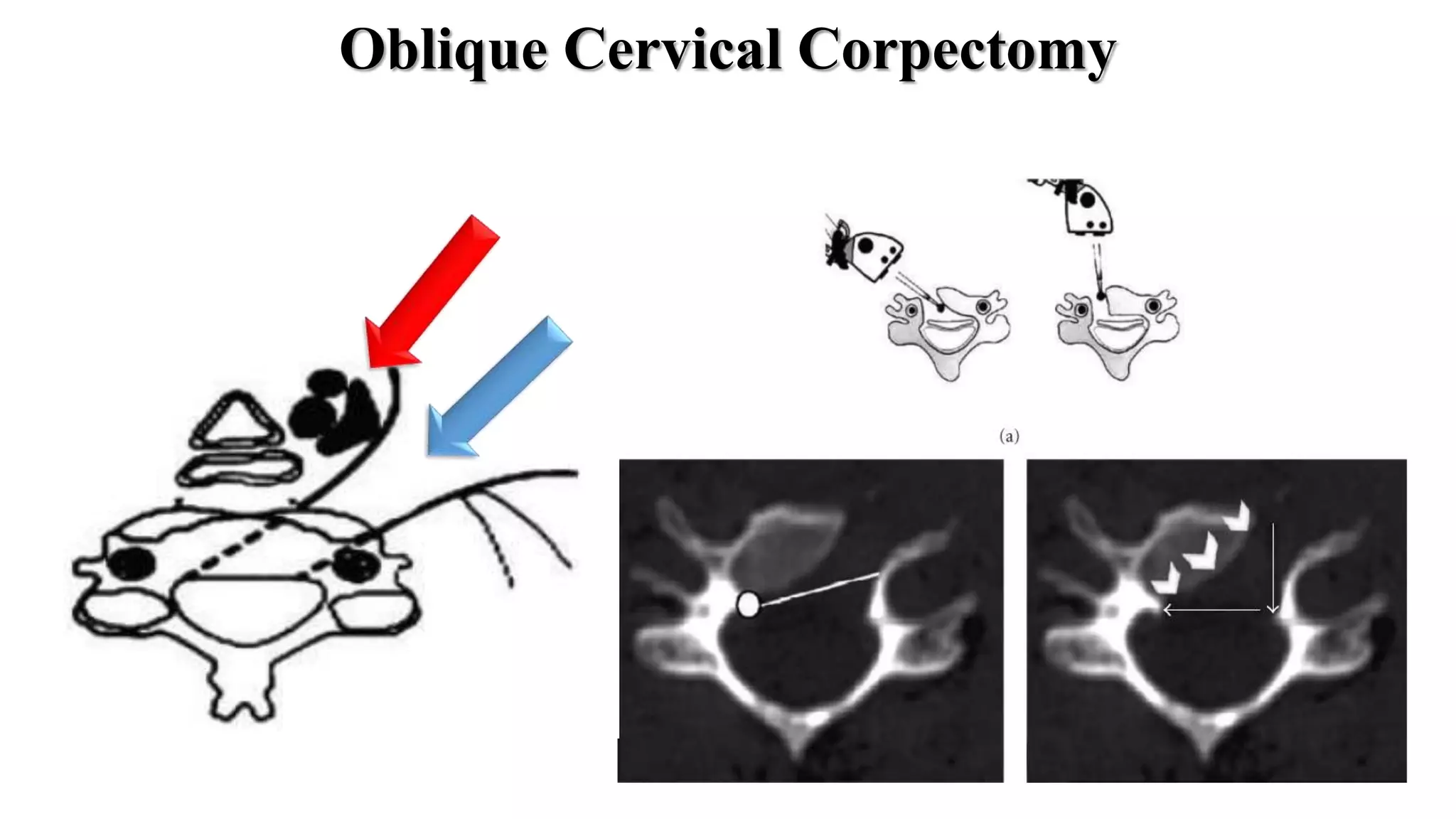
 Oblique Cervical Corpectomy
 With fusion & halo vest or with fusion and fixation
 Posterior surgery:
 Laminectomy
 Laminectomy + fixation & fusion
 Laminoplasty (open-door or double-door laminoplasty)
 Combined anterior-posterior surgery:
Choice Of Approach
 Factors in favor of ant. approach:
 Presence of facilities & expertise
 Occupying ratio more than 60%
 Hill-shaped calcification
 Kyphotic deformity or degenerative instability
 Limited corpectomy levels (up to 4)
 Factors allow post. approach:
 Comorbidity prevent more lengthy procedures
 Occupying ratio less than 60%
 Plateau-shaped calcification
 Preserved lordotic spine or maximum straightening
Anesthesia & Monitoring
 Awake fiberoptic intubation/positioning
 Intraoperative neural monitoring
 Motor evoked potentials,
 Somatosensory Evoked Potentials (SEPs),
 Electromyography

Posterior Approaches
 Laminectomy:
 Laminectomy + fixation & fusion
 Laminoplasty (open-door or double-door laminoplasty)
Laminectomy
 Advantages:
 Simple procedure
 Effective in selected cases
 Disadvantages:
 Post laminectomy scar formation may
compress cord
 ↑ incidence of kyphosis & instability
 ↑ incidence of POLL progression
 Procedure:
 C3-C7 (possibility of OPLL progression)
 + < 25% of medial facetectomy (for root
decompression)
Laminectomy & Fusion
 Advantages:
 ↓ risk of postoperative kyphotic deformity & spinal instability
 Disadvantages:
 Potential risk of vertebral artery or neural injury
 More lengthy procedure
 Procedures:
 Cables can be used in sublaminar, interspinous, or facet wiring techniques
 Screws & rods/plate construct fixation can be uses with lateral mass
plating or pedicular screw fixation
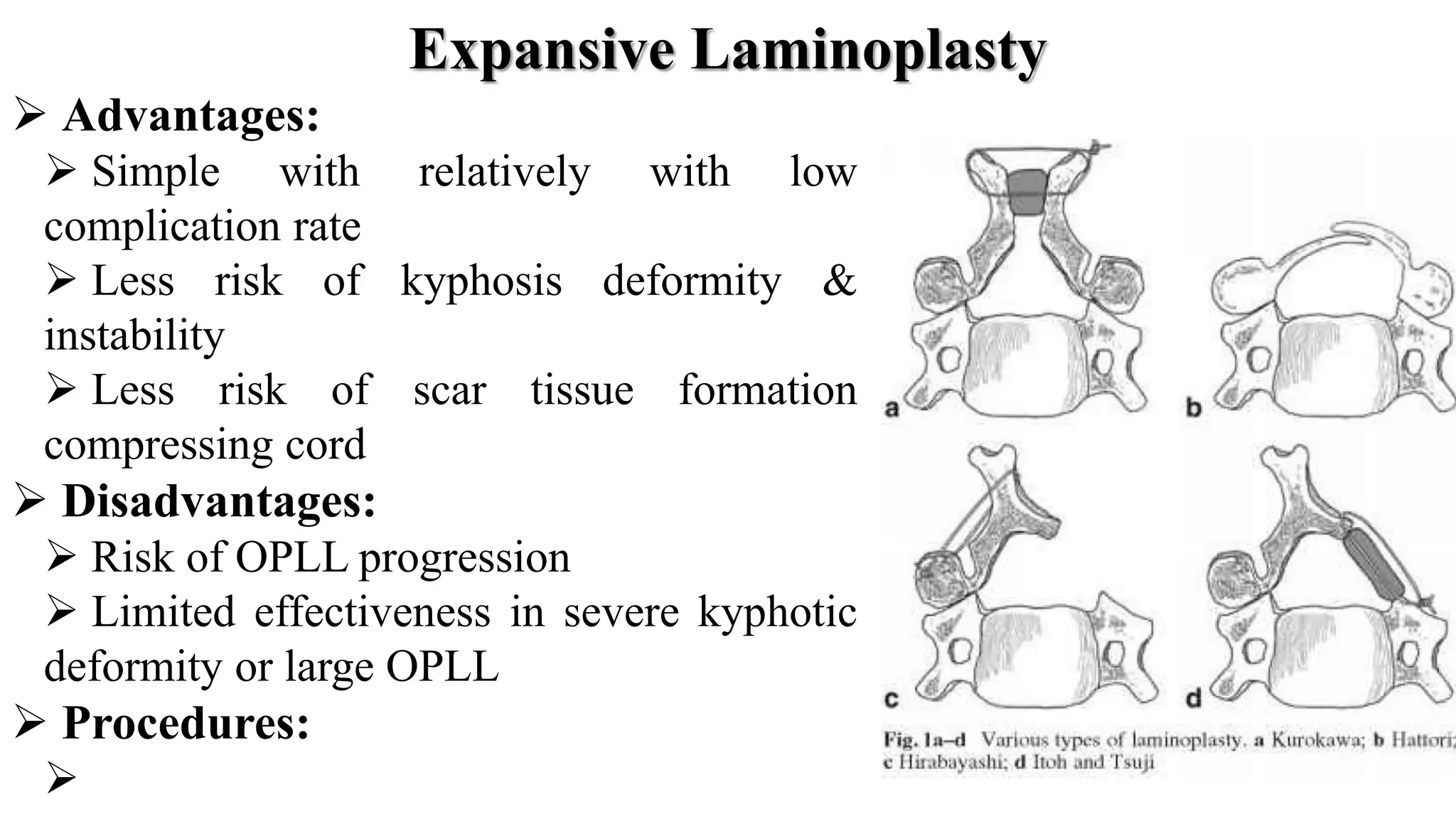
Expansive Laminoplasty
 Advantages:
 Simple with relatively with low
complication rate
 Less risk of kyphosis deformity &
instability
 Less risk of scar tissue formation
compressing cord
 Disadvantages:
 Risk of OPLL progression
 Limited effectiveness in severe kyphotic
deformity or large OPLL
 Procedures:

Ant. Approach
 Corpectomy with removal of calcified mass
 Corpectomy without removal of calcified mass (ant. floating method)
 Open Window Corpectomy (removal of post. ½ of body leaving the
ant. One)
 Oblique Cervical Corpectomy
+
 Fusion & halo vest (for 6-8 weeks) or
 Internal fixation & fusion
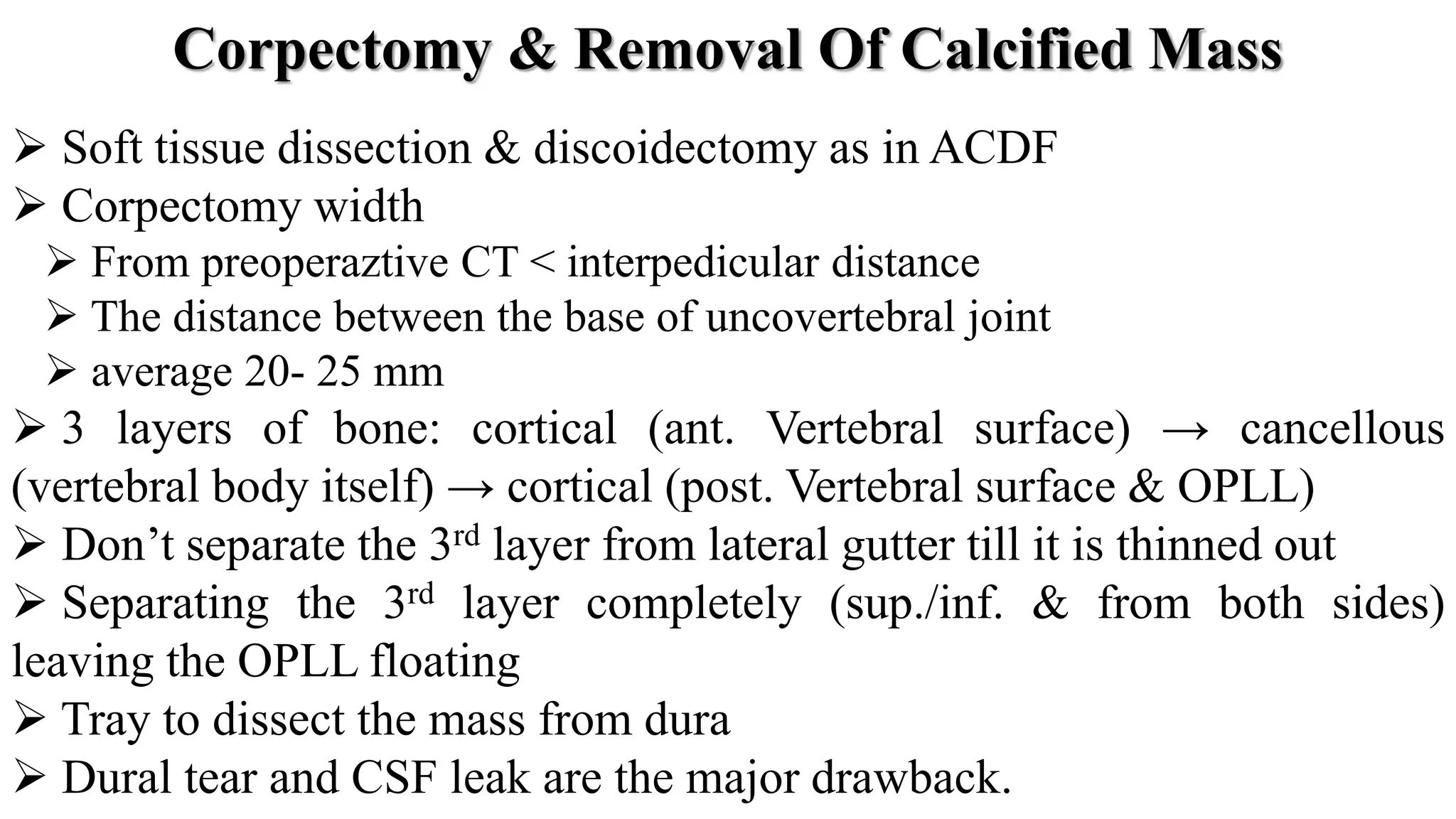
Corpectomy & Removal Of Calcified Mass
 Soft tissue dissection & discoidectomy as in ACDF
 Corpectomy width
 From preoperaztive CT < interpedicular distance
 The distance between the base of uncovertebral joint
 average 20- 25 mm
 3 layers of bone: cortical (ant. Vertebral surface) → cancellous
(vertebral body itself) → cortical (post. Vertebral surface & OPLL)
 Don’t separate the 3rd layer from lateral gutter till it is thinned out
 Separating the 3rd layer completely (sup./inf. & from both sides)
leaving the OPLL floating
 Tray to dissect the mass from dura
 Dural tear and CSF leak are the major drawback.
The Anterior Floating Method
 More extensive lateral exposure (>25 mm) to facilitate anterior
migration of the OPLL mass
Open Window Corpectomy
Oblique Cervical Corpectomy
Fixation By Halo Vest
 6-8 weeks
Fixation By Plating System
 Dynamic plates much more better than fixed plate in bone fusion
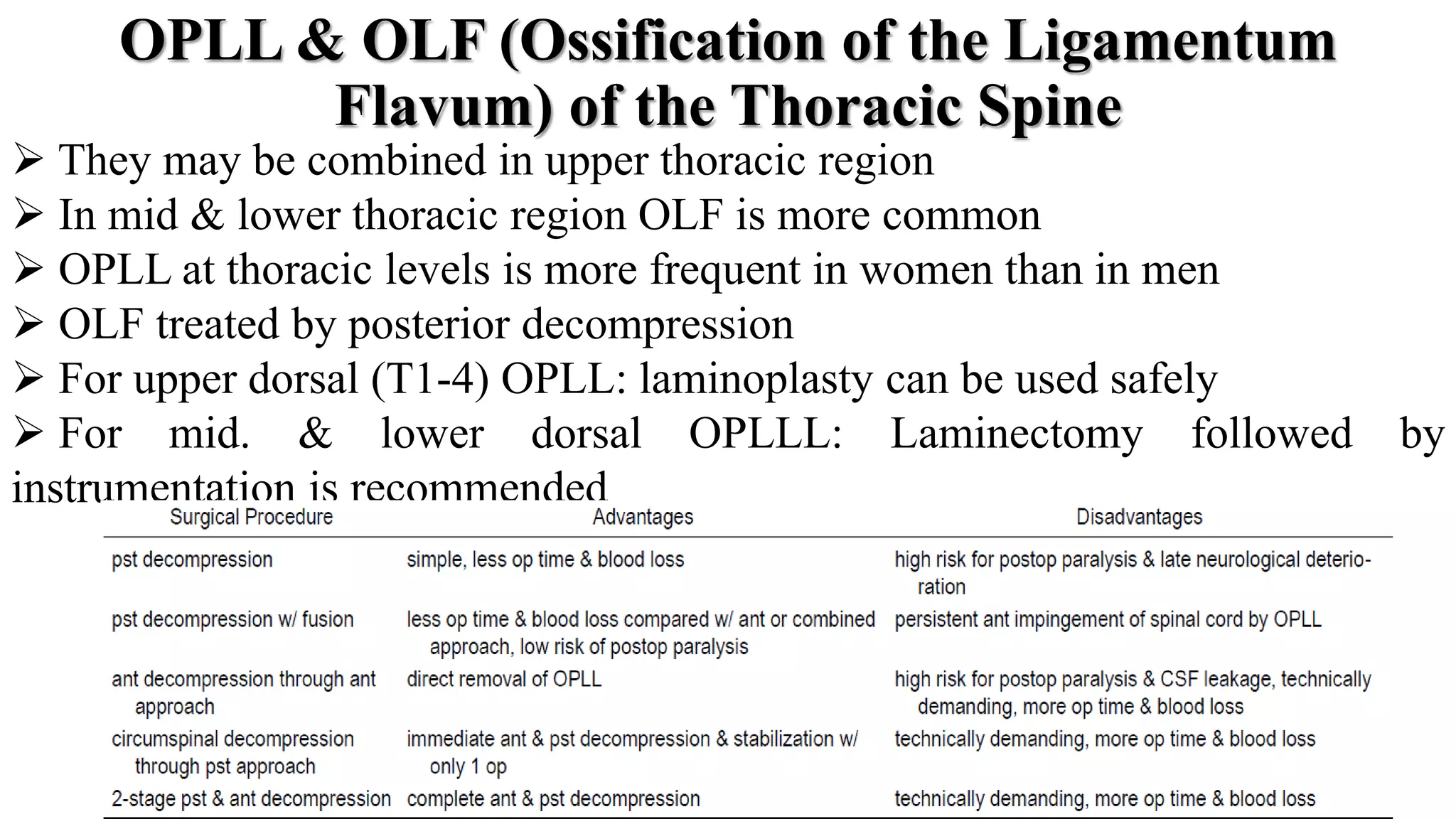
OPLL & OLF (Ossification of the Ligamentum
Flavum) of the Thoracic Spine
 They may be combined in upper thoracic region
 In mid & lower thoracic region OLF is more common
 OPLL at thoracic levels is more frequent in women than in men
 OLF treated by posterior decompression
 For upper dorsal (T1-4) OPLL: laminoplasty can be used safely
 For mid. & lower dorsal OPLLL: Laminectomy followed by
instrumentation is recommended
Ossified Posterior Longitudinal Ligament (OPLL)

Ossified Posterior Longitudinal Ligament (OPLL)

  • 1.
    OPLL Mohamed Wael Samir,MD Prof. of Neurosurgery Ain Shams University Cairo, Egypt
  • 2.
    ILOs  Pathology ofOPLL  Clinical presentation  Diagnosis of OPLL  Management of OPLL
  • 4.
    Pathology  1) Cellof origin & pathogenesis  2) Epidemiology  3) Macroscopic features  4) Microscopic features  5) Immunohistochemistry  6) Genetic features  7) Radiological features  8) Growth pattern & spread  9) Grading & behavior  10) Prognosis
  • 5.
    Pathogenesis  ligament cellsfrom patients with OPLL have osteoblast-like characteristics Factors that intiate these cells to form calcification & ossification are:  Genetic factors: Genetic locus for OPLL is thought to be located close to the HLA region, on chromosome 6p  Hormonal factors: non–insulin dependent D.M., hypoparathyroidism and hypophosphatemic  Environmental factors: Mechanical stress in ligaments of the spine  Life style
  • 6.
    Pathogenesis Of NeuralInjury In OPLL  A) Mechanical:  1) Static compression:  Occupying ratio greater than 60% indicates high risk of the development of myelopathy  SAC < 6 mm  2) Dynamic compression:  Degenerative spondylolithesis  Threshold of SAC  Normal= 13mm Myelopathy  with SAC < 6 mm = Static compression  Myelopathy with SAC 6-13 = Dynamic  B) Vascular:
  • 7.
    Pathology  1) Cellof origin & pathogenesis  2) Epidemiology  3) Macroscopic features  4) Microscopic features  5) Immunohistochemistry  6) Genetic features  7) Radiological features  8) Growth pattern & spread  9) Grading & behavior  10) Prognosis
  • 8.
    Epidemiology  Incidence:  InJapanese >30 ys up to 4%.  In the United States and Europe, up to 1.7%.  Gender:  Cervical: Male > Female (2 : 1)  Dorsal: Female > Male  Race:  More in Japanese  Age:  Started in 40s and became symptomatic in 50s  Risk factors:  Genetic: genetic locus for OPLL is thought to be located close to the HLA region, on chromosome 6p  DM
  • 9.
    Pathology  1) Cellof origin & pathogenesis  2) Epidemiology  3) Macroscopic features  4) Microscopic features  5) Immunohistochemistry  6) Genetic features  7) Radiological features  8) Growth pattern & spread  9) Grading & behavior  10) Prognosis
  • 10.
    Pathology  Site:  Cervical(C2-C4): 70%,  Dorsal (T1-T4): 15%  Lumbar (L1-L3):15%  There is high frequency with which cervical OPLL is associated with thoracolumbar OPLL and OLF  Character:  Early: PLL hypertrophy  Then: Punctate calcification within PLL  Then: Actual ossification 
  • 11.
    Four Classical TypesOf OPLL Circumscribed  1) Segmental type (39%),  2) Mixed type (29%),  3) Continuous type (27%),  4) Circumscribed type (5%)
  • 12.
    Types Of OPLL  Hill-typeSquare-type mushroom-type Continuous type circumscribed type segmental type Continuous type Mixed type
  • 13.
    Pathology  1) Cellof origin & pathogenesis  2) Epidemiology  3) Macroscopic features  4) Microscopic features  5) Immunohistochemistry  6) Genetic features  7) Radiological features  8) Growth pattern & spread  9) Grading & behavior  10) Prognosis
  • 14.
    Microscopic Features  EarlyOPLL:  Hypertrophy PLL due to fibroblastic hyperplasia and increased collagen deposition with accompanying punctate ossification centers  Immature form:  Woven bone with fibrocartilaginous cell proliferation  Mature form:  Lamellar bone with well-developed haversian systems  Mostly endochondral ossification & sometimes membranous
  • 15.
    Microscopic Features OfPathological Changes Of Cord  Demyelination and loss of axon always found in the posterior and posterolateral part of the cord (so posterior decompression may insult the cord whis is alredy insulted posteriorly)
  • 16.
    Pathology  1) Cellof origin & pathogenesis  2) Epidemiology  3) Macroscopic features  4) Microscopic features  5) Immunohistochemistry  6) Genetic features  7) Radiological features  8) Growth pattern & spread  9) Grading & behavior  10) Prognosis
  • 17.
    Genetic Features  Agenetic locus near the human leukocyte antigen site (HLA) on chromosome 6p  Ossification of post. Longitudinal ligament (OPLL)  Ossification of ligamentum flavum (OLF)  Ossification of ant. Longitudinal ligament (OALL)  Diffuse idiopathic skeletal hyperostosis (DISH)
  • 18.
    Pathology  1) Cellof origin & pathogenesis  2) Epidemiology  3) Macroscopic features  4) Microscopic features  5) Immunohistochemistry  6) Genetic features  7) Radiological features  8) Growth pattern & spread  9) Grading & behavior  10) Prognosis
  • 19.
    Types Of OPLL  Hill-typeSquare-type mushroom-type Continuous type circumscribed type segmental type Continuous type Mixed type
  • 20.
  • 21.
    Pathology  1) Cellof origin & pathogenesis  2) Epidemiology  3) Macroscopic features  4) Microscopic features  5) Immunohistochemistry  6) Genetic features  7) Radiological features  8) Growth pattern & spread  9) Grading & behavior  10) Prognosis
  • 22.
    Natural History OfOPLL  OPLL ↑ in thickness 0.4mm/y & in longitudinal expansion 0.67mm/y  It is more with continuous- or mixed-type OPLL  A rapid progression in the 4th decade then gradually decreases in the 5th or 6th decade.  It occurs also postoperative  In 60- 70 % after posterior decompression  In 36-64 % after anterior decompression and fusion Do These mean prophylactic surgery is indicated?
  • 23.
    Postoperative Progression OfThe Ossified Lesion
  • 24.
    Causes Of LateDeterioration  Postoperative progression of OPLL,  Progressive deformity and instability  Thoracic myelopathy secondary to OPLL or OLF or both,  Degenerative lumbar stenosis,
  • 25.
    Pathology  1) Cellof origin & pathogenesis  2) Epidemiology  3) Macroscopic features  4) Microscopic features  5) Immunohistochemistry  6) Genetic features  7) Radiological features  8) Growth pattern & spread  9) Grading & behavior  10) Prognosis
  • 26.
    Prognosis  Patient’s factors: Old age  Preoperative neurological stat & duration of symptoms  History of trauma causing acute presentation  Disease’s factors:  Occupying ratio of OPLL or SAC  Sagittal shape of ossification (hill-shaped) especially with posterior decompression  Management’s factors:  Progression may be more with posterior decompression
  • 28.
    Clinical Picture  Accidentaldiscovery  Onset: Usually gradual progressive but may be acute (after trauma)  Pain:  Axial pain  Radicular  Neurological deficits:  Myelopathy or myeloradiculopathy rather than radiculopathy alone  Associated coexisting conditions:  Diabetic  Hypoparathyroidism,  Myotonic muscular dystrophy
  • 29.
  • 30.
    The Modified JapaneseOrthopaedic Association (mJOA) Scale  Normal: 18  Mild myelopathy: 15-17  Moderate myelopathy: 12-14  Severe myelopathy: ≤ 11
  • 32.
    Plain Radiography  Basedon lateral 6-foot plain x-rays, the normal anteroposterior (AP) dimension of the cervical spinal canal should measure 17 mm from C3- 7. Absolute stenosis was defined as a canal measuring 10 m or less, whereas relative stenosis was defined by a canal of 10 to 13 mm
  • 33.
    Types Of OPLL Continuoustype Plateau-shaped Circumscribed type hill-shaped
  • 34.
    CT  Thin axial Reconstructed 2D- and 3D-CT,  Myelo-CT scans
  • 35.
  • 36.
    CT  Hill-type Square-type mushroom-type Continuoustype Circumscribed type segmental type Continuous type Mixed type
  • 37.
  • 38.
    CT Signs ofDural Penetrance (Single-layer & Double-layer Signs) Double-layerSingle-layer (large central mass with unilateral “C” signs) Single-layer (large central mass with bilateral “C” signs)
  • 39.
  • 40.
  • 41.
  • 42.
    Radiological Signs HelpIn Choosing Approach  Occupying ratio:  > 40% indicates high risk of the development of myelopathy  > 40% carry more risk in posterior decompression especially with hill-shaped ossification  Space available for the cord (SAC):  Normal ≥ 13 mm  Relative cervical stenosis: 10-13 mm  Absolute stenosis: < 10 mm  K line: A line drawn from the middle of the spinal canal at the C2 and C7 levels
  • 43.
  • 44.
  • 45.
    Investigations: MRI  Highincidence of associated disc herniation in patients with cervical OPLL  Differentiation between multiple discs & early OPLL by the contrast enhancement in OPLL and extension behind bodies.  Pathological changes in spinal cord
  • 47.
  • 48.
    Conservative Management  Indications: Axial pain without or with subclinical myelopathy (e.g. only extensor planter)  Main insult is dynamic compression (less than 60% stenosis or 6-13 mm SAC  Sever comorbidity  Measures:  Collar  Traction  Carful life stile
  • 49.
    Surgery: Indications Is therea rule for prophylactic surgery?  Myelopathy or radiculo-myelopathy with predominant myelopathy  Role of prophylactic surgery in asymptomatic patient  Sever canal compromise:  SAC less than 6mm or  Occupational ratio more than 60%  Presence of cord signal in MRI  SSEP is affected  Young age (less than 65ys) 
  • 50.
    Surgical Procedures Anterior surgery:Single/multilevel (up to 4)  Corpectomy with removal of calcified mass  Corpectomy without removal of calcified mass (ant. floating method)  Open Window Corpectomy (removal of post1/2 of body leaving the ant. One)  Oblique Cervical Corpectomy  With fusion & halo vest or with fusion and fixation  Posterior surgery:  Laminectomy  Laminectomy + fixation & fusion  Laminoplasty (open-door or double-door laminoplasty)  Combined anterior-posterior surgery:
  • 51.
    Choice Of Approach Factors in favor of ant. approach:  Presence of facilities & expertise  Occupying ratio more than 60%  Hill-shaped calcification  Kyphotic deformity or degenerative instability  Limited corpectomy levels (up to 4)  Factors allow post. approach:  Comorbidity prevent more lengthy procedures  Occupying ratio less than 60%  Plateau-shaped calcification  Preserved lordotic spine or maximum straightening
  • 52.
    Anesthesia & Monitoring Awake fiberoptic intubation/positioning  Intraoperative neural monitoring  Motor evoked potentials,  Somatosensory Evoked Potentials (SEPs),  Electromyography 
  • 54.
    Posterior Approaches  Laminectomy: Laminectomy + fixation & fusion  Laminoplasty (open-door or double-door laminoplasty)
  • 55.
    Laminectomy  Advantages:  Simpleprocedure  Effective in selected cases  Disadvantages:  Post laminectomy scar formation may compress cord  ↑ incidence of kyphosis & instability  ↑ incidence of POLL progression  Procedure:  C3-C7 (possibility of OPLL progression)  + < 25% of medial facetectomy (for root decompression)
  • 56.
    Laminectomy & Fusion Advantages:  ↓ risk of postoperative kyphotic deformity & spinal instability  Disadvantages:  Potential risk of vertebral artery or neural injury  More lengthy procedure  Procedures:  Cables can be used in sublaminar, interspinous, or facet wiring techniques  Screws & rods/plate construct fixation can be uses with lateral mass plating or pedicular screw fixation
  • 57.
    Expansive Laminoplasty  Advantages: Simple with relatively with low complication rate  Less risk of kyphosis deformity & instability  Less risk of scar tissue formation compressing cord  Disadvantages:  Risk of OPLL progression  Limited effectiveness in severe kyphotic deformity or large OPLL  Procedures: 
  • 59.
    Ant. Approach  Corpectomywith removal of calcified mass  Corpectomy without removal of calcified mass (ant. floating method)  Open Window Corpectomy (removal of post. ½ of body leaving the ant. One)  Oblique Cervical Corpectomy +  Fusion & halo vest (for 6-8 weeks) or  Internal fixation & fusion
  • 60.
    Corpectomy & RemovalOf Calcified Mass  Soft tissue dissection & discoidectomy as in ACDF  Corpectomy width  From preoperaztive CT < interpedicular distance  The distance between the base of uncovertebral joint  average 20- 25 mm  3 layers of bone: cortical (ant. Vertebral surface) → cancellous (vertebral body itself) → cortical (post. Vertebral surface & OPLL)  Don’t separate the 3rd layer from lateral gutter till it is thinned out  Separating the 3rd layer completely (sup./inf. & from both sides) leaving the OPLL floating  Tray to dissect the mass from dura  Dural tear and CSF leak are the major drawback.
  • 61.
    The Anterior FloatingMethod  More extensive lateral exposure (>25 mm) to facilitate anterior migration of the OPLL mass
  • 62.
  • 63.
  • 64.
    Fixation By HaloVest  6-8 weeks
  • 65.
    Fixation By PlatingSystem  Dynamic plates much more better than fixed plate in bone fusion
  • 67.
    OPLL & OLF(Ossification of the Ligamentum Flavum) of the Thoracic Spine  They may be combined in upper thoracic region  In mid & lower thoracic region OLF is more common  OPLL at thoracic levels is more frequent in women than in men  OLF treated by posterior decompression  For upper dorsal (T1-4) OPLL: laminoplasty can be used safely  For mid. & lower dorsal OPLLL: Laminectomy followed by instrumentation is recommended