National Action Plan on
       Climate Change, UNFCCC and
        EGREE (UNDP-GEF Project)


            Dr. MCR HRD Institute of AP, Hyderabad


                                                     26 July ‘12
Dr. N. Sai Bhaskar Reddy,
CEO, GEO http://e-geo.org
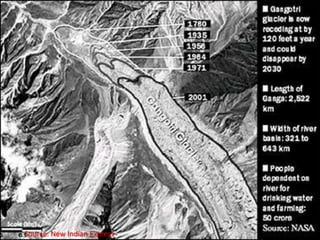
Source: New Indian Express
Climate Changes
 in India

• Increase in surface
  temperature by 0.4
  degree C over the
  past century.
• Warming trend
  along the west
  coast, in central
  India, the interior
  peninsula, and
  northeastern India.
Climate Changes in
  India

• Cooling trend in northwest
  India and parts of South
  India.
• Regional monsoon
  variations: increased
  monsoon seasonal rainfall
  along the west coast,
  northern Andhra Pradesh
  and North-western India,
  decreased monsoon
  seasonal rainfall over
  eastern Madhya Pradesh,
  North-eastern India, and
  parts of Gujarat and
Climate Changes in India

• Observed trends of multi-
  decadal periods of more
  frequent droughts, followed
  by less severe droughts.
• Studies have shown a rising
  trend in the frequency of
  heavy rain events and
  decrease in frequency of
  moderate events over
  central India from 1951 to
  2000.
                                5
Climate Changes in
  India

• Records of coastal tide
  gauges in the north
  Indian ocean for the
  last 40 years has
  revealed an estimated
  sea level rise
  between 1.06-1.75
  mm per year.
• The available
  monitoring data on
  Himalayan glaciers
  indicates recession
                            6
  of some glaciers.
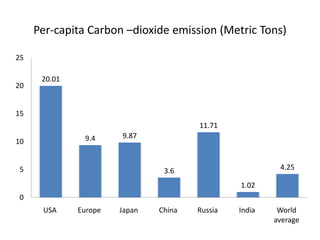
Per-capita Carbon –dioxide emission (Metric Tons)

25

      20.01
20


15
                                       11.71
               9.4     9.87
10


5                               3.6                      4.25

                                                1.02
0
      USA     Europe   Japan   China   Russia   India    World
                                                        average
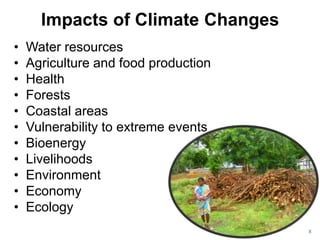
Impacts of Climate Changes
•   Water resources
•   Agriculture and food production
•   Health
•   Forests
•   Coastal areas
•   Vulnerability to extreme events
•   Bioenergy
•   Livelihoods
•   Environment
•   Economy
•   Ecology
                                      8
National Action Plan for
 Climate Change (NAPCC)

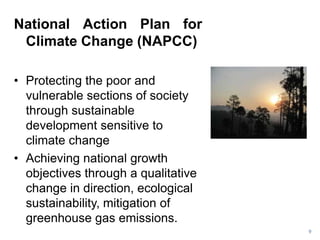
• Protecting the poor and
  vulnerable sections of society
  through sustainable
  development sensitive to
  climate change
• Achieving national growth
  objectives through a qualitative
  change in direction, ecological
  sustainability, mitigation of
  greenhouse gas emissions.
                                     9
National Action Plan for
 Climate Change (NAPCC)

• Efficient and cost effective
  strategies for end use Demand
  side Management.
• Technologies for adaptation and
  mitigation of greenhouse gases
  emissions.
• Promote sustainable
  development - Regulatory and
  voluntary mechanisms
                                    10
Core of NAPCC - National
                  Missions
• National Solar Mission:The NAPCC aims
  to promote the development and use of
  solar energy for power generation and
  other uses with the ultimate objective
  of making solar competitive with fossil-
  based energy options.
• National Mission for Enhanced Energy
  Efficiency: Current initiatives are
  expected to yield savings of 10,000 MW
  by 2012.

These National Missions are being institutionalized by the respective Ministries/
Departments.
Core of NAPCC - National
                 Missions
• National Mission on Sustainable
  Habitat: To promote energy efficiency
  as a core component of urban
  planning.
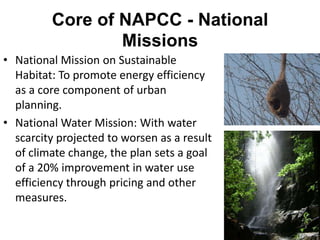
• National Water Mission: With water
  scarcity projected to worsen as a result
  of climate change, the plan sets a goal
  of a 20% improvement in water use
  efficiency through pricing and other
  measures.
Core of NAPCC - National
                  Missions
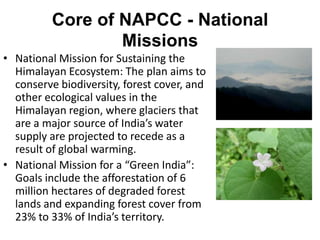
• National Mission for Sustaining the
  Himalayan Ecosystem: The plan aims to
  conserve biodiversity, forest cover, and
  other ecological values in the
  Himalayan region, where glaciers that
  are a major source of India’s water
  supply are projected to recede as a
  result of global warming.
• National Mission for a “Green India”:
  Goals include the afforestation of 6
  million hectares of degraded forest
  lands and expanding forest cover from
  23% to 33% of India’s territory.
Core of NAPCC - National
                Missions
• National Mission for Sustainable
  Agriculture: The plan aims to support
  climate adaptation in agriculture through
  the development of climate-resilient
  crops, expansion of weather insurance
  mechanisms, and agricultural practices.
• National Mission on Strategic Knowledge
  for Climate Change: To gain a better
  understanding of climate science, impacts
  and challenges, the plan envisions a new
  Climate Science Research Fund, improved
  climate modeling, and increased
  international collaboration. It also
  encourage private sector initiatives to
  develop adaptation and mitigation
  technologies through venture capital
  funds.
Rural Livlihoods - Resources
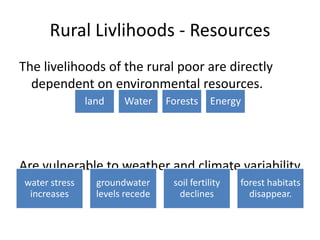
The livelihoods of the rural poor are directly
  dependent on environmental resources.
               land    Water     Forests     Energy


Are vulnerable to weather and climate variability
water stress     groundwater      soil fertility   forest habitats
 increases       levels recede     declines          disappear.
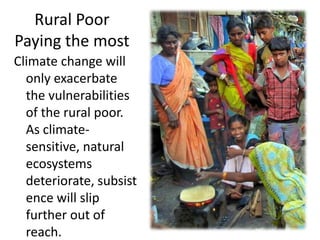
Rural Poor
Paying the most
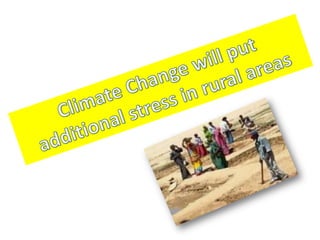
Climate change will
  only exacerbate
  the vulnerabilities
  of the rural poor.
  As climate-
  sensitive, natural
  ecosystems
  deteriorate, subsist
  ence will slip
  further out of
  reach.
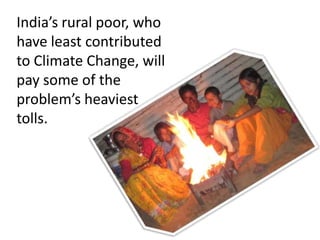
India’s rural poor, who
have least contributed
to Climate Change, will
pay some of the
problem’s heaviest
tolls.
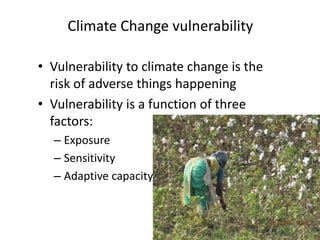
Climate Change vulnerability

• Vulnerability to climate change is the
  risk of adverse things happening
• Vulnerability is a function of three
  factors:
  – Exposure
  – Sensitivity
  – Adaptive capacity
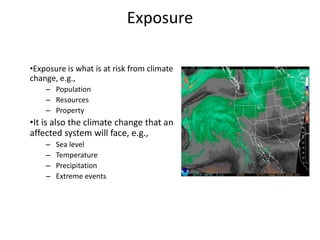
Exposure

•Exposure is what is at risk from climate
change, e.g.,
    – Population
    – Resources
    – Property
•It is also the climate change that an
affected system will face, e.g.,
    –   Sea level
    –   Temperature
    –   Precipitation
    –   Extreme events
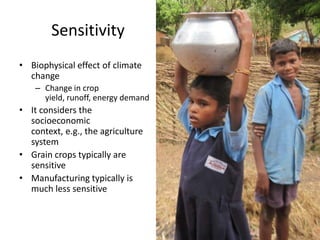
Sensitivity
• Biophysical effect of climate
  change
    – Change in crop
      yield, runoff, energy demand
• It considers the
  socioeconomic
  context, e.g., the agriculture
  system
• Grain crops typically are
  sensitive
• Manufacturing typically is
  much less sensitive
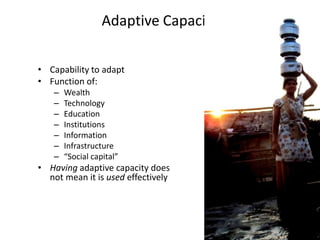
Adaptive Capacity

• Capability to adapt
• Function of:
    –   Wealth
    –   Technology
    –   Education
    –   Institutions
    –   Information
    –   Infrastructure
    –   “Social capital”
• Having adaptive capacity does
  not mean it is used effectively
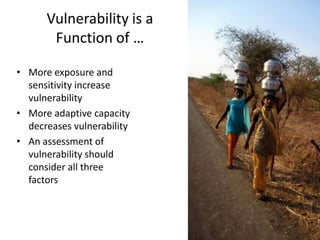
Vulnerability is a
       Function of …

• More exposure and
  sensitivity increase
  vulnerability
• More adaptive capacity
  decreases vulnerability
• An assessment of
  vulnerability should
  consider all three
  factors
Adaptation
“adjustment in natural or human
  systems in response to actual or
  expected climatic stimuli or their
  effects, which moderates harm of
  exploits beneficial opportunities”
(Third Assessment Report, Working
  Group II)

Includes “actual” (realized) or
  “expected” (future) changes in
  climate
Adaptation (continued)
Two types of adaptation
Autonomous adaptation or reactive adaptation tends to be what
people and systems do as impacts of climate change become
apparent


Anticipatory or proactive adaptation are measures taken to
reduce potential risks of future climate change
UNFCCC
     Overview of UNFCCC

United Nations Framework Convention on Climate Change

 A global legal instrument (international agreement) on the control
 and management of greenhouse gases (GHG).
 Adopted in 1992, entered into force in 1994.
 Status of participation: 189 Parties.
 Contains 2 annexes:
     Annex 1: countries with obligations to take measures to mitigate the
     effects of climate change
     Annex 2: countries with obligations to provide financing to developing
     countries for their obligations under UNFCC
 Affiliated instruments: Kyoto Protocol.
UNFCCC
      Overall goal and objectives

What is the overall goal?
  “ to protect the climate system for the benefit of present
  and future generations of mankind. ”


What are the further objectives?
  “ to achieve stabilisation of greenhouse gas
  concentrations in the atmosphere at a level that would
  prevent dangerous anthropogenic interference with the
  climate system. ”
UNFCCC
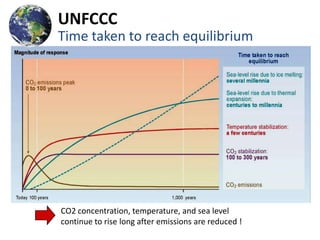
Time taken to reach equilibrium


CO2 concentration, temperature, and sea level
continue to rise long after emissions are reduced !
UNFCCC
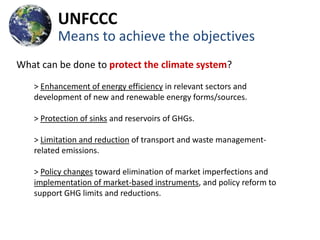
         Means to achieve the objectives
What can be done to protect the climate system?
   > Enhancement of energy efficiency in relevant sectors and
   development of new and renewable energy forms/sources.

   > Protection of sinks and reservoirs of GHGs.

   > Limitation and reduction of transport and waste management-
   related emissions.

   > Policy changes toward elimination of market imperfections and
   implementation of market-based instruments, and policy reform to
   support GHG limits and reductions.
UNFCCC
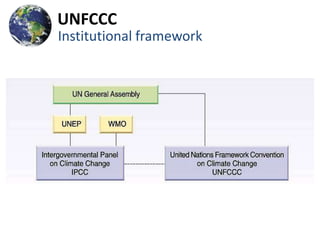
Institutional framework
UNFCCC
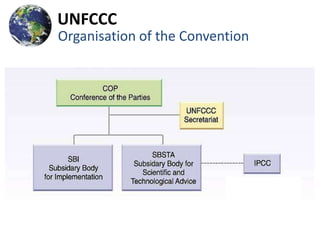
Organisation of the Convention
UNFCCC
       National level actors
National UNFCCC focal points
   > Responsible for the Government’s interaction and
   communication with UNFCCC.
   > Usually a specific ministry / department.
   > Usually interacting with a wide range of other organizations /
   stakeholders at the national level.

National CDM or JI organizations (DNA)
   > Specific organization (authority) that is responsible for
   approving CDM and JI activities at the national level.
   > Often, but not always, the same as the National Focal
   Point.
KYOTO PROTOCOL
           Bringing UNFCCC into action
The Kyoto Protocol
   > An addition to UNFCCC that requires developed countries to limit their GHG
   emissions in 2012, as compared to their emissions in 1990.
   > Provides detailed methods and mechanisms for how the emission reductions
   can be achieved, measured and verified.
   > All members in UNFCCC have not agreed to sign the Kyoto Protocol!

A long process of ratification
   > Adopted in 1997, but required the ratification of more than 55 countries
   representing more than 55% of GHG emissions.
   > Entered into force on February 16th, 2005 after ratification of the Russian
   Federation (now 163 countries covering 61.6% of global emissions have ratified
   the protocol).
KYOTO PROTOCOL
            A market-based instrument
Kyoto Protocol characteristics
   > Commits Annex 1 countries to reduce GHG emissions by 5.2% by 2012
   compared to 1990.
   > Actual commitment period: 2008 - 2012.
   > Individual goals for each country.

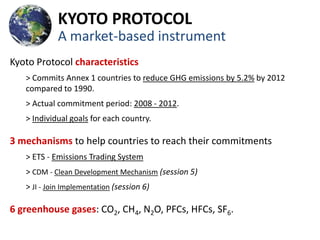
3 mechanisms to help countries to reach their commitments
   > ETS - Emissions Trading System
   > CDM - Clean Development Mechanism (session 5)
   > JI - Join Implementation (session 6)

6 greenhouse gases: CO2, CH4, N2O, PFCs, HFCs, SF6.
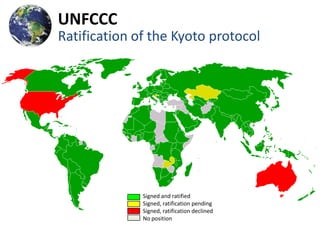
UNFCCC
Ratification of the Kyoto protocol


              Signed and ratified
              Signed, ratification pending
              Signed, ratification declined
              No position
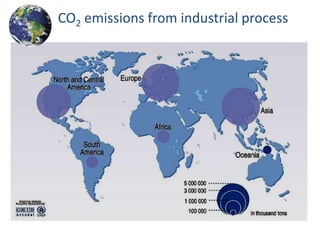
CO2 emissions from industrial process
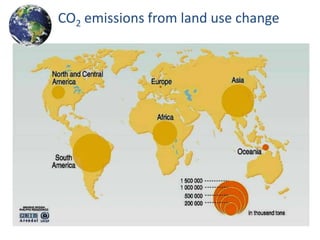
CO2 emissions from land use change
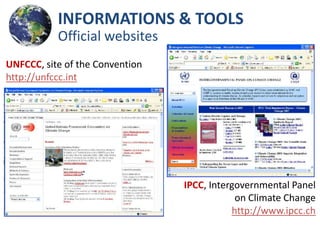
INFORMATIONS & TOOLS
           Official websites
UNFCCC, site of the Convention
http://unfccc.int


                                 IPCC, Intergovernmental Panel
                                             on Climate Change
                                            http://www.ipcc.ch
UNDP – GEF Project
• Government of India, with UNDP as the lead
  agency, is implementing a Global Environment
  Facility (GEF) supported project -
  “Mainstreaming Coastal and Marine
  Biodiversity Conservation into Production
  Sectors in the Godavari River Estuarine
  Ecosystem, Andhra Pradesh”.
COUNTRY: India

PROJECT TITLE: Mainstreaming Coastal and Marine Biodiversity
  Conservation into Production Sectors in the East Godavari
  River Estuarine Ecosystem (EGREE)

GEF AGENCY: UNDP

OTHER EXECUTING PARTNER: Ministry of Environment & Forests
  (MoEF), Government of India / Wildlife
  Wing, Environment, Forests, Science & Technology
  Department, State Government of Andhra Pradesh

GEF FOCAL AREA: Biodiversity
The project will focus specifically on removing
  the key barriers to mainstreaming
  environmental management considerations
  into major production activities that are
  impacting the Godavari region, with special
  focus on Coringa Wildlife Sanctuary.
The main components of the project
             include
a) Sectoral mainstreaming including knowledge
   management for coastal and marine
   biodiversity conservation;
b) Institutional Capacity Development; and
c) Sustainable Community Livelihoods and
   Natural Resource Use in the Godavari River
   Estuary.

Climate Change UNFCCC

  • 1.
    National Action Planon Climate Change, UNFCCC and EGREE (UNDP-GEF Project) Dr. MCR HRD Institute of AP, Hyderabad 26 July ‘12 Dr. N. Sai Bhaskar Reddy, CEO, GEO http://e-geo.org
  • 2.
  • 3.
    Climate Changes inIndia • Increase in surface temperature by 0.4 degree C over the past century. • Warming trend along the west coast, in central India, the interior peninsula, and northeastern India.
  • 4.
    Climate Changes in India • Cooling trend in northwest India and parts of South India. • Regional monsoon variations: increased monsoon seasonal rainfall along the west coast, northern Andhra Pradesh and North-western India, decreased monsoon seasonal rainfall over eastern Madhya Pradesh, North-eastern India, and parts of Gujarat and
  • 5.
    Climate Changes inIndia • Observed trends of multi- decadal periods of more frequent droughts, followed by less severe droughts. • Studies have shown a rising trend in the frequency of heavy rain events and decrease in frequency of moderate events over central India from 1951 to 2000. 5
  • 6.
    Climate Changes in India • Records of coastal tide gauges in the north Indian ocean for the last 40 years has revealed an estimated sea level rise between 1.06-1.75 mm per year. • The available monitoring data on Himalayan glaciers indicates recession 6 of some glaciers.
  • 7.
    Per-capita Carbon –dioxideemission (Metric Tons) 25 20.01 20 15 11.71 9.4 9.87 10 5 3.6 4.25 1.02 0 USA Europe Japan China Russia India World average
  • 8.
    Impacts of ClimateChanges • Water resources • Agriculture and food production • Health • Forests • Coastal areas • Vulnerability to extreme events • Bioenergy • Livelihoods • Environment • Economy • Ecology 8
  • 9.
    National Action Planfor Climate Change (NAPCC) • Protecting the poor and vulnerable sections of society through sustainable development sensitive to climate change • Achieving national growth objectives through a qualitative change in direction, ecological sustainability, mitigation of greenhouse gas emissions. 9
  • 10.
    National Action Planfor Climate Change (NAPCC) • Efficient and cost effective strategies for end use Demand side Management. • Technologies for adaptation and mitigation of greenhouse gases emissions. • Promote sustainable development - Regulatory and voluntary mechanisms 10
  • 11.
    Core of NAPCC- National Missions • National Solar Mission:The NAPCC aims to promote the development and use of solar energy for power generation and other uses with the ultimate objective of making solar competitive with fossil- based energy options. • National Mission for Enhanced Energy Efficiency: Current initiatives are expected to yield savings of 10,000 MW by 2012. These National Missions are being institutionalized by the respective Ministries/ Departments.
  • 12.
    Core of NAPCC- National Missions • National Mission on Sustainable Habitat: To promote energy efficiency as a core component of urban planning. • National Water Mission: With water scarcity projected to worsen as a result of climate change, the plan sets a goal of a 20% improvement in water use efficiency through pricing and other measures.
  • 13.
    Core of NAPCC- National Missions • National Mission for Sustaining the Himalayan Ecosystem: The plan aims to conserve biodiversity, forest cover, and other ecological values in the Himalayan region, where glaciers that are a major source of India’s water supply are projected to recede as a result of global warming. • National Mission for a “Green India”: Goals include the afforestation of 6 million hectares of degraded forest lands and expanding forest cover from 23% to 33% of India’s territory.
  • 14.
    Core of NAPCC- National Missions • National Mission for Sustainable Agriculture: The plan aims to support climate adaptation in agriculture through the development of climate-resilient crops, expansion of weather insurance mechanisms, and agricultural practices. • National Mission on Strategic Knowledge for Climate Change: To gain a better understanding of climate science, impacts and challenges, the plan envisions a new Climate Science Research Fund, improved climate modeling, and increased international collaboration. It also encourage private sector initiatives to develop adaptation and mitigation technologies through venture capital funds.
  • 16.
    Rural Livlihoods -Resources The livelihoods of the rural poor are directly dependent on environmental resources. land Water Forests Energy Are vulnerable to weather and climate variability water stress groundwater soil fertility forest habitats increases levels recede declines disappear.
  • 17.
    Rural Poor Paying themost Climate change will only exacerbate the vulnerabilities of the rural poor. As climate- sensitive, natural ecosystems deteriorate, subsist ence will slip further out of reach.
  • 18.
    India’s rural poor,who have least contributed to Climate Change, will pay some of the problem’s heaviest tolls.
  • 19.
    Climate Change vulnerability •Vulnerability to climate change is the risk of adverse things happening • Vulnerability is a function of three factors: – Exposure – Sensitivity – Adaptive capacity
  • 20.
    Exposure •Exposure is whatis at risk from climate change, e.g., – Population – Resources – Property •It is also the climate change that an affected system will face, e.g., – Sea level – Temperature – Precipitation – Extreme events
  • 21.
    Sensitivity • Biophysical effectof climate change – Change in crop yield, runoff, energy demand • It considers the socioeconomic context, e.g., the agriculture system • Grain crops typically are sensitive • Manufacturing typically is much less sensitive
  • 22.
    Adaptive Capacity • Capabilityto adapt • Function of: – Wealth – Technology – Education – Institutions – Information – Infrastructure – “Social capital” • Having adaptive capacity does not mean it is used effectively
  • 23.
    Vulnerability is a Function of … • More exposure and sensitivity increase vulnerability • More adaptive capacity decreases vulnerability • An assessment of vulnerability should consider all three factors
  • 24.
    Adaptation “adjustment in naturalor human systems in response to actual or expected climatic stimuli or their effects, which moderates harm of exploits beneficial opportunities” (Third Assessment Report, Working Group II) Includes “actual” (realized) or “expected” (future) changes in climate
  • 25.
    Adaptation (continued) Two typesof adaptation Autonomous adaptation or reactive adaptation tends to be what people and systems do as impacts of climate change become apparent Anticipatory or proactive adaptation are measures taken to reduce potential risks of future climate change
  • 27.
    UNFCCC Overview of UNFCCC United Nations Framework Convention on Climate Change A global legal instrument (international agreement) on the control and management of greenhouse gases (GHG). Adopted in 1992, entered into force in 1994. Status of participation: 189 Parties. Contains 2 annexes: Annex 1: countries with obligations to take measures to mitigate the effects of climate change Annex 2: countries with obligations to provide financing to developing countries for their obligations under UNFCC Affiliated instruments: Kyoto Protocol.
  • 28.
    UNFCCC Overall goal and objectives What is the overall goal? “ to protect the climate system for the benefit of present and future generations of mankind. ” What are the further objectives? “ to achieve stabilisation of greenhouse gas concentrations in the atmosphere at a level that would prevent dangerous anthropogenic interference with the climate system. ”
  • 29.
    UNFCCC Time taken toreach equilibrium CO2 concentration, temperature, and sea level continue to rise long after emissions are reduced !
  • 30.
    UNFCCC Means to achieve the objectives What can be done to protect the climate system? > Enhancement of energy efficiency in relevant sectors and development of new and renewable energy forms/sources. > Protection of sinks and reservoirs of GHGs. > Limitation and reduction of transport and waste management- related emissions. > Policy changes toward elimination of market imperfections and implementation of market-based instruments, and policy reform to support GHG limits and reductions.
  • 31.
  • 32.
  • 33.
    UNFCCC National level actors National UNFCCC focal points > Responsible for the Government’s interaction and communication with UNFCCC. > Usually a specific ministry / department. > Usually interacting with a wide range of other organizations / stakeholders at the national level. National CDM or JI organizations (DNA) > Specific organization (authority) that is responsible for approving CDM and JI activities at the national level. > Often, but not always, the same as the National Focal Point.
  • 34.
    KYOTO PROTOCOL Bringing UNFCCC into action The Kyoto Protocol > An addition to UNFCCC that requires developed countries to limit their GHG emissions in 2012, as compared to their emissions in 1990. > Provides detailed methods and mechanisms for how the emission reductions can be achieved, measured and verified. > All members in UNFCCC have not agreed to sign the Kyoto Protocol! A long process of ratification > Adopted in 1997, but required the ratification of more than 55 countries representing more than 55% of GHG emissions. > Entered into force on February 16th, 2005 after ratification of the Russian Federation (now 163 countries covering 61.6% of global emissions have ratified the protocol).
  • 35.
    KYOTO PROTOCOL A market-based instrument Kyoto Protocol characteristics > Commits Annex 1 countries to reduce GHG emissions by 5.2% by 2012 compared to 1990. > Actual commitment period: 2008 - 2012. > Individual goals for each country. 3 mechanisms to help countries to reach their commitments > ETS - Emissions Trading System > CDM - Clean Development Mechanism (session 5) > JI - Join Implementation (session 6) 6 greenhouse gases: CO2, CH4, N2O, PFCs, HFCs, SF6.
  • 36.
    UNFCCC Ratification of theKyoto protocol Signed and ratified Signed, ratification pending Signed, ratification declined No position
  • 37.
    CO2 emissions fromindustrial process
  • 38.
    CO2 emissions fromland use change
  • 39.
    INFORMATIONS & TOOLS Official websites UNFCCC, site of the Convention http://unfccc.int IPCC, Intergovernmental Panel on Climate Change http://www.ipcc.ch
  • 40.
    UNDP – GEFProject • Government of India, with UNDP as the lead agency, is implementing a Global Environment Facility (GEF) supported project - “Mainstreaming Coastal and Marine Biodiversity Conservation into Production Sectors in the Godavari River Estuarine Ecosystem, Andhra Pradesh”.
  • 41.
    COUNTRY: India PROJECT TITLE:Mainstreaming Coastal and Marine Biodiversity Conservation into Production Sectors in the East Godavari River Estuarine Ecosystem (EGREE) GEF AGENCY: UNDP OTHER EXECUTING PARTNER: Ministry of Environment & Forests (MoEF), Government of India / Wildlife Wing, Environment, Forests, Science & Technology Department, State Government of Andhra Pradesh GEF FOCAL AREA: Biodiversity
  • 42.
    The project willfocus specifically on removing the key barriers to mainstreaming environmental management considerations into major production activities that are impacting the Godavari region, with special focus on Coringa Wildlife Sanctuary.
  • 43.
    The main componentsof the project include a) Sectoral mainstreaming including knowledge management for coastal and marine biodiversity conservation; b) Institutional Capacity Development; and c) Sustainable Community Livelihoods and Natural Resource Use in the Godavari River Estuary.