THE UNITED NATIONS CONVENTION
TO COMBAT DESERTIFICATION ITS
IMPLICATIONS AND BENEFITS TO
UGANDA
RIO Multi-lateral Environment Agreements and National
Frameworks in Uganda
ON 8TH NOVEMBER 2019
By Stephen Muwaya UNCCD National Focal Point
Ministry of Agriculture, Animal Industry and Fisheries
SECRETARIAT OF THE CONVENTION TO COMBAT DESERTIFICATION
SECRETARIAT DE LA CONVENTION SUR LA LUTTE CONTRE LA DESERTIFICATION
UNCCD
Background
Great sahelian drought and famine of 1968-
1974.
United Nations Conference on Desertification
held in Nairobi in 1977.
African countries insisted on adequate
attention for desertification at the 1992 Earth
Summit.
SECRETARIAT OF THE CONVENTION TO COMBAT DESERTIFICATION
SECRETARIAT DE LA CONVENTION SUR LA LUTTE CONTRE LA DESERTIFICATION
UNCCD Background
Inter-Governmental Negotiating Committee to
prepare a legally binding agreement on
Desertification by June 1994.
The UNCCD was adopted on 17th June 1994.
The convention entered into force on 26th December
1996.
SECRETARIAT OF THE CONVENTION TO COMBAT DESERTIFICATION
SECRETARIAT DE LA CONVENTION SUR LA LUTTE CONTRE LA DESERTIFICATION
UNCCD
When did Uganda become a Party
to the UNCCD?
Dates of signature and ratification of the UNCCD by
Uganda:
Signed- 21st November 1994
Ratified 25th June 1997.
To date, there are 191 Parties to the UNCCD.
SECRETARIAT OF THE CONVENTION TO COMBAT DESERTIFICATION
SECRETARIAT DE LA CONVENTION SUR LA LUTTE CONTRE LA DESERTIFICATION
UNCCD
What are the objectives of the
UNCCD?
The objective of the UNCCD is to combat
desertification and mitigate the effects of
drought in countries experiencing serious
drought and/or desertification, particularly
in Africa, so as to achieve sustainable
development.
SECRETARIAT OF THE CONVENTION TO COMBAT DESERTIFICATION
SECRETARIAT DE LA CONVENTION SUR LA LUTTE CONTRE LA DESERTIFICATION
UNCCD
What exactly is Desertification?
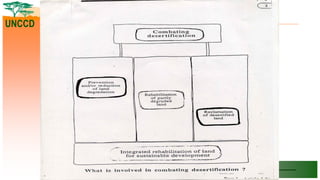
“Desertification" as land degradation in arid, semi-
arid and dry sub-humid areas resulting from
various factors, including climatic variations and
human activities;
Land degradation" as reduction or loss, of the
productivity and complexity of rain fed cropland,
irrigated cropland, or range, pasture, forest and
woodlands resulting from land uses or processes,
such as; soil erosion, deterioration of soil
properties and loss of natural vegetation.
SECRETARIAT OF THE CONVENTION TO COMBAT DESERTIFICATION
SECRETARIAT DE LA CONVENTION SUR LA LUTTE CONTRE LA DESERTIFICATION
UNCCD
SECRETARIAT OF THE CONVENTION TO COMBAT DESERTIFICATION
SECRETARIAT DE LA CONVENTION SUR LA LUTTE CONTRE LA DESERTIFICATION
UNCCD
Priority areas for UNCCD
implementation in Uganda
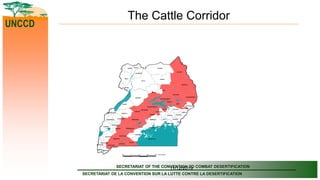
• The Cattle Corridor
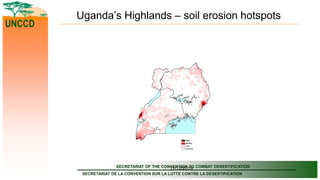
• The Eastern and South Western Highlands
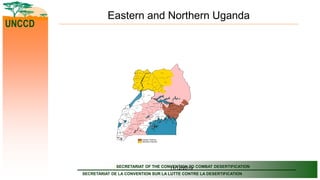
• Eastern and Northern Uganda
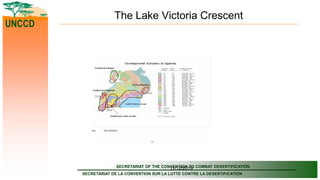
• The Lake Victoria Crescent Area
SECRETARIAT OF THE CONVENTION TO COMBAT DESERTIFICATION
SECRETARIAT DE LA CONVENTION SUR LA LUTTE CONTRE LA DESERTIFICATION
UNCCD
11/12/2019
The Cattle Corridor
GULU
KOTIDO
LIRA
MUKONO
KITGUM
APAC
MASINDI
PADER
ARUA
MOROTO
HOIMA
BUGIRI
RAKAI
KALANGALA
MPIGI
MUBENDE
KAMULI
KUMI
MASAKA
KATAKWI
MAYUGE
KIBOGA
KIBAALE
NEBBI
SOROTI
KASESE
BUSHENYI
NAKAPIRIPIRIT
KYENJOJO
WAKISO
YUMBE
IBANDA
NAKASEKE
IGANGA
MOYO
ADJUMANI
ISINGIRO
KIRUHURA
LUWERO
PALLISA
NAKASONGOLA
KABALE
TORORO
MBALE
KAMWENGE
SEMBABULE
MBARARA
NTUNGAMO
KAYUNGA
KABAROLE
BUNDIBUGYO
RUKUNGIRI
JINJA
KAPCHORWA
KANUNGU
BUSIA
SIRONKO
KABERAMAIDO
KISORO
KAMPALA
50 0 50 100 150 Kilo me ters
SECRETARIAT OF THE CONVENTION TO COMBAT DESERTIFICATION
SECRETARIAT DE LA CONVENTION SUR LA LUTTE CONTRE LA DESERTIFICATION
UNCCD
11/12/2019
Uganda’s Highlands – soil erosion hotspots
SECRETARIAT OF THE CONVENTION TO COMBAT DESERTIFICATION
SECRETARIAT DE LA CONVENTION SUR LA LUTTE CONTRE LA DESERTIFICATION
UNCCD
11/12/2019
Eastern and Northern Uganda
MUKONO
KITGUM
AMURU
PADER
LIRA
MASINDI
HOIMA
BUGIRI
APAC
RAKAI
KALANGALA
MPIGI
GULU
ARUA
MASAKA
KIBOGAKIBAALE
NEBBI
MUBENDE
KAMULI
KIRUHURA
KASESE
BUSHENYI
MAYUGE
KYENJOJO
OYAM
WAKISO
YUMBE
NAKASEKE
MOYO
ADJUMANI
ISINGIRO
BULIISA
LUWERO
NAKASONGOLA
KABALE
IGANGA
KAMWENGE
PALLISA
MBARARA
MITYANA
NTUNGAMO
KAYUNGA
SSEMBABULE
KABAROLE
BUNDIBUGYO
MARACHA
TORORO
JINJA
RUKUNGIRI
KANUNGU
IBANDA
BUSIA
SIRONKO
KALIRO
KISORO
KAPCHORWA
KOBOKO
MBALE
LYANTONDE
BUKWA
BUTALEJA
NAMUTUMBA MANAFWA
BUDAKA BUDUDA
KAMPALA
Eastern Districts
Northern Districts
SECRETARIAT OF THE CONVENTION TO COMBAT DESERTIFICATION
SECRETARIAT DE LA CONVENTION SUR LA LUTTE CONTRE LA DESERTIFICATION
UNCCD
11/12/2019
The Lake Victoria Crescent
SECRETARIAT OF THE CONVENTION TO COMBAT DESERTIFICATION
SECRETARIAT DE LA CONVENTION SUR LA LUTTE CONTRE LA DESERTIFICATION
UNCCD
Some of the practices leading to Land
Degradation in Uganda
• Inappropriate agricultural practices such as non-application
of soil and water conservation measures
• Cultivation along riverbanks leads to siltation and may lead
to floods.
• Overgrazing on rangelands leaving soil exposed to erosion.
• Indiscriminate felling of trees for wood fuel, construction
and other uses causes loss of vegetative cover and
windbreaks that protect the land from erosion.
• Inappropriate land use such as conversion of fragile lands
under forests, game reserves and wetlands to other uses
e.g. settlements and farmland.
• Uncontrolled burning of vegetation predisposing the soil to
erosion.
• Over-cultivation of land leading to depletion of soil fertility.
SECRETARIAT OF THE CONVENTION TO COMBAT DESERTIFICATION
SECRETARIAT DE LA CONVENTION SUR LA LUTTE CONTRE LA DESERTIFICATION
UNCCD
Obligations of Affected Country
Parties:
• Give due priority to combating desertification and allocate
adequate resources in accordance with their circumstances
and capabilities;
• Establish strategies and priorities to combat desertification
and mitigate the effects of drought;
• Address the underlying causes of desertification and the
socio- economic factors contributing to desertification
processes;
• Promote awareness and participation of local populations,
particularly women and youth, with the support of Non-
Governmental Organizations; and
• Strengthen existing legislation and enact new laws as well
as put in place policies and action programs.
SECRETARIAT OF THE CONVENTION TO COMBAT DESERTIFICATION
SECRETARIAT DE LA CONVENTION SUR LA LUTTE CONTRE LA DESERTIFICATION
UNCCD
Institutional Arrangements for UNCCD Implementation
International
• The Conference of the Parties
• UNCCD has a Global Secretariat in Bonn Germany
• Regional Coordination Units in Morroco
National
• National Focal point MAAIF
• Inter Ministerial National Steering Committee
• National NGO Coordinating Committee
• District Steering Committees
SECRETARIAT OF THE CONVENTION TO COMBAT DESERTIFICATION
SECRETARIAT DE LA CONVENTION SUR LA LUTTE CONTRE LA DESERTIFICATION
UNCCD
Measures to implement the UNCCD in
Uganda
• National Action Program to Combat Desertification 2000
• Road Map for NAP implementation and Resource
Mobilization
• Integrated Dryland Development Program
• Mainstreaming of the NAP into Development
Frameworks
• Integration of Drylands issues into District Environment
Action Plan and District Development Plans
• National Capacity Self Assessment (NCSA) of Multilateral
Environment Agreements
SECRETARIAT OF THE CONVENTION TO COMBAT DESERTIFICATION
SECRETARIAT DE LA CONVENTION SUR LA LUTTE CONTRE LA DESERTIFICATION
UNCCD
11/12/2019
SLM Strategic Investment Framework
• Formulation of the Uganda Sustainable
Land Management Strategic Investment
Framework (2010 – 2020)
• commissioned by the Government of
Uganda with direct support from key
TerrAfrica partners including NEPAD,
UNDP, FAO, UNCCD-GM, and the World
Bank and the GEF
SECRETARIAT OF THE CONVENTION TO COMBAT DESERTIFICATION
SECRETARIAT DE LA CONVENTION SUR LA LUTTE CONTRE LA DESERTIFICATION
UNCCD
The SIF SLM framework
• The U SIF SLM is an excellent tool that identified
hotspots, gaps and priorities for scaling up
sustainable land management and outlined clear
roles for key sectors and stakeholders to guide
and focus interventions which curtail land
degradation and its effects in various parts of the
country
• The Inter Ministerial framework has guided
investments in land management in Uganda
through 5 sectors , right from policy makers down
to the farmers who plan and utilise the land.
SECRETARIAT OF THE CONVENTION TO COMBAT DESERTIFICATION
SECRETARIAT DE LA CONVENTION SUR LA LUTTE CONTRE LA DESERTIFICATION
UNCCD
SLM Strategic Investment Framework
The framework has brought together five key
sectors that have a strong bearing on land
management - led by Ministry of Agriculture,
Animal Industry and Fisheries, Ministry of Lands,
Housing and Urban development, Ministry of
Water and Environment, Ministry of Trade,
Industry and Cooperatives and Ministry of Energy
and Mineral Development
SECRETARIAT OF THE CONVENTION TO COMBAT DESERTIFICATION
SECRETARIAT DE LA CONVENTION SUR LA LUTTE CONTRE LA DESERTIFICATION
UNCCD
11/12/2019
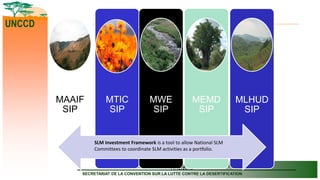
MTIC
SIP
MAAIF
SIP
MWE
SIP
MEMD
SIP
MLHUD
SIP
SLM Investment Framework is a tool to allow National SLM
Committees to coordinate SLM activities as a portfolio.
SECRETARIAT OF THE CONVENTION TO COMBAT DESERTIFICATION
SECRETARIAT DE LA CONVENTION SUR LA LUTTE CONTRE LA DESERTIFICATION
UNCCD
11/12/2019
Sector Roles and responsibilities
a. Energy Sector
• Sustainably managed biomass energy sources
(balanced and efficient utilization)
• Develop renewable energy (e.g. gasification for
homes and institutions)
• Improve efficiency in charcoal production & use
• Knowledge management and M&E
SECRETARIAT OF THE CONVENTION TO COMBAT DESERTIFICATION
SECRETARIAT DE LA CONVENTION SUR LA LUTTE CONTRE LA DESERTIFICATION
UNCCD
11/12/2019
Sector Roles and responsibilities (cont’d)
b. Agriculture Sector
• INM including inorganic and organic fertilizers, BNF, agro-
forestry, etc.
• Soil and water conservation
• CA (entailing minimum tillage, cover crops/green manures,
judicious crop rotations, etc)
• Water utilization components e.g. drinking structures, irrigation,
etc.
• Development of an early warning system
• Adaptation to climate change and variability e.g. drought
resistant/ early maturing crop varieties, etc.
• Validation of decision support tools/ crop models
• Knowledge management and M&E
• Policy harmonization & implementation (e.g. Land Use Policy)
SECRETARIAT OF THE CONVENTION TO COMBAT DESERTIFICATION
SECRETARIAT DE LA CONVENTION SUR LA LUTTE CONTRE LA DESERTIFICATION
UNCCD
11/12/2019
Sector Roles and responsibilities (cont’d)
c. Water and Environment Sector
– Adaptation and mitigation to impacts of climate change and
variability
– Establishment of early warning systems (short and medium
term weather and climate forecasts - drought, floods etc)
– Water harvesting/ water supply to pastoral communities
– Watershed management
– Afforestation, reforestation and agro-forestry
– Knowledge management and M&E
SECRETARIAT OF THE CONVENTION TO COMBAT DESERTIFICATION
SECRETARIAT DE LA CONVENTION SUR LA LUTTE CONTRE LA DESERTIFICATION
UNCCD
11/12/2019
Sector Roles and responsibilities (cont’d)
d. Lands Sector
– Development of land use plans
– Participatory land use planning (PLUP)
– Participatory watershed management plans
– Improved land administration
– Knowledge management and M&E
– Policy harmonization & implementation (e.g. Land
Use Policy)
SECRETARIAT OF THE CONVENTION TO COMBAT DESERTIFICATION
SECRETARIAT DE LA CONVENTION SUR LA LUTTE CONTRE LA DESERTIFICATION
UNCCD
11/12/2019
Sector Roles and responsibilities (cont’d)
e. Trade Sector
– Promotion of trade diversification through SLM
– Promotion of SLM friendly value chains
– Promotion of inter-ministerial cooperation on trade
development for agricultural and natural product
sectors
– Business skills development
– Information on markets and requirements
– Knowledge management and M&E
– Mainstreaming SLM into trade promotion and policy
making processes and related implementation plans.
SECRETARIAT OF THE CONVENTION TO COMBAT DESERTIFICATION
SECRETARIAT DE LA CONVENTION SUR LA LUTTE CONTRE LA DESERTIFICATION
UNCCD
Land Degradation Neutrality
• Land degradation neutrality (LDN)
“a state whereby the amount and quality of land
resources necessary to support ecosystem functions
and services and enhance food security remain stable
or increase within specified temporal and spatial
scales and ecosystems”.
• LDN achievement is monitored using land
based indicators
26
SECRETARIAT OF THE CONVENTION TO COMBAT DESERTIFICATION
SECRETARIAT DE LA CONVENTION SUR LA LUTTE CONTRE LA DESERTIFICATION
UNCCD
LDN land-based indicators
• SO1- improve the condition of ecosystems, combat
desertification/land degradation, promote SLM and
contribute to LDN
– Indicator SO1-1: Trends in land cover
– Indicator SO1-2: Trends in land productivity or functioning of
the land
– Indicator SO1-3: Trends in carbon stocks above and below
ground
– Sustainable Development Goal indicator 15.3.1: Proportion of
land that is degraded over total land area
SECRETARIAT OF THE CONVENTION TO COMBAT DESERTIFICATION
SECRETARIAT DE LA CONVENTION SUR LA LUTTE CONTRE LA DESERTIFICATION
UNCCD
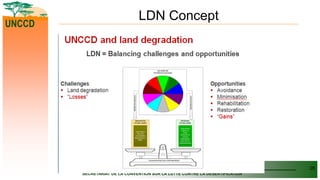
LDN Concept
28
SECRETARIAT OF THE CONVENTION TO COMBAT DESERTIFICATION
SECRETARIAT DE LA CONVENTION SUR LA LUTTE CONTRE LA DESERTIFICATION
UNCCD
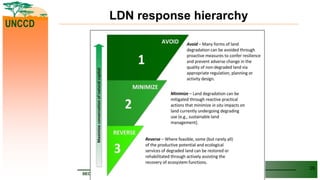
LDN response hierarchy
29
SECRETARIAT OF THE CONVENTION TO COMBAT DESERTIFICATION
SECRETARIAT DE LA CONVENTION SUR LA LUTTE CONTRE LA DESERTIFICATION
UNCCD
LDN Targets at the national scale
i. Land Degradation Neutral Uganda in 2030 compared to
baseline (or 2015) i.e. LDN achieved by 2030 as
compared to 2015 (no net loss)
ii. 21% tree/forest cover by 2030 (in line with Vision 2040 & NDC)
iii. 12 % wetland cover by 2030 (in line with Vision 2040 &
NDC)
iv. Areas of declining/stressed land productivity reduced by
50% by 2030
v. Level of SOC at county level by 2030 maintained or
improved compared to baseline
30
SECRETARIAT OF THE CONVENTION TO COMBAT DESERTIFICATION
SECRETARIAT DE LA CONVENTION SUR LA LUTTE CONTRE LA DESERTIFICATION
UNCCD
Challenges & constraints
– Inadequate funding of Natural Resources
management activities;
– Adoption of some SLM technologies require a lot of
money, making it unaffordable to many farmers
– Urgent need for the mechanisation
– High population growth rate and substantial young
population that wants to unsustainably utilize natural
resources
– Climate Change
– Inadequate capacity to monitor and assess land
degradation

UNCCD presentation

  • 1.
    THE UNITED NATIONSCONVENTION TO COMBAT DESERTIFICATION ITS IMPLICATIONS AND BENEFITS TO UGANDA RIO Multi-lateral Environment Agreements and National Frameworks in Uganda ON 8TH NOVEMBER 2019 By Stephen Muwaya UNCCD National Focal Point Ministry of Agriculture, Animal Industry and Fisheries
  • 2.
    SECRETARIAT OF THECONVENTION TO COMBAT DESERTIFICATION SECRETARIAT DE LA CONVENTION SUR LA LUTTE CONTRE LA DESERTIFICATION UNCCD Background Great sahelian drought and famine of 1968- 1974. United Nations Conference on Desertification held in Nairobi in 1977. African countries insisted on adequate attention for desertification at the 1992 Earth Summit.
  • 3.
    SECRETARIAT OF THECONVENTION TO COMBAT DESERTIFICATION SECRETARIAT DE LA CONVENTION SUR LA LUTTE CONTRE LA DESERTIFICATION UNCCD Background Inter-Governmental Negotiating Committee to prepare a legally binding agreement on Desertification by June 1994. The UNCCD was adopted on 17th June 1994. The convention entered into force on 26th December 1996.
  • 4.
    SECRETARIAT OF THECONVENTION TO COMBAT DESERTIFICATION SECRETARIAT DE LA CONVENTION SUR LA LUTTE CONTRE LA DESERTIFICATION UNCCD When did Uganda become a Party to the UNCCD? Dates of signature and ratification of the UNCCD by Uganda: Signed- 21st November 1994 Ratified 25th June 1997. To date, there are 191 Parties to the UNCCD.
  • 5.
    SECRETARIAT OF THECONVENTION TO COMBAT DESERTIFICATION SECRETARIAT DE LA CONVENTION SUR LA LUTTE CONTRE LA DESERTIFICATION UNCCD What are the objectives of the UNCCD? The objective of the UNCCD is to combat desertification and mitigate the effects of drought in countries experiencing serious drought and/or desertification, particularly in Africa, so as to achieve sustainable development.
  • 6.
    SECRETARIAT OF THECONVENTION TO COMBAT DESERTIFICATION SECRETARIAT DE LA CONVENTION SUR LA LUTTE CONTRE LA DESERTIFICATION UNCCD What exactly is Desertification? “Desertification" as land degradation in arid, semi- arid and dry sub-humid areas resulting from various factors, including climatic variations and human activities; Land degradation" as reduction or loss, of the productivity and complexity of rain fed cropland, irrigated cropland, or range, pasture, forest and woodlands resulting from land uses or processes, such as; soil erosion, deterioration of soil properties and loss of natural vegetation.
  • 7.
    SECRETARIAT OF THECONVENTION TO COMBAT DESERTIFICATION SECRETARIAT DE LA CONVENTION SUR LA LUTTE CONTRE LA DESERTIFICATION UNCCD
  • 8.
    SECRETARIAT OF THECONVENTION TO COMBAT DESERTIFICATION SECRETARIAT DE LA CONVENTION SUR LA LUTTE CONTRE LA DESERTIFICATION UNCCD Priority areas for UNCCD implementation in Uganda • The Cattle Corridor • The Eastern and South Western Highlands • Eastern and Northern Uganda • The Lake Victoria Crescent Area
  • 9.
    SECRETARIAT OF THECONVENTION TO COMBAT DESERTIFICATION SECRETARIAT DE LA CONVENTION SUR LA LUTTE CONTRE LA DESERTIFICATION UNCCD 11/12/2019 The Cattle Corridor GULU KOTIDO LIRA MUKONO KITGUM APAC MASINDI PADER ARUA MOROTO HOIMA BUGIRI RAKAI KALANGALA MPIGI MUBENDE KAMULI KUMI MASAKA KATAKWI MAYUGE KIBOGA KIBAALE NEBBI SOROTI KASESE BUSHENYI NAKAPIRIPIRIT KYENJOJO WAKISO YUMBE IBANDA NAKASEKE IGANGA MOYO ADJUMANI ISINGIRO KIRUHURA LUWERO PALLISA NAKASONGOLA KABALE TORORO MBALE KAMWENGE SEMBABULE MBARARA NTUNGAMO KAYUNGA KABAROLE BUNDIBUGYO RUKUNGIRI JINJA KAPCHORWA KANUNGU BUSIA SIRONKO KABERAMAIDO KISORO KAMPALA 50 0 50 100 150 Kilo me ters
  • 10.
    SECRETARIAT OF THECONVENTION TO COMBAT DESERTIFICATION SECRETARIAT DE LA CONVENTION SUR LA LUTTE CONTRE LA DESERTIFICATION UNCCD 11/12/2019 Uganda’s Highlands – soil erosion hotspots
  • 11.
    SECRETARIAT OF THECONVENTION TO COMBAT DESERTIFICATION SECRETARIAT DE LA CONVENTION SUR LA LUTTE CONTRE LA DESERTIFICATION UNCCD 11/12/2019 Eastern and Northern Uganda MUKONO KITGUM AMURU PADER LIRA MASINDI HOIMA BUGIRI APAC RAKAI KALANGALA MPIGI GULU ARUA MASAKA KIBOGAKIBAALE NEBBI MUBENDE KAMULI KIRUHURA KASESE BUSHENYI MAYUGE KYENJOJO OYAM WAKISO YUMBE NAKASEKE MOYO ADJUMANI ISINGIRO BULIISA LUWERO NAKASONGOLA KABALE IGANGA KAMWENGE PALLISA MBARARA MITYANA NTUNGAMO KAYUNGA SSEMBABULE KABAROLE BUNDIBUGYO MARACHA TORORO JINJA RUKUNGIRI KANUNGU IBANDA BUSIA SIRONKO KALIRO KISORO KAPCHORWA KOBOKO MBALE LYANTONDE BUKWA BUTALEJA NAMUTUMBA MANAFWA BUDAKA BUDUDA KAMPALA Eastern Districts Northern Districts
  • 12.
    SECRETARIAT OF THECONVENTION TO COMBAT DESERTIFICATION SECRETARIAT DE LA CONVENTION SUR LA LUTTE CONTRE LA DESERTIFICATION UNCCD 11/12/2019 The Lake Victoria Crescent
  • 13.
    SECRETARIAT OF THECONVENTION TO COMBAT DESERTIFICATION SECRETARIAT DE LA CONVENTION SUR LA LUTTE CONTRE LA DESERTIFICATION UNCCD Some of the practices leading to Land Degradation in Uganda • Inappropriate agricultural practices such as non-application of soil and water conservation measures • Cultivation along riverbanks leads to siltation and may lead to floods. • Overgrazing on rangelands leaving soil exposed to erosion. • Indiscriminate felling of trees for wood fuel, construction and other uses causes loss of vegetative cover and windbreaks that protect the land from erosion. • Inappropriate land use such as conversion of fragile lands under forests, game reserves and wetlands to other uses e.g. settlements and farmland. • Uncontrolled burning of vegetation predisposing the soil to erosion. • Over-cultivation of land leading to depletion of soil fertility.
  • 14.
    SECRETARIAT OF THECONVENTION TO COMBAT DESERTIFICATION SECRETARIAT DE LA CONVENTION SUR LA LUTTE CONTRE LA DESERTIFICATION UNCCD Obligations of Affected Country Parties: • Give due priority to combating desertification and allocate adequate resources in accordance with their circumstances and capabilities; • Establish strategies and priorities to combat desertification and mitigate the effects of drought; • Address the underlying causes of desertification and the socio- economic factors contributing to desertification processes; • Promote awareness and participation of local populations, particularly women and youth, with the support of Non- Governmental Organizations; and • Strengthen existing legislation and enact new laws as well as put in place policies and action programs.
  • 15.
    SECRETARIAT OF THECONVENTION TO COMBAT DESERTIFICATION SECRETARIAT DE LA CONVENTION SUR LA LUTTE CONTRE LA DESERTIFICATION UNCCD Institutional Arrangements for UNCCD Implementation International • The Conference of the Parties • UNCCD has a Global Secretariat in Bonn Germany • Regional Coordination Units in Morroco National • National Focal point MAAIF • Inter Ministerial National Steering Committee • National NGO Coordinating Committee • District Steering Committees
  • 16.
    SECRETARIAT OF THECONVENTION TO COMBAT DESERTIFICATION SECRETARIAT DE LA CONVENTION SUR LA LUTTE CONTRE LA DESERTIFICATION UNCCD Measures to implement the UNCCD in Uganda • National Action Program to Combat Desertification 2000 • Road Map for NAP implementation and Resource Mobilization • Integrated Dryland Development Program • Mainstreaming of the NAP into Development Frameworks • Integration of Drylands issues into District Environment Action Plan and District Development Plans • National Capacity Self Assessment (NCSA) of Multilateral Environment Agreements
  • 17.
    SECRETARIAT OF THECONVENTION TO COMBAT DESERTIFICATION SECRETARIAT DE LA CONVENTION SUR LA LUTTE CONTRE LA DESERTIFICATION UNCCD 11/12/2019 SLM Strategic Investment Framework • Formulation of the Uganda Sustainable Land Management Strategic Investment Framework (2010 – 2020) • commissioned by the Government of Uganda with direct support from key TerrAfrica partners including NEPAD, UNDP, FAO, UNCCD-GM, and the World Bank and the GEF
  • 18.
    SECRETARIAT OF THECONVENTION TO COMBAT DESERTIFICATION SECRETARIAT DE LA CONVENTION SUR LA LUTTE CONTRE LA DESERTIFICATION UNCCD The SIF SLM framework • The U SIF SLM is an excellent tool that identified hotspots, gaps and priorities for scaling up sustainable land management and outlined clear roles for key sectors and stakeholders to guide and focus interventions which curtail land degradation and its effects in various parts of the country • The Inter Ministerial framework has guided investments in land management in Uganda through 5 sectors , right from policy makers down to the farmers who plan and utilise the land.
  • 19.
    SECRETARIAT OF THECONVENTION TO COMBAT DESERTIFICATION SECRETARIAT DE LA CONVENTION SUR LA LUTTE CONTRE LA DESERTIFICATION UNCCD SLM Strategic Investment Framework The framework has brought together five key sectors that have a strong bearing on land management - led by Ministry of Agriculture, Animal Industry and Fisheries, Ministry of Lands, Housing and Urban development, Ministry of Water and Environment, Ministry of Trade, Industry and Cooperatives and Ministry of Energy and Mineral Development
  • 20.
    SECRETARIAT OF THECONVENTION TO COMBAT DESERTIFICATION SECRETARIAT DE LA CONVENTION SUR LA LUTTE CONTRE LA DESERTIFICATION UNCCD 11/12/2019 MTIC SIP MAAIF SIP MWE SIP MEMD SIP MLHUD SIP SLM Investment Framework is a tool to allow National SLM Committees to coordinate SLM activities as a portfolio.
  • 21.
    SECRETARIAT OF THECONVENTION TO COMBAT DESERTIFICATION SECRETARIAT DE LA CONVENTION SUR LA LUTTE CONTRE LA DESERTIFICATION UNCCD 11/12/2019 Sector Roles and responsibilities a. Energy Sector • Sustainably managed biomass energy sources (balanced and efficient utilization) • Develop renewable energy (e.g. gasification for homes and institutions) • Improve efficiency in charcoal production & use • Knowledge management and M&E
  • 22.
    SECRETARIAT OF THECONVENTION TO COMBAT DESERTIFICATION SECRETARIAT DE LA CONVENTION SUR LA LUTTE CONTRE LA DESERTIFICATION UNCCD 11/12/2019 Sector Roles and responsibilities (cont’d) b. Agriculture Sector • INM including inorganic and organic fertilizers, BNF, agro- forestry, etc. • Soil and water conservation • CA (entailing minimum tillage, cover crops/green manures, judicious crop rotations, etc) • Water utilization components e.g. drinking structures, irrigation, etc. • Development of an early warning system • Adaptation to climate change and variability e.g. drought resistant/ early maturing crop varieties, etc. • Validation of decision support tools/ crop models • Knowledge management and M&E • Policy harmonization & implementation (e.g. Land Use Policy)
  • 23.
    SECRETARIAT OF THECONVENTION TO COMBAT DESERTIFICATION SECRETARIAT DE LA CONVENTION SUR LA LUTTE CONTRE LA DESERTIFICATION UNCCD 11/12/2019 Sector Roles and responsibilities (cont’d) c. Water and Environment Sector – Adaptation and mitigation to impacts of climate change and variability – Establishment of early warning systems (short and medium term weather and climate forecasts - drought, floods etc) – Water harvesting/ water supply to pastoral communities – Watershed management – Afforestation, reforestation and agro-forestry – Knowledge management and M&E
  • 24.
    SECRETARIAT OF THECONVENTION TO COMBAT DESERTIFICATION SECRETARIAT DE LA CONVENTION SUR LA LUTTE CONTRE LA DESERTIFICATION UNCCD 11/12/2019 Sector Roles and responsibilities (cont’d) d. Lands Sector – Development of land use plans – Participatory land use planning (PLUP) – Participatory watershed management plans – Improved land administration – Knowledge management and M&E – Policy harmonization & implementation (e.g. Land Use Policy)
  • 25.
    SECRETARIAT OF THECONVENTION TO COMBAT DESERTIFICATION SECRETARIAT DE LA CONVENTION SUR LA LUTTE CONTRE LA DESERTIFICATION UNCCD 11/12/2019 Sector Roles and responsibilities (cont’d) e. Trade Sector – Promotion of trade diversification through SLM – Promotion of SLM friendly value chains – Promotion of inter-ministerial cooperation on trade development for agricultural and natural product sectors – Business skills development – Information on markets and requirements – Knowledge management and M&E – Mainstreaming SLM into trade promotion and policy making processes and related implementation plans.
  • 26.
    SECRETARIAT OF THECONVENTION TO COMBAT DESERTIFICATION SECRETARIAT DE LA CONVENTION SUR LA LUTTE CONTRE LA DESERTIFICATION UNCCD Land Degradation Neutrality • Land degradation neutrality (LDN) “a state whereby the amount and quality of land resources necessary to support ecosystem functions and services and enhance food security remain stable or increase within specified temporal and spatial scales and ecosystems”. • LDN achievement is monitored using land based indicators 26
  • 27.
    SECRETARIAT OF THECONVENTION TO COMBAT DESERTIFICATION SECRETARIAT DE LA CONVENTION SUR LA LUTTE CONTRE LA DESERTIFICATION UNCCD LDN land-based indicators • SO1- improve the condition of ecosystems, combat desertification/land degradation, promote SLM and contribute to LDN – Indicator SO1-1: Trends in land cover – Indicator SO1-2: Trends in land productivity or functioning of the land – Indicator SO1-3: Trends in carbon stocks above and below ground – Sustainable Development Goal indicator 15.3.1: Proportion of land that is degraded over total land area
  • 28.
    SECRETARIAT OF THECONVENTION TO COMBAT DESERTIFICATION SECRETARIAT DE LA CONVENTION SUR LA LUTTE CONTRE LA DESERTIFICATION UNCCD LDN Concept 28
  • 29.
    SECRETARIAT OF THECONVENTION TO COMBAT DESERTIFICATION SECRETARIAT DE LA CONVENTION SUR LA LUTTE CONTRE LA DESERTIFICATION UNCCD LDN response hierarchy 29
  • 30.
    SECRETARIAT OF THECONVENTION TO COMBAT DESERTIFICATION SECRETARIAT DE LA CONVENTION SUR LA LUTTE CONTRE LA DESERTIFICATION UNCCD LDN Targets at the national scale i. Land Degradation Neutral Uganda in 2030 compared to baseline (or 2015) i.e. LDN achieved by 2030 as compared to 2015 (no net loss) ii. 21% tree/forest cover by 2030 (in line with Vision 2040 & NDC) iii. 12 % wetland cover by 2030 (in line with Vision 2040 & NDC) iv. Areas of declining/stressed land productivity reduced by 50% by 2030 v. Level of SOC at county level by 2030 maintained or improved compared to baseline 30
  • 31.
    SECRETARIAT OF THECONVENTION TO COMBAT DESERTIFICATION SECRETARIAT DE LA CONVENTION SUR LA LUTTE CONTRE LA DESERTIFICATION UNCCD Challenges & constraints – Inadequate funding of Natural Resources management activities; – Adoption of some SLM technologies require a lot of money, making it unaffordable to many farmers – Urgent need for the mechanisation – High population growth rate and substantial young population that wants to unsustainably utilize natural resources – Climate Change – Inadequate capacity to monitor and assess land degradation