Climate Change & the Challenge
                                          of Poverty Alleviation
                                                               26 - 28 July, 2012

                                Centre for Climate Change and Environment Advisory
                                   DR. MCR HRD Institute Campus, Hyderabad


                                                                               26 July 2012
     Dr. N. Sai Bhaskar Reddy
  Chief Executive Officer [CEO],
GEOECOLOGY ENERGY ORGANISATION [GEO]
            http://e-geo.org
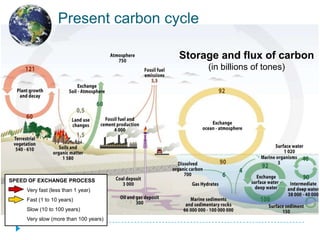
Present carbon cycle

                                       Storage and flux of carbon
                                            (in billions of tones)


SPEED OF EXCHANGE PROCESS
     Very fast (less than 1 year)
     Fast (1 to 10 years)
     Slow (10 to 100 years)
     Very slow (more than 100 years)
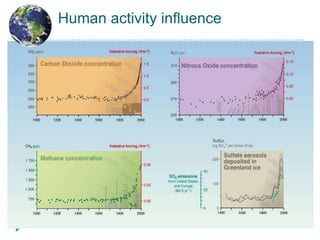
Human activity influence
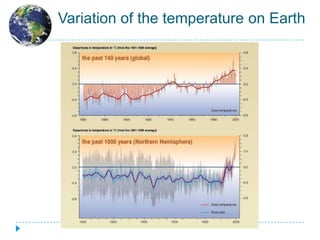
Variation of the temperature on Earth
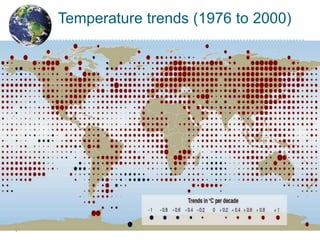
Temperature trends (1976 to 2000)
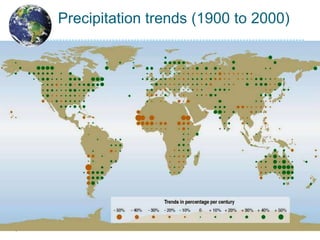
Precipitation trends (1900 to 2000)
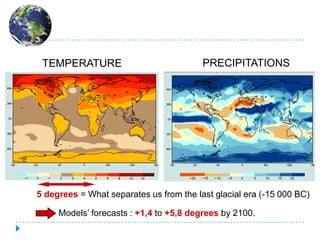
TEMPERATURE                                  PRECIPITATIONS


5 degrees = What separates us from the last glacial era (-15 000 BC)

     Models’Source : IPCC/SRESA2+1,4 to +5,8 degrees by 2100.
             forecasts :
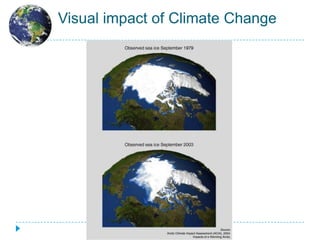
Visual impact of Climate Change
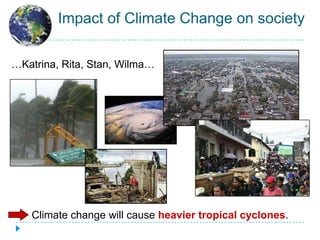
Impact of Climate Change on society

…Katrina, Rita, Stan, Wilma…


   Climate change will cause heavier tropical cyclones.
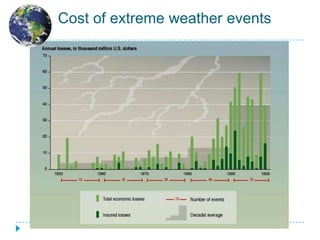
Cost of extreme weather events
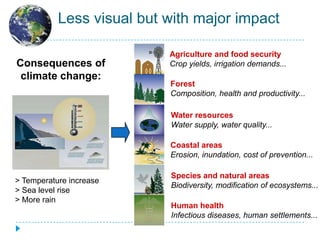
Less visual but with major impact

                           Agriculture and food security
Consequences of            Crop yields, irrigation demands...
 climate change:
                           Forest
                           Composition, health and productivity...

                           Water resources
                           Water supply, water quality...

                           Coastal areas
                           Erosion, inundation, cost of prevention...

                           Species and natural areas
> Temperature increase
                           Biodiversity, modification of ecosystems...
> Sea level rise
> More rain
                           Human health
                           Infectious diseases, human settlements...
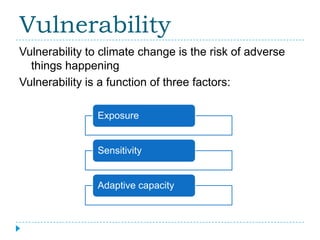
Vulnerability
Vulnerability to climate change is the risk of adverse
  things happening
Vulnerability is a function of three factors:

               Exposure


               Sensitivity


               Adaptive capacity
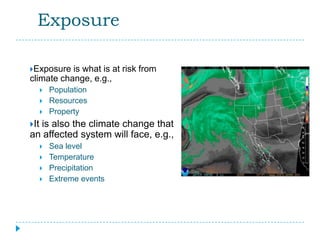
Exposure

Exposure  is what is at risk from
climate change, e.g.,
         Population
         Resources
         Property
It
  is also the climate change that
an affected system will face, e.g.,
         Sea level
         Temperature
         Precipitation
         Extreme events
Sensitivity
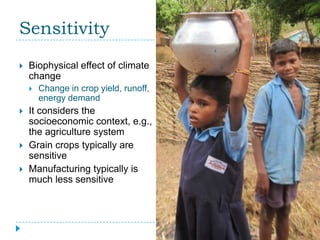
   Biophysical effect of climate
    change
       Change in crop yield, runoff,
        energy demand
   It considers the
    socioeconomic context, e.g.,
    the agriculture system
   Grain crops typically are
    sensitive
   Manufacturing typically is
    much less sensitive
Adaptive Capacity

   Capability to adapt
   Function of:
       Wealth
       Technology
       Education
       Institutions
       Information
       Infrastructure
       “Social capital”
   Having adaptive capacity
    does not mean it is used
    effectively
Vulnerability is a
Function of …

   More exposure and
    sensitivity increase
    vulnerability
   More adaptive
    capacity decreases
    vulnerability
   An assessment of
    vulnerability should
    consider all three
    factors
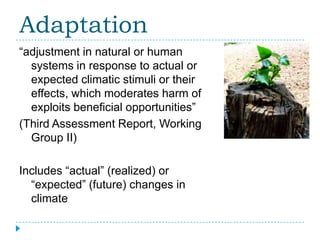
Adaptation
“adjustment in natural or human
  systems in response to actual or
  expected climatic stimuli or their
  effects, which moderates harm of
  exploits beneficial opportunities”
(Third Assessment Report, Working
  Group II)

Includes “actual” (realized) or
  “expected” (future) changes in
  climate
Adaptation                  (continued)

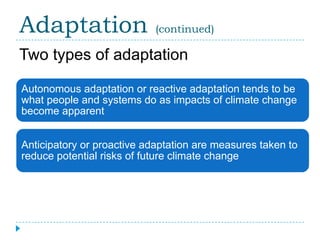
Two types of adaptation

Autonomous adaptation or reactive adaptation tends to be
what people and systems do as impacts of climate change
become apparent


Anticipatory or proactive adaptation are measures taken to
reduce potential risks of future climate change
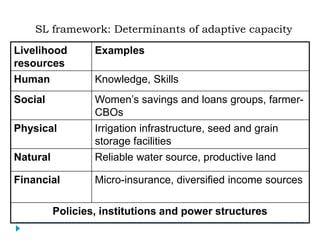
SL framework: Determinants of adaptive capacity
Livelihood        Examples
resources
Human             Knowledge, Skills
Social            Women’s savings and loans groups, farmer-
                  CBOs
Physical          Irrigation infrastructure, seed and grain
                  storage facilities
Natural           Reliable water source, productive land

Financial         Micro-insurance, diversified income sources

          Policies, institutions and power structures
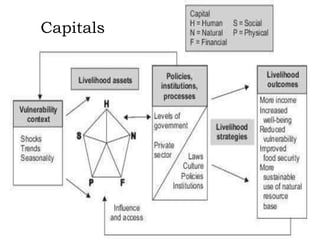
Capitals
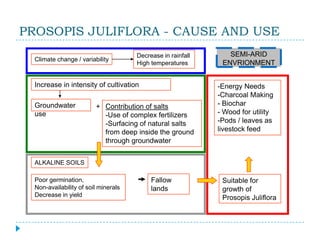
PROSOPIS JULIFLORA - CAUSE AND USE
                                      Decrease in rainfall      SEMI-ARID
  Climate change / variability
                                      High temperatures       ENVRIONMENT


  Increase in intensity of cultivation                       -Energy Needs
                                                             -Charcoal Making
  Groundwater            + Contribution of salts             - Biochar
  use                      -Use of complex fertilizers       - Wood for utility
                           -Surfacing of natural salts       -Pods / leaves as
                           from deep inside the ground       livestock feed
                           through groundwater


  ALKALINE SOILS

  Poor germination,                        Fallow             Suitable for
  Non-availability of soil minerals        lands              growth of
  Decrease in yield                                           Prosopis Juliflora
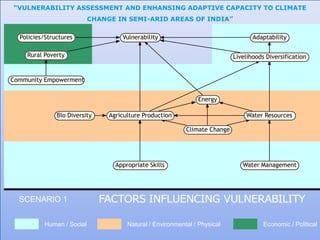
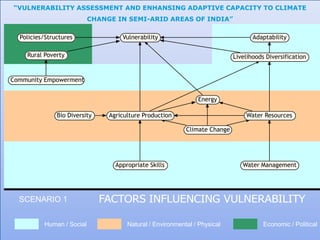
“VULNERABILITY ASSESSMENT AND ENHANSING ADAPTIVE CAPACITY TO CLIMATE
                           CHANGE IN SEMI-ARID AREAS OF INDIA”

  Policies/Structures               Vulnerability                                  Adaptability

    Rural Poverty                                                           Livelihoods Diversification


Community Empowerment


                                                               Energy

               Bio Diversity    Agriculture Production                          Water Resources

                                                           Climate Change


                                  Appropriate Skills                           Water Management


  SCENARIO 1


          Human / Social              Natural / Environmental / Physical               Economic / Political
    22                                                           AFPRO
Vulnerability assessment tools
   CC Vulnerability assessment tools
   Software / assessment tools
   Cristal
   Other tools
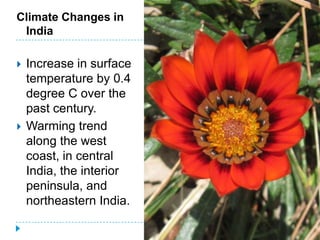
Climate Changes in
 India

   Increase in surface
    temperature by 0.4
    degree C over the
    past century.
   Warming trend
    along the west
    coast, in central
    India, the interior
    peninsula, and
    northeastern India.
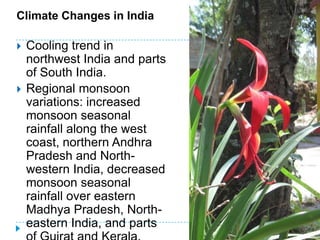
Climate Changes in India

   Cooling trend in
    northwest India and parts
    of South India.
   Regional monsoon
    variations: increased
    monsoon seasonal
    rainfall along the west
    coast, northern Andhra
    Pradesh and North-
    western India, decreased
    monsoon seasonal
    rainfall over eastern
    Madhya Pradesh, North-
    eastern India, and parts
Climate Changes in India

   Observed trends of multi-
    decadal periods of more
    frequent droughts, followed
    by less severe droughts.
   Studies have shown a rising
    trend in the frequency of
    heavy rain events and
    decrease in frequency of
    moderate events over central
    India from 1951 to 2000.

                                   26
Climate Changes in
 India

   Records of coastal
    tide gauges in the
    north Indian ocean for
    the last 40 years has
    revealed an
    estimated sea level
    rise between 1.06-
    1.75 mm per year.
   The available
    monitoring data on
    Himalayan glaciers
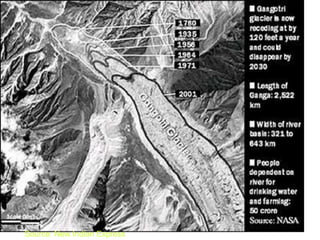
    indicates recession of
    some glaciers.           27
Per-capita Carbon –dioxide emission (Metric
Tons)
25

     20.01
20


15
                                      11.71
              9.4     9.87
10


5                              3.6                      4.25

                                               1.02
0
     USA     Europe   Japan   China   Russia   India    World
                                                       average
Impacts of Climate Changes

   Water resources
   Agriculture and food production
   Health
   Forests
   Coastal areas
   Vulnerability to extreme events
   Bioenergy
   Livelihoods
   Environment
   Economy
   Ecology
                                      29
National Action Plan for
 Climate Change (NAPCC)

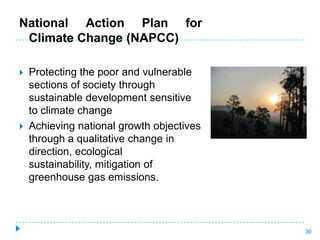
   Protecting the poor and vulnerable
    sections of society through
    sustainable development sensitive
    to climate change
   Achieving national growth objectives
    through a qualitative change in
    direction, ecological
    sustainability, mitigation of
    greenhouse gas emissions.


                                           30
National Action Plan for
 Climate Change (NAPCC)

   Efficient and cost effective strategies
    for end use Demand side
    Management.
   Technologies for adaptation and
    mitigation of greenhouse gases
    emissions.
   Promote sustainable development -
    Regulatory and voluntary
    mechanisms


                                              31
Core of NAPCC - National Missions

     National Solar Mission:The
      NAPCC aims to promote the
      development and use of solar
      energy for power generation and
      other uses with the ultimate
      objective of making solar
      competitive with fossil-based
      energy options.
     National Mission for Enhanced
      Energy Efficiency: Current
      initiatives are expected to yield
These National Missions are being institutionalized by the
respective Ministries/ Departments. 2012.
      savings of 10,000 MW by
Core of NAPCC - National Missions

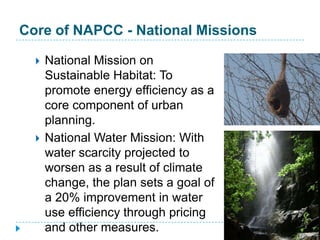
     National Mission on
      Sustainable Habitat: To
      promote energy efficiency as a
      core component of urban
      planning.
     National Water Mission: With
      water scarcity projected to
      worsen as a result of climate
      change, the plan sets a goal of
      a 20% improvement in water
      use efficiency through pricing
      and other measures.
Core of NAPCC - National Missions
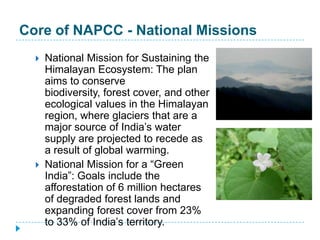
     National Mission for Sustaining the
      Himalayan Ecosystem: The plan
      aims to conserve
      biodiversity, forest cover, and other
      ecological values in the Himalayan
      region, where glaciers that are a
      major source of India’s water
      supply are projected to recede as
      a result of global warming.
     National Mission for a “Green
      India”: Goals include the
      afforestation of 6 million hectares
      of degraded forest lands and
      expanding forest cover from 23%
      to 33% of India’s territory.
Core of NAPCC - National Missions
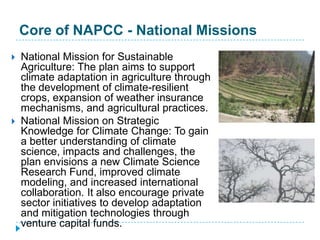
   National Mission for Sustainable
    Agriculture: The plan aims to support
    climate adaptation in agriculture through
    the development of climate-resilient
    crops, expansion of weather insurance
    mechanisms, and agricultural practices.
   National Mission on Strategic
    Knowledge for Climate Change: To gain
    a better understanding of climate
    science, impacts and challenges, the
    plan envisions a new Climate Science
    Research Fund, improved climate
    modeling, and increased international
    collaboration. It also encourage private
    sector initiatives to develop adaptation
    and mitigation technologies through
    venture capital funds.
Source: New Indian Express
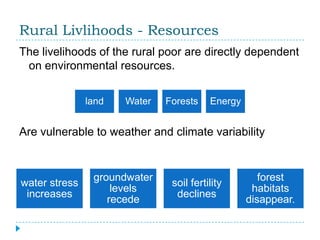
Rural Livlihoods - Resources
The livelihoods of the rural poor are directly dependent
 on environmental resources.


               land   Water   Forests    Energy


Are vulnerable to weather and climate variability


                groundwater                          forest
water stress                   soil fertility
                    levels                         habitats
 increases                      declines
                   recede                         disappear.
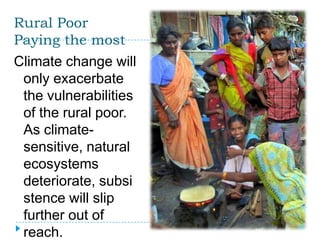
Rural Poor
Paying the most
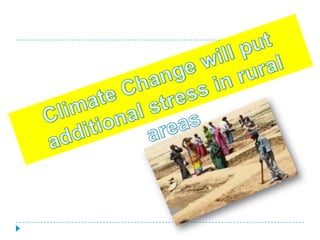
Climate change will
 only exacerbate
 the vulnerabilities
 of the rural poor.
 As climate-
 sensitive, natural
 ecosystems
 deteriorate, subsi
 stence will slip
 further out of
 reach.
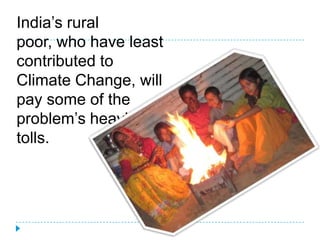
India’s rural
poor, who have least
contributed to
Climate Change, will
pay some of the
problem’s heaviest
tolls.
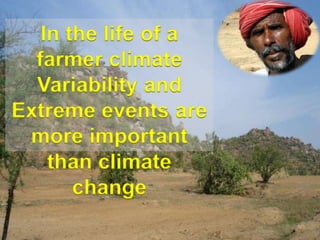
In the life of a
  farmer climate
  Variability and
Extreme events are
 more important
    than climate
       change
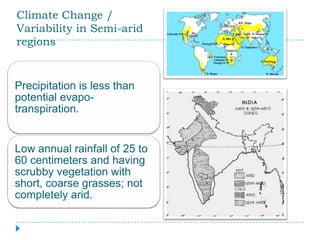
Climate Change /
Variability in Semi-arid
regions


Precipitation is less than
potential evapo-
transpiration.


Low annual rainfall of 25 to
60 centimeters and having
scrubby vegetation with
short, coarse grasses; not
completely arid.
Climate Change / Variability in Semi-arid
                      regions


Climate Variability and extremes are an expected
characteristic of semi-arid lands.


The people vulnerable to droughts, which trigger
frequent subsistence crises
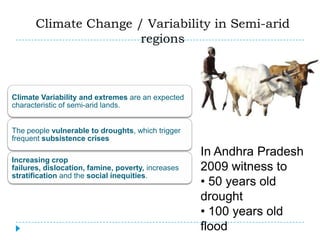
                                                    In Andhra Pradesh
Increasing crop
failures, dislocation, famine, poverty, increases   2009 witness to
stratification and the social inequities.
                                                    • 50 years old
                                                    drought
                                                    • 100 years old
                                                    flood
“VULNERABILITY ASSESSMENT AND ENHANSING ADAPTIVE CAPACITY TO CLIMATE
                           CHANGE IN SEMI-ARID AREAS OF INDIA”

  Policies/Structures               Vulnerability                                  Adaptability

    Rural Poverty                                                           Livelihoods Diversification


Community Empowerment


                                                               Energy

               Bio Diversity    Agriculture Production                          Water Resources

                                                           Climate Change


                                  Appropriate Skills                           Water Management


  SCENARIO 1


          Human / Social              Natural / Environmental / Physical               Economic / Political
    44                                                           AFPRO
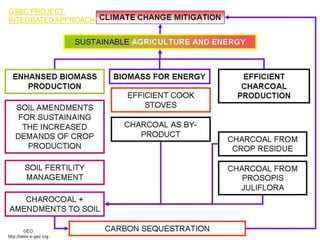
GSBC PROJECT
INTEGRATED APPROACH
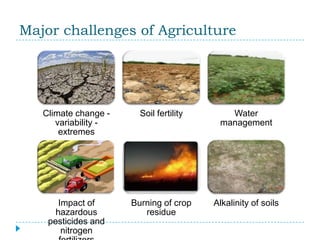
Major challenges of Agriculture


   Climate change -     Soil fertility      Water
      variability -                       management
       extremes


       Impact of      Burning of crop    Alkalinity of soils
      hazardous          residue
    pesticides and
        nitrogen
100
                                                        200
                                                              300
                                                                    400
                                                                          500
                                                                                600
                                                                                      700
                                                                                            800
                                                                                                  900
                                                                                                                1000
                                                                                                                                1100
                                                                                                                                       1200
                                                                                                                                              1300


                                              0
                                         195152
                                         195253
                                         195354
                                         195455
                                         195556
                                         195657
                                         195758
                                         195859
                                         195960
                                         196061
                                         196162
                                         196263
                                         196364
                                         196465
                                         196566
                                         196667
                                         196768
                                         196869
                                         196970
                                         197071
                                         197172
                                         197273
                                         197374
                                         197475
                                         197576
                                         197677
                                         197778
                                         197879
                                         197980
                                         198081
                                         198182
                                         198283
                                         198384
                                         198485
                                         198586
                                         198687
                                         198788
                                         198889
                                         198990
                                         199091
                                         199192
                                         199293
                                         199394
                                         199495
                                         199596
                                         199697
                                         199798
                                         199899
                                         199900
                                         200001
                                         200102
                                         200203
                                         200304
                                         200405
                                         200506
                                         200607
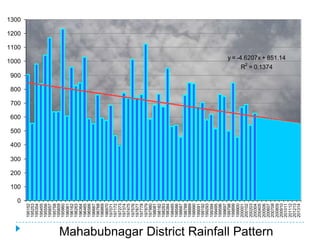
                                                                                                              R2 = 0.1374


Mahabubnagar District Rainfall Pattern


                                         200708
                                         200809
                                         200910
                                                                                                        y = -4.6207x + 851.14


                                         201011
                                         201112
                                         201213
                                         201314
Crop       Water


 Soil      Climate


Energy   Environment
Field level
interventions
                       ACTIVITY


                       CAPACITY
                     DEVELOPMENT


      FACILITATION                 RESEARCH
INCREAS
                                                                                                                ED
                                                                                                             PRODUC       SOIL
               SPIRITU                                                                         CARBON                   TEMPER
                 AL                                                                                            TION
                                                                                               SEQUES                    ATURE
                                                                                               TRATION                  REGULAT
                                                                                                                           ED
   CREMAT
                            BELIEFS
     ION
                                                                                    TERMITE                                        MOISTUR
                                                                                    S / ANTS                                          E
               CULTUR                                                               REPULSI                                        RETENTI
                 AL                                                                    ON                                            ON


    ALTARS                  RITUALS                      ENER
                                                          GY                    EARTHW
                                                                                                                                      WATER
                                                                                  ORMS                         SOIL
               FESTIVA                                                                                                                CONSER
                                                                                INCREAS                     AMENDMENT
                 LS                                                                                                                   VATION
                                                                                    E
                                                BIOC
                                                HAR
                                                                                                                                   NITROGE
                                                                                                                                      N/
                                                            BIOMASS                 BIOCHAR
                                                                                                                                   PHOSPH
                                                                                    COMPOS
                                                                                                                                    OROUS
                                                                                       T
                           FOOD                                                                                                    RETENTI
              INSECT                  PRESE                                                                                           ON
               REPEL                  RVING                                                      SOIL
                LENT                  FOOD                                                     MICROBE
                                                                                                  S                     NURSERI
    FILTERI                                                                                    DENSITY       PESTICID     ES
                                                CLEANI
      NG                                                                                       INCREAS         ES
                                                  NG
    MEDIA                                                                                         E          ADBSOR
                                                                                                              BTION
                                                                                   GOOD
                                                                                   STOVES
SOAK                                                   MEDICI                      • TLUDs
PITS                                                    NE                         • Other
                                                                                     stoves                              POULTRY
                                                                                                                          - CH4
                         PRACTICES                                                                                       REDUCTI
                                                                                                                            ON
BIOCH
  AR                                                   MATTR        WASTE          SOURCE
URINAL                                                  ESS         MANAGE             S           CROP
   S                                                                MENT           (BIOMAS        RESIDUE
                                                                    • Sludge          S)

    BIOCH                                        TOOTH                                                                   ANIMALS
      AR                                         POWD
    BRICKS                                         ER
              AQUAR                   AIR                                          POULTR                                              LIVESTOC
               IUM /                  QUALITY                                                                   FYM /                  K - URINE
                                                                                   Y LITTER
              TERRA       WATER       • CO2 /                                                                 COMPOST                     AND
              RIUMS       TREAT         CH4                                                                                              DUNG
                          MENT                  Dr. N. Sai Bhaskar Reddy, GEO
                                                http://e-geo.org | http://biocharculture.com
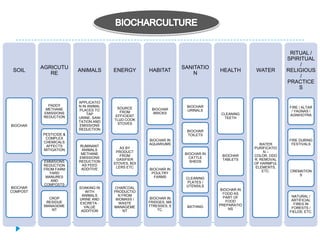
RITUAL /
                                                                                                           SPIRITUAL
                                                                                                               /
          AGRICUTU                                                SANITATIO
 SOIL                   ANIMALS       ENERGY        HABITAT                     HEALTH        WATER        RELIGIOUS
             RE                                                       N
                                                                                                               /
                                                                                                           PRACTICE
                                                                                                               S

                        APPLICATIO
            PADDY       N IN ANIMAL                                 BIOCHAR
                                        SOURCE                                                              FIRE / ALTAR
           METHANE      PLACES TO                    BIOCHAR        URINALS
                                         FROM                                                                / YAGNAS /
          EMISSIONS         TAP                       BRICKS                     CLEANING
                                       EFFICIENT                                                            AGNIHOTRA
          REDUCTION     URINE, SANI                                               TEETH
                                      TLUD COOK
                        TATION AND
                                        STOVES
BIOCHAR                 EMISSIONS
                        REDUCTION
                                                                    BIOCHAR
          PESTICIDE &                                               TOILETS
           COMPLEX
                                                    BIOCHAR IN                                             FIRE DURING
          CHEMICALS
                                                    AQUARIUMS                                   WATER       FESTIVALS
           AFFECTS      RUMINANT
                                         AS BY                                               PURIFICATIO
          MITIGATION     ANIMALS
                                       PRODUCT                                                    N–
                         METHANE                                   BIOCHAR IN
                                         FROM                                    BIOCHAR     COLOR, ODO
                        EMISSIONS                                    CATTLE
                                       GASIFIER                                  TABLETS     R, REMOVAL
          EMMISIONS     REDUCTION                                    SHEDS
                                      STOVES, BOI                                            OF HARMFUL
          REDUCTION      AS FEED
                                       LERS ETC                                              ELEMENTS,
          FROM FARM      ADDITIVE                   BIOCHAR IN
                                                                                                 ETC.       CREMATION
            YARD                                     POULTRY
                                                                                                                S
           MANURES                                    FARMS        CLEANING
             AND                                                    PLATES /
          COMPOSTS                                                 UTENSILS
BIOCHAR                 SOAKING IN    CHARCOAL
                                                                                BIOCHAR IN
COMPOST                    WITH       PRODUCTIO
                                                                                 FOOD AS
                         ANIMALS        N FROM                                                              NATURAL /
             CROP                                    BIOCHAR IN                   PART OF
                        URINE AND      BIOMASS /                                                            ARTIFICIAL
            RESIDUE                                 FRIDGES, MA                    FOOD
                        EXCRETA -       WASTE                                                                FIRES IN
           MANAGEME                                 TTRESSES, E     BATHING     PREPARATIO
                          VALUE       MANAGEME                                                              FORESTS /
              NT                                         TC.                        NS
                         ADDITION          NT                                                              FIELDS, ETC.
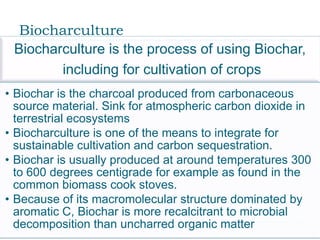
Biocharculture
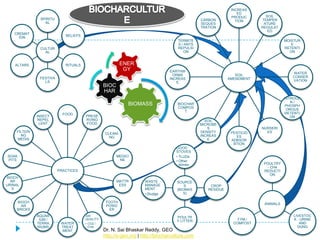
 Biocharculture is the process of using Biochar,
        including for cultivation of crops
• Biochar is the charcoal produced from carbonaceous
  source material. Sink for atmospheric carbon dioxide in
  terrestrial ecosystems
• Biocharculture is one of the means to integrate for
  sustainable cultivation and carbon sequestration.
• Biochar is usually produced at around temperatures 300
  to 600 degrees centigrade for example as found in the
  common biomass cook stoves.
• Because of its macromolecular structure dominated by
  aromatic C, Biochar is more recalcitrant to microbial
  decomposition than uncharred organic matter
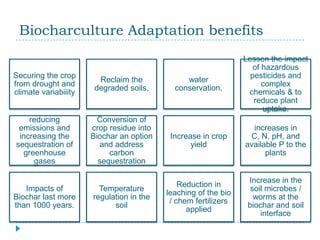
Biocharculture Adaptation benefits
                                                                Lessen the impact
                                                                   of hazardous
Securing the crop                                                 pesticides and
                        Reclaim the            water
from drought and                                                      complex
                       degraded soils,      conservation,
climate variabiiity                                              chemicals & to
                                                                   reduce plant
                                                                      uptake.
    reducing            Conversion of
 emissions and        crop residue into                           increases in
 increasing the       Biochar an option    Increase in crop      C, N, pH, and
sequestration of         and address             yield          available P to the
  greenhouse               carbon                                     plants
     gases              sequestration

                                                                 Increase in the
                                              Reduction in
   Impacts of           Temperature                               soil microbes /
                                          leaching of the bio
Biochar last more     regulation in the                            worms at the
                                           / chem fertilizers
than 1000 years.            soil                                 biochar and soil
                                                applied
                                                                     interface
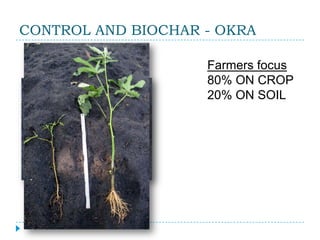
CONTROL AND BIOCHAR - OKRA

                    Farmers focus
                    80% ON CROP
                    20% ON SOIL
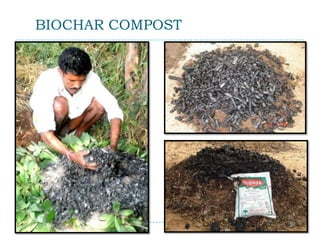
BIOCHAR COMPOST
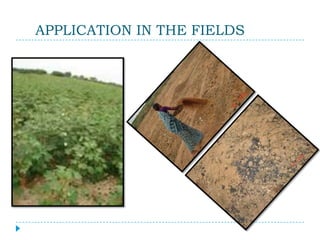
APPLICATION IN THE FIELDS
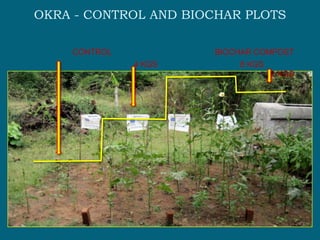
OKRA - CONTROL AND BIOCHAR PLOTS

    CONTROL           BIOCHAR COMPOST
              4 KGS       8 KGS
                                  12 KGS
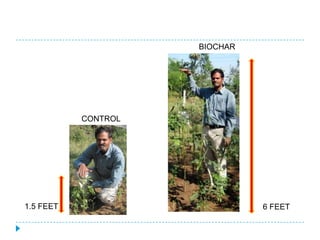
BIOCHAR


           CONTROL


1.5 FEET                       6 FEET
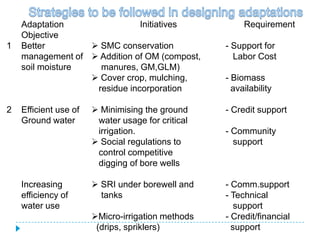
Adaptation                Initiatives               Requirement
    Objective
1   Better         SMC conservation               - Support for
    management of  Addition of OM (compost,         Labor Cost
    soil moisture   manures, GM,GLM)
                   Cover crop, mulching,          - Biomass
                   residue incorporation             availability

2   Efficient use of    Minimising the ground     - Credit support
    Ground water        water usage for critical
                        irrigation.                - Community
                        Social regulations to       support
                        control competitive
                        digging of bore wells

    Increasing          SRI under borewell and    - Comm.support
    efficiency of        tanks                     - Technical
    water use                                         support
                       Micro-irrigation methods   - Credit/financial
                        (drips, spriklers)           support
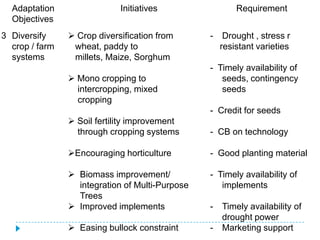
Adaptation                 Initiatives                 Requirement
  Objectives
3 Diversify      Crop diversification from      -    Drought , stress r
  crop / farm    wheat, paddy to                     resistant varieties
  systems        millets, Maize, Sorghum
                                                 - Timely availability of
                 Mono cropping to                  seeds, contingency
                  intercropping, mixed              seeds
                  cropping
                                                 - Credit for seeds
                 Soil fertility improvement
                  through cropping systems       - CB on technology

                Encouraging horticulture        - Good planting material

                 Biomass improvement/           - Timely availability of
                  integration of Multi-Purpose      implements
                  Trees
                 Improved implements            -   Timely availability of
                                                     drought power
                 Easing bullock constraint      -   Marketing support
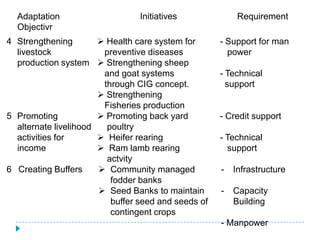
Adaptation                     Initiatives              Requirement
  Objectivr
4 Strengthening         Health care system for      - Support for man
  livestock             preventive diseases            power
  production system  Strengthening sheep
                        and goat systems             - Technical
                        through CIG concept.           support
                        Strengthening
                        Fisheries production
5 Promoting             Promoting back yard         - Credit support
  alternate livelihood   poultry
  activities for        Heifer rearing              - Technical
  income                Ram lamb rearing              support
                         actvity
6 Creating Buffers      Community managed           -   Infrastructure
                          fodder banks
                        Seed Banks to maintain      -   Capacity
                          buffer seed and seeds of       Building
                          contingent crops
                                                     - Manpower
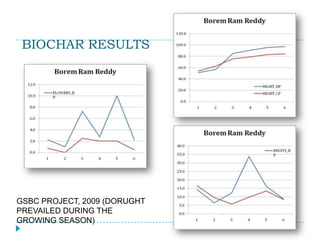
BIOCHAR RESULTS


GSBC PROJECT, 2009 (DORUGHT
PREVAILED DURING THE
GROWING SEASON)
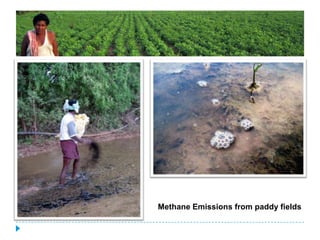
Methane Emissions from paddy fields
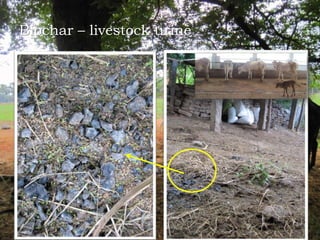
Biochar – livestock urine
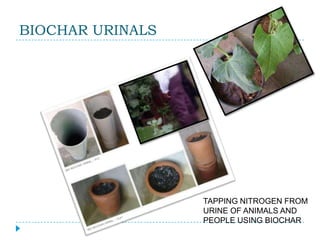
BIOCHAR URINALS


                  TAPPING NITROGEN FROM
                  URINE OF ANIMALS AND
                  PEOPLE USING BIOCHAR
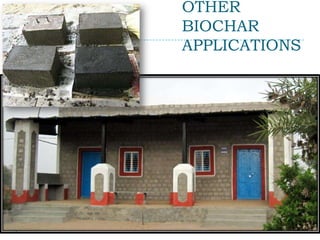
OTHER
     BIOCHAR
     APPLICATIONS


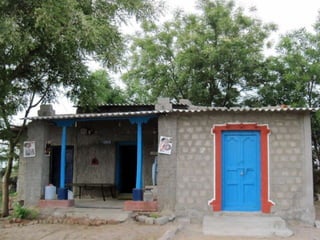
BIOCHAR BRICKS, GREEN BUILDINGS
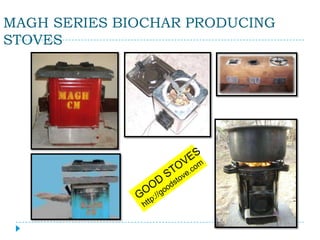
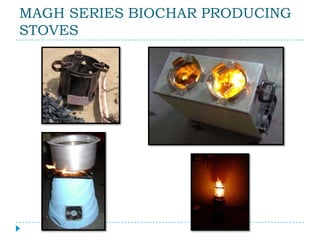
MAGH SERIES BIOCHAR PRODUCING
STOVES
MAGH SERIES BIOCHAR PRODUCING
STOVES
BIOCHAR INDIA | BIOCHARCULTURE | GOOD STOVE | GEO | GOODPLANET
BIOCHAR LINKS
Terra Preta Info - Indian conext   Biochar Urine
Biochar Experiments                Biochar Urinals
Biochar - Alkaline soils
Biochar - Alkaline soils report    Biochar Soil life
Charcoal production                Termites
                                   Earthworms
Biochar Production
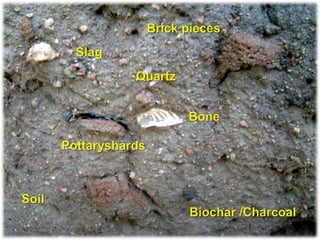
Magh Biochar Retort               Pottery Shards
GEO mini metal kiln                In soils
ARTI - Charcoal
                                   Cleaning
Biochar Plants                     Biochar for Cleaning
Prosopis Juliflora
Prosopis Juliflora report          Green Buildings
                                   Biochar Bricks
Stoves
Magh series tlud woodgas or        Rural Trash
microgasifier stoves               Biochar plus
Anila
                                   GSBC PROJECT ON CNN
Vulnerability and Impact Assessment   climate change

Vulnerability and Impact Assessment climate change

  • 1.
    Climate Change &the Challenge of Poverty Alleviation 26 - 28 July, 2012 Centre for Climate Change and Environment Advisory DR. MCR HRD Institute Campus, Hyderabad 26 July 2012 Dr. N. Sai Bhaskar Reddy Chief Executive Officer [CEO], GEOECOLOGY ENERGY ORGANISATION [GEO] http://e-geo.org
  • 2.
    Present carbon cycle Storage and flux of carbon (in billions of tones) SPEED OF EXCHANGE PROCESS Very fast (less than 1 year) Fast (1 to 10 years) Slow (10 to 100 years) Very slow (more than 100 years)
  • 3.
  • 4.
    Variation of thetemperature on Earth
  • 5.
  • 6.
  • 7.
    TEMPERATURE PRECIPITATIONS 5 degrees = What separates us from the last glacial era (-15 000 BC) Models’Source : IPCC/SRESA2+1,4 to +5,8 degrees by 2100. forecasts :
  • 8.
    Visual impact ofClimate Change
  • 9.
    Impact of ClimateChange on society …Katrina, Rita, Stan, Wilma… Climate change will cause heavier tropical cyclones.
  • 10.
    Cost of extremeweather events
  • 11.
    Less visual butwith major impact Agriculture and food security Consequences of Crop yields, irrigation demands... climate change: Forest Composition, health and productivity... Water resources Water supply, water quality... Coastal areas Erosion, inundation, cost of prevention... Species and natural areas > Temperature increase Biodiversity, modification of ecosystems... > Sea level rise > More rain Human health Infectious diseases, human settlements...
  • 12.
    Vulnerability Vulnerability to climatechange is the risk of adverse things happening Vulnerability is a function of three factors: Exposure Sensitivity Adaptive capacity
  • 13.
    Exposure Exposure iswhat is at risk from climate change, e.g.,  Population  Resources  Property It is also the climate change that an affected system will face, e.g.,  Sea level  Temperature  Precipitation  Extreme events
  • 14.
    Sensitivity  Biophysical effect of climate change  Change in crop yield, runoff, energy demand  It considers the socioeconomic context, e.g., the agriculture system  Grain crops typically are sensitive  Manufacturing typically is much less sensitive
  • 15.
    Adaptive Capacity  Capability to adapt  Function of:  Wealth  Technology  Education  Institutions  Information  Infrastructure  “Social capital”  Having adaptive capacity does not mean it is used effectively
  • 16.
    Vulnerability is a Functionof …  More exposure and sensitivity increase vulnerability  More adaptive capacity decreases vulnerability  An assessment of vulnerability should consider all three factors
  • 17.
    Adaptation “adjustment in naturalor human systems in response to actual or expected climatic stimuli or their effects, which moderates harm of exploits beneficial opportunities” (Third Assessment Report, Working Group II) Includes “actual” (realized) or “expected” (future) changes in climate
  • 18.
    Adaptation (continued) Two types of adaptation Autonomous adaptation or reactive adaptation tends to be what people and systems do as impacts of climate change become apparent Anticipatory or proactive adaptation are measures taken to reduce potential risks of future climate change
  • 19.
    SL framework: Determinantsof adaptive capacity Livelihood Examples resources Human Knowledge, Skills Social Women’s savings and loans groups, farmer- CBOs Physical Irrigation infrastructure, seed and grain storage facilities Natural Reliable water source, productive land Financial Micro-insurance, diversified income sources Policies, institutions and power structures
  • 20.
  • 21.
    PROSOPIS JULIFLORA -CAUSE AND USE Decrease in rainfall SEMI-ARID Climate change / variability High temperatures ENVRIONMENT Increase in intensity of cultivation -Energy Needs -Charcoal Making Groundwater + Contribution of salts - Biochar use -Use of complex fertilizers - Wood for utility -Surfacing of natural salts -Pods / leaves as from deep inside the ground livestock feed through groundwater ALKALINE SOILS Poor germination, Fallow Suitable for Non-availability of soil minerals lands growth of Decrease in yield Prosopis Juliflora
  • 22.
    “VULNERABILITY ASSESSMENT ANDENHANSING ADAPTIVE CAPACITY TO CLIMATE CHANGE IN SEMI-ARID AREAS OF INDIA” Policies/Structures Vulnerability Adaptability Rural Poverty Livelihoods Diversification Community Empowerment Energy Bio Diversity Agriculture Production Water Resources Climate Change Appropriate Skills Water Management SCENARIO 1 Human / Social Natural / Environmental / Physical Economic / Political 22 AFPRO
  • 23.
    Vulnerability assessment tools  CC Vulnerability assessment tools  Software / assessment tools  Cristal  Other tools
  • 24.
    Climate Changes in India  Increase in surface temperature by 0.4 degree C over the past century.  Warming trend along the west coast, in central India, the interior peninsula, and northeastern India.
  • 25.
    Climate Changes inIndia  Cooling trend in northwest India and parts of South India.  Regional monsoon variations: increased monsoon seasonal rainfall along the west coast, northern Andhra Pradesh and North- western India, decreased monsoon seasonal rainfall over eastern Madhya Pradesh, North- eastern India, and parts
  • 26.
    Climate Changes inIndia  Observed trends of multi- decadal periods of more frequent droughts, followed by less severe droughts.  Studies have shown a rising trend in the frequency of heavy rain events and decrease in frequency of moderate events over central India from 1951 to 2000. 26
  • 27.
    Climate Changes in India  Records of coastal tide gauges in the north Indian ocean for the last 40 years has revealed an estimated sea level rise between 1.06- 1.75 mm per year.  The available monitoring data on Himalayan glaciers indicates recession of some glaciers. 27
  • 28.
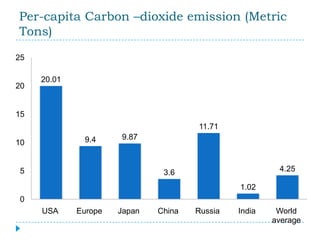
    Per-capita Carbon –dioxideemission (Metric Tons) 25 20.01 20 15 11.71 9.4 9.87 10 5 3.6 4.25 1.02 0 USA Europe Japan China Russia India World average
  • 29.
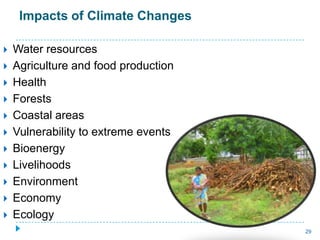
    Impacts of ClimateChanges  Water resources  Agriculture and food production  Health  Forests  Coastal areas  Vulnerability to extreme events  Bioenergy  Livelihoods  Environment  Economy  Ecology 29
  • 30.
    National Action Planfor Climate Change (NAPCC)  Protecting the poor and vulnerable sections of society through sustainable development sensitive to climate change  Achieving national growth objectives through a qualitative change in direction, ecological sustainability, mitigation of greenhouse gas emissions. 30
  • 31.
    National Action Planfor Climate Change (NAPCC)  Efficient and cost effective strategies for end use Demand side Management.  Technologies for adaptation and mitigation of greenhouse gases emissions.  Promote sustainable development - Regulatory and voluntary mechanisms 31
  • 32.
    Core of NAPCC- National Missions  National Solar Mission:The NAPCC aims to promote the development and use of solar energy for power generation and other uses with the ultimate objective of making solar competitive with fossil-based energy options.  National Mission for Enhanced Energy Efficiency: Current initiatives are expected to yield These National Missions are being institutionalized by the respective Ministries/ Departments. 2012. savings of 10,000 MW by
  • 33.
    Core of NAPCC- National Missions  National Mission on Sustainable Habitat: To promote energy efficiency as a core component of urban planning.  National Water Mission: With water scarcity projected to worsen as a result of climate change, the plan sets a goal of a 20% improvement in water use efficiency through pricing and other measures.
  • 34.
    Core of NAPCC- National Missions  National Mission for Sustaining the Himalayan Ecosystem: The plan aims to conserve biodiversity, forest cover, and other ecological values in the Himalayan region, where glaciers that are a major source of India’s water supply are projected to recede as a result of global warming.  National Mission for a “Green India”: Goals include the afforestation of 6 million hectares of degraded forest lands and expanding forest cover from 23% to 33% of India’s territory.
  • 35.
    Core of NAPCC- National Missions  National Mission for Sustainable Agriculture: The plan aims to support climate adaptation in agriculture through the development of climate-resilient crops, expansion of weather insurance mechanisms, and agricultural practices.  National Mission on Strategic Knowledge for Climate Change: To gain a better understanding of climate science, impacts and challenges, the plan envisions a new Climate Science Research Fund, improved climate modeling, and increased international collaboration. It also encourage private sector initiatives to develop adaptation and mitigation technologies through venture capital funds.
  • 36.
  • 38.
    Rural Livlihoods -Resources The livelihoods of the rural poor are directly dependent on environmental resources. land Water Forests Energy Are vulnerable to weather and climate variability groundwater forest water stress soil fertility levels habitats increases declines recede disappear.
  • 39.
    Rural Poor Paying themost Climate change will only exacerbate the vulnerabilities of the rural poor. As climate- sensitive, natural ecosystems deteriorate, subsi stence will slip further out of reach.
  • 40.
    India’s rural poor, whohave least contributed to Climate Change, will pay some of the problem’s heaviest tolls.
  • 41.
    In the lifeof a farmer climate Variability and Extreme events are more important than climate change
  • 42.
    Climate Change / Variabilityin Semi-arid regions Precipitation is less than potential evapo- transpiration. Low annual rainfall of 25 to 60 centimeters and having scrubby vegetation with short, coarse grasses; not completely arid.
  • 43.
    Climate Change /Variability in Semi-arid regions Climate Variability and extremes are an expected characteristic of semi-arid lands. The people vulnerable to droughts, which trigger frequent subsistence crises In Andhra Pradesh Increasing crop failures, dislocation, famine, poverty, increases 2009 witness to stratification and the social inequities. • 50 years old drought • 100 years old flood
  • 44.
    “VULNERABILITY ASSESSMENT ANDENHANSING ADAPTIVE CAPACITY TO CLIMATE CHANGE IN SEMI-ARID AREAS OF INDIA” Policies/Structures Vulnerability Adaptability Rural Poverty Livelihoods Diversification Community Empowerment Energy Bio Diversity Agriculture Production Water Resources Climate Change Appropriate Skills Water Management SCENARIO 1 Human / Social Natural / Environmental / Physical Economic / Political 44 AFPRO
  • 45.
  • 46.
    Major challenges ofAgriculture Climate change - Soil fertility Water variability - management extremes Impact of Burning of crop Alkalinity of soils hazardous residue pesticides and nitrogen
  • 47.
    100 200 300 400 500 600 700 800 900 1000 1100 1200 1300 0 195152 195253 195354 195455 195556 195657 195758 195859 195960 196061 196162 196263 196364 196465 196566 196667 196768 196869 196970 197071 197172 197273 197374 197475 197576 197677 197778 197879 197980 198081 198182 198283 198384 198485 198586 198687 198788 198889 198990 199091 199192 199293 199394 199495 199596 199697 199798 199899 199900 200001 200102 200203 200304 200405 200506 200607 R2 = 0.1374 Mahabubnagar District Rainfall Pattern 200708 200809 200910 y = -4.6207x + 851.14 201011 201112 201213 201314
  • 48.
    Crop Water Soil Climate Energy Environment
  • 49.
    Field level interventions ACTIVITY CAPACITY DEVELOPMENT FACILITATION RESEARCH
  • 50.
    INCREAS ED PRODUC SOIL SPIRITU CARBON TEMPER AL TION SEQUES ATURE TRATION REGULAT ED CREMAT BELIEFS ION TERMITE MOISTUR S / ANTS E CULTUR REPULSI RETENTI AL ON ON ALTARS RITUALS ENER GY EARTHW WATER ORMS SOIL FESTIVA CONSER INCREAS AMENDMENT LS VATION E BIOC HAR NITROGE N/ BIOMASS BIOCHAR PHOSPH COMPOS OROUS T FOOD RETENTI INSECT PRESE ON REPEL RVING SOIL LENT FOOD MICROBE S NURSERI FILTERI DENSITY PESTICID ES CLEANI NG INCREAS ES NG MEDIA E ADBSOR BTION GOOD STOVES SOAK MEDICI • TLUDs PITS NE • Other stoves POULTRY - CH4 PRACTICES REDUCTI ON BIOCH AR MATTR WASTE SOURCE URINAL ESS MANAGE S CROP S MENT (BIOMAS RESIDUE • Sludge S) BIOCH TOOTH ANIMALS AR POWD BRICKS ER AQUAR AIR POULTR LIVESTOC IUM / QUALITY FYM / K - URINE Y LITTER TERRA WATER • CO2 / COMPOST AND RIUMS TREAT CH4 DUNG MENT Dr. N. Sai Bhaskar Reddy, GEO http://e-geo.org | http://biocharculture.com
  • 51.
    RITUAL / SPIRITUAL / AGRICUTU SANITATIO SOIL ANIMALS ENERGY HABITAT HEALTH WATER RELIGIOUS RE N / PRACTICE S APPLICATIO PADDY N IN ANIMAL BIOCHAR SOURCE FIRE / ALTAR METHANE PLACES TO BIOCHAR URINALS FROM / YAGNAS / EMISSIONS TAP BRICKS CLEANING EFFICIENT AGNIHOTRA REDUCTION URINE, SANI TEETH TLUD COOK TATION AND STOVES BIOCHAR EMISSIONS REDUCTION BIOCHAR PESTICIDE & TOILETS COMPLEX BIOCHAR IN FIRE DURING CHEMICALS AQUARIUMS WATER FESTIVALS AFFECTS RUMINANT AS BY PURIFICATIO MITIGATION ANIMALS PRODUCT N– METHANE BIOCHAR IN FROM BIOCHAR COLOR, ODO EMISSIONS CATTLE GASIFIER TABLETS R, REMOVAL EMMISIONS REDUCTION SHEDS STOVES, BOI OF HARMFUL REDUCTION AS FEED LERS ETC ELEMENTS, FROM FARM ADDITIVE BIOCHAR IN ETC. CREMATION YARD POULTRY S MANURES FARMS CLEANING AND PLATES / COMPOSTS UTENSILS BIOCHAR SOAKING IN CHARCOAL BIOCHAR IN COMPOST WITH PRODUCTIO FOOD AS ANIMALS N FROM NATURAL / CROP BIOCHAR IN PART OF URINE AND BIOMASS / ARTIFICIAL RESIDUE FRIDGES, MA FOOD EXCRETA - WASTE FIRES IN MANAGEME TTRESSES, E BATHING PREPARATIO VALUE MANAGEME FORESTS / NT TC. NS ADDITION NT FIELDS, ETC.
  • 52.
    Biocharculture Biocharculture isthe process of using Biochar, including for cultivation of crops • Biochar is the charcoal produced from carbonaceous source material. Sink for atmospheric carbon dioxide in terrestrial ecosystems • Biocharculture is one of the means to integrate for sustainable cultivation and carbon sequestration. • Biochar is usually produced at around temperatures 300 to 600 degrees centigrade for example as found in the common biomass cook stoves. • Because of its macromolecular structure dominated by aromatic C, Biochar is more recalcitrant to microbial decomposition than uncharred organic matter
  • 53.
    Biocharculture Adaptation benefits Lessen the impact of hazardous Securing the crop pesticides and Reclaim the water from drought and complex degraded soils, conservation, climate variabiiity chemicals & to reduce plant uptake. reducing Conversion of emissions and crop residue into increases in increasing the Biochar an option Increase in crop C, N, pH, and sequestration of and address yield available P to the greenhouse carbon plants gases sequestration Increase in the Reduction in Impacts of Temperature soil microbes / leaching of the bio Biochar last more regulation in the worms at the / chem fertilizers than 1000 years. soil biochar and soil applied interface
  • 54.
    CONTROL AND BIOCHAR- OKRA Farmers focus 80% ON CROP 20% ON SOIL
  • 55.
  • 56.
  • 57.
    OKRA - CONTROLAND BIOCHAR PLOTS CONTROL BIOCHAR COMPOST 4 KGS 8 KGS 12 KGS
  • 58.
    BIOCHAR CONTROL 1.5 FEET 6 FEET
  • 59.
    Adaptation Initiatives Requirement Objective 1 Better  SMC conservation - Support for management of  Addition of OM (compost, Labor Cost soil moisture manures, GM,GLM)  Cover crop, mulching, - Biomass residue incorporation availability 2 Efficient use of  Minimising the ground - Credit support Ground water water usage for critical irrigation. - Community  Social regulations to support control competitive digging of bore wells Increasing  SRI under borewell and - Comm.support efficiency of tanks - Technical water use support Micro-irrigation methods - Credit/financial (drips, spriklers) support
  • 60.
    Adaptation Initiatives Requirement Objectives 3 Diversify  Crop diversification from - Drought , stress r crop / farm wheat, paddy to resistant varieties systems millets, Maize, Sorghum - Timely availability of  Mono cropping to seeds, contingency intercropping, mixed seeds cropping - Credit for seeds  Soil fertility improvement through cropping systems - CB on technology Encouraging horticulture - Good planting material  Biomass improvement/ - Timely availability of integration of Multi-Purpose implements Trees  Improved implements - Timely availability of drought power  Easing bullock constraint - Marketing support
  • 61.
    Adaptation Initiatives Requirement Objectivr 4 Strengthening  Health care system for - Support for man livestock preventive diseases power production system  Strengthening sheep and goat systems - Technical through CIG concept. support  Strengthening Fisheries production 5 Promoting  Promoting back yard - Credit support alternate livelihood poultry activities for  Heifer rearing - Technical income  Ram lamb rearing support actvity 6 Creating Buffers  Community managed - Infrastructure fodder banks  Seed Banks to maintain - Capacity buffer seed and seeds of Building contingent crops - Manpower
  • 62.
    BIOCHAR RESULTS GSBC PROJECT,2009 (DORUGHT PREVAILED DURING THE GROWING SEASON)
  • 63.
  • 64.
  • 65.
    BIOCHAR URINALS TAPPING NITROGEN FROM URINE OF ANIMALS AND PEOPLE USING BIOCHAR
  • 66.
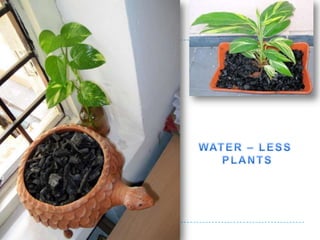
    OTHER BIOCHAR APPLICATIONS BIOCHAR BRICKS, GREEN BUILDINGS
  • 70.
    MAGH SERIES BIOCHARPRODUCING STOVES
  • 71.
    MAGH SERIES BIOCHARPRODUCING STOVES
  • 74.
    BIOCHAR INDIA |BIOCHARCULTURE | GOOD STOVE | GEO | GOODPLANET BIOCHAR LINKS Terra Preta Info - Indian conext Biochar Urine Biochar Experiments Biochar Urinals Biochar - Alkaline soils Biochar - Alkaline soils report Biochar Soil life Charcoal production Termites Earthworms Biochar Production Magh Biochar Retort  Pottery Shards GEO mini metal kiln In soils ARTI - Charcoal Cleaning Biochar Plants Biochar for Cleaning Prosopis Juliflora Prosopis Juliflora report Green Buildings Biochar Bricks Stoves Magh series tlud woodgas or Rural Trash microgasifier stoves Biochar plus Anila GSBC PROJECT ON CNN

Editor's Notes

  • #53 Biochar is a part of the solution for cotton crop sustainable cultivation, there is a need to create large scale awareness among the farmers to continue traditional best practices of Biochar application and also adopt appropriate best technologies for improving the fertility of the soils and their sustainability.