CLASSROOM
MANAGEMENT
Concept of Classroom Management
By Maria Nasir
Needs of Classroom Management
By Sarah Ehsan
Principles of Classroom Management
By Farwa Iqbal
Components of Classroom Management
By Maryam Tariq
Effective Classroom Management
By Aniqa Amir
Concept of Classroom Norms
By Misbah Dil Muhammad
CONCEPT OF CLASSROOM
MANAGEMENT
BY MARIA NASIR
WHAT IS CLASSROOM MANAGEMENT?
• “The actions taken by the teachers to create and maintain a
learning environment conducive for successful instruction”.
By Evertson & Weinstein
• Classroom management maintains order in the classroom.
• It creates both the best situation in which the students can
learn and the teacher can teach.
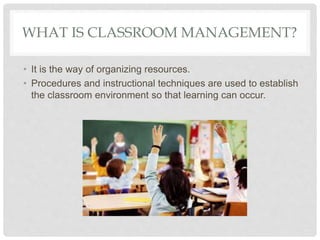
WHAT IS CLASSROOM MANAGEMENT?
• It is the way of organizing resources.
• Procedures and instructional techniques are used to establish
the classroom environment so that learning can occur.
NEED OF CLASSROOM
MANAGEMENT
BY SARAH EHSAN
NEEDS OF CLASSROOM MANAGEMENT
• A well-defined classroom management plan should create a
set of rules that students can apply and that create an
environment of mutual respect and learning.
• It includes routines, rules and consequences.
• Effective classroom management paves the way for the
teacher to engage the students in learning.
NEEDS
• There are some needs which are important for classroom
management.
• Good seating arrangement.
• Provide complete learning material.
• Classroom should be airy, ventilated and clean.
• Teachers should be cooperative.
• Students should be active in all classroom activities.
• Teachers have to monitor their activities.
• Use visual aids like; graphs, charts, pictures etc.
WHY WE NEED THESE NEEDS?
• We need these needs to create a good and learning
environment.
• To maintain discipline.
• To reduce behavioral problems.
• To develop confidence in students.
• To teach them how to interact with society.
• To make them a good citizen.
• Use computer based programs to enhance their cognitive
skills.
PRINCIPLES OF CLASSROOM
MANAGEMENT
BY FARWA IQBAL
PRINCIPLES OF CLASSROOM
MANAGEMENT
• Willingness of the teacher to accept responsibility.
• Make a good first impression (both for teacher and student).
• Building a good relationship with students.
• Get down to students level when working with them.
• Address them about the problems in their behavior.
• Demonstrate well and listen actively while students are
speaking.
• Make your lesson relevant and interesting.
PRINCIPLES
• Involve parents and guardians.
• Focusing. Be sure you have the attention of everyone in your
classroom before you start your lesson.
• Long term, solution-oriented approaches to problems (rather
than short term).
• Provide extensive, frequent and specific feedback.
COMPONENTS OF
CLASSROOM MANAGEMENT
BY MARYAM TARIQ
COMPONENTS OF CLASSROOM
MANAGEMENT
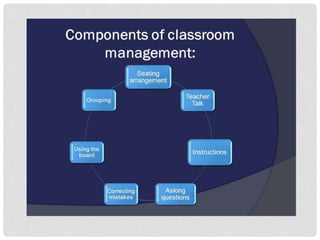
• Proper use of Time
• The efficient use of time is an important variable in helping
students achieve learning goals and making the classroom
a pleasant place for teachers and students.
• Setting up the classroom
• Deciding what type of seating arrangement you want. It
depends upon the type of furniture you have.
• Taking Attendance
• Taking attendance is a responsibility. Attendance should be
done as soon as students are settled in class.
COMPONENTS
• Cleanliness
• Cleanliness is the main component of classroom
management.
• A clean and tidy classroom looks more effective.
• Body Language
• Body language is another component of classroom
management.
• As we communicate more with our body than our words.
• Social Skills
• Social skills are also important for classroom management
and for students. These skills help students to
communicate effectively with society.
EFFECTIVE CLASSROOM
MANAGEMENT
BY ANIQA AMIR
EFFECTIVE CLASSROOM MANAGEMENT
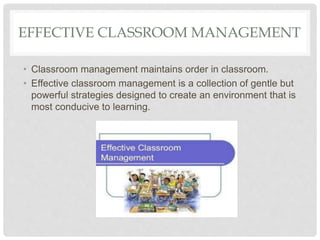
• Classroom management maintains order in classroom.
• Effective classroom management is a collection of gentle but
powerful strategies designed to create an environment that is
most conducive to learning.
HOW CAN WE MAKE OUR CLASSROOM
EFFECTIVE?
• Effective classroom always begin with establishing proper
rapport/ interaction.
• This interaction establishes a positive relationship with the
class and teacher.
• Effective classroom management paves the way for the
teacher to engage the students in learning.
• Decisions have to be made with the good of the students in
mind.
SOME STRATEGIES USED TO MAKE
EFFECTIVE CLASSROOM
• Teachers need to create an environment that promotes
learning.
• Make sure students are deeply involved with their work.
• The climate of classroom is work oriented, but relaxed and
pleasant.
• Create a learning environment that encourages social
interaction.
• Monitors the activities.
• Gives students non-verbal cues.
• Communication should be effective.
• Rules and procedures should be aligned with teaching
strategies.
CONCEPT OF CLASSROOM
NORMS
BY MISBAH DIL MUHAMMAD
WHAT ARE CLASSROOM NORMS?
• Classroom norms are the behavioral expectations and rules of
the class.
• Classroom norms inform us how we are expected to behave
towards each other.
• It also helps to insure that students indeed understand the
classroom community’s expectations and provides the
rationale for them to monitor and change their own behaviors.
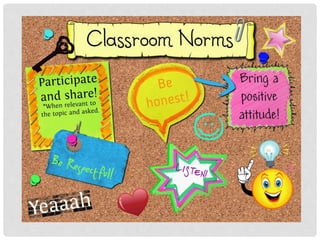
CLASSROOM NORMS
• Some components of classroom norms are;
• Be honest.
• Listen when other speaking.
• Do not disturb others.
• Follow directions.
• Wait for your turn.
• Work and play safely
• Work together for common goal.
• Strong relationship between teacher and student.
• Active participation in classroom activities.
Classroom management

Classroom management

  • 1.
  • 2.
    Concept of ClassroomManagement By Maria Nasir Needs of Classroom Management By Sarah Ehsan Principles of Classroom Management By Farwa Iqbal Components of Classroom Management By Maryam Tariq Effective Classroom Management By Aniqa Amir Concept of Classroom Norms By Misbah Dil Muhammad
  • 3.
  • 5.
    WHAT IS CLASSROOMMANAGEMENT? • “The actions taken by the teachers to create and maintain a learning environment conducive for successful instruction”. By Evertson & Weinstein • Classroom management maintains order in the classroom. • It creates both the best situation in which the students can learn and the teacher can teach.
  • 6.
    WHAT IS CLASSROOMMANAGEMENT? • It is the way of organizing resources. • Procedures and instructional techniques are used to establish the classroom environment so that learning can occur.
  • 7.
  • 8.
    NEEDS OF CLASSROOMMANAGEMENT • A well-defined classroom management plan should create a set of rules that students can apply and that create an environment of mutual respect and learning. • It includes routines, rules and consequences. • Effective classroom management paves the way for the teacher to engage the students in learning.
  • 9.
    NEEDS • There aresome needs which are important for classroom management. • Good seating arrangement. • Provide complete learning material. • Classroom should be airy, ventilated and clean. • Teachers should be cooperative. • Students should be active in all classroom activities. • Teachers have to monitor their activities. • Use visual aids like; graphs, charts, pictures etc.
  • 10.
    WHY WE NEEDTHESE NEEDS? • We need these needs to create a good and learning environment. • To maintain discipline. • To reduce behavioral problems. • To develop confidence in students. • To teach them how to interact with society. • To make them a good citizen. • Use computer based programs to enhance their cognitive skills.
  • 11.
  • 13.
    PRINCIPLES OF CLASSROOM MANAGEMENT •Willingness of the teacher to accept responsibility. • Make a good first impression (both for teacher and student). • Building a good relationship with students. • Get down to students level when working with them. • Address them about the problems in their behavior. • Demonstrate well and listen actively while students are speaking. • Make your lesson relevant and interesting.
  • 14.
    PRINCIPLES • Involve parentsand guardians. • Focusing. Be sure you have the attention of everyone in your classroom before you start your lesson. • Long term, solution-oriented approaches to problems (rather than short term). • Provide extensive, frequent and specific feedback.
  • 15.
  • 16.
    COMPONENTS OF CLASSROOM MANAGEMENT •Proper use of Time • The efficient use of time is an important variable in helping students achieve learning goals and making the classroom a pleasant place for teachers and students. • Setting up the classroom • Deciding what type of seating arrangement you want. It depends upon the type of furniture you have. • Taking Attendance • Taking attendance is a responsibility. Attendance should be done as soon as students are settled in class.
  • 17.
    COMPONENTS • Cleanliness • Cleanlinessis the main component of classroom management. • A clean and tidy classroom looks more effective. • Body Language • Body language is another component of classroom management. • As we communicate more with our body than our words. • Social Skills • Social skills are also important for classroom management and for students. These skills help students to communicate effectively with society.
  • 19.
  • 20.
    EFFECTIVE CLASSROOM MANAGEMENT •Classroom management maintains order in classroom. • Effective classroom management is a collection of gentle but powerful strategies designed to create an environment that is most conducive to learning.
  • 21.
    HOW CAN WEMAKE OUR CLASSROOM EFFECTIVE? • Effective classroom always begin with establishing proper rapport/ interaction. • This interaction establishes a positive relationship with the class and teacher. • Effective classroom management paves the way for the teacher to engage the students in learning. • Decisions have to be made with the good of the students in mind.
  • 22.
    SOME STRATEGIES USEDTO MAKE EFFECTIVE CLASSROOM • Teachers need to create an environment that promotes learning. • Make sure students are deeply involved with their work. • The climate of classroom is work oriented, but relaxed and pleasant. • Create a learning environment that encourages social interaction. • Monitors the activities. • Gives students non-verbal cues. • Communication should be effective. • Rules and procedures should be aligned with teaching strategies.
  • 23.
    CONCEPT OF CLASSROOM NORMS BYMISBAH DIL MUHAMMAD
  • 24.
    WHAT ARE CLASSROOMNORMS? • Classroom norms are the behavioral expectations and rules of the class. • Classroom norms inform us how we are expected to behave towards each other. • It also helps to insure that students indeed understand the classroom community’s expectations and provides the rationale for them to monitor and change their own behaviors.
  • 25.
    CLASSROOM NORMS • Somecomponents of classroom norms are; • Be honest. • Listen when other speaking. • Do not disturb others. • Follow directions. • Wait for your turn. • Work and play safely • Work together for common goal. • Strong relationship between teacher and student. • Active participation in classroom activities.