
ObjectivesThe session will enable participants to:
define classroom management
explain classroom dynamics
outline characteristics of a good classroom
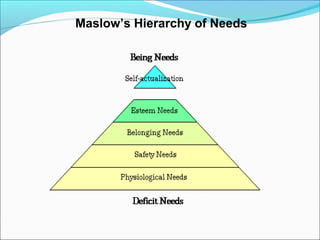
apply Maslow’s hierarchy of needs in identifying
disruptive behaviors.
describe behavior modification
write a lay out of behavior modification plan to
classroom rules
Management
Effective utilization and coordination of
resources
The guidance and control of action
required to execute a program. Also, the
individuals charged with the
responsibility of conducting a program.
What is Classroom Management
The management of student behavior and learning
activities by teachers.
Procedures and instructional techniques that are
used to establish the classroom environments so
that learning can occur.
So:
Classroom management refers to all of the things that a
teacher does to organize students, space, time, and
materials so that maximum learning can take place
with minimum distractions
Importance of Classroom Management
classroom management is the most important factor
governing student learning. Three authors reviewed 50 years
of research on student learning, encompassing 11,000
statistical findings. They discovered 28 factors that help
students learn;
and classroom management was the number one.
Characteristics of A Well-Managed
Classroom
 Students are deeply involved with their work, especially
with academic, teacher-led instruction.
 Students know what is expected of them and are
generally successful.
 There is relatively little wasted time, confusion, or
disruption.
 The climate of the classroom is work-oriented but
relaxed and pleasant.
Cont…
Students are seated so that their attention is directed
toward the teacher.
Students are able to clearly see chalkboards, screens,
presentations and displays.
Students are motivated.
Teacher and students are aiming for the same
direction.
High traffic areas should be free of congestion.
Students are seated so that teachers can see any
students ant times. It is important that all students are
within the view of the teacher at all times.
Managing Learning focusing on:
Physical Environment
Human Behavior
Time
Resources (Lesson planning)
What to Manage in the class
Managing physical environmentEffective use of space
(not congested, neat, easiness in approach )
Light
(Proper, quality, quantity, direction, )
Temperature
(Normal, fans, heaters)
Furniture
(Not broken, managed, repaired)
Noise
Managing physical environment
Equipments
(Availability, working, prepared,)
Moving passage
(No hurdle, open, access to all class)
Teaching material
(Prepared, readable, planned, )
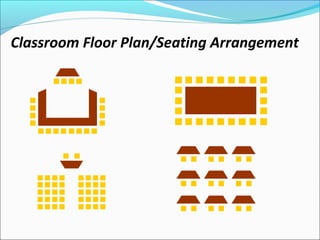
Seating plan
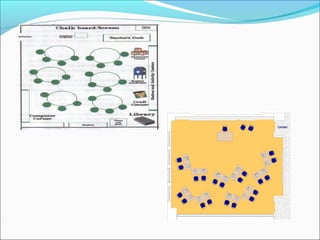
(Flexible and according to the needs)
Classroom Floor Plan/Seating Arrangement
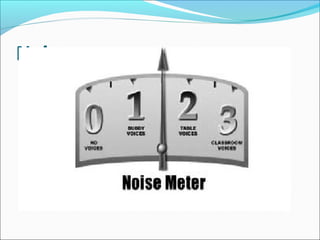
Noise
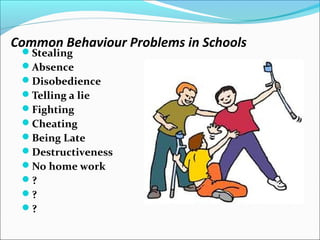
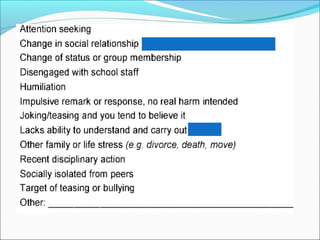
Common Behaviour Problems in Schools
Stealing
Absence
Disobedience
Telling a lie
Fighting
Cheating
Being Late
Destructiveness
No home work
?
?
?
Maslow’s Hierarchy of Needs
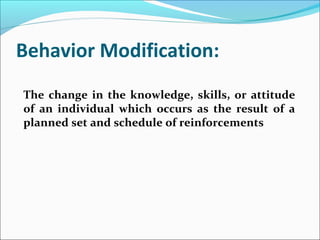
Behavior Modification:
The change in the knowledge, skills, or attitude
of an individual which occurs as the result of a
planned set and schedule of reinforcements
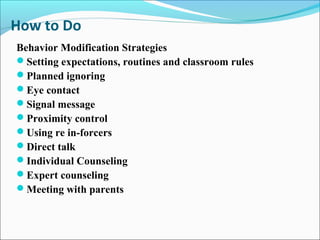
How to Do
Behavior Modification Strategies
Setting expectations, routines and classroom rules
Planned ignoring
Eye contact
Signal message
Proximity control
Using re in-forcers
Direct talk
Individual Counseling
Expert counseling
Meeting with parents
Characteristics of Classroom RulesPositively stated
Concise
Workable and realistic
with consensus
according to the class level
short in number
display in written form in the class
must be reminded
Examples of Bad Rules
Be responsible
Be a good citizen
Pay attention
Be ready to learn
Demonstrate respect for others
Examples of Good Rules
We shall:
 Turn in completed assignments on time.
 Bring paper, pencil, and books to class.
 Sit in our seat unless we have permission to leave
it.
 Obey our teachers.
 Raise our hand and wait for permission to speak.
 Work when we are supposed to.
 not hurt others.
 Walk, don't run, when ever needed, in the
classroom.
 Keep hands, feet, and objects to our self.
Motivation
It is not a bribe! Use it:
Line Leader ................................Hamza Asadullah
Caller ........................................Taha Yaqub
Boards ........................................Noman Munir
Equipment ................................Khalid Saleem
Floors ........................................Tariq Ejaz
Sharing ResponsibilitiesSharing Responsibilities
Motivational Tools
Certificates
Positive comments
Communicating home
Special rewards
Special tasks
Whole class rewards
Honor Board
Skip a homework assignment
Two bonus points on next test
Structuring Classroom Space For Disruptive Students
Disruptive students should be placed in the front of the
classroom near the teacher, but not separated from rest of
class.
Two disruptive students should not be allowed to sit next to
each other.
Disruptive students need more frequent reinforcement than
other students. Having them close to the teacher makes this
possible.
If there are a group of difficult students, have the most
difficult one sit close to the teacher and spread the others
out. Place appropriate students next to disruptive students.
Students should have only relevant materials on their desk.
Do not place easily distracted students near the window or
other location where distraction is likely.
CLASSROOM MANAGEMENT
C --- Clarify the tasks and instructions.
L --- “Learning” is the thing for which all the stage is set.
A --- Arrange the seats according to the activities.
S --- Smile, smile and keep smiling, your smile makes them smile.
S --- Socialization is key to proper behavior.
R ---Respect and recognize the feelings of your students.
O --- Organize material and human resources properly.
O --- Organize the time because you can’t get it again.
M --- Make rules and share responsibilities.
M --- Management is about Planning, Organizing, Directing and Controlling, this is all
you have to do in your classroom.
A --- Ask questions frequently during your lecture, it makes your teaching effective.
N --- Negotiate to the problem child separately, don’t scold him in front of whole class.
A --- Appreciate your students on every task completion.
G --- Generate new ideas yourself and accept ideas from your students as well.
E --- Establish standards of good behavior.
M --- Misbehaviors should not occur frequently, if this happens, something is wrong
with your teaching style.
E --- Engage every student through mysteries, riddles, jokes and puzzles.
N --- Not the punishment but the reward can win the hearts.
T --- Think before you leave.
Final words1. Leave your all negative thinking at the
doorstep of class
2. Have a genuine interest in your students.
3. Communicate classroom rules clearly.
4. Practice Rules
5. Show that you are human.
6. Minimize the power differential in everyday
communication.
7. Address problem behavior directly and
immediately.
8. Adopt a collaborative approach.
Classroom management

Classroom management

  • 3.
    ObjectivesThe session willenable participants to: define classroom management explain classroom dynamics outline characteristics of a good classroom apply Maslow’s hierarchy of needs in identifying disruptive behaviors. describe behavior modification write a lay out of behavior modification plan to classroom rules
  • 4.
    Management Effective utilization andcoordination of resources The guidance and control of action required to execute a program. Also, the individuals charged with the responsibility of conducting a program.
  • 5.
    What is ClassroomManagement The management of student behavior and learning activities by teachers. Procedures and instructional techniques that are used to establish the classroom environments so that learning can occur.
  • 6.
    So: Classroom management refersto all of the things that a teacher does to organize students, space, time, and materials so that maximum learning can take place with minimum distractions
  • 7.
    Importance of ClassroomManagement classroom management is the most important factor governing student learning. Three authors reviewed 50 years of research on student learning, encompassing 11,000 statistical findings. They discovered 28 factors that help students learn; and classroom management was the number one.
  • 8.
    Characteristics of AWell-Managed Classroom  Students are deeply involved with their work, especially with academic, teacher-led instruction.  Students know what is expected of them and are generally successful.  There is relatively little wasted time, confusion, or disruption.  The climate of the classroom is work-oriented but relaxed and pleasant.
  • 9.
    Cont… Students are seatedso that their attention is directed toward the teacher. Students are able to clearly see chalkboards, screens, presentations and displays. Students are motivated. Teacher and students are aiming for the same direction. High traffic areas should be free of congestion. Students are seated so that teachers can see any students ant times. It is important that all students are within the view of the teacher at all times.
  • 11.
    Managing Learning focusingon: Physical Environment Human Behavior Time Resources (Lesson planning) What to Manage in the class
  • 12.
    Managing physical environmentEffectiveuse of space (not congested, neat, easiness in approach ) Light (Proper, quality, quantity, direction, ) Temperature (Normal, fans, heaters) Furniture (Not broken, managed, repaired) Noise
  • 13.
    Managing physical environment Equipments (Availability,working, prepared,) Moving passage (No hurdle, open, access to all class) Teaching material (Prepared, readable, planned, ) Seating plan (Flexible and according to the needs)
  • 15.
  • 18.
  • 20.
    Common Behaviour Problemsin Schools Stealing Absence Disobedience Telling a lie Fighting Cheating Being Late Destructiveness No home work ? ? ?
  • 23.
  • 24.
    Behavior Modification: The changein the knowledge, skills, or attitude of an individual which occurs as the result of a planned set and schedule of reinforcements
  • 25.
    How to Do BehaviorModification Strategies Setting expectations, routines and classroom rules Planned ignoring Eye contact Signal message Proximity control Using re in-forcers Direct talk Individual Counseling Expert counseling Meeting with parents
  • 28.
    Characteristics of ClassroomRulesPositively stated Concise Workable and realistic with consensus according to the class level short in number display in written form in the class must be reminded
  • 29.
    Examples of BadRules Be responsible Be a good citizen Pay attention Be ready to learn Demonstrate respect for others
  • 30.
    Examples of GoodRules We shall:  Turn in completed assignments on time.  Bring paper, pencil, and books to class.  Sit in our seat unless we have permission to leave it.  Obey our teachers.  Raise our hand and wait for permission to speak.  Work when we are supposed to.  not hurt others.  Walk, don't run, when ever needed, in the classroom.  Keep hands, feet, and objects to our self.
  • 31.
    Motivation It is nota bribe! Use it:
  • 32.
    Line Leader ................................HamzaAsadullah Caller ........................................Taha Yaqub Boards ........................................Noman Munir Equipment ................................Khalid Saleem Floors ........................................Tariq Ejaz Sharing ResponsibilitiesSharing Responsibilities
  • 33.
    Motivational Tools Certificates Positive comments Communicatinghome Special rewards Special tasks Whole class rewards Honor Board Skip a homework assignment Two bonus points on next test
  • 34.
    Structuring Classroom SpaceFor Disruptive Students Disruptive students should be placed in the front of the classroom near the teacher, but not separated from rest of class. Two disruptive students should not be allowed to sit next to each other. Disruptive students need more frequent reinforcement than other students. Having them close to the teacher makes this possible. If there are a group of difficult students, have the most difficult one sit close to the teacher and spread the others out. Place appropriate students next to disruptive students. Students should have only relevant materials on their desk. Do not place easily distracted students near the window or other location where distraction is likely.
  • 35.
    CLASSROOM MANAGEMENT C ---Clarify the tasks and instructions. L --- “Learning” is the thing for which all the stage is set. A --- Arrange the seats according to the activities. S --- Smile, smile and keep smiling, your smile makes them smile. S --- Socialization is key to proper behavior. R ---Respect and recognize the feelings of your students. O --- Organize material and human resources properly. O --- Organize the time because you can’t get it again. M --- Make rules and share responsibilities. M --- Management is about Planning, Organizing, Directing and Controlling, this is all you have to do in your classroom. A --- Ask questions frequently during your lecture, it makes your teaching effective. N --- Negotiate to the problem child separately, don’t scold him in front of whole class. A --- Appreciate your students on every task completion. G --- Generate new ideas yourself and accept ideas from your students as well. E --- Establish standards of good behavior. M --- Misbehaviors should not occur frequently, if this happens, something is wrong with your teaching style. E --- Engage every student through mysteries, riddles, jokes and puzzles. N --- Not the punishment but the reward can win the hearts. T --- Think before you leave.
  • 36.
    Final words1. Leaveyour all negative thinking at the doorstep of class 2. Have a genuine interest in your students. 3. Communicate classroom rules clearly. 4. Practice Rules 5. Show that you are human. 6. Minimize the power differential in everyday communication. 7. Address problem behavior directly and immediately. 8. Adopt a collaborative approach.