


CLASSROOM
MANAGEMENT
Lecturer: Prof. Malyn C. Singson ◎
for BIPRISA 2019 seminar
CLASSROOM MANAGEMENT
 methods of preventing misbehavior
and dealing with it if it arises.
 techniques teachers use to
maintain control in the classroom.
IMPORTANCE :
They increase student
success by creating orderly
environment that enhance
students academic skills and
competencies.
INDUCTION VS MENTORING
ARE THEY THE SAME?
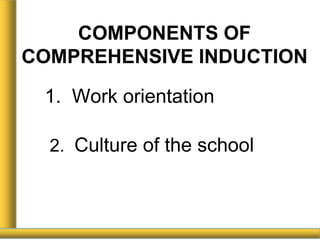
COMPONENTS OF
COMPREHENSIVE INDUCTION
1. Work orientation
2. Culture of the school
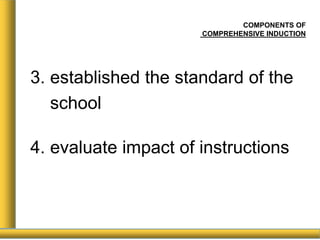
COMPONENTS OF
COMPREHENSIVE INDUCTION
3. established the standard of the
school
4. evaluate impact of instructions
COMPONENTS OF
COMPREHENSIVE INDUCTION
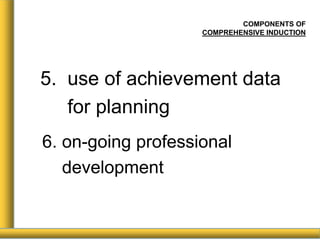
5. use of achievement data
for planning
6. on-going professional
development
COMPONENTS OF
COMPREHENSIVE INDUCTION
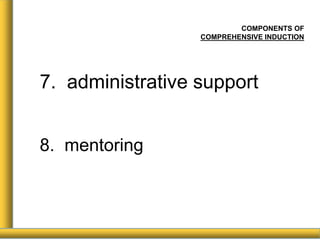
7. administrative support
8. mentoring
PROGRAM DOES NOT
IMPROVE STUDENT
LEARNING
TEACHERS IMPROVE
STUDENT LEARNING
CRUCIAL ELEMENTS IN
EFFECTIVE TEACHING
CRUCIAL ELEMENTS
IN EFFECTIVE TEACHING
1. rules and procedures
(house rules)
2. disciplinary interventions
CRUCIAL ELEMENTS
IN EFFECTIVE TEACHING
3. teacher-student relationship
4. smoothness and momentum
during lesson presentation
CRUCIAL ELEMENTS
IN EFFECTIVE TEACHING
5. variety of challenging
seatwork assigned to
students
6. mental set
No single role is
sufficient to guarantee
student learning.
Are good classroom
managers born or made?
PRINCIPLES IN
CLASSROOM MANAGEMENT
Principles in
classroom management
1. Consistent proactive discipline.
Principles in
classroom management
2. Establish routine for all daily
tasks and needs.
Principles in
classroom management
3. Orchestrate smooth
transitions and continuity of
momentum.
Principles in
classroom management
4. Strike a balance between
variety
and challenge in student's
activities tasks and needs.
Principles in
classroom management
5. Resolve minor inattentions
and disruptions before they
become major disruptions.
Principles in
classroom management
6. Be aware of all action
activities in the classroom.
Principles in
classroom management
7. Reinforce positive behavior.
Principles in
classroom management
8. Treat minor disturbance
calmly.
Principles in
classroom management
9. Workout a physical
arrangement of chairs that
facilitates an interactive
teaching-learning process
calmly.
Principles in
classroom management
10. Minimize discipline to
maximize instructional time.
Principles in
classroom management
11. Manage your time.
Be flexible with time work
assignments.
“Organize.
Don't agonize organize.”
 Induction vs Mentoring
 Components of Comprehensive
Induction
 Crucial elements of effective teaching
 Principles in classroom management
 Classroom Management
In a nutshell..
ONCE YOU
BECOME
FEARLESS...
YOU BECOME
LIMITLESS
The act of
spreading
knowledge
is one of the
highest
expressions of
unconditional love
that one can ever
give.
Thank you for listening!

Classroom Management 101