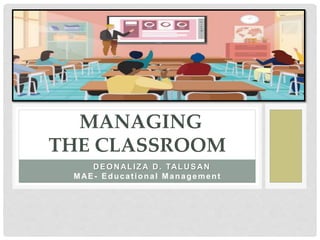
MANAGING
THE CLASSROOM
DEONALIZA D. TALUSAN
MAE- Educational Management
CONCEPT OF CLASSROOM
MANAGEMENT
WHAT IS CLASSROOM MANAGEMENT?
• is a term used by teachers to describe
the process of ensuring that classroom
lessons run smoothly despite disruptive
behavior by students
• the term also implies the prevention of
disruptive behavior. It is possibly the
most difficult aspect of teaching for
many teachers
WHAT IS CLASSROOM MANAGEMENT?
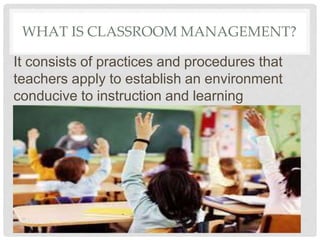
It consists of practices and procedures that
teachers apply to establish an environment
conducive to instruction and learning
EFFECTIVE CLASSROOM
MANAGEMENT
EFFECTIVE CLASSROOM MANAGEMENT
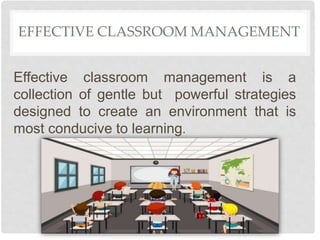
Effective classroom management is a
collection of gentle but powerful strategies
designed to create an environment that is
most conducive to learning.
• Effective classroom always begin with establishing proper rapport/
interaction.
• This interaction establishes a positive relationship with the class
and teacher.
• Effective classroom management paves the way for the
teacher to engage the students in learning.
• Decisions have to be made with the good of the students in mind.
EFFECTIVE CLASSROOM MANAGEMENT
SOME STRATEGIES USED TO MAKE
EFFECTIVE CLASSROOM
• Teachers need to create an environment that promotes learning.
• Make sure students are deeply involved with their work.
• The climate of classroom is work oriented, but relaxed and
pleasant.
• Create a learning environment that encourages social
interaction.
• Monitors the activities.
• Gives students non-verbal cues.
• Communication should be effective.
• Rules and procedures should be aligned with teaching
strategies.
DESIGNING THE PHYSICAL
ENVIRONMENT OF THE CLASSROOM
DESIGNING THE PHYSICAL
ENVIRONMENT OF THE CLASSROOM
• The term physical environment refers to
over all design and layout of a given
classroom and its learning centers.
• Teachers should design the environment
by organizing its spaces, furnishings, and
materials to maximize the learning
opportunities and the engagement of
every child
A CONDUCIVE PHYSICAL LEARNING
ENVIRONMENT INCLUDES
•Conveniently arranged furniture
•Flexible Seating Arrangement
•Clean,well ventilated, noise free
and fresh classroom
CONDUCIVE PHYSICAL LEARNING
ENVIRONMENT
FURNITURE ARRANGEMENT
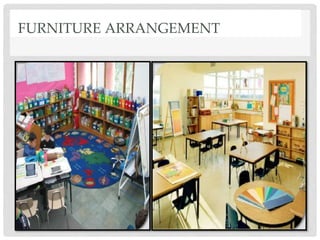
• Furniture such as chairs and tables for
demonstration or displays must be positioned
appropriately
• Exhibits shelves are either permanently pinned
to the wall or made to stand at the sides
• White board for writing and clarifying lesson
discussion together with the bulletin boards are
available for posting important messages and
outstanding pieces of student work, art and
illustration
FURNITURE ARRANGEMENT
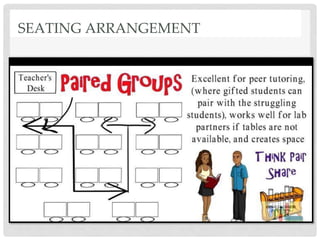
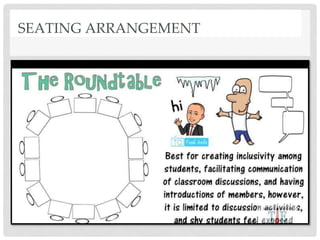
SEATING ARRANGEMENT
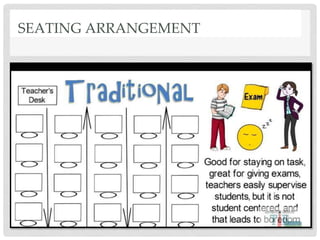
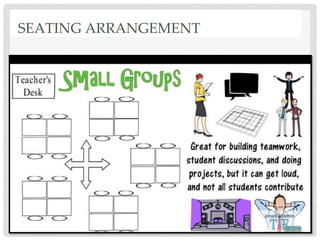
•seating Arrangement deserves
foremost consideration since
the students stay in each at the
longest time during the day
SEATING ARRANGEMENT
SEATING ARRANGEMENT
SEATING ARRANGEMENT
SEATING ARRANGEMENT
SEATING ARRANGEMENT
SEATING ARRANGEMENT
CREATING A POSITIVE ENVIRONMENT
FOR LEARNING
CREATING A POSITIVE ENVIRONMENT
FOR LEARNING
• A well-defined classroom management plan
should create a set of rules that students
can apply and that create an environment
of mutual respect and learning.
• It includes routines, rules and
consequences.
• Effective classroom management paves
the way for the teacher to engage the
students in learning.
CREATING A POSITIVE ENVIRONMENT
FOR LEARNING
• We need these needs to create a good
and learning environment.
• To maintain discipline.
• To reduce behavioral problems.
• To develop confidence in students.
• To teach them how to interact with society.
• To make them a good citizen.
• Use computer based programs to enhance
their cognitive skills.
CREATING A POSITIVE ENVIRONMENT
FOR LEARNING
• We need these needs to create a good
and learning environment.
• To maintain discipline.
• To reduce behavioral problems.
• To develop confidence in students.
• To teach them how to interact with society.
• To make them a good citizen.
• Use computer based programs to enhance
their cognitive skills.
DEALING WITH PROBLEM
BEHAVIOR
DEALING WITH PROBLEM BEHAVIOR
•Classroom management is closely
linked to issues of motivation,
discipline and respect.
A large part of traditional classroom
management involves behavior
modification
TECHNIQUES
•Corporal punishment
•Rote discipline
•Preventive techniques
•Good teacher-student
relationships
TECHNIQUES
•Corporal punishment
•Rote discipline
•Preventive techniques
•Good teacher-student
relationships
CORPORAL PUNISHMENT
Until recently, corporal punishment was
widely used as a means of controlling
disruptive behavior but it is now illegal in
most schools. It is still advocated in
some contexts by ultra- religious people
such as James Dobson
ROTE DISCIPLINE
It involves assigning a disorderly
student sentences or the classroom
rules to write repeatedly. Among the
many types of classroom management
approaches, it is very commonly used.
PREVENTIVE APPROACH
Preventive approaches to classroom
management involve creating a positive
classroom community with mutual
respect between teacher and student.
Teachers using the preventive approach
offer warmth, acceptance, and support
unconditionally.
.
PREVENTIVE APPROACH
Preventive techniques also involve the
strategic use of praise and rewards to
inform students about their behavior
rather than as a means of controlling
student behavior.
GOOD TEACHER-STUDENT
RELATIONSHIPS
A good teacher-student relationships in
the classroom involves the appropriate
levels of dominance, cooperation, and
awareness of high-needs students
COMMON MISTAKES IN CLASSROOM
BEHAVIOR MANAGEMENT
COMMON MISTAKES IN CLASSROOM
BEHAVIOR MANAGEMENT
Two students with similar looking
misbehavior may require entirely
different intervention strategies.
Not every approach works for every
child.
COMMON MISTAKES IN CLASSROOM
BEHAVIOR MANAGEMENT
Teachers need to learn to be flexible.
Another common mistake is for the teacher to become
increasingly frustrated and negative when an approach is
not working
The teacher may raise his or her voice or increase adverse
consequences in an effort to make the approach work.
This may impair the teacher- student relationship.
COMMON MISTAKES IN CLASSROOM
BEHAVIOR MANAGEMENT
Inconsistency in expectations and
consequences is an additional mistake that
can lead to dysfunction in the classroom.
To avoid this, teachers should communicate
expectations to students clearly and be
sufficiently .
COMMON MISTAKES IN CLASSROOM
BEHAVIOR MANAGEMENT
"Ignoring and approving" is an effective
classroom management strategy.
This involves ignoring students when they
behave undesirably and approving their
behavior when it is desirable.
When students are praised for their good
behavior but ignored for their bad behavior,
this may increase the frequency of good
behavior and decrease bad behavior
COMMON MISTAKES IN CLASSROOM
BEHAVIOR MANAGEMENT
Student behavior may be maintained by attention
If students have a history of getting attention
after misbehavior, they may continue this
behavior as long as it continues to get attention.
If student misbehavior is ignored, but good
behavior results in attention, students may
instead behave appropriately to acquire
attention.
COMMON MISTAKES IN CLASSROOM
BEHAVIOR MANAGEMENT
Therefore principles and
concepts like behavior
management, child development
and child psychology are to be
optimally used for effectively
managing the classroom.
classroom management.pptx

classroom management.pptx

  • 1.
    MANAGING THE CLASSROOM DEONALIZA D.TALUSAN MAE- Educational Management
  • 2.
  • 3.
    WHAT IS CLASSROOMMANAGEMENT? • is a term used by teachers to describe the process of ensuring that classroom lessons run smoothly despite disruptive behavior by students • the term also implies the prevention of disruptive behavior. It is possibly the most difficult aspect of teaching for many teachers
  • 4.
    WHAT IS CLASSROOMMANAGEMENT? It consists of practices and procedures that teachers apply to establish an environment conducive to instruction and learning
  • 5.
  • 6.
    EFFECTIVE CLASSROOM MANAGEMENT Effectiveclassroom management is a collection of gentle but powerful strategies designed to create an environment that is most conducive to learning.
  • 7.
    • Effective classroomalways begin with establishing proper rapport/ interaction. • This interaction establishes a positive relationship with the class and teacher. • Effective classroom management paves the way for the teacher to engage the students in learning. • Decisions have to be made with the good of the students in mind. EFFECTIVE CLASSROOM MANAGEMENT
  • 8.
    SOME STRATEGIES USEDTO MAKE EFFECTIVE CLASSROOM • Teachers need to create an environment that promotes learning. • Make sure students are deeply involved with their work. • The climate of classroom is work oriented, but relaxed and pleasant. • Create a learning environment that encourages social interaction. • Monitors the activities. • Gives students non-verbal cues. • Communication should be effective. • Rules and procedures should be aligned with teaching strategies.
  • 9.
  • 10.
    DESIGNING THE PHYSICAL ENVIRONMENTOF THE CLASSROOM • The term physical environment refers to over all design and layout of a given classroom and its learning centers. • Teachers should design the environment by organizing its spaces, furnishings, and materials to maximize the learning opportunities and the engagement of every child
  • 11.
    A CONDUCIVE PHYSICALLEARNING ENVIRONMENT INCLUDES •Conveniently arranged furniture •Flexible Seating Arrangement •Clean,well ventilated, noise free and fresh classroom
  • 12.
  • 13.
    FURNITURE ARRANGEMENT • Furnituresuch as chairs and tables for demonstration or displays must be positioned appropriately • Exhibits shelves are either permanently pinned to the wall or made to stand at the sides • White board for writing and clarifying lesson discussion together with the bulletin boards are available for posting important messages and outstanding pieces of student work, art and illustration
  • 14.
  • 15.
    SEATING ARRANGEMENT •seating Arrangementdeserves foremost consideration since the students stay in each at the longest time during the day
  • 16.
  • 17.
  • 18.
  • 19.
  • 20.
  • 21.
  • 22.
    CREATING A POSITIVEENVIRONMENT FOR LEARNING
  • 23.
    CREATING A POSITIVEENVIRONMENT FOR LEARNING • A well-defined classroom management plan should create a set of rules that students can apply and that create an environment of mutual respect and learning. • It includes routines, rules and consequences. • Effective classroom management paves the way for the teacher to engage the students in learning.
  • 24.
    CREATING A POSITIVEENVIRONMENT FOR LEARNING • We need these needs to create a good and learning environment. • To maintain discipline. • To reduce behavioral problems. • To develop confidence in students. • To teach them how to interact with society. • To make them a good citizen. • Use computer based programs to enhance their cognitive skills.
  • 25.
    CREATING A POSITIVEENVIRONMENT FOR LEARNING • We need these needs to create a good and learning environment. • To maintain discipline. • To reduce behavioral problems. • To develop confidence in students. • To teach them how to interact with society. • To make them a good citizen. • Use computer based programs to enhance their cognitive skills.
  • 26.
  • 27.
    DEALING WITH PROBLEMBEHAVIOR •Classroom management is closely linked to issues of motivation, discipline and respect. A large part of traditional classroom management involves behavior modification
  • 28.
    TECHNIQUES •Corporal punishment •Rote discipline •Preventivetechniques •Good teacher-student relationships
  • 29.
    TECHNIQUES •Corporal punishment •Rote discipline •Preventivetechniques •Good teacher-student relationships
  • 30.
    CORPORAL PUNISHMENT Until recently,corporal punishment was widely used as a means of controlling disruptive behavior but it is now illegal in most schools. It is still advocated in some contexts by ultra- religious people such as James Dobson
  • 31.
    ROTE DISCIPLINE It involvesassigning a disorderly student sentences or the classroom rules to write repeatedly. Among the many types of classroom management approaches, it is very commonly used.
  • 32.
    PREVENTIVE APPROACH Preventive approachesto classroom management involve creating a positive classroom community with mutual respect between teacher and student. Teachers using the preventive approach offer warmth, acceptance, and support unconditionally. .
  • 33.
    PREVENTIVE APPROACH Preventive techniquesalso involve the strategic use of praise and rewards to inform students about their behavior rather than as a means of controlling student behavior.
  • 34.
    GOOD TEACHER-STUDENT RELATIONSHIPS A goodteacher-student relationships in the classroom involves the appropriate levels of dominance, cooperation, and awareness of high-needs students
  • 35.
    COMMON MISTAKES INCLASSROOM BEHAVIOR MANAGEMENT
  • 36.
    COMMON MISTAKES INCLASSROOM BEHAVIOR MANAGEMENT Two students with similar looking misbehavior may require entirely different intervention strategies. Not every approach works for every child.
  • 37.
    COMMON MISTAKES INCLASSROOM BEHAVIOR MANAGEMENT Teachers need to learn to be flexible. Another common mistake is for the teacher to become increasingly frustrated and negative when an approach is not working The teacher may raise his or her voice or increase adverse consequences in an effort to make the approach work. This may impair the teacher- student relationship.
  • 38.
    COMMON MISTAKES INCLASSROOM BEHAVIOR MANAGEMENT Inconsistency in expectations and consequences is an additional mistake that can lead to dysfunction in the classroom. To avoid this, teachers should communicate expectations to students clearly and be sufficiently .
  • 39.
    COMMON MISTAKES INCLASSROOM BEHAVIOR MANAGEMENT "Ignoring and approving" is an effective classroom management strategy. This involves ignoring students when they behave undesirably and approving their behavior when it is desirable. When students are praised for their good behavior but ignored for their bad behavior, this may increase the frequency of good behavior and decrease bad behavior
  • 40.
    COMMON MISTAKES INCLASSROOM BEHAVIOR MANAGEMENT Student behavior may be maintained by attention If students have a history of getting attention after misbehavior, they may continue this behavior as long as it continues to get attention. If student misbehavior is ignored, but good behavior results in attention, students may instead behave appropriately to acquire attention.
  • 41.
    COMMON MISTAKES INCLASSROOM BEHAVIOR MANAGEMENT Therefore principles and concepts like behavior management, child development and child psychology are to be optimally used for effectively managing the classroom.