CLASSROOM
MANAGEMENT
CHRISTIAN TRAINING COLLEGE,
LUCKNOW
Presented By:
Ms. Ranjana Prasad
1.1 Definitions of Classroom Management
Effective classroom management is an indicator of student’s success. The primary
purpose of the classroom management is to get control on the students. Classroom
management consists of practice and processes that a teacher uses to uphold an
environment in which instruction and learning can occur smoothly. (Wong, H. K., 2004).
Classroom management refers to those methods and strategies used by the educators to
maintain a helping classroom learning environment. Although there are various
techniques involves in classroom management but the most important strategies are those
which realize the students that they are in the environment which allow them to learn and
achieve.
1. The term classroom management does not have just a single definition. Most
commonly it refers to the procedures in which the teacher sets up the classroom in
such a way that the students learn more effectively.
2. “Classroom management is a multifaceted process which depends upon an
engaging curriculum, student’s responsibility, appropriate teaching modeling,
effective instruction, and management skills to work towards conflict resolution
with individuals and the whole class.” (Mallory, M.2008)
1. “The concept of the classroom management is broader than the notion of student
discipline .it includes all the things teachers must do to foster student involvement
and cooperation in classroom activities and to establish a productive working
environment”
2. “Classroom management can and should do more than elicit predictable obedience;
indeed, it can and should be one vehicle for the enhancement of student self-
understanding, self-evaluation, and the internalization of self-control.”
3. “Classroom management describes the processes you use to keep a classroom
organized, lessons running smoothly, and students engaged in the lesson. Although
maintaining discipline is a component of classroom management, establishing
procedures and rapport are just as important in keeping a classroom running
efficiently.”
Activity-1.1
Visit the websites included in references for searching out more definitions and for
more clarity of the concept.
1.2 Importance of Classroom Management
Good teachers manage their classroom through proper procedures and routine while
ineffective teachers lack this aspect of classroom management .When the class is
organized and disciplined, the teacher can allocate much time to teaching rather than
spending more time on disciplining the students .There are some important features of
classroom management which are discussed below.
4
1.2.1 Consistent Routine
The term procedure refers to something which the teacher wants to do while routine is
something which the students do automatically. For example, if the teacher starts each
class with the procedure by writing an activity on board daily, the students follow and
complete that task as they know what the teacher expects from them. Therefore, they take
the start of the class silently and on-task. Procedure and routine are the ways through
which the classroom runs; they are not the laws which will come with consequences if
they are broken.
1.2.2 Effective Time Management
Effective time management leads the classroom to maximum learning output. Once the
students understand the procedure and routine of the classroom, they do work efficiently
without extra instructions. Instead of making they sit passively and waiting for their
teacher’s announcement, they actively participate in learning according to the minutes set
down by the teacher. When the students get involve in their daily activities, meanwhile
the teacher gains enough time for managing other routine activities such as attendance,
arrangement of resources for activities in the class etc. In this way the daily agenda of the
classroom does not effect.
1.2.3 Positive Atmosphere
A well managed classroom has a positive atmosphere. The students know that their
teacher is the leader and instructor of the classroom. A properly manage class runs
through a systematic procedure by the teacher. Every student feels comfortable because
they know that teacher is facilitating them in learning and is always ready and
approachable for the answers of their questions. A friendly atmosphere provides
opportunity to the learner to interact with teacher and peer groups, while on the other
hand a stressful, negative and fearful atmosphere do not allow purposeful learning.
1.2.4 High Test Scores
The rationale of the test is not to bring forth the students mistakes but to guide them for
good performance in the class. Those teachers, who effectively managed their
classrooms, inform the students on a very first day that what they will learn from the
particular unit because it makes the students ready for learning. Expert teacher Julie
Johnson says that she demonstrates what she wants them to do. They practice the skill
together and then I test them the same way we practice in my class, test is not a bad
word”. When students develop their confidence, it reflects from their test scores. (Harry
K. Wong & Rosemary, 2009)
1.2.5 Student Impact
Effective classroom management is important because it has a great impact on the overall
performance of the students such as their behaviour, organization skills, attitude,
discipline and achievement etc. If the teacher has good skills of management and who
can communicate with students effectively, their student’s intellectual growth will be
higher. A well managed classroom provides a favorable environment for the intellectual
growth of the students.
5
1.2.6 Engage Students
Classroom management is important for effective teaching because it engages the
students in creative activities and makes them learn the material rather than memorizing
them for classroom tests. A well managed classroom teaching involves the students in
question answer, discussions and other motivating activities. When the teacher moves
around the class while delivering the lecture, gives answer to the questions of the students
and responds to students through verbal and non verbal methods ensure that students are
paying attention to learning. It enhances the confidence of the students and makes the
learning more effective.
1.2.7 Preparation
Classroom management becomes more effective when the teacher is prepared before
coming to the class. When the teacher comes without preparation in the class it gives a
time to the students for creating disturbance in the class, and it causes problems for the
teacher in formulating daily plan. To avoid such disturbed situations, the teacher should
have handy lesson plans which she /he can use in time of emergency. This is one of the
most important tools of classroom management.
1.3 Importance of Goals by the Teacher for Classroom Management
Goals and objectives set by the teacher for the classroom management is very important.
A teacher sets goals and objectives for mental and physical development of the students
and to help them to achieve educational goals ultimately. Students are given objectives
and they strive for its achievement. It realizes them to feel more organized and
responsible in their educational career. Goals and objectives are important for the
classroom management for the following reasons.
1.3.1 Better Teaching
The teachers who set goals and objectives for their teaching, they force to make a good
lesson plan and always try to accomplish their objectives. When a teacher has specific
goals in mind, he must carefully plan how to achieve those goals and objectives. For this
purpose the teacher needs to have depth understanding of curriculum that how to proceed
the planning to cover it with in proper time. Many subjects such as mathematics are
cumulative subjects and need students to have master skills as they go on, because those
skills are continuously require to the entire course. Students who have no command on
those skills usually left behind, so by setting goals teachers carefully plan that how to
teach the course while keeping all the students on the same pace.
1.3.2 Student Focus
Students, who are aware about the goals expected from them by the teacher, give a clear
picture to them that where they have to focus their attention. The planned goals provide a
chance to the students to learn more to reach to the already established criteria by a teacher
for lesson. This achievement of goals gives a sense of accomplishment to the students.
6
1.3.3 Teacher Goal-Setting
Setting of goals by the teacher opens new gates of learning for the students. Students also
learn how to set the goals and derive the objectives from them in the real life situation. It
makes them goal oriented intellectuals. The teacher makes goals for lesson and tries to
achieve them in classroom, and the students learn that what steps should be taken to reach
to success in some activities.
1.3.4 Motivation
Motivation is one important principle of learning. The students cannot learn if they are
not motivated. Motivation also plays an important role in the management of classroom,
for example if the students are highly motivated to learning, they will carry on the daily
activities with high zeal and the class will be automatically disciplined. Therefore, setting
of goals in the classroom motivates the students towards highly academic achievement.
This motivation of the students can be done by the teacher through material or verbal
incentives. For further detail check the following website.
Activity-1.2
Arrange a meeting with teachers of a school in your surrounding and discuss the
importance of classroom management with them.
1.4 Designs/Styles of Classroom Management
The arrangement of desks in the classroom makes certain the safe learning and boost up
students participation. To a great extent the physical layout of the class is very important
in developing a productive classroom environment. The best teachers have a good
understanding of seating arrangement in the class. They always arrange the seats
according to the needs of the students and the subjects. Some teachers change the seating
arrangement throughout the years. Following are some of the arrangements styles of
classroom seating.
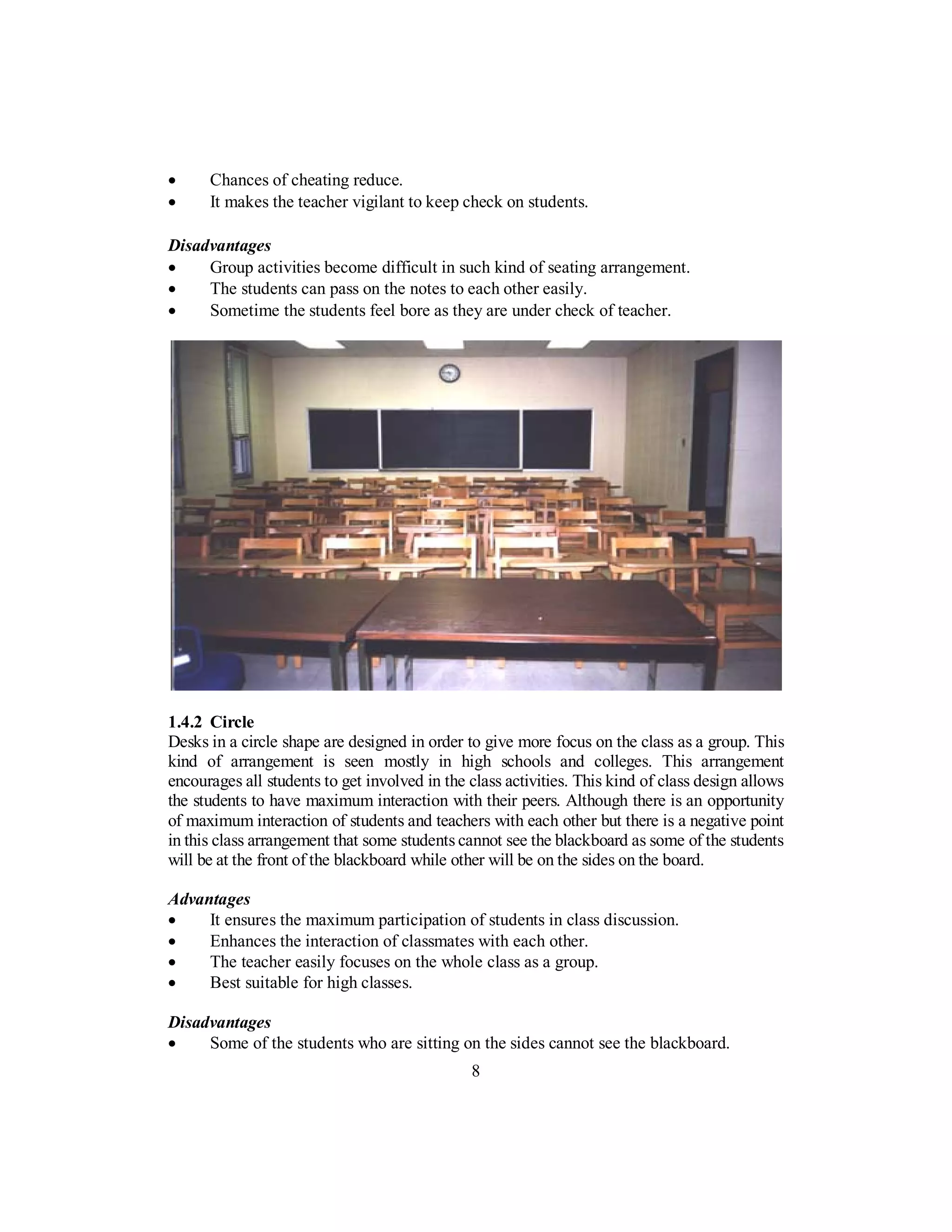
1.4.1 Rows
Traditionally, the desks are arranged in rows, this allows the whole class to see the
blackboard. It is also easy both for teacher and students to walk around the desks in the
class. It provides an opportunity to the teacher to timely assists the students individually
in an easy manner. This type of desks arrangement lessens the possibility of cheating but
increases the ability of students to pass notes to each other. Therefore it is necessary that
the teacher table should be kept in the middle that he or she can see all the students sitting
in the class. It is harder to arrange group activities in this type of class arrangement.
Advantages
• Students can see the blackboard easily.
• It makes easy the movement of teacher and students in the class.
• The teacher can provide immediate help to each student.
7
• Chances of cheating reduce.
• It makes the teacher vigilant to keep check on students.
Disadvantages
• Group activities become difficult in such kind of seating arrangement.
• The students can pass on the notes to each other easily.
• Sometime the students feel bore as they are under check of teacher.
1.4.2 Circle
Desks in a circle shape are designed in order to give more focus on the class as a group. This
kind of arrangement is seen mostly in high schools and colleges. This arrangement
encourages all students to get involved in the class activities. This kind of class design allows
the students to have maximum interaction with their peers. Although there is an opportunity
of maximum interaction of students and teachers with each other but there is a negative point
in this class arrangement that some students cannot see the blackboard as some of the students
will be at the front of the blackboard while other will be on the sides on the board.
Advantages
• It ensures the maximum participation of students in class discussion.
• Enhances the interaction of classmates with each other.
• The teacher easily focuses on the whole class as a group.
• Best suitable for high classes.
Disadvantages
• Some of the students who are sitting on the sides cannot see the blackboard.
8
• Maximum interaction of students with each other can create discipline problems in
the class.
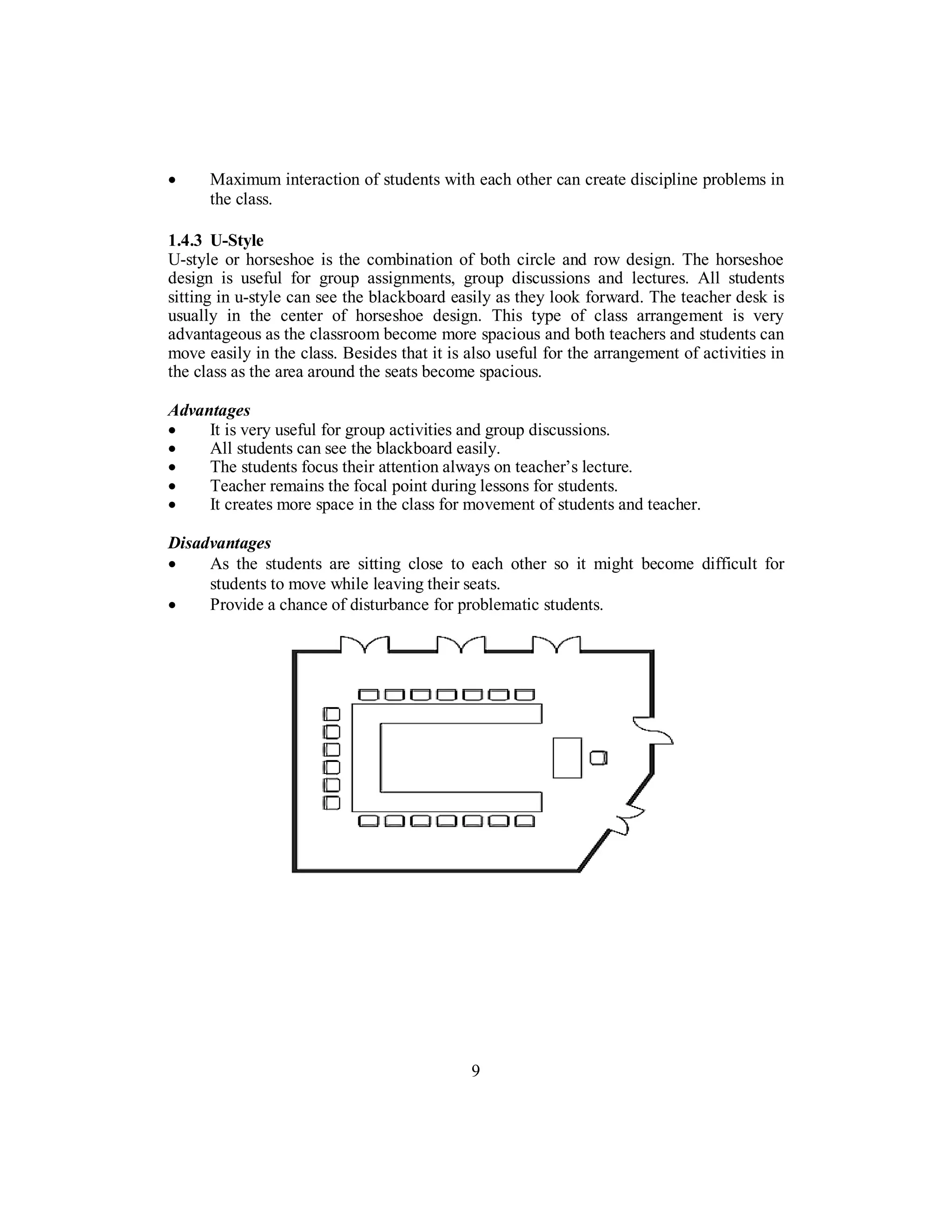
1.4.3 U-Style
U-style or horseshoe is the combination of both circle and row design. The horseshoe
design is useful for group assignments, group discussions and lectures. All students
sitting in u-style can see the blackboard easily as they look forward. The teacher desk is
usually in the center of horseshoe design. This type of class arrangement is very
advantageous as the classroom become more spacious and both teachers and students can
move easily in the class. Besides that it is also useful for the arrangement of activities in
the class as the area around the seats become spacious.
Advantages
• It is very useful for group activities and group discussions.
• All students can see the blackboard easily.
• The students focus their attention always on teacher’s lecture.
• Teacher remains the focal point during lessons for students.
• It creates more space in the class for movement of students and teacher.
Disadvantages
• As the students are sitting close to each other so it might become difficult for
students to move while leaving their seats.
• Provide a chance of disturbance for problematic students.
9
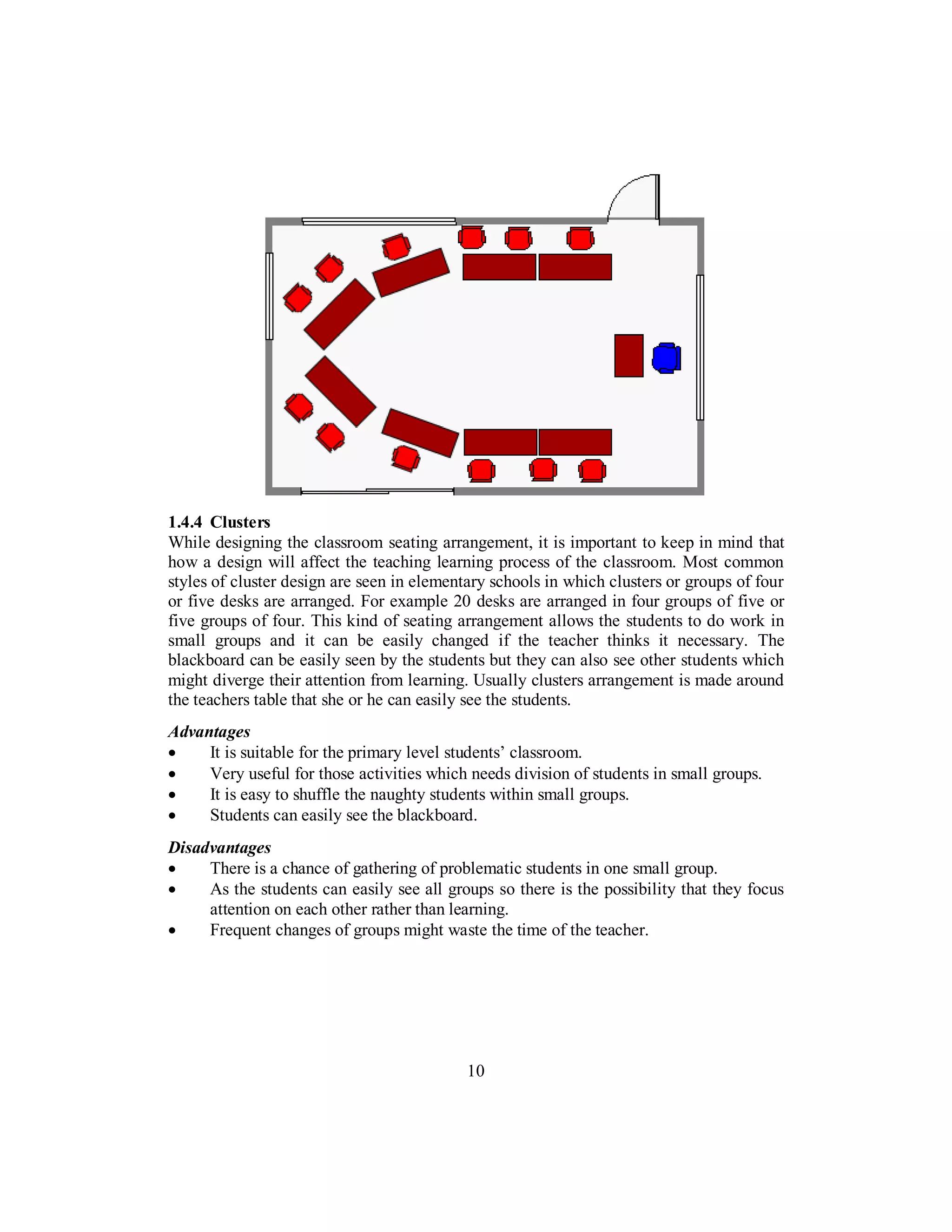
1.4.4 Clusters
While designing the classroom seating arrangement, it is important to keep in mind that
how a design will affect the teaching learning process of the classroom. Most common
styles of cluster design are seen in elementary schools in which clusters or groups of four
or five desks are arranged. For example 20 desks are arranged in four groups of five or
five groups of four. This kind of seating arrangement allows the students to do work in
small groups and it can be easily changed if the teacher thinks it necessary. The
blackboard can be easily seen by the students but they can also see other students which
might diverge their attention from learning. Usually clusters arrangement is made around
the teachers table that she or he can easily see the students.
Advantages
• It is suitable for the primary level students’ classroom.
• Very useful for those activities which needs division of students in small groups.
• It is easy to shuffle the naughty students within small groups.
• Students can easily see the blackboard.
Disadvantages
• There is a chance of gathering of problematic students in one small group.
• As the students can easily see all groups so there is the possibility that they focus
attention on each other rather than learning.
• Frequent changes of groups might waste the time of the teacher.
10
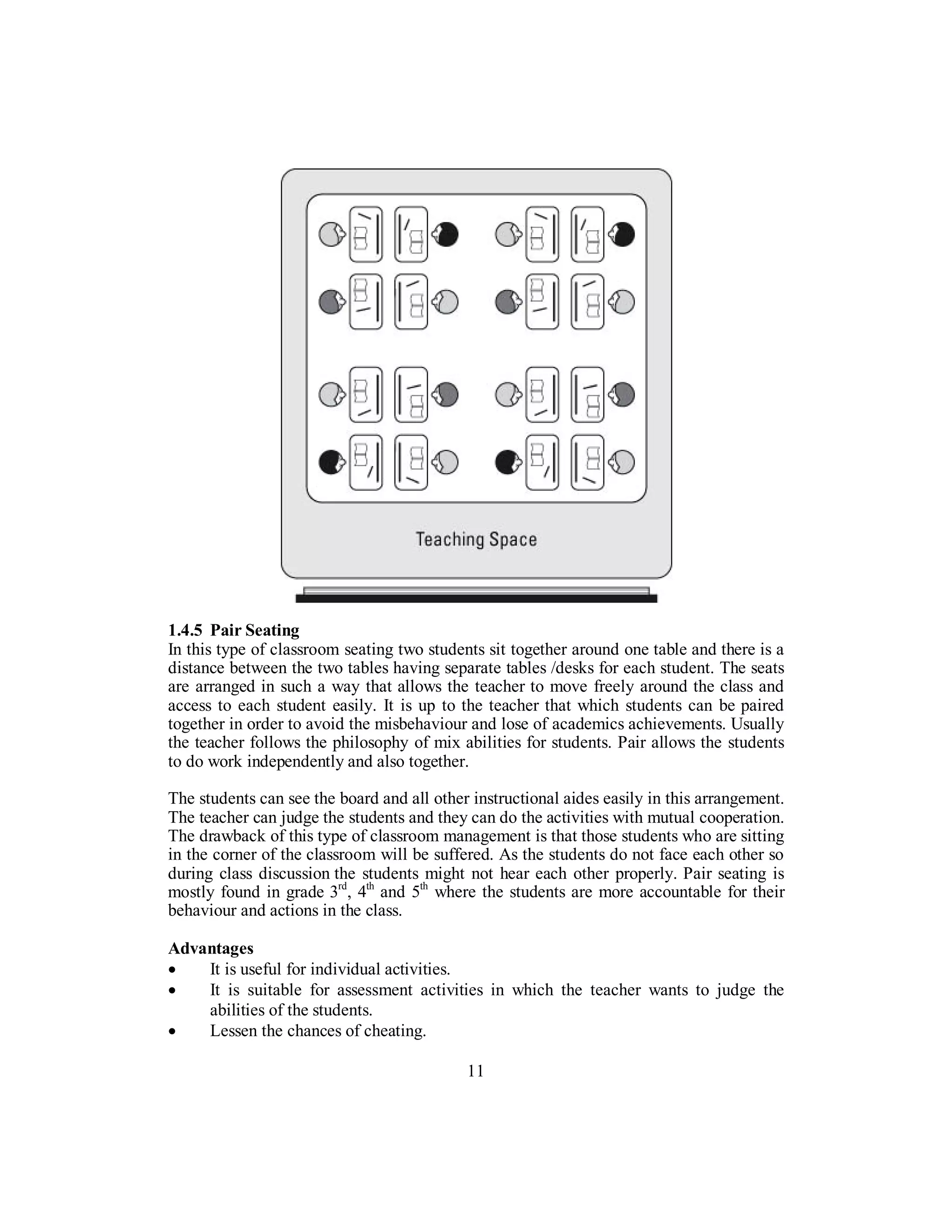
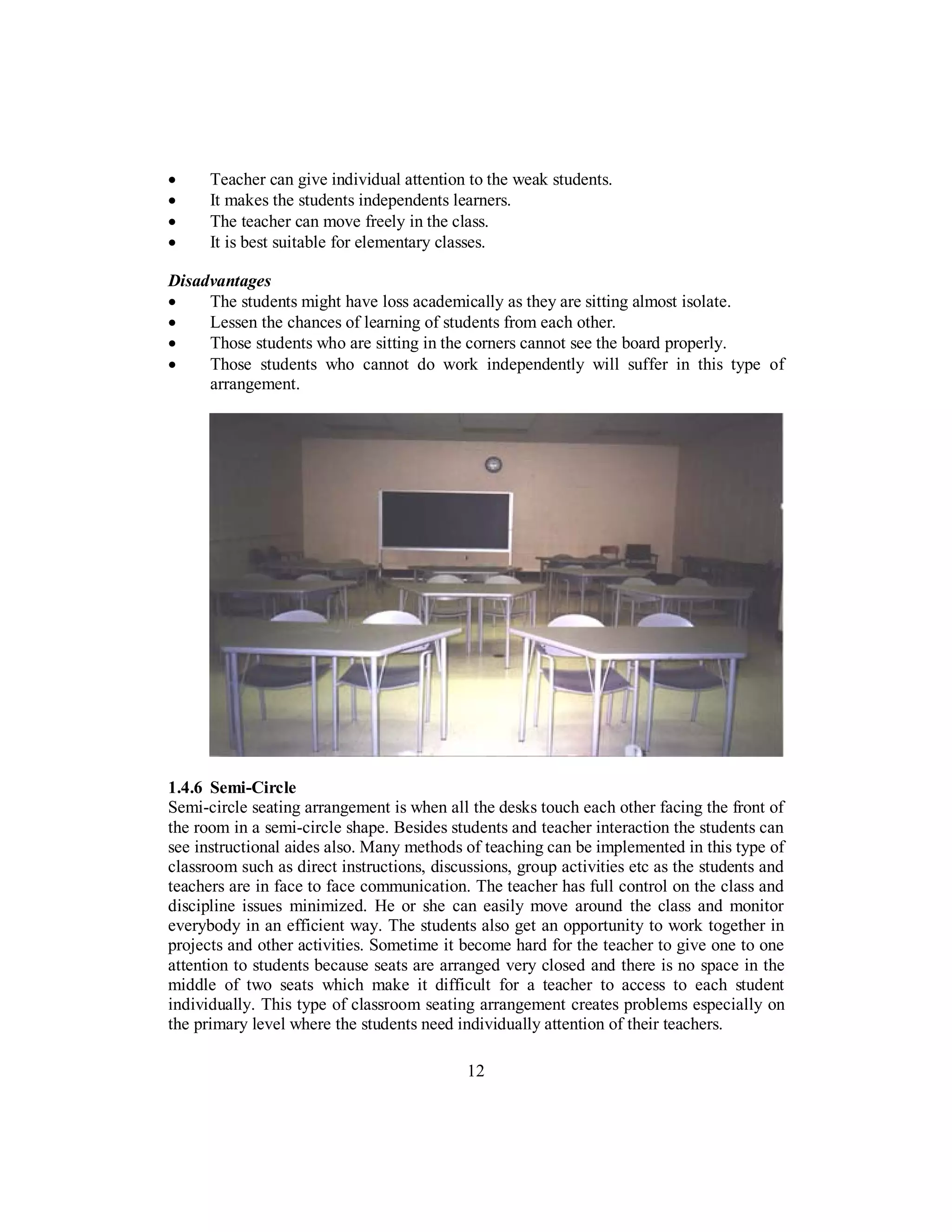
1.4.5 Pair Seating
In this type of classroom seating two students sit together around one table and there is a
distance between the two tables having separate tables /desks for each student. The seats
are arranged in such a way that allows the teacher to move freely around the class and
access to each student easily. It is up to the teacher that which students can be paired
together in order to avoid the misbehaviour and lose of academics achievements. Usually
the teacher follows the philosophy of mix abilities for students. Pair allows the students
to do work independently and also together.
The students can see the board and all other instructional aides easily in this arrangement.
The teacher can judge the students and they can do the activities with mutual cooperation.
The drawback of this type of classroom management is that those students who are sitting
in the corner of the classroom will be suffered. As the students do not face each other so
during class discussion the students might not hear each other properly. Pair seating is
mostly found in grade 3rd
, 4th
and 5th
where the students are more accountable for their
behaviour and actions in the class.
Advantages
• It is useful for individual activities.
• It is suitable for assessment activities in which the teacher wants to judge the
abilities of the students.
• Lessen the chances of cheating.
11
• Teacher can give individual attention to the weak students.
• It makes the students independents learners.
• The teacher can move freely in the class.
• It is best suitable for elementary classes.
Disadvantages
• The students might have loss academically as they are sitting almost isolate.
• Lessen the chances of learning of students from each other.
• Those students who are sitting in the corners cannot see the board properly.
• Those students who cannot do work independently will suffer in this type of
arrangement.
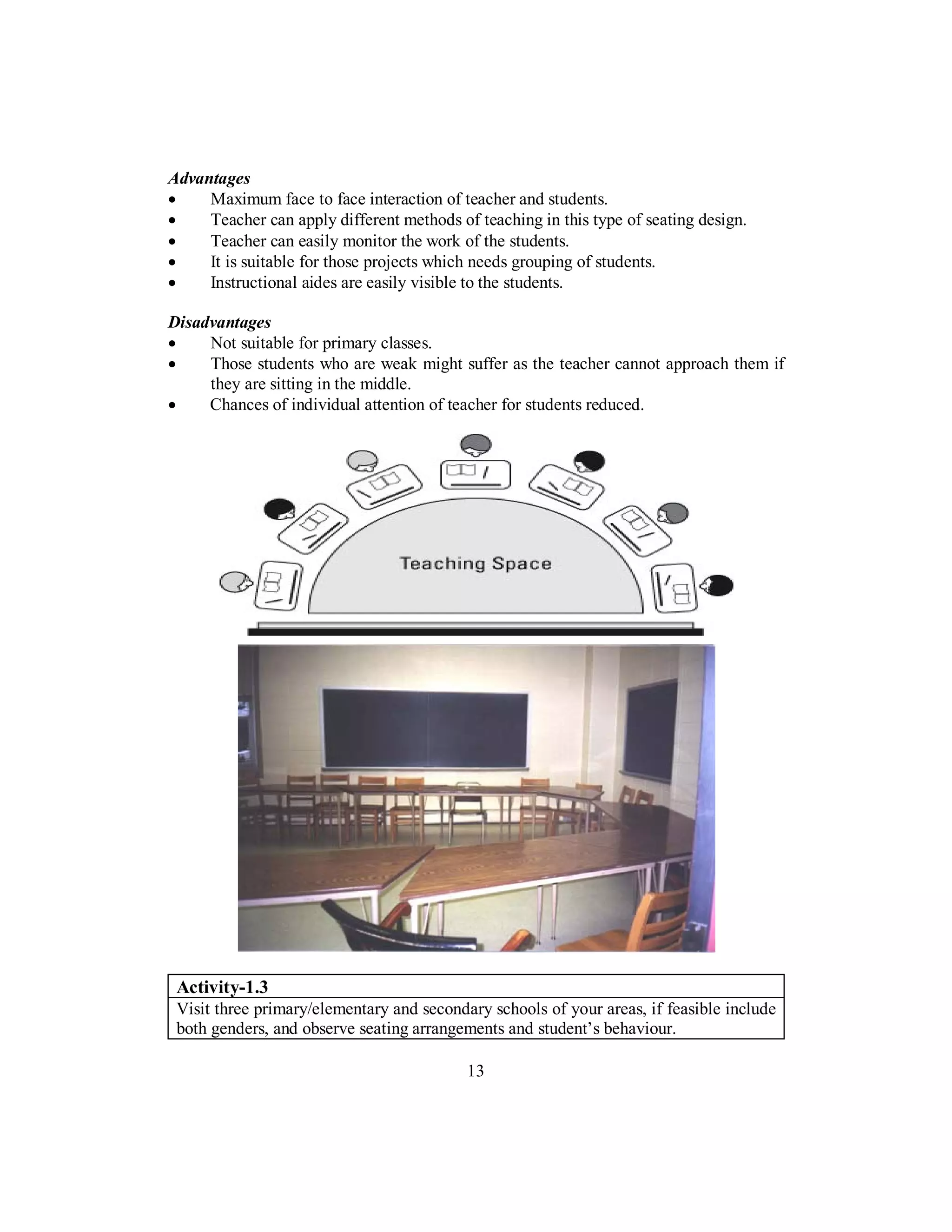
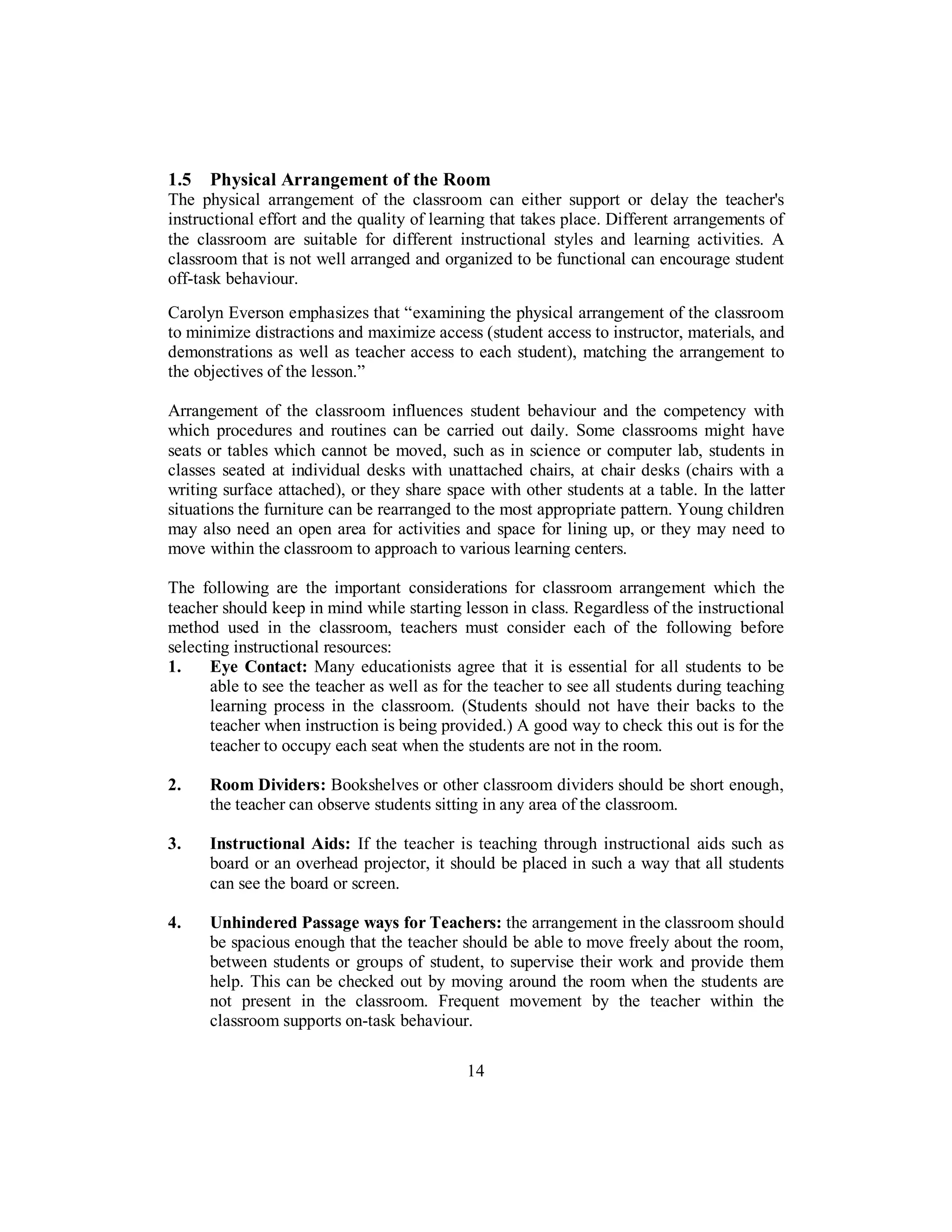
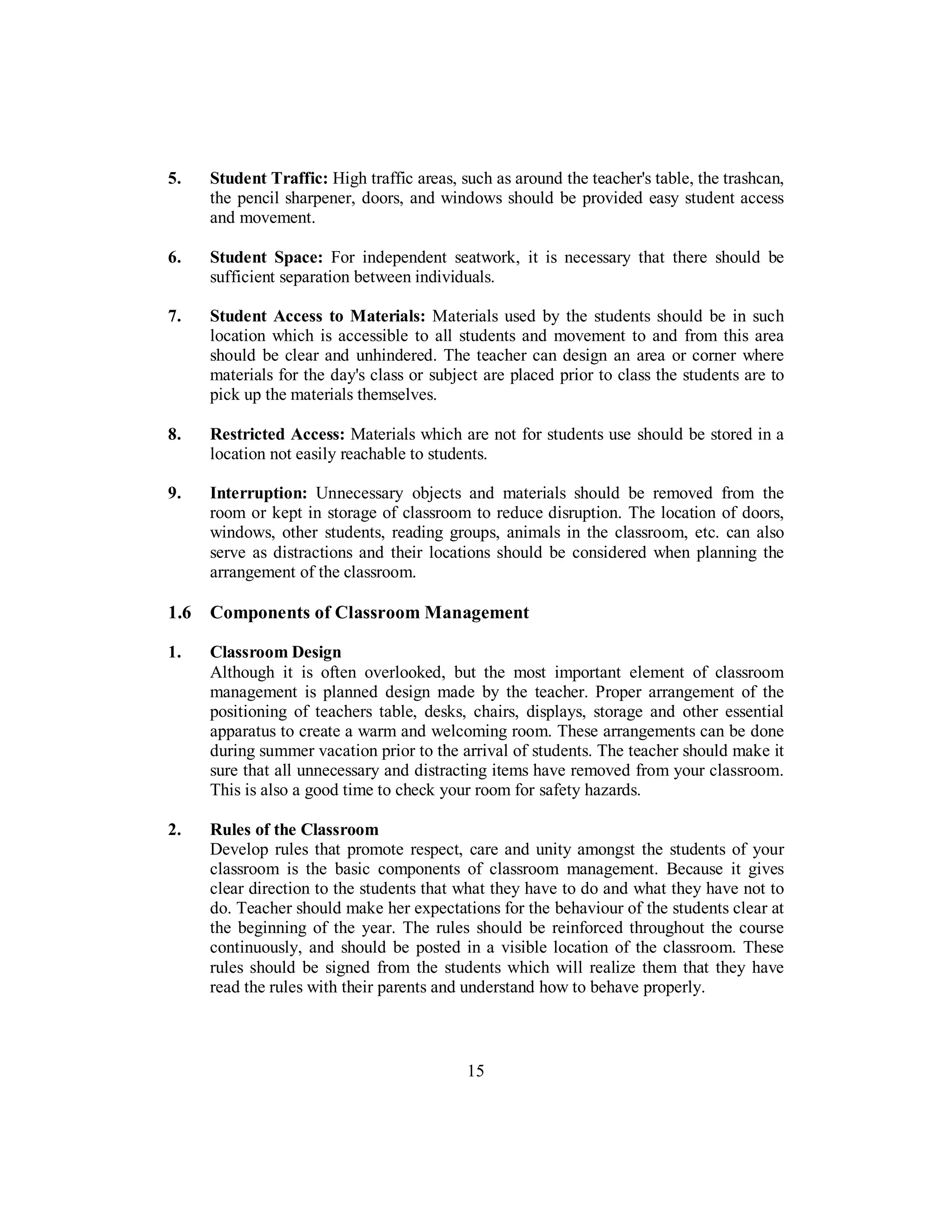
1.4.6 Semi-Circle
Semi-circle seating arrangement is when all the desks touch each other facing the front of
the room in a semi-circle shape. Besides students and teacher interaction the students can
see instructional aides also. Many methods of teaching can be implemented in this type of
classroom such as direct instructions, discussions, group activities etc as the students and
teachers are in face to face communication. The teacher has full control on the class and
discipline issues minimized. He or she can easily move around the class and monitor
everybody in an efficient way. The students also get an opportunity to work together in
projects and other activities. Sometime it become hard for the teacher to give one to one
attention to students because seats are arranged very closed and there is no space in the
middle of two seats which make it difficult for a teacher to access to each student
individually. This type of classroom seating arrangement creates problems especially on
the primary level where the students need individually attention of their teachers.
12
Advantages
• Maximum face to face interaction of teacher and students.
• Teacher can apply different methods of teaching in this type of seating design.
• Teacher can easily monitor the work of the students.
• It is suitable for those projects which needs grouping of students.
• Instructional aides are easily visible to the students.
Disadvantages
• Not suitable for primary classes.
• Those students who are weak might suffer as the teacher cannot approach them if
they are sitting in the middle.
• Chances of individual attention of teacher for students reduced.
Activity-1.3
Visit three primary/elementary and secondary schools of your areas, if feasible include
both genders, and observe seating arrangements and student’s behaviour.
13
1.5 Physical Arrangement of the Room
The physical arrangement of the classroom can either support or delay the teacher's
instructional effort and the quality of learning that takes place. Different arrangements of
the classroom are suitable for different instructional styles and learning activities. A
classroom that is not well arranged and organized to be functional can encourage student
off-task behaviour.
Carolyn Everson emphasizes that “examining the physical arrangement of the classroom
to minimize distractions and maximize access (student access to instructor, materials, and
demonstrations as well as teacher access to each student), matching the arrangement to
the objectives of the lesson.”
Arrangement of the classroom influences student behaviour and the competency with
which procedures and routines can be carried out daily. Some classrooms might have
seats or tables which cannot be moved, such as in science or computer lab, students in
classes seated at individual desks with unattached chairs, at chair desks (chairs with a
writing surface attached), or they share space with other students at a table. In the latter
situations the furniture can be rearranged to the most appropriate pattern. Young children
may also need an open area for activities and space for lining up, or they may need to
move within the classroom to approach to various learning centers.
The following are the important considerations for classroom arrangement which the
teacher should keep in mind while starting lesson in class. Regardless of the instructional
method used in the classroom, teachers must consider each of the following before
selecting instructional resources:
1. Eye Contact: Many educationists agree that it is essential for all students to be
able to see the teacher as well as for the teacher to see all students during teaching
learning process in the classroom. (Students should not have their backs to the
teacher when instruction is being provided.) A good way to check this out is for the
teacher to occupy each seat when the students are not in the room.
2. Room Dividers: Bookshelves or other classroom dividers should be short enough,
the teacher can observe students sitting in any area of the classroom.
3. Instructional Aids: If the teacher is teaching through instructional aids such as
board or an overhead projector, it should be placed in such a way that all students
can see the board or screen.
4. Unhindered Passage ways for Teachers: the arrangement in the classroom should
be spacious enough that the teacher should be able to move freely about the room,
between students or groups of student, to supervise their work and provide them
help. This can be checked out by moving around the room when the students are
not present in the classroom. Frequent movement by the teacher within the
classroom supports on-task behaviour.
14
5. Student Traffic: High traffic areas, such as around the teacher's table, the trashcan,
the pencil sharpener, doors, and windows should be provided easy student access
and movement.
6. Student Space: For independent seatwork, it is necessary that there should be
sufficient separation between individuals.
7. Student Access to Materials: Materials used by the students should be in such
location which is accessible to all students and movement to and from this area
should be clear and unhindered. The teacher can design an area or corner where
materials for the day's class or subject are placed prior to class the students are to
pick up the materials themselves.
8. Restricted Access: Materials which are not for students use should be stored in a
location not easily reachable to students.
9. Interruption: Unnecessary objects and materials should be removed from the
room or kept in storage of classroom to reduce disruption. The location of doors,
windows, other students, reading groups, animals in the classroom, etc. can also
serve as distractions and their locations should be considered when planning the
arrangement of the classroom.
1.6 Components of Classroom Management
1. Classroom Design
Although it is often overlooked, but the most important element of classroom
management is planned design made by the teacher. Proper arrangement of the
positioning of teachers table, desks, chairs, displays, storage and other essential
apparatus to create a warm and welcoming room. These arrangements can be done
during summer vacation prior to the arrival of students. The teacher should make it
sure that all unnecessary and distracting items have removed from your classroom.
This is also a good time to check your room for safety hazards.
2. Rules of the Classroom
Develop rules that promote respect, care and unity amongst the students of your
classroom is the basic components of classroom management. Because it gives
clear direction to the students that what they have to do and what they have not to
do. Teacher should make her expectations for the behaviour of the students clear at
the beginning of the year. The rules should be reinforced throughout the course
continuously, and should be posted in a visible location of the classroom. These
rules should be signed from the students which will realize them that they have
read the rules with their parents and understand how to behave properly.
15
3. Discipline
Classroom rules must have tangible consequences. Students observe the limitations
of each teacher from the very first day of school. So the teacher needs to be firm,
fair and consistent. The class should be started with the warmth welcome to the
student and confirm their knowledge about the classroom rules. If the teacher has
some disruption by issuing demerits, detention, or other official warnings he or she
should never, hit, harass, embarrass or shout at students-this is very unprofessional
and often illegal action.
4. Scheduling of Classroom
Keep your class in order by staying on time and on task. The class work must be
done during class time, and plenty of time should be left for in-class assignments.
Cramming work and instruction if too close to other activities can create disruptive
behaviour and poor understanding of concepts in the class. There should be space
before and after every room change, lunch, and recess for students to settle down.
Having a regular daily schedule helps you and your students to prepare for upcoming
tasks. Be firm but fair with your students. Always leave room for unseen events.
5. Organization of Classroom
Organization is the most important component of classroom management. It refers
to the organization of teacher both outside and inside of the classroom. Keeping
student files, assignments, lesson plans and administrative paperwork in order all
comes under organization. It sets a good example for your students and keeps
teacher from wasting instructional time looking for materials. Share the skills of
organizing the things with your students. Take their help in posting the classroom
calendar, homework schedule and assignments on the board. Allow your students
to see and learn how you make notes for them. It will help them to discriminate
irrelevant information from important details. The skill of organization makes the
students independent learners. They can perform the tasks with the less help of
their teacher, and in this way the discipline problems reduced in the classroom.
6. Instructional Technique
Teachers are able to communicate information with their students as they see fit.
The basic component by which teacher can make their students discipline and
organized in the classroom is his or her skills of instructional techniques. The
expertise of the teacher in the instructional techniques reflects the best management
of her classroom. For this purpose it is important that the teacher should tailor
his/her instructional technique to the grade level of the students and subject area. A
practical on demonstration of electricity will keep 8th graders occupied, but may
prove disordered in a 3rd grade classroom. So it should be according to the style
and intensity of lessons and class. Follow-up lecture method sessions will
comfortable the group activities. For better management consult your colleagues
for ideas about new lessons and to earn about each of your student's learning style.
16
7. Communication of Teacher
If the communication in the class is weak than it will adversely effects the
management of the class. Communication is the most important component of
classroom management. It is essential that a teacher should have clear and constant
lines of communication with their students, administration, colleagues, and parents.
Without it teacher will lose the respect of colleagues, attention of her students, and
cooperation of parents. For better communication it is necessary that teacher should
be responsive to the concerns of others and be flexible and willing to accommodate
rational requests.
8. Learning Goals
Establishing learning goals is vital and important component of classroom
management which leads to the success of teaching learning process and efficient
management of classroom. For good management of lessons in the class the teacher
should communicate and explain the learning goals at the beginning of each unit or
at the beginning of each class period. It will be helpful both for teacher and
students, if you provide them with a learning goal for activities or for each unit,
they will be clear about the extent of knowledge which they should be able to learn
and display. The learning goals need to be check after each lesson to provide a
positive feedback to the students. It is also necessary for the teacher to bring
innovative changes in her lesson planning.
9. Routines of Classroom
Structuring the routine of classroom is very important in school settings. In
elementary schools the teachers set the routine of classrooms for the beginning and
end of each day. For example, playing time of students, warmth welcome to the
students as they enter in the classroom in the morning and taking the last minutes
of class time to summarize the lessons taught that day. Daily schedules is an
important component as it also effective tool in aiding student learning. A teacher
should post the schedule outlining of the basic topics he/she will be teaching each
day, along with a brief explanation of each topic. It will help the students better
prepare themselves.
10. Classroom Rules and Social Expectations
Establishing clear classroom rules and ensuring that students know the
consequences of their actions can go a long way towards minimizing disruptive
behaviour. Post a list of classroom rules somewhere visible to students at any given
time, or give each student a handout containing the rules. Some general classroom
rules may include raising a hand to ask a question and remaining seated while the
teacher is speaking. Social expectations should also be somewhat emphasized, such
as sharing supplies when necessary and being respectful towards fellow students.
11. Correction and Discipline
If the class is disciplined and students are conveyed in a positive way about their
misbehaviour, the problems of mismanagement in the class not arise. Students
17
should be informed of the consequences of their behaviour if they disobey the
classroom rules and regulations. The actions in response to disruptive behaviour
and disobedience must be very carefully taken. Disciplinary actions should start
from gentle, such as a verbal warning, to harsher such as a trip to the principal's
office, and should reflect the type of mistake done by the students in order to
realize their mistake. Students should not be sent to the principal for minor
violations such as talking to a neighbor student during a class lecture, nor should
they be given a verbal warning for engaging in a dangerous behaviour because it
can harm the other students.
12. Encouragement and Praise
Encouragement and praise both are very important components of classroom.
Because it motivate the students towards learning. Although disciplinary actions
are necessary often to correct students' misbehaviour but the emphasis in any
classroom should be on rewarding positive behaviour. If the behaviour of the
students is under control ultimately the classroom will be managed. A student who
wants attention from his/her teacher but he only receives that attention when he
misbehaves, will continue to misbehave on student’s part. A teacher can avoid this
occurrence by rewarding students, either verbally or with incentives (candy, a short
break from lecture, etc), for being on-task and attentive praise and encouragement
to each student is an effective method of minimizing disrupting behaviour and
promoting good behaviour and engaged the students in learning.
13. Consistency
The next component of classroom management is consistency. Everything a
teacher does in the class should be consistent and constant, from setting learning
goals for each class period to provide a disciplinary action to misbehaviour of each
student. Lack of consistency on part of teacher promotes a sense of hesitation
among students and often leads to a higher frequency of disruptive behaviour.
Activity-1.4
Visit to the nearby school of your area and observe the important components of
classroom management implemented by the teacher.
1.7 Need and Role of Classroom Management
Classroom management is essential for smooth running of teaching learning process. The
managed and disciplined class leads to the maximum learning output. The need of the
classroom management arises on the basis of following reasons.
1. Productive environment inside of classroom is very necessary for the students
learning. This atmosphere of class can only be attained when the classroom is well
managed. If the atmosphere of the classroom is positive the students will be sitting
in the class without any fear and will be able to concentrate on the learning.
18
2. The management of classroom enables the students to remain cooperative,
respectful, and on task with each other and with teacher. Students are more
receptive as learners when guidance is more focused, and they behave better by
virtue of respect for teachers instead of because of fear of consequences.
3. Organization of the classroom is the fundamental element for positive learning
environment of the class. It minimizes the wastage of time as well as of other
resources because every activity of the class goes according to the pre set organized
way. The more organized a teacher is, the more effective he/she can be. Students,
especially at higher levels of education, are likely to respond positively to
structured and organized environments.
4. Planning and management both play an important role in effective teaching
learning process. When the classroom is well managed, the planning made by the
teacher for all activities of the classroom will be implemented successfully.
5. In an organized and manage class, the teacher attention remain focused and works
with a sense of purpose in the classroom.
6. It becomes very easy for the teacher to engaging all the students in purposeful
activities during school hours, therefore the management of classroom play very
essential part in engaging the students in creative activities.
7. Encouragement boost up the energies of students for effective learning, and it is
only possible when the teacher gives attention to the students according to their
level. A managed and control classroom makes this job very easy for the teacher.
8. The basic role of classroom management is to provide an opportunity to the teacher
to motivate her/his students to meet the challenges and exceed expectations.
9. Collaboration stimulates the students for teamwork in all learning activities
whether that held inside or outside of the classroom. Students help each other to
learn while participating in constructivist learning activities.
10. Classroom management has important role in fixing the rules and procedures of the
classroom. Without rules and procedures the learning environment cannot be
fruitful.
11. Classroom management has a great contribution in the achievement of learning
goals of a lesson deliver by the teacher. Because the students can learn far better in
the discipline classroom environment.
12. It is very essential for the teacher to arrange the classroom seating according to the
nature and requirements of the subject. Each subject demands different
arrangement of seating in the classroom. So the skills of management of the teacher
19
make it easy to arrange the seats of students according to the activities of the
subjects.
13. The teachers and administrator need to have real estimate of resources need for a
school and classroom activities, the management enables both teacher and
administration to make the actual estimate of required resources for all activities.
14. The classroom management enables the teacher to remain consistent in his or her
behaviour with students during classroom lesson. Through effective and consistent
feedback to the students, teachers establish a positive relationship with individual
students to realize them that they are valued.
1.8 Summary
Classroom management is the term, teachers and instructors use to explain the act of
managing their classroom and students to guarantee that stressful and non-educational
circumstances are avoided, and students learn topics and subjects effectively. Classroom
management is a broader term and involves more than the management and discipline of
the students. It also involves the availability of additional information on topics and all
activities related to teaching learning processes in the class. Effective classroom
management makes the classroom atmosphere less stressful for teachers and ensures that
students are provided with the correct information and knowledge with in a calm
environment in which they can learn easily and effectively. Maintaining good
management in the classrooms is one of the most difficult tasks facing by inexperienced
and new teachers. Many disrupting behaviours in the classroom should be improved
before they become serious discipline problems. Such behaviours can be minimized by
the teacher's ability to utilize effective organizational practices. Such practices are the
spirit of the teaching learning process and are crucial to establish and maintain classroom
control.
Classroom management will differ from one teacher to another. Because it depends on
the teacher’s personality, teaching styles, attentiveness, awareness and number of
students in their classroom at any given time. Effective classroom management involves
teachers being prepared for teaching of lessons, organized for activities ,motivating
students, providing and maintain proper and effective discipline, making students feel
comfortable, facilititate students ,building student self-esteem and designing productive
and interesting lesson plans. Besides that the designing of classroom environment and the
seating arrangement is very essential. Classroom management is a skill that is not only
learned but learns by daily practiced.
20
1.9 Self-Assessment Questions
1. Define the concept of classroom management?
2. How classroom management is important for effective teaching? Discuss in detail.
3. Critically explain the different designs of classroom management with example.
4. Describe the major components of classroom management.
5. Write a detail note on the need of classroom management.
21
1.10 References/Suggested Reading
Wong, Harry & Wong, Rosemary. (2009). The first days of school: how to be an
effective teacher. Singapore: Harry K. Wong Publications, Inc.
Wong, H.K., (2004) The First Days of School California: Harry K. Wong Publishing, Inc.
Nayak, A. Rao, V. (2002).Classroom teaching: methods and practices.APH Publishing
Corporation. New Delhi.
The ED 310 Task Force. (1998).Organizing and Managing Classroom Environments. Simon
& Schuster custom Publishing. Gould Street.
Good, T, Brophy, J. (1997). Looking in Classroom. Longman (6th
ed.) .New York.
L. Robert, L. Smith, C. and (1984). Effective Classroom Management, Nichlos
Publishing Company, New York.
McCreary, R. Classroom management definitions. Retrieved March25, 2011,
from.http://www.ehow.com/about_5438989_classroom-management-definition.html.
Fiore, C. Retrieved on March26th, 2011 from
http://www.ehow.com/facts_5410362_define-classroom-management.html.
Curington, L. Retrieved on March26th 2011 from
http://www.ehow.com/about_5421809_importance-classroom-management.html.
Giselle, D. Retrieved on March26th 2011 from
http://www.ehow.com/about_5378723_classroom-management-important.html.
Jennifer,V.(2011).Retrieved on March 26th
2011from
http://www.ehow.com/info_7796946_important-teachers-goals-classroom.html.
Ramsden, A. (1999).Seating arrangements. Retrieved on March 30th
2011from
http://www.uwsp.edu/education/pshaw/Seating%20Arrangements.htm.
Stacey, W. (2011).Retrieved on March 30th
2011 from
http://www.ehow.com/info_7960263_classroom-arrangement-styles.html.
Ashley, B. (2011). Washington State University.
http://www.ehow.co.uk/info_7889557_six-components-classroom-management.html.
22
UNIT-2
COMPONENTS OF CLASSROOM
MANAGEMENT
Written By:
Dr. Naveed Sultana
Reviewed By:
Prof. Dr. Rehana Masrur
23
CONTENTS
S. No. Description Page No.
Introduction................................................................................................... 25
Objectives ..................................................................................................... 26
2.1 Different Components of Classroom Management......................................... 27
2.2 Use of Teachers’ Qualities, Techniques and Skills......................................... 28
2.3 Individual Differences................................................................................... 33
2.4 Personality Development............................................................................... 35
2.5 Cognitive Styles and Abilities........................................................................ 41
2.6 Temperament ................................................................................................ 45
2.7 Self Assessment Questions–I......................................................................... 47
2.8 Cultural Background...................................................................................... 47
2.9 Asperger’s Syndrome .................................................................................... 48
2.10 Teaching Students with Attention-Deficit/Hyperactivity Disorder.................. 51
2.11 Oppositional Defiant Disorder (ODD) ........................................................... 54
2.12 Conduct Disorder (CD).................................................................................. 56
2.13 Self Assessment Questions–II........................................................................ 59
2.14 References/Suggested Readings..................................................................... 60
24
INTRODUCTION
Classroom management is a term used by teachers to describe the process of ensuring
that classroom lessons run smoothly despite disruptive behaviour by students. The term
also implies the prevention of disruptive behaviour. It is possibly the most difficult aspect
of teaching for many teachers. Classroom management is closely linked to issues of
motivation, discipline and respect. A large part of traditional classroom management
involves behaviour modification, although many teachers see using behavioural
approaches alone as overly simplistic. Many teachers establish rules and procedures at
the beginning of the school year. According to specialists in the field of education, school
and classroom management aims at encouraging and establishing student self-control
through a process of promoting positive student achievement and behaviour. Thus
academic achievement, teacher efficacy, and teacher and student behaviour are directly
linked with the concept of school and classroom management.
Classroom management focuses on three major components: content management,
conduct management, and covenant management. Every teacher has to focus on these
components if he/she wants to become a successful teacher in his/her career.
In addition to promoting order in the classroom and guaranteeing the physical and
psychological safety of all who are present. One desired outcome is to teach and establish
behaviours that will serve one well in life: politeness, respect for others and their ways,
responsibility for one’s own behaviour, and giving one’s best effort, among others.
Teachers are responsible to promote values among their students that values will lead to a
moral and satisfying life such as empathy, kindness, helpfulness, and tolerance.
Pupils seem to respect teachers who are firm and decisive while being concerned, patient,
and tolerant. Punishment alone DOES NOT teach them a lesson (or else it teaches the
wrong one). Punishing a behaviour does not guarantee that a more appropriate one will
take its place. Controlling simply by intimidation generates the "four R’s" of reaction to
nasty discipline: retreat, resentment, rebellion, and revenge.
We don’t win when we subdue our students. We win when our students learn new and
better behaviours. Handle behavioural situations in such a way that everyone leaves the
event feeling as if they have been respected and treated fairly.
25
OBJECTIVES
After studying this unit, you will be able:
1. To describe different components of classroom management necessary for managing
the classroom for teaching learning process.
2. To learn and apply teaching techniques and skills to make the teaching learning
effective, interactive, attractive and communicative.
3. To describe the nature and importance of individual differences as main component
of classroom management.
4. To explore the effect of cultural background on the learning of students.
5. To evaluate the role of child development and its different kinds for making the
teachers well conversant about the different requirements of students at elementary
level.
6. To enlist the different characteristics of temperament which differentiate the students
with each other.
7. To analyze the different cognitive styles and abilities and their contribution for
effective learning.
8. To understand and describe the nature and effect of Asperger’s syndrome on
students’ personality.
9. To differentiate the Attention Deficit Hyperactivity Disorder (ADHD),
Oppositional Defiant Disorder (ODD), and Conduct Disorder (CD).
10. To describe the effects of Attention deficit hyperactivity disorder (ADHD),
Oppositional defiant disorder (ODD), and Conduct disorder (CD) on students’
learning.
26
2.1 Different Components of Classroom Management
Classroom management is fundamental to achieving positive educational outcomes.
Organization and behaviour management in the classroom provide students with structure,
which promotes learning. This is especially important in elementary school classrooms, but
the same principles can be applied to middle school and high school students as well. There
are six basic components of classroom management that can help turn a rowdy classroom
into a place for learning.
(a) Learning Goals
Establishing learning goals is vital to successful classroom management.
Communicate learning goals at the beginning of each unit of material or at the
beginning of each class period. It may be helpful to you and your students if you
provide them with a learning rubric for activities or for each unit that explains the
extent of knowledge which they should be able to demonstrate. Be sure to provide
feedback on whether each student is meeting the learning goals you establish.
(b) Routines
In elementary school classrooms, teachers may set routines for the beginning and
end of each day. Daily schedules can also be effective tools in aiding student
learning. Post a schedule outlining the basic topics, you will be teaching each day,
along with a brief description of each topic, to help students better prepare
themselves.
(c) Classroom Rules and Social Expectations
Establishing clear classroom rules and ensuring that students know the
consequences of their actions can minimize disruptive behaviour. Post a list of
classroom rules somewhere visible to students at any given time, or give each
student a handout containing the rules. Some general classroom rules may include
raising a hand to ask a question and remaining seated while the teacher is speaking.
Social expectations should also be somewhat emphasized, such as sharing supplies
when necessary and being respectful toward fellow students.
(d) Correction and Discipline
Students should be informed of the consequences of their actions if they should
disobey classroom rules and expectations. Be very clear about what actions you
will take in response to disruptive behaviour and disobedience. Disciplinary actions
should progress from mild, such as a verbal warning, to more severe, such as a trip
to the principal’s office, and should reflect the type of infraction. Students should
not be sent to the principal for small infractions such as talking to a nearby student
during a lecture, nor should they be given a verbal warning for engaging in a
dangerous behaviour that could harm another student.
27
(e) Encouragement and Praise
Though disciplinary actions are often necessary to correct students’ misbehaviour,
the emphasis in any classroom should be on rewarding positive behaviour. A
student who wants attention from his teacher but only receives that attention when
he misbehaves will continue to misbehave. You can prevent this phenomenon by
rewarding students, either verbally or with treats (candy, a short break from lecture,
etc), for being on-task and attentive. Providing praise and encouragement to each
student is an effective method of minimizing disruptive behaviour and promoting
good behaviour and engaged learning.
(f) Consistency
The sixth component of classroom management is consistency. Everything a
teacher does should be consistent, from setting learning goals for each class period
to dispensing a disciplinary action for every student misbehaviour. Lack of
consistency on your part, promotes a sense of uncertainty among students and often
leads to a higher incidence of disruptive behaviour.
Activity-2.1
Discuss with your course mates about different components of classroom management
and enlist which components are addressed by your teacher during teaching.
2.2 Use of Teachers’ Qualities, Techniques and Skills
(i) Teachers’ Qualities
All students have had hundreds of teachers in their lifetimes. A very few of these
teachers they remember as being exceptionally good. What are the qualities that
combine to create an excellent, memorable teacher? Why do some teachers inspire
students to work three times harder than they normally would, while others inspire
students to skip class? Why do students learn more from some teachers than others?
If you are trying to become a better teacher, these are important questions. This
issue of "Emphasis on Teaching" focuses on the four essential qualities that
distinguish exceptional teachers: knowledge, communication skills, interest, and
respect for students.
(a) Knowledge
Students consistently and clearly target as the number one quality of a good teacher
exactly what you would expect: knowledge of the subject. You must be an expert
in your field if you are going to be a good teacher. This is a prerequisite.
(b) Communication
The second core quality that good teachers possess is the ability to communicate
their knowledge and expertise to their students. You may be the greatest expert
ever in your field, but what would happen if you lectured in Latin? How much
would your students learn?
28
A good teacher can take a subject and help make it crystal clear to the students. A
bad teacher can take that some material and make it impenetrable. Or a bad teacher
can devote so little time and effort to preparation that the material presented is
intrinsically confusing and disorganized. A good teacher is willing to expend the
effort needed to find innovative and creative ways to make complicated ideas
understandable to their students, and to fit new ideas into the context available to
the student. A good teacher can explain complicated material in a way that students
can understand and use.
There is a saying, "Give me a fish and I eat for a day, teach me to fish and I eat for
a lifetime." This is the philosophy of a good teacher. Give your students an answer
and they can solve one problem, but show students the techniques needed to find
the answer for themselves and they can become self-sufficient in the field. Students
need to be shown how to apply the new techniques you teach to problem solving.
(c) Interest
A good teacher starts with a firm knowledge of the subject, and builds on that with
a clarity and understanding designed to help students master the material. The best
teachers then go one step further. Because good teachers are interested in the
material being taught, they make the class interesting and relevant to the students.
Knowledge is worthless unless it is delivered to the students in a form they can
understand. But the effort expended making the material understandable is wasted
if the students are asleep when it is delivered, or if the students can see no point in
learning the material.
Good teachers recognize this, and work hard to make their material relevant. They
show students how the material will apply to their lives and their careers. Bad
teachers make material "relevant" by threatening students with failure on a test.
Good teachers go far beyond this: they make students want to learn the material by
making it interesting.
(d) Respect
Good teachers always possess these three core qualities: knowledge, the ability to
convey to students an understanding of that knowledge, and the ability to make the
material interesting and relevant to students. Complementing these three is a fourth
quality: good teachers have a deep-seated concern and respect for the students in
the classroom. Why else would a teacher put in the time and effort needed to create
a high quality class?
The creation of a good class requires an immense amount of work. You don’t
simply come up with clear explanations and examples and experiments for class off
the top of your head. You don’t create fair, consistent, high quality tests and
homework assignments (read "learning experiences") five minutes before you hand
them out. You don’t figure out ways to integrate new materials and research into a
class in an understandable way on the drive in one morning. You work at this sort
of quality all the time. You spend time with your students so you can learn about
29
holes in their understanding. You read and write and create to build an exciting and
interesting class every day. The only thing that would drive you to do that is a
concern and respect for the adults in your classroom.
Conclusion
When you strive and work to become a good teacher and to create a good class, the
four core qualities are essential: knowledge, the skills to convey that knowledge,
the ability to make the material you are teaching interesting and relevant, and a
deep-seated respect for the student. Without these four qualities, good teaching will
not exist.
(ii) Teachers’ Techniques
For effective teaching to take place, an appropriate teaching method must be
employed. A teacher may develop lesson plans or use lesson plans that have been
developed by other teachers. When deciding the teaching methods to use, a teacher
considers the students’ background knowledge, environment, and learning goals.
Students have different ways of absorbing information and of demonstrating their
knowledge. Teachers often use techniques which cater to multiple learning styles to
help students retain information and strengthen understanding. A variety of
strategies and methods are used to ensure that all students have equal opportunities
to learn. A lesson plan may be carried out in several ways: Questioning, explaining,
modeling, collaborating, and demonstrating.
(i) Setting the Scene
The importance of starting off on the right foot cannot be overestimated. The
students are most likely to learn in a relaxed and friendly environment.
(ii) Being Student Centered
Being student centered means focusing on what the students want to know and
involving them in the learning as much as possible. Essentially it is about moving
away from an authoritarian form of teaching where you, as the teacher, knows
exactly what the students need to know and are going to teach it whether they like
it or not.
(iii) Assessing Prior Knowledge
Finding out what students know already is very important. Remember that even if
they know it already, time spent rehearsing the information is not wasted – by
calling it up, they will be preparing themselves for learning.
(iv) Getting Students to Participate
Students are most likely to learn when they are actively involved with the learning.
This keeps students interested. Thus you could have a discussion, some practical
work, get the students to think through a case and look at a model all in one
session. Useful techniques include questioning, brainstorming, interaction with
students and role-play.
30
(v) Asking Questions and Dealing with Answers
Questions are the simplest way of getting students to interact with a teacher.
However, asking questions is not as simple as it appears. Questions can also probe
at different levels of knowledge. The most common questions asked by teachers
look at recall of facts. However, it may be more useful to see whether the student
can use those facts, and whether they can solve new problems with those facts. The
most common problem we see with asking questions is that teachers don’t allow
students long enough to think of an answer. Remember that complex questions
need more thinking time. Rather than answering the question yourself when the
student can’t, ask yourself why. There are several possibilities:
• the student doesn’t understand - try putting the question another way
• the question had more than one part and the student cannot remember the
first point – try to keep it simple
• the question was too difficult – reframe the question at an easier level (this
may make several smaller questions) as working through the answer to the
question with you in small stages will help students understand the
underlying concept.
(vi) Checking Understanding
During a session it is worth monitoring the progress of the students. Check that
they understand the points you have just covered and make sure they have no
questions before you move onto the next topic. By checking you will be able to
manage the pace of the session (this means the speed at which information is
delivered) and make sure that the information is delivered at the right level or pitch.
(vii) Using Visual Aids
This is another way of keeping students interested. The aphorism “a picture tells a
thousand words” is true. Students can interact with diagrammatic information
easily. Common tools are diagrams (from books, CD ROMs etc), flip charts and
overhead projectors. It is important to think about why you are using a visual aid
and take some time over selecting the correct one.
(viii) Setting Homework
This is often referred to as lifelong learning through which students can understand
the content as doing by self at home. Students often refer to this as ‘setting
homework’, and are familiar with the process as they have been exposed to
problem-based-learning.
(ix) Summarising and Closing a Session
Summarising at the end of a session is important. We could reduce a lot of teaching
theory to the statement “tell them what you going to do, do it, tell them what you
just did”. This perfectly demonstrates the three part nature of a well planned lesson,
and also reveals a critical fact about the summary – no new facts. The summary is
just that – a summary of the content of the lesson at the end of the lesson. Its aim is
31
to reinforce the most important points of the lesson. It can be done in several ways.
The most common are teacher led; where the teacher summarises the most
important points for the students, or student led; where the students are invited to
summarise for the group. The last part of a session involves preparing students for
what is to come next week – this enables them to read up, activate the knowledge
they already have and make the most of the lesson.
(iii) Teachers Skills
In this section we have to look at the basic teaching skills you will need to start
teaching. You will now be able to plan a simple lesson, and use your time with the
students effectively. The key points to remember are:
When am I teaching? – make sure you are prepared
What am I teaching? –make sure you understand the aims and objectives of the session
Overall teachers have to concentrate on following teaching skills:
a. Effective classroom teaching to varied audiences in terms of subject matter
b. Effective classroom teaching in terms of pedagogy
c. Ability to convey the competence in subject matter and confidence in one’s
ability to teach
d. Ability to develop course curriculum and individual lessons
e. Effective use of common instructional aids, including audiovisual techniques
f. Ability to help students understand the general principles and concepts
underlying a particular lesson
g. Ability to explain both basic and difficult concepts clearly
h. Ability to put a specific lesson into larger context (clinical relevance, prior
material)
i. Ability to ask good questions (testing, study, case histories)
j. Ability to provide feedback to students
k. Awareness of the strengths and limitations of various means for evaluating
teaching performance
l. Ability to adjust lesson plan based on information garnered from student
questions
m. Ability to foster an effective learning environment including showing respect
for the student, encouraging their intellectual growth and providing a role
model for scholarship and intellectual vigor.
Activity-2.2
Keeping in view the qualities, techniques and skills of teacher, enlist the characteristics
of your teacher and share it with your class fellows.
2.3 Individual Differences
Students are all different. That is what makes students unique and interesting human
beings. Obvious differences include hair color, height, size, and eye color. Other
differences may not be so obvious, but definitely affect learning and behaviour in the
32
classrooms. Although classroom management plans are written for most classroom
settings, classroom management is also affected by student characteristics. Individual
goals, interests, culture, home background, age, academic ability levels, mental health
issues, behaviour problems, eating disorders, inappropriate or unhealthy sexual practices,
use of drugs, and addiction problems influence the classroom management plan.
Classrooms are also affected by life circumstances of the children and adolescents.
Students come from a wide range of experiences and situations that determine how they
react to classroom activities and classroom management procedures. Although schools
should be places of safety and security, they often provide opportunities for student-on-
student bullying and inappropriate interactions between students (Marzano, Gaddy,
Foseid, Foseid, & Marzano, 2005). Just as teachers modify instruction for student
differences, teachers make adjustments to classroom management to meet the needs of
different students (Evertson & Emmer, 2009).
To identify individual differences, teachers may look at many different sources for
information. Sources might include classroom observations, work samples, school
records, standardized testing, and reports from other teachers (Evertson & Emmer, 2009).
Individual differences is a cornerstone subject area in modern psychology. Diversity in
the classroom takes multiple forms. We often think of diversity in demographic or group
terms, such as age, class, culture, disabilities, ethnicity, gender, or sexual orientation. But
the most common involves individual difference: in background, levels of preparation,
learning styles, interests, and abilities.
You aren’t simply teaching one students with twenty different faces; you are teaching
twenty different students, each with distinctive needs and talents, and different levels of
motivation, attention, knowledge, time to devote to your class, and maturity.
Many instructors fear that the very diversity of our classes means that talented students
aren’t sufficiently challenged and that the weakest students determine the class’ pace.
How can you provide an optimal learning environment for every student? Instead of
asking whether you should teach to the top or to the middle, consider ways to meet the
needs and build on the strengths of all your students.
Here are some practical suggestions.
1. Get to know your students
Nothing undermines stereotypes or misconceptions quicker than simple knowing
your students. Learn something about their strengths, talents, and interests and
draw upon those in your interactions with them. And remember, students who feel
connected to your work harder.
2. Make sure your students know why the material is worth learning.
Students who are engaged and motivated will put more effort into your course.
33
3. Create a classroom where student input about content and pedagogy is welcome.
No doubt you will feel uncomfortable when students criticize an aspect of your
class or your teaching style. But if you are to reach them effectively, you need to
encourage them to reflect critically on their own learning.
4. Vary your presentation style.
Because students have diverse learning styles, consider using a variety of
instructional approaches: lectures, discussion, PowerPoint presentations, audio
(including music), video, charts and graphs, simulations, and images.
5. Highlight critical concepts and skills.
Make sure that all students master key concepts and skills.
6. Approach the material interactively.
Inquiry-based instruction, hands-on experiments, project and problem-based learning.
7. Integrate small group learning into your teaching.
Collaborative and team-based learning, including pairs and small group activities,
allow students to learn from their peers.
8. Don’t get locked into “lock-step” teaching.
All students don’t need to be doing exactly the same thing at the same time. You
might adopt “differentiated instruction,” where one group pursues one activity
while you work closely with another group on particular skills or concepts.
9. Create a support system.
Some students need additional help if they are to succeed. You can refer them to
student support services, but also holding special sessions or creating online
tutorials to address struggling students’ special needs.
Need of Individual Differences
The aim of education is to enable each student to attain all-round development according
to his/her own attributes. To achieve this, students should be provided with suitable
assistance and guidance in accordance with their abilities and learning needs, so that they
can develop their potential to the full.
Each student is a unique individual, different in cognitive and affective development,
social maturity, ability, motivation, aspiration, learning styles, needs, interests and
potential. Apart from this, there are other factors underlying student differences. These
include innate differences in intelligence, differences in social and economic background,
variations in past learning experiences, and perhaps variations in the level of congruence
between the learner and the curriculum. In view of these factors, catering for individual
differences is intended neither to narrow the gap between individuals nor to even out their
abilities and performance. It should aim for understanding why students are able or
unable to learn well and finding appropriate ways to help them learn better.
34
We have the conviction that all students can learn. To address the needs of students,
teachers should provide them with a variety of learning opportunities for effective
learning, such as using diversified resources rather than focusing only on textbooks, and
making use of a spectrum of intelligences and multi-sensory experiences to tap the
different potential of students. Schools can adopt different modes of assessment to find
out the strengths and weaknesses of students before deciding on the appropriate
curriculum, and learning and teaching strategies for them.
Activity-2.3
Share with your course mates about their individual differences and prepare the list of
different individual differences prevail in your class.
2.4 Personality Development
Personality can be defined as a dynamic and organized set of characteristics possessed by
a person that uniquely influences his or her cognitions, motivations, and behaviours in
various situations. The word "personality" originates from the Latin persona, which
means mask. Significantly, in the theatre of the ancient Latin-speaking world, the mask
was not used as a plot device to disguise the identity of a character, but rather was a
convention employed to represent or typify that character. Personality may also refer to
the patterns of thoughts, feelings and behaviours consistently exhibited by an individual
over time that strongly influence our expectations, self-perceptions, values and attitudes,
and predicts our reactions to people, problems and stress. In a phrase, personality is not
just who we are, it is also how we are.
Philosophical Assumptions
The study of personality is not a purely empirical discipline, as it brings in elements of
art, science, and philosophy to draw general conclusions. The following five categories
are some of the most fundamental philosophical assumptions which may lead to
personality aspects:
1. Freedom versus Determinism
This is the debate over whether we have control over our own behaviour and
understand the motives behind it (Freedom), or if our behaviour is causally
determined by forces beyond our control (Determinism). Determinism has been
considered unconscious, environmental, or biological by various theories.
2. Heredity versus Environment
Personality is thought to be determined largely by genetics and biology, by
environment and experiences, or by some combination of both. There is evidence
for all possibilities that most personality traits are based on the joint influence of
genetics and environment.
3. Uniqueness versus Universality
The argument over whether we are all unique individuals (Uniqueness) or if
humans are basically similar in their nature (Universality). Gordon Allport,
35
Abraham Maslow, and Carl Rogers were all advocates of the uniqueness of
individuals. Behaviourists and cognitive theorists, in contrast, emphasized the
importance of universal principles such as reinforcement and self-efficacy.
4. Active versus Reactive
Do we primarily act through our own initiative (Active), or react to outside stimuli
(Reactive)? Behavioural theorists typically believe that humans are passively
shaped by their environments, whereas humanistic and cognitive theorists believe
that humans are more active.
5. Optimistic versus Pessimistic
According to optimistic view personality theories differ on whether people can
change their personalities (Optimism), while pessimism believes if people are
doomed to remain the same throughout their lives (Pessimism). Theories that place
a great deal of emphasis on learning are often, but not always, more optimistic than
theories that do not emphasize learning
(a) Physical Development
Physical development refers to physical changes in the body and involves changes
in bone thickness, size, weight, gross motor, fine motor, vision, hearing, and
perceptual development. Growth is rapid during the first two years of life. The
child’s size, shape, senses, and organs undergo change. As each physical change
occurs, the child gains new abilities. During the first year, physical development
mainly involves the infant coordinating motor skills. The infant repeats motor
actions which serve to build physical strength and motor coordination. Here gross
motor skills and fine motor skills need to be discussed separately for
comprehending the physical development.
(i) Physical Development: Gross Motor Skills
The term "gross motor" development refers to physical skills that use large body
movements, normally involving the entire body. In the sense used here, gross
means "large" rather than "disgusting."
Between ages 2 and 3 years, young children stop "toddling," or using the awkward,
wide-legged robot-like stance that is the hallmark of new walkers. As they develop
a smoother gait, they also develop the ability to run, jump, and hop. Children of
this age can participate in throwing and catching games with larger balls. They can
also push themselves around with their feet while sitting on a riding toy.
Children who are 3 to 4 years old can climb up stairs using a method of bringing
both feet together on each step before proceeding to the next step (in contrast,
adults place one foot on each step in sequence). However, young children may still
need some "back-up" assistance to prevent falls in case they become unsteady in
this new skill. Children of this age will also be stumped when it’s time to go back
down the stairs; they tend to turn around and scoot down the stairs backwards. 3 to
36
4 year olds can jump and hope higher as their leg muscles grow stronger. Many can
even hop on one foot for short periods of time.
Also at this age (3 to 4 years), children develop better upper body mobility. As a
result, their catching and throwing abilities improve in speed and accuracy. In
addition, they can typically hit a stationary ball from a tee with a bat. As whole
body coordination improves, children of this age can now peddle and steer a
tricycle. They can also kick a larger ball placed directly in front of their bodies.
By ages 4 to 5, children can go up and down the stairs alone in the adult fashion (i.e.,
taking one step at a time). Their running continues to smooth out and increase in
speed. Children of this age can also skip and add spin to their throws. They also have
more control when riding their tricycles (or bicycles), and can drive them faster.
During ages 5 to 6, young children continue to refine earlier skills. They’re running
even faster and can start to ride bicycles with training wheels for added stability. In
addition, they can step sideways. Children of this age begin mastering new forms
of physical play such as the jungle gym, and begin to use the see-saw, slide, and
swing on their own. They often start jumping rope, skating, hitting balls with bats,
and so on. Many children of this age enjoy learning to play organized sports such
as soccer, basketball, t-ball or swimming. In addition, 5 to 6 year olds often like to
participate in physical extracurricular activities such as karate, gymnastics, or
dance. Children continue to refine and improve their gross motor skills through age
7 and beyond.
(ii) Physical Development: Fine Motor Skills
Fine motor skills are necessary to engage in smaller, more precise movements,
normally using the hands and fingers. Fine motor skills are different than gross
motor skills which require less precision to perform.
By ages 2 to 3 years, children can create things with their hands. They can build
towers out of blocks, mold clay into rough shapes, and scribble with a crayon or
pen. Children of this age can also insert objects into matching spaces, such as
placing round pegs into round holes. 2 to 3 year-olds often begin showing a
preference for using one hand more often than the other, which is the beginning of
becoming left or right-handed.
Around ages 3 to 4 years, children start to manipulate clothing fasteners, like
zippers and snaps, and continue to gain independence in dressing and undressing
themselves. Before they enter school, most children will gain the ability to
completely dress and undress themselves (even though they may take a long time
to finish the task). At this age, children can also begin using scissors to cut paper.
Caregivers should be sure to give children blunt, round-edged "kid" scissors for
safety reasons!
37
3 to 4 year- olds continue to refine their eating skills and can use utensils like forks
and spoons. Young children at this age can also use larger writing instruments, like
fat crayons, in a writing hold rather than just grasping them with their fist. They
can also use a twisting motion with their hands, useful for opening door knobs or
twisting lids off containers. Because children can now open containers with lids,
caregivers should make certain that harmful substances such as cleaners and
medications are stored out of reach in a locked area to prevent accidental
poisonings.
During ages 4 to 5 years, children continue to refine fine motor skills and build
upon earlier skills. For instance, they can now button and unbutton their clothes by
themselves. Their artistic skills improve, and they can draw simple stick figures
and copy shapes such as circles, squares, and large letters. Drawing more complex
shapes, however, may take longer.
5-7 year-olds begin to show the skills necessary for starting or succeeding in
school, such as printing letters and numbers and creating shapes such as triangles.
They are able to use paints, pencils and crayons with better control. Children can
also complete other self-care tasks beyond dressing and undressing, such as
brushing their teeth and combing their hair. Children of this age can also
independently feed themselves without an adult’s immediate supervision or help.
(b) Cognitive Development
Cognitive development refers to the ways children reason (think), develop
language, solve problems, and gain knowledge. Identifying colors, completing a
maze, knowing the difference between one and many, and knowing how things are
similar are all examples of cognitive tasks. Children learn through their senses and
through their interactions with people and things in the world. They interact with
the world through the senses (see, touch, hear, smell, taste), and construct meaning
and understanding of the world. As children gain understanding and meaning of the
world, their cognitive development can be observed in the ways they play, use
language, interact with others, and construct objects and materials. As children
grow and interact with their world, they go through various stages of development.
Although the stages are not precisely tied to a particular age, there are
characteristics that describe children at different ages.
(i) The Importance of Early Childhood Cognitive Development
Early childhood generally refers to the period from birth through age 5. A child’s
cognitive development during early childhood, which includes building skills such
as pre-reading, language, vocabulary, and numeracy, begins from the moment a
child is born. Developmental scientists have found that the brain acquires a
tremendous amount of information about language in the first year of life even
before infants can speak. By the time babies utter or understand their first words,
they know which particular sounds their language uses, what sounds can be
combined to create words, and the tempo and rhythm of words and phrases.
38
There is a strong connection between the development a child undergoes early in
life and the level of success that the child will experience later in life. For example,
infants who are better at distinguishing the building blocks of speech at 6 months
are better at other more complex language skills at 2 and 3 years of age and better
at acquiring the skills for learning to read at 4 and 5 years of age. Not surprisingly,
a child’s knowledge of the alphabet in kindergarten is one of the most significant
predictors of what that child’s tenth grade reading ability will be.
When young children are provided an environment rich in language and literacy
interactions and full of opportunities to listen to and use language constantly, they
can begin to acquire the essential building blocks for learning how to read. A child
who enters school without these skills runs a significant risk of starting behind and
staying behind.
(ii) Stages of Early Childhood Cognitive Development
During the first few years of life, children undergo a rapid period of cognitive
development, taking them from an extremely primitive state of function to one in
which they begin to understand complex concepts. The developmental psychologist
Jean Piaget classified this development into two major stages: sensorimotor and
preoperational, the latter of which comprised four substages. The Piagetan model is
one way caregivers can evaluate a child’s development and identify any delays or
challenges.
(a) Sensorimotor Stage
The earliest stage of cognitive development is the sensorimotor stage. Children
develop and utilize motor skills, but their intellectual development is restricted
almost entirely to sensory input. In this stage, children understand little that is not
occurring directly to them, and anything that passes from their direct, immediate
experience loses its importance. A ball that rolls out of sight ceases to exist.
Children usually grow out of this stage by two years of age.
(b) Symbols
The first part of the preoperational stage involves the development of symbolic
thinking. Here, children can retain symbolic knowledge of an item or person even
when it is not in their line of sight. A child can remember extended family
members, or realize that a favorite toy is missing and look for it. This stage usually
occurs between two and four years of age.
(c) Language
Another stage in the preoperational phase of cognitive development is the growth
and use of language. Young children begin to understand language, but early on
can only grasp literal meanings. Older children learn to interpret the spoken word
and can understand the intent behind what they hear. A child late in this stage could
interpret the phrase, "I’d like to give you some cereal, but I don’t see your bowl,"
39
as a request to get their bowl, where a younger child would have to be told directly.
Children between three and six years old experience this stage of development.
(d) Intuition
The intuitive stage of development marks the beginning of non-magical thinking in
children. Young children, when asked how something happened, often come up
with completely nonsensical answers. As children begin to develop cognitively, the
ability to reason comes into play, as does their understanding of the steps involved
in a process. A young child might believe that food just appears in the kitchen
cabinets and refrigerator, while an older child would understand that parents must
go to the store and purchase groceries. This stage encompasses children between
four and seven years of age.
(c) Social and Emotional Development
The expression of feelings about self, others, and things describe emotional
development. Learning to relate to others is social development. Emotional and social
development are often described and grouped together because they are closely
interrelated growth patterns. Feelings of trust, fear, confidence, pride, friendship, and
humor are all part of social-emotional development. Other emotional traits are self
concept and self esteem. Learning to trust and show affection to others is a part of
social-emotional development. The child’s relationship to a trusting and caring adult is
a foundation of emotional development and personality development. Furthermore,
when a child has been neglected, rejected, and does not feel secure, he has difficulty in
developing skills to socialize with others.
Overall social and emotional development refers the development of social skills and
emotional maturity that are needed to forge relationships and relate to others. Often
developing empathy and understanding the needs of others is also included in the area of
social development.
In order to develop socially, children need to interact with their peers and adults in a
socially acceptable way. Developing good social skills is necessary for them to be able to
eventually form healthy relationships and fit into various social scenarios comfortably.
Parental interactions are the building blocks for healthy social and emotional
development in children. By giving lots of love and attention to the baby, parents form a
close bond with the child, allowing him or her to grow in a comfortable, secure and
socially healthy atmosphere.
As a child grows and matures, his language skills improve, making social emotional
development and social interactions with peers an important part of his life, as he
becomes more involved with other children and adults around him. When the child
reaches preschool, friendships become increasingly important. At this stage of social
development, children often prefer to play with same-sex friends, and often start
forming” best friend” relationship with selected peers.
Friendships, attention and approval of his or her peers and significant adults become
increasingly important to a preschool child. At this age, children become focused on
40
seeking approval from their parents and friends. They often prefer playing with their
friends or alone, apart from their parents. They begin to show a strong desire for
independence and often insist on making their own choices and preferences in clothing,
food, activities and so on. Most preschoolers at this stage of social development,
however, still often need an adult assistance and supervision in order to help them settle
arguments or get necessary supplies. Many social development skills are acquired at this
age as children learn to compromise, share and take turns.
The early years of a child’s life present a unique opportunity for healthy development,
and research has shown the great importance of the first five years of life. During these
formative years, both positive and negative experiences help shape the children’s
cognitive, social, behavioural and emotional development.
Social and emotional development milestones are often harder to specify than those of
physical development. This area includes various skills that involve self-awareness and
self control. Social and emotional development is reflected in the ability of the child to
pay attention, make smooth transitions from one activity to another, empathies and
cooperate with others and other skills. Research shows that social development in
children skills are very important in school readiness for children and play a big role in
the child’s social integration in school.
Activity-2.4
Prepare the chart of characteristics of physical, cognitive and emotional development of
child.
2.5 Cognitive Styles and Abilities
(a) Cognitive Styles
Cognitive style or "thinking style" is a term used in cognitive psychology to
describe the way individuals think, perceive and remember information. Cognitive
style differs from cognitive ability (or level), the latter being measured by aptitude
tests or so-called intelligence tests. Controversy exists over the exact meaning of
the term cognitive style and also as to whether it is a single or multiple dimension
of human personality. However, it remains a key concept in the areas of education
and management. If a pupil has a cognitive style that is similar to that of his/her
teacher, the chances that the pupil will have a more positive learning experience are
improved. Likewise, team members with similar cognitive styles likely feel more
positive about their participation with the team. While matching cognitive styles
may make participants feel more comfortable when working with one another, this
alone cannot guarantee the success of the outcome.
Cognitive styles refer to the preferred way individual processes information. Unlike
individual differences in abilities (e.g., Gardner, Guilford, Sternberg) which
describe peak performance, styles describe a person’s typical mode of thinking,
41
remembering or problem solving. Furthermore, styles are usually considered to be
bipolar dimensions whereas abilities are unipolar (ranging from zero to a maximum
value). Having more of ability is usually considered beneficial while having a
particular cognitive style simply denotes a tendency to behave in a certain manner.
Cognitive style is a usually described as a personality dimension which influences
attitudes, values, and social interaction.
A number of cognitive styles have been identified and studied over the years. Field
independence versus field dependence is probably the most well known style. It
refers to a tendency to approach the environment in an analytical, as opposed to
global, fashion. At a perceptual level, field independent personalities are able to
distinguish figures as discrete from their backgrounds compared to field dependent
individuals who experience events in an undifferentiated way. In addition, field
dependent individuals have a greater social orientation relative to field independent
personalities. Studies have identified number connections between this cognitive
style and learning (see Messick, 1978). For example, field independent individuals
are likely to learn more effectively under conditions of intrinsic motivation (e.g.,
self-study) and are influenced less by social reinforcement.
Other cognitive styles that have been identified include:
• scanning-differences in the extent and intensity of attention resulting in
variations in the vividness of experience and the span of awareness
• leveling versus sharpening-individual variations in remembering that pertain
to the distinctiveness of memories and the tendency to merge similar events
• reflection versus impulsivity-individual consistencies in the speed and
adequacy with which alternative hypotheses are formed and responses made
• conceptual differentiation-differences in the tendency to categorize perceived
similarities among stimuli in terms of separate concepts or dimensions
Theoretically, cognitive styles could be used to predict what kind of instructional
strategies or methods would be most effective for a given individual and learning task.
(b) Cognitive Abilities
You have probably heard about cognitive abilities or cognition. What is cognition?
Cognition has to do with how a person understands and acts in the world. It is a set
of abilities, skills or processes that are part of nearly every human action.
Cognitive abilities are the brain-based skills we need to carry out any task from the
simplest to the most complex. They have more to do with the mechanisms of how
we learn, remember, problem-solve, and pay attention rather than with any actual
knowledge. Any task can be broken down into the different cognitive skills or
functions needed to complete that task successfully. For instance, answering the
telephone involves at least: perception (hearing the ring tone), decision taking
42
(answering or not), motor skill (lifting the receiver), language skills (talking and
understanding language), and social skills (interpreting tone of voice and interact-
ing properly with another human being).
The fields of neuropsychology, cognitive psychology, and thus cognitive training
are based on the framework that cognition consists of different mental functions or
cognitive abilities which are based on specific constellations of brain structures.
For instance memory skills rely mainly on parts of the temporal lobes (next to the
temples) and parts of the frontal lobes (behind the forehead).
In the table below, you can browse through the main brain functions involved in
cognition. You will also find brain teasers that will help you challenge all the cog-
nitive abilities described below: Learn and have fun!
43
COGNITIVE ABILITIES ARE MENTAL SKILLS
Cognitive Ability/
Brain Function
Skills Involved
Perception Recognition and interpretation of sensory stimuli (smell, touch,
hearing, etc.)
Attention
Abilitytosustainconcentrationona particular object,action, or thought.
Ability to manage competing demands in our environment.
Memory
Short-term/working memory (limited storage).
Long-term memory (unlimited storage).
Motor
Ability to mobilize our muscles and bodies.
Ability to manipulate objects.
Language
Skills allowing us to translate sounds into words and generate
verbal output.
Visual and Spatial
Processing
Ability to process incoming visual stimuli.
Ability to understand spatial relationship between objects.
Ability to visualize images and scenarios.
Executive Functions
Abilities that enable goal-oriented behaviour, such as the
ability to plan, and execute a goal. These include:
Flexibility: the capacity for quickly switching to the appropriate
mental mode.
Theory of mind: insight into other people’s inner world, their
plans, their likes and dislikes.
Anticipation: prediction based on pattern recognition.
Problem-solving: defining the problem in the right way to
then generate solutions and pick the right one.
Decision making: the ability to make decisions based on
problem-solving, on incomplete information and on emotions
(ours and others’).
Working memory: the capacityto hold and manipulate information
“on-line” inrealtime.
Emotional self-regulation: the ability to identify and manage
one’s own emotions for good performance.
Sequencing: the ability to break down complex actions into
manageable units and prioritize them in the right order.
Inhibition: the ability to withstand distraction, and internal urges.
Activity-2.5
Keeping in view the nature of cognitive styles and abilities, enlist different styles and
abilities of yourself and your class fellows, and compare it with content of this topic.
44
2.6 Temperament
Children, from birth, differ in the ways they react to their environment. Temperament
refers to the quality and degree or intensity of emotional reactions. Passivity, irritability,
and activity are three factors that affect a child’s temperament. Passivity refers to how
actively involved a child is with his or her environment or surroundings. A passive infant
withdraws from or is otherwise not engaged with a new person or event. An active infant
does something in response to a new person or event. There is also difference in the level
of irritability (tendency to feel distressed) of infants. Some infants may cry easily and be
difficult to comfort and soothe even if you hold them. Other infants may rarely cry and
are not bothered as much by change. Caring for these infants is usually viewed as easier
for adults. Activity levels or levels of movement also vary in infants. Some infants make
few movements, are quiet, and when asleep, may hardly move. Other infants constantly
move their limbs (arms and legs) and may be restless in sleep.
As caregivers, we need to nurture and give loving attention to all infants regardless of
their temperament. We also need to adjust to the temperament of different children. Even
very irritable infants can grow to be emotionally happy and well adjusted if caregivers are
patient, responsive, and loving in their caregiving ways.
(a) Temperament Characteristics
(i) Activity
Activity refers to the child’s physical energy. Is the child constantly moving, or
does the child have a relaxing approach? A high-energy child may have difficulty
sitting still in class, whereas a child with low energy can tolerate a very structured
environment. The former may use gross motor skills like running and jumping
more frequently. Conversely, a child with a lower activity level may rely more on
fine motor skills, such as drawing and putting puzzles together. This trait can also
refer to mental activity, such as deep thinking or reading—activities which become
more significant as the person matures.
(ii) Regularity
Regularity refers to the level of predictability in a child’s biological functions, such as
waking, becoming tired, hunger, and bowel movements. Does the child have a routine
in eating and sleeping habits, or are these events more random? For example, a child
with a high regularity rating may want to eat at 2 p.m. everyday, whereas a child lower
on the regularity scale may eat at sporadic times throughout the day.
(iii) Initial reaction
Initial reaction is also known as Approach or Withdrawal. This refers to how the
child responds (whether positively or negatively) to new people or environments.
Does the child approach people or things in the environment without hesitation, or
does the child shy away? A bold child tends to approach things quickly, as if
without thinking, whereas a cautious child typically prefers to watch for a while
before engaging in new experiences.
45
(iv) Adaptability
Adaptability refers to how long it takes the child to adjust to change over time (as
opposed to an initial reaction). Does the child adjust to the changes in their
environment easily, or is the child resistant? A child who adjusts easily may be
quick to settle into a new routine, whereas a resistant child may take a long time to
adjust to the situation.
(v) Intensity
Intensity refers to the energy level of a positive or negative response. Does the
child react intensely to a situation, or does the child respond in a calm and quiet
manner? A more intense child may jump up and down screaming with excitement,
whereas a mild-mannered child may smile or show no emotion.
(vi) Mood
Mood refers to the child’s general tendency towards a happy or unhappy demeanor. All
children have a variety of emotions and reactions, such as cheerful and stormy, happy
and unhappy. Yet each child biologically tends to have a generally positive or negative
outlook. A baby who frequently smiles and coos could be considered a cheerful baby,
whereas a baby who frequently cries or fusses might be considered a stormy baby.
(vii) Distractibility
Distractibility refers to the child’s tendency to be sidetracked by other things going on
around them. Does the child get easily distracted by what is happening in the
environment, or can the child concentrate despite the interruptions? An easily distracted
child is engaged by external events and has difficulty returning to the task at hand,
whereas a rarely distracted child stays focused and completes the task at hand.
(viii) Persistence and Attention Span
Persistence and attention span refer to the child’s length of time on a task and
ability to stay with the task through frustrations—whether the child stays with an
activity for a long period of time or loses interest quickly.
(ix) Sensitivity
Sensitivity refers to how easily a child is disturbed by changes in the environment.
This is also called sensory threshold or threshold of responsiveness. Is the child
bothered by external stimuli like noises, textures, or lights, or does the child seem
to ignore them? A sensitive child may lose focus when a door slams, whereas a
child less sensitive to external noises will be able to maintain focus.
Activity-2.6
Observe your class fellows and enlist the characteristics of their temperament and
discuss with them.
46
2.7 Self- Assessment Questions–I
1. Discuss the concept and components of classroom management. Also highlight the
role of teacher for managing the class effectively.
2. Discuss the role of individual difference in managing the classroom activities.
3. Explain the different aspects of personality development.
4. How does temperament affect the classroom environment? Discuss.
2.8 Cultural Background
Students are not only intellectual but also social and emotional beings, and all these
dimensions interact to impact learning and performance. To plan an effective course, it is
important to consider who our students are, taking into account their;
• Prior knowledge
• Intellectual development
• Cultural background
• Generational experiences and expectations
All these aspects are important but knowledge of cultural background plays a vital role in
the context of classroom management. During the teaching, teacher may concentrate on
these questions: What is the cultural background of the students? How might cultural
differences among your students (or between you and your students) affect the course
you are planning?
While all cultures value learning, the kinds of learning valued in particular cultures, the
manner in which learning is believed to best occur, and the ways in which the roles of
students and teachers are conceptualized may differ profoundly from culture to culture.
When students from different cultures share a classroom – or if you, as the instructor,
come from a different culture than your students – it is important to consider how cultural
background can affect classroom dynamics and learning.
(a) Tips for Teaching in a Diverse Classroom
Here are six types of knowledge you can develop to help your students succeed in
your classroom.
1. Learn About Your Own Culture
Become aware of how the influence of your own culture, language, social interests,
goals, cognitions, and values could prevent you from learning how you could best
teach your students of culturally and linguistically diverse backgrounds. Also,
understanding and respecting your own cultural roots can help you respect your
students’ cultural roots.
2. Learn About Your Students’ Culture
Understand how your students’ cultures affect their perceptions, self-esteem,
values, classroom behaviour, and learning. Use that understanding to help your
students feel welcomed, affirmed, respected, and valued.
47
3. Understand Your Students’ Linguistic Traits
Learn how students’ patterns of communication and various dialects affect their
classroom learning and how second-language learning affects their acquisition of
literacy.
4. Use this Knowledge to Inform Your Teaching
Let your knowledge of your students’ diverse cultures inform your teaching. This, along
with a sincerely caring attitude, increases student participation and engagement.
5. Use Multicultural Books and Materials to Foster Cross-Cultural Understanding
Sensitively use multicultural literature, especially children’s literature, to honor students’
culture and foster cross-cultural understanding. Be open to a variety of instructional
strategies as students’ cultures may make certain strategies (such as competitive games or
getting students to volunteer information) uncomfortable for them.
6. Know About Your Students’ Home and School Relationships
Collaborate with parents and caregivers on children’s literacy development and don’t rely
on preconceived notions of the importance of literacy within your students’ families.
Acquiring this rich store of knowledge may seem overwhelming, but whatever
investment you can make will be well worth the time and effort. Make it a career-long
goal to build your knowledge bases a little piece at a time. At the very least, notice how
your students with diverse backgrounds react differently to various language and literacy
teaching strategies and be willing to modify your approach to find mutual success.
Activity-2.7
Conduct an interview with your class fellows to examine their cultural background and
its impact on their learning.
2.9 Asperger’s Syndrome
Asperger’s syndrome, also called Asperger’s disorder, is a type of pervasive development
disorder (PDD). PDDs are a group of conditions that involve delays in the development
of many basic skills, most notably the ability to socialize with others, to communicate,
and to use imagination.
Although Asperger’s syndrome is similar in some ways to autism -- another, more severe
type of pervasive development disorder PDD -- there are some important differences.
Children with Asperger’s syndrome typically function better than do those with autism.
In addition, children with Asperger’s syndrome generally have normal intelligence and
near-normal language development, although they may develop problems communicating
as they get older.
48
Asperger’s syndrome was named for the Austrian doctor, Hans Asperger, who first
described the disorder in 1944. However, Asperger’s syndrome was not recognized as a
unique disorder until much later.
(a) What Are the Symptoms of Asperger’s Syndrome?
The symptoms of Asperger’s syndrome vary and can range from mild to severe.
Common symptoms include:
• Problems with social skills: Children with Asperger’s syndrome generally
have difficulty interacting with others and often are awkward in social
situations. They generally do not make friends easily.
• Eccentric or repetitive behaviours: Children with this condition may
develop odd, repetitive movements, such as hand wringing or finger twisting.
• Unusual preoccupations or rituals: A child with Asperger’s syndrome may
develop rituals that he or she refuses to alter, such as getting dressed in a
specific order.
• Communication difficulties: People with Asperger’s syndrome may not
make eye contact when speaking with someone. They may have trouble
using facial expressions and gestures, and understanding body language.
They also tend to have problems understanding language in context.
• Limited range of interests: A child with Asperger’s syndrome may develop
an intense, almost obsessive, interest in a few areas, such as sports schedules,
weather, or maps.
• Coordination problems: The movements of children with Asperger’s
syndrome may seem clumsy or awkward.
• Skilled or talented: Many children with Asperger’s syndrome are
exceptionally talented or skilled in a particular area, such as music or math.
(b) What Causes Asperger’s Syndrome?
The exact cause of Asperger’s syndrome is not known. However, the fact that it
tends to run in families suggests that a tendency to develop the disorder may be
inherited (passed on from parent to child).
(c) How Common Is Asperger’s Syndrome?
Asperger’s syndrome has only recently been recognized as a unique disorder. For
that reason, the exact number of people with the disorder is unknown, although it is
more common than autism. Estimates suggest Asperger’s syndrome affects from
0.024% to 0.36% of children. It is more common in males than in females, and
usually is first diagnosed in children between the ages of 2 and 6 years.
(d) How Is Asperger’s Syndrome Diagnosed?
If symptoms are present, the doctor will begin an evaluation by performing a
complete medical history and physical exam. Although there are no tests for
Asperger’s syndrome, the doctor may use various tests -- such as X-rays and blood
tests – to determine if there is a physical disorder causing the symptoms.
49
If no physical disorder is found, the child may be referred to a specialist in
childhood development disorders, such as a child and adolescent psychiatrist or
psychologist, pediatric neurologist, developmental pediatrician, or another health
professional who is specially trained to diagnose and treat Asperger’s syndrome.
The doctor bases his or her diagnosis on the child’s level of development, and the
doctor’s observation of the child’s speech and behaviour, including his or her play
and ability to socialize with others. The doctor often seeks input from the child’s
parents, teachers, and other adults who are familiar with the child’s symptoms.
(e) Managing the Asperger Syndrome
Asperger syndrome treatment attempts to manage distressing symptoms and to
teach age-appropriate social, communication and vocational skills that are not
naturally acquired during development, with intervention tailored to the needs of
the individual based on multidisciplinary assessment. Although progress has been
made, data supporting the efficacy of particular interventions are limited.
(i) Therapies
The ideal treatment for AS coordinates therapies that address core symptoms
of the disorder, including poor communication skills and obsessive or
repetitive routines. While most professionals agree that the earlier the
intervention, the better, there is no single best treatment package. AS
treatment resembles that of other high-functioning ASDs, except that it takes
into account the linguistic capabilities, verbal strengths, and nonverbal
vulnerabilities of individuals with AS. A typical program generally includes:
• The training of social skills for more effective interpersonal interactions.
• Cognitive behavioural therapy to improve stress management relating
to anxiety or explosive emotions and to cut back on obsessive interests
and repetitive routines,
• Medication, for coexisting conditions such as major depressive disorder
and anxiety disorder
• Occupational or physical therapy to assist with poor sensory integration
and motor coordination
• Social communication intervention, which is specialized speech therapy to
help with the pragmatics of the give and take of normal conversation.
• The training and support of parents, particularly in behavioural
techniques to use in the home.
(ii) Medications
Medication can be effective in combination with behavioural interventions
and environmental accommodations in treating co- morbid symptoms such as
anxiety disorder, major depressive disorder, inattention and aggression.
Activity-2.8
Identify the child who is suffering with Asperger syndrome and apply the therapies to
overcome on this disorder.
50
2.10 Teaching Students with Attention-Deficit/Hyperactivity Disorder
Attention deficit hyperactivity disorder (ADHD) is a developmental disorder. It is
characterized primarily by "the co-existence of attentional problems and hyperactivity,
with each behaviour occurring infrequently alone" and symptoms starting before seven
years of age. ADHD is the most commonly studied and diagnosed psychiatric disorder in
children, affecting about 3 to 5 percent of children globally and diagnosed in about 2 to
16 percent of school-aged children. It is a chronic disorder with 30 to 50 percent of those
individuals diagnosed in childhood continuing to have symptoms into adulthood.
Adolescents and adults with ADHD tend to develop coping mechanisms to compensate
for some or all of their impairments.
ADHD is diagnosed two to four times more frequently in boys than in girls. ADHD
management usually involves some combination of medications, behaviour
modifications, lifestyle changes, and counseling.
(a) Signs and Symptoms
The symptom categories of ADHD in children yield three potential classifications
of ADHD. In 1994, it was renamed ADHD and broken down into three subtypes,
each with its own pattern of behaviours:
1. an inattentive type, with signs that include:
inability to pay attention to details or a tendency to make careless errors in
schoolwork or other activities
difficulty with sustained attention in tasks or play activities
apparent listening problems
difficulty in following instructions
problems with organization
avoidance or dislike of tasks that require mental effort
tendency to lose things like toys, notebooks, or homework
distractibility
forgetfulness in daily activities
2. a hyperactive-impulsive type, with signs that include:
fidgeting or squirming
difficulty remaining seated
excessive running or climbing
difficulty playing quietly
always seeming to be "on the go"
excessive talking
blurting out answers before hearing the full question
difficulty in waiting for a turn or in line
problems with interrupting or intruding
3. a combined type, which involves a combination of the other two types and
is the most common
51
Although it can be challenging to raise kids with ADHD, it’s important to
remember they aren’t "bad," "acting out," or being difficult on purpose. And
they have difficulty controlling their behaviour without medication or
behavioural therapy.
(b) Causes of ADHD
ADHD is not caused by poor parenting, too much sugar, or vaccines.
ADHD has biological origins that aren’t yet clearly understood. No single cause
has been identified, but researchers are exploring a number of possible genetic and
environmental links. Studies have shown that many kids with ADHD have a close
relative who also has the disorder.
Although experts are unsure whether this is a cause of the disorder, they have
found that certain areas of the brain are about 5% to 10% smaller in size and
activity in kids with ADHD. Chemical changes in the brain also have been found.
Research also links smoking during pregnancy to later ADHD in a child. Other risk
factors may include premature delivery, very low birth weight, and injuries to the
brain at birth.
Some studies have even suggested a link between excessive early television
watching and future attention problems. American Academy of Pediatrics’ (AAP)
suggests the parents that children under 2 years old should not have any "screen
time" (TV, DVDs or videotapes, computers, or video games) and that kids 2 years
and older should be limited to 1 to 2 hours per day, or less, of quality television
programming
(c) ADHD in the Classroom
As your child’s most important advocate, you should become familiar with your
child’s medical, legal, and educational rights.
Kids with ADHD are eligible for special services or accommodations at school
under the Individuals with Disabilities in Education Act (IDEA) and an anti-
discrimination law known as Section 504. Keep in touch with teachers and school
officials to monitor your child’s progress.
In addition to using routines and a clear system of rewards, here are some other tips
to share with teachers for classroom success:
• Reduce seating distractions. Lessening distractions might be as simple as
seating your child near the teacher instead of near the window.
• Use a homework folder for parent-teacher communications. The teacher
can include assignments and progress notes, and you can check to make sure
all work is completed on time.
• Break down assignments. Keep instructions clear and brief, breaking down
larger tasks into smaller, more manageable pieces.
52
• Give positive reinforcement. Always be on the lookout for positive behaviours.
Ask the teacher to offer praise when your child stays seated, doesn’t call out, or
waits his or her turn instead of criticizing when he or she doesn’t.
• Teach good study skills. Underlining, note taking, and reading out loud can
help your child stay focused and retain information.
• Supervise. Check that your child goes and comes from school with the
correct books and materials. Sometimes kids are paired with a buddy can
help them stay on track.
• Be sensitive to self-esteem issues. Ask the teacher to provide feedback to
your child in private, and avoid asking your child to perform a task in public
that might be too difficult.
• Involve the school counselor or psychologist. He or she can help design
behavioural programs to address specific problems in the classroom.
(d) Three Components of Successful Programs for Children with ADHD
The three main components for successfully teaching ADHD children are academic
instruction, behavioural interventions, and classroom accommodations. This guide
outlines a series of strategies proven successful in, not only educating children with
ADHD but also all children. By incorporating techniques from these three areas into
their everyday instructional and classroom management practices, teachers will
improve the academic performance and the behaviour of their students with ADHD.
(i) Academic Instruction:
The first major component of the most effective instruction for children with
ADHD is effective school instruction. Teachers can help prepare their students
with ADHD to achieve by applying the principles of effective teaching when
they introduce, conduct, and conclude each lesson during the school day. The
discussion and techniques that follow pertain to the instructional process in
general (across subject areas); strategies for specific subject areas appear in the
subsequent subsection “Individualizing Instructional Practices.”
(ii) Behavioural Interventions:
The second major component of effective ADHD school instruction involves the
use of behavioural interventions. The purpose of behavioural interventions in the
school setting is to assist ADHD students in displaying the behaviours that are
most conducive to their own learning and that of classmates. Well-managed
classrooms prevent many disciplinary problems and provide an environment that
is most favorable for learning. When a teacher’s time must be spent interacting
with students whose behaviours are not focused on the lesson being presented,
less time is available for assisting other students. Behavioural interventions
should be viewed as an opportunity for teaching in the most effective and
efficient manner, rather than as an opportunity for punishment.
53
(iii) Classroom Accommodations:
The third component of a strategy for effectively educating children with
ADHD involves physical ADHD classroom accommodations. Children with
ADHD often have difficulty adjusting to the structured environment of a
classroom, determining what is important, and focusing on their assigned
work. They are easily distracted by other children or by nearby activities in
the school classroom. As a result, many children with ADHD benefit from
ADHD teaching accommodations that reduce distractions in the classroom
environment and help them to stay on task and learn. Certain
accommodations within the physical and learning environments of the
classroom can benefit children with ADHD.
Activity-2.9
Enlist the problems faced by students with ADHD during their teaching learning
process in our schools.
2.11 Oppositional Defiant Disorder (ODD)
(a) What is it?
Oppositional Defiant Disorder (ODD) is a psychiatric disorder that is characterized
by two different sets of problems. These are aggressiveness and a tendency to
purposefully bother and irritate others. It is often the reason that people seek
treatment. When ODD is present with ADHD, depression, anxiety disorders, or
other neuropsychiatric disorders, it makes life with that child far more difficult. For
Example, ADHD plus ODD is much worse than ADHD alone, often enough to
make people seek treatment. ODD is a condition in which a child displays an
ongoing pattern of uncooperative, defiant, hostile, and annoying behaviour toward
people in authority. The child’s behaviour often disrupts the child’s normal daily
activities, including activities within the family and at school.
Many children and teens with ODD also have other behavioural problems, such as
attention-deficit/hyperactivity disorder, learning disabilities, mood disorders (such
as depression), and anxiety disorders. Some children with ODD go on to develop a
more serious behaviour disorder called conduct disorder. The criteria for ODD are:
1. Often loses temper
2. Often argues with adults
3. Often actively defies or refuses to comply with adults’ requests or rules
4. Often deliberately annoys people
5. Often blames others for his or her mistakes or misbehaviour.
6. Is often touchy or easily annoyed by others.
7. Is often angry and resentful.
8. Is often spiteful and vindictive.
54
(i) How often is "often"?
All of the criteria above include the word "often". But what exactly does that
mean? Recent studies have shown that these behaviours occur to a varying degree
in all children. These researchers have found that the "often" is best solved by the
following criteria.
(ii) Occurs at least twice a week
• Is touchy or easily annoyed by others
• Loses temper
• Argues with adults
• Actively defies or refuses to comply with adults’ requests or rules
(iii) Occurs at least four times per week
• Is angry and resentful
• Deliberately annoys people
(b) What causes it?
No one knows for certain. The usual pattern is for problems to begin between ages
1-3. If you think about it, a lot of these behaviours are normal at age 2, but in this
disorder they never go away. It does run in families. If a parent is alcoholic and has
been in trouble with the law, their children are almost three times as likely to have
ODD. That is, 18% of children will have ODD if the parents are alcoholic and the
father has been in trouble with the law.
(c) How can you tell if a child has it?
ODD is diagnosed in the same way as many other psychiatric disorders in children.
You need to examine the child, talk with the child, talk to the parents, and review
the medical history. Sometimes other medical tests are necessary to make sure it is
not something else. You always need to check children out for other psychiatric
disorders, as it is common the children with ODD will have other problems, too.
There are a number of sleep disorders which can look like ODD or make it worse.
Who gets it?
A lot of children! This is the most common psychiatric problem in children. Over
5% of children have this. In younger children it is more common in boys than girls,
but as they grow older, the rate is the same in males and females.
(d) What Are the Symptoms of Oppositional Defiant Disorder?
Symptoms of ODD may include:
• Throwing repeated temper tantrums
• Excessively arguing with adults
• Actively refusing to comply with requests and rules
• Deliberately trying to annoy or upset others, or being easily annoyed by others
• Blaming others for your mistakes
• Having frequent outbursts of anger and resentment
• Being spiteful and seeking revenge
• Swearing or using obscene language
• Saying mean and hateful things when upset
55
In addition, many children with ODD are moody, easily frustrated, and have a low
self-esteem. They also may abuse drugs and alcohol.
(e) What Causes Oppositional Defiant Disorder?
The exact cause of ODD is not known, but it is believed that a combination of
biological, genetic, and environmental factors may contribute to the condition.
• Biological: Some studies suggest that defects in or injuries to certain areas of
the brain can lead to serious behavioural problems in children. In addition,
ODD has been linked to abnormal amounts of special chemicals in the brain
called neurotransmitters. Neurotransmitters help nerve cells in the brain
communicate with each other. If these chemicals are out of balance or not
working properly, messages may not make it through the brain correctly,
leading to symptoms of ODD, and other mental illnesses. Further, many
children and teens with ODD also have other mental illnesses, such as
ADHD, learning disorders, depression, or an anxiety disorder, which may
contribute to their behaviour problems.
• Genetics: Many children and teens with ODD have close family members with
mental illnesses, including mood disorders, anxiety disorders, and personality
disorders. This suggests that a vulnerability to develop ODD may be inherited.
• Environmental: Factors such as a dysfunctional family life, a family history
of mental illnesses and/or substance abuse, and inconsistent discipline by
parents may contribute to the development of behaviour disorders.
Activity-2.10
Conduct an interview with a student who is suffering with Oppositional Defiant
Disorder (ODD) about his/ her difficulties in normal class room environment.
2.12 Conduct Disorder (CD)
In some ways, conduct disorder is just a worse version of ODD. However recent research
suggests that there are some differences. Children with ODD seem to have worse social
skills than those with CD. Children with ODD seem to do better in school. (1). Conduct
disorder is the most serious childhood psychiatric disorder. Approximately 6-10% of
boys and 2-9% of girls have this disorder.
Here is the Definition.
A repetitive and persistent pattern of behaviour in which the basic rights of others or
major society rules are violated. At least three of the following criteria must be present in
the last 12 months, and at least one criterion must have been present in the last 6 months.
(a) Causes of CD
Aggression to people and animals
Often bullies, threatens, or intimidates others
Often initiates physical fights
56
Has used a weapon that can cause serious physical harm to others (a bat, brick,
broken bottle, knife, gun)
Physically cruel to animals
Physically cruel to people
Has stolen while confronting a victim (mugging, purse snatching, extortion, armed
robbery)
Destruction of property
Has deliberately engaged in fire setting with the intention of causing serious damage
Has deliberately destroyed other’s property other than by fire setting
Deceitfulness or theft
Has broken into someone else’s house, building or car
Often lies to obtain goods or favors or to avoid work
Has stolen items of nontrivial value without confronting a victim (shoplifting, forgery)
Serious violations of rules
Often stays out at night despite parental prohibitions, beginning before 13 years of age
Has run away from home overnight at least twice without returning home for a
lengthy period
Often skips school before age 13.
The above problem causes significant impairment in social, academic, and
occupational functioning.
(b) How are ODD and CD Related?
Currently, the research shows that in many respects, CD is a more severe form of
ODD. Severe ODD can lead to CD. Milder ODD usually does not. The common
thread that separates CD and ODD is safety. If a child has CD there are safety
concerns. Sometimes it is the personal safety of others in the school, family, or
community. Sometimes it is the safety of the possessions of other people in the
school, family or community. Often the safety of the child with CD is a great
concern. Children with ODD are an annoyance, but not especially dangerous. If
you have a child with CD disorder in your home, most likely you do not feel
entirely safe. Or, you do not feel that your things are entirely safe. It is the hardest
pediatric neuropsychiatric disorder to live with as a sibling, parent, or foster parent.
Nothing else even comes close. It is worse than any medical disorder in pediatrics.
Some parents have told me that at times it is worse than having your child die.
(c) Conduct Disorder and Co- morbidity
It has been common in the past for people to think that conduct disorder is just the
beginning of being a criminal. Up until the last few years, children with conduct
disorder were often "written off". It is now clear that this is true only with a
minority of cases. It is very easy to focus on the management of the CD child and
forget to check the child out for other neuropsychiatric disorders. A careful
examination of children with CD almost always reveals other neuropsychiatric
disorders. Some of the most exciting developments in this area of medicine involve
57
understanding these phenomena. It is called co-morbidity that is the tendency for
disorders to occur together.
It is very common to see children with CD plus another one or two neuropsychiatric
diagnoses. By far the most common combination is CD plus ADHD. Between 30-50% of
children with CD will also have ADHD. Another common combination is CD plus
depression or anxiety. One quarter to one half of children with CD have either an anxiety
disorder or depression. CD disorder plus substance abuse is also very common. Also
common are associations with Learning Disorders, bipolar disorder and Tourettes
Syndrome. It is exceptionally rare for a child to present for evaluation by a pediatric
psychiatrist to have pure CD. Here are some examples of the co-morbid presentations.
Looking for co-morbid disorders in every child with conduct disorder is absolutely
essential. Many of the treatments of these children depend on what co-morbid disorder is
also present.
Activity-2.11
Compare the symptoms of Conduct Disorder (CD), Oppositional Defiant Disorder
(ODD) and Attention Deficit Hyperactivity Disorder (ADHD). Also enlist the teaching
learning problems of these students.
58
2.13 Self-Assessment Questions–II
1. Discuss the importance of cultural background in teaching learning process.
2. Explain the different aspects of Asperger’s Syndrome.
3. What do you mean by Attention Deficit Hyperactive Disorder? Also highlight
teaching strategies for teaching the ADHD students.
4. Differentiate the Oppositional Defiant Disorder (ODD) and Conduct Disorder (CD)
and explore their causes and remedies for minimizing their negative effects on
students learning.
59

CLASSROOM MANAGEMENT merged.pdf

  • 1.
  • 2.
    1.1 Definitions ofClassroom Management Effective classroom management is an indicator of student’s success. The primary purpose of the classroom management is to get control on the students. Classroom management consists of practice and processes that a teacher uses to uphold an environment in which instruction and learning can occur smoothly. (Wong, H. K., 2004). Classroom management refers to those methods and strategies used by the educators to maintain a helping classroom learning environment. Although there are various techniques involves in classroom management but the most important strategies are those which realize the students that they are in the environment which allow them to learn and achieve. 1. The term classroom management does not have just a single definition. Most commonly it refers to the procedures in which the teacher sets up the classroom in such a way that the students learn more effectively. 2. “Classroom management is a multifaceted process which depends upon an engaging curriculum, student’s responsibility, appropriate teaching modeling, effective instruction, and management skills to work towards conflict resolution with individuals and the whole class.” (Mallory, M.2008) 1. “The concept of the classroom management is broader than the notion of student discipline .it includes all the things teachers must do to foster student involvement and cooperation in classroom activities and to establish a productive working environment” 2. “Classroom management can and should do more than elicit predictable obedience; indeed, it can and should be one vehicle for the enhancement of student self- understanding, self-evaluation, and the internalization of self-control.” 3. “Classroom management describes the processes you use to keep a classroom organized, lessons running smoothly, and students engaged in the lesson. Although maintaining discipline is a component of classroom management, establishing procedures and rapport are just as important in keeping a classroom running efficiently.” Activity-1.1 Visit the websites included in references for searching out more definitions and for more clarity of the concept. 1.2 Importance of Classroom Management Good teachers manage their classroom through proper procedures and routine while ineffective teachers lack this aspect of classroom management .When the class is organized and disciplined, the teacher can allocate much time to teaching rather than spending more time on disciplining the students .There are some important features of classroom management which are discussed below. 4
  • 3.
    1.2.1 Consistent Routine Theterm procedure refers to something which the teacher wants to do while routine is something which the students do automatically. For example, if the teacher starts each class with the procedure by writing an activity on board daily, the students follow and complete that task as they know what the teacher expects from them. Therefore, they take the start of the class silently and on-task. Procedure and routine are the ways through which the classroom runs; they are not the laws which will come with consequences if they are broken. 1.2.2 Effective Time Management Effective time management leads the classroom to maximum learning output. Once the students understand the procedure and routine of the classroom, they do work efficiently without extra instructions. Instead of making they sit passively and waiting for their teacher’s announcement, they actively participate in learning according to the minutes set down by the teacher. When the students get involve in their daily activities, meanwhile the teacher gains enough time for managing other routine activities such as attendance, arrangement of resources for activities in the class etc. In this way the daily agenda of the classroom does not effect. 1.2.3 Positive Atmosphere A well managed classroom has a positive atmosphere. The students know that their teacher is the leader and instructor of the classroom. A properly manage class runs through a systematic procedure by the teacher. Every student feels comfortable because they know that teacher is facilitating them in learning and is always ready and approachable for the answers of their questions. A friendly atmosphere provides opportunity to the learner to interact with teacher and peer groups, while on the other hand a stressful, negative and fearful atmosphere do not allow purposeful learning. 1.2.4 High Test Scores The rationale of the test is not to bring forth the students mistakes but to guide them for good performance in the class. Those teachers, who effectively managed their classrooms, inform the students on a very first day that what they will learn from the particular unit because it makes the students ready for learning. Expert teacher Julie Johnson says that she demonstrates what she wants them to do. They practice the skill together and then I test them the same way we practice in my class, test is not a bad word”. When students develop their confidence, it reflects from their test scores. (Harry K. Wong & Rosemary, 2009) 1.2.5 Student Impact Effective classroom management is important because it has a great impact on the overall performance of the students such as their behaviour, organization skills, attitude, discipline and achievement etc. If the teacher has good skills of management and who can communicate with students effectively, their student’s intellectual growth will be higher. A well managed classroom provides a favorable environment for the intellectual growth of the students. 5
  • 4.
    1.2.6 Engage Students Classroommanagement is important for effective teaching because it engages the students in creative activities and makes them learn the material rather than memorizing them for classroom tests. A well managed classroom teaching involves the students in question answer, discussions and other motivating activities. When the teacher moves around the class while delivering the lecture, gives answer to the questions of the students and responds to students through verbal and non verbal methods ensure that students are paying attention to learning. It enhances the confidence of the students and makes the learning more effective. 1.2.7 Preparation Classroom management becomes more effective when the teacher is prepared before coming to the class. When the teacher comes without preparation in the class it gives a time to the students for creating disturbance in the class, and it causes problems for the teacher in formulating daily plan. To avoid such disturbed situations, the teacher should have handy lesson plans which she /he can use in time of emergency. This is one of the most important tools of classroom management. 1.3 Importance of Goals by the Teacher for Classroom Management Goals and objectives set by the teacher for the classroom management is very important. A teacher sets goals and objectives for mental and physical development of the students and to help them to achieve educational goals ultimately. Students are given objectives and they strive for its achievement. It realizes them to feel more organized and responsible in their educational career. Goals and objectives are important for the classroom management for the following reasons. 1.3.1 Better Teaching The teachers who set goals and objectives for their teaching, they force to make a good lesson plan and always try to accomplish their objectives. When a teacher has specific goals in mind, he must carefully plan how to achieve those goals and objectives. For this purpose the teacher needs to have depth understanding of curriculum that how to proceed the planning to cover it with in proper time. Many subjects such as mathematics are cumulative subjects and need students to have master skills as they go on, because those skills are continuously require to the entire course. Students who have no command on those skills usually left behind, so by setting goals teachers carefully plan that how to teach the course while keeping all the students on the same pace. 1.3.2 Student Focus Students, who are aware about the goals expected from them by the teacher, give a clear picture to them that where they have to focus their attention. The planned goals provide a chance to the students to learn more to reach to the already established criteria by a teacher for lesson. This achievement of goals gives a sense of accomplishment to the students. 6
  • 5.
    1.3.3 Teacher Goal-Setting Settingof goals by the teacher opens new gates of learning for the students. Students also learn how to set the goals and derive the objectives from them in the real life situation. It makes them goal oriented intellectuals. The teacher makes goals for lesson and tries to achieve them in classroom, and the students learn that what steps should be taken to reach to success in some activities. 1.3.4 Motivation Motivation is one important principle of learning. The students cannot learn if they are not motivated. Motivation also plays an important role in the management of classroom, for example if the students are highly motivated to learning, they will carry on the daily activities with high zeal and the class will be automatically disciplined. Therefore, setting of goals in the classroom motivates the students towards highly academic achievement. This motivation of the students can be done by the teacher through material or verbal incentives. For further detail check the following website. Activity-1.2 Arrange a meeting with teachers of a school in your surrounding and discuss the importance of classroom management with them. 1.4 Designs/Styles of Classroom Management The arrangement of desks in the classroom makes certain the safe learning and boost up students participation. To a great extent the physical layout of the class is very important in developing a productive classroom environment. The best teachers have a good understanding of seating arrangement in the class. They always arrange the seats according to the needs of the students and the subjects. Some teachers change the seating arrangement throughout the years. Following are some of the arrangements styles of classroom seating. 1.4.1 Rows Traditionally, the desks are arranged in rows, this allows the whole class to see the blackboard. It is also easy both for teacher and students to walk around the desks in the class. It provides an opportunity to the teacher to timely assists the students individually in an easy manner. This type of desks arrangement lessens the possibility of cheating but increases the ability of students to pass notes to each other. Therefore it is necessary that the teacher table should be kept in the middle that he or she can see all the students sitting in the class. It is harder to arrange group activities in this type of class arrangement. Advantages • Students can see the blackboard easily. • It makes easy the movement of teacher and students in the class. • The teacher can provide immediate help to each student. 7
  • 6.
    • Chances ofcheating reduce. • It makes the teacher vigilant to keep check on students. Disadvantages • Group activities become difficult in such kind of seating arrangement. • The students can pass on the notes to each other easily. • Sometime the students feel bore as they are under check of teacher. 1.4.2 Circle Desks in a circle shape are designed in order to give more focus on the class as a group. This kind of arrangement is seen mostly in high schools and colleges. This arrangement encourages all students to get involved in the class activities. This kind of class design allows the students to have maximum interaction with their peers. Although there is an opportunity of maximum interaction of students and teachers with each other but there is a negative point in this class arrangement that some students cannot see the blackboard as some of the students will be at the front of the blackboard while other will be on the sides on the board. Advantages • It ensures the maximum participation of students in class discussion. • Enhances the interaction of classmates with each other. • The teacher easily focuses on the whole class as a group. • Best suitable for high classes. Disadvantages • Some of the students who are sitting on the sides cannot see the blackboard. 8
  • 7.
    • Maximum interactionof students with each other can create discipline problems in the class. 1.4.3 U-Style U-style or horseshoe is the combination of both circle and row design. The horseshoe design is useful for group assignments, group discussions and lectures. All students sitting in u-style can see the blackboard easily as they look forward. The teacher desk is usually in the center of horseshoe design. This type of class arrangement is very advantageous as the classroom become more spacious and both teachers and students can move easily in the class. Besides that it is also useful for the arrangement of activities in the class as the area around the seats become spacious. Advantages • It is very useful for group activities and group discussions. • All students can see the blackboard easily. • The students focus their attention always on teacher’s lecture. • Teacher remains the focal point during lessons for students. • It creates more space in the class for movement of students and teacher. Disadvantages • As the students are sitting close to each other so it might become difficult for students to move while leaving their seats. • Provide a chance of disturbance for problematic students. 9
  • 8.
    1.4.4 Clusters While designingthe classroom seating arrangement, it is important to keep in mind that how a design will affect the teaching learning process of the classroom. Most common styles of cluster design are seen in elementary schools in which clusters or groups of four or five desks are arranged. For example 20 desks are arranged in four groups of five or five groups of four. This kind of seating arrangement allows the students to do work in small groups and it can be easily changed if the teacher thinks it necessary. The blackboard can be easily seen by the students but they can also see other students which might diverge their attention from learning. Usually clusters arrangement is made around the teachers table that she or he can easily see the students. Advantages • It is suitable for the primary level students’ classroom. • Very useful for those activities which needs division of students in small groups. • It is easy to shuffle the naughty students within small groups. • Students can easily see the blackboard. Disadvantages • There is a chance of gathering of problematic students in one small group. • As the students can easily see all groups so there is the possibility that they focus attention on each other rather than learning. • Frequent changes of groups might waste the time of the teacher. 10
  • 9.
    1.4.5 Pair Seating Inthis type of classroom seating two students sit together around one table and there is a distance between the two tables having separate tables /desks for each student. The seats are arranged in such a way that allows the teacher to move freely around the class and access to each student easily. It is up to the teacher that which students can be paired together in order to avoid the misbehaviour and lose of academics achievements. Usually the teacher follows the philosophy of mix abilities for students. Pair allows the students to do work independently and also together. The students can see the board and all other instructional aides easily in this arrangement. The teacher can judge the students and they can do the activities with mutual cooperation. The drawback of this type of classroom management is that those students who are sitting in the corner of the classroom will be suffered. As the students do not face each other so during class discussion the students might not hear each other properly. Pair seating is mostly found in grade 3rd , 4th and 5th where the students are more accountable for their behaviour and actions in the class. Advantages • It is useful for individual activities. • It is suitable for assessment activities in which the teacher wants to judge the abilities of the students. • Lessen the chances of cheating. 11
  • 10.
    • Teacher cangive individual attention to the weak students. • It makes the students independents learners. • The teacher can move freely in the class. • It is best suitable for elementary classes. Disadvantages • The students might have loss academically as they are sitting almost isolate. • Lessen the chances of learning of students from each other. • Those students who are sitting in the corners cannot see the board properly. • Those students who cannot do work independently will suffer in this type of arrangement. 1.4.6 Semi-Circle Semi-circle seating arrangement is when all the desks touch each other facing the front of the room in a semi-circle shape. Besides students and teacher interaction the students can see instructional aides also. Many methods of teaching can be implemented in this type of classroom such as direct instructions, discussions, group activities etc as the students and teachers are in face to face communication. The teacher has full control on the class and discipline issues minimized. He or she can easily move around the class and monitor everybody in an efficient way. The students also get an opportunity to work together in projects and other activities. Sometime it become hard for the teacher to give one to one attention to students because seats are arranged very closed and there is no space in the middle of two seats which make it difficult for a teacher to access to each student individually. This type of classroom seating arrangement creates problems especially on the primary level where the students need individually attention of their teachers. 12
  • 11.
    Advantages • Maximum faceto face interaction of teacher and students. • Teacher can apply different methods of teaching in this type of seating design. • Teacher can easily monitor the work of the students. • It is suitable for those projects which needs grouping of students. • Instructional aides are easily visible to the students. Disadvantages • Not suitable for primary classes. • Those students who are weak might suffer as the teacher cannot approach them if they are sitting in the middle. • Chances of individual attention of teacher for students reduced. Activity-1.3 Visit three primary/elementary and secondary schools of your areas, if feasible include both genders, and observe seating arrangements and student’s behaviour. 13
  • 12.
    1.5 Physical Arrangementof the Room The physical arrangement of the classroom can either support or delay the teacher's instructional effort and the quality of learning that takes place. Different arrangements of the classroom are suitable for different instructional styles and learning activities. A classroom that is not well arranged and organized to be functional can encourage student off-task behaviour. Carolyn Everson emphasizes that “examining the physical arrangement of the classroom to minimize distractions and maximize access (student access to instructor, materials, and demonstrations as well as teacher access to each student), matching the arrangement to the objectives of the lesson.” Arrangement of the classroom influences student behaviour and the competency with which procedures and routines can be carried out daily. Some classrooms might have seats or tables which cannot be moved, such as in science or computer lab, students in classes seated at individual desks with unattached chairs, at chair desks (chairs with a writing surface attached), or they share space with other students at a table. In the latter situations the furniture can be rearranged to the most appropriate pattern. Young children may also need an open area for activities and space for lining up, or they may need to move within the classroom to approach to various learning centers. The following are the important considerations for classroom arrangement which the teacher should keep in mind while starting lesson in class. Regardless of the instructional method used in the classroom, teachers must consider each of the following before selecting instructional resources: 1. Eye Contact: Many educationists agree that it is essential for all students to be able to see the teacher as well as for the teacher to see all students during teaching learning process in the classroom. (Students should not have their backs to the teacher when instruction is being provided.) A good way to check this out is for the teacher to occupy each seat when the students are not in the room. 2. Room Dividers: Bookshelves or other classroom dividers should be short enough, the teacher can observe students sitting in any area of the classroom. 3. Instructional Aids: If the teacher is teaching through instructional aids such as board or an overhead projector, it should be placed in such a way that all students can see the board or screen. 4. Unhindered Passage ways for Teachers: the arrangement in the classroom should be spacious enough that the teacher should be able to move freely about the room, between students or groups of student, to supervise their work and provide them help. This can be checked out by moving around the room when the students are not present in the classroom. Frequent movement by the teacher within the classroom supports on-task behaviour. 14
  • 13.
    5. Student Traffic:High traffic areas, such as around the teacher's table, the trashcan, the pencil sharpener, doors, and windows should be provided easy student access and movement. 6. Student Space: For independent seatwork, it is necessary that there should be sufficient separation between individuals. 7. Student Access to Materials: Materials used by the students should be in such location which is accessible to all students and movement to and from this area should be clear and unhindered. The teacher can design an area or corner where materials for the day's class or subject are placed prior to class the students are to pick up the materials themselves. 8. Restricted Access: Materials which are not for students use should be stored in a location not easily reachable to students. 9. Interruption: Unnecessary objects and materials should be removed from the room or kept in storage of classroom to reduce disruption. The location of doors, windows, other students, reading groups, animals in the classroom, etc. can also serve as distractions and their locations should be considered when planning the arrangement of the classroom. 1.6 Components of Classroom Management 1. Classroom Design Although it is often overlooked, but the most important element of classroom management is planned design made by the teacher. Proper arrangement of the positioning of teachers table, desks, chairs, displays, storage and other essential apparatus to create a warm and welcoming room. These arrangements can be done during summer vacation prior to the arrival of students. The teacher should make it sure that all unnecessary and distracting items have removed from your classroom. This is also a good time to check your room for safety hazards. 2. Rules of the Classroom Develop rules that promote respect, care and unity amongst the students of your classroom is the basic components of classroom management. Because it gives clear direction to the students that what they have to do and what they have not to do. Teacher should make her expectations for the behaviour of the students clear at the beginning of the year. The rules should be reinforced throughout the course continuously, and should be posted in a visible location of the classroom. These rules should be signed from the students which will realize them that they have read the rules with their parents and understand how to behave properly. 15
  • 14.
    3. Discipline Classroom rulesmust have tangible consequences. Students observe the limitations of each teacher from the very first day of school. So the teacher needs to be firm, fair and consistent. The class should be started with the warmth welcome to the student and confirm their knowledge about the classroom rules. If the teacher has some disruption by issuing demerits, detention, or other official warnings he or she should never, hit, harass, embarrass or shout at students-this is very unprofessional and often illegal action. 4. Scheduling of Classroom Keep your class in order by staying on time and on task. The class work must be done during class time, and plenty of time should be left for in-class assignments. Cramming work and instruction if too close to other activities can create disruptive behaviour and poor understanding of concepts in the class. There should be space before and after every room change, lunch, and recess for students to settle down. Having a regular daily schedule helps you and your students to prepare for upcoming tasks. Be firm but fair with your students. Always leave room for unseen events. 5. Organization of Classroom Organization is the most important component of classroom management. It refers to the organization of teacher both outside and inside of the classroom. Keeping student files, assignments, lesson plans and administrative paperwork in order all comes under organization. It sets a good example for your students and keeps teacher from wasting instructional time looking for materials. Share the skills of organizing the things with your students. Take their help in posting the classroom calendar, homework schedule and assignments on the board. Allow your students to see and learn how you make notes for them. It will help them to discriminate irrelevant information from important details. The skill of organization makes the students independent learners. They can perform the tasks with the less help of their teacher, and in this way the discipline problems reduced in the classroom. 6. Instructional Technique Teachers are able to communicate information with their students as they see fit. The basic component by which teacher can make their students discipline and organized in the classroom is his or her skills of instructional techniques. The expertise of the teacher in the instructional techniques reflects the best management of her classroom. For this purpose it is important that the teacher should tailor his/her instructional technique to the grade level of the students and subject area. A practical on demonstration of electricity will keep 8th graders occupied, but may prove disordered in a 3rd grade classroom. So it should be according to the style and intensity of lessons and class. Follow-up lecture method sessions will comfortable the group activities. For better management consult your colleagues for ideas about new lessons and to earn about each of your student's learning style. 16
  • 15.
    7. Communication ofTeacher If the communication in the class is weak than it will adversely effects the management of the class. Communication is the most important component of classroom management. It is essential that a teacher should have clear and constant lines of communication with their students, administration, colleagues, and parents. Without it teacher will lose the respect of colleagues, attention of her students, and cooperation of parents. For better communication it is necessary that teacher should be responsive to the concerns of others and be flexible and willing to accommodate rational requests. 8. Learning Goals Establishing learning goals is vital and important component of classroom management which leads to the success of teaching learning process and efficient management of classroom. For good management of lessons in the class the teacher should communicate and explain the learning goals at the beginning of each unit or at the beginning of each class period. It will be helpful both for teacher and students, if you provide them with a learning goal for activities or for each unit, they will be clear about the extent of knowledge which they should be able to learn and display. The learning goals need to be check after each lesson to provide a positive feedback to the students. It is also necessary for the teacher to bring innovative changes in her lesson planning. 9. Routines of Classroom Structuring the routine of classroom is very important in school settings. In elementary schools the teachers set the routine of classrooms for the beginning and end of each day. For example, playing time of students, warmth welcome to the students as they enter in the classroom in the morning and taking the last minutes of class time to summarize the lessons taught that day. Daily schedules is an important component as it also effective tool in aiding student learning. A teacher should post the schedule outlining of the basic topics he/she will be teaching each day, along with a brief explanation of each topic. It will help the students better prepare themselves. 10. Classroom Rules and Social Expectations Establishing clear classroom rules and ensuring that students know the consequences of their actions can go a long way towards minimizing disruptive behaviour. Post a list of classroom rules somewhere visible to students at any given time, or give each student a handout containing the rules. Some general classroom rules may include raising a hand to ask a question and remaining seated while the teacher is speaking. Social expectations should also be somewhat emphasized, such as sharing supplies when necessary and being respectful towards fellow students. 11. Correction and Discipline If the class is disciplined and students are conveyed in a positive way about their misbehaviour, the problems of mismanagement in the class not arise. Students 17
  • 16.
    should be informedof the consequences of their behaviour if they disobey the classroom rules and regulations. The actions in response to disruptive behaviour and disobedience must be very carefully taken. Disciplinary actions should start from gentle, such as a verbal warning, to harsher such as a trip to the principal's office, and should reflect the type of mistake done by the students in order to realize their mistake. Students should not be sent to the principal for minor violations such as talking to a neighbor student during a class lecture, nor should they be given a verbal warning for engaging in a dangerous behaviour because it can harm the other students. 12. Encouragement and Praise Encouragement and praise both are very important components of classroom. Because it motivate the students towards learning. Although disciplinary actions are necessary often to correct students' misbehaviour but the emphasis in any classroom should be on rewarding positive behaviour. If the behaviour of the students is under control ultimately the classroom will be managed. A student who wants attention from his/her teacher but he only receives that attention when he misbehaves, will continue to misbehave on student’s part. A teacher can avoid this occurrence by rewarding students, either verbally or with incentives (candy, a short break from lecture, etc), for being on-task and attentive praise and encouragement to each student is an effective method of minimizing disrupting behaviour and promoting good behaviour and engaged the students in learning. 13. Consistency The next component of classroom management is consistency. Everything a teacher does in the class should be consistent and constant, from setting learning goals for each class period to provide a disciplinary action to misbehaviour of each student. Lack of consistency on part of teacher promotes a sense of hesitation among students and often leads to a higher frequency of disruptive behaviour. Activity-1.4 Visit to the nearby school of your area and observe the important components of classroom management implemented by the teacher. 1.7 Need and Role of Classroom Management Classroom management is essential for smooth running of teaching learning process. The managed and disciplined class leads to the maximum learning output. The need of the classroom management arises on the basis of following reasons. 1. Productive environment inside of classroom is very necessary for the students learning. This atmosphere of class can only be attained when the classroom is well managed. If the atmosphere of the classroom is positive the students will be sitting in the class without any fear and will be able to concentrate on the learning. 18
  • 17.
    2. The managementof classroom enables the students to remain cooperative, respectful, and on task with each other and with teacher. Students are more receptive as learners when guidance is more focused, and they behave better by virtue of respect for teachers instead of because of fear of consequences. 3. Organization of the classroom is the fundamental element for positive learning environment of the class. It minimizes the wastage of time as well as of other resources because every activity of the class goes according to the pre set organized way. The more organized a teacher is, the more effective he/she can be. Students, especially at higher levels of education, are likely to respond positively to structured and organized environments. 4. Planning and management both play an important role in effective teaching learning process. When the classroom is well managed, the planning made by the teacher for all activities of the classroom will be implemented successfully. 5. In an organized and manage class, the teacher attention remain focused and works with a sense of purpose in the classroom. 6. It becomes very easy for the teacher to engaging all the students in purposeful activities during school hours, therefore the management of classroom play very essential part in engaging the students in creative activities. 7. Encouragement boost up the energies of students for effective learning, and it is only possible when the teacher gives attention to the students according to their level. A managed and control classroom makes this job very easy for the teacher. 8. The basic role of classroom management is to provide an opportunity to the teacher to motivate her/his students to meet the challenges and exceed expectations. 9. Collaboration stimulates the students for teamwork in all learning activities whether that held inside or outside of the classroom. Students help each other to learn while participating in constructivist learning activities. 10. Classroom management has important role in fixing the rules and procedures of the classroom. Without rules and procedures the learning environment cannot be fruitful. 11. Classroom management has a great contribution in the achievement of learning goals of a lesson deliver by the teacher. Because the students can learn far better in the discipline classroom environment. 12. It is very essential for the teacher to arrange the classroom seating according to the nature and requirements of the subject. Each subject demands different arrangement of seating in the classroom. So the skills of management of the teacher 19
  • 18.
    make it easyto arrange the seats of students according to the activities of the subjects. 13. The teachers and administrator need to have real estimate of resources need for a school and classroom activities, the management enables both teacher and administration to make the actual estimate of required resources for all activities. 14. The classroom management enables the teacher to remain consistent in his or her behaviour with students during classroom lesson. Through effective and consistent feedback to the students, teachers establish a positive relationship with individual students to realize them that they are valued. 1.8 Summary Classroom management is the term, teachers and instructors use to explain the act of managing their classroom and students to guarantee that stressful and non-educational circumstances are avoided, and students learn topics and subjects effectively. Classroom management is a broader term and involves more than the management and discipline of the students. It also involves the availability of additional information on topics and all activities related to teaching learning processes in the class. Effective classroom management makes the classroom atmosphere less stressful for teachers and ensures that students are provided with the correct information and knowledge with in a calm environment in which they can learn easily and effectively. Maintaining good management in the classrooms is one of the most difficult tasks facing by inexperienced and new teachers. Many disrupting behaviours in the classroom should be improved before they become serious discipline problems. Such behaviours can be minimized by the teacher's ability to utilize effective organizational practices. Such practices are the spirit of the teaching learning process and are crucial to establish and maintain classroom control. Classroom management will differ from one teacher to another. Because it depends on the teacher’s personality, teaching styles, attentiveness, awareness and number of students in their classroom at any given time. Effective classroom management involves teachers being prepared for teaching of lessons, organized for activities ,motivating students, providing and maintain proper and effective discipline, making students feel comfortable, facilititate students ,building student self-esteem and designing productive and interesting lesson plans. Besides that the designing of classroom environment and the seating arrangement is very essential. Classroom management is a skill that is not only learned but learns by daily practiced. 20
  • 19.
    1.9 Self-Assessment Questions 1.Define the concept of classroom management? 2. How classroom management is important for effective teaching? Discuss in detail. 3. Critically explain the different designs of classroom management with example. 4. Describe the major components of classroom management. 5. Write a detail note on the need of classroom management. 21
  • 20.
    1.10 References/Suggested Reading Wong,Harry & Wong, Rosemary. (2009). The first days of school: how to be an effective teacher. Singapore: Harry K. Wong Publications, Inc. Wong, H.K., (2004) The First Days of School California: Harry K. Wong Publishing, Inc. Nayak, A. Rao, V. (2002).Classroom teaching: methods and practices.APH Publishing Corporation. New Delhi. The ED 310 Task Force. (1998).Organizing and Managing Classroom Environments. Simon & Schuster custom Publishing. Gould Street. Good, T, Brophy, J. (1997). Looking in Classroom. Longman (6th ed.) .New York. L. Robert, L. Smith, C. and (1984). Effective Classroom Management, Nichlos Publishing Company, New York. McCreary, R. Classroom management definitions. Retrieved March25, 2011, from.http://www.ehow.com/about_5438989_classroom-management-definition.html. Fiore, C. Retrieved on March26th, 2011 from http://www.ehow.com/facts_5410362_define-classroom-management.html. Curington, L. Retrieved on March26th 2011 from http://www.ehow.com/about_5421809_importance-classroom-management.html. Giselle, D. Retrieved on March26th 2011 from http://www.ehow.com/about_5378723_classroom-management-important.html. Jennifer,V.(2011).Retrieved on March 26th 2011from http://www.ehow.com/info_7796946_important-teachers-goals-classroom.html. Ramsden, A. (1999).Seating arrangements. Retrieved on March 30th 2011from http://www.uwsp.edu/education/pshaw/Seating%20Arrangements.htm. Stacey, W. (2011).Retrieved on March 30th 2011 from http://www.ehow.com/info_7960263_classroom-arrangement-styles.html. Ashley, B. (2011). Washington State University. http://www.ehow.co.uk/info_7889557_six-components-classroom-management.html. 22
  • 21.
    UNIT-2 COMPONENTS OF CLASSROOM MANAGEMENT WrittenBy: Dr. Naveed Sultana Reviewed By: Prof. Dr. Rehana Masrur 23
  • 22.
    CONTENTS S. No. DescriptionPage No. Introduction................................................................................................... 25 Objectives ..................................................................................................... 26 2.1 Different Components of Classroom Management......................................... 27 2.2 Use of Teachers’ Qualities, Techniques and Skills......................................... 28 2.3 Individual Differences................................................................................... 33 2.4 Personality Development............................................................................... 35 2.5 Cognitive Styles and Abilities........................................................................ 41 2.6 Temperament ................................................................................................ 45 2.7 Self Assessment Questions–I......................................................................... 47 2.8 Cultural Background...................................................................................... 47 2.9 Asperger’s Syndrome .................................................................................... 48 2.10 Teaching Students with Attention-Deficit/Hyperactivity Disorder.................. 51 2.11 Oppositional Defiant Disorder (ODD) ........................................................... 54 2.12 Conduct Disorder (CD).................................................................................. 56 2.13 Self Assessment Questions–II........................................................................ 59 2.14 References/Suggested Readings..................................................................... 60 24
  • 23.
    INTRODUCTION Classroom management isa term used by teachers to describe the process of ensuring that classroom lessons run smoothly despite disruptive behaviour by students. The term also implies the prevention of disruptive behaviour. It is possibly the most difficult aspect of teaching for many teachers. Classroom management is closely linked to issues of motivation, discipline and respect. A large part of traditional classroom management involves behaviour modification, although many teachers see using behavioural approaches alone as overly simplistic. Many teachers establish rules and procedures at the beginning of the school year. According to specialists in the field of education, school and classroom management aims at encouraging and establishing student self-control through a process of promoting positive student achievement and behaviour. Thus academic achievement, teacher efficacy, and teacher and student behaviour are directly linked with the concept of school and classroom management. Classroom management focuses on three major components: content management, conduct management, and covenant management. Every teacher has to focus on these components if he/she wants to become a successful teacher in his/her career. In addition to promoting order in the classroom and guaranteeing the physical and psychological safety of all who are present. One desired outcome is to teach and establish behaviours that will serve one well in life: politeness, respect for others and their ways, responsibility for one’s own behaviour, and giving one’s best effort, among others. Teachers are responsible to promote values among their students that values will lead to a moral and satisfying life such as empathy, kindness, helpfulness, and tolerance. Pupils seem to respect teachers who are firm and decisive while being concerned, patient, and tolerant. Punishment alone DOES NOT teach them a lesson (or else it teaches the wrong one). Punishing a behaviour does not guarantee that a more appropriate one will take its place. Controlling simply by intimidation generates the "four R’s" of reaction to nasty discipline: retreat, resentment, rebellion, and revenge. We don’t win when we subdue our students. We win when our students learn new and better behaviours. Handle behavioural situations in such a way that everyone leaves the event feeling as if they have been respected and treated fairly. 25
  • 24.
    OBJECTIVES After studying thisunit, you will be able: 1. To describe different components of classroom management necessary for managing the classroom for teaching learning process. 2. To learn and apply teaching techniques and skills to make the teaching learning effective, interactive, attractive and communicative. 3. To describe the nature and importance of individual differences as main component of classroom management. 4. To explore the effect of cultural background on the learning of students. 5. To evaluate the role of child development and its different kinds for making the teachers well conversant about the different requirements of students at elementary level. 6. To enlist the different characteristics of temperament which differentiate the students with each other. 7. To analyze the different cognitive styles and abilities and their contribution for effective learning. 8. To understand and describe the nature and effect of Asperger’s syndrome on students’ personality. 9. To differentiate the Attention Deficit Hyperactivity Disorder (ADHD), Oppositional Defiant Disorder (ODD), and Conduct Disorder (CD). 10. To describe the effects of Attention deficit hyperactivity disorder (ADHD), Oppositional defiant disorder (ODD), and Conduct disorder (CD) on students’ learning. 26
  • 25.
    2.1 Different Componentsof Classroom Management Classroom management is fundamental to achieving positive educational outcomes. Organization and behaviour management in the classroom provide students with structure, which promotes learning. This is especially important in elementary school classrooms, but the same principles can be applied to middle school and high school students as well. There are six basic components of classroom management that can help turn a rowdy classroom into a place for learning. (a) Learning Goals Establishing learning goals is vital to successful classroom management. Communicate learning goals at the beginning of each unit of material or at the beginning of each class period. It may be helpful to you and your students if you provide them with a learning rubric for activities or for each unit that explains the extent of knowledge which they should be able to demonstrate. Be sure to provide feedback on whether each student is meeting the learning goals you establish. (b) Routines In elementary school classrooms, teachers may set routines for the beginning and end of each day. Daily schedules can also be effective tools in aiding student learning. Post a schedule outlining the basic topics, you will be teaching each day, along with a brief description of each topic, to help students better prepare themselves. (c) Classroom Rules and Social Expectations Establishing clear classroom rules and ensuring that students know the consequences of their actions can minimize disruptive behaviour. Post a list of classroom rules somewhere visible to students at any given time, or give each student a handout containing the rules. Some general classroom rules may include raising a hand to ask a question and remaining seated while the teacher is speaking. Social expectations should also be somewhat emphasized, such as sharing supplies when necessary and being respectful toward fellow students. (d) Correction and Discipline Students should be informed of the consequences of their actions if they should disobey classroom rules and expectations. Be very clear about what actions you will take in response to disruptive behaviour and disobedience. Disciplinary actions should progress from mild, such as a verbal warning, to more severe, such as a trip to the principal’s office, and should reflect the type of infraction. Students should not be sent to the principal for small infractions such as talking to a nearby student during a lecture, nor should they be given a verbal warning for engaging in a dangerous behaviour that could harm another student. 27
  • 26.
    (e) Encouragement andPraise Though disciplinary actions are often necessary to correct students’ misbehaviour, the emphasis in any classroom should be on rewarding positive behaviour. A student who wants attention from his teacher but only receives that attention when he misbehaves will continue to misbehave. You can prevent this phenomenon by rewarding students, either verbally or with treats (candy, a short break from lecture, etc), for being on-task and attentive. Providing praise and encouragement to each student is an effective method of minimizing disruptive behaviour and promoting good behaviour and engaged learning. (f) Consistency The sixth component of classroom management is consistency. Everything a teacher does should be consistent, from setting learning goals for each class period to dispensing a disciplinary action for every student misbehaviour. Lack of consistency on your part, promotes a sense of uncertainty among students and often leads to a higher incidence of disruptive behaviour. Activity-2.1 Discuss with your course mates about different components of classroom management and enlist which components are addressed by your teacher during teaching. 2.2 Use of Teachers’ Qualities, Techniques and Skills (i) Teachers’ Qualities All students have had hundreds of teachers in their lifetimes. A very few of these teachers they remember as being exceptionally good. What are the qualities that combine to create an excellent, memorable teacher? Why do some teachers inspire students to work three times harder than they normally would, while others inspire students to skip class? Why do students learn more from some teachers than others? If you are trying to become a better teacher, these are important questions. This issue of "Emphasis on Teaching" focuses on the four essential qualities that distinguish exceptional teachers: knowledge, communication skills, interest, and respect for students. (a) Knowledge Students consistently and clearly target as the number one quality of a good teacher exactly what you would expect: knowledge of the subject. You must be an expert in your field if you are going to be a good teacher. This is a prerequisite. (b) Communication The second core quality that good teachers possess is the ability to communicate their knowledge and expertise to their students. You may be the greatest expert ever in your field, but what would happen if you lectured in Latin? How much would your students learn? 28
  • 27.
    A good teachercan take a subject and help make it crystal clear to the students. A bad teacher can take that some material and make it impenetrable. Or a bad teacher can devote so little time and effort to preparation that the material presented is intrinsically confusing and disorganized. A good teacher is willing to expend the effort needed to find innovative and creative ways to make complicated ideas understandable to their students, and to fit new ideas into the context available to the student. A good teacher can explain complicated material in a way that students can understand and use. There is a saying, "Give me a fish and I eat for a day, teach me to fish and I eat for a lifetime." This is the philosophy of a good teacher. Give your students an answer and they can solve one problem, but show students the techniques needed to find the answer for themselves and they can become self-sufficient in the field. Students need to be shown how to apply the new techniques you teach to problem solving. (c) Interest A good teacher starts with a firm knowledge of the subject, and builds on that with a clarity and understanding designed to help students master the material. The best teachers then go one step further. Because good teachers are interested in the material being taught, they make the class interesting and relevant to the students. Knowledge is worthless unless it is delivered to the students in a form they can understand. But the effort expended making the material understandable is wasted if the students are asleep when it is delivered, or if the students can see no point in learning the material. Good teachers recognize this, and work hard to make their material relevant. They show students how the material will apply to their lives and their careers. Bad teachers make material "relevant" by threatening students with failure on a test. Good teachers go far beyond this: they make students want to learn the material by making it interesting. (d) Respect Good teachers always possess these three core qualities: knowledge, the ability to convey to students an understanding of that knowledge, and the ability to make the material interesting and relevant to students. Complementing these three is a fourth quality: good teachers have a deep-seated concern and respect for the students in the classroom. Why else would a teacher put in the time and effort needed to create a high quality class? The creation of a good class requires an immense amount of work. You don’t simply come up with clear explanations and examples and experiments for class off the top of your head. You don’t create fair, consistent, high quality tests and homework assignments (read "learning experiences") five minutes before you hand them out. You don’t figure out ways to integrate new materials and research into a class in an understandable way on the drive in one morning. You work at this sort of quality all the time. You spend time with your students so you can learn about 29
  • 28.
    holes in theirunderstanding. You read and write and create to build an exciting and interesting class every day. The only thing that would drive you to do that is a concern and respect for the adults in your classroom. Conclusion When you strive and work to become a good teacher and to create a good class, the four core qualities are essential: knowledge, the skills to convey that knowledge, the ability to make the material you are teaching interesting and relevant, and a deep-seated respect for the student. Without these four qualities, good teaching will not exist. (ii) Teachers’ Techniques For effective teaching to take place, an appropriate teaching method must be employed. A teacher may develop lesson plans or use lesson plans that have been developed by other teachers. When deciding the teaching methods to use, a teacher considers the students’ background knowledge, environment, and learning goals. Students have different ways of absorbing information and of demonstrating their knowledge. Teachers often use techniques which cater to multiple learning styles to help students retain information and strengthen understanding. A variety of strategies and methods are used to ensure that all students have equal opportunities to learn. A lesson plan may be carried out in several ways: Questioning, explaining, modeling, collaborating, and demonstrating. (i) Setting the Scene The importance of starting off on the right foot cannot be overestimated. The students are most likely to learn in a relaxed and friendly environment. (ii) Being Student Centered Being student centered means focusing on what the students want to know and involving them in the learning as much as possible. Essentially it is about moving away from an authoritarian form of teaching where you, as the teacher, knows exactly what the students need to know and are going to teach it whether they like it or not. (iii) Assessing Prior Knowledge Finding out what students know already is very important. Remember that even if they know it already, time spent rehearsing the information is not wasted – by calling it up, they will be preparing themselves for learning. (iv) Getting Students to Participate Students are most likely to learn when they are actively involved with the learning. This keeps students interested. Thus you could have a discussion, some practical work, get the students to think through a case and look at a model all in one session. Useful techniques include questioning, brainstorming, interaction with students and role-play. 30
  • 29.
    (v) Asking Questionsand Dealing with Answers Questions are the simplest way of getting students to interact with a teacher. However, asking questions is not as simple as it appears. Questions can also probe at different levels of knowledge. The most common questions asked by teachers look at recall of facts. However, it may be more useful to see whether the student can use those facts, and whether they can solve new problems with those facts. The most common problem we see with asking questions is that teachers don’t allow students long enough to think of an answer. Remember that complex questions need more thinking time. Rather than answering the question yourself when the student can’t, ask yourself why. There are several possibilities: • the student doesn’t understand - try putting the question another way • the question had more than one part and the student cannot remember the first point – try to keep it simple • the question was too difficult – reframe the question at an easier level (this may make several smaller questions) as working through the answer to the question with you in small stages will help students understand the underlying concept. (vi) Checking Understanding During a session it is worth monitoring the progress of the students. Check that they understand the points you have just covered and make sure they have no questions before you move onto the next topic. By checking you will be able to manage the pace of the session (this means the speed at which information is delivered) and make sure that the information is delivered at the right level or pitch. (vii) Using Visual Aids This is another way of keeping students interested. The aphorism “a picture tells a thousand words” is true. Students can interact with diagrammatic information easily. Common tools are diagrams (from books, CD ROMs etc), flip charts and overhead projectors. It is important to think about why you are using a visual aid and take some time over selecting the correct one. (viii) Setting Homework This is often referred to as lifelong learning through which students can understand the content as doing by self at home. Students often refer to this as ‘setting homework’, and are familiar with the process as they have been exposed to problem-based-learning. (ix) Summarising and Closing a Session Summarising at the end of a session is important. We could reduce a lot of teaching theory to the statement “tell them what you going to do, do it, tell them what you just did”. This perfectly demonstrates the three part nature of a well planned lesson, and also reveals a critical fact about the summary – no new facts. The summary is just that – a summary of the content of the lesson at the end of the lesson. Its aim is 31
  • 30.
    to reinforce themost important points of the lesson. It can be done in several ways. The most common are teacher led; where the teacher summarises the most important points for the students, or student led; where the students are invited to summarise for the group. The last part of a session involves preparing students for what is to come next week – this enables them to read up, activate the knowledge they already have and make the most of the lesson. (iii) Teachers Skills In this section we have to look at the basic teaching skills you will need to start teaching. You will now be able to plan a simple lesson, and use your time with the students effectively. The key points to remember are: When am I teaching? – make sure you are prepared What am I teaching? –make sure you understand the aims and objectives of the session Overall teachers have to concentrate on following teaching skills: a. Effective classroom teaching to varied audiences in terms of subject matter b. Effective classroom teaching in terms of pedagogy c. Ability to convey the competence in subject matter and confidence in one’s ability to teach d. Ability to develop course curriculum and individual lessons e. Effective use of common instructional aids, including audiovisual techniques f. Ability to help students understand the general principles and concepts underlying a particular lesson g. Ability to explain both basic and difficult concepts clearly h. Ability to put a specific lesson into larger context (clinical relevance, prior material) i. Ability to ask good questions (testing, study, case histories) j. Ability to provide feedback to students k. Awareness of the strengths and limitations of various means for evaluating teaching performance l. Ability to adjust lesson plan based on information garnered from student questions m. Ability to foster an effective learning environment including showing respect for the student, encouraging their intellectual growth and providing a role model for scholarship and intellectual vigor. Activity-2.2 Keeping in view the qualities, techniques and skills of teacher, enlist the characteristics of your teacher and share it with your class fellows. 2.3 Individual Differences Students are all different. That is what makes students unique and interesting human beings. Obvious differences include hair color, height, size, and eye color. Other differences may not be so obvious, but definitely affect learning and behaviour in the 32
  • 31.
    classrooms. Although classroommanagement plans are written for most classroom settings, classroom management is also affected by student characteristics. Individual goals, interests, culture, home background, age, academic ability levels, mental health issues, behaviour problems, eating disorders, inappropriate or unhealthy sexual practices, use of drugs, and addiction problems influence the classroom management plan. Classrooms are also affected by life circumstances of the children and adolescents. Students come from a wide range of experiences and situations that determine how they react to classroom activities and classroom management procedures. Although schools should be places of safety and security, they often provide opportunities for student-on- student bullying and inappropriate interactions between students (Marzano, Gaddy, Foseid, Foseid, & Marzano, 2005). Just as teachers modify instruction for student differences, teachers make adjustments to classroom management to meet the needs of different students (Evertson & Emmer, 2009). To identify individual differences, teachers may look at many different sources for information. Sources might include classroom observations, work samples, school records, standardized testing, and reports from other teachers (Evertson & Emmer, 2009). Individual differences is a cornerstone subject area in modern psychology. Diversity in the classroom takes multiple forms. We often think of diversity in demographic or group terms, such as age, class, culture, disabilities, ethnicity, gender, or sexual orientation. But the most common involves individual difference: in background, levels of preparation, learning styles, interests, and abilities. You aren’t simply teaching one students with twenty different faces; you are teaching twenty different students, each with distinctive needs and talents, and different levels of motivation, attention, knowledge, time to devote to your class, and maturity. Many instructors fear that the very diversity of our classes means that talented students aren’t sufficiently challenged and that the weakest students determine the class’ pace. How can you provide an optimal learning environment for every student? Instead of asking whether you should teach to the top or to the middle, consider ways to meet the needs and build on the strengths of all your students. Here are some practical suggestions. 1. Get to know your students Nothing undermines stereotypes or misconceptions quicker than simple knowing your students. Learn something about their strengths, talents, and interests and draw upon those in your interactions with them. And remember, students who feel connected to your work harder. 2. Make sure your students know why the material is worth learning. Students who are engaged and motivated will put more effort into your course. 33
  • 32.
    3. Create aclassroom where student input about content and pedagogy is welcome. No doubt you will feel uncomfortable when students criticize an aspect of your class or your teaching style. But if you are to reach them effectively, you need to encourage them to reflect critically on their own learning. 4. Vary your presentation style. Because students have diverse learning styles, consider using a variety of instructional approaches: lectures, discussion, PowerPoint presentations, audio (including music), video, charts and graphs, simulations, and images. 5. Highlight critical concepts and skills. Make sure that all students master key concepts and skills. 6. Approach the material interactively. Inquiry-based instruction, hands-on experiments, project and problem-based learning. 7. Integrate small group learning into your teaching. Collaborative and team-based learning, including pairs and small group activities, allow students to learn from their peers. 8. Don’t get locked into “lock-step” teaching. All students don’t need to be doing exactly the same thing at the same time. You might adopt “differentiated instruction,” where one group pursues one activity while you work closely with another group on particular skills or concepts. 9. Create a support system. Some students need additional help if they are to succeed. You can refer them to student support services, but also holding special sessions or creating online tutorials to address struggling students’ special needs. Need of Individual Differences The aim of education is to enable each student to attain all-round development according to his/her own attributes. To achieve this, students should be provided with suitable assistance and guidance in accordance with their abilities and learning needs, so that they can develop their potential to the full. Each student is a unique individual, different in cognitive and affective development, social maturity, ability, motivation, aspiration, learning styles, needs, interests and potential. Apart from this, there are other factors underlying student differences. These include innate differences in intelligence, differences in social and economic background, variations in past learning experiences, and perhaps variations in the level of congruence between the learner and the curriculum. In view of these factors, catering for individual differences is intended neither to narrow the gap between individuals nor to even out their abilities and performance. It should aim for understanding why students are able or unable to learn well and finding appropriate ways to help them learn better. 34
  • 33.
    We have theconviction that all students can learn. To address the needs of students, teachers should provide them with a variety of learning opportunities for effective learning, such as using diversified resources rather than focusing only on textbooks, and making use of a spectrum of intelligences and multi-sensory experiences to tap the different potential of students. Schools can adopt different modes of assessment to find out the strengths and weaknesses of students before deciding on the appropriate curriculum, and learning and teaching strategies for them. Activity-2.3 Share with your course mates about their individual differences and prepare the list of different individual differences prevail in your class. 2.4 Personality Development Personality can be defined as a dynamic and organized set of characteristics possessed by a person that uniquely influences his or her cognitions, motivations, and behaviours in various situations. The word "personality" originates from the Latin persona, which means mask. Significantly, in the theatre of the ancient Latin-speaking world, the mask was not used as a plot device to disguise the identity of a character, but rather was a convention employed to represent or typify that character. Personality may also refer to the patterns of thoughts, feelings and behaviours consistently exhibited by an individual over time that strongly influence our expectations, self-perceptions, values and attitudes, and predicts our reactions to people, problems and stress. In a phrase, personality is not just who we are, it is also how we are. Philosophical Assumptions The study of personality is not a purely empirical discipline, as it brings in elements of art, science, and philosophy to draw general conclusions. The following five categories are some of the most fundamental philosophical assumptions which may lead to personality aspects: 1. Freedom versus Determinism This is the debate over whether we have control over our own behaviour and understand the motives behind it (Freedom), or if our behaviour is causally determined by forces beyond our control (Determinism). Determinism has been considered unconscious, environmental, or biological by various theories. 2. Heredity versus Environment Personality is thought to be determined largely by genetics and biology, by environment and experiences, or by some combination of both. There is evidence for all possibilities that most personality traits are based on the joint influence of genetics and environment. 3. Uniqueness versus Universality The argument over whether we are all unique individuals (Uniqueness) or if humans are basically similar in their nature (Universality). Gordon Allport, 35
  • 34.
    Abraham Maslow, andCarl Rogers were all advocates of the uniqueness of individuals. Behaviourists and cognitive theorists, in contrast, emphasized the importance of universal principles such as reinforcement and self-efficacy. 4. Active versus Reactive Do we primarily act through our own initiative (Active), or react to outside stimuli (Reactive)? Behavioural theorists typically believe that humans are passively shaped by their environments, whereas humanistic and cognitive theorists believe that humans are more active. 5. Optimistic versus Pessimistic According to optimistic view personality theories differ on whether people can change their personalities (Optimism), while pessimism believes if people are doomed to remain the same throughout their lives (Pessimism). Theories that place a great deal of emphasis on learning are often, but not always, more optimistic than theories that do not emphasize learning (a) Physical Development Physical development refers to physical changes in the body and involves changes in bone thickness, size, weight, gross motor, fine motor, vision, hearing, and perceptual development. Growth is rapid during the first two years of life. The child’s size, shape, senses, and organs undergo change. As each physical change occurs, the child gains new abilities. During the first year, physical development mainly involves the infant coordinating motor skills. The infant repeats motor actions which serve to build physical strength and motor coordination. Here gross motor skills and fine motor skills need to be discussed separately for comprehending the physical development. (i) Physical Development: Gross Motor Skills The term "gross motor" development refers to physical skills that use large body movements, normally involving the entire body. In the sense used here, gross means "large" rather than "disgusting." Between ages 2 and 3 years, young children stop "toddling," or using the awkward, wide-legged robot-like stance that is the hallmark of new walkers. As they develop a smoother gait, they also develop the ability to run, jump, and hop. Children of this age can participate in throwing and catching games with larger balls. They can also push themselves around with their feet while sitting on a riding toy. Children who are 3 to 4 years old can climb up stairs using a method of bringing both feet together on each step before proceeding to the next step (in contrast, adults place one foot on each step in sequence). However, young children may still need some "back-up" assistance to prevent falls in case they become unsteady in this new skill. Children of this age will also be stumped when it’s time to go back down the stairs; they tend to turn around and scoot down the stairs backwards. 3 to 36
  • 35.
    4 year oldscan jump and hope higher as their leg muscles grow stronger. Many can even hop on one foot for short periods of time. Also at this age (3 to 4 years), children develop better upper body mobility. As a result, their catching and throwing abilities improve in speed and accuracy. In addition, they can typically hit a stationary ball from a tee with a bat. As whole body coordination improves, children of this age can now peddle and steer a tricycle. They can also kick a larger ball placed directly in front of their bodies. By ages 4 to 5, children can go up and down the stairs alone in the adult fashion (i.e., taking one step at a time). Their running continues to smooth out and increase in speed. Children of this age can also skip and add spin to their throws. They also have more control when riding their tricycles (or bicycles), and can drive them faster. During ages 5 to 6, young children continue to refine earlier skills. They’re running even faster and can start to ride bicycles with training wheels for added stability. In addition, they can step sideways. Children of this age begin mastering new forms of physical play such as the jungle gym, and begin to use the see-saw, slide, and swing on their own. They often start jumping rope, skating, hitting balls with bats, and so on. Many children of this age enjoy learning to play organized sports such as soccer, basketball, t-ball or swimming. In addition, 5 to 6 year olds often like to participate in physical extracurricular activities such as karate, gymnastics, or dance. Children continue to refine and improve their gross motor skills through age 7 and beyond. (ii) Physical Development: Fine Motor Skills Fine motor skills are necessary to engage in smaller, more precise movements, normally using the hands and fingers. Fine motor skills are different than gross motor skills which require less precision to perform. By ages 2 to 3 years, children can create things with their hands. They can build towers out of blocks, mold clay into rough shapes, and scribble with a crayon or pen. Children of this age can also insert objects into matching spaces, such as placing round pegs into round holes. 2 to 3 year-olds often begin showing a preference for using one hand more often than the other, which is the beginning of becoming left or right-handed. Around ages 3 to 4 years, children start to manipulate clothing fasteners, like zippers and snaps, and continue to gain independence in dressing and undressing themselves. Before they enter school, most children will gain the ability to completely dress and undress themselves (even though they may take a long time to finish the task). At this age, children can also begin using scissors to cut paper. Caregivers should be sure to give children blunt, round-edged "kid" scissors for safety reasons! 37
  • 36.
    3 to 4year- olds continue to refine their eating skills and can use utensils like forks and spoons. Young children at this age can also use larger writing instruments, like fat crayons, in a writing hold rather than just grasping them with their fist. They can also use a twisting motion with their hands, useful for opening door knobs or twisting lids off containers. Because children can now open containers with lids, caregivers should make certain that harmful substances such as cleaners and medications are stored out of reach in a locked area to prevent accidental poisonings. During ages 4 to 5 years, children continue to refine fine motor skills and build upon earlier skills. For instance, they can now button and unbutton their clothes by themselves. Their artistic skills improve, and they can draw simple stick figures and copy shapes such as circles, squares, and large letters. Drawing more complex shapes, however, may take longer. 5-7 year-olds begin to show the skills necessary for starting or succeeding in school, such as printing letters and numbers and creating shapes such as triangles. They are able to use paints, pencils and crayons with better control. Children can also complete other self-care tasks beyond dressing and undressing, such as brushing their teeth and combing their hair. Children of this age can also independently feed themselves without an adult’s immediate supervision or help. (b) Cognitive Development Cognitive development refers to the ways children reason (think), develop language, solve problems, and gain knowledge. Identifying colors, completing a maze, knowing the difference between one and many, and knowing how things are similar are all examples of cognitive tasks. Children learn through their senses and through their interactions with people and things in the world. They interact with the world through the senses (see, touch, hear, smell, taste), and construct meaning and understanding of the world. As children gain understanding and meaning of the world, their cognitive development can be observed in the ways they play, use language, interact with others, and construct objects and materials. As children grow and interact with their world, they go through various stages of development. Although the stages are not precisely tied to a particular age, there are characteristics that describe children at different ages. (i) The Importance of Early Childhood Cognitive Development Early childhood generally refers to the period from birth through age 5. A child’s cognitive development during early childhood, which includes building skills such as pre-reading, language, vocabulary, and numeracy, begins from the moment a child is born. Developmental scientists have found that the brain acquires a tremendous amount of information about language in the first year of life even before infants can speak. By the time babies utter or understand their first words, they know which particular sounds their language uses, what sounds can be combined to create words, and the tempo and rhythm of words and phrases. 38
  • 37.
    There is astrong connection between the development a child undergoes early in life and the level of success that the child will experience later in life. For example, infants who are better at distinguishing the building blocks of speech at 6 months are better at other more complex language skills at 2 and 3 years of age and better at acquiring the skills for learning to read at 4 and 5 years of age. Not surprisingly, a child’s knowledge of the alphabet in kindergarten is one of the most significant predictors of what that child’s tenth grade reading ability will be. When young children are provided an environment rich in language and literacy interactions and full of opportunities to listen to and use language constantly, they can begin to acquire the essential building blocks for learning how to read. A child who enters school without these skills runs a significant risk of starting behind and staying behind. (ii) Stages of Early Childhood Cognitive Development During the first few years of life, children undergo a rapid period of cognitive development, taking them from an extremely primitive state of function to one in which they begin to understand complex concepts. The developmental psychologist Jean Piaget classified this development into two major stages: sensorimotor and preoperational, the latter of which comprised four substages. The Piagetan model is one way caregivers can evaluate a child’s development and identify any delays or challenges. (a) Sensorimotor Stage The earliest stage of cognitive development is the sensorimotor stage. Children develop and utilize motor skills, but their intellectual development is restricted almost entirely to sensory input. In this stage, children understand little that is not occurring directly to them, and anything that passes from their direct, immediate experience loses its importance. A ball that rolls out of sight ceases to exist. Children usually grow out of this stage by two years of age. (b) Symbols The first part of the preoperational stage involves the development of symbolic thinking. Here, children can retain symbolic knowledge of an item or person even when it is not in their line of sight. A child can remember extended family members, or realize that a favorite toy is missing and look for it. This stage usually occurs between two and four years of age. (c) Language Another stage in the preoperational phase of cognitive development is the growth and use of language. Young children begin to understand language, but early on can only grasp literal meanings. Older children learn to interpret the spoken word and can understand the intent behind what they hear. A child late in this stage could interpret the phrase, "I’d like to give you some cereal, but I don’t see your bowl," 39
  • 38.
    as a requestto get their bowl, where a younger child would have to be told directly. Children between three and six years old experience this stage of development. (d) Intuition The intuitive stage of development marks the beginning of non-magical thinking in children. Young children, when asked how something happened, often come up with completely nonsensical answers. As children begin to develop cognitively, the ability to reason comes into play, as does their understanding of the steps involved in a process. A young child might believe that food just appears in the kitchen cabinets and refrigerator, while an older child would understand that parents must go to the store and purchase groceries. This stage encompasses children between four and seven years of age. (c) Social and Emotional Development The expression of feelings about self, others, and things describe emotional development. Learning to relate to others is social development. Emotional and social development are often described and grouped together because they are closely interrelated growth patterns. Feelings of trust, fear, confidence, pride, friendship, and humor are all part of social-emotional development. Other emotional traits are self concept and self esteem. Learning to trust and show affection to others is a part of social-emotional development. The child’s relationship to a trusting and caring adult is a foundation of emotional development and personality development. Furthermore, when a child has been neglected, rejected, and does not feel secure, he has difficulty in developing skills to socialize with others. Overall social and emotional development refers the development of social skills and emotional maturity that are needed to forge relationships and relate to others. Often developing empathy and understanding the needs of others is also included in the area of social development. In order to develop socially, children need to interact with their peers and adults in a socially acceptable way. Developing good social skills is necessary for them to be able to eventually form healthy relationships and fit into various social scenarios comfortably. Parental interactions are the building blocks for healthy social and emotional development in children. By giving lots of love and attention to the baby, parents form a close bond with the child, allowing him or her to grow in a comfortable, secure and socially healthy atmosphere. As a child grows and matures, his language skills improve, making social emotional development and social interactions with peers an important part of his life, as he becomes more involved with other children and adults around him. When the child reaches preschool, friendships become increasingly important. At this stage of social development, children often prefer to play with same-sex friends, and often start forming” best friend” relationship with selected peers. Friendships, attention and approval of his or her peers and significant adults become increasingly important to a preschool child. At this age, children become focused on 40
  • 39.
    seeking approval fromtheir parents and friends. They often prefer playing with their friends or alone, apart from their parents. They begin to show a strong desire for independence and often insist on making their own choices and preferences in clothing, food, activities and so on. Most preschoolers at this stage of social development, however, still often need an adult assistance and supervision in order to help them settle arguments or get necessary supplies. Many social development skills are acquired at this age as children learn to compromise, share and take turns. The early years of a child’s life present a unique opportunity for healthy development, and research has shown the great importance of the first five years of life. During these formative years, both positive and negative experiences help shape the children’s cognitive, social, behavioural and emotional development. Social and emotional development milestones are often harder to specify than those of physical development. This area includes various skills that involve self-awareness and self control. Social and emotional development is reflected in the ability of the child to pay attention, make smooth transitions from one activity to another, empathies and cooperate with others and other skills. Research shows that social development in children skills are very important in school readiness for children and play a big role in the child’s social integration in school. Activity-2.4 Prepare the chart of characteristics of physical, cognitive and emotional development of child. 2.5 Cognitive Styles and Abilities (a) Cognitive Styles Cognitive style or "thinking style" is a term used in cognitive psychology to describe the way individuals think, perceive and remember information. Cognitive style differs from cognitive ability (or level), the latter being measured by aptitude tests or so-called intelligence tests. Controversy exists over the exact meaning of the term cognitive style and also as to whether it is a single or multiple dimension of human personality. However, it remains a key concept in the areas of education and management. If a pupil has a cognitive style that is similar to that of his/her teacher, the chances that the pupil will have a more positive learning experience are improved. Likewise, team members with similar cognitive styles likely feel more positive about their participation with the team. While matching cognitive styles may make participants feel more comfortable when working with one another, this alone cannot guarantee the success of the outcome. Cognitive styles refer to the preferred way individual processes information. Unlike individual differences in abilities (e.g., Gardner, Guilford, Sternberg) which describe peak performance, styles describe a person’s typical mode of thinking, 41
  • 40.
    remembering or problemsolving. Furthermore, styles are usually considered to be bipolar dimensions whereas abilities are unipolar (ranging from zero to a maximum value). Having more of ability is usually considered beneficial while having a particular cognitive style simply denotes a tendency to behave in a certain manner. Cognitive style is a usually described as a personality dimension which influences attitudes, values, and social interaction. A number of cognitive styles have been identified and studied over the years. Field independence versus field dependence is probably the most well known style. It refers to a tendency to approach the environment in an analytical, as opposed to global, fashion. At a perceptual level, field independent personalities are able to distinguish figures as discrete from their backgrounds compared to field dependent individuals who experience events in an undifferentiated way. In addition, field dependent individuals have a greater social orientation relative to field independent personalities. Studies have identified number connections between this cognitive style and learning (see Messick, 1978). For example, field independent individuals are likely to learn more effectively under conditions of intrinsic motivation (e.g., self-study) and are influenced less by social reinforcement. Other cognitive styles that have been identified include: • scanning-differences in the extent and intensity of attention resulting in variations in the vividness of experience and the span of awareness • leveling versus sharpening-individual variations in remembering that pertain to the distinctiveness of memories and the tendency to merge similar events • reflection versus impulsivity-individual consistencies in the speed and adequacy with which alternative hypotheses are formed and responses made • conceptual differentiation-differences in the tendency to categorize perceived similarities among stimuli in terms of separate concepts or dimensions Theoretically, cognitive styles could be used to predict what kind of instructional strategies or methods would be most effective for a given individual and learning task. (b) Cognitive Abilities You have probably heard about cognitive abilities or cognition. What is cognition? Cognition has to do with how a person understands and acts in the world. It is a set of abilities, skills or processes that are part of nearly every human action. Cognitive abilities are the brain-based skills we need to carry out any task from the simplest to the most complex. They have more to do with the mechanisms of how we learn, remember, problem-solve, and pay attention rather than with any actual knowledge. Any task can be broken down into the different cognitive skills or functions needed to complete that task successfully. For instance, answering the telephone involves at least: perception (hearing the ring tone), decision taking 42
  • 41.
    (answering or not),motor skill (lifting the receiver), language skills (talking and understanding language), and social skills (interpreting tone of voice and interact- ing properly with another human being). The fields of neuropsychology, cognitive psychology, and thus cognitive training are based on the framework that cognition consists of different mental functions or cognitive abilities which are based on specific constellations of brain structures. For instance memory skills rely mainly on parts of the temporal lobes (next to the temples) and parts of the frontal lobes (behind the forehead). In the table below, you can browse through the main brain functions involved in cognition. You will also find brain teasers that will help you challenge all the cog- nitive abilities described below: Learn and have fun! 43
  • 42.
    COGNITIVE ABILITIES AREMENTAL SKILLS Cognitive Ability/ Brain Function Skills Involved Perception Recognition and interpretation of sensory stimuli (smell, touch, hearing, etc.) Attention Abilitytosustainconcentrationona particular object,action, or thought. Ability to manage competing demands in our environment. Memory Short-term/working memory (limited storage). Long-term memory (unlimited storage). Motor Ability to mobilize our muscles and bodies. Ability to manipulate objects. Language Skills allowing us to translate sounds into words and generate verbal output. Visual and Spatial Processing Ability to process incoming visual stimuli. Ability to understand spatial relationship between objects. Ability to visualize images and scenarios. Executive Functions Abilities that enable goal-oriented behaviour, such as the ability to plan, and execute a goal. These include: Flexibility: the capacity for quickly switching to the appropriate mental mode. Theory of mind: insight into other people’s inner world, their plans, their likes and dislikes. Anticipation: prediction based on pattern recognition. Problem-solving: defining the problem in the right way to then generate solutions and pick the right one. Decision making: the ability to make decisions based on problem-solving, on incomplete information and on emotions (ours and others’). Working memory: the capacityto hold and manipulate information “on-line” inrealtime. Emotional self-regulation: the ability to identify and manage one’s own emotions for good performance. Sequencing: the ability to break down complex actions into manageable units and prioritize them in the right order. Inhibition: the ability to withstand distraction, and internal urges. Activity-2.5 Keeping in view the nature of cognitive styles and abilities, enlist different styles and abilities of yourself and your class fellows, and compare it with content of this topic. 44
  • 43.
    2.6 Temperament Children, frombirth, differ in the ways they react to their environment. Temperament refers to the quality and degree or intensity of emotional reactions. Passivity, irritability, and activity are three factors that affect a child’s temperament. Passivity refers to how actively involved a child is with his or her environment or surroundings. A passive infant withdraws from or is otherwise not engaged with a new person or event. An active infant does something in response to a new person or event. There is also difference in the level of irritability (tendency to feel distressed) of infants. Some infants may cry easily and be difficult to comfort and soothe even if you hold them. Other infants may rarely cry and are not bothered as much by change. Caring for these infants is usually viewed as easier for adults. Activity levels or levels of movement also vary in infants. Some infants make few movements, are quiet, and when asleep, may hardly move. Other infants constantly move their limbs (arms and legs) and may be restless in sleep. As caregivers, we need to nurture and give loving attention to all infants regardless of their temperament. We also need to adjust to the temperament of different children. Even very irritable infants can grow to be emotionally happy and well adjusted if caregivers are patient, responsive, and loving in their caregiving ways. (a) Temperament Characteristics (i) Activity Activity refers to the child’s physical energy. Is the child constantly moving, or does the child have a relaxing approach? A high-energy child may have difficulty sitting still in class, whereas a child with low energy can tolerate a very structured environment. The former may use gross motor skills like running and jumping more frequently. Conversely, a child with a lower activity level may rely more on fine motor skills, such as drawing and putting puzzles together. This trait can also refer to mental activity, such as deep thinking or reading—activities which become more significant as the person matures. (ii) Regularity Regularity refers to the level of predictability in a child’s biological functions, such as waking, becoming tired, hunger, and bowel movements. Does the child have a routine in eating and sleeping habits, or are these events more random? For example, a child with a high regularity rating may want to eat at 2 p.m. everyday, whereas a child lower on the regularity scale may eat at sporadic times throughout the day. (iii) Initial reaction Initial reaction is also known as Approach or Withdrawal. This refers to how the child responds (whether positively or negatively) to new people or environments. Does the child approach people or things in the environment without hesitation, or does the child shy away? A bold child tends to approach things quickly, as if without thinking, whereas a cautious child typically prefers to watch for a while before engaging in new experiences. 45
  • 44.
    (iv) Adaptability Adaptability refersto how long it takes the child to adjust to change over time (as opposed to an initial reaction). Does the child adjust to the changes in their environment easily, or is the child resistant? A child who adjusts easily may be quick to settle into a new routine, whereas a resistant child may take a long time to adjust to the situation. (v) Intensity Intensity refers to the energy level of a positive or negative response. Does the child react intensely to a situation, or does the child respond in a calm and quiet manner? A more intense child may jump up and down screaming with excitement, whereas a mild-mannered child may smile or show no emotion. (vi) Mood Mood refers to the child’s general tendency towards a happy or unhappy demeanor. All children have a variety of emotions and reactions, such as cheerful and stormy, happy and unhappy. Yet each child biologically tends to have a generally positive or negative outlook. A baby who frequently smiles and coos could be considered a cheerful baby, whereas a baby who frequently cries or fusses might be considered a stormy baby. (vii) Distractibility Distractibility refers to the child’s tendency to be sidetracked by other things going on around them. Does the child get easily distracted by what is happening in the environment, or can the child concentrate despite the interruptions? An easily distracted child is engaged by external events and has difficulty returning to the task at hand, whereas a rarely distracted child stays focused and completes the task at hand. (viii) Persistence and Attention Span Persistence and attention span refer to the child’s length of time on a task and ability to stay with the task through frustrations—whether the child stays with an activity for a long period of time or loses interest quickly. (ix) Sensitivity Sensitivity refers to how easily a child is disturbed by changes in the environment. This is also called sensory threshold or threshold of responsiveness. Is the child bothered by external stimuli like noises, textures, or lights, or does the child seem to ignore them? A sensitive child may lose focus when a door slams, whereas a child less sensitive to external noises will be able to maintain focus. Activity-2.6 Observe your class fellows and enlist the characteristics of their temperament and discuss with them. 46
  • 45.
    2.7 Self- AssessmentQuestions–I 1. Discuss the concept and components of classroom management. Also highlight the role of teacher for managing the class effectively. 2. Discuss the role of individual difference in managing the classroom activities. 3. Explain the different aspects of personality development. 4. How does temperament affect the classroom environment? Discuss. 2.8 Cultural Background Students are not only intellectual but also social and emotional beings, and all these dimensions interact to impact learning and performance. To plan an effective course, it is important to consider who our students are, taking into account their; • Prior knowledge • Intellectual development • Cultural background • Generational experiences and expectations All these aspects are important but knowledge of cultural background plays a vital role in the context of classroom management. During the teaching, teacher may concentrate on these questions: What is the cultural background of the students? How might cultural differences among your students (or between you and your students) affect the course you are planning? While all cultures value learning, the kinds of learning valued in particular cultures, the manner in which learning is believed to best occur, and the ways in which the roles of students and teachers are conceptualized may differ profoundly from culture to culture. When students from different cultures share a classroom – or if you, as the instructor, come from a different culture than your students – it is important to consider how cultural background can affect classroom dynamics and learning. (a) Tips for Teaching in a Diverse Classroom Here are six types of knowledge you can develop to help your students succeed in your classroom. 1. Learn About Your Own Culture Become aware of how the influence of your own culture, language, social interests, goals, cognitions, and values could prevent you from learning how you could best teach your students of culturally and linguistically diverse backgrounds. Also, understanding and respecting your own cultural roots can help you respect your students’ cultural roots. 2. Learn About Your Students’ Culture Understand how your students’ cultures affect their perceptions, self-esteem, values, classroom behaviour, and learning. Use that understanding to help your students feel welcomed, affirmed, respected, and valued. 47
  • 46.
    3. Understand YourStudents’ Linguistic Traits Learn how students’ patterns of communication and various dialects affect their classroom learning and how second-language learning affects their acquisition of literacy. 4. Use this Knowledge to Inform Your Teaching Let your knowledge of your students’ diverse cultures inform your teaching. This, along with a sincerely caring attitude, increases student participation and engagement. 5. Use Multicultural Books and Materials to Foster Cross-Cultural Understanding Sensitively use multicultural literature, especially children’s literature, to honor students’ culture and foster cross-cultural understanding. Be open to a variety of instructional strategies as students’ cultures may make certain strategies (such as competitive games or getting students to volunteer information) uncomfortable for them. 6. Know About Your Students’ Home and School Relationships Collaborate with parents and caregivers on children’s literacy development and don’t rely on preconceived notions of the importance of literacy within your students’ families. Acquiring this rich store of knowledge may seem overwhelming, but whatever investment you can make will be well worth the time and effort. Make it a career-long goal to build your knowledge bases a little piece at a time. At the very least, notice how your students with diverse backgrounds react differently to various language and literacy teaching strategies and be willing to modify your approach to find mutual success. Activity-2.7 Conduct an interview with your class fellows to examine their cultural background and its impact on their learning. 2.9 Asperger’s Syndrome Asperger’s syndrome, also called Asperger’s disorder, is a type of pervasive development disorder (PDD). PDDs are a group of conditions that involve delays in the development of many basic skills, most notably the ability to socialize with others, to communicate, and to use imagination. Although Asperger’s syndrome is similar in some ways to autism -- another, more severe type of pervasive development disorder PDD -- there are some important differences. Children with Asperger’s syndrome typically function better than do those with autism. In addition, children with Asperger’s syndrome generally have normal intelligence and near-normal language development, although they may develop problems communicating as they get older. 48
  • 47.
    Asperger’s syndrome wasnamed for the Austrian doctor, Hans Asperger, who first described the disorder in 1944. However, Asperger’s syndrome was not recognized as a unique disorder until much later. (a) What Are the Symptoms of Asperger’s Syndrome? The symptoms of Asperger’s syndrome vary and can range from mild to severe. Common symptoms include: • Problems with social skills: Children with Asperger’s syndrome generally have difficulty interacting with others and often are awkward in social situations. They generally do not make friends easily. • Eccentric or repetitive behaviours: Children with this condition may develop odd, repetitive movements, such as hand wringing or finger twisting. • Unusual preoccupations or rituals: A child with Asperger’s syndrome may develop rituals that he or she refuses to alter, such as getting dressed in a specific order. • Communication difficulties: People with Asperger’s syndrome may not make eye contact when speaking with someone. They may have trouble using facial expressions and gestures, and understanding body language. They also tend to have problems understanding language in context. • Limited range of interests: A child with Asperger’s syndrome may develop an intense, almost obsessive, interest in a few areas, such as sports schedules, weather, or maps. • Coordination problems: The movements of children with Asperger’s syndrome may seem clumsy or awkward. • Skilled or talented: Many children with Asperger’s syndrome are exceptionally talented or skilled in a particular area, such as music or math. (b) What Causes Asperger’s Syndrome? The exact cause of Asperger’s syndrome is not known. However, the fact that it tends to run in families suggests that a tendency to develop the disorder may be inherited (passed on from parent to child). (c) How Common Is Asperger’s Syndrome? Asperger’s syndrome has only recently been recognized as a unique disorder. For that reason, the exact number of people with the disorder is unknown, although it is more common than autism. Estimates suggest Asperger’s syndrome affects from 0.024% to 0.36% of children. It is more common in males than in females, and usually is first diagnosed in children between the ages of 2 and 6 years. (d) How Is Asperger’s Syndrome Diagnosed? If symptoms are present, the doctor will begin an evaluation by performing a complete medical history and physical exam. Although there are no tests for Asperger’s syndrome, the doctor may use various tests -- such as X-rays and blood tests – to determine if there is a physical disorder causing the symptoms. 49
  • 48.
    If no physicaldisorder is found, the child may be referred to a specialist in childhood development disorders, such as a child and adolescent psychiatrist or psychologist, pediatric neurologist, developmental pediatrician, or another health professional who is specially trained to diagnose and treat Asperger’s syndrome. The doctor bases his or her diagnosis on the child’s level of development, and the doctor’s observation of the child’s speech and behaviour, including his or her play and ability to socialize with others. The doctor often seeks input from the child’s parents, teachers, and other adults who are familiar with the child’s symptoms. (e) Managing the Asperger Syndrome Asperger syndrome treatment attempts to manage distressing symptoms and to teach age-appropriate social, communication and vocational skills that are not naturally acquired during development, with intervention tailored to the needs of the individual based on multidisciplinary assessment. Although progress has been made, data supporting the efficacy of particular interventions are limited. (i) Therapies The ideal treatment for AS coordinates therapies that address core symptoms of the disorder, including poor communication skills and obsessive or repetitive routines. While most professionals agree that the earlier the intervention, the better, there is no single best treatment package. AS treatment resembles that of other high-functioning ASDs, except that it takes into account the linguistic capabilities, verbal strengths, and nonverbal vulnerabilities of individuals with AS. A typical program generally includes: • The training of social skills for more effective interpersonal interactions. • Cognitive behavioural therapy to improve stress management relating to anxiety or explosive emotions and to cut back on obsessive interests and repetitive routines, • Medication, for coexisting conditions such as major depressive disorder and anxiety disorder • Occupational or physical therapy to assist with poor sensory integration and motor coordination • Social communication intervention, which is specialized speech therapy to help with the pragmatics of the give and take of normal conversation. • The training and support of parents, particularly in behavioural techniques to use in the home. (ii) Medications Medication can be effective in combination with behavioural interventions and environmental accommodations in treating co- morbid symptoms such as anxiety disorder, major depressive disorder, inattention and aggression. Activity-2.8 Identify the child who is suffering with Asperger syndrome and apply the therapies to overcome on this disorder. 50
  • 49.
    2.10 Teaching Studentswith Attention-Deficit/Hyperactivity Disorder Attention deficit hyperactivity disorder (ADHD) is a developmental disorder. It is characterized primarily by "the co-existence of attentional problems and hyperactivity, with each behaviour occurring infrequently alone" and symptoms starting before seven years of age. ADHD is the most commonly studied and diagnosed psychiatric disorder in children, affecting about 3 to 5 percent of children globally and diagnosed in about 2 to 16 percent of school-aged children. It is a chronic disorder with 30 to 50 percent of those individuals diagnosed in childhood continuing to have symptoms into adulthood. Adolescents and adults with ADHD tend to develop coping mechanisms to compensate for some or all of their impairments. ADHD is diagnosed two to four times more frequently in boys than in girls. ADHD management usually involves some combination of medications, behaviour modifications, lifestyle changes, and counseling. (a) Signs and Symptoms The symptom categories of ADHD in children yield three potential classifications of ADHD. In 1994, it was renamed ADHD and broken down into three subtypes, each with its own pattern of behaviours: 1. an inattentive type, with signs that include: inability to pay attention to details or a tendency to make careless errors in schoolwork or other activities difficulty with sustained attention in tasks or play activities apparent listening problems difficulty in following instructions problems with organization avoidance or dislike of tasks that require mental effort tendency to lose things like toys, notebooks, or homework distractibility forgetfulness in daily activities 2. a hyperactive-impulsive type, with signs that include: fidgeting or squirming difficulty remaining seated excessive running or climbing difficulty playing quietly always seeming to be "on the go" excessive talking blurting out answers before hearing the full question difficulty in waiting for a turn or in line problems with interrupting or intruding 3. a combined type, which involves a combination of the other two types and is the most common 51
  • 50.
    Although it canbe challenging to raise kids with ADHD, it’s important to remember they aren’t "bad," "acting out," or being difficult on purpose. And they have difficulty controlling their behaviour without medication or behavioural therapy. (b) Causes of ADHD ADHD is not caused by poor parenting, too much sugar, or vaccines. ADHD has biological origins that aren’t yet clearly understood. No single cause has been identified, but researchers are exploring a number of possible genetic and environmental links. Studies have shown that many kids with ADHD have a close relative who also has the disorder. Although experts are unsure whether this is a cause of the disorder, they have found that certain areas of the brain are about 5% to 10% smaller in size and activity in kids with ADHD. Chemical changes in the brain also have been found. Research also links smoking during pregnancy to later ADHD in a child. Other risk factors may include premature delivery, very low birth weight, and injuries to the brain at birth. Some studies have even suggested a link between excessive early television watching and future attention problems. American Academy of Pediatrics’ (AAP) suggests the parents that children under 2 years old should not have any "screen time" (TV, DVDs or videotapes, computers, or video games) and that kids 2 years and older should be limited to 1 to 2 hours per day, or less, of quality television programming (c) ADHD in the Classroom As your child’s most important advocate, you should become familiar with your child’s medical, legal, and educational rights. Kids with ADHD are eligible for special services or accommodations at school under the Individuals with Disabilities in Education Act (IDEA) and an anti- discrimination law known as Section 504. Keep in touch with teachers and school officials to monitor your child’s progress. In addition to using routines and a clear system of rewards, here are some other tips to share with teachers for classroom success: • Reduce seating distractions. Lessening distractions might be as simple as seating your child near the teacher instead of near the window. • Use a homework folder for parent-teacher communications. The teacher can include assignments and progress notes, and you can check to make sure all work is completed on time. • Break down assignments. Keep instructions clear and brief, breaking down larger tasks into smaller, more manageable pieces. 52
  • 51.
    • Give positivereinforcement. Always be on the lookout for positive behaviours. Ask the teacher to offer praise when your child stays seated, doesn’t call out, or waits his or her turn instead of criticizing when he or she doesn’t. • Teach good study skills. Underlining, note taking, and reading out loud can help your child stay focused and retain information. • Supervise. Check that your child goes and comes from school with the correct books and materials. Sometimes kids are paired with a buddy can help them stay on track. • Be sensitive to self-esteem issues. Ask the teacher to provide feedback to your child in private, and avoid asking your child to perform a task in public that might be too difficult. • Involve the school counselor or psychologist. He or she can help design behavioural programs to address specific problems in the classroom. (d) Three Components of Successful Programs for Children with ADHD The three main components for successfully teaching ADHD children are academic instruction, behavioural interventions, and classroom accommodations. This guide outlines a series of strategies proven successful in, not only educating children with ADHD but also all children. By incorporating techniques from these three areas into their everyday instructional and classroom management practices, teachers will improve the academic performance and the behaviour of their students with ADHD. (i) Academic Instruction: The first major component of the most effective instruction for children with ADHD is effective school instruction. Teachers can help prepare their students with ADHD to achieve by applying the principles of effective teaching when they introduce, conduct, and conclude each lesson during the school day. The discussion and techniques that follow pertain to the instructional process in general (across subject areas); strategies for specific subject areas appear in the subsequent subsection “Individualizing Instructional Practices.” (ii) Behavioural Interventions: The second major component of effective ADHD school instruction involves the use of behavioural interventions. The purpose of behavioural interventions in the school setting is to assist ADHD students in displaying the behaviours that are most conducive to their own learning and that of classmates. Well-managed classrooms prevent many disciplinary problems and provide an environment that is most favorable for learning. When a teacher’s time must be spent interacting with students whose behaviours are not focused on the lesson being presented, less time is available for assisting other students. Behavioural interventions should be viewed as an opportunity for teaching in the most effective and efficient manner, rather than as an opportunity for punishment. 53
  • 52.
    (iii) Classroom Accommodations: Thethird component of a strategy for effectively educating children with ADHD involves physical ADHD classroom accommodations. Children with ADHD often have difficulty adjusting to the structured environment of a classroom, determining what is important, and focusing on their assigned work. They are easily distracted by other children or by nearby activities in the school classroom. As a result, many children with ADHD benefit from ADHD teaching accommodations that reduce distractions in the classroom environment and help them to stay on task and learn. Certain accommodations within the physical and learning environments of the classroom can benefit children with ADHD. Activity-2.9 Enlist the problems faced by students with ADHD during their teaching learning process in our schools. 2.11 Oppositional Defiant Disorder (ODD) (a) What is it? Oppositional Defiant Disorder (ODD) is a psychiatric disorder that is characterized by two different sets of problems. These are aggressiveness and a tendency to purposefully bother and irritate others. It is often the reason that people seek treatment. When ODD is present with ADHD, depression, anxiety disorders, or other neuropsychiatric disorders, it makes life with that child far more difficult. For Example, ADHD plus ODD is much worse than ADHD alone, often enough to make people seek treatment. ODD is a condition in which a child displays an ongoing pattern of uncooperative, defiant, hostile, and annoying behaviour toward people in authority. The child’s behaviour often disrupts the child’s normal daily activities, including activities within the family and at school. Many children and teens with ODD also have other behavioural problems, such as attention-deficit/hyperactivity disorder, learning disabilities, mood disorders (such as depression), and anxiety disorders. Some children with ODD go on to develop a more serious behaviour disorder called conduct disorder. The criteria for ODD are: 1. Often loses temper 2. Often argues with adults 3. Often actively defies or refuses to comply with adults’ requests or rules 4. Often deliberately annoys people 5. Often blames others for his or her mistakes or misbehaviour. 6. Is often touchy or easily annoyed by others. 7. Is often angry and resentful. 8. Is often spiteful and vindictive. 54
  • 53.
    (i) How oftenis "often"? All of the criteria above include the word "often". But what exactly does that mean? Recent studies have shown that these behaviours occur to a varying degree in all children. These researchers have found that the "often" is best solved by the following criteria. (ii) Occurs at least twice a week • Is touchy or easily annoyed by others • Loses temper • Argues with adults • Actively defies or refuses to comply with adults’ requests or rules (iii) Occurs at least four times per week • Is angry and resentful • Deliberately annoys people (b) What causes it? No one knows for certain. The usual pattern is for problems to begin between ages 1-3. If you think about it, a lot of these behaviours are normal at age 2, but in this disorder they never go away. It does run in families. If a parent is alcoholic and has been in trouble with the law, their children are almost three times as likely to have ODD. That is, 18% of children will have ODD if the parents are alcoholic and the father has been in trouble with the law. (c) How can you tell if a child has it? ODD is diagnosed in the same way as many other psychiatric disorders in children. You need to examine the child, talk with the child, talk to the parents, and review the medical history. Sometimes other medical tests are necessary to make sure it is not something else. You always need to check children out for other psychiatric disorders, as it is common the children with ODD will have other problems, too. There are a number of sleep disorders which can look like ODD or make it worse. Who gets it? A lot of children! This is the most common psychiatric problem in children. Over 5% of children have this. In younger children it is more common in boys than girls, but as they grow older, the rate is the same in males and females. (d) What Are the Symptoms of Oppositional Defiant Disorder? Symptoms of ODD may include: • Throwing repeated temper tantrums • Excessively arguing with adults • Actively refusing to comply with requests and rules • Deliberately trying to annoy or upset others, or being easily annoyed by others • Blaming others for your mistakes • Having frequent outbursts of anger and resentment • Being spiteful and seeking revenge • Swearing or using obscene language • Saying mean and hateful things when upset 55
  • 54.
    In addition, manychildren with ODD are moody, easily frustrated, and have a low self-esteem. They also may abuse drugs and alcohol. (e) What Causes Oppositional Defiant Disorder? The exact cause of ODD is not known, but it is believed that a combination of biological, genetic, and environmental factors may contribute to the condition. • Biological: Some studies suggest that defects in or injuries to certain areas of the brain can lead to serious behavioural problems in children. In addition, ODD has been linked to abnormal amounts of special chemicals in the brain called neurotransmitters. Neurotransmitters help nerve cells in the brain communicate with each other. If these chemicals are out of balance or not working properly, messages may not make it through the brain correctly, leading to symptoms of ODD, and other mental illnesses. Further, many children and teens with ODD also have other mental illnesses, such as ADHD, learning disorders, depression, or an anxiety disorder, which may contribute to their behaviour problems. • Genetics: Many children and teens with ODD have close family members with mental illnesses, including mood disorders, anxiety disorders, and personality disorders. This suggests that a vulnerability to develop ODD may be inherited. • Environmental: Factors such as a dysfunctional family life, a family history of mental illnesses and/or substance abuse, and inconsistent discipline by parents may contribute to the development of behaviour disorders. Activity-2.10 Conduct an interview with a student who is suffering with Oppositional Defiant Disorder (ODD) about his/ her difficulties in normal class room environment. 2.12 Conduct Disorder (CD) In some ways, conduct disorder is just a worse version of ODD. However recent research suggests that there are some differences. Children with ODD seem to have worse social skills than those with CD. Children with ODD seem to do better in school. (1). Conduct disorder is the most serious childhood psychiatric disorder. Approximately 6-10% of boys and 2-9% of girls have this disorder. Here is the Definition. A repetitive and persistent pattern of behaviour in which the basic rights of others or major society rules are violated. At least three of the following criteria must be present in the last 12 months, and at least one criterion must have been present in the last 6 months. (a) Causes of CD Aggression to people and animals Often bullies, threatens, or intimidates others Often initiates physical fights 56
  • 55.
    Has used aweapon that can cause serious physical harm to others (a bat, brick, broken bottle, knife, gun) Physically cruel to animals Physically cruel to people Has stolen while confronting a victim (mugging, purse snatching, extortion, armed robbery) Destruction of property Has deliberately engaged in fire setting with the intention of causing serious damage Has deliberately destroyed other’s property other than by fire setting Deceitfulness or theft Has broken into someone else’s house, building or car Often lies to obtain goods or favors or to avoid work Has stolen items of nontrivial value without confronting a victim (shoplifting, forgery) Serious violations of rules Often stays out at night despite parental prohibitions, beginning before 13 years of age Has run away from home overnight at least twice without returning home for a lengthy period Often skips school before age 13. The above problem causes significant impairment in social, academic, and occupational functioning. (b) How are ODD and CD Related? Currently, the research shows that in many respects, CD is a more severe form of ODD. Severe ODD can lead to CD. Milder ODD usually does not. The common thread that separates CD and ODD is safety. If a child has CD there are safety concerns. Sometimes it is the personal safety of others in the school, family, or community. Sometimes it is the safety of the possessions of other people in the school, family or community. Often the safety of the child with CD is a great concern. Children with ODD are an annoyance, but not especially dangerous. If you have a child with CD disorder in your home, most likely you do not feel entirely safe. Or, you do not feel that your things are entirely safe. It is the hardest pediatric neuropsychiatric disorder to live with as a sibling, parent, or foster parent. Nothing else even comes close. It is worse than any medical disorder in pediatrics. Some parents have told me that at times it is worse than having your child die. (c) Conduct Disorder and Co- morbidity It has been common in the past for people to think that conduct disorder is just the beginning of being a criminal. Up until the last few years, children with conduct disorder were often "written off". It is now clear that this is true only with a minority of cases. It is very easy to focus on the management of the CD child and forget to check the child out for other neuropsychiatric disorders. A careful examination of children with CD almost always reveals other neuropsychiatric disorders. Some of the most exciting developments in this area of medicine involve 57
  • 56.
    understanding these phenomena.It is called co-morbidity that is the tendency for disorders to occur together. It is very common to see children with CD plus another one or two neuropsychiatric diagnoses. By far the most common combination is CD plus ADHD. Between 30-50% of children with CD will also have ADHD. Another common combination is CD plus depression or anxiety. One quarter to one half of children with CD have either an anxiety disorder or depression. CD disorder plus substance abuse is also very common. Also common are associations with Learning Disorders, bipolar disorder and Tourettes Syndrome. It is exceptionally rare for a child to present for evaluation by a pediatric psychiatrist to have pure CD. Here are some examples of the co-morbid presentations. Looking for co-morbid disorders in every child with conduct disorder is absolutely essential. Many of the treatments of these children depend on what co-morbid disorder is also present. Activity-2.11 Compare the symptoms of Conduct Disorder (CD), Oppositional Defiant Disorder (ODD) and Attention Deficit Hyperactivity Disorder (ADHD). Also enlist the teaching learning problems of these students. 58
  • 57.
    2.13 Self-Assessment Questions–II 1.Discuss the importance of cultural background in teaching learning process. 2. Explain the different aspects of Asperger’s Syndrome. 3. What do you mean by Attention Deficit Hyperactive Disorder? Also highlight teaching strategies for teaching the ADHD students. 4. Differentiate the Oppositional Defiant Disorder (ODD) and Conduct Disorder (CD) and explore their causes and remedies for minimizing their negative effects on students learning. 59