CURRICULUM REFORMS
IN PAKISTAN (1947-
2020)
MS Education (Leadership and Management)
Group Members
■ Maria Mubashar
■ Fajar Rashid
■ Sumaiya Maqsood
■ Mehwish Mubashar
■ Aniqa Amir
National Education Conference 1947:
■ First National Education Conference was held at Karachi from November 27th to
December 1st, 1947.
■ Quaid-i-Azam was its convener.
■ He provided basic guidelines for future educational development.
■ He also emphasized people to realize the sense of honour, integrity and selfless
services to the nation.
■ At this occasion, Fazal-ur-Rehman, the Education Minister of the country proposed
three dimensions of education, i.e. spiritual, social and vocational.
■ A number of committees were also formed at this occasion such as
– Primary and Secondary Education Committee,
– Adult Education Committee,
– Technical Education Committee,
– Scientific Research Committee,
– University Education Committee,
– Women’s Education Committee,
– Cultural Relations Committee.
National Education Conference 1947:
■ The major recommendations of the conference were:
1. Free and compulsory education in Pakistan
2. Education should be teamed with Islamic values
3. Emphasis on science and technical education.
■ Unfortunately, this policy could not be implemented properly due to various
reasons including increased number of immigrants and other administrative
problems of new born country and British colonial system was continued.
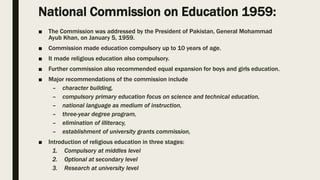
National Commission on Education 1959:
■ The Commission was addressed by the President of Pakistan, General Mohammad
Ayub Khan, on January 5, 1959.
■ Commission made education compulsory up to 10 years of age.
■ It made religious education also compulsory.
■ Further commission also recommended equal expansion for boys and girls education.
■ Major recommendations of the commission include
– character building,
– compulsory primary education focus on science and technical education,
– national language as medium of instruction,
– three-year degree program,
– elimination of illiteracy,
– establishment of university grants commission,
■ Introduction of religious education in three stages:
1. Compulsory at middles level
2. Optional at secondary level
3. Research at university level
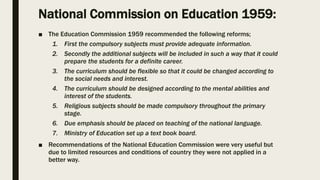
National Commission on Education 1959:
■ The Education Commission 1959 recommended the following reforms;
1. First the compulsory subjects must provide adequate information.
2. Secondly the additional subjects will be included in such a way that it could
prepare the students for a definite career.
3. The curriculum should be flexible so that it could be changed according to
the social needs and interest.
4. The curriculum should be designed according to the mental abilities and
interest of the students.
5. Religious subjects should be made compulsory throughout the primary
stage.
6. Due emphasis should be placed on teaching of the national language.
7. Ministry of Education set up a text book board.
■ Recommendations of the National Education Commission were very useful but
due to limited resources and conditions of country they were not applied in a
better way.
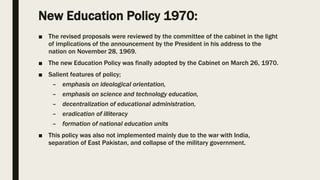
New Education Policy 1970:
■ The revised proposals were reviewed by the committee of the cabinet in the light
of implications of the announcement by the President in his address to the
nation on November 28, 1969.
■ The new Education Policy was finally adopted by the Cabinet on March 26, 1970.
■ Salient features of policy;
– emphasis on ideological orientation,
– emphasis on science and technology education,
– decentralization of educational administration,
– eradication of illiteracy
– formation of national education units
■ This policy was also not implemented mainly due to the war with India,
separation of East Pakistan, and collapse of the military government.
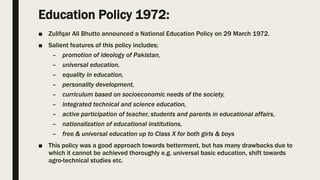
Education Policy 1972:
■ Zulifqar Ali Bhutto announced a National Education Policy on 29 March 1972.
■ Salient features of this policy includes;
– promotion of ideology of Pakistan,
– universal education,
– equality in education,
– personality development,
– curriculum based on socioeconomic needs of the society,
– integrated technical and science education,
– active participation of teacher, students and parents in educational affairs,
– nationalization of educational institutions,
– free & universal education up to Class X for both girls & boys
■ This policy was a good approach towards betterment, but has many drawbacks due to
which it cannot be achieved thoroughly e.g. universal basic education, shift towards
agro-technical studies etc.
National Education Policy 1979:
■ Minister for Education announced this policy in October 1978.
■ The draft work plan of the policy was presented to the Cabinet in December, 1978.
■ The Policy was announced in February 1979.
■ In 1979 National Educational Conference was held for reviewing the education system
and developed following aims:
1. Fostering loyalty to Islam
2. Creation of concept of Muslim Ummah
3. Promotion of science and technical education
4. Equal opportunities
■ The following strategies were suggested to achieve the goals,
– Curriculum revision
– Merging madrassa and traditional education
– Urdu as a medium of education
– Effective participation of community in literacy programs
– Linked scientific and technical education
– Separate set up for male and female.
■ This policy was not implemented properly and failed due to lack of planning and financial
resources.
National Education Policy 1992:
■ A National Conference was held at Islamabad in April, 1991 under the chairmanship of
the Federal Education Minister.
■ In this Conference scholars, writers, newspaper editors, scientists, teachers and
Lawyers proposals for preparing the Education Policy.
■ The policy framework was discussed by the Education Minister with the Education
Committees of the Senate and the National Assembly.
■ The Policy was announced in December 1992.
■ The major aspect, aims and goals of National Education Policy includes;
– promotion of Islamic values through education,
– improvement in women education,
– range of general and technical education at secondary level,
– demand oriented curriculum,
– expended span of graduation and post-graduation,
– use of AV aids promoting private sector to participate in enhancement of literacy.
■ This policy could not be implemented due to change in political scenario of country.
National Education Policy 1998:
■ The Prime Minister advised the Ministry of Education to design a new Education
Policy in January 1998.
■ The first revised draft was submitted to the Cabinet on 18 February, 1998.
■ The Policy was announced in March 1998.
■ Major objectives of National Education Policy includes;
– making the Quranic principles and Islamic practices an integral part of education
system,
– to achieve universal primary education,
– to meet the basic educational needs of every individual,
– to expand the basic education,
– to ensure equal opportunity of higher education,
– laid emphasis on diversification,
– to make curriculum development a continuous process,
– to introduce in-service training programs for betterment of education.
National Education Policy 1998:
■ Suggestions for achievement of above goals were,
– Introduction of idea of multiple text
– Development of National Testing Services
– Expansion and emphasis on technical and science education
– Upgrading the quality of Deeni Madaras
– Teacher training programs both pre and in service
– Introduction of comprehensive monitoring system
■ National Education Policy (1998-2010) also discussed Uniform curricula for all the
public and private sectors shall be adopted gradually.
■ Curriculum at secondary stage will be based on following principals
– Compulsory subjects
The knowledge that is useful for a developing society
– Additional subjects
To prepare the students for a definite career
– Developing insight (Problem solving ability)
– Independent thinking
– Introducing innovative design in textbooks
Education Sector Reforms 2005-2010:
■ This originated from the policy of 1998-2010 and focuses on development of human
resources.
■ The existing Education Policy was announced in 2009.
■ The major thrust areas of ESR includes;
– free and universal primary education,
– free text books,
– equal access to opportunities of learning and improving all aspects in quality
education,
– introduction of new educational curricula,
– development of training learning resources and materials,
– offering incentives for private sector,
– introduction of computer course at all levels,
– strengthening of research in higher education and grant for affiliation
of madrasas.
National Curriculum 2006-2007:
■ The key features of the National Curriculum 2006-2007 are as follows:
– Learning objectives correspond to students’ learning outcomes (SLOs)
– Progressive approaches for primary, middle, secondary and tertiary stages of
learning
– Life skills are integrated across subjects - vertical and horizontal connections
are ensured
– Focus on promoting creative writing and analytical thinking for learners
rather than rote learning
– Detailed guidelines have been provided in the curriculum for textbook writers
and teachers for delivery of the curriculum effectively
– Guidelines have been provided for assessment and evaluation in addition to
the learning outcomes specified in the Curriculum
Curriculum Reforms 2000-2009 – Milestones
Achieved & Planned
■ 2000 – Review of Basic Science Subjects under Education Sector Reforms Action
Plan 2001-06 and production of textbooks
■ 2002 - Review of Social Science Subjects under ESR and production of textbooks
■ 2005 - Comprehensive review of all subjects
■ 2006-7- Completion of review National Curriculum 2006-7 and its publication
■ 2007 - National Textbook and Learning Materials Policy and Plan of Action – 2007-
2010 Implementation of National Curriculum 2006-7
■ 2007-9 - Development of textbooks in phases. Phase I = Grades I, VI, IX & XI
National Education Policy 2017-2025:
■ National and international developments in education have created conditions for
revision of National Education Policy 2009.
■ Global competition demands human capital that is creative, constructive and
contributing to individual and collective wellbeing.
■ Locally these new developments include devolution of social sector ministries
including;
■ Ministry of Federal Education and Professional Training under 18th amendment,
■ Insertion of article 25(a) in the constitution under which free and compulsory
education of all the children aged 5-16 (up to matric) became a fundamental right
and the state responsibility,
■ Replacement of Education For All (EFA) and Millennium Development Goals (MDGs)
by the UN’s Sustainable Development Goals (SDGs) that have been adopted by
Pakistan also as its own Agenda for Development.
Curriculum reforms in Pakistan (1947-2020)