CLASSROOM MANAGEMENT
TAKE A FEW MINUTES TO:
• Define what “Classroom management” means for you.
• Then share your ideas with a partner and identify similarities
and differences.
• What is the basis of such definition you provided?
CLASSROOM MANAGEMENT: DEFINITION
• Richard (1990), classroom management is defined as an
organisation and how a teacher controls the students’
behaviour so that the teaching and learning process can
happen effectively.
• Alberto& Troutman (1986), classroom management is a skill
which requires the teacher to manage the time, space,
resources and students´ behaviour in preparing a conductive
learning environment.
• Your classroom management is the way that you manage
students´ learning by organising and controlling what
happens in your classroom….
• Or the way that you consciously decide not to organize and
control.
• Or the way that you delegate or relinquish such control to the
learners.
• Your classroom management choices play a large part in
creating the individual working atmosphere or your class—
how it feels to be in a room with you as a teacher.
• Such choices reflect what you believe about teaching and
learning.
• Behind each selection of a technique is an intention—the
thing that you want to happen.
THE AIMS OF CLASSROOM MANAGEMENT:
• Encourage the desired behaviour from the students
• Create positive learning environment
• Form an interpersonal relationship between the teacher and
students
• Use the time allocated for learning to optimal
• Encourage the involvement of students in the teaching and
learning process
• Reduce the disciplinary problems
• Manage an effective routine
• Students will become more independent
CLASSROOM MANAGEMENT VS METHODOLOGY
• The techniques of classroom management are independent of
whichever method is used since they undelie all methods.
• The most effective teaching and learning is going to happen
when learners are actively involved, interested and engaged in
their work.
• All effective teaching requires an active momento-by-
momento processing of the current situation and a flexible
ever-changing reflection as to what might be the best thing to
do next.
• Good classroom management involves learning from
experience, but never allowing that experience to put you into
automatic pilot.
KEY ELEMENTS IN CLASSROOM MANAGEMENT
• The classroom
• The teacher
• The learner
THE CLASSROOM
• The teaching/learning space and how best to organise it and
exploit what it offers.
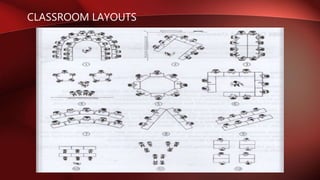
CLASSROOM LAYOUTS
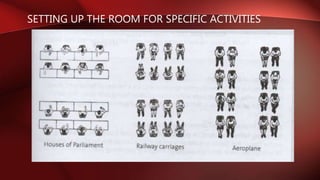
SETTING UP THE ROOM FOR SPECIFIC ACTIVITIES
IMPROVING THE CLASSROOM ENVIRONMENT
• Teachers’ main job is to create the conditions within which
learning is most likely to happen.
• What kind of environment was it? It is a vital question to ask
yourself (without reflecting on it, your are likely to uncritically
reproduce learning environments that you grew up in as a
child, even if you hated them at a time)
THINK ABOUT THE FOLLOWING:
• Atmosphere (physical and psychological aspects?
• Learners’ view of me (authority, manager, colleague, etc.)
• My view of my role as a teacher (What do I understand by a
‘teacher’?)
• Rapport (relationships among participants)
• Ownership of the room
• Democracy (who will decide things?)
• Respect
REFLECT:
• Is your classroom a place that you feel happy to walk into?
• How do you think your students feel?
• What small changes could make the biggest improvements?
WATCH THE VIDEO AND PAY ATTENTION TO:
– Classroom layout
– Teacher’s actions
– Atmosphere
– Learners’ view of the teacher
– Rapport
– Ownership of the room
– Democracy
– Respect

CLASSROOM MANAGEMENT.pptx

  • 1.
  • 2.
    TAKE A FEWMINUTES TO: • Define what “Classroom management” means for you. • Then share your ideas with a partner and identify similarities and differences. • What is the basis of such definition you provided?
  • 3.
    CLASSROOM MANAGEMENT: DEFINITION •Richard (1990), classroom management is defined as an organisation and how a teacher controls the students’ behaviour so that the teaching and learning process can happen effectively. • Alberto& Troutman (1986), classroom management is a skill which requires the teacher to manage the time, space, resources and students´ behaviour in preparing a conductive learning environment.
  • 4.
    • Your classroommanagement is the way that you manage students´ learning by organising and controlling what happens in your classroom…. • Or the way that you consciously decide not to organize and control. • Or the way that you delegate or relinquish such control to the learners.
  • 5.
    • Your classroommanagement choices play a large part in creating the individual working atmosphere or your class— how it feels to be in a room with you as a teacher. • Such choices reflect what you believe about teaching and learning. • Behind each selection of a technique is an intention—the thing that you want to happen.
  • 6.
    THE AIMS OFCLASSROOM MANAGEMENT: • Encourage the desired behaviour from the students • Create positive learning environment • Form an interpersonal relationship between the teacher and students • Use the time allocated for learning to optimal • Encourage the involvement of students in the teaching and learning process • Reduce the disciplinary problems • Manage an effective routine • Students will become more independent
  • 7.
    CLASSROOM MANAGEMENT VSMETHODOLOGY • The techniques of classroom management are independent of whichever method is used since they undelie all methods. • The most effective teaching and learning is going to happen when learners are actively involved, interested and engaged in their work. • All effective teaching requires an active momento-by- momento processing of the current situation and a flexible ever-changing reflection as to what might be the best thing to do next.
  • 8.
    • Good classroommanagement involves learning from experience, but never allowing that experience to put you into automatic pilot.
  • 9.
    KEY ELEMENTS INCLASSROOM MANAGEMENT • The classroom • The teacher • The learner
  • 10.
    THE CLASSROOM • Theteaching/learning space and how best to organise it and exploit what it offers.
  • 14.
  • 15.
    SETTING UP THEROOM FOR SPECIFIC ACTIVITIES
  • 17.
    IMPROVING THE CLASSROOMENVIRONMENT • Teachers’ main job is to create the conditions within which learning is most likely to happen. • What kind of environment was it? It is a vital question to ask yourself (without reflecting on it, your are likely to uncritically reproduce learning environments that you grew up in as a child, even if you hated them at a time)
  • 18.
    THINK ABOUT THEFOLLOWING: • Atmosphere (physical and psychological aspects? • Learners’ view of me (authority, manager, colleague, etc.) • My view of my role as a teacher (What do I understand by a ‘teacher’?) • Rapport (relationships among participants) • Ownership of the room • Democracy (who will decide things?) • Respect
  • 19.
    REFLECT: • Is yourclassroom a place that you feel happy to walk into? • How do you think your students feel? • What small changes could make the biggest improvements?
  • 20.
    WATCH THE VIDEOAND PAY ATTENTION TO: – Classroom layout – Teacher’s actions – Atmosphere – Learners’ view of the teacher – Rapport – Ownership of the room – Democracy – Respect