PREPARED BY:
PHYSICS DEPARTMENT
  SBPI TEMERLOH
2.5 Understanding the
    effects of force
Learning Outcomes

A student should be able to :


• State the effects of balanced force acting
on an object.


• State the effects of unbalanced force
acting on an object.
•Determine the relationship between
force,mass and acceleration. F=ma
 The action of pushing or pulling is a force.

 It is a vector quantity

 Its SI unit is Newton (N) or kg m sˉ²

 A force is not visible but the effect of a force
  can be observed
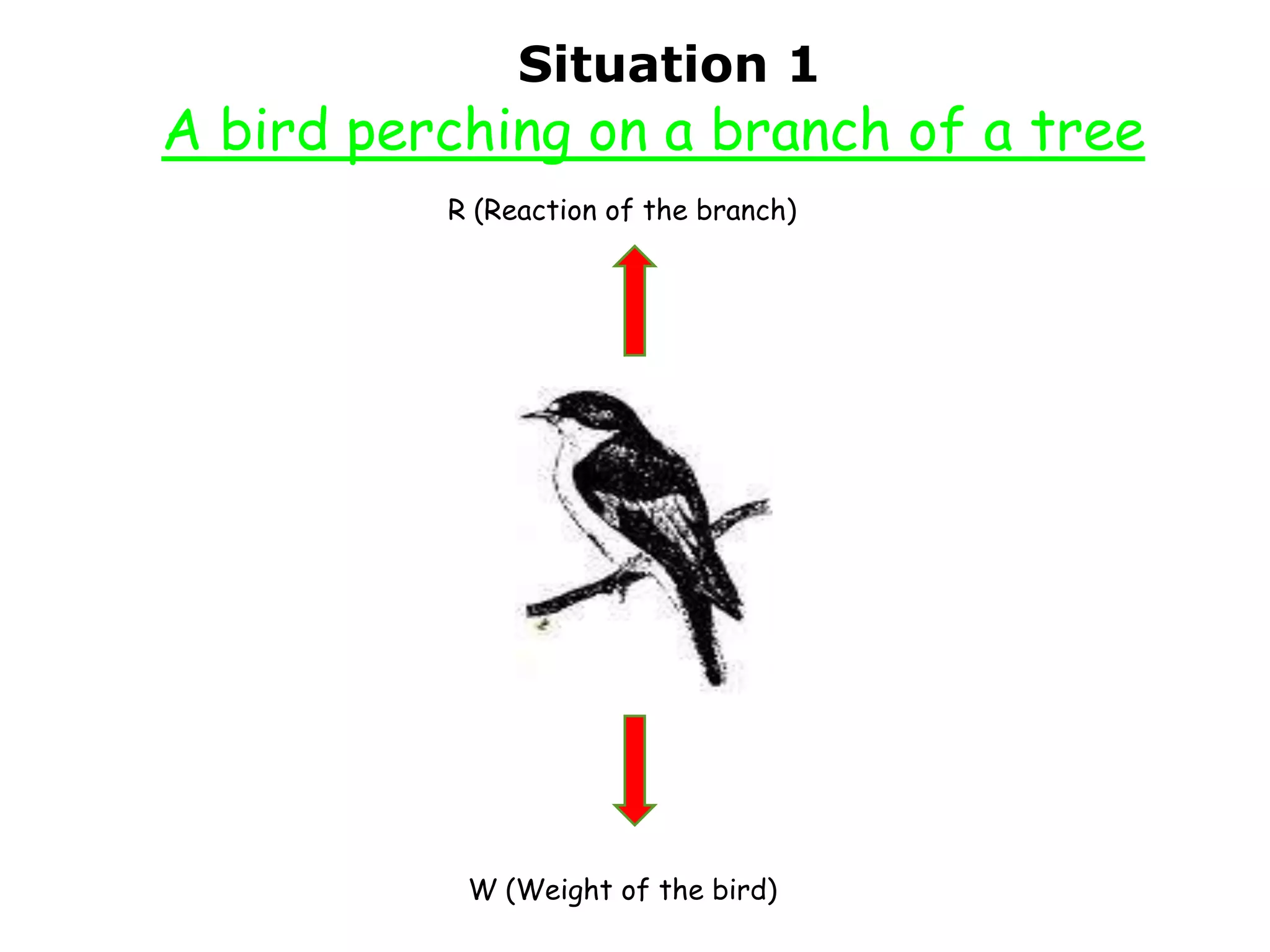
Situation 1
A bird perching on a branch of a tree
          R (Reaction of the branch)


           W (Weight of the bird)
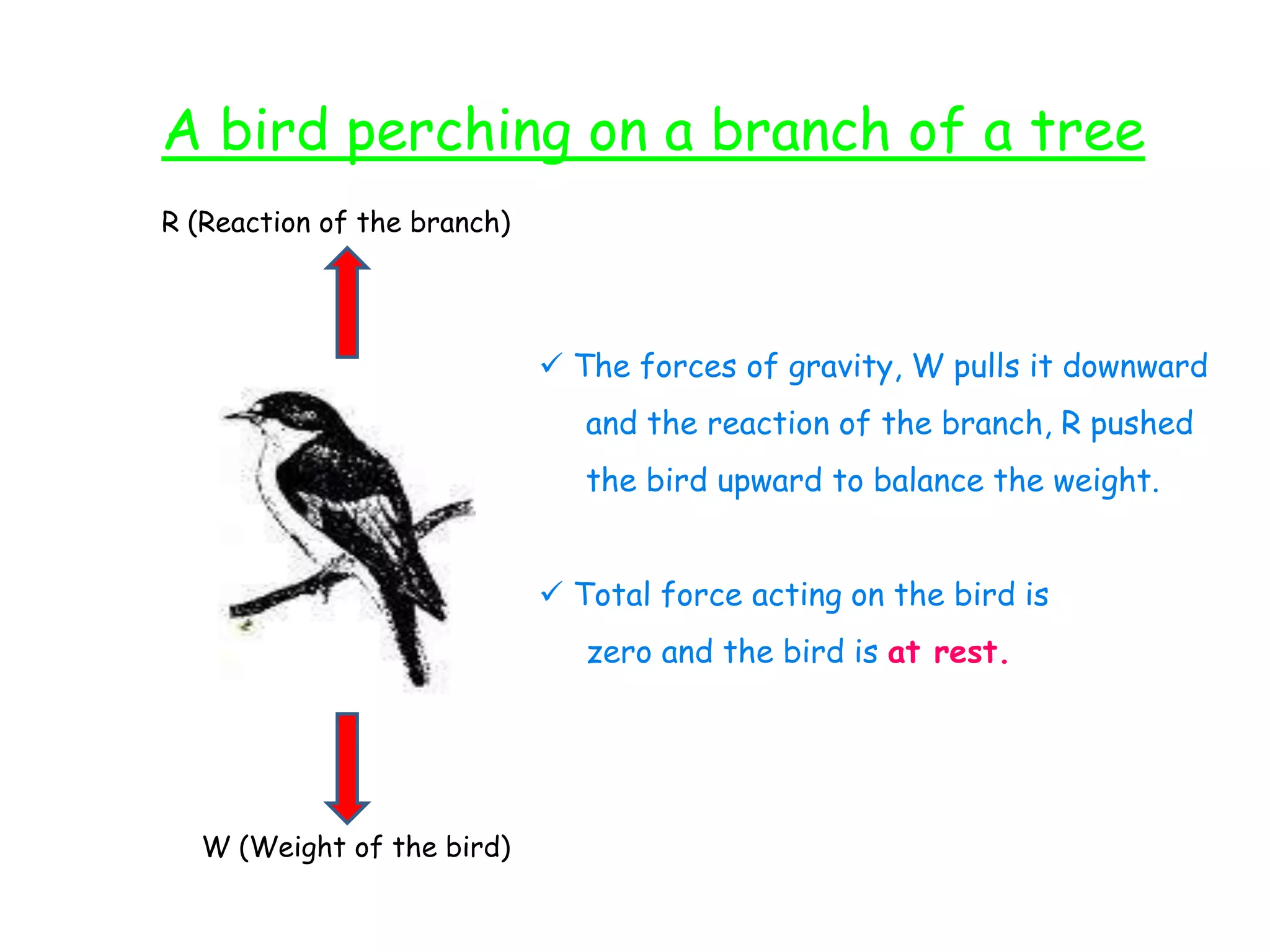
A bird perching on a branch of a tree
R (Reaction of the branch)


                              The forces of gravity, W pulls it downward
                                and the reaction of the branch, R pushed
                                the bird upward to balance the weight.


                              Total force acting on the bird is
                                zero and the bird is at rest.


  W (Weight of the bird)
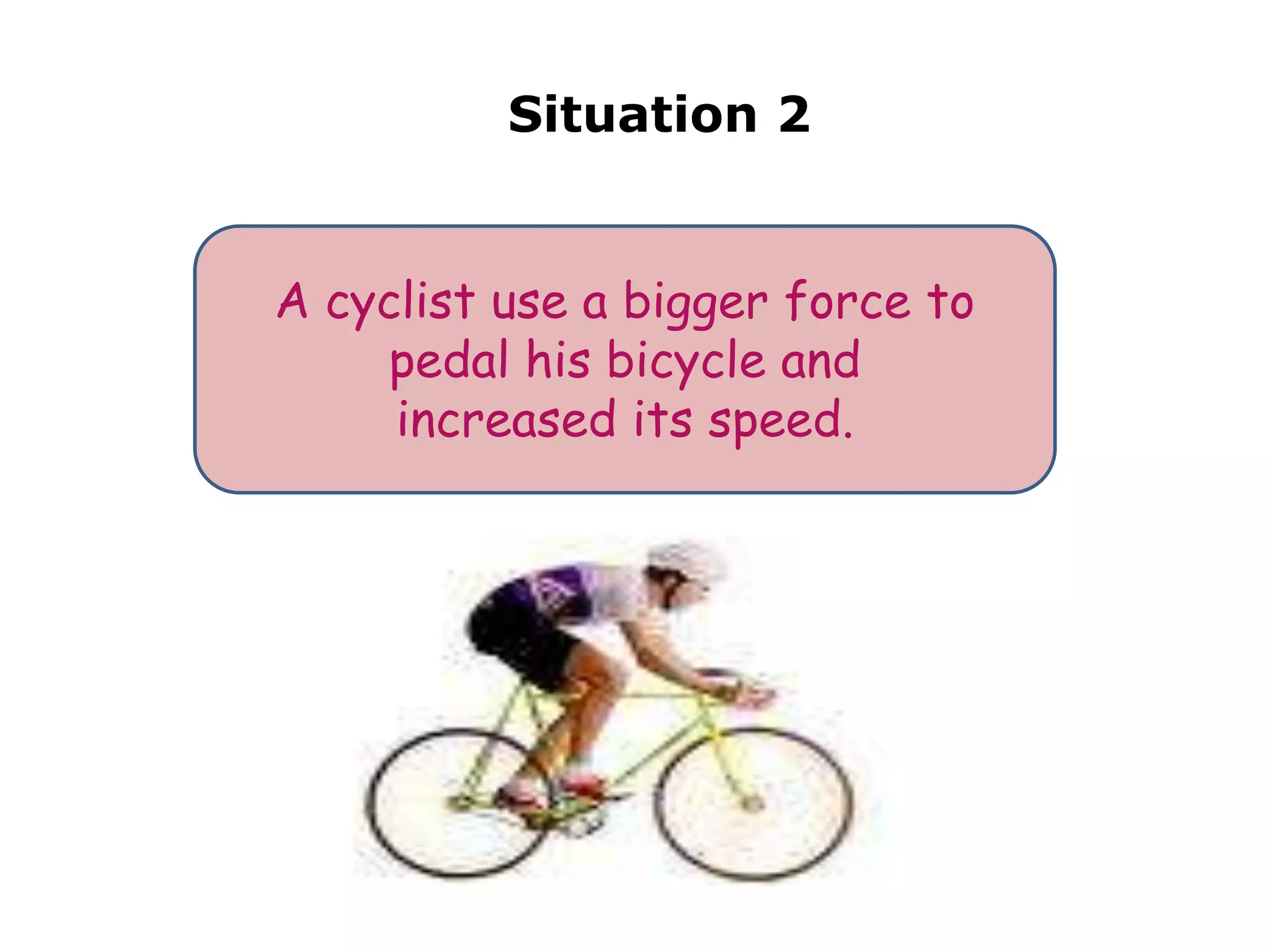
Situation 2


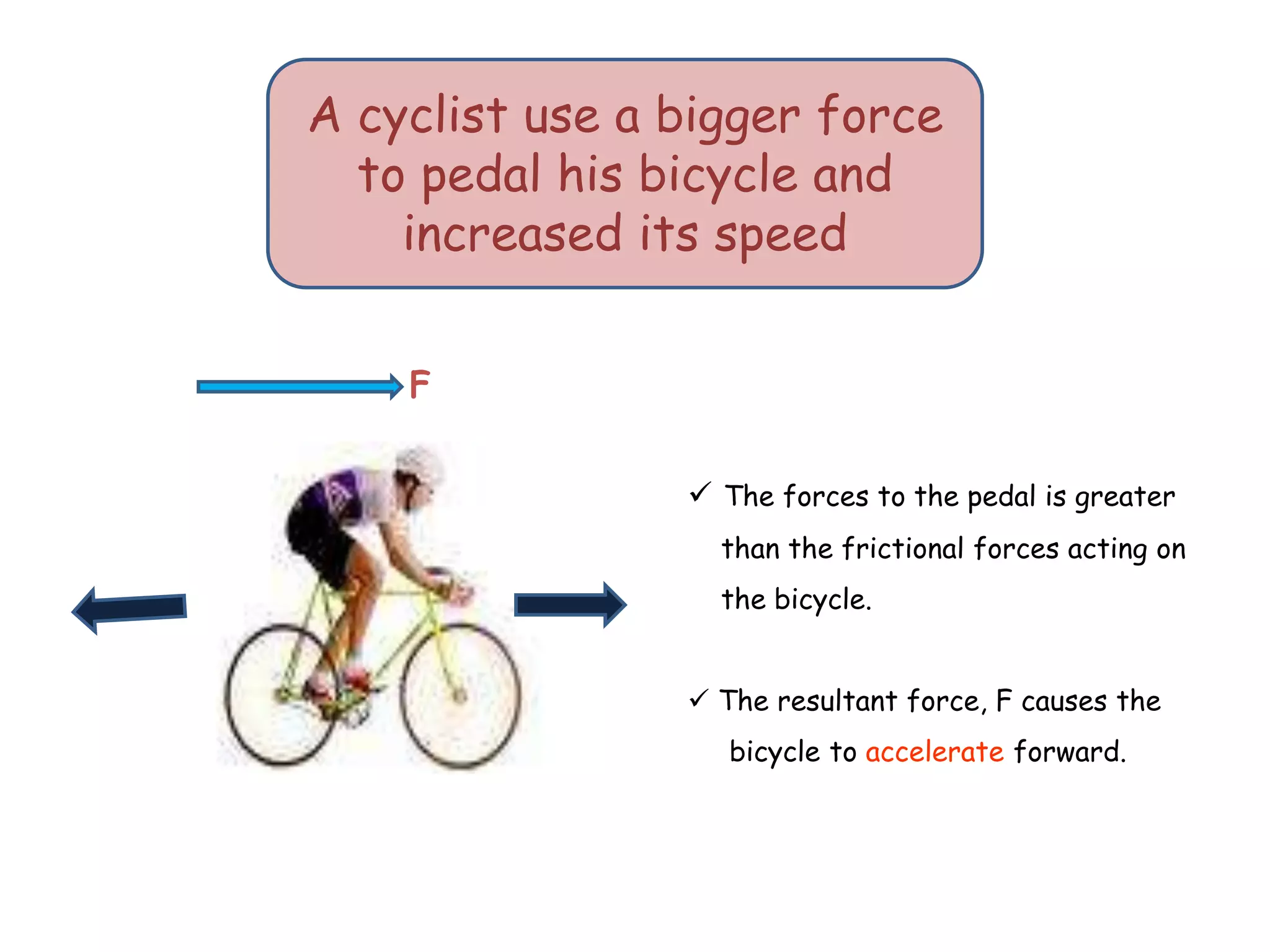
A cyclist use a bigger force to
    pedal his bicycle and
     increased its speed.
A cyclist use a bigger force
  to pedal his bicycle and
    increased its speed

    F


                 The forces to the pedal is greater
                  than the frictional forces acting on
                  the bicycle.


                 The resultant force, F causes the
                   bicycle to accelerate forward.
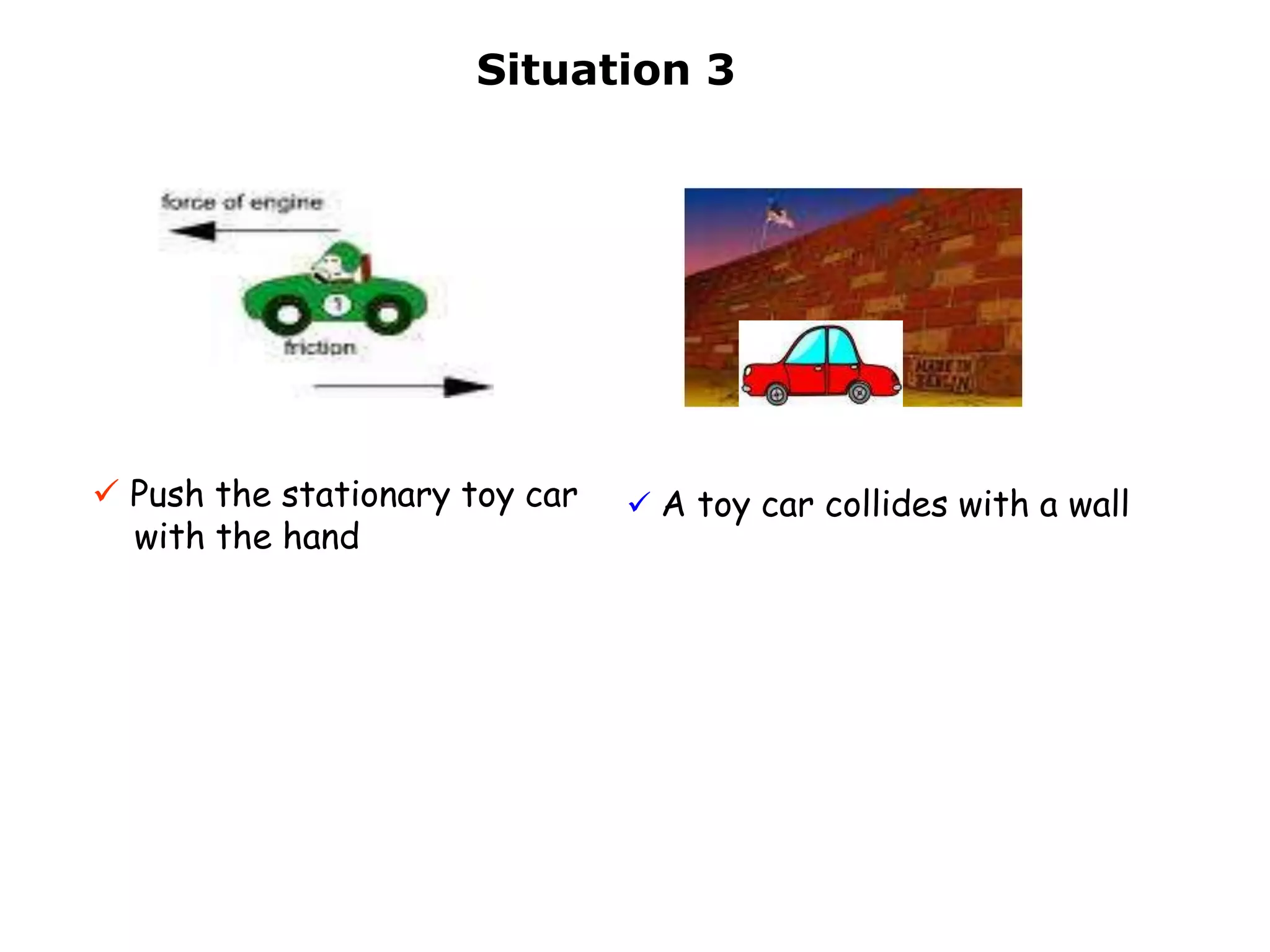
Situation 3


 Push the stationary toy car    A toy car collides with a wall
  with the hand
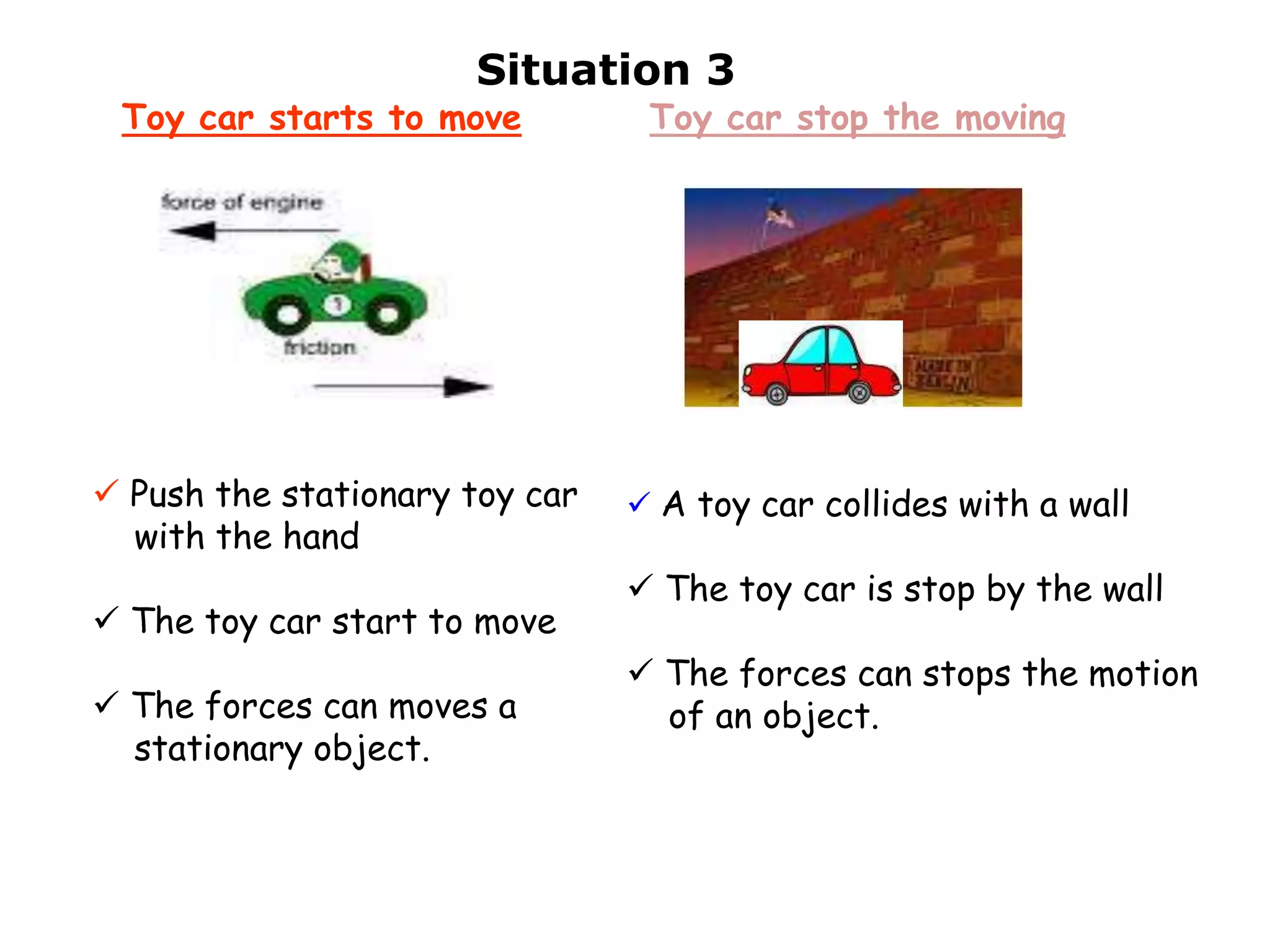
Situation 3
 Toy car starts to move          Toy car stop the moving


 Push the stationary toy car    A toy car collides with a wall
  with the hand
                                 The toy car is stop by the wall
 The toy car start to move
                                 The forces can stops the motion
 The forces can moves a          of an object.
  stationary object.
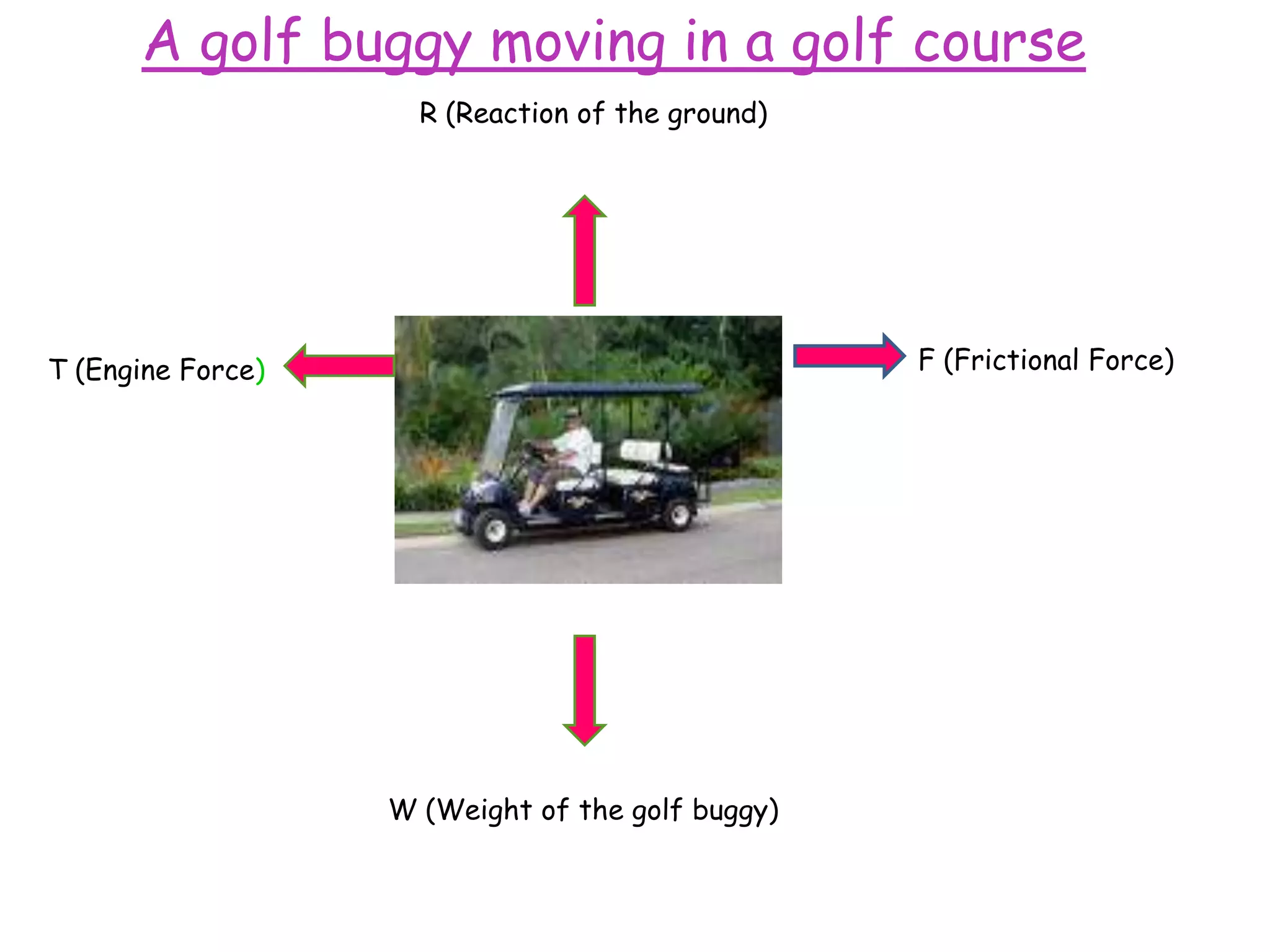
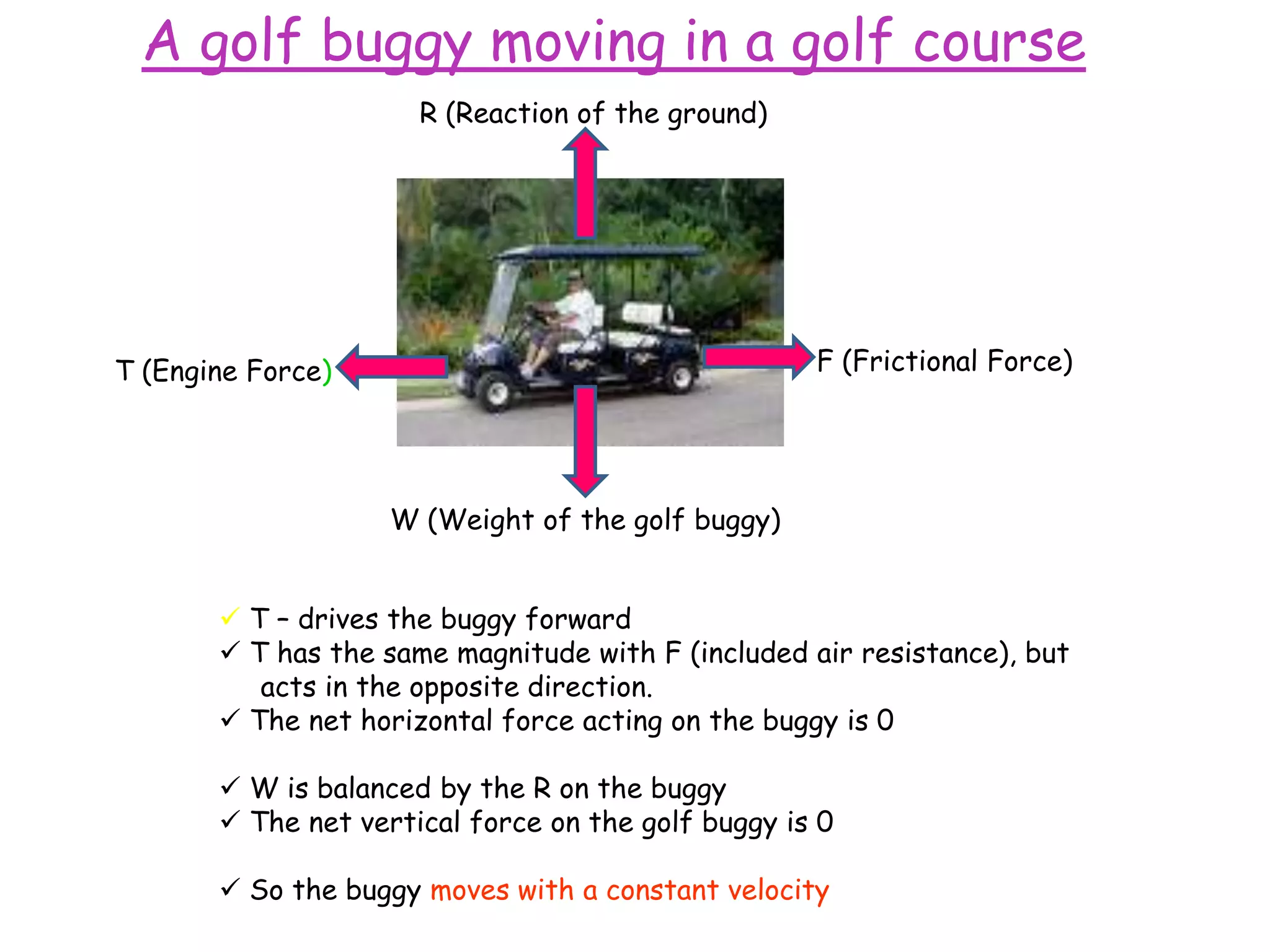
A golf buggy moving in a golf course
                     R (Reaction of the ground)


T (Engine Force)                                  F (Frictional Force)


                   W (Weight of the golf buggy)
A golf buggy moving in a golf course
                      R (Reaction of the ground)


T (Engine Force)                                    F (Frictional Force)


                    W (Weight of the golf buggy)


        T – drives the buggy forward
        T has the same magnitude with F (included air resistance), but
          acts in the opposite direction.
        The net horizontal force acting on the buggy is 0

        W is balanced by the R on the buggy
        The net vertical force on the golf buggy is 0

        So the buggy moves with a constant velocity
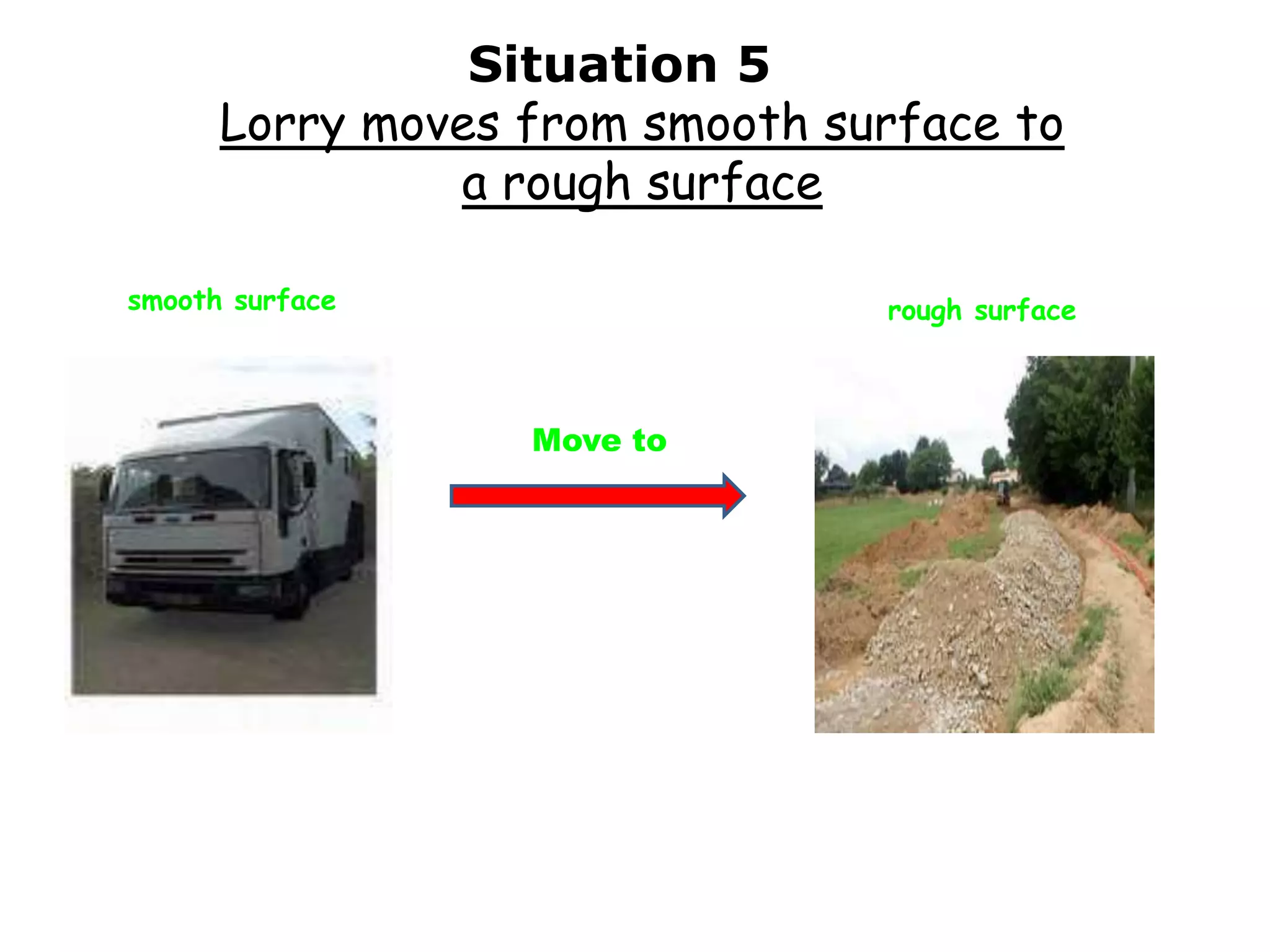
Situation 5
      Lorry moves from smooth surface to
               a rough surface

smooth surface                  rough surface


                  Move to
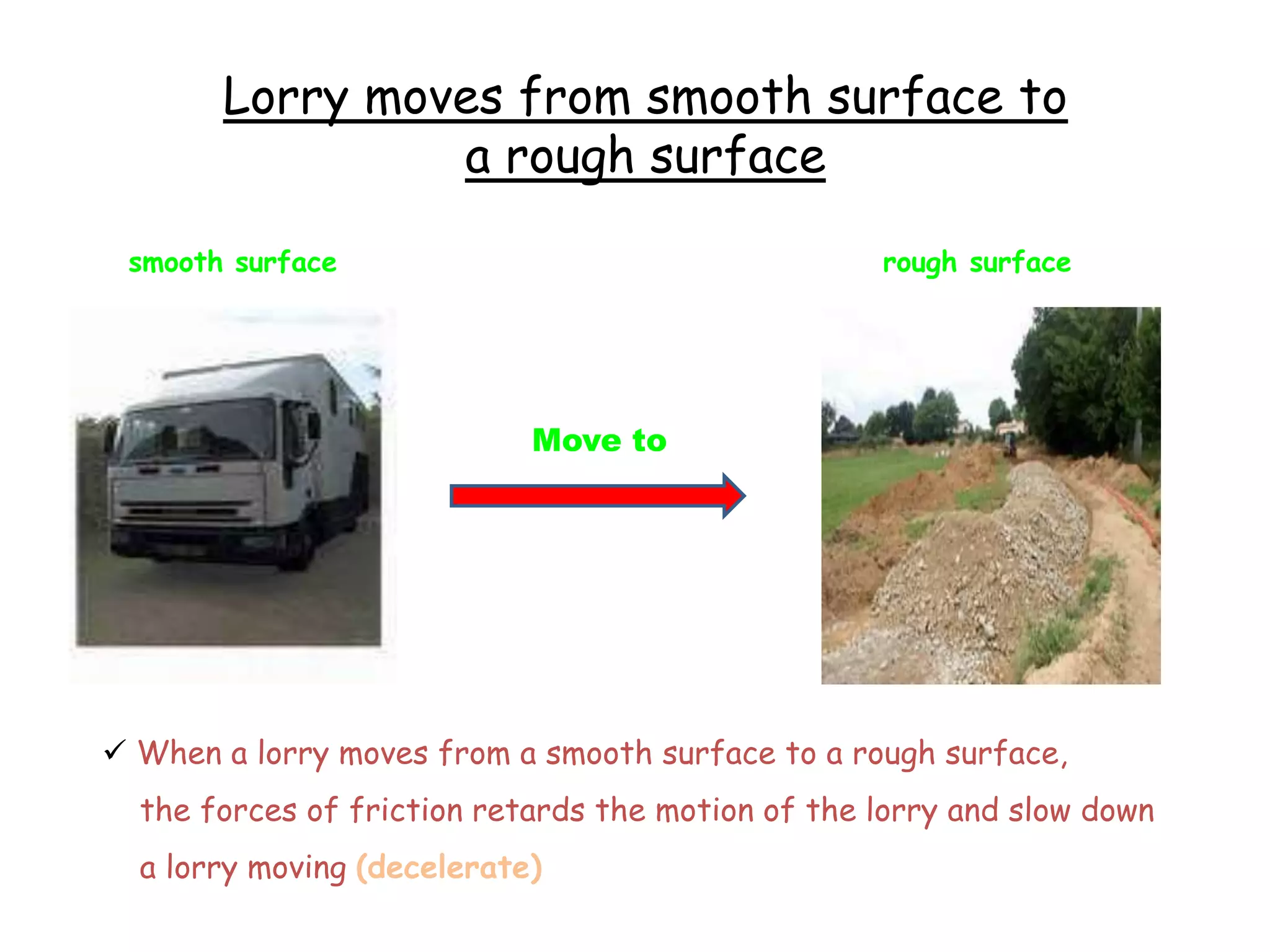
Lorry moves from smooth surface to
                a rough surface

 smooth surface                                    rough surface


                            Move to


 When a lorry moves from a smooth surface to a rough surface,
  the forces of friction retards the motion of the lorry and slow down
  a lorry moving (decelerate)
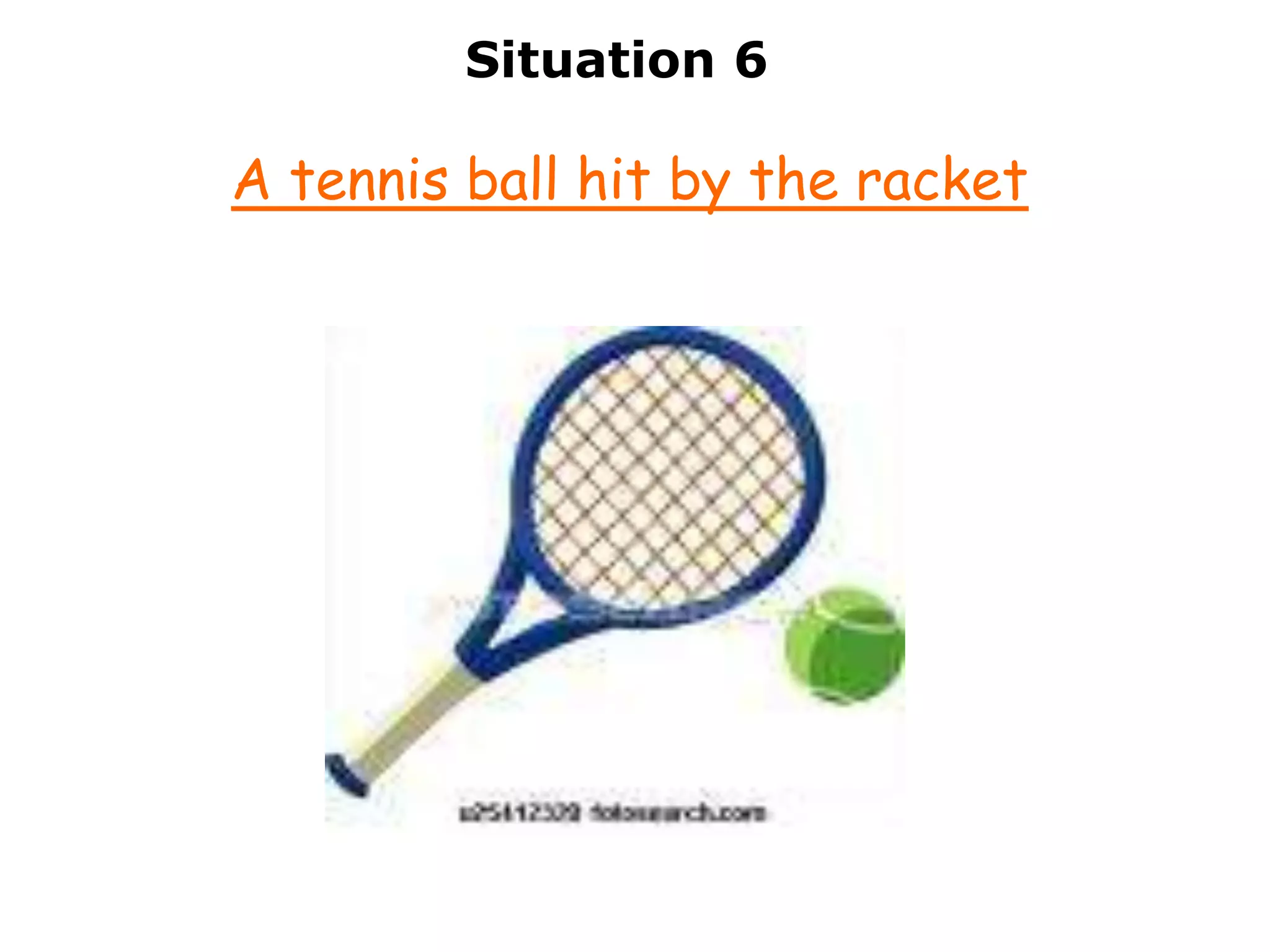
Situation 6

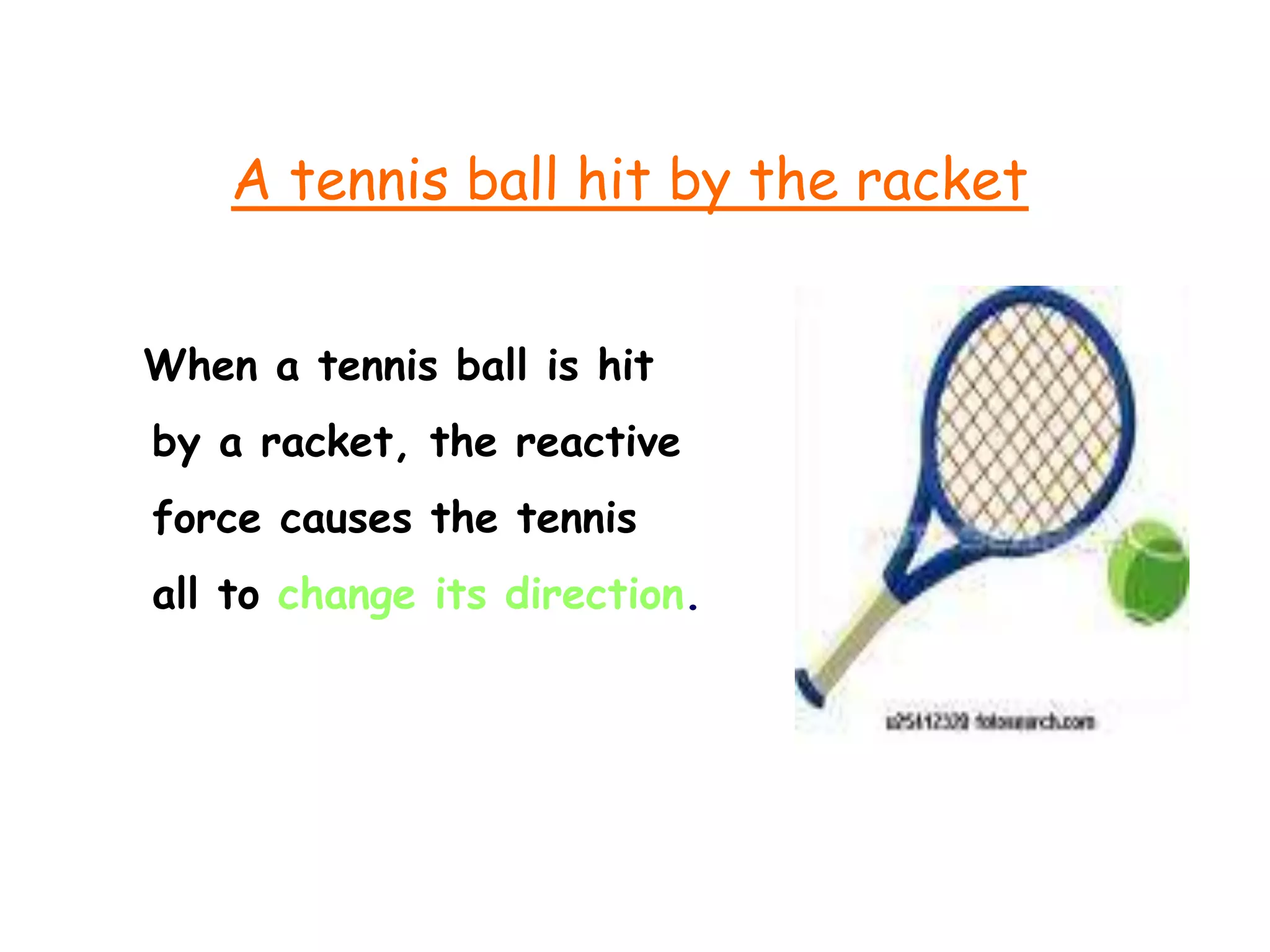
A tennis ball hit by the racket


When a tennis ball is hit
by a racket, the reactive
force causes the tennis
all to change its direction.
Situation 7

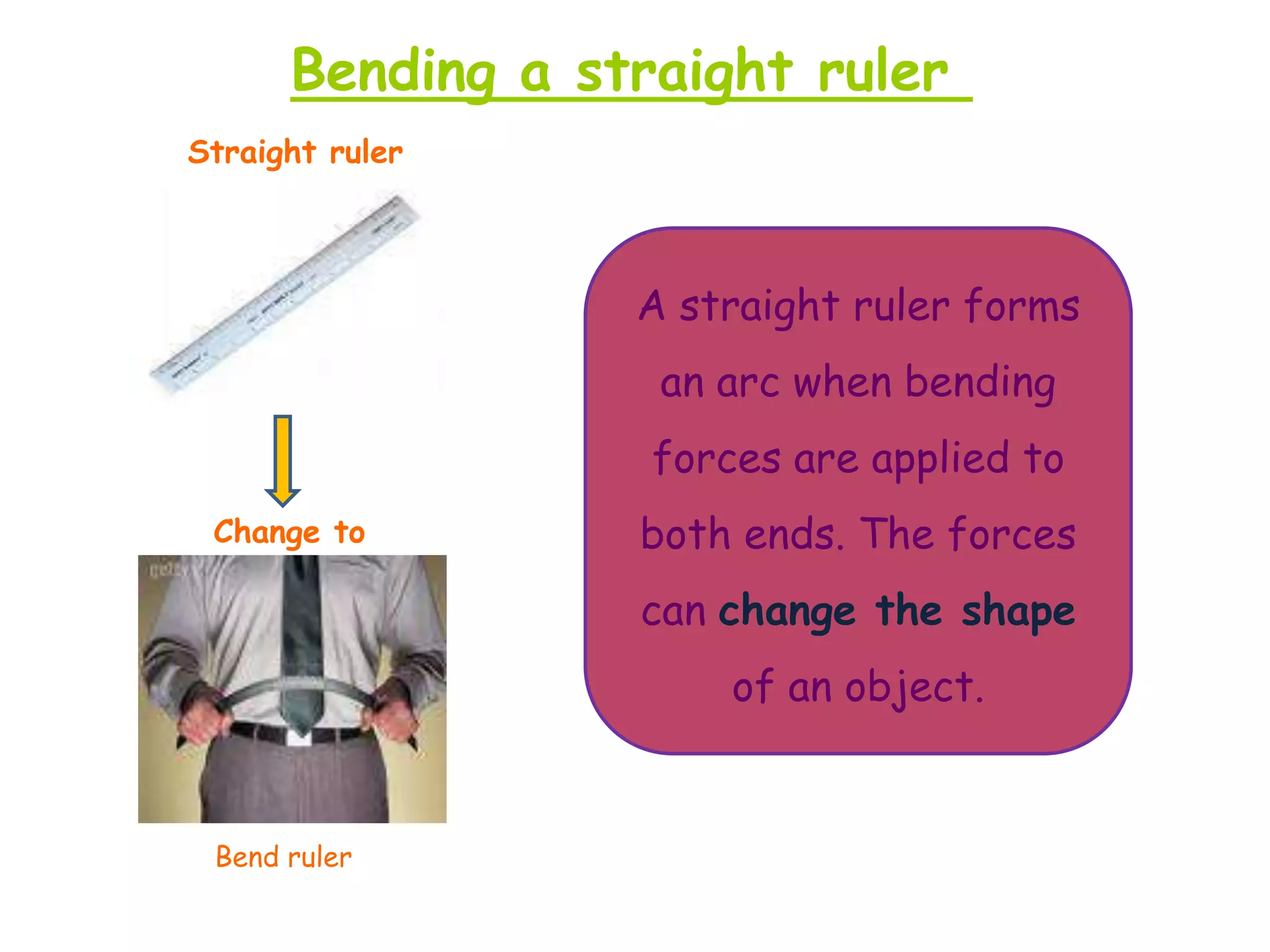
Bending a straight ruler
Straight ruler


                  A straight ruler forms
                   an arc when bending
                   forces are applied to
 Change to        both ends. The forces
                  can change the shape
                       of an object.


 Bend ruler
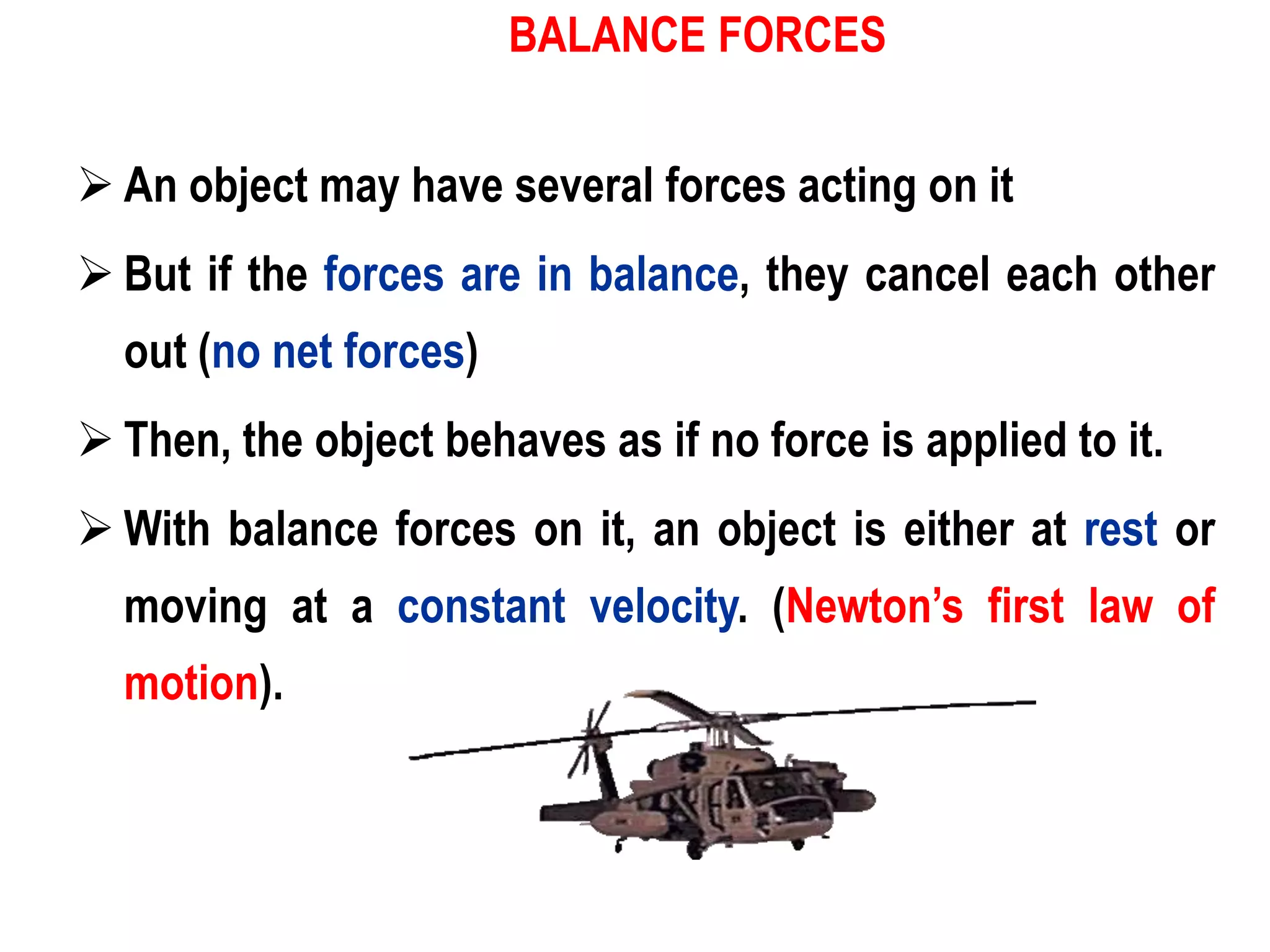
BALANCE FORCES


 An object may have several forces acting on it
 But if the forces are in balance, they cancel each other
  out (no net forces)
 Then, the object behaves as if no force is applied to it.
 With balance forces on it, an object is either at rest or
  moving at a constant velocity. (Newton’s first law of
  motion).
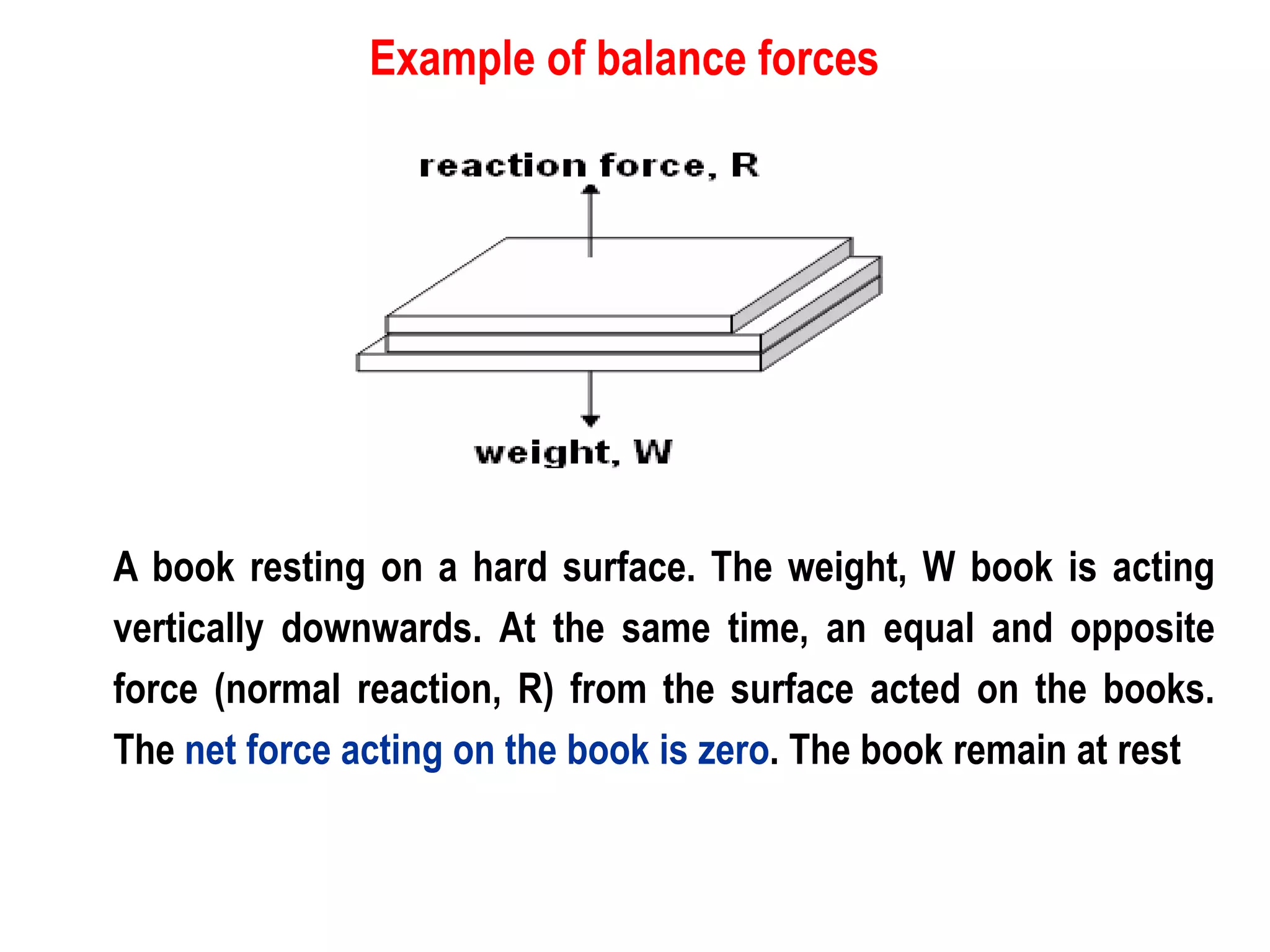
Example of balance forces


A book resting on a hard surface. The weight, W book is acting
vertically downwards. At the same time, an equal and opposite
force (normal reaction, R) from the surface acted on the books.
The net force acting on the book is zero. The book remain at rest
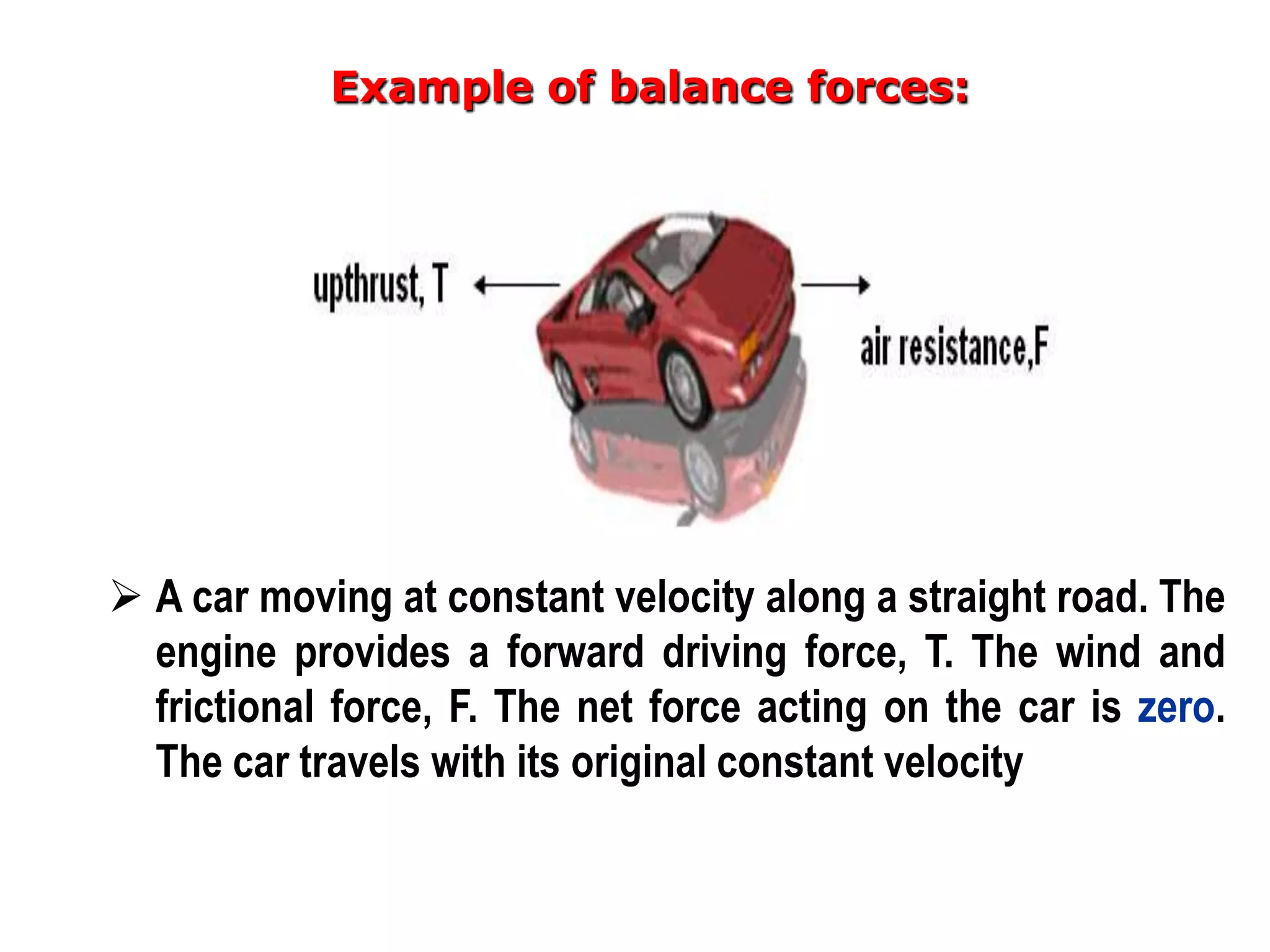
Example of balance forces:


 A car moving at constant velocity along a straight road. The
  engine provides a forward driving force, T. The wind and
  frictional force, F. The net force acting on the car is zero.
  The car travels with its original constant velocity
Example of balance forces:


An airplane is flying horizontally at a constant height with a
constant velocity. The engine provides a forward thrust,T. The
wind and air resistance provides a drag, F against the forwards
motion. The wings of the plane provide a lift, L vertically to
balance its downward weight, W. When these four forces are
balanced, the net force acting on the plane is zero. This means
that the lift force is equal to its weight, and the forward thrust is
equal to the drag.
UNBALANCED FORCE

• When two or more forces acting on a body are not balance, there
  must be a net force acting on it.
• This net force is known as the unbalanced force or the resultant
  force.
• An object will accelerate if the forces acting on it are not balance.
• Unbalanced forces acting on an object can cause the object:

   (i)   to start or stop moving
                  when a golfer hits a stationary golf ball, a force acts on
                  the ball and causes it to fly off from rest. The net force
                  or the unbalance force causes the golf ball to
                  accelerate.
(ii)   to accelerate or decelerate

       -when the engine of a moving car is shut down, the car will
       slow down and finally stop. The net force due to friction is
       acting against the direction of the   motion of the car. It
       causes the car to decelerate

(iii) to change its direction

       -when a footballer kicks a fast moving ball towards him, the
       ball bounces off and moves in other direction. The
       unbalanced force causes the ball to change its direction.
• The motion of a body due to an unbalanced force is closely
  related to Newton’s second law of motion

• the acceleration of moving body is related to the net force
  applied on it and the mass of the body
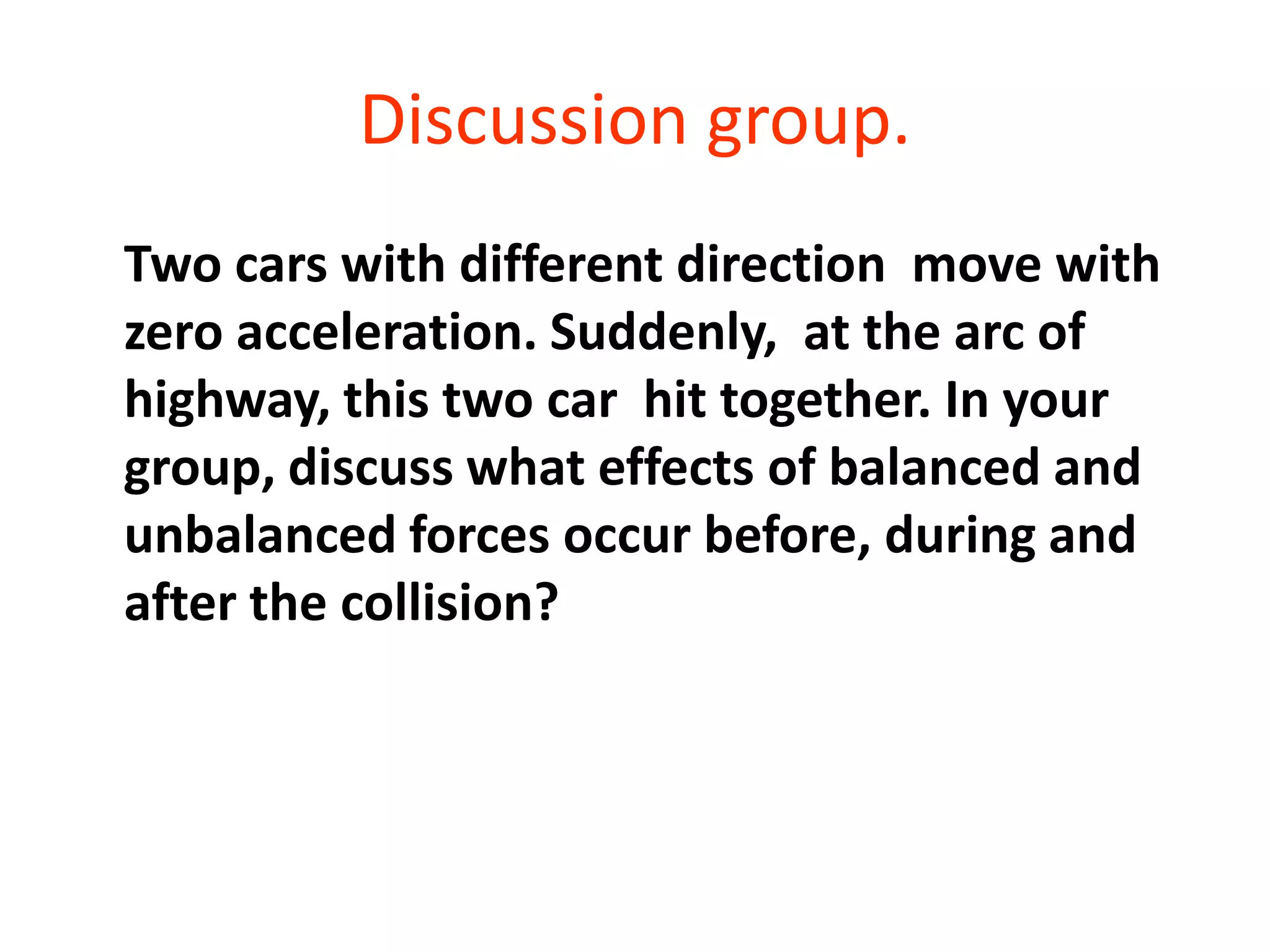
Discussion group.
Two cars with different direction move with
zero acceleration. Suddenly, at the arc of
highway, this two car hit together. In your
group, discuss what effects of balanced and
unbalanced forces occur before, during and
after the collision?
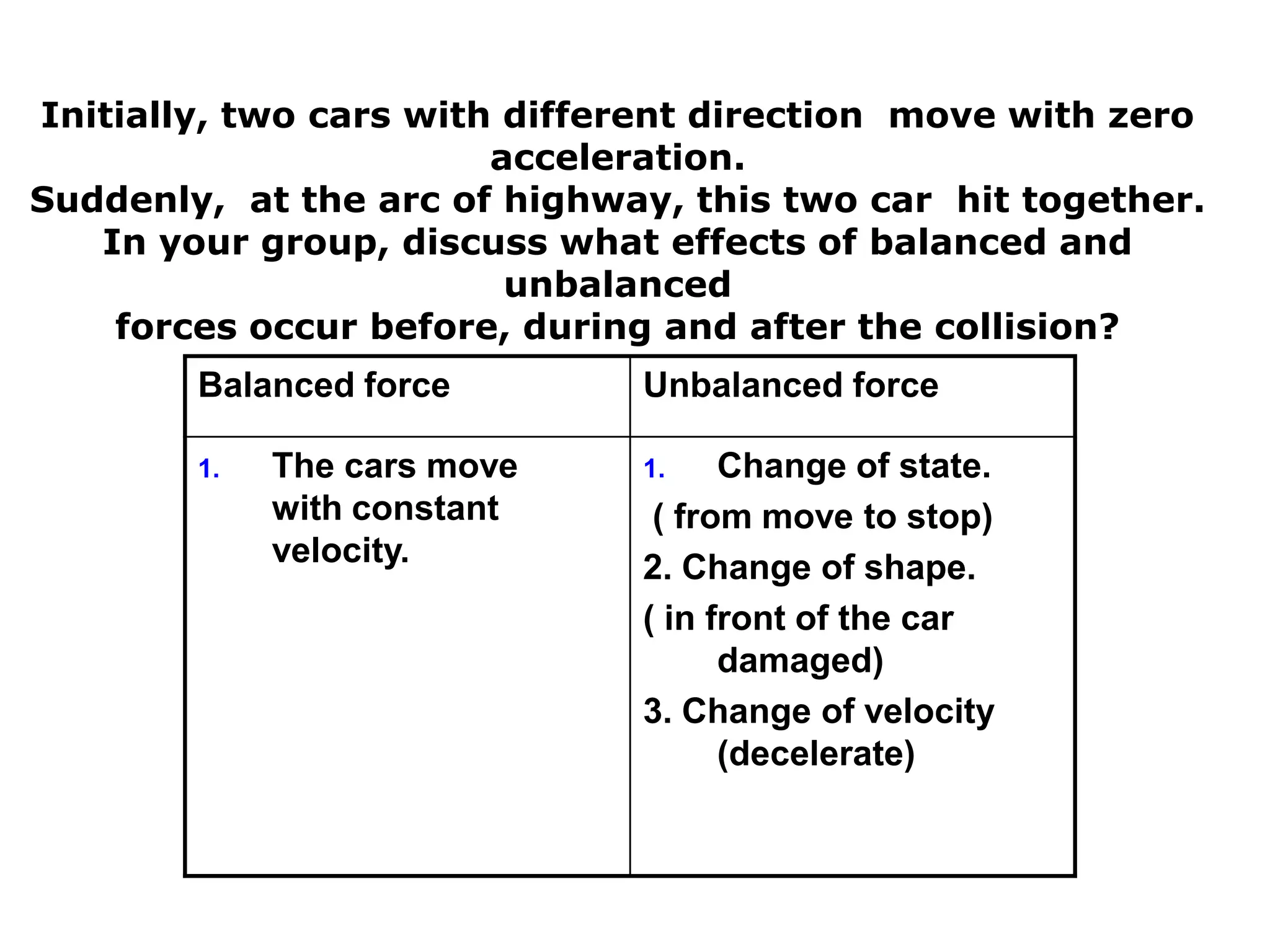
Initially, two cars with different direction move with zero
                        acceleration.
Suddenly, at the arc of highway, this two car hit together.
   In your group, discuss what effects of balanced and
                         unbalanced
    forces occur before, during and after the collision?
        Balanced force        Unbalanced force

        1.   The cars move    1.    Change of state.
             with constant     ( from move to stop)
             velocity.        2. Change of shape.
                              ( in front of the car
                                    damaged)
                              3. Change of velocity
                                    (decelerate)
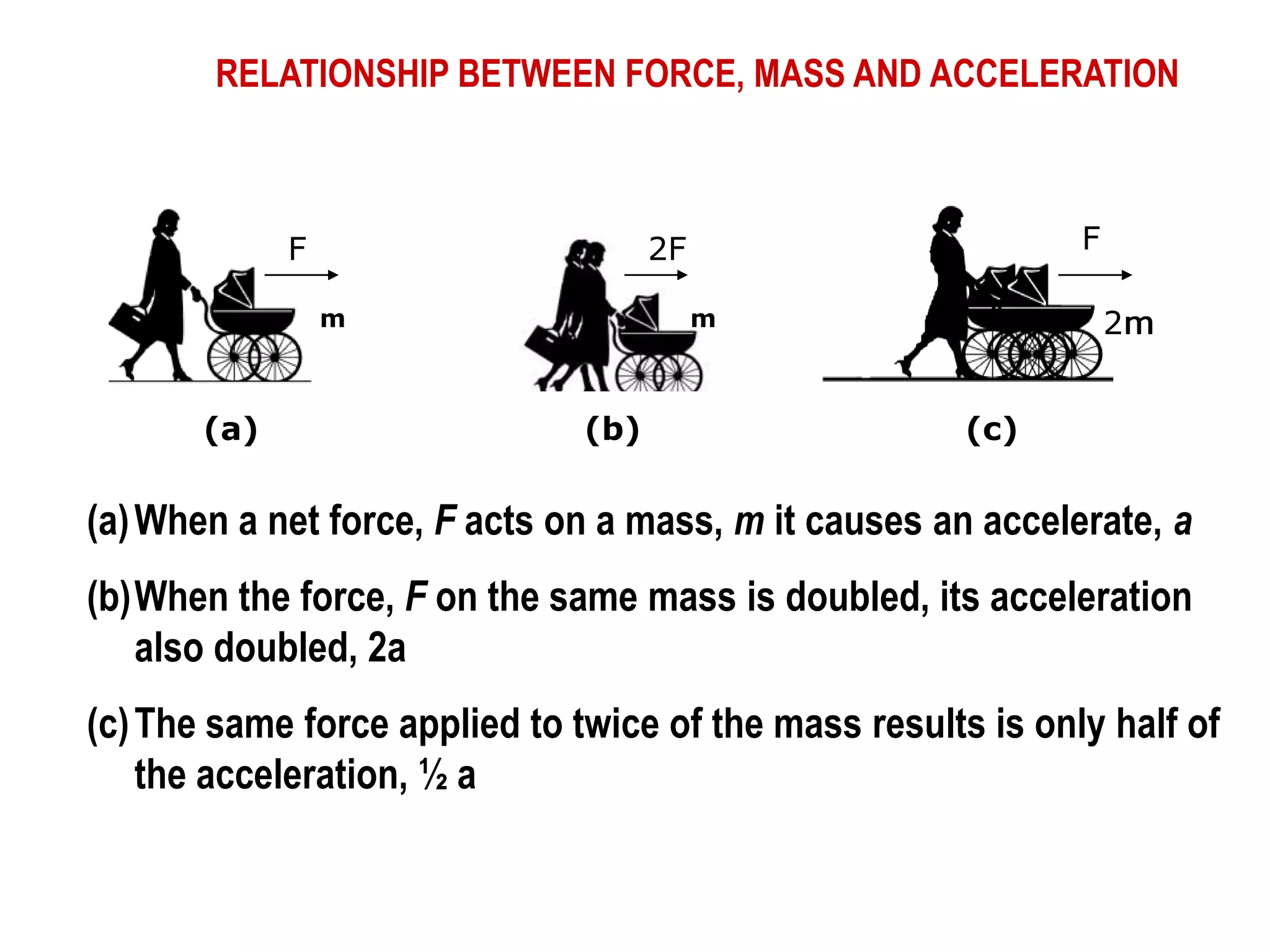
RELATIONSHIP BETWEEN FORCE, MASS AND ACCELERATION


             F                       2F                       F

                 m                        m                       2m
                                                                   m


       (a)                     (b)                     (c)

(a) When a net force, F acts on a mass, m it causes an accelerate, a
(b)When the force, F on the same mass is doubled, its acceleration
   also doubled, 2a
(c) The same force applied to twice of the mass results is only half of
    the acceleration, ½ a
• Newton’s second law of motion states
  the acceleration produced by a net force on an object is directly
  proportional to the magnitude of the net force applied and is
  inversely proportional to the mass of the object. The direction
  of the acceleration is the same as that of the net force
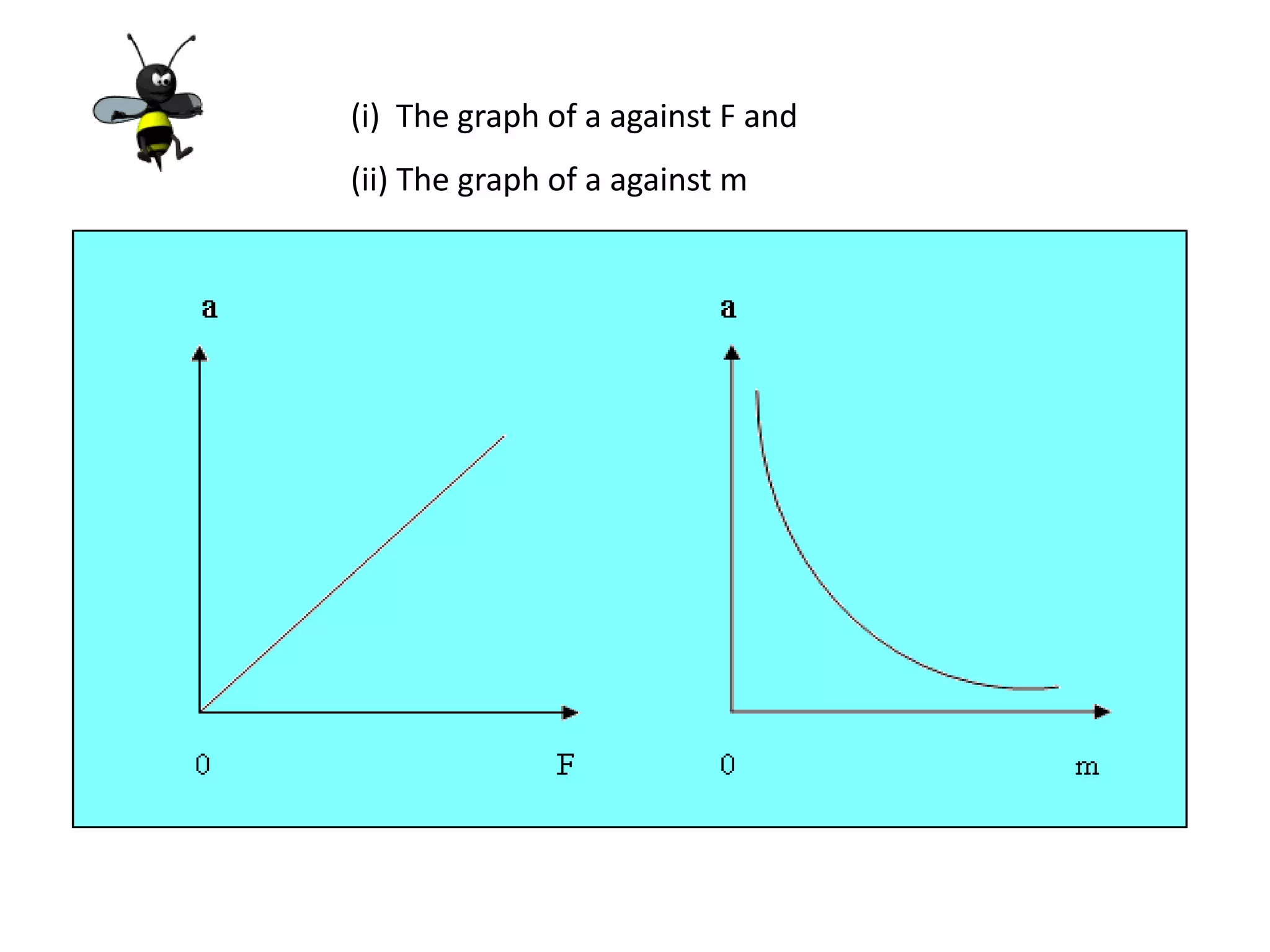
• Combining the relation ship, a ∞ F and a ∞ 1          , we get
(i) The graph of a against F and
(ii) The graph of a against m
Example:
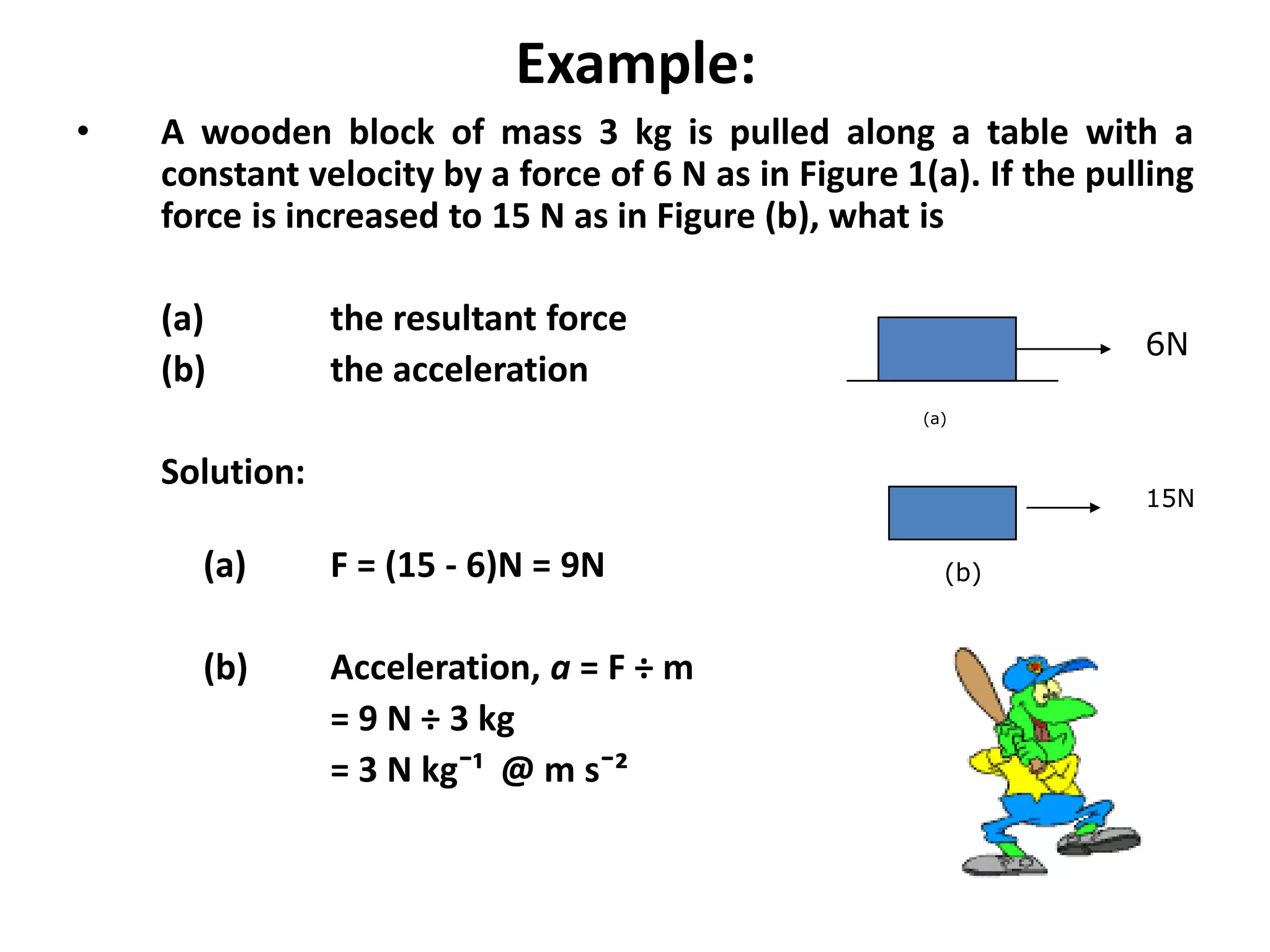
•   A wooden block of mass 3 kg is pulled along a table with a
    constant velocity by a force of 6 N as in Figure 1(a). If the pulling
    force is increased to 15 N as in Figure (b), what is

    (a)         the resultant force
                                                                     6N
    (b)         the acceleration
                                                      (a)


    Solution:
                                                                     15N

      (a)       F = (15 - 6)N = 9N                      (b)


      (b)       Acceleration, a = F ÷ m
                = 9 N ÷ 3 kg
                = 3 N kgˉ¹ @ m sˉ²
Its time to do exercise!
Exercise 2.5 the effect of force

2.5 the effects of a force edit

  • 1.
  • 3.
    2.5 Understanding the effects of force
  • 4.
    Learning Outcomes A studentshould be able to : • State the effects of balanced force acting on an object. • State the effects of unbalanced force acting on an object. •Determine the relationship between force,mass and acceleration. F=ma
  • 5.
     The actionof pushing or pulling is a force.  It is a vector quantity  Its SI unit is Newton (N) or kg m sˉ²  A force is not visible but the effect of a force can be observed
  • 6.
    Situation 1 A birdperching on a branch of a tree R (Reaction of the branch) W (Weight of the bird)
  • 7.
    A bird perchingon a branch of a tree R (Reaction of the branch)  The forces of gravity, W pulls it downward and the reaction of the branch, R pushed the bird upward to balance the weight.  Total force acting on the bird is zero and the bird is at rest. W (Weight of the bird)
  • 8.
    Situation 2 A cyclistuse a bigger force to pedal his bicycle and increased its speed.
  • 9.
    A cyclist usea bigger force to pedal his bicycle and increased its speed F  The forces to the pedal is greater than the frictional forces acting on the bicycle.  The resultant force, F causes the bicycle to accelerate forward.
  • 10.
    Situation 3  Pushthe stationary toy car  A toy car collides with a wall with the hand
  • 11.
    Situation 3 Toycar starts to move Toy car stop the moving  Push the stationary toy car  A toy car collides with a wall with the hand  The toy car is stop by the wall  The toy car start to move  The forces can stops the motion  The forces can moves a of an object. stationary object.
  • 12.
    A golf buggymoving in a golf course R (Reaction of the ground) T (Engine Force) F (Frictional Force) W (Weight of the golf buggy)
  • 13.
    A golf buggymoving in a golf course R (Reaction of the ground) T (Engine Force) F (Frictional Force) W (Weight of the golf buggy)  T – drives the buggy forward  T has the same magnitude with F (included air resistance), but acts in the opposite direction.  The net horizontal force acting on the buggy is 0  W is balanced by the R on the buggy  The net vertical force on the golf buggy is 0  So the buggy moves with a constant velocity
  • 14.
    Situation 5 Lorry moves from smooth surface to a rough surface smooth surface rough surface Move to
  • 15.
    Lorry moves fromsmooth surface to a rough surface smooth surface rough surface Move to  When a lorry moves from a smooth surface to a rough surface, the forces of friction retards the motion of the lorry and slow down a lorry moving (decelerate)
  • 16.
    Situation 6 A tennisball hit by the racket
  • 17.
    A tennis ballhit by the racket When a tennis ball is hit by a racket, the reactive force causes the tennis all to change its direction.
  • 18.
    Situation 7 Bending astraight ruler
  • 19.
    Bending a straightruler Straight ruler A straight ruler forms an arc when bending forces are applied to Change to both ends. The forces can change the shape of an object. Bend ruler
  • 20.
    BALANCE FORCES  Anobject may have several forces acting on it  But if the forces are in balance, they cancel each other out (no net forces)  Then, the object behaves as if no force is applied to it.  With balance forces on it, an object is either at rest or moving at a constant velocity. (Newton’s first law of motion).
  • 21.
    Example of balanceforces A book resting on a hard surface. The weight, W book is acting vertically downwards. At the same time, an equal and opposite force (normal reaction, R) from the surface acted on the books. The net force acting on the book is zero. The book remain at rest
  • 22.
    Example of balanceforces:  A car moving at constant velocity along a straight road. The engine provides a forward driving force, T. The wind and frictional force, F. The net force acting on the car is zero. The car travels with its original constant velocity
  • 23.
    Example of balanceforces: An airplane is flying horizontally at a constant height with a constant velocity. The engine provides a forward thrust,T. The wind and air resistance provides a drag, F against the forwards motion. The wings of the plane provide a lift, L vertically to balance its downward weight, W. When these four forces are balanced, the net force acting on the plane is zero. This means that the lift force is equal to its weight, and the forward thrust is equal to the drag.
  • 24.
    UNBALANCED FORCE • Whentwo or more forces acting on a body are not balance, there must be a net force acting on it. • This net force is known as the unbalanced force or the resultant force. • An object will accelerate if the forces acting on it are not balance. • Unbalanced forces acting on an object can cause the object: (i) to start or stop moving when a golfer hits a stationary golf ball, a force acts on the ball and causes it to fly off from rest. The net force or the unbalance force causes the golf ball to accelerate.
  • 25.
    (ii) to accelerate or decelerate -when the engine of a moving car is shut down, the car will slow down and finally stop. The net force due to friction is acting against the direction of the motion of the car. It causes the car to decelerate (iii) to change its direction -when a footballer kicks a fast moving ball towards him, the ball bounces off and moves in other direction. The unbalanced force causes the ball to change its direction.
  • 26.
    • The motionof a body due to an unbalanced force is closely related to Newton’s second law of motion • the acceleration of moving body is related to the net force applied on it and the mass of the body
  • 27.
    Discussion group. Two carswith different direction move with zero acceleration. Suddenly, at the arc of highway, this two car hit together. In your group, discuss what effects of balanced and unbalanced forces occur before, during and after the collision?
  • 28.
    Initially, two carswith different direction move with zero acceleration. Suddenly, at the arc of highway, this two car hit together. In your group, discuss what effects of balanced and unbalanced forces occur before, during and after the collision? Balanced force Unbalanced force 1. The cars move 1. Change of state. with constant ( from move to stop) velocity. 2. Change of shape. ( in front of the car damaged) 3. Change of velocity (decelerate)
  • 29.
    RELATIONSHIP BETWEEN FORCE,MASS AND ACCELERATION F 2F F m m 2m m (a) (b) (c) (a) When a net force, F acts on a mass, m it causes an accelerate, a (b)When the force, F on the same mass is doubled, its acceleration also doubled, 2a (c) The same force applied to twice of the mass results is only half of the acceleration, ½ a
  • 30.
    • Newton’s secondlaw of motion states the acceleration produced by a net force on an object is directly proportional to the magnitude of the net force applied and is inversely proportional to the mass of the object. The direction of the acceleration is the same as that of the net force • Combining the relation ship, a ∞ F and a ∞ 1 , we get
  • 31.
    (i) The graphof a against F and (ii) The graph of a against m
  • 32.
    Example: • A wooden block of mass 3 kg is pulled along a table with a constant velocity by a force of 6 N as in Figure 1(a). If the pulling force is increased to 15 N as in Figure (b), what is (a) the resultant force 6N (b) the acceleration (a) Solution: 15N (a) F = (15 - 6)N = 9N (b) (b) Acceleration, a = F ÷ m = 9 N ÷ 3 kg = 3 N kgˉ¹ @ m sˉ²
  • 33.
    Its time todo exercise! Exercise 2.5 the effect of force