Lens Enhancement-
Considering For Prescribing
Presented By:
Shivani Kansara(M.optom)
Brahamdev Mandal(M.optom)
Hari Jyot college of optometry
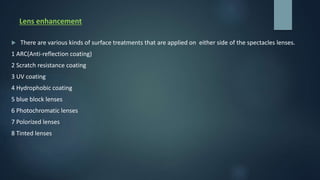
Lens enhancement
 There are various kinds of surface treatments that are applied on either side of the spectacles lenses.
1 ARC(Anti-reflection coating)
2 Scratch resistance coating
3 UV coating
4 Hydrophobic coating
5 blue block lenses
6 Photochromatic lenses
7 Polorized lenses
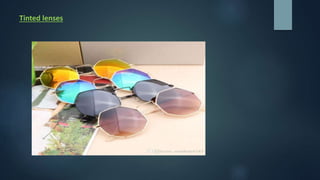
8 Tinted lenses
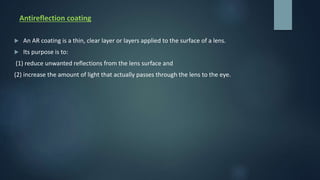
Antireflection coating
 An AR coating is a thin, clear layer or layers applied to the surface of a lens.
 Its purpose is to:
(1) reduce unwanted reflections from the lens surface and
(2) increase the amount of light that actually passes through the lens to the eye.
Antireflection coating
• Anti-reflection coatings and the more recent multi-coat anti-reflection coatings significantly
reduce the reflection at each surface.
• For a single layer anti-reflection coating the thickness of the coating is one quarter the
wavelength of light (yellow of about 550 nm is used as the reference wavelength for light). Thus
the thickness of single coatings is about 137 nm.
• Anti-reflection coatings (A/R) improve the visual function, reducing the troublesome multiple
reflections off the lens surfaces. they improve visual function and improve contrast sensitivity.
• It also makes a considerable difference to the appearance of the spectacles, taking the glassy look
off the lenses.
• A/R coatings are particularly important for high index lenses and flat form lenses, such as the new
aspheric lenses.
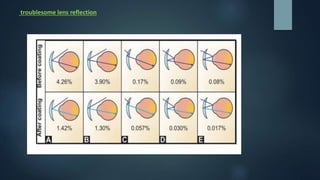
• A lens of refractive index 1.806 will lose 16.5% to reflection, compared with CR-39 which would
lose about 8%.
• Moreover, flat form lenses create troublesome reflections for the wearer. The flatter the surfaces
the more noticeable will be the surface reflections.
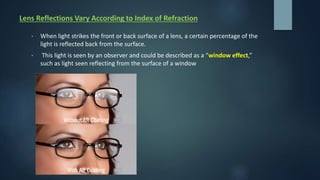
Lens Reflections Vary According to Index of Refraction
• When light strikes the front or back surface of a lens, a certain percentage of the
light is reflected back from the surface.
• This light is seen by an observer and could be described as a “window effect,”
such as light seen reflecting from the surface of a window
Reflections
Reflection-Troublesome to the wearers because
1) Produce ghost image
2) Falsification of image position
3) Haze and loss of contrast
4) Produce veiling glare
Reflected image is troublesome if
1) It’s located near a fixated object
2) It’s sufficiently intense to stand out from its background
3) It is in focus
troublesome lens reflection
Methods to control
1) Base curve selection
2) Alteration of pantoscopic tilt
3) Changing the vertex distance
4) Selection of small lens sizes
5) Patient education and counseling
6) Antireflective Coatings
Principle
 Works on the principle of DESTRUCTIVE INTERFERENCE
 Conditions should be satisfied for good ARC are
1) Amplitude condition
2) Path condition
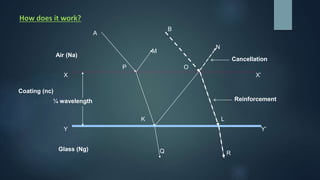
How does it work?
X X’
Y Y’
A
P
B
O
M
N
K L
Q R
Air (Na)
Coating (nc)
¼ wavelength
Glass (Ng)
Reinforcement
Cancellation
Production of ARC
GLASS
Clean the lens thoroughly
• Place in the vacuum chamber and remove all the air
• Heat to about 300 C for hardness
• MgF2 pellets are heated to about 2500 C for vaporization which deposits on the lens
Thickness can be confirmed by
1) Observing the color of the light reflected from lens surface
2) Photoelectric cell
PLASTIC
• CR-39 lenses are heated to less than 100 C
( Excessive heating may lead to loss of stability and optical characteristic )
• lenses are boiled for 2 hours to remove water vapor and volatile organic compounds
• Process carried out with electron beam evaporation sources and micro processor
controlled monitoring technique
• Thin coat of NaO2 ( Quartz ) is applied for hardness on which the ARC is given
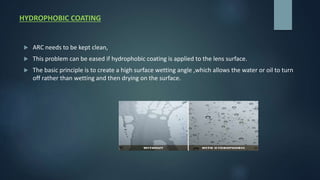
HYDROPHOBIC COATING
 ARC needs to be kept clean,
 This problem can be eased if hydrophobic coating is applied to the lens surface.
 The basic principle is to create a high surface wetting angle ,which allows the water or oil to turn
off rather than wetting and then drying on the surface.
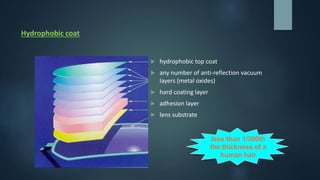
Hydrophobic coat
 hydrophobic top coat
 any number of anti-reflection vacuum
layers (metal oxides)
 hard coating layer
 adhesion layer
 lens substrate
less than 1/300th
the thickness of a
human hair
Advantages
 Better cosmoses
 Better vision
 increased transmission
 reduced secondary reflections (night driving)
 reduced side glare
 reduced eyeball reflections
DRAWBACK OF ARC
 Historical reasons, education
 “Durability”
 “Difficult to clean”
Scratch resistant coatings
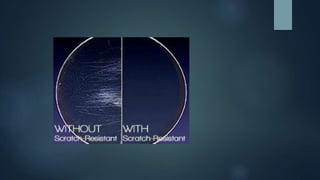
 Scratch resistant coatings for plastic lenses were developed because of the relative lack of
surface durability of plastic. While CR-39 is reasonably durable, some materials such as
polycarbonate are not recommended without a coating. A/R coatings for plastic lens are
applied after the scratch resistant coatings.
 While scratch resistant coatings improve the surface durability of plastic lenses they also
reduce the impact resistance. This should be considered if impact resistance is an important
criterion for lens selection. Although also reduced in impact resistance, coated
polycarbonate has a much higher impact resistance than any other materials coated or
uncoated.
 Most plastic lenses with scratch resistant coatings and A/R coatings are also given an
aquaphobic coating which is intended to make cleaning easier
SRC
 Because of the tendency of plastic lenses to scratch more easily than glass lenses,
manufacturers have developed processes of coating the plastic lens to develop more surface
hardness and thus more resistance to scratching.
 SRC lenses are not specifically designed to reduce lens reflections. SRC plastic lenses,
however, do exhibit some reduction of lens reflections.
 This means that they will have a higher light transmission compared with a non-SRC lens.
 An uncoated CR-39 plastic lens transmits about 92% of the incident light. By antiscratch
coating the lens, transmission may increase to just short of 96%.
 Scratch-resistant coatings are also called antiscratch coatings or hard coatings.
How Scratch-Resistant Coatings Are Applied
 Antiscratch coatings may be applied during manufacture or in the optical laboratory. The quality of
available coatings varies. If the lens is to be antireflection coated,
 the quality of the hard coating is essential to the success of the antireflection coating.24 Here are
the two main ways that hard coatings are applied:
1. Thermally Cured Hard Coating. With this hard coating process, lenses are dipped in a “varnish” and
removed from the varnish at a consistent rate to control thickness of the coating. The lenses are then
thermally cured or “baked” over an extended period of time. This method is commonly used by lens
manufacturers.
2. UV-Cured Hard Coatings. Scratch-resistant coatings can be applied using a system that spins the
coating on the lens. It then uses UV light to cure the coating
 The coating unit is normally enclosed in a positive pressure area to ensure a dust-
free environment.
 The type of liquid coating material used will vary, depending upon lens material
and whether or not the lens is to be tinted later.
 (There is a trade-off between coating hardness and tintability.) UV curing is done
in seconds.
 This makes it considerably faster than the hours-long thermal curing process.
 At the time of this writing, UV curing is the method of choice for surfacing
laboratories.
 A coating unit is essential for surfacing laboratories that process polycarbonate
lenses.
Front Side Only or Both Sides?
 Antiscratch coatings may be applied to only the front side of a lens or to both sides. SRC lenses
that come factory finished (i.e., stock lenses) will usually be coated on both front and back
surfaces. If a lens is semifinished and must be surfaced on the back side to obtain the needed
power, however, it will be antiscratch-coated
 only on the front unless the laboratory applies a back surface coating.
 Since the front surface is most susceptible to scratching, one-side-only antiscratch coatings may
be justifiable. If the wearer (and dispenser) is expecting front and back antiscratch protection on
regular plastic lenses, however, it may be necessary to ask for it.
Care of Scratch-Resistant-Coated Lenses
 Lenses with antiscratch coatings should not be exposed to excessive heat; approximately 200° F is a
safe upper temperature limit.
 (Obviously the better quality coatings will do better under stressed conditions.)
 Therefore a certain amount of care should be taken when heating the frame for the insertion of lenses.
 It is not advisable to immerse coated plastic lenses in a hot salt bath.
 An air blower is the safer alternative to help prevent possible surface crazing.
Cleaning Lenses With Scratch-Resistant Coatings
 Cleaning instructions for SRC lenses are basically the same as for regular CR-39 lenses.
Identifying Scratch-Resistant-Coated Lenses
 It may be possible to identify an SRC lens by seeing if water beads on the surface as it does on a
waxed car.
 Another test is to mark the surface with a water-soluble marking pen.
 An antiscratch coating can cause the mark to look streaky or blotchy.
 These tests may detect most, but not all, antiscratch coatings successfully.
 It is almost unnecessary to check for the presence of a scratch-resistant coating since it may
generally be presumed that most plastic lenses now come with such a coating
HARD COATING OR SCRATCH RESISTANT COATINGS (SRC)
 Hard coating is a procedure by which a thin layer of material usually 0.5 micron to 10 micron
thick is applied to the lens surface.
 The most common material used is lacquer which is applied either by dipping or by spinning
procedure.
Thermally cured hard coating
 lenses are dipped in a “varnish “ and removed from the varnish at a consistent rate to control
thickness of the coating.
 The lenses are then thermally cured or “banked” over extended period of time.
Antifog Coating
 Antifog coatings are used for individuals who are constantly going into and out of
changing temperature environments or who are exposed to other environmental
conditions that would fog lenses.
 Wearers who may appreciate antifog coatings include cooks, ice skaters,and skiers.
 Antifog coatings can be made as permanent coatings applied directly to the lens during
manufacture.
 To produce the antifogging properties, the lens is coated with a resin film that absorbs
moisture.
 “When the absorption reaches the saturation point, the interfacial activator [within the
resin] changes water droplets into a thin outer layer of water.44” It is much more common
to find permanently applied antifog coatings in sport eyewear, such as swimming goggles.
 Prescription lenses with an antifog coating are not always available.
 When available they are limited to single vision lenses.
 Fortunately, there are sprays and drops that can be applied to ordinary spectacle lenses
to reduce fogging, such as Zero-Fog lens treatment by OMS Opto Chemicals.
 Although Zero-Fog claims to be compatible with AR coatings, not all antifog sprays or
drops are.
Mirror Coating
 A mirror coating can be applied by a vacuum process to the front surface of the lens, causing the
lens to have the same properties as a two-way mirror.
 When applied as a full-mirror coating, the observer is unable to see the wearer’s eyes and sees his
or her own image reflected from the lens. The wearer is able to look through the lens normally.
 There is, of course, a reduction in the transmission of the lens simply because of the high percentage
of light reflected.
Edge Coating
 Lenses may be edge coated to reduce the concentric rings visible to the observer. The idea of edge
coating is to apply a color to the bevel area of a lens that matches the frame, camouflaging the edge.
Many times edge coatings look “funny.”
 This is because they are usually applied with a small brush, then hardened in an oven. If the job is not
done well, if an inappropriate frame is chosen, or if the color match is poor, the net effect can be
worse than no coating at all.
 There are many suitable alternatives to edge coatings.
 These include the following:
• Polishing the edge of the lens
• Rolling the edge of the lens
• AR coating the lens
• Using a lens of higher refractive index to reduce edge thickness
• Using any combination of the above
Ultraviolet filters
 Uv light comprises approximately 5%of total solar radiation .
 Ozone in earth’s atmosphere absorb almost all solar Uv- c radiation of the reminder which strike
the earth’s surface approximately 90% is UV-a and 10% is uv –B
 Uv exposure may also come from ARC welding and UV emitting light bulbs.
The effect of visible and nonvisible light on the eye
 Light is electromagnetic radiation found in the wavelength range that includes infrared (IR), visible,
and ultraviolet (UV) radiation.
 The visible spectrum is considered to be between 380 and 760 nm.1 (However, light with a
wavelength as short as 309 nm may be seen if it is of sufficient intensity.
 Light having sufficient intensity and a wavelength as short as 298 nm could be seen if it were not
absorbed by the crystalline lens before reaching the retina.)
 Instead it is absorbed by the cornea, aqueous humor, crystalline lens, or vitreous humor of the eye.
 If too much of this “light” is absorbed by the individual eye structure in sufficient quantity or over an
excessively lengthy period, it can be potentially harmful.
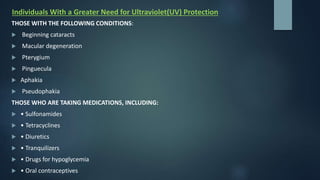
Individuals With a Greater Need for Ultraviolet(UV) Protection
THOSE WITH THE FOLLOWING CONDITIONS:
 Beginning cataracts
 Macular degeneration
 Pterygium
 Pinguecula
 Aphakia
 Pseudophakia
THOSE WHO ARE TAKING MEDICATIONS, INCLUDING:
 • Sulfonamides
 • Tetracyclines
 • Diuretics
 • Tranquilizers
 • Drugs for hypoglycemia
 • Oral contraceptives
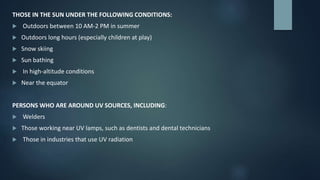
THOSE IN THE SUN UNDER THE FOLLOWING CONDITIONS:
 Outdoors between 10 AM-2 PM in summer
 Outdoors long hours (especially children at play)
 Snow skiing
 Sun bathing
 In high-altitude conditions
 Near the equator
PERSONS WHO ARE AROUND UV SOURCES, INCLUDING:
 Welders
 Those working near UV lamps, such as dentists and dental technicians
 Those in industries that use UV radiation
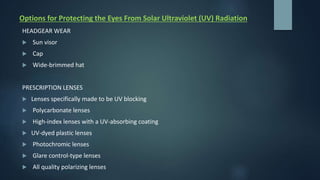
Options for Protecting the Eyes From Solar Ultraviolet (UV) Radiation
HEADGEAR WEAR
 Sun visor
 Cap
 Wide-brimmed hat
PRESCRIPTION LENSES
 Lenses specifically made to be UV blocking
 Polycarbonate lenses
 High-index lenses with a UV-absorbing coating
 UV-dyed plastic lenses
 Photochromic lenses
 Glare control-type lenses
 All quality polarizing lenses
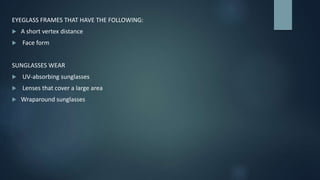
EYEGLASS FRAMES THAT HAVE THE FOLLOWING:
 A short vertex distance
 Face form
SUNGLASSES WEAR
 UV-absorbing sunglasses
 Lenses that cover a large area
 Wraparound sunglasses
Tinted lenses
How much tint is enough ?
 Normal transmission for sun lenses is generally between 15% to 30%
 General purpose sun lenses should not be darken than 8%
 Although for special purpose such as skiing, mountain climbing or use on the beach,
transmission may go as low as 3%
 It should be not that people who are exposed to sunlight for long period of time on
continual basis will require sun lenses that transmit 15% or less.
 In fact, it is strongly recommended that sun-glasses transmitting 10% or less of visible
light be used all person who will working in bright sunlight during the day, will
expected to perform critical night duties soon afterward.
Effect of Lens and Windshield Tint on Visual Acuity
 Day vision = 20/20
 Night vision = 20/32
 Night + 82% transmitting pink tint = 20/40
 Night + tinted windshield = 20/46
 Night + tinted windshield + 82% transmitting pink tint =20/60
A. Tinted solid glass lenses
 One or more metals or metallic oxides are added to the basic batch at the time of manufacturing
 They provide the desired physical and chemical properties
 Concentration of metals and mettalic oxides is less than 1%
Advantages
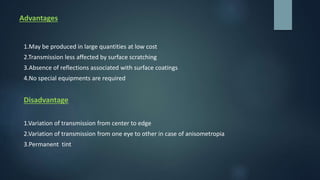
1.May be produced in large quantities at low cost
2.Transmission less affected by surface scratching
3.Absence of reflections associated with surface coatings
4.No special equipments are required
Disadvantage
1.Variation of transmission from center to edge
2.Variation of transmission from one eye to other in case of anisometropia
3.Permanent tint
B. Glass lenses with surface coatings
 Lens is tinted by depositing a thin metallic oxide on the surface of the lens
 The coating is deposited by an evaporation process conducted under vacuum at high
temperatures
 Density of coated lens depends on the Thickness of the metallic oxide coating
Tinted plastic lenses
 Plastic lenses cannot be surface coated by evaporation because they would be deformed by high
temperature
 Thus they are tinted by dipping them in a solution containing the appropriate organic dye
 Density depends on the nature of the dye and length of time the lenses immersed in the dye
Advantages
1. The dye penetrates the surface layer of the lens to a uniform depth
2. Thus lenses are of uniform density regardless of thickness
3. Some tints can be removed by dipping the lens in a bleaching solution
Disadvantages
1. The color of dyed plastic lenses is not as stable as in glass lenses
2. Most dyed lenses fade with time
3. Same material from different manufacturing batch absorbs dye at dis-similar rates
4. An old lens may not tint same as a new one
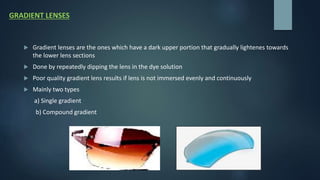
GRADIENT LENSES
 Gradient lenses are the ones which have a dark upper portion that gradually lightenes towards
the lower lens sections
 Done by repeatedly dipping the lens in the dye solution
 Poor quality gradient lens results if lens is not immersed evenly and continuously
 Mainly two types
a) Single gradient
b) Compound gradient
PINK
 Uniform transmission across the visible spectrum
 Thus no color distortion for the wearer
 Used for unfavourable indoor lighteninig
YELLOW
 Called as KALICHROME / AMBER
 Absorbs light in blue end of spectrum
 Reduces glare from light scattered by atmosphere
 It is subject to myth and speculation
 Believed to increase contrast hence used in shooters and sportsmen
BROWN
 Absorbs blue end in higher proportion than yellow
 Commonly used to improve contrast on bright, hazy and smoggy days
GREEN
 Also called as COLOBAR
 Transmission curve closely approximates the color sensitivity curve of the human eye
 Earlier popularly used in Military & Pilots
 There is good absobption of UV and IR rays
GREY
 Called as NEUTRAL LENS
 Most popular for sunglasses
 Evenness of transmission through whole visible spectrum
 Allows colors to be seen in there natural state relative to one another
 Thus satisfactory for use in color deficient
BLUE
 Also called as alpha
 Also to absorb the blue end of the spectrum which is the property
PHOTOCHROMATIC
• Photo=Light
• Chrom=colour
• phenomenon that colour of material is change by light irradiation.
• They are lenses that darken on exposure to long wavelength UV reaction and visible light
and become lighter in absence of light.
• whether you glasses or not, eyes experience eyestrain.
• e.g tv, computer , reading , sunlight.Etc causing eye strain and watering.
• photochromatic lenses can help your eyes to cope up as they react to different light
conditions during the day.
• gives a visual comfort whether indoors of outdoors.
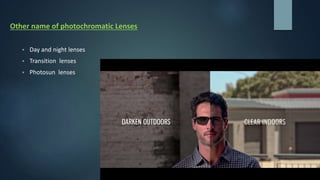
Other name of photochromatic Lenses
 Day and night lenses
 Transition lenses
 Photosun lenses
Different manufacturing method
• Inhibition
• In-mass
• Multimatrix
• Dip coating
• Front surface coating
• Transbonding
Advantages
 Cooling effect
 Used as goggles
 Reduce the transmission in photophobic patients albinism
 Photochromatic lenses can provide the light amount of protection for different light condition
Disadvantages
 Reduce visual acuity
 Difficulty in night driving
 If thickness is different ,it gives different colour.
 They are not adjust immediately
 They do not darken when womb inside vehicles because windscreen green glass absorbs virtually
100% of uv light
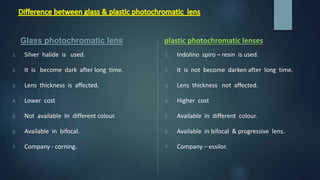
 Two types of photochromatic Lens
 Glass photochromatic lens
 plastic photochromatic lens
1. Indolino spiro – resin is used.
2. It is not become darken after long time.
3. Lens thickness not affected.
4. Higher cost
5. Available in different colour.
6. Available in bifocal & progressive lens.
7. Company – essilor.
1. Silver halide is used.
2. It is become dark after long time.
3. Lens thickness is affected.
4. Lower cost
5. Not available In different colour.
6. Available in bifocal.
7. Company - corning.
Glass photochromatic lens plastic photochromatic lenses
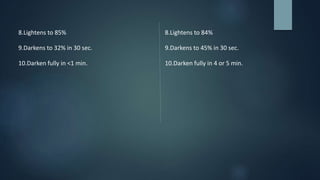
8.Lightens to 84%
9.Darkens to 45% in 30 sec.
10.Darken fully in 4 or 5 min.
8.Lightens to 85%
9.Darkens to 32% in 30 sec.
10.Darken fully in <1 min.
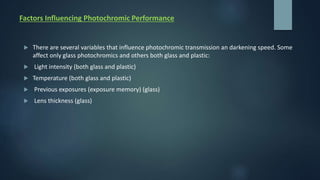
Factors Influencing Photochromic Performance
 There are several variables that influence photochromic transmission an darkening speed. Some
affect only glass photochromics and others both glass and plastic:
 Light intensity (both glass and plastic)
 Temperature (both glass and plastic)
 Previous exposures (exposure memory) (glass)
 Lens thickness (glass)
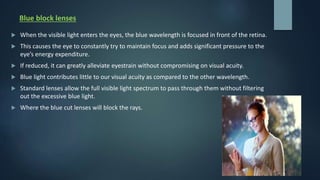
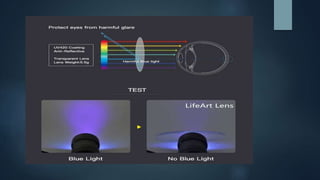
Blue block lenses
 When the visible light enters the eyes, the blue wavelength is focused in front of the retina.
 This causes the eye to constantly try to maintain focus and adds significant pressure to the
eye’s energy expenditure.
 If reduced, it can greatly alleviate eyestrain without compromising on visual acuity.
 Blue light contributes little to our visual acuity as compared to the other wavelength.
 Standard lenses allow the full visible light spectrum to pass through them without filtering
out the excessive blue light.
 Where the blue cut lenses will block the rays.
But are they actually helpful?
 It is established that blue light at night can meddle with sleep and lead to a
myriad of harmful consequences.
 However, a prolonged exposure to it during daytime is just as dangerous.
 This is where the blue light blocking glasses come into play.
Advantages
 They aid people to sleep more easily at night.
 They lower digital eyestrain.
 They avoid long term damage to the eye that could result in macular
degeneration.
 As for blocking blue light while looking at screen at darkness so as to not disrupt
MELATONIN production, blue light blocking glasses are needless to say, very
effective.
 Blue light filters apps or matte screens hardly work for that purpose.
 Blue light is a signal that stimulates and notifies the body that the sun is up-
which is why it may muddle with our brains at bedtime.
 Reports have also indicated that continued exposure to blue light emitting
displays can cease or limit brains from producing the sleep-inducing hormone,
MELATONIN.
Polorized lenses
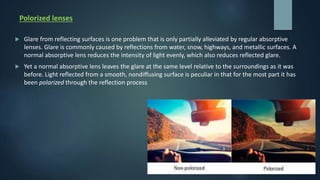
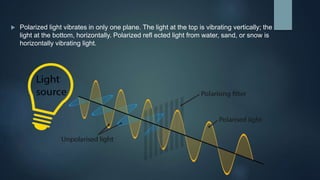
 Glare from reflecting surfaces is one problem that is only partially alleviated by regular absorptive
lenses. Glare is commonly caused by reflections from water, snow, highways, and metallic surfaces. A
normal absorptive lens reduces the intensity of light evenly, which also reduces reflected glare.
 Yet a normal absorptive lens leaves the glare at the same level relative to the surroundings as it was
before. Light reflected from a smooth, nondiffusing surface is peculiar in that for the most part it has
been polarized through the reflection process
 Polarized light vibrates in only one plane. The light at the top is vibrating vertically; the
light at the bottom, horizontally. Polarized refl ected light from water, sand, or snow is
horizontally vibrating light.
When should polarizing lenses be used ?
 To decrease driving fatigue and increase driving safety
 For fishing and for boating on the water
 For more visual comfort at the beach
 So that colors are not bleached out
 So that bright, snowy days are not as blinding
 To block UV radiation
 Polarizing lenses are good sunglasses
Lens enhancement-Consideration for prescribing
 lenses are available to meet specific vision needs, lifestyle applications or recreational and hobby needs.
 These lenses are designed with a special segment size and shape, and powers for specific distances such
as for a golf lens.
 Some have special colors for certain vision use, for example, specially tinted hunting lens.
 Some lenses are designed to meet the needs of patients needing extremely high power prescriptions.
For e.g. high index with aspheric with arc.
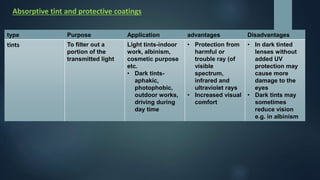
Absorptive tint and protective coatings
type Purpose Application advantages Disadvantages
tints To filter out a
portion of the
transmitted light
Light tints-indoor
work, albinism,
cosmetic purpose
etc.
• Dark tints-
aphakic,
photophobic,
outdoor works,
driving during
day time
• Protection from
harmful or
trouble ray (of
visible
spectrum,
infrared and
ultraviolet rays
• Increased visual
comfort
• In dark tinted
lenses without
added UV
protection may
cause more
damage to the
eyes
• Dark tints may
sometimes
reduce vision
e.g. in albinism
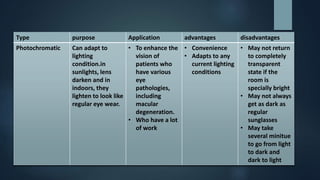
Type purpose Application advantages disadvantages
Photochromatic Can adapt to
lighting
condition.in
sunlights, lens
darken and in
indoors, they
lighten to look like
regular eye wear.
• To enhance the
vision of
patients who
have various
eye
pathologies,
including
macular
degeneration.
• Who have a lot
of work
• Convenience
• Adapts to any
current lighting
conditions
• May not return
to completely
transparent
state if the
room is
specially bright
• May not always
get as dark as
regular
sunglasses
• May take
several minitue
to go from light
to dark and
dark to light
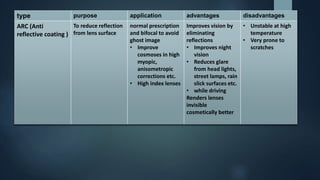
type purpose application advantages disadvantages
ARC (Anti
reflective coating )
To reduce reflection
from lens surface
normal prescription
and bifocal to avoid
ghost image
• Improve
cosmoses in high
myopic,
anisometropic
corrections etc.
• High index lenses
Improves vision by
eliminating
reflections
• Improves night
vision
• Reduces glare
from head lights,
street lamps, rain
slick surfaces etc.
• while driving
Renders lenses
invisible
cosmetically better
• Unstable at high
temperature
• Very prone to
scratches
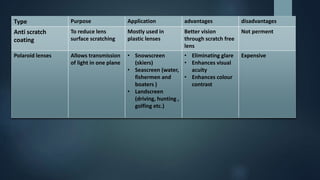
Type Purpose Application advantages disadvantages
Anti scratch
coating
To reduce lens
surface scratching
Mostly used in
plastic lenses
Better vision
through scratch free
lens
Not perment
Polaroid lenses Allows transmission
of light in one plane
• Snowscreen
(skiers)
• Seascreen (water,
fishermen and
boaters )
• Landscreen
(driving, hunting ,
golfing etc.)
• Eliminating glare
• Enhances visual
acuity
• Enhances colour
contrast
Expensive
 Thank you

Lens enhancement considering for prescribing

  • 1.
    Lens Enhancement- Considering ForPrescribing Presented By: Shivani Kansara(M.optom) Brahamdev Mandal(M.optom) Hari Jyot college of optometry
  • 2.
    Lens enhancement  Thereare various kinds of surface treatments that are applied on either side of the spectacles lenses. 1 ARC(Anti-reflection coating) 2 Scratch resistance coating 3 UV coating 4 Hydrophobic coating 5 blue block lenses 6 Photochromatic lenses 7 Polorized lenses 8 Tinted lenses
  • 3.
    Antireflection coating  AnAR coating is a thin, clear layer or layers applied to the surface of a lens.  Its purpose is to: (1) reduce unwanted reflections from the lens surface and (2) increase the amount of light that actually passes through the lens to the eye.
  • 4.
    Antireflection coating • Anti-reflectioncoatings and the more recent multi-coat anti-reflection coatings significantly reduce the reflection at each surface. • For a single layer anti-reflection coating the thickness of the coating is one quarter the wavelength of light (yellow of about 550 nm is used as the reference wavelength for light). Thus the thickness of single coatings is about 137 nm. • Anti-reflection coatings (A/R) improve the visual function, reducing the troublesome multiple reflections off the lens surfaces. they improve visual function and improve contrast sensitivity. • It also makes a considerable difference to the appearance of the spectacles, taking the glassy look off the lenses. • A/R coatings are particularly important for high index lenses and flat form lenses, such as the new aspheric lenses. • A lens of refractive index 1.806 will lose 16.5% to reflection, compared with CR-39 which would lose about 8%. • Moreover, flat form lenses create troublesome reflections for the wearer. The flatter the surfaces the more noticeable will be the surface reflections.
  • 5.
    Lens Reflections VaryAccording to Index of Refraction • When light strikes the front or back surface of a lens, a certain percentage of the light is reflected back from the surface. • This light is seen by an observer and could be described as a “window effect,” such as light seen reflecting from the surface of a window
  • 6.
    Reflections Reflection-Troublesome to thewearers because 1) Produce ghost image 2) Falsification of image position 3) Haze and loss of contrast 4) Produce veiling glare Reflected image is troublesome if 1) It’s located near a fixated object 2) It’s sufficiently intense to stand out from its background 3) It is in focus
  • 7.
  • 8.
    Methods to control 1)Base curve selection 2) Alteration of pantoscopic tilt 3) Changing the vertex distance 4) Selection of small lens sizes 5) Patient education and counseling 6) Antireflective Coatings
  • 9.
    Principle  Works onthe principle of DESTRUCTIVE INTERFERENCE  Conditions should be satisfied for good ARC are 1) Amplitude condition 2) Path condition
  • 10.
    How does itwork? X X’ Y Y’ A P B O M N K L Q R Air (Na) Coating (nc) ¼ wavelength Glass (Ng) Reinforcement Cancellation
  • 11.
    Production of ARC GLASS Cleanthe lens thoroughly • Place in the vacuum chamber and remove all the air • Heat to about 300 C for hardness • MgF2 pellets are heated to about 2500 C for vaporization which deposits on the lens Thickness can be confirmed by 1) Observing the color of the light reflected from lens surface 2) Photoelectric cell PLASTIC • CR-39 lenses are heated to less than 100 C ( Excessive heating may lead to loss of stability and optical characteristic ) • lenses are boiled for 2 hours to remove water vapor and volatile organic compounds • Process carried out with electron beam evaporation sources and micro processor controlled monitoring technique • Thin coat of NaO2 ( Quartz ) is applied for hardness on which the ARC is given
  • 12.
    HYDROPHOBIC COATING  ARCneeds to be kept clean,  This problem can be eased if hydrophobic coating is applied to the lens surface.  The basic principle is to create a high surface wetting angle ,which allows the water or oil to turn off rather than wetting and then drying on the surface.
  • 13.
    Hydrophobic coat  hydrophobictop coat  any number of anti-reflection vacuum layers (metal oxides)  hard coating layer  adhesion layer  lens substrate less than 1/300th the thickness of a human hair
  • 14.
    Advantages  Better cosmoses Better vision  increased transmission  reduced secondary reflections (night driving)  reduced side glare  reduced eyeball reflections DRAWBACK OF ARC  Historical reasons, education  “Durability”  “Difficult to clean”
  • 15.
    Scratch resistant coatings Scratch resistant coatings for plastic lenses were developed because of the relative lack of surface durability of plastic. While CR-39 is reasonably durable, some materials such as polycarbonate are not recommended without a coating. A/R coatings for plastic lens are applied after the scratch resistant coatings.  While scratch resistant coatings improve the surface durability of plastic lenses they also reduce the impact resistance. This should be considered if impact resistance is an important criterion for lens selection. Although also reduced in impact resistance, coated polycarbonate has a much higher impact resistance than any other materials coated or uncoated.  Most plastic lenses with scratch resistant coatings and A/R coatings are also given an aquaphobic coating which is intended to make cleaning easier
  • 16.
    SRC  Because ofthe tendency of plastic lenses to scratch more easily than glass lenses, manufacturers have developed processes of coating the plastic lens to develop more surface hardness and thus more resistance to scratching.  SRC lenses are not specifically designed to reduce lens reflections. SRC plastic lenses, however, do exhibit some reduction of lens reflections.  This means that they will have a higher light transmission compared with a non-SRC lens.  An uncoated CR-39 plastic lens transmits about 92% of the incident light. By antiscratch coating the lens, transmission may increase to just short of 96%.  Scratch-resistant coatings are also called antiscratch coatings or hard coatings.
  • 17.
    How Scratch-Resistant CoatingsAre Applied  Antiscratch coatings may be applied during manufacture or in the optical laboratory. The quality of available coatings varies. If the lens is to be antireflection coated,  the quality of the hard coating is essential to the success of the antireflection coating.24 Here are the two main ways that hard coatings are applied: 1. Thermally Cured Hard Coating. With this hard coating process, lenses are dipped in a “varnish” and removed from the varnish at a consistent rate to control thickness of the coating. The lenses are then thermally cured or “baked” over an extended period of time. This method is commonly used by lens manufacturers. 2. UV-Cured Hard Coatings. Scratch-resistant coatings can be applied using a system that spins the coating on the lens. It then uses UV light to cure the coating
  • 18.
     The coatingunit is normally enclosed in a positive pressure area to ensure a dust- free environment.  The type of liquid coating material used will vary, depending upon lens material and whether or not the lens is to be tinted later.  (There is a trade-off between coating hardness and tintability.) UV curing is done in seconds.  This makes it considerably faster than the hours-long thermal curing process.  At the time of this writing, UV curing is the method of choice for surfacing laboratories.  A coating unit is essential for surfacing laboratories that process polycarbonate lenses.
  • 19.
    Front Side Onlyor Both Sides?  Antiscratch coatings may be applied to only the front side of a lens or to both sides. SRC lenses that come factory finished (i.e., stock lenses) will usually be coated on both front and back surfaces. If a lens is semifinished and must be surfaced on the back side to obtain the needed power, however, it will be antiscratch-coated  only on the front unless the laboratory applies a back surface coating.  Since the front surface is most susceptible to scratching, one-side-only antiscratch coatings may be justifiable. If the wearer (and dispenser) is expecting front and back antiscratch protection on regular plastic lenses, however, it may be necessary to ask for it.
  • 20.
    Care of Scratch-Resistant-CoatedLenses  Lenses with antiscratch coatings should not be exposed to excessive heat; approximately 200° F is a safe upper temperature limit.  (Obviously the better quality coatings will do better under stressed conditions.)  Therefore a certain amount of care should be taken when heating the frame for the insertion of lenses.  It is not advisable to immerse coated plastic lenses in a hot salt bath.  An air blower is the safer alternative to help prevent possible surface crazing.
  • 21.
    Cleaning Lenses WithScratch-Resistant Coatings  Cleaning instructions for SRC lenses are basically the same as for regular CR-39 lenses. Identifying Scratch-Resistant-Coated Lenses  It may be possible to identify an SRC lens by seeing if water beads on the surface as it does on a waxed car.  Another test is to mark the surface with a water-soluble marking pen.  An antiscratch coating can cause the mark to look streaky or blotchy.  These tests may detect most, but not all, antiscratch coatings successfully.  It is almost unnecessary to check for the presence of a scratch-resistant coating since it may generally be presumed that most plastic lenses now come with such a coating
  • 22.
    HARD COATING ORSCRATCH RESISTANT COATINGS (SRC)  Hard coating is a procedure by which a thin layer of material usually 0.5 micron to 10 micron thick is applied to the lens surface.  The most common material used is lacquer which is applied either by dipping or by spinning procedure. Thermally cured hard coating  lenses are dipped in a “varnish “ and removed from the varnish at a consistent rate to control thickness of the coating.  The lenses are then thermally cured or “banked” over extended period of time.
  • 24.
    Antifog Coating  Antifogcoatings are used for individuals who are constantly going into and out of changing temperature environments or who are exposed to other environmental conditions that would fog lenses.  Wearers who may appreciate antifog coatings include cooks, ice skaters,and skiers.  Antifog coatings can be made as permanent coatings applied directly to the lens during manufacture.  To produce the antifogging properties, the lens is coated with a resin film that absorbs moisture.
  • 25.
     “When theabsorption reaches the saturation point, the interfacial activator [within the resin] changes water droplets into a thin outer layer of water.44” It is much more common to find permanently applied antifog coatings in sport eyewear, such as swimming goggles.  Prescription lenses with an antifog coating are not always available.  When available they are limited to single vision lenses.  Fortunately, there are sprays and drops that can be applied to ordinary spectacle lenses to reduce fogging, such as Zero-Fog lens treatment by OMS Opto Chemicals.  Although Zero-Fog claims to be compatible with AR coatings, not all antifog sprays or drops are.
  • 26.
    Mirror Coating  Amirror coating can be applied by a vacuum process to the front surface of the lens, causing the lens to have the same properties as a two-way mirror.  When applied as a full-mirror coating, the observer is unable to see the wearer’s eyes and sees his or her own image reflected from the lens. The wearer is able to look through the lens normally.  There is, of course, a reduction in the transmission of the lens simply because of the high percentage of light reflected.
  • 27.
    Edge Coating  Lensesmay be edge coated to reduce the concentric rings visible to the observer. The idea of edge coating is to apply a color to the bevel area of a lens that matches the frame, camouflaging the edge. Many times edge coatings look “funny.”  This is because they are usually applied with a small brush, then hardened in an oven. If the job is not done well, if an inappropriate frame is chosen, or if the color match is poor, the net effect can be worse than no coating at all.  There are many suitable alternatives to edge coatings.  These include the following: • Polishing the edge of the lens • Rolling the edge of the lens • AR coating the lens • Using a lens of higher refractive index to reduce edge thickness • Using any combination of the above
  • 28.
    Ultraviolet filters  Uvlight comprises approximately 5%of total solar radiation .  Ozone in earth’s atmosphere absorb almost all solar Uv- c radiation of the reminder which strike the earth’s surface approximately 90% is UV-a and 10% is uv –B  Uv exposure may also come from ARC welding and UV emitting light bulbs.
  • 29.
    The effect ofvisible and nonvisible light on the eye  Light is electromagnetic radiation found in the wavelength range that includes infrared (IR), visible, and ultraviolet (UV) radiation.  The visible spectrum is considered to be between 380 and 760 nm.1 (However, light with a wavelength as short as 309 nm may be seen if it is of sufficient intensity.  Light having sufficient intensity and a wavelength as short as 298 nm could be seen if it were not absorbed by the crystalline lens before reaching the retina.)  Instead it is absorbed by the cornea, aqueous humor, crystalline lens, or vitreous humor of the eye.  If too much of this “light” is absorbed by the individual eye structure in sufficient quantity or over an excessively lengthy period, it can be potentially harmful.
  • 30.
    Individuals With aGreater Need for Ultraviolet(UV) Protection THOSE WITH THE FOLLOWING CONDITIONS:  Beginning cataracts  Macular degeneration  Pterygium  Pinguecula  Aphakia  Pseudophakia THOSE WHO ARE TAKING MEDICATIONS, INCLUDING:  • Sulfonamides  • Tetracyclines  • Diuretics  • Tranquilizers  • Drugs for hypoglycemia  • Oral contraceptives
  • 31.
    THOSE IN THESUN UNDER THE FOLLOWING CONDITIONS:  Outdoors between 10 AM-2 PM in summer  Outdoors long hours (especially children at play)  Snow skiing  Sun bathing  In high-altitude conditions  Near the equator PERSONS WHO ARE AROUND UV SOURCES, INCLUDING:  Welders  Those working near UV lamps, such as dentists and dental technicians  Those in industries that use UV radiation
  • 32.
    Options for Protectingthe Eyes From Solar Ultraviolet (UV) Radiation HEADGEAR WEAR  Sun visor  Cap  Wide-brimmed hat PRESCRIPTION LENSES  Lenses specifically made to be UV blocking  Polycarbonate lenses  High-index lenses with a UV-absorbing coating  UV-dyed plastic lenses  Photochromic lenses  Glare control-type lenses  All quality polarizing lenses
  • 33.
    EYEGLASS FRAMES THATHAVE THE FOLLOWING:  A short vertex distance  Face form SUNGLASSES WEAR  UV-absorbing sunglasses  Lenses that cover a large area  Wraparound sunglasses
  • 34.
  • 35.
    How much tintis enough ?  Normal transmission for sun lenses is generally between 15% to 30%  General purpose sun lenses should not be darken than 8%  Although for special purpose such as skiing, mountain climbing or use on the beach, transmission may go as low as 3%  It should be not that people who are exposed to sunlight for long period of time on continual basis will require sun lenses that transmit 15% or less.  In fact, it is strongly recommended that sun-glasses transmitting 10% or less of visible light be used all person who will working in bright sunlight during the day, will expected to perform critical night duties soon afterward.
  • 36.
    Effect of Lensand Windshield Tint on Visual Acuity  Day vision = 20/20  Night vision = 20/32  Night + 82% transmitting pink tint = 20/40  Night + tinted windshield = 20/46  Night + tinted windshield + 82% transmitting pink tint =20/60
  • 37.
    A. Tinted solidglass lenses  One or more metals or metallic oxides are added to the basic batch at the time of manufacturing  They provide the desired physical and chemical properties  Concentration of metals and mettalic oxides is less than 1%
  • 38.
    Advantages 1.May be producedin large quantities at low cost 2.Transmission less affected by surface scratching 3.Absence of reflections associated with surface coatings 4.No special equipments are required Disadvantage 1.Variation of transmission from center to edge 2.Variation of transmission from one eye to other in case of anisometropia 3.Permanent tint
  • 39.
    B. Glass lenseswith surface coatings  Lens is tinted by depositing a thin metallic oxide on the surface of the lens  The coating is deposited by an evaporation process conducted under vacuum at high temperatures  Density of coated lens depends on the Thickness of the metallic oxide coating
  • 40.
    Tinted plastic lenses Plastic lenses cannot be surface coated by evaporation because they would be deformed by high temperature  Thus they are tinted by dipping them in a solution containing the appropriate organic dye  Density depends on the nature of the dye and length of time the lenses immersed in the dye
  • 41.
    Advantages 1. The dyepenetrates the surface layer of the lens to a uniform depth 2. Thus lenses are of uniform density regardless of thickness 3. Some tints can be removed by dipping the lens in a bleaching solution Disadvantages 1. The color of dyed plastic lenses is not as stable as in glass lenses 2. Most dyed lenses fade with time 3. Same material from different manufacturing batch absorbs dye at dis-similar rates 4. An old lens may not tint same as a new one
  • 42.
    GRADIENT LENSES  Gradientlenses are the ones which have a dark upper portion that gradually lightenes towards the lower lens sections  Done by repeatedly dipping the lens in the dye solution  Poor quality gradient lens results if lens is not immersed evenly and continuously  Mainly two types a) Single gradient b) Compound gradient
  • 43.
    PINK  Uniform transmissionacross the visible spectrum  Thus no color distortion for the wearer  Used for unfavourable indoor lighteninig
  • 44.
    YELLOW  Called asKALICHROME / AMBER  Absorbs light in blue end of spectrum  Reduces glare from light scattered by atmosphere  It is subject to myth and speculation  Believed to increase contrast hence used in shooters and sportsmen
  • 45.
    BROWN  Absorbs blueend in higher proportion than yellow  Commonly used to improve contrast on bright, hazy and smoggy days
  • 46.
    GREEN  Also calledas COLOBAR  Transmission curve closely approximates the color sensitivity curve of the human eye  Earlier popularly used in Military & Pilots  There is good absobption of UV and IR rays
  • 47.
    GREY  Called asNEUTRAL LENS  Most popular for sunglasses  Evenness of transmission through whole visible spectrum  Allows colors to be seen in there natural state relative to one another  Thus satisfactory for use in color deficient
  • 48.
    BLUE  Also calledas alpha  Also to absorb the blue end of the spectrum which is the property
  • 49.
    PHOTOCHROMATIC • Photo=Light • Chrom=colour •phenomenon that colour of material is change by light irradiation. • They are lenses that darken on exposure to long wavelength UV reaction and visible light and become lighter in absence of light. • whether you glasses or not, eyes experience eyestrain. • e.g tv, computer , reading , sunlight.Etc causing eye strain and watering. • photochromatic lenses can help your eyes to cope up as they react to different light conditions during the day. • gives a visual comfort whether indoors of outdoors.
  • 50.
    Other name ofphotochromatic Lenses  Day and night lenses  Transition lenses  Photosun lenses
  • 51.
    Different manufacturing method •Inhibition • In-mass • Multimatrix • Dip coating • Front surface coating • Transbonding
  • 52.
    Advantages  Cooling effect Used as goggles  Reduce the transmission in photophobic patients albinism  Photochromatic lenses can provide the light amount of protection for different light condition Disadvantages  Reduce visual acuity  Difficulty in night driving  If thickness is different ,it gives different colour.  They are not adjust immediately  They do not darken when womb inside vehicles because windscreen green glass absorbs virtually 100% of uv light
  • 53.
     Two typesof photochromatic Lens  Glass photochromatic lens  plastic photochromatic lens
  • 54.
    1. Indolino spiro– resin is used. 2. It is not become darken after long time. 3. Lens thickness not affected. 4. Higher cost 5. Available in different colour. 6. Available in bifocal & progressive lens. 7. Company – essilor. 1. Silver halide is used. 2. It is become dark after long time. 3. Lens thickness is affected. 4. Lower cost 5. Not available In different colour. 6. Available in bifocal. 7. Company - corning. Glass photochromatic lens plastic photochromatic lenses
  • 55.
    8.Lightens to 84% 9.Darkensto 45% in 30 sec. 10.Darken fully in 4 or 5 min. 8.Lightens to 85% 9.Darkens to 32% in 30 sec. 10.Darken fully in <1 min.
  • 56.
    Factors Influencing PhotochromicPerformance  There are several variables that influence photochromic transmission an darkening speed. Some affect only glass photochromics and others both glass and plastic:  Light intensity (both glass and plastic)  Temperature (both glass and plastic)  Previous exposures (exposure memory) (glass)  Lens thickness (glass)
  • 57.
    Blue block lenses When the visible light enters the eyes, the blue wavelength is focused in front of the retina.  This causes the eye to constantly try to maintain focus and adds significant pressure to the eye’s energy expenditure.  If reduced, it can greatly alleviate eyestrain without compromising on visual acuity.  Blue light contributes little to our visual acuity as compared to the other wavelength.  Standard lenses allow the full visible light spectrum to pass through them without filtering out the excessive blue light.  Where the blue cut lenses will block the rays.
  • 59.
    But are theyactually helpful?  It is established that blue light at night can meddle with sleep and lead to a myriad of harmful consequences.  However, a prolonged exposure to it during daytime is just as dangerous.  This is where the blue light blocking glasses come into play. Advantages  They aid people to sleep more easily at night.  They lower digital eyestrain.  They avoid long term damage to the eye that could result in macular degeneration.
  • 60.
     As forblocking blue light while looking at screen at darkness so as to not disrupt MELATONIN production, blue light blocking glasses are needless to say, very effective.  Blue light filters apps or matte screens hardly work for that purpose.  Blue light is a signal that stimulates and notifies the body that the sun is up- which is why it may muddle with our brains at bedtime.  Reports have also indicated that continued exposure to blue light emitting displays can cease or limit brains from producing the sleep-inducing hormone, MELATONIN.
  • 61.
    Polorized lenses  Glarefrom reflecting surfaces is one problem that is only partially alleviated by regular absorptive lenses. Glare is commonly caused by reflections from water, snow, highways, and metallic surfaces. A normal absorptive lens reduces the intensity of light evenly, which also reduces reflected glare.  Yet a normal absorptive lens leaves the glare at the same level relative to the surroundings as it was before. Light reflected from a smooth, nondiffusing surface is peculiar in that for the most part it has been polarized through the reflection process
  • 62.
     Polarized lightvibrates in only one plane. The light at the top is vibrating vertically; the light at the bottom, horizontally. Polarized refl ected light from water, sand, or snow is horizontally vibrating light.
  • 63.
    When should polarizinglenses be used ?  To decrease driving fatigue and increase driving safety  For fishing and for boating on the water  For more visual comfort at the beach  So that colors are not bleached out  So that bright, snowy days are not as blinding  To block UV radiation  Polarizing lenses are good sunglasses
  • 64.
    Lens enhancement-Consideration forprescribing  lenses are available to meet specific vision needs, lifestyle applications or recreational and hobby needs.  These lenses are designed with a special segment size and shape, and powers for specific distances such as for a golf lens.  Some have special colors for certain vision use, for example, specially tinted hunting lens.  Some lenses are designed to meet the needs of patients needing extremely high power prescriptions. For e.g. high index with aspheric with arc.
  • 65.
    Absorptive tint andprotective coatings type Purpose Application advantages Disadvantages tints To filter out a portion of the transmitted light Light tints-indoor work, albinism, cosmetic purpose etc. • Dark tints- aphakic, photophobic, outdoor works, driving during day time • Protection from harmful or trouble ray (of visible spectrum, infrared and ultraviolet rays • Increased visual comfort • In dark tinted lenses without added UV protection may cause more damage to the eyes • Dark tints may sometimes reduce vision e.g. in albinism
  • 66.
    Type purpose Applicationadvantages disadvantages Photochromatic Can adapt to lighting condition.in sunlights, lens darken and in indoors, they lighten to look like regular eye wear. • To enhance the vision of patients who have various eye pathologies, including macular degeneration. • Who have a lot of work • Convenience • Adapts to any current lighting conditions • May not return to completely transparent state if the room is specially bright • May not always get as dark as regular sunglasses • May take several minitue to go from light to dark and dark to light
  • 67.
    type purpose applicationadvantages disadvantages ARC (Anti reflective coating ) To reduce reflection from lens surface normal prescription and bifocal to avoid ghost image • Improve cosmoses in high myopic, anisometropic corrections etc. • High index lenses Improves vision by eliminating reflections • Improves night vision • Reduces glare from head lights, street lamps, rain slick surfaces etc. • while driving Renders lenses invisible cosmetically better • Unstable at high temperature • Very prone to scratches
  • 68.
    Type Purpose Applicationadvantages disadvantages Anti scratch coating To reduce lens surface scratching Mostly used in plastic lenses Better vision through scratch free lens Not perment Polaroid lenses Allows transmission of light in one plane • Snowscreen (skiers) • Seascreen (water, fishermen and boaters ) • Landscreen (driving, hunting , golfing etc.) • Eliminating glare • Enhances visual acuity • Enhances colour contrast Expensive
  • 69.