CHEN502
PROCESS DYNAMICS AND CONTROL
Module 2:
Design and Hardware Aspects of Process
Control System
Prof. Momoh Omuya Raheem
Room 55, PTDF Building
Email: omuyar2002@yahoo.com
Learning Outcome
It is the intent of this Module to help the student to:
1. Classify the variables in chemical processes.
2. Identify the design elements of a control system.
3. Develop control aspects of a complete chemical
plant.
4. Highlight control system development.
5. Discuss hardware for a process control system.
2
1. CLASSIFICATION OF THE VARIABLES IN
A CHEMICAL PROCESS
• Input variables denote the effect of
surrounding on the chemical process.
• Output variables denote the effect of the
process on the surrounding.
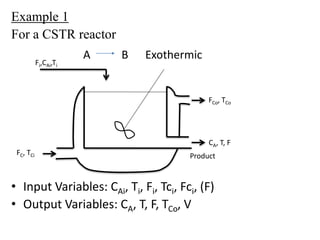
Example 1
For a CSTR reactor
• Input Variables: CAi, Ti, Fi, Tci, Fci, (F)
• Output Variables: CA, T, F, TCo, V
FC, TCi
CA, T, F
FCo, TCo
Product
Fi,CAi,Ti
A B Exothermic
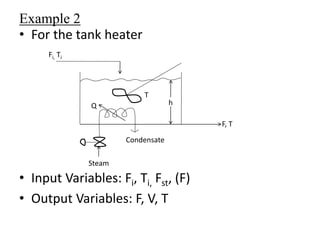
Example 2
• For the tank heater
• Input Variables: Fi, Ti, Fst, (F)
• Output Variables: F, V, T
F, T
Fi, Ti
Q
T
h
Steam
Condensate
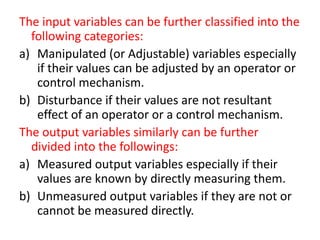
The input variables can be further classified into the
following categories:
a) Manipulated (or Adjustable) variables especially
if their values can be adjusted by an operator or
control mechanism.
b) Disturbance if their values are not resultant
effect of an operator or a control mechanism.
The output variables similarly can be further
divided into the followings:
a) Measured output variables especially if their
values are known by directly measuring them.
b) Unmeasured output variables if they are not or
cannot be measured directly.
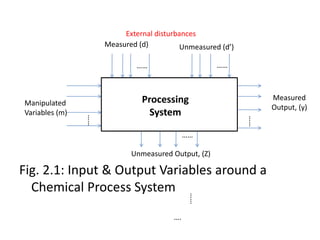
Fig. 2.1: Input & Output Variables around a
Chemical Process System
External disturbances
Processing
System
Unmeasured Output, (Z)
Measured
Output, (y)
Manipulated
Variables (m)
Measured (d) Unmeasured (d’)
….
…… ……
……
……
……
……
2. DESIGN ELEMENTS OF A CONTROL SYSTEM
(A) Define Control Objectives
Question 1
What are the operational objectives that a
control system is called upon to achieve?
1. Ensuring the stability of a system,
2. Suppressing the influence of external
disturbance,
3. Optimizing the economic performance of a
plant,
4. A combination of the above.
At the beginning the control objectives are
defined qualitatively, subsequently, they are
quantified in terms of the output variables.
1. For CSTR discussed in Example 1, the control objective
(qualitatively defined) is to ensure the stability of unstable
steady state. A quantitative control objective requires that
the temperature (an output variable) not deviate more than
5% from its nominal value at the unstable steady state.
2. For the stirred tank heater (suppressing external
disturbances)
Qualitatively: T and V(h) should be desired value
Quantitatively;
T = Ts
V = Vs Where Ts and Vs are given and they are desired values
3. For the Batch reactor (optimizing the economic performance)
Qualitatively: maximizing profit
Quantitatively;
It requires the solution of maximization of profit
which yield the value of the steam flow rate, Q(t);
at each instant during the reaction period.
(B) Select Measurement
Whatever our control objective is, we need some
means to monitor the performance of the chemical
process. This is done by measuring the values of
some certain process variables (Temperature,
Pressure, Flow rate etc).
Question 2
What variables should we measure in order to
monitor the operational performance of the plant?
Answer: primary measurements are easy but a secondary
measurement gives mathematical relationship between
unmeasured outputs.
For the Stirred Tank
Simple measurement
T = Ts and V = Vs
Difficult Measurements
A mathematical expression relating the two
Unmeasured Output = f(secondary measurements)
Example
Consider a simple distillation column in the distillate
composition is set 95% pentane against 5% hexane.
Feedback control using analysis
Feedforward control using analysis
Therefore, use a secondary measurement (T)
Analyzer can be
unreliable or very
costly
(C) Select the Control Configuration
Question 3
What is the best control configuration for a
given chemical process situation?
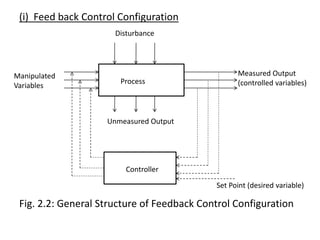
(i) Feed back Control Configuration
Fig. 2.2: General Structure of Feedback Control Configuration
Process
Controller
Disturbance
Unmeasured Output
Set Point (desired variable)
Measured Output
(controlled variables)
Manipulated
Variables
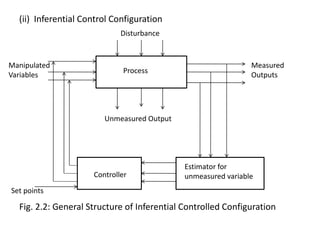
(ii) Inferential Control Configuration
Fig. 2.2: General Structure of Inferential Controlled Configuration
Process
Disturbance
Unmeasured Output
Controller
Estimator for
unmeasured variable
Set points
Measured
Outputs
Manipulated
Variables
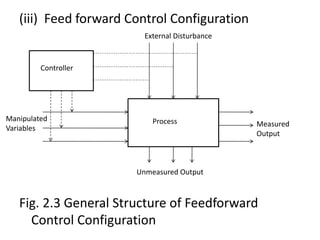
(iii) Feed forward Control Configuration
Fig. 2.3 General Structure of Feedforward
Control Configuration
Process Measured
Output
Unmeasured Output
Controller
Manipulated
Variables
External Disturbance
(D) Design the Controller
In every control configuration the controller is the
active element that receives the information from the
measurements and takes appropriate control action(s) to
adjust the values of the manipulated variables. For the
design of a controller one must answer the next question.
Question 4
How is the information taken from the measurements
used to adjust the values of the manipulated variables?
Answer
Use the control law.
E.g. For the Stirred tank heater
At steady state,
The energy balance of the heater
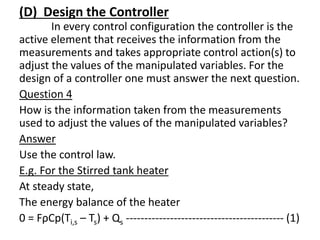
0 = FρCp(Ti,s – Ts) + Qs ------------------------------------------- (1)
Diagrammatically
How T changes with time will be given by the
transient energy balance around the tank; that is
Subtracting eqn 1 from eqn 2, we have
Note that, since Ts = constant
Time
Ts
Ti,s
Ti
dT/dt
=
))/dt
T
-
(d(T s
(3
-
-
-
Qs)
-
(Q
+
Ts)]
-
(T
-
s)
Ti,
-
Cp[(Ti
F
=
Ts))/dt
-
Cp(d(T
V 

(2)
-
-
-
-
Q
+
T)
-
Cp(Ti
F
=
d(T)/dt
Cp
V 

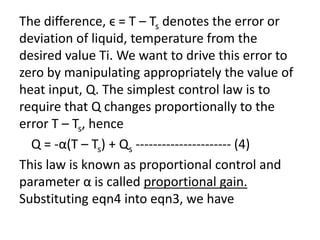
The difference, ϵ = T – Ts denotes the error or
deviation of liquid, temperature from the
desired value Ti. We want to drive this error to
zero by manipulating appropriately the value of
heat input, Q. The simplest control law is to
require that Q changes proportionally to the
error T – Ts, hence
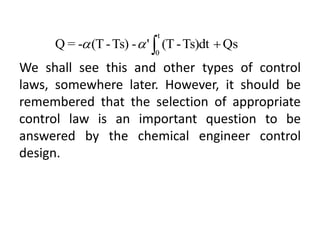
Q = -α(T – Ts) + Qs ---------------------- (4)
This law is known as proportional control and
parameter α is called proportional gain.
Substituting eqn4 into eqn3, we have
VρCp d(T – Ts)/dt = FρCp[(Ti – Ti,s) – (T – Ts)] – α(T – Ts) -------- (5)
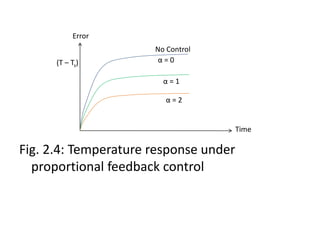
Eqn5 is solved for (T – Ts), and for various values
of gain and yield the solutions shown in Fig..
below. It’s noticed that more of the solutions is
satisfactory since T – Ts ≠ 0. Thus one concludes
that the proportional control law is not
acceptable.
Fig. 2.4: Temperature response under
proportional feedback control
Error
Time
(T – Ts)
No Control
α = 0
α = 1
α = 2
However, considerable improvement in the
quality of the resulting control can be obtained
if one uses a different control law known as
integral control. In this case Q is proportional to
the time integral of (T – Ts); thus,
Substituting again Q from eqn6 into eqn3, we
have
(6)
-
-
-
-
-
-
-
-
-
Qs
+
Ts)dt
-
(T
'
t
0


 
Q
)
7
(
Ts)dt
-
(T
'
-
]
Ts)
-
(T
-
s)
Ti,
-
Cp[(Ti
F
=
Ts))/dt
-
(d(T
Cp
V
t
0








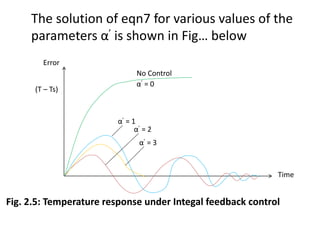
The solution of eqn7 for various values of the
parameters α’ is shown in Fig… below
Time
Error
(T – Ts)
α’ = 1
α’ = 2
α’ = 3
α’ = 0
No Control
Fig. 2.5: Temperature response under Integal feedback control
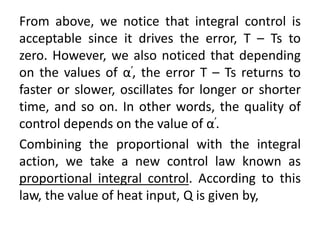
From above, we notice that integral control is
acceptable since it drives the error, T – Ts to
zero. However, we also noticed that depending
on the values of α’, the error T – Ts returns to
faster or slower, oscillates for longer or shorter
time, and so on. In other words, the quality of
control depends on the value of α’.
Combining the proportional with the integral
action, we take a new control law known as
proportional integral control. According to this
law, the value of heat input, Q is given by,
We shall see this and other types of control
laws, somewhere later. However, it should be
remembered that the selection of appropriate
control law is an important question to be
answered by the chemical engineer control
design.
Qs
Ts)dt
-
(T
'
-
Ts)
-
(T
-
=
Q
t
0




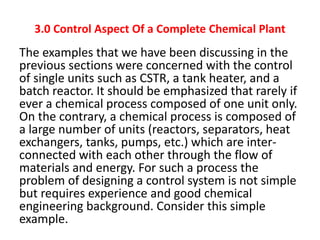
3.0 Control Aspect Of a Complete Chemical Plant
The examples that we have been discussing in the
previous sections were concerned with the control
of single units such as CSTR, a tank heater, and a
batch reactor. It should be emphasized that rarely if
ever a chemical process composed of one unit only.
On the contrary, a chemical process is composed of
a large number of units (reactors, separators, heat
exchangers, tanks, pumps, etc.) which are inter-
connected with each other through the flow of
materials and energy. For such a process the
problem of designing a control system is not simple
but requires experience and good chemical
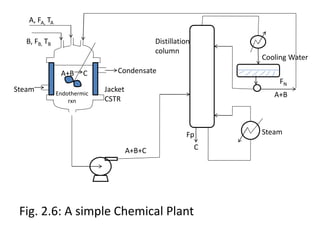
engineering background. Consider this simple
example.
Fig. 2.6: A simple Chemical Plant
Cooling Water
Steam
Steam
Condensate
Jacket
CSTR
Distillation
column
C
Fp
FN
A+B
A+B+C
A+B C
B, FB, TB
A, FA, TA
Endothermic
rxn
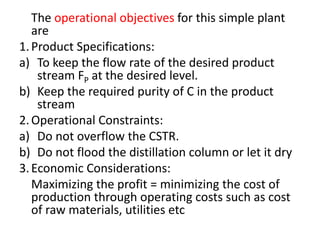
The operational objectives for this simple plant
are
1.Product Specifications:
a) To keep the flow rate of the desired product
stream FP at the desired level.
b) Keep the required purity of C in the product
stream
2.Operational Constraints:
a) Do not overflow the CSTR.
b) Do not flood the distillation column or let it dry
3.Economic Considerations:
Maximizing the profit = minimizing the cost of
production through operating costs such as cost
of raw materials, utilities etc
The disturbance that will affect the foregoing objectives
are:
a) The flow rates, compositions, and temperature of the
streams of the two raw materials.
b) The pressure in the distillation column.
c) The temperature of the coolant used in the condenser
of the distillation column. (For example, if the coolant
is water. It will have a different temperature during
the day than during the night)
At first glance, the problem of designing a control
system even for this simple plant looks very complex.
Indeed it is. The basically new feature for the control
design of such a system is the interaction between the
units (reactor, column).
The output of the reactors affects the operation
of the column in a profound manner and the
overhead product of the column influences the
conversion in the CSTR. This tighten interaction
between the two units seriously complicates the
design of the control system for the overall process.
Suppose that we want to control the
composition of the bottoms product by
manipulating the steam in the reboiler of the
column. This control action will affect the
composition of the overhead product (A+B), which
will in turn affect the reaction conversion in the
CSTR.
On the other hand, to keep the conversion in
the CSTR constant at the design level, we try to
keep the ratio FA/FB = constant and the
temperature T in the CSTR constant. Any
changes in FA/FB or T will affect the conversion
in the reactor and thus the composition of the
column will affect the purity of the two product
streams.
The control of integrated processes is the
basic objective for a chemical engineer. One to
its complexity, though, we will start by analyzing
the control problems for single Unit and
eventually we will try the integrated processes.
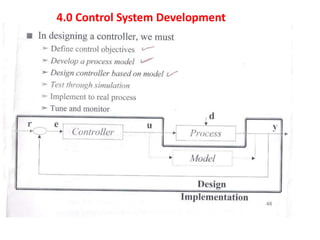
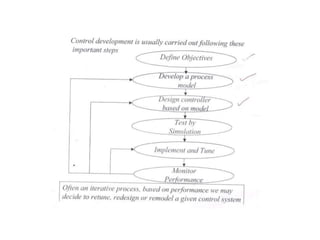
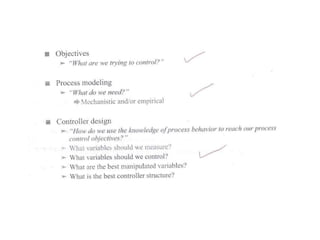
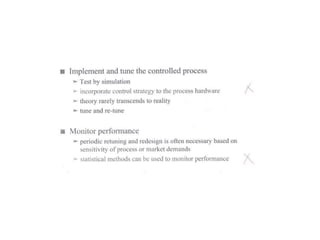
4.0 Control System Development
5.0 Hardware for a Process Control System
5.1 Hardware Elements of a Control System
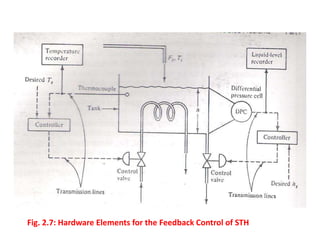
In every control configuration, we can distinguish the
following hardware system:
1. The chemical process: It may be unit operation equipment,
reactors, mechanical, etc.,
2. The measuring instruments or sensors: Examples are:
thermocouple, venture meters, gas or liquid
chromatographs, etc.
3. Transducers: These are elements that can convert physical
measurements into signals for easy interpretation, e.g.,
pneumatic or electrical signals.
4. Transmission lines: They are either pneumatic but currently
deployment of electric signals.
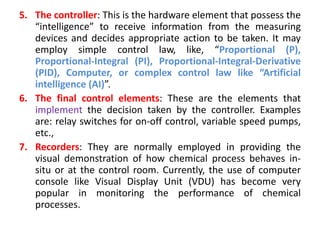
5. The controller: This is the hardware element that possess the
“intelligence” to receive information from the measuring
devices and decides appropriate action to be taken. It may
employ simple control law, like, “Proportional (P),
Proportional-Integral (PI), Proportional-Integral-Derivative
(PID), Computer, or complex control law like “Artificial
intelligence (AI)”.
6. The final control elements: These are the elements that
implement the decision taken by the controller. Examples
are: relay switches for on-off control, variable speed pumps,
etc.,
7. Recorders: They are normally employed in providing the
visual demonstration of how chemical process behaves in-
situ or at the control room. Currently, the use of computer
console like Visual Display Unit (VDU) has become very
popular in monitoring the performance of chemical
processes.
Fig. 2.7: Hardware Elements for the Feedback Control of STH
5.2 Employment of Digital Computers in Process Control
The rapid technological development of digital computers
since the last forty years, coupled with significant reduction of
their costs, has had significant effect on how chemical plants can
be controlled. The commonest examples are discussed as follow:
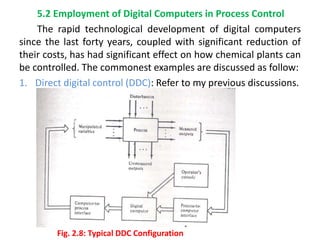
1. Direct digital control (DDC): Refer to my previous discussions.
Fig. 2.8: Typical DDC Configuration
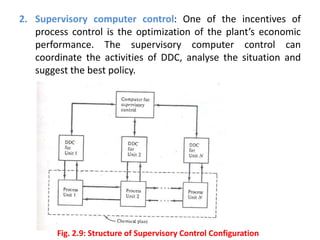
2. Supervisory computer control: One of the incentives of
process control is the optimization of the plant’s economic
performance. The supervisory computer control can
coordinate the activities of DDC, analyse the situation and
suggest the best policy.
Fig. 2.9: Structure of Supervisory Control Configuration
3. Scheduling computer control: In this case, the computer can
be used to schedule the operation of a plant depending on
the conditions in the market (demand, supply, prices) change
with time by cutting production to avoid overstocking,
increasing production, new production line, etc.
ASK YOUR QUESTIONS
IF ANY !!!
Thank U all for listening

Presentation on process dynamics and control

  • 1.
    CHEN502 PROCESS DYNAMICS ANDCONTROL Module 2: Design and Hardware Aspects of Process Control System Prof. Momoh Omuya Raheem Room 55, PTDF Building Email: omuyar2002@yahoo.com
  • 2.
    Learning Outcome It isthe intent of this Module to help the student to: 1. Classify the variables in chemical processes. 2. Identify the design elements of a control system. 3. Develop control aspects of a complete chemical plant. 4. Highlight control system development. 5. Discuss hardware for a process control system. 2
  • 3.
    1. CLASSIFICATION OFTHE VARIABLES IN A CHEMICAL PROCESS • Input variables denote the effect of surrounding on the chemical process. • Output variables denote the effect of the process on the surrounding.
  • 4.
    Example 1 For aCSTR reactor • Input Variables: CAi, Ti, Fi, Tci, Fci, (F) • Output Variables: CA, T, F, TCo, V FC, TCi CA, T, F FCo, TCo Product Fi,CAi,Ti A B Exothermic
  • 5.
    Example 2 • Forthe tank heater • Input Variables: Fi, Ti, Fst, (F) • Output Variables: F, V, T F, T Fi, Ti Q T h Steam Condensate
  • 6.
    The input variablescan be further classified into the following categories: a) Manipulated (or Adjustable) variables especially if their values can be adjusted by an operator or control mechanism. b) Disturbance if their values are not resultant effect of an operator or a control mechanism. The output variables similarly can be further divided into the followings: a) Measured output variables especially if their values are known by directly measuring them. b) Unmeasured output variables if they are not or cannot be measured directly.
  • 7.
    Fig. 2.1: Input& Output Variables around a Chemical Process System External disturbances Processing System Unmeasured Output, (Z) Measured Output, (y) Manipulated Variables (m) Measured (d) Unmeasured (d’) …. …… …… …… …… …… ……
  • 8.
    2. DESIGN ELEMENTSOF A CONTROL SYSTEM (A) Define Control Objectives Question 1 What are the operational objectives that a control system is called upon to achieve? 1. Ensuring the stability of a system, 2. Suppressing the influence of external disturbance, 3. Optimizing the economic performance of a plant, 4. A combination of the above. At the beginning the control objectives are defined qualitatively, subsequently, they are quantified in terms of the output variables.
  • 9.
    1. For CSTRdiscussed in Example 1, the control objective (qualitatively defined) is to ensure the stability of unstable steady state. A quantitative control objective requires that the temperature (an output variable) not deviate more than 5% from its nominal value at the unstable steady state. 2. For the stirred tank heater (suppressing external disturbances) Qualitatively: T and V(h) should be desired value Quantitatively; T = Ts V = Vs Where Ts and Vs are given and they are desired values 3. For the Batch reactor (optimizing the economic performance) Qualitatively: maximizing profit
  • 10.
    Quantitatively; It requires thesolution of maximization of profit which yield the value of the steam flow rate, Q(t); at each instant during the reaction period. (B) Select Measurement Whatever our control objective is, we need some means to monitor the performance of the chemical process. This is done by measuring the values of some certain process variables (Temperature, Pressure, Flow rate etc). Question 2 What variables should we measure in order to monitor the operational performance of the plant?
  • 11.
    Answer: primary measurementsare easy but a secondary measurement gives mathematical relationship between unmeasured outputs. For the Stirred Tank Simple measurement T = Ts and V = Vs Difficult Measurements A mathematical expression relating the two Unmeasured Output = f(secondary measurements) Example Consider a simple distillation column in the distillate composition is set 95% pentane against 5% hexane. Feedback control using analysis Feedforward control using analysis Therefore, use a secondary measurement (T) Analyzer can be unreliable or very costly
  • 12.
    (C) Select theControl Configuration Question 3 What is the best control configuration for a given chemical process situation?
  • 13.
    (i) Feed backControl Configuration Fig. 2.2: General Structure of Feedback Control Configuration Process Controller Disturbance Unmeasured Output Set Point (desired variable) Measured Output (controlled variables) Manipulated Variables
  • 14.
    (ii) Inferential ControlConfiguration Fig. 2.2: General Structure of Inferential Controlled Configuration Process Disturbance Unmeasured Output Controller Estimator for unmeasured variable Set points Measured Outputs Manipulated Variables
  • 15.
    (iii) Feed forwardControl Configuration Fig. 2.3 General Structure of Feedforward Control Configuration Process Measured Output Unmeasured Output Controller Manipulated Variables External Disturbance
  • 16.
    (D) Design theController In every control configuration the controller is the active element that receives the information from the measurements and takes appropriate control action(s) to adjust the values of the manipulated variables. For the design of a controller one must answer the next question. Question 4 How is the information taken from the measurements used to adjust the values of the manipulated variables? Answer Use the control law. E.g. For the Stirred tank heater At steady state, The energy balance of the heater 0 = FρCp(Ti,s – Ts) + Qs ------------------------------------------- (1)
  • 17.
    Diagrammatically How T changeswith time will be given by the transient energy balance around the tank; that is Subtracting eqn 1 from eqn 2, we have Note that, since Ts = constant Time Ts Ti,s Ti dT/dt = ))/dt T - (d(T s (3 - - - Qs) - (Q + Ts)] - (T - s) Ti, - Cp[(Ti F = Ts))/dt - Cp(d(T V   (2) - - - - Q + T) - Cp(Ti F = d(T)/dt Cp V  
  • 18.
    The difference, ϵ= T – Ts denotes the error or deviation of liquid, temperature from the desired value Ti. We want to drive this error to zero by manipulating appropriately the value of heat input, Q. The simplest control law is to require that Q changes proportionally to the error T – Ts, hence Q = -α(T – Ts) + Qs ---------------------- (4) This law is known as proportional control and parameter α is called proportional gain. Substituting eqn4 into eqn3, we have
  • 19.
    VρCp d(T –Ts)/dt = FρCp[(Ti – Ti,s) – (T – Ts)] – α(T – Ts) -------- (5) Eqn5 is solved for (T – Ts), and for various values of gain and yield the solutions shown in Fig.. below. It’s noticed that more of the solutions is satisfactory since T – Ts ≠ 0. Thus one concludes that the proportional control law is not acceptable.
  • 20.
    Fig. 2.4: Temperatureresponse under proportional feedback control Error Time (T – Ts) No Control α = 0 α = 1 α = 2
  • 21.
    However, considerable improvementin the quality of the resulting control can be obtained if one uses a different control law known as integral control. In this case Q is proportional to the time integral of (T – Ts); thus, Substituting again Q from eqn6 into eqn3, we have (6) - - - - - - - - - Qs + Ts)dt - (T ' t 0     Q ) 7 ( Ts)dt - (T ' - ] Ts) - (T - s) Ti, - Cp[(Ti F = Ts))/dt - (d(T Cp V t 0        
  • 22.
    The solution ofeqn7 for various values of the parameters α’ is shown in Fig… below Time Error (T – Ts) α’ = 1 α’ = 2 α’ = 3 α’ = 0 No Control Fig. 2.5: Temperature response under Integal feedback control
  • 23.
    From above, wenotice that integral control is acceptable since it drives the error, T – Ts to zero. However, we also noticed that depending on the values of α’, the error T – Ts returns to faster or slower, oscillates for longer or shorter time, and so on. In other words, the quality of control depends on the value of α’. Combining the proportional with the integral action, we take a new control law known as proportional integral control. According to this law, the value of heat input, Q is given by,
  • 24.
    We shall seethis and other types of control laws, somewhere later. However, it should be remembered that the selection of appropriate control law is an important question to be answered by the chemical engineer control design. Qs Ts)dt - (T ' - Ts) - (T - = Q t 0    
  • 25.
    3.0 Control AspectOf a Complete Chemical Plant The examples that we have been discussing in the previous sections were concerned with the control of single units such as CSTR, a tank heater, and a batch reactor. It should be emphasized that rarely if ever a chemical process composed of one unit only. On the contrary, a chemical process is composed of a large number of units (reactors, separators, heat exchangers, tanks, pumps, etc.) which are inter- connected with each other through the flow of materials and energy. For such a process the problem of designing a control system is not simple but requires experience and good chemical engineering background. Consider this simple example.
  • 26.
    Fig. 2.6: Asimple Chemical Plant Cooling Water Steam Steam Condensate Jacket CSTR Distillation column C Fp FN A+B A+B+C A+B C B, FB, TB A, FA, TA Endothermic rxn
  • 27.
    The operational objectivesfor this simple plant are 1.Product Specifications: a) To keep the flow rate of the desired product stream FP at the desired level. b) Keep the required purity of C in the product stream 2.Operational Constraints: a) Do not overflow the CSTR. b) Do not flood the distillation column or let it dry 3.Economic Considerations: Maximizing the profit = minimizing the cost of production through operating costs such as cost of raw materials, utilities etc
  • 28.
    The disturbance thatwill affect the foregoing objectives are: a) The flow rates, compositions, and temperature of the streams of the two raw materials. b) The pressure in the distillation column. c) The temperature of the coolant used in the condenser of the distillation column. (For example, if the coolant is water. It will have a different temperature during the day than during the night) At first glance, the problem of designing a control system even for this simple plant looks very complex. Indeed it is. The basically new feature for the control design of such a system is the interaction between the units (reactor, column).
  • 29.
    The output ofthe reactors affects the operation of the column in a profound manner and the overhead product of the column influences the conversion in the CSTR. This tighten interaction between the two units seriously complicates the design of the control system for the overall process. Suppose that we want to control the composition of the bottoms product by manipulating the steam in the reboiler of the column. This control action will affect the composition of the overhead product (A+B), which will in turn affect the reaction conversion in the CSTR.
  • 30.
    On the otherhand, to keep the conversion in the CSTR constant at the design level, we try to keep the ratio FA/FB = constant and the temperature T in the CSTR constant. Any changes in FA/FB or T will affect the conversion in the reactor and thus the composition of the column will affect the purity of the two product streams. The control of integrated processes is the basic objective for a chemical engineer. One to its complexity, though, we will start by analyzing the control problems for single Unit and eventually we will try the integrated processes.
  • 31.
    4.0 Control SystemDevelopment
  • 35.
    5.0 Hardware fora Process Control System 5.1 Hardware Elements of a Control System In every control configuration, we can distinguish the following hardware system: 1. The chemical process: It may be unit operation equipment, reactors, mechanical, etc., 2. The measuring instruments or sensors: Examples are: thermocouple, venture meters, gas or liquid chromatographs, etc. 3. Transducers: These are elements that can convert physical measurements into signals for easy interpretation, e.g., pneumatic or electrical signals. 4. Transmission lines: They are either pneumatic but currently deployment of electric signals.
  • 36.
    5. The controller:This is the hardware element that possess the “intelligence” to receive information from the measuring devices and decides appropriate action to be taken. It may employ simple control law, like, “Proportional (P), Proportional-Integral (PI), Proportional-Integral-Derivative (PID), Computer, or complex control law like “Artificial intelligence (AI)”. 6. The final control elements: These are the elements that implement the decision taken by the controller. Examples are: relay switches for on-off control, variable speed pumps, etc., 7. Recorders: They are normally employed in providing the visual demonstration of how chemical process behaves in- situ or at the control room. Currently, the use of computer console like Visual Display Unit (VDU) has become very popular in monitoring the performance of chemical processes.
  • 37.
    Fig. 2.7: HardwareElements for the Feedback Control of STH
  • 38.
    5.2 Employment ofDigital Computers in Process Control The rapid technological development of digital computers since the last forty years, coupled with significant reduction of their costs, has had significant effect on how chemical plants can be controlled. The commonest examples are discussed as follow: 1. Direct digital control (DDC): Refer to my previous discussions. Fig. 2.8: Typical DDC Configuration
  • 39.
    2. Supervisory computercontrol: One of the incentives of process control is the optimization of the plant’s economic performance. The supervisory computer control can coordinate the activities of DDC, analyse the situation and suggest the best policy. Fig. 2.9: Structure of Supervisory Control Configuration
  • 40.
    3. Scheduling computercontrol: In this case, the computer can be used to schedule the operation of a plant depending on the conditions in the market (demand, supply, prices) change with time by cutting production to avoid overstocking, increasing production, new production line, etc.
  • 41.
  • 42.
    Thank U allfor listening