ICE 3015: CONTROL SYSTEM
COMPONENTS
Class 7: Synchros – Basics and
Construction
Dr. S. Meenatchisundaram
Email: meenasundar@gmail.com
Control System Components (ICE 3015)
Dr. S.Meenatchisundaram, MIT, Manipal, Aug – Nov 2018
Synchros - Introduction:
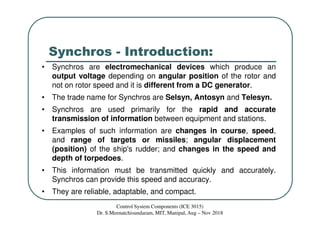
• Synchros are electromechanical devices which produce an
output voltage depending on angular position of the rotor and
not on rotor speed and it is different from a DC generator.
• The trade name for Synchros are Selsyn, Antosyn and Telesyn.
• Synchros are used primarily for the rapid and accurate
transmission of information between equipment and stations.
• Examples of such information are changes in course, speed,
and range of targets or missiles; angular displacement
(position) of the ship's rudder; and changes in the speed and
depth of torpedoes.
• This information must be transmitted quickly and accurately.
Synchros can provide this speed and accuracy.
• They are reliable, adaptable, and compact.
Control System Components (ICE 3015)
Dr. S.Meenatchisundaram, MIT, Manipal, Aug – Nov 2018
Introduction:
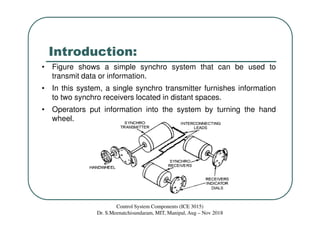
• Figure shows a simple synchro system that can be used to
transmit data or information.
• In this system, a single synchro transmitter furnishes information
to two synchro receivers located in distant spaces.
• Operators put information into the system by turning the hand
wheel.
Control System Components (ICE 3015)
Dr. S.Meenatchisundaram, MIT, Manipal, Aug – Nov 2018
Introduction:
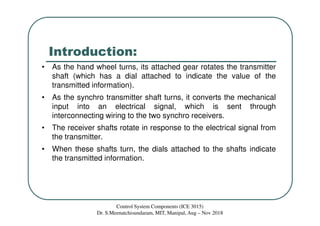
• As the hand wheel turns, its attached gear rotates the transmitter
shaft (which has a dial attached to indicate the value of the
transmitted information).
• As the synchro transmitter shaft turns, it converts the mechanical
input into an electrical signal, which is sent through
interconnecting wiring to the two synchro receivers.
• The receiver shafts rotate in response to the electrical signal from
the transmitter.
• When these shafts turn, the dials attached to the shafts indicate
the transmitted information.
Control System Components (ICE 3015)
Dr. S.Meenatchisundaram, MIT, Manipal, Aug – Nov 2018
Classification:
• Synchros work in teams. Two or more synchros interconnected
electrically form a synchro system.
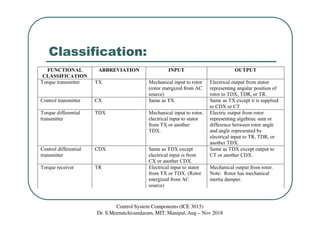
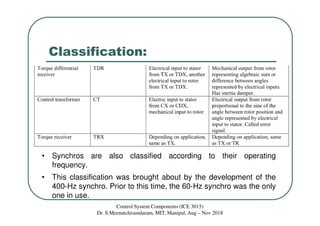
• There are two general classifications of synchro systems—
Torque Systems and Control Systems. The load dictates the
type of synchro system, and thus the type of synchro.
• Torque-synchro systems are classified "torque" because they are
mainly concerned with the torque or turning force required to
move light loads such as dials, pointers, or similar indicators.
• The positioning of these devices requires a relatively low amount
of torque.
• Control synchros are used in systems that are designed to move
heavy loads such as gun directors, radar antennas, and missile
launchers.
Control System Components (ICE 3015)
Dr. S.Meenatchisundaram, MIT, Manipal, Aug – Nov 2018
Classification:
Control System Components (ICE 3015)
Dr. S.Meenatchisundaram, MIT, Manipal, Aug – Nov 2018
Classification:
Control System Components (ICE 3015)
Dr. S.Meenatchisundaram, MIT, Manipal, Aug – Nov 2018
• Synchros are also classified according to their operating
frequency.
• This classification was brought about by the development of the
400-Hz synchro. Prior to this time, the 60-Hz synchro was the only
one in use.
Schematic Symbols:
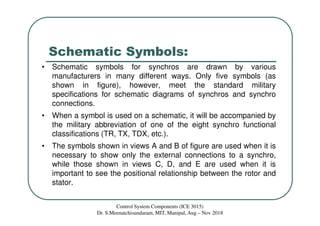
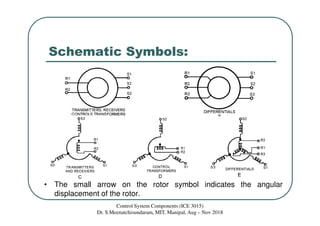
• Schematic symbols for synchros are drawn by various
manufacturers in many different ways. Only five symbols (as
shown in figure), however, meet the standard military
specifications for schematic diagrams of synchros and synchro
connections.
• When a symbol is used on a schematic, it will be accompanied by
the military abbreviation of one of the eight synchro functional
classifications (TR, TX, TDX, etc.).
• The symbols shown in views A and B of figure are used when it is
necessary to show only the external connections to a synchro,
while those shown in views C, D, and E are used when it is
important to see the positional relationship between the rotor and
stator.
Control System Components (ICE 3015)
Dr. S.Meenatchisundaram, MIT, Manipal, Aug – Nov 2018
Schematic Symbols:
Control System Components (ICE 3015)
Dr. S.Meenatchisundaram, MIT, Manipal, Aug – Nov 2018
• The small arrow on the rotor symbol indicates the angular
displacement of the rotor.
Construction:
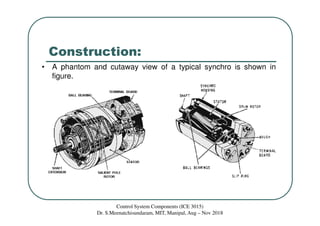
• A phantom and cutaway view of a typical synchro is shown in
figure.
Control System Components (ICE 3015)
Dr. S.Meenatchisundaram, MIT, Manipal, Aug – Nov 2018
Construction:
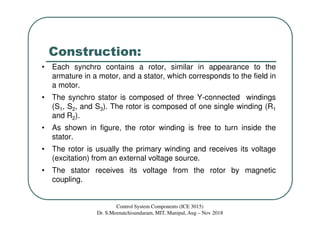
• Each synchro contains a rotor, similar in appearance to the
armature in a motor, and a stator, which corresponds to the field in
a motor.
• The synchro stator is composed of three Y-connected windings
(S1, S2, and S3). The rotor is composed of one single winding (R1
and R2).
• As shown in figure, the rotor winding is free to turn inside the
stator.
• The rotor is usually the primary winding and receives its voltage
(excitation) from an external voltage source.
• The stator receives its voltage from the rotor by magnetic
coupling.
Control System Components (ICE 3015)
Dr. S.Meenatchisundaram, MIT, Manipal, Aug – Nov 2018
Construction:
Rotor Construction:
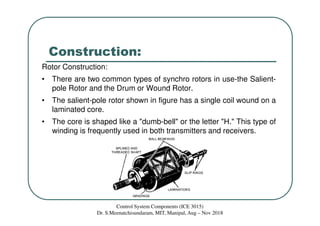
• There are two common types of synchro rotors in use-the Salient-
pole Rotor and the Drum or Wound Rotor.
• The salient-pole rotor shown in figure has a single coil wound on a
laminated core.
• The core is shaped like a "dumb-bell" or the letter "H." This type of
winding is frequently used in both transmitters and receivers.
Control System Components (ICE 3015)
Dr. S.Meenatchisundaram, MIT, Manipal, Aug – Nov 2018
Construction:
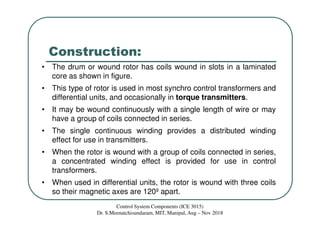
• The drum or wound rotor has coils wound in slots in a laminated
core as shown in figure.
• This type of rotor is used in most synchro control transformers and
differential units, and occasionally in torque transmitters.
• It may be wound continuously with a single length of wire or may
have a group of coils connected in series.
• The single continuous winding provides a distributed winding
effect for use in transmitters.
• When the rotor is wound with a group of coils connected in series,
a concentrated winding effect is provided for use in control
transformers.
• When used in differential units, the rotor is wound with three coils
so their magnetic axes are 120º apart.
Control System Components (ICE 3015)
Dr. S.Meenatchisundaram, MIT, Manipal, Aug – Nov 2018
Construction:
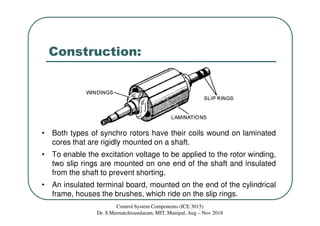
• Both types of synchro rotors have their coils wound on laminated
cores that are rigidly mounted on a shaft.
• To enable the excitation voltage to be applied to the rotor winding,
two slip rings are mounted on one end of the shaft and insulated
from the shaft to prevent shorting.
• An insulated terminal board, mounted on the end of the cylindrical
frame, houses the brushes, which ride on the slip rings.
Control System Components (ICE 3015)
Dr. S.Meenatchisundaram, MIT, Manipal, Aug – Nov 2018
Construction:
• These brushes provide continuous electrical contact to the rotor
during its rotation.
• Also mounted on the rotor shaft are low-friction ball bearings,
which permit the rotor to turn easily.
Stator Construction:
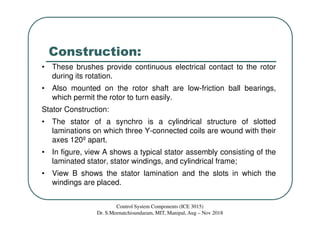
• The stator of a synchro is a cylindrical structure of slotted
laminations on which three Y-connected coils are wound with their
axes 120º apart.
• In figure, view A shows a typical stator assembly consisting of the
laminated stator, stator windings, and cylindrical frame;
• View B shows the stator lamination and the slots in which the
windings are placed.
Control System Components (ICE 3015)
Dr. S.Meenatchisundaram, MIT, Manipal, Aug – Nov 2018
Construction:
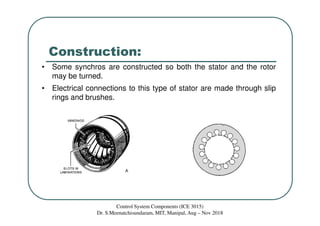
• Some synchros are constructed so both the stator and the rotor
may be turned.
• Electrical connections to this type of stator are made through slip
rings and brushes.
Control System Components (ICE 3015)
Dr. S.Meenatchisundaram, MIT, Manipal, Aug – Nov 2018
Construction:
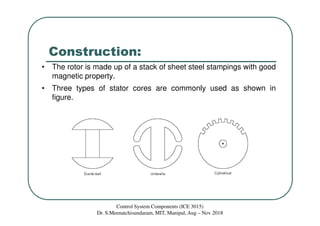
• The rotor is made up of a stack of sheet steel stampings with good
magnetic property.
• Three types of stator cores are commonly used as shown in
figure.
Control System Components (ICE 3015)
Dr. S.Meenatchisundaram, MIT, Manipal, Aug – Nov 2018
Construction:
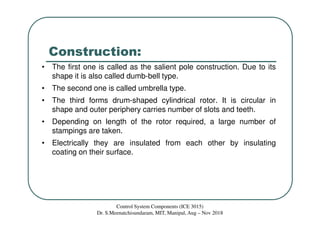
• The first one is called as the salient pole construction. Due to its
shape it is also called dumb-bell type.
• The second one is called umbrella type.
• The third forms drum-shaped cylindrical rotor. It is circular in
shape and outer periphery carries number of slots and teeth.
• Depending on length of the rotor required, a large number of
stampings are taken.
• Electrically they are insulated from each other by insulating
coating on their surface.
Control System Components (ICE 3015)
Dr. S.Meenatchisundaram, MIT, Manipal, Aug – Nov 2018
Summary:
• Synchros, as stated earlier, are simply variable transformers.
• They differ from conventional transformers by having one primary
winding (the rotor), which may be rotated through 360º and three
stationary secondary windings (the stator) spaced 120º apart.
• It follows that the magnetic field within the synchro may also be
rotated through 360º.
• If an iron bar or an electromagnet were placed in this field and
allowed to turn freely, it would always tend to line up in the
direction of the magnetic field.
• This is the basic principle underlying all synchro operations.
Control System Components (ICE 3015)
Dr. S.Meenatchisundaram, MIT, Manipal, Aug – Nov 2018
References:
• Navy Electricity and Electronics Training Series (NEETS)
Module 15—Principles of Synchros, Servos, and Gyros
http://www.rfcafe.com/references/electrical/NEETS-
Modules/NEETS-Module-15-1-1-1-10.htm
Control System Components (ICE 3015)
Dr. S.Meenatchisundaram, MIT, Manipal, Aug – Nov 2018

Lecture 7 Synchros - Basics and Construction

  • 1.
    ICE 3015: CONTROLSYSTEM COMPONENTS Class 7: Synchros – Basics and Construction Dr. S. Meenatchisundaram Email: meenasundar@gmail.com Control System Components (ICE 3015) Dr. S.Meenatchisundaram, MIT, Manipal, Aug – Nov 2018
  • 2.
    Synchros - Introduction: •Synchros are electromechanical devices which produce an output voltage depending on angular position of the rotor and not on rotor speed and it is different from a DC generator. • The trade name for Synchros are Selsyn, Antosyn and Telesyn. • Synchros are used primarily for the rapid and accurate transmission of information between equipment and stations. • Examples of such information are changes in course, speed, and range of targets or missiles; angular displacement (position) of the ship's rudder; and changes in the speed and depth of torpedoes. • This information must be transmitted quickly and accurately. Synchros can provide this speed and accuracy. • They are reliable, adaptable, and compact. Control System Components (ICE 3015) Dr. S.Meenatchisundaram, MIT, Manipal, Aug – Nov 2018
  • 3.
    Introduction: • Figure showsa simple synchro system that can be used to transmit data or information. • In this system, a single synchro transmitter furnishes information to two synchro receivers located in distant spaces. • Operators put information into the system by turning the hand wheel. Control System Components (ICE 3015) Dr. S.Meenatchisundaram, MIT, Manipal, Aug – Nov 2018
  • 4.
    Introduction: • As thehand wheel turns, its attached gear rotates the transmitter shaft (which has a dial attached to indicate the value of the transmitted information). • As the synchro transmitter shaft turns, it converts the mechanical input into an electrical signal, which is sent through interconnecting wiring to the two synchro receivers. • The receiver shafts rotate in response to the electrical signal from the transmitter. • When these shafts turn, the dials attached to the shafts indicate the transmitted information. Control System Components (ICE 3015) Dr. S.Meenatchisundaram, MIT, Manipal, Aug – Nov 2018
  • 5.
    Classification: • Synchros workin teams. Two or more synchros interconnected electrically form a synchro system. • There are two general classifications of synchro systems— Torque Systems and Control Systems. The load dictates the type of synchro system, and thus the type of synchro. • Torque-synchro systems are classified "torque" because they are mainly concerned with the torque or turning force required to move light loads such as dials, pointers, or similar indicators. • The positioning of these devices requires a relatively low amount of torque. • Control synchros are used in systems that are designed to move heavy loads such as gun directors, radar antennas, and missile launchers. Control System Components (ICE 3015) Dr. S.Meenatchisundaram, MIT, Manipal, Aug – Nov 2018
  • 6.
    Classification: Control System Components(ICE 3015) Dr. S.Meenatchisundaram, MIT, Manipal, Aug – Nov 2018
  • 7.
    Classification: Control System Components(ICE 3015) Dr. S.Meenatchisundaram, MIT, Manipal, Aug – Nov 2018 • Synchros are also classified according to their operating frequency. • This classification was brought about by the development of the 400-Hz synchro. Prior to this time, the 60-Hz synchro was the only one in use.
  • 8.
    Schematic Symbols: • Schematicsymbols for synchros are drawn by various manufacturers in many different ways. Only five symbols (as shown in figure), however, meet the standard military specifications for schematic diagrams of synchros and synchro connections. • When a symbol is used on a schematic, it will be accompanied by the military abbreviation of one of the eight synchro functional classifications (TR, TX, TDX, etc.). • The symbols shown in views A and B of figure are used when it is necessary to show only the external connections to a synchro, while those shown in views C, D, and E are used when it is important to see the positional relationship between the rotor and stator. Control System Components (ICE 3015) Dr. S.Meenatchisundaram, MIT, Manipal, Aug – Nov 2018
  • 9.
    Schematic Symbols: Control SystemComponents (ICE 3015) Dr. S.Meenatchisundaram, MIT, Manipal, Aug – Nov 2018 • The small arrow on the rotor symbol indicates the angular displacement of the rotor.
  • 10.
    Construction: • A phantomand cutaway view of a typical synchro is shown in figure. Control System Components (ICE 3015) Dr. S.Meenatchisundaram, MIT, Manipal, Aug – Nov 2018
  • 11.
    Construction: • Each synchrocontains a rotor, similar in appearance to the armature in a motor, and a stator, which corresponds to the field in a motor. • The synchro stator is composed of three Y-connected windings (S1, S2, and S3). The rotor is composed of one single winding (R1 and R2). • As shown in figure, the rotor winding is free to turn inside the stator. • The rotor is usually the primary winding and receives its voltage (excitation) from an external voltage source. • The stator receives its voltage from the rotor by magnetic coupling. Control System Components (ICE 3015) Dr. S.Meenatchisundaram, MIT, Manipal, Aug – Nov 2018
  • 12.
    Construction: Rotor Construction: • Thereare two common types of synchro rotors in use-the Salient- pole Rotor and the Drum or Wound Rotor. • The salient-pole rotor shown in figure has a single coil wound on a laminated core. • The core is shaped like a "dumb-bell" or the letter "H." This type of winding is frequently used in both transmitters and receivers. Control System Components (ICE 3015) Dr. S.Meenatchisundaram, MIT, Manipal, Aug – Nov 2018
  • 13.
    Construction: • The drumor wound rotor has coils wound in slots in a laminated core as shown in figure. • This type of rotor is used in most synchro control transformers and differential units, and occasionally in torque transmitters. • It may be wound continuously with a single length of wire or may have a group of coils connected in series. • The single continuous winding provides a distributed winding effect for use in transmitters. • When the rotor is wound with a group of coils connected in series, a concentrated winding effect is provided for use in control transformers. • When used in differential units, the rotor is wound with three coils so their magnetic axes are 120º apart. Control System Components (ICE 3015) Dr. S.Meenatchisundaram, MIT, Manipal, Aug – Nov 2018
  • 14.
    Construction: • Both typesof synchro rotors have their coils wound on laminated cores that are rigidly mounted on a shaft. • To enable the excitation voltage to be applied to the rotor winding, two slip rings are mounted on one end of the shaft and insulated from the shaft to prevent shorting. • An insulated terminal board, mounted on the end of the cylindrical frame, houses the brushes, which ride on the slip rings. Control System Components (ICE 3015) Dr. S.Meenatchisundaram, MIT, Manipal, Aug – Nov 2018
  • 15.
    Construction: • These brushesprovide continuous electrical contact to the rotor during its rotation. • Also mounted on the rotor shaft are low-friction ball bearings, which permit the rotor to turn easily. Stator Construction: • The stator of a synchro is a cylindrical structure of slotted laminations on which three Y-connected coils are wound with their axes 120º apart. • In figure, view A shows a typical stator assembly consisting of the laminated stator, stator windings, and cylindrical frame; • View B shows the stator lamination and the slots in which the windings are placed. Control System Components (ICE 3015) Dr. S.Meenatchisundaram, MIT, Manipal, Aug – Nov 2018
  • 16.
    Construction: • Some synchrosare constructed so both the stator and the rotor may be turned. • Electrical connections to this type of stator are made through slip rings and brushes. Control System Components (ICE 3015) Dr. S.Meenatchisundaram, MIT, Manipal, Aug – Nov 2018
  • 17.
    Construction: • The rotoris made up of a stack of sheet steel stampings with good magnetic property. • Three types of stator cores are commonly used as shown in figure. Control System Components (ICE 3015) Dr. S.Meenatchisundaram, MIT, Manipal, Aug – Nov 2018
  • 18.
    Construction: • The firstone is called as the salient pole construction. Due to its shape it is also called dumb-bell type. • The second one is called umbrella type. • The third forms drum-shaped cylindrical rotor. It is circular in shape and outer periphery carries number of slots and teeth. • Depending on length of the rotor required, a large number of stampings are taken. • Electrically they are insulated from each other by insulating coating on their surface. Control System Components (ICE 3015) Dr. S.Meenatchisundaram, MIT, Manipal, Aug – Nov 2018
  • 19.
    Summary: • Synchros, asstated earlier, are simply variable transformers. • They differ from conventional transformers by having one primary winding (the rotor), which may be rotated through 360º and three stationary secondary windings (the stator) spaced 120º apart. • It follows that the magnetic field within the synchro may also be rotated through 360º. • If an iron bar or an electromagnet were placed in this field and allowed to turn freely, it would always tend to line up in the direction of the magnetic field. • This is the basic principle underlying all synchro operations. Control System Components (ICE 3015) Dr. S.Meenatchisundaram, MIT, Manipal, Aug – Nov 2018
  • 20.
    References: • Navy Electricityand Electronics Training Series (NEETS) Module 15—Principles of Synchros, Servos, and Gyros http://www.rfcafe.com/references/electrical/NEETS- Modules/NEETS-Module-15-1-1-1-10.htm Control System Components (ICE 3015) Dr. S.Meenatchisundaram, MIT, Manipal, Aug – Nov 2018