








Load cells convert applied forces like tension, compression, pressure, or torque into electrical signals proportional to the force. The most common types are strain gauge, capacitive, and hydraulic load cells. A load cell works by measuring the deformation or change in an electrical property caused by an applied force. During calibration, load cells are tested incrementally using specific weights to ensure accuracy by evaluating linearity and repeatability. Annual recalibration is recommended best practice for load cell users.
LOAD
CELL:
Definition:
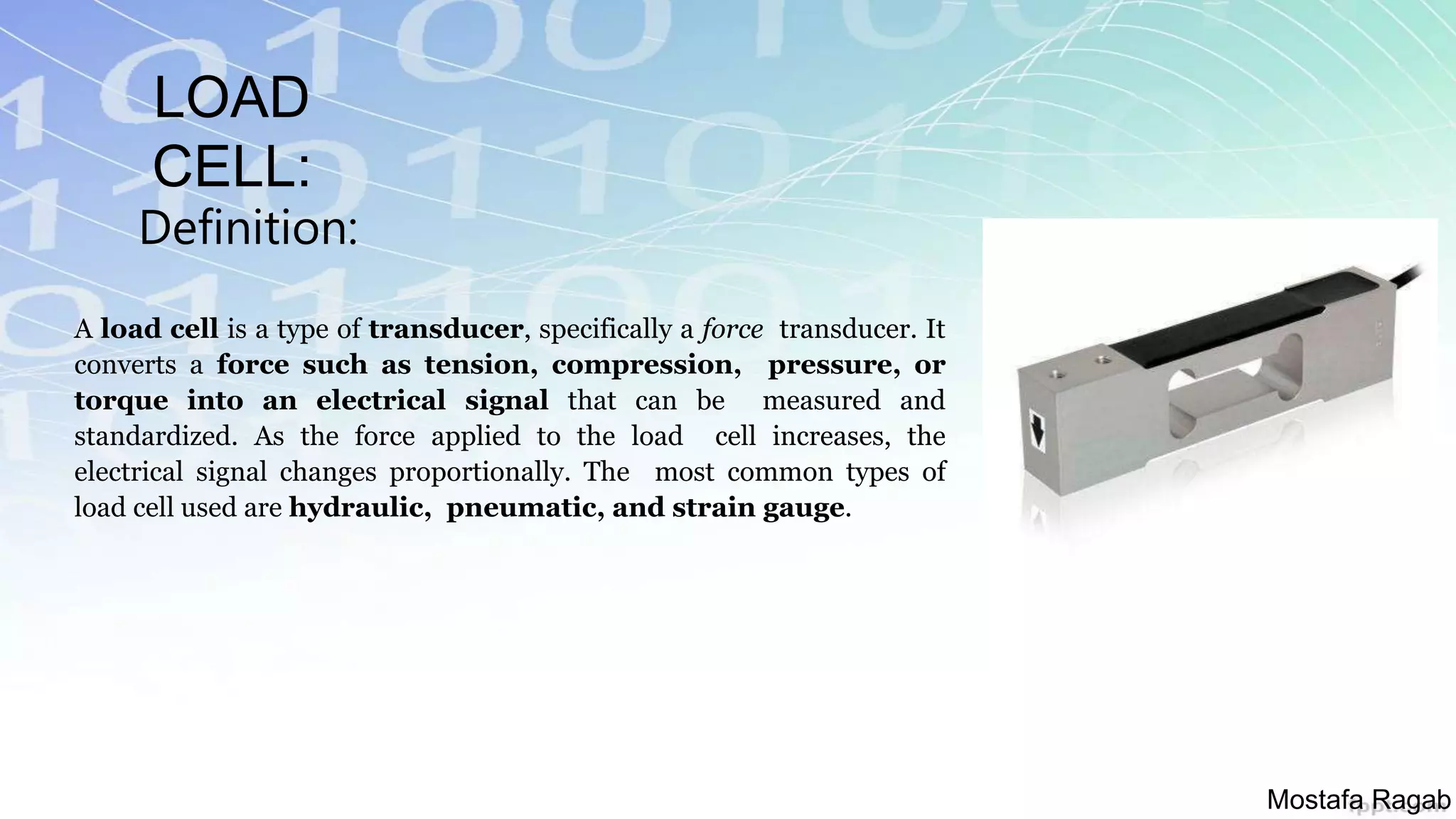
A load cellis a type of transducer, specifically a force transducer. It
converts a force such as tension, compression, pressure, or
torque into an electrical signal that can be measured and
standardized. As the force applied to the load cell increases, the
electrical signal changes proportionally. The most common types of
load cell used are hydraulic, pneumatic, and strain gauge.
Mostafa Ragab
1. Resistive LoadCells
It is the most common type of load cell used
widely in various industries for a large variety
of load cell applications.
Mostafa Ragab
5.
Principle of operation
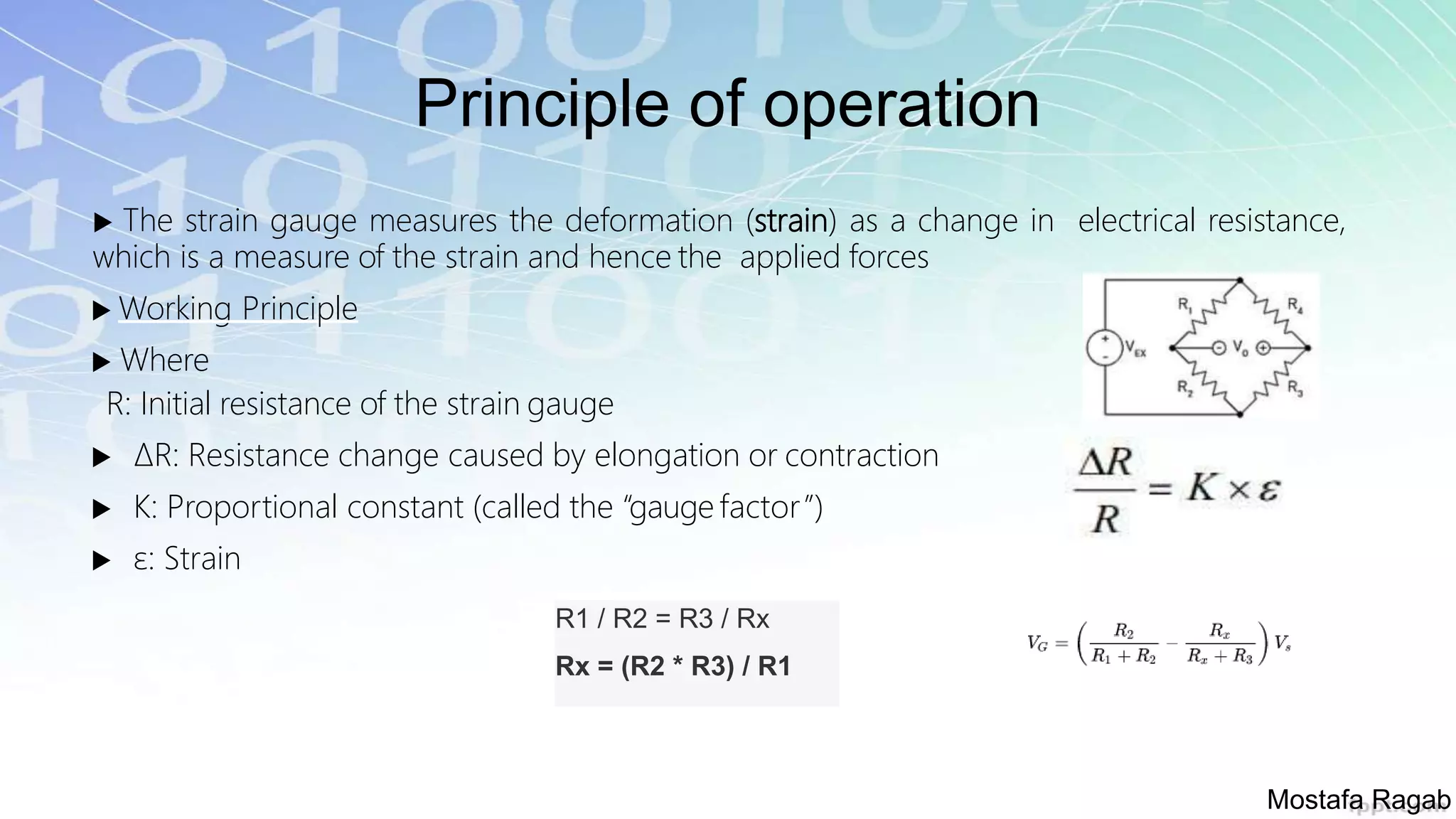
The strain gauge measures the deformation (strain) as a change in electrical resistance,
which is a measure of the strain and hence the applied forces
Working Principle
Where
R: Initial resistance of the strain gauge
ΔR: Resistance change caused by elongation or contraction
K: Proportional constant (called the “gauge factor”)
ε: Strain
R1 / R2 = R3 / Rx
Rx = (R2 * R3) / R1
Mostafa Ragab
2. Capacitive LoadCell:
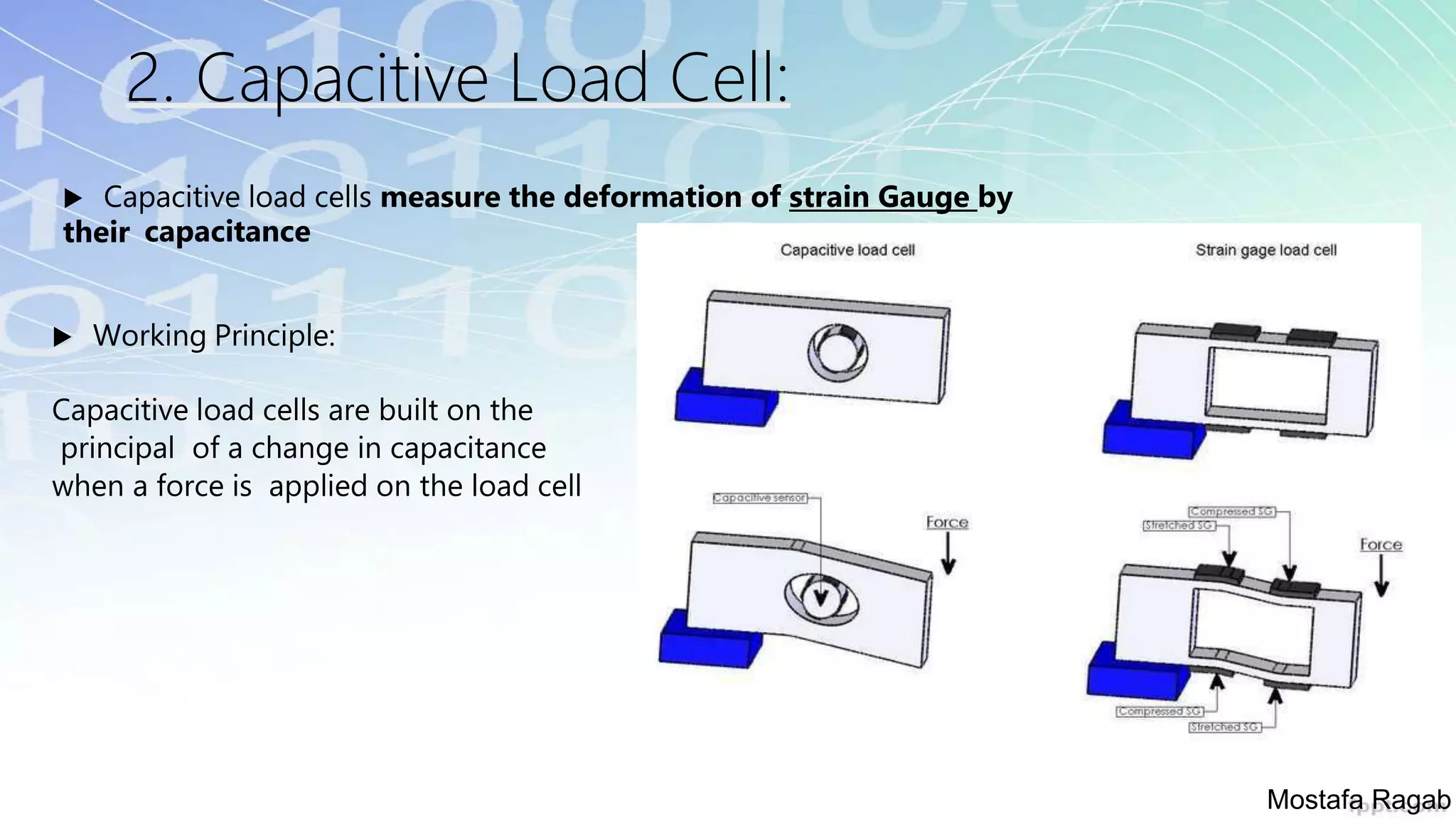
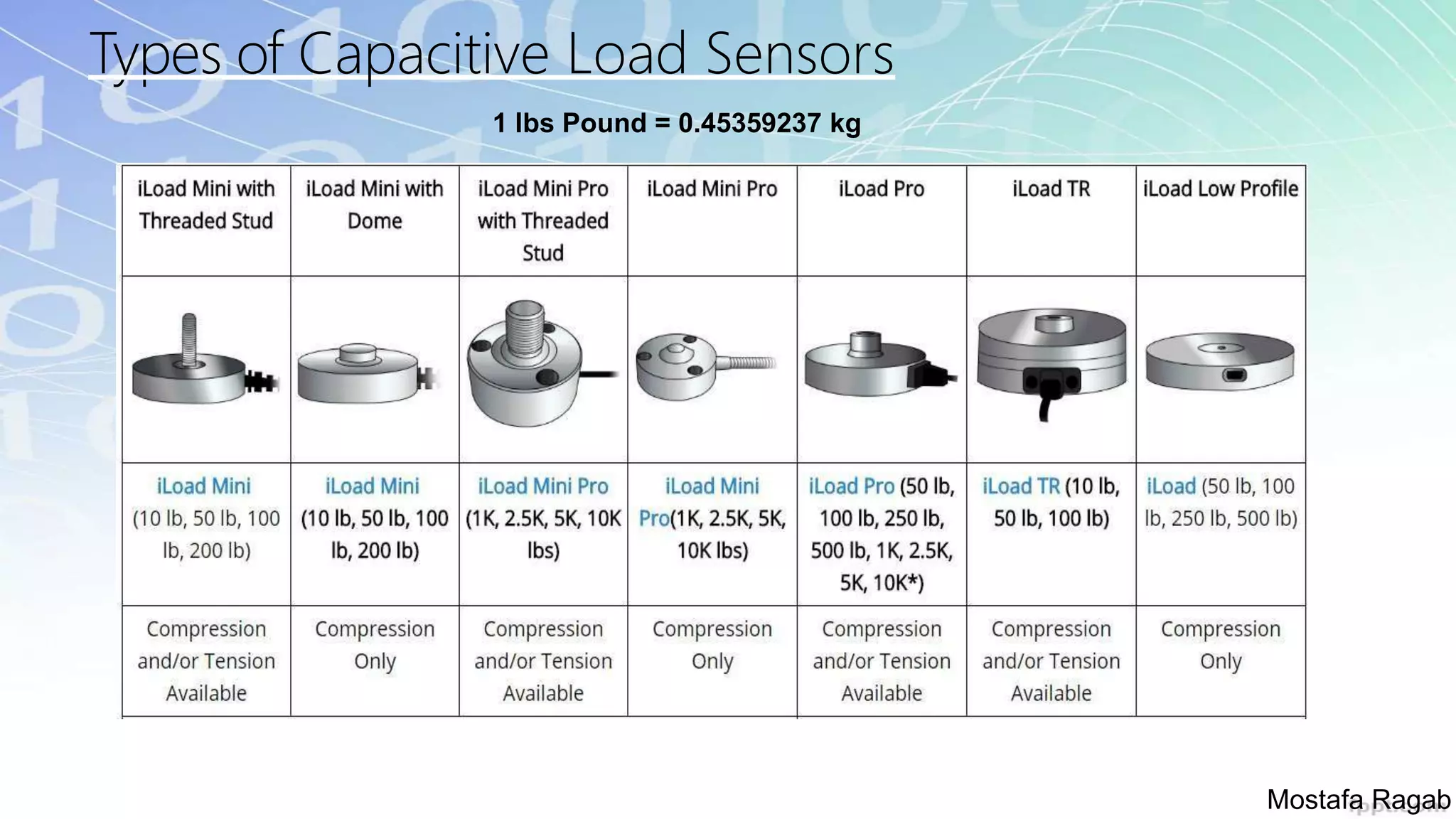
Capacitive load cells measure the deformation of strain Gauge by
their capacitance
Working Principle:
Capacitive load cells are built on the
principal of a change in capacitance
when a force is applied on the load cell
Mostafa Ragab
3. Vibrating wireLoad Cells:
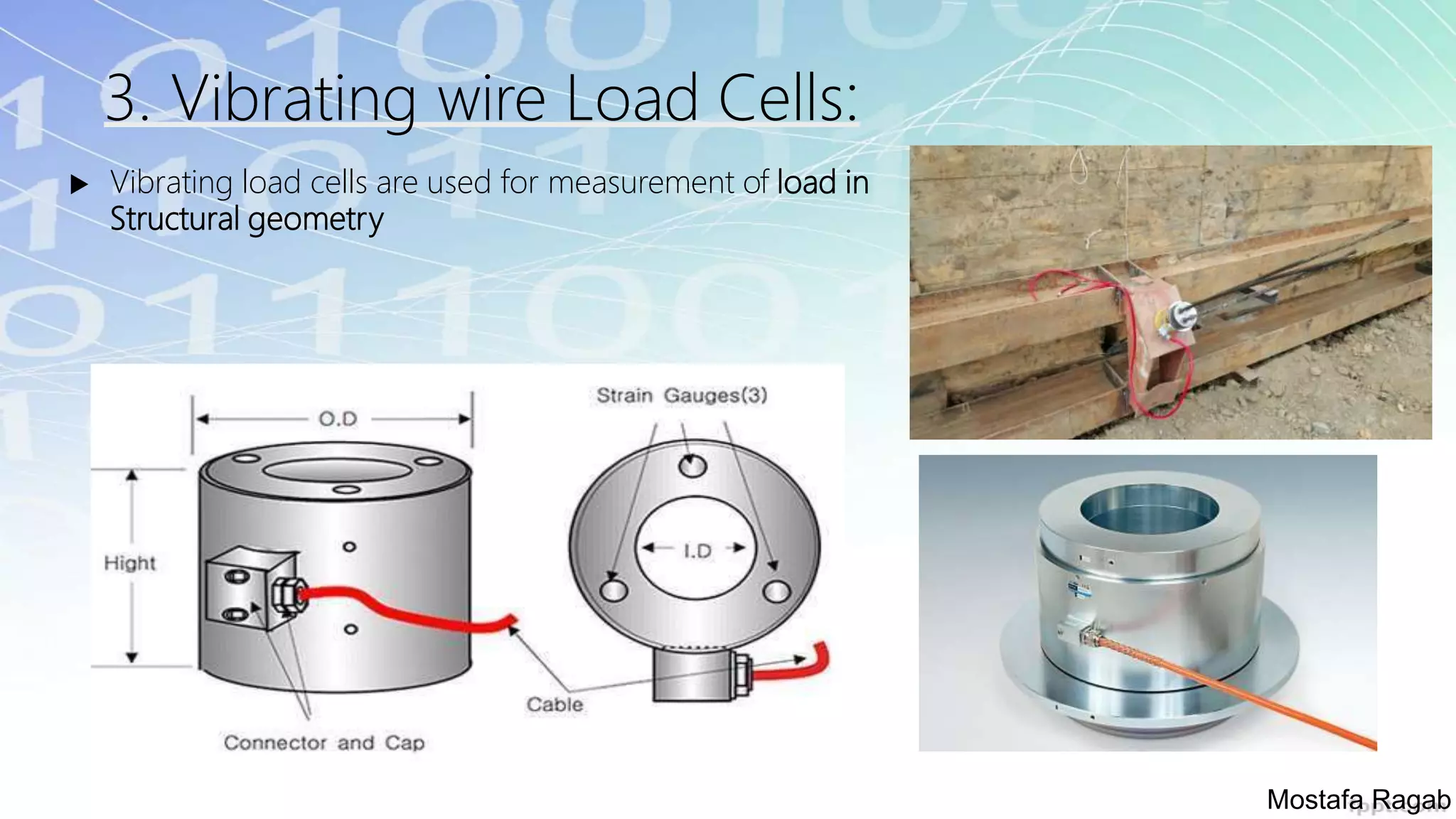
Vibrating load cells are used for measurement of load in
Structural geometry
Mostafa Ragab
10.
Vibrating wire LoadCells:
Advantages and Limitations:
Advantages:
An efficient way to monitor the load in structural elements
High accuracy and Long-term performance
Multiple gage system allowing to account for eccentric loading effects
Limitations:
Not suitable for dynamic loading
Special manufacturing technologies required to minimize the zero drift
Need to lightning protection should be evaluated
Zero drift
Gradual change in the scale zero of a measuring instrument.
Mostafa Ragab
11.
4. Piezoelectric LoadCell:
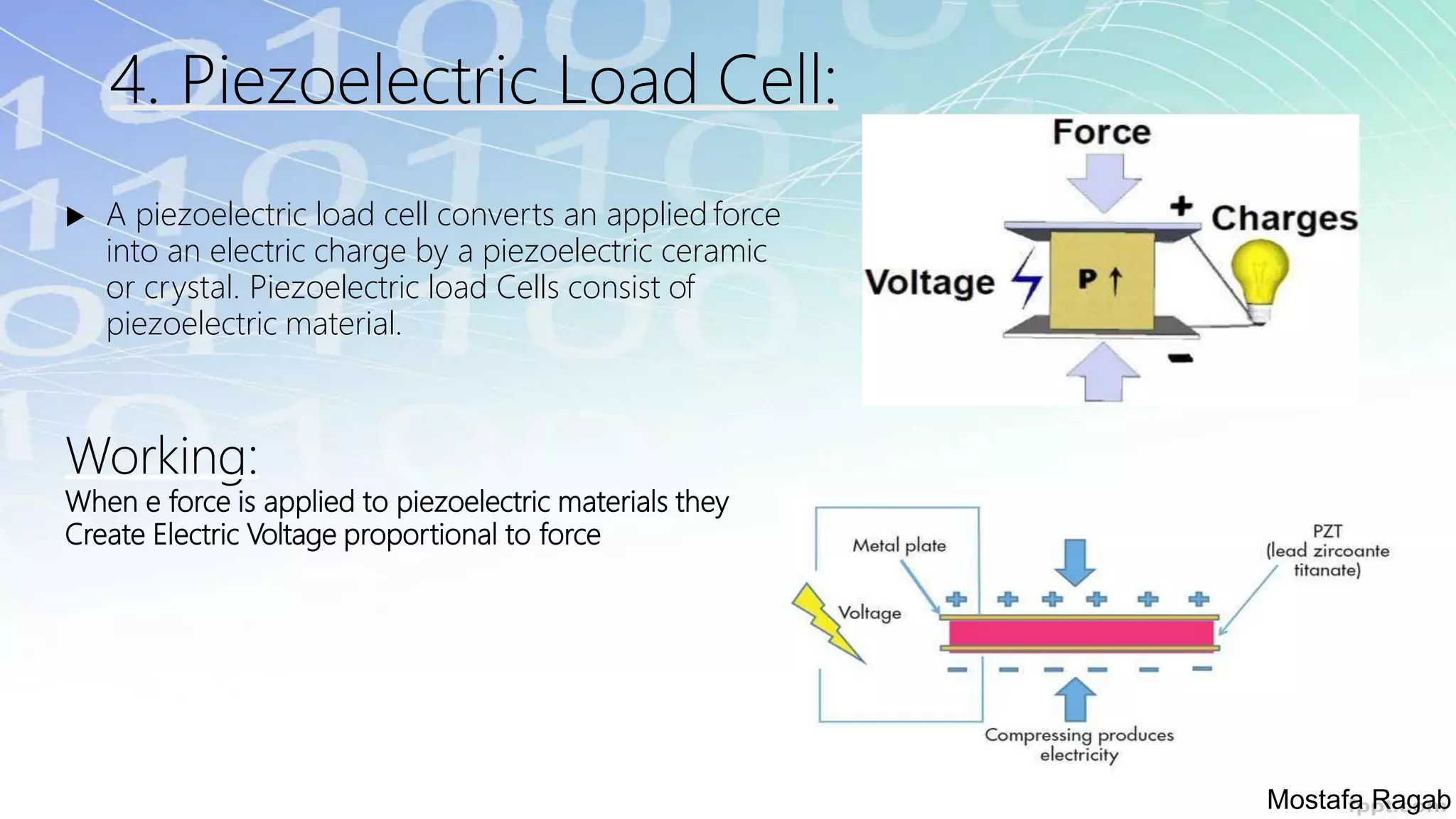
A piezoelectric load cell converts an applied force
into an electric charge by a piezoelectric ceramic
or crystal. Piezoelectric load Cells consist of
piezoelectric material.
Working:
When e force is applied to piezoelectric materials they
Create Electric Voltage proportional to force
Mostafa Ragab
12.
Piezoelectric Load Cell:
Advantages and Limitations:
Advantages
No need of external force.
Easy to handle and use as it has small dimensions.
High frequency response it means the parameters change very rapidly.
Limitations:
It is not suitable for measurement in static condition.
It is affected by temperatures.
Output is low so some external circuit is attached to it.
It is very difficult to give desired shape to this material and also desired strength.
Mostafa Ragab
13.
5. Hydraulic LoadCell:
Construction:
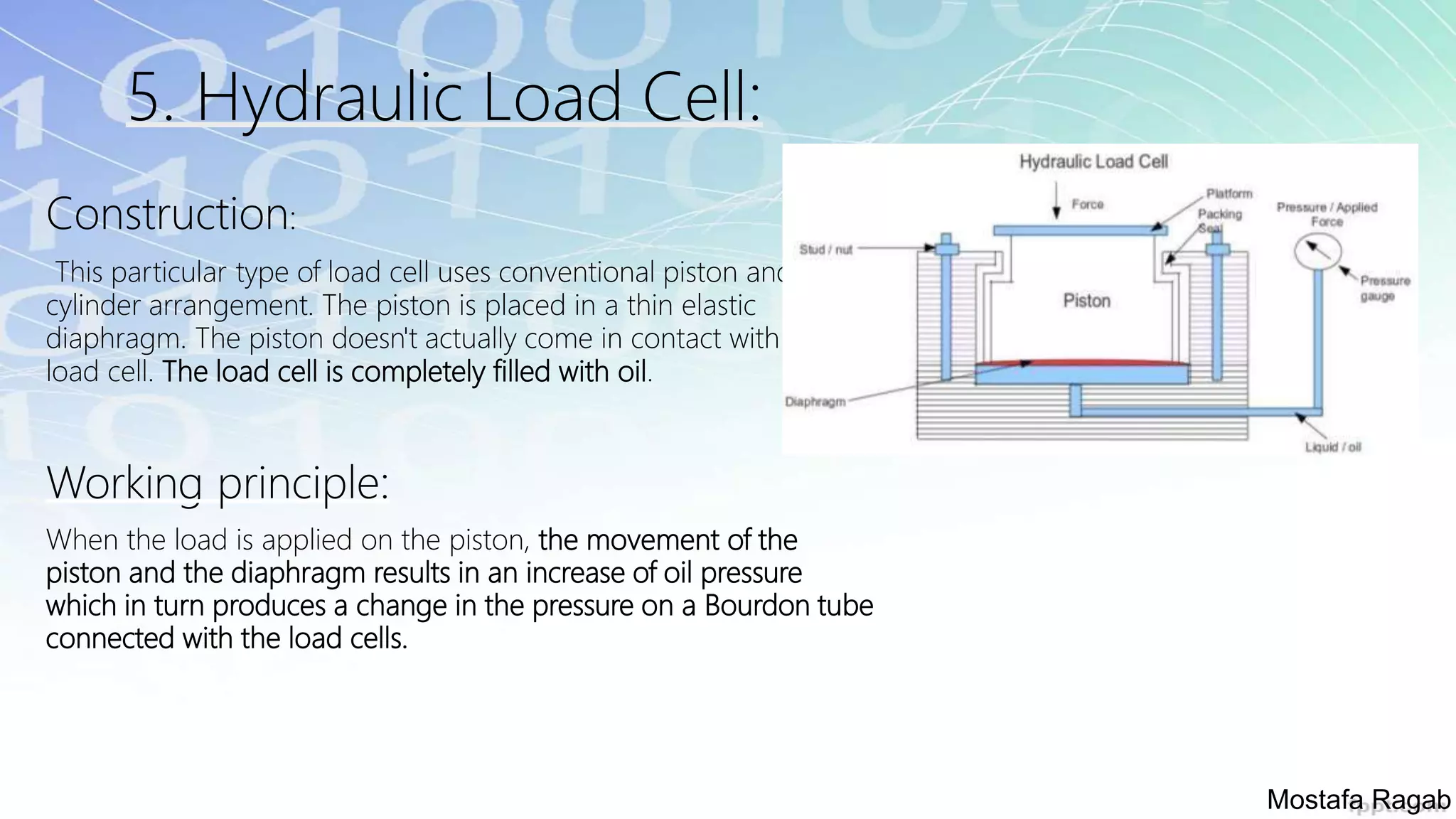
This particular type of load cell uses conventional piston and
cylinder arrangement. The piston is placed in a thin elastic
diaphragm. The piston doesn't actually come in contact with the
load cell. The load cell is completely filled with oil.
Working principle:
When the load is applied on the piston, the movement of the
piston and the diaphragm results in an increase of oil pressure
which in turn produces a change in the pressure on a Bourdon tube
connected with the load cells.
Mostafa Ragab
14.
Hydraulic Load Cell:Limitations:
This technology is more expensive than other types of load cells. It is a
more costly technology and thus cannot effectively compete on a cost of
purchase basis
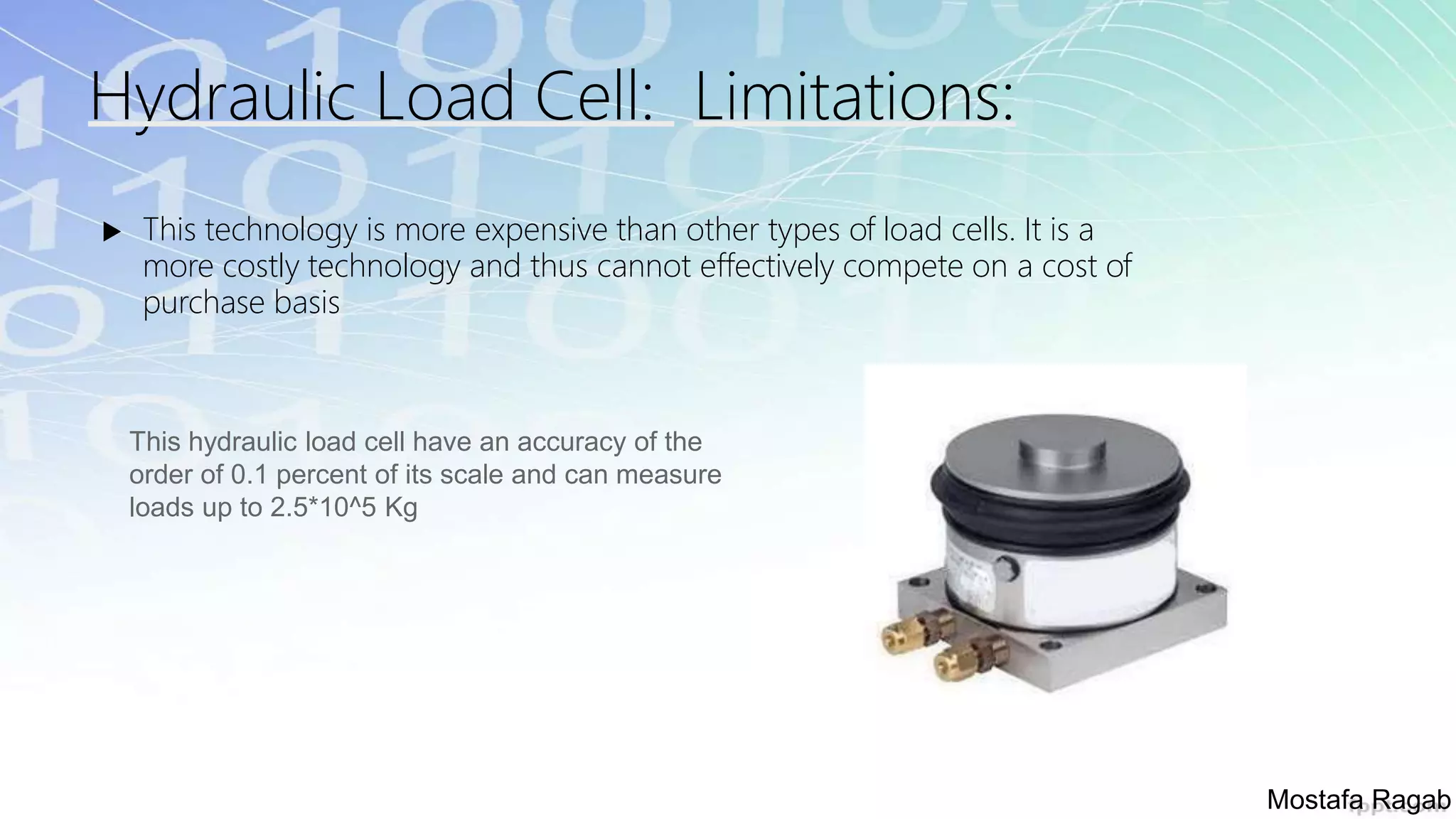
This hydraulic load cell have an accuracy of the
order of 0.1 percent of its scale and can measure
loads up to 2.5*10^5 Kg
Mostafa Ragab
15.
6. Pneumatic loadcell:
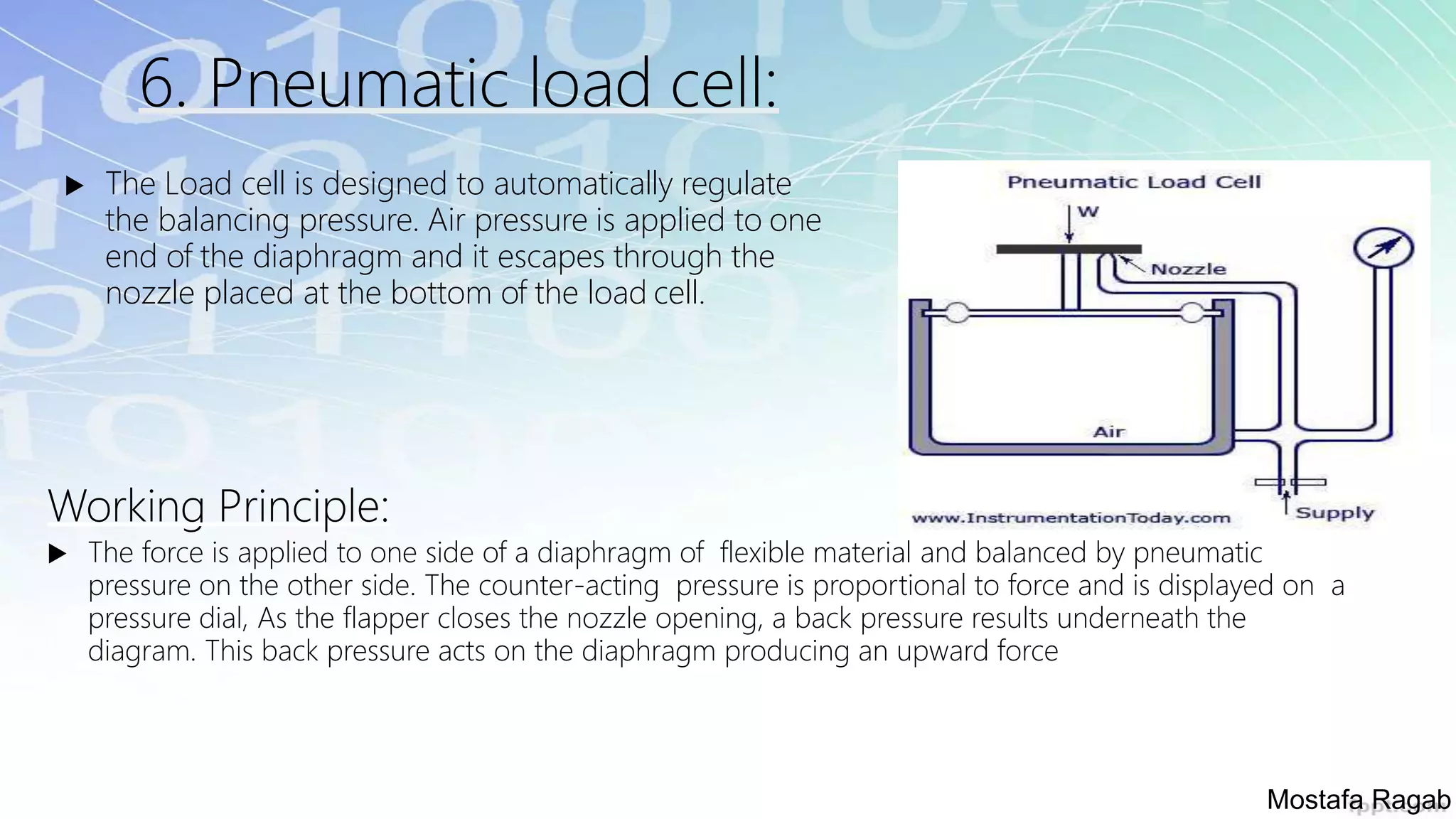
The Load cell is designed to automatically regulate
the balancing pressure. Air pressure is applied to one
end of the diaphragm and it escapes through the
nozzle placed at the bottom of the load cell.
Working Principle:
The force is applied to one side of a diaphragm of flexible material and balanced by pneumatic
pressure on the other side. The counter-acting pressure is proportional to force and is displayed on a
pressure dial, As the flapper closes the nozzle opening, a back pressure results underneath the
diagram. This back pressure acts on the diaphragm producing an upward force
Mostafa Ragab
16.
Pneumatic load cell:
Advantagesand Limitations:
Advantages:
The advantages of this type is that they are explosion proof.
They are not sensitive to temperature variations.
They contain no fluids like other type that might contaminate the process
if diaphragm destroyed.
Limitations:
They are relatively slow speed of response.
They need for clean, dry, regulated air or
Mostafa Ragab
17.
Excitation, Rated outputand hysteresis
• The bridge is excited with stabilized voltage (usually 10V, but can be 20V, 5V, or less for
battery powered instrumentation). The difference voltage proportional to the load then
appears on the signal outputs. The cell output is rated in millivolts per volt (mV/V) of the
difference voltage at full rated mechanical load. So a 2.96 mV/V load cell will provide 29.6
millivolt signal at full load when excited with 10 volts.
• Typical sensitivity values are 1 to 3 mV/V. Typical maximum excitation voltage is around 15
volts.
Mostafa Ragab
18.
Calibration
Annual re-calibration isconsidered best practice by many load cell users for ensuring the most
accurate measurements.
Standard calibration tests will use linearity and repeatability as a calibration guideline as these
are both used to determine accuracy. Calibration is conducted incrementally starting working in
ascending or descending order. For example, in the case of a 60 tonne load cell, then specific test
weights that measure in 5, 10, 20, 40 and 60 tonne increments may be used – A five step
calibration process is usually sufficient for ensuring a device is accurately calibrated. Repeating this
five-step calibration procedure 2-3 times is recommended for consistent results
• Zero calibration & Span calibration
Mostafa Ragab