Glycolysis
BEER
Glycolysis
 Major pathway of glucose metabolism
 Function aerobically or anaerobically
 Metabolic pathway for fructose, galactose and other
carbohydrates
 Link for HMP shunt, Uronic acid , TAG synthesis, Alanine
Glycolysis
Definition:
Degradation or Oxidation of glucose or glycogen to pyruvate
or lactate
Synonyms :
EMP pathway (Embden -Meyerhof and Parnas pathway)
Types:
Aerobic glycolysis: presence of mitochondria and oxygen
Anaerobic glycolysis: Absence / deficiency of oxygen
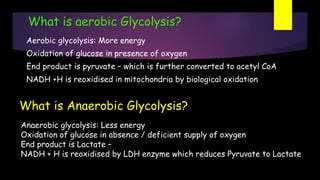
What is aerobic Glycolysis?
Aerobic glycolysis: More energy
Oxidation of glucose in presence of oxygen
End product is pyruvate – which is further converted to acetyl CoA
NADH +H is reoxidised in mitochondria by biological oxidation
Anaerobic glycolysis: Less energy
Oxidation of glucose in absence / deficient supply of oxygen
End product is Lactate –
NADH + H is reoxidised by LDH enzyme which reduces Pyruvate to Lactate
What is Anaerobic Glycolysis?
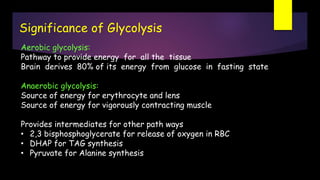
Aerobic glycolysis:
Pathway to provide energy for all the tissue
Brain derives 80% of its energy from glucose in fasting state
Anaerobic glycolysis:
Source of energy for erythrocyte and lens
Source of energy for vigorously contracting muscle
Provides intermediates for other path ways
• 2,3 bisphosphoglycerate for release of oxygen in RBC
• DHAP for TAG synthesis
• Pyruvate for Alanine synthesis
Significance of Glycolysis
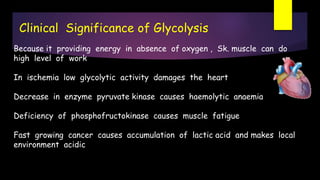
Because it providing energy in absence of oxygen , Sk. muscle can do
high level of work
In ischemia low glycolytic activity damages the heart
Decrease in enzyme pyruvate kinase causes haemolytic anaemia
Deficiency of phosphofructokinase causes muscle fatigue
Fast growing cancer causes accumulation of lactic acid and makes local
environment acidic
Clinical Significance of Glycolysis
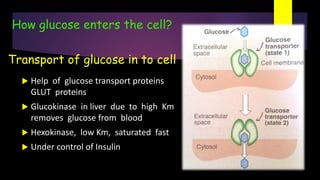
Transport of glucose in to cell
 Help of glucose transport proteins
GLUT proteins
 Glucokinase in liver due to high Km
removes glucose from blood
 Hexokinase, low Km, saturated fast
 Under control of Insulin
How glucose enters the cell?
Metabolic site of Glycolysis -Reactions
All Tissue
Main metabolic pathway giving energy
Erythrocyte, lens and Nervous tissue derives their energy from
Glycolysis
Cellular site:
Cytosol / Cytoplasm of the cell
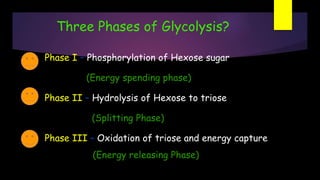
Three Phases of Glycolysis?
Phase I – Phosphorylation of Hexose sugar
(Energy spending phase)
Phase II – Hydrolysis of Hexose to triose
(Splitting Phase)
Phase III – Oxidation of triose and energy capture
(Energy releasing Phase)
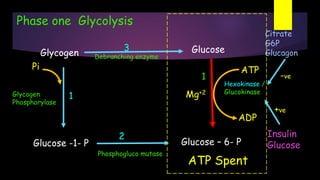
Phase one Glycolysis
Glycogen
Glucose -1- P
Glucose
Glucose – 6- P
Hexokinase /
GlucokinaseGlycogen
Phosphorylase
Debranching enzyme
Phosphogluco mutase
Insulin
Glucose
ADP
ATP
Mg+2
Pi
1
2
3
1
+ve
Citrate
G6P
Glucagon
-ve
ATP Spent
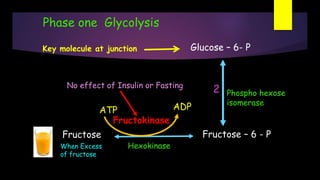
Phase one Glycolysis
Fructose Fructose – 6 - P
Glucose – 6- P
Phospho hexose
isomerase
Fructokinase
2
When Excess
of fructose
ADPATP
No effect of Insulin or Fasting
Key molecule at junction
Hexokinase
Phase one Glycolysis
Fructose –1, 6 – Bis Phosphate
Phospho fructokinase 1 [PFK]
3
ADP
ATP
Fructose – 6 - P
• ADP
• Fructose 2,6,BisPO4
• Insulin
+ve
• Glucagon
• Citrate
• ATP-ve
Mg+2
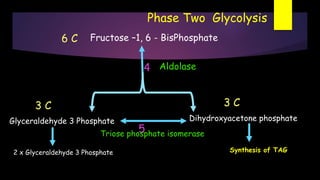
Phase Two Glycolysis
Fructose –1, 6 - BisPhosphate
Aldolase
5
Glyceraldehyde 3 Phosphate
Triose phosphate isomerase
Dihydroxyacetone phosphate
4
Synthesis of TAG2 x Glyceraldehyde 3 Phosphate
3 C 3 C
6 C
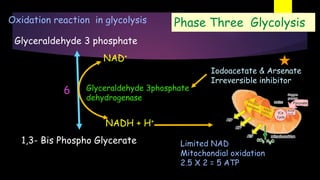
Phase Three Glycolysis
1,3- Bis Phospho Glycerate
Glyceraldehyde 3phosphate
dehydrogenase
6
NADH + H+
NAD+
Glyceraldehyde 3 phosphate
Limited NAD
Mitochondial oxidation
2.5 X 2 = 5 ATP
Oxidation reaction in glycolysis
Iodoacetate & Arsenate
Irreversible inhibitor
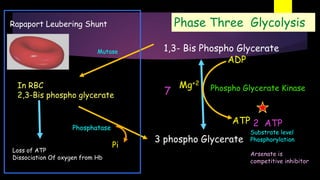
1,3- Bis Phospho Glycerate
Phospho Glycerate Kinase
Mutase
ATP
ADP
3 phospho Glycerate
In RBC
2,3-Bis phospho glycerate
Phosphatase
Pi
Loss of ATP
Dissociation Of oxygen from Hb
2 ATP
Substrate level
Phosphorylation
Arsenate is
competitive inhibitor
Rapaport Leubering Shunt
Mg+2
Phase Three Glycolysis
7
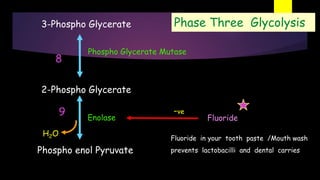
3-Phospho Glycerate
Phospho Glycerate Mutase
Phospho enol Pyruvate
2-Phospho Glycerate
Enolase
H2O
Fluoride
-ve
Fluoride in your tooth paste /Mouth wash
prevents lactobacilli and dental carries
Phase Three Glycolysis
8
9
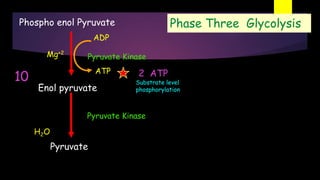
Phospho enol Pyruvate
Pyruvate Kinase
Pyruvate
Enol pyruvate
Pyruvate Kinase
H2O
ATP
ADP
Mg+2
2 ATP
Substrate level
phosphorylation
10
Phase Three Glycolysis
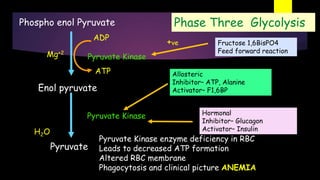
Phospho enol Pyruvate
Pyruvate Kinase
Pyruvate
Enol pyruvate
Pyruvate Kinase
H2O
ATP
ADP
Mg+2
Fructose 1,6BisPO4
Feed forward reaction
+ve
Pyruvate Kinase enzyme deficiency in RBC
Leads to decreased ATP formation
Altered RBC membrane
Phagocytosis and clinical picture ANEMIA
Allosteric
Inhibitor– ATP, Alanine
Activator– F1,6BP
Hormonal
Inhibitor– Glucagon
Activator– Insulin
Phase Three Glycolysis
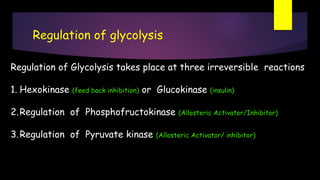
Regulation of glycolysis
Regulation of Glycolysis takes place at three irreversible reactions
1. Hexokinase (feed back inhibition) or Glucokinase (insulin)
2.Regulation of Phosphofructokinase (Allosteric Activator/Inhibitor)
3.Regulation of Pyruvate kinase (Allosteric Activator/ inhibitor)
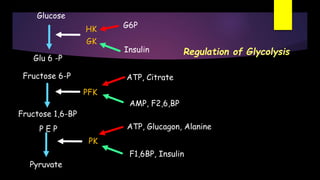
Glucose
Glu 6 -P
Fructose 6-P
Fructose 1,6-BP
P E P
Pyruvate
HK
GK
PFK
PK
G6P
Insulin
ATP, Citrate
AMP, F2,6,BP
ATP, Glucagon, Alanine
F1,6BP, Insulin
Regulation of Glycolysis
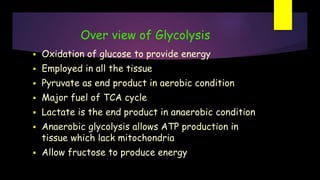
Over view of Glycolysis
 Oxidation of glucose to provide energy
 Employed in all the tissue
 Pyruvate as end product in aerobic condition
 Major fuel of TCA cycle
 Lactate is the end product in anaerobic condition
 Anaerobic glycolysis allows ATP production in
tissue which lack mitochondria
 Allow fructose to produce energy
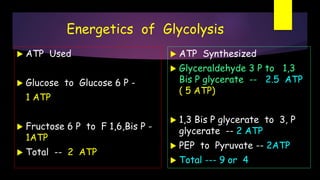
Energetics of Glycolysis
 ATP Used
 Glucose to Glucose 6 P -
1 ATP
 Fructose 6 P to F 1,6,Bis P -
1ATP
 Total -- 2 ATP
 ATP Synthesized
 Glyceraldehyde 3 P to 1,3
Bis P glycerate -- 2.5 ATP
( 5 ATP)
 1,3 Bis P glycerate to 3, P
glycerate -- 2 ATP
 PEP to Pyruvate -- 2ATP
 Total --- 9 or 4
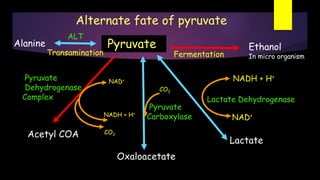
Alternate fate of pyruvate
Pyruvate
Lactate
Lactate Dehydrogenase
NAD+
NADH + H+
Oxaloacetate
Acetyl COA
Pyruvate
Dehydrogenase
Complex
Pyruvate
Carboxylase
Ethanol
In micro organism
NAD+
NADH + H+
CO2
CO2
Alanine
Transamination Fermentation
ALT
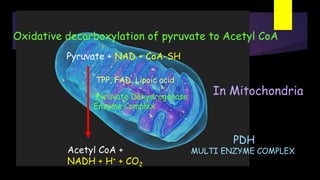
Pyruvate + NAD + CoA-SH
Acetyl CoA +
NADH + H+ + CO2
Pyruvate Dehydrogenase
Enzyme Complex
TPP, FAD, Lipoic acid
Oxidative decarboxylation of pyruvate to Acetyl CoA
In Mitochondria
PDH
MULTI ENZYME COMPLEX
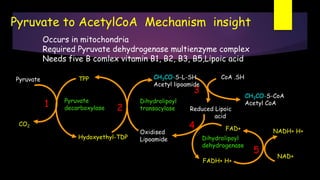
Pyruvate to AcetylCoA Mechanism insight
Occurs in mitochondria
Required Pyruvate dehydrogenase multienzyme complex
Needs five B comlex vitamin B1, B2, B3, B5,Lipoic acid
Pyruvate
Pyruvate
decarboxylase
Oxidised
LipoamideHydoxyethyl-TDP
TPP
CO2
CH3CO-S-L-SH
Acetyl lipoamide
CoA .SH
CH3CO-S-CoA
Acetyl CoA
Reduced Lipoic
acid
FAD+
FADH+ H+
NAD+
NADH+ H+
Dihydrolipoyl
transacylase
Dihydrolipoyl
dehydrogenase
1 2
3
4
5
Pyruvate
Lactate
Lactate Dehydrogenase
NAD+
NADH + H+
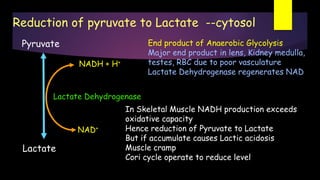
End product of Anaerobic Glycolysis
Major end product in lens, Kidney medulla,
testes, RBC due to poor vasculature
Lactate Dehydrogenase regenerates NAD
Reduction of pyruvate to Lactate --cytosol
In Skeletal Muscle NADH production exceeds
oxidative capacity
Hence reduction of Pyruvate to Lactate
But if accumulate causes Lactic acidosis
Muscle cramp
Cori cycle operate to reduce level
Shunt pathway In erythrocyte
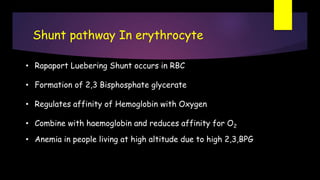
• Rapaport Luebering Shunt occurs in RBC
• Formation of 2,3 Bisphosphate glycerate
• Regulates affinity of Hemoglobin with Oxygen
• Combine with haemoglobin and reduces affinity for O2
• Anemia in people living at high altitude due to high 2,3,BPG
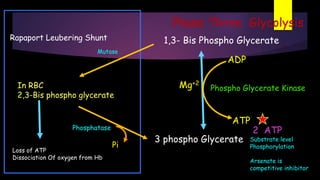
Phase Three Glycolysis
Mutase
In RBC
2,3-Bis phospho glycerate
Phosphatase
Pi
Loss of ATP
Dissociation Of oxygen from Hb
Rapaport Leubering Shunt 1,3- Bis Phospho Glycerate
Phospho Glycerate Kinase
ATP
ADP
3 phospho Glycerate
2 ATP
Substrate level
Phosphorylation
Arsenate is
competitive inhibitor
Mg+2
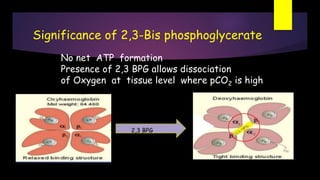
Significance of 2,3-Bis phosphoglycerate
No net ATP formation
Presence of 2,3 BPG allows dissociation
of Oxygen at tissue level where pCO2 is high
2,3 BPG
Next on Gluconeogenesis

Class 2 3 glycolysis

  • 1.
  • 2.
    Glycolysis  Major pathwayof glucose metabolism  Function aerobically or anaerobically  Metabolic pathway for fructose, galactose and other carbohydrates  Link for HMP shunt, Uronic acid , TAG synthesis, Alanine
  • 3.
    Glycolysis Definition: Degradation or Oxidationof glucose or glycogen to pyruvate or lactate Synonyms : EMP pathway (Embden -Meyerhof and Parnas pathway) Types: Aerobic glycolysis: presence of mitochondria and oxygen Anaerobic glycolysis: Absence / deficiency of oxygen
  • 4.
    What is aerobicGlycolysis? Aerobic glycolysis: More energy Oxidation of glucose in presence of oxygen End product is pyruvate – which is further converted to acetyl CoA NADH +H is reoxidised in mitochondria by biological oxidation Anaerobic glycolysis: Less energy Oxidation of glucose in absence / deficient supply of oxygen End product is Lactate – NADH + H is reoxidised by LDH enzyme which reduces Pyruvate to Lactate What is Anaerobic Glycolysis?
  • 5.
    Aerobic glycolysis: Pathway toprovide energy for all the tissue Brain derives 80% of its energy from glucose in fasting state Anaerobic glycolysis: Source of energy for erythrocyte and lens Source of energy for vigorously contracting muscle Provides intermediates for other path ways • 2,3 bisphosphoglycerate for release of oxygen in RBC • DHAP for TAG synthesis • Pyruvate for Alanine synthesis Significance of Glycolysis
  • 6.
    Because it providingenergy in absence of oxygen , Sk. muscle can do high level of work In ischemia low glycolytic activity damages the heart Decrease in enzyme pyruvate kinase causes haemolytic anaemia Deficiency of phosphofructokinase causes muscle fatigue Fast growing cancer causes accumulation of lactic acid and makes local environment acidic Clinical Significance of Glycolysis
  • 7.
    Transport of glucosein to cell  Help of glucose transport proteins GLUT proteins  Glucokinase in liver due to high Km removes glucose from blood  Hexokinase, low Km, saturated fast  Under control of Insulin How glucose enters the cell?
  • 8.
    Metabolic site ofGlycolysis -Reactions All Tissue Main metabolic pathway giving energy Erythrocyte, lens and Nervous tissue derives their energy from Glycolysis Cellular site: Cytosol / Cytoplasm of the cell
  • 9.
    Three Phases ofGlycolysis? Phase I – Phosphorylation of Hexose sugar (Energy spending phase) Phase II – Hydrolysis of Hexose to triose (Splitting Phase) Phase III – Oxidation of triose and energy capture (Energy releasing Phase)
  • 10.
    Phase one Glycolysis Glycogen Glucose-1- P Glucose Glucose – 6- P Hexokinase / GlucokinaseGlycogen Phosphorylase Debranching enzyme Phosphogluco mutase Insulin Glucose ADP ATP Mg+2 Pi 1 2 3 1 +ve Citrate G6P Glucagon -ve ATP Spent
  • 11.
    Phase one Glycolysis FructoseFructose – 6 - P Glucose – 6- P Phospho hexose isomerase Fructokinase 2 When Excess of fructose ADPATP No effect of Insulin or Fasting Key molecule at junction Hexokinase
  • 12.
    Phase one Glycolysis Fructose–1, 6 – Bis Phosphate Phospho fructokinase 1 [PFK] 3 ADP ATP Fructose – 6 - P • ADP • Fructose 2,6,BisPO4 • Insulin +ve • Glucagon • Citrate • ATP-ve Mg+2
  • 13.
    Phase Two Glycolysis Fructose–1, 6 - BisPhosphate Aldolase 5 Glyceraldehyde 3 Phosphate Triose phosphate isomerase Dihydroxyacetone phosphate 4 Synthesis of TAG2 x Glyceraldehyde 3 Phosphate 3 C 3 C 6 C
  • 14.
    Phase Three Glycolysis 1,3-Bis Phospho Glycerate Glyceraldehyde 3phosphate dehydrogenase 6 NADH + H+ NAD+ Glyceraldehyde 3 phosphate Limited NAD Mitochondial oxidation 2.5 X 2 = 5 ATP Oxidation reaction in glycolysis Iodoacetate & Arsenate Irreversible inhibitor
  • 15.
    1,3- Bis PhosphoGlycerate Phospho Glycerate Kinase Mutase ATP ADP 3 phospho Glycerate In RBC 2,3-Bis phospho glycerate Phosphatase Pi Loss of ATP Dissociation Of oxygen from Hb 2 ATP Substrate level Phosphorylation Arsenate is competitive inhibitor Rapaport Leubering Shunt Mg+2 Phase Three Glycolysis 7
  • 16.
    3-Phospho Glycerate Phospho GlycerateMutase Phospho enol Pyruvate 2-Phospho Glycerate Enolase H2O Fluoride -ve Fluoride in your tooth paste /Mouth wash prevents lactobacilli and dental carries Phase Three Glycolysis 8 9
  • 17.
    Phospho enol Pyruvate PyruvateKinase Pyruvate Enol pyruvate Pyruvate Kinase H2O ATP ADP Mg+2 2 ATP Substrate level phosphorylation 10 Phase Three Glycolysis
  • 18.
    Phospho enol Pyruvate PyruvateKinase Pyruvate Enol pyruvate Pyruvate Kinase H2O ATP ADP Mg+2 Fructose 1,6BisPO4 Feed forward reaction +ve Pyruvate Kinase enzyme deficiency in RBC Leads to decreased ATP formation Altered RBC membrane Phagocytosis and clinical picture ANEMIA Allosteric Inhibitor– ATP, Alanine Activator– F1,6BP Hormonal Inhibitor– Glucagon Activator– Insulin Phase Three Glycolysis
  • 19.
    Regulation of glycolysis Regulationof Glycolysis takes place at three irreversible reactions 1. Hexokinase (feed back inhibition) or Glucokinase (insulin) 2.Regulation of Phosphofructokinase (Allosteric Activator/Inhibitor) 3.Regulation of Pyruvate kinase (Allosteric Activator/ inhibitor)
  • 20.
    Glucose Glu 6 -P Fructose6-P Fructose 1,6-BP P E P Pyruvate HK GK PFK PK G6P Insulin ATP, Citrate AMP, F2,6,BP ATP, Glucagon, Alanine F1,6BP, Insulin Regulation of Glycolysis
  • 21.
    Over view ofGlycolysis  Oxidation of glucose to provide energy  Employed in all the tissue  Pyruvate as end product in aerobic condition  Major fuel of TCA cycle  Lactate is the end product in anaerobic condition  Anaerobic glycolysis allows ATP production in tissue which lack mitochondria  Allow fructose to produce energy
  • 22.
    Energetics of Glycolysis ATP Used  Glucose to Glucose 6 P - 1 ATP  Fructose 6 P to F 1,6,Bis P - 1ATP  Total -- 2 ATP  ATP Synthesized  Glyceraldehyde 3 P to 1,3 Bis P glycerate -- 2.5 ATP ( 5 ATP)  1,3 Bis P glycerate to 3, P glycerate -- 2 ATP  PEP to Pyruvate -- 2ATP  Total --- 9 or 4
  • 23.
    Alternate fate ofpyruvate Pyruvate Lactate Lactate Dehydrogenase NAD+ NADH + H+ Oxaloacetate Acetyl COA Pyruvate Dehydrogenase Complex Pyruvate Carboxylase Ethanol In micro organism NAD+ NADH + H+ CO2 CO2 Alanine Transamination Fermentation ALT
  • 24.
    Pyruvate + NAD+ CoA-SH Acetyl CoA + NADH + H+ + CO2 Pyruvate Dehydrogenase Enzyme Complex TPP, FAD, Lipoic acid Oxidative decarboxylation of pyruvate to Acetyl CoA In Mitochondria PDH MULTI ENZYME COMPLEX
  • 25.
    Pyruvate to AcetylCoAMechanism insight Occurs in mitochondria Required Pyruvate dehydrogenase multienzyme complex Needs five B comlex vitamin B1, B2, B3, B5,Lipoic acid Pyruvate Pyruvate decarboxylase Oxidised LipoamideHydoxyethyl-TDP TPP CO2 CH3CO-S-L-SH Acetyl lipoamide CoA .SH CH3CO-S-CoA Acetyl CoA Reduced Lipoic acid FAD+ FADH+ H+ NAD+ NADH+ H+ Dihydrolipoyl transacylase Dihydrolipoyl dehydrogenase 1 2 3 4 5
  • 26.
    Pyruvate Lactate Lactate Dehydrogenase NAD+ NADH +H+ End product of Anaerobic Glycolysis Major end product in lens, Kidney medulla, testes, RBC due to poor vasculature Lactate Dehydrogenase regenerates NAD Reduction of pyruvate to Lactate --cytosol In Skeletal Muscle NADH production exceeds oxidative capacity Hence reduction of Pyruvate to Lactate But if accumulate causes Lactic acidosis Muscle cramp Cori cycle operate to reduce level
  • 27.
    Shunt pathway Inerythrocyte • Rapaport Luebering Shunt occurs in RBC • Formation of 2,3 Bisphosphate glycerate • Regulates affinity of Hemoglobin with Oxygen • Combine with haemoglobin and reduces affinity for O2 • Anemia in people living at high altitude due to high 2,3,BPG
  • 28.
    Phase Three Glycolysis Mutase InRBC 2,3-Bis phospho glycerate Phosphatase Pi Loss of ATP Dissociation Of oxygen from Hb Rapaport Leubering Shunt 1,3- Bis Phospho Glycerate Phospho Glycerate Kinase ATP ADP 3 phospho Glycerate 2 ATP Substrate level Phosphorylation Arsenate is competitive inhibitor Mg+2
  • 29.
    Significance of 2,3-Bisphosphoglycerate No net ATP formation Presence of 2,3 BPG allows dissociation of Oxygen at tissue level where pCO2 is high 2,3 BPG
  • 30.

Editor's Notes

  • #7 Cardiac muscle has adapted aerobic performance & low glycolytic activity. It develops ischemia under low glycolysis.
  • #11 Glucokinase – liver enzyme act at high concentration of blood glucose – uptake of glucose in liver cell against gradient for lowering of BGL. Glucokinase in pancreatic B cell detects high level of glucose to release insulin. Hexokinase – in tissue other than liver and pancreatic b cells, it can act at low concentration of glucose & it is influence by Insulin for internalization. Remember when glucose is in excess glycogen break down is little but in starvation glycogen play tow functions one provide glucose to other tissue and also produce energy. In muscle glycogen degradation is for glycolysis only.
  • #12 Glucose -6 – phosphate is a key molecule at the junction of various metabolic pathways. Fructose obtained from fruit, sucrose and honey can enter by this route in glycolysis. Fructokinase in liver , kidney and intestine phosphorylates fructose to F-1-P which is independent of insulin or fasting. In diabetic it is myth that fructose consumption is safe as it does not elevated blood glucose level and enters cell freely but it has highest lipogenic character which increases the risk of atherogenesis and CHD.
  • #13 Phsopho Fructokinase is 1st regulatory enzyme of glycolysis. It is allosteric enzyme which has positive and negative modulators.