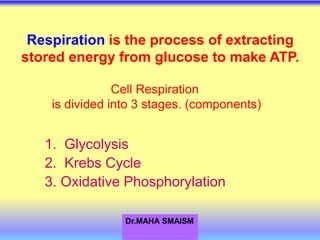
Cell Respiration
is divided into 3 stages. (components)
1. Glycolysis
2. Krebs Cycle
3. Oxidative Phosphorylation
Respiration is the process of extracting
stored energy from glucose to make ATP.
Dr.MAHA SMAISM
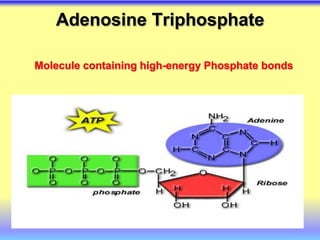
Adenosine Triphosphate
Molecule containing high-energy Phosphate bonds
2007-2008
Cellular Respiration
Stage 1:
Glycolysis
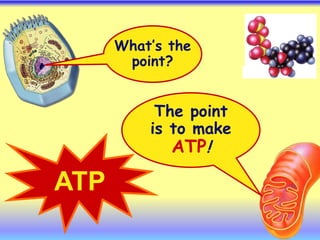
What’s the
point?
The point
is to make
ATP!
ATP
GLYCOLYSIS
Glycolysis is a series of reactions that takes place in the cytoplasm of all
cells .In the pathway of glycolysis, glucose is split into two pyruvate
molecules under aerobic conditions; or two lactate under anaerobic
conditions, along with production of a small quantity of energy.
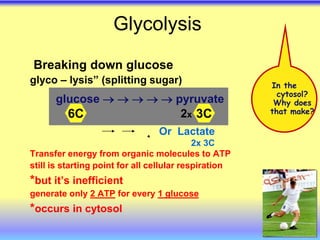
Glycolysis
Breaking down glucose
glyco – lysis” (splitting sugar)
Transfer energy from organic molecules to ATP
still is starting point for all cellular respiration
*but it’s inefficient
glucose
1
for every
ATP
2
generate only
*occurs in cytosol
glucose      pyruvate
2x
6C 3C
In the
cytosol?
Why does
that make?
Or Lactate
2x 3C
Importance of the pathway
1-Glucose is converted to pyruvate (aerobic condition) Or
lactate(anaerobic condtion)
2-All the reaction steps take place in the cytoplasm.
3-Glycolysis is the only source of energy in erythrocytes
4-Glycolytic pathway provides carbon skeletons for synthesis
certain non-essential amino acids as well as glycerol part
of fat.
5-Most of the reactions of glycolytic path way are reversible
which are also used for gluconeogenesis .
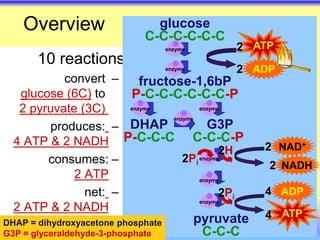
10 reactions
–
convert
to
C)
6
glucose (
C)
3
pyruvate (
2
–
produces:
NADH
2
ATP &
4
–
consumes:
ATP
2
–
net:
NADH
2
ATP &
2
glucose
C-C-C-C-C-C
fructose-1,6bP
P-C-C-C-C-C-C-P
DHAP
P-C-C-C
G3P
C-C-C-P
pyruvate
C-C-C
Overview
DHAP = dihydroxyacetone phosphate
G3P = glyceraldehyde-3-phosphate
ATP
2
ADP
2
ATP
4
ADP
4
NAD+
2
2Pi
enzyme
enzyme
enzyme enzyme
enzyme
enzyme
enzyme
enzyme
2Pi
2H
NADH
2
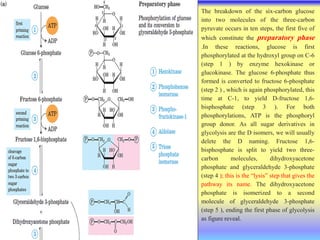
The breakdown of the six-carbon glucose
into two molecules of the three-carbon
pyruvate occurs in ten steps, the first five of
which constitute the preparatory phase
.In these reactions, glucose is first
phosphorylated at the hydroxyl group on C-6
(step 1 ) by enzyme hexokinase or
glucokinase. The glucose 6-phosphate thus
formed is converted to fructose 6-phosphate
(step 2 ) , which is again phosphorylated, this
time at C-1, to yield D-fructose 1,6-
bisphosphate (step 3 ). For both
phosphorylations, ATP is the phosphoryl
group donor. As all sugar derivatives in
glycolysis are the D isomers, we will usually
delete the D naming. Fructose 1,6-
bisphosphate is split to yield two three-
carbon molecules, dihydroxyacetone
phosphate and glyceraldehyde 3-phosphate
(step 4 ); this is the “lysis” step that gives the
pathway its name. The dihydroxyacetone
phosphate is isomerized to a second
molecule of glyceraldehyde 3-phosphate
(step 5 ), ending the first phase of glycolysis
as figure reveal.
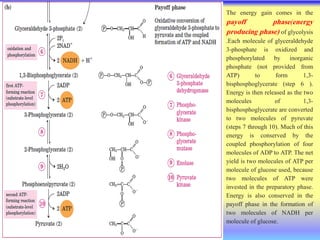
The energy gain comes in the
payoff phase(energy
producing phase) of glycolysis
.Each molecule of glyceraldehyde
3-phosphate is oxidized and
phosphorylated by inorganic
phosphate (not provided from
ATP) to form 1,3-
bisphosphoglycerate (step 6 ).
Energy is then released as the two
molecules of 1,3-
bisphosphoglycerate are converted
to two molecules of pyruvate
(steps 7 through 10). Much of this
energy is conserved by the
coupled phosphorylation of four
molecules of ADP to ATP. The net
yield is two molecules of ATP per
molecule of glucose used, because
two molecules of ATP were
invested in the preparatory phase.
Energy is also conserved in the
payoff phase in the formation of
two molecules of NADH per
molecule of glucose.
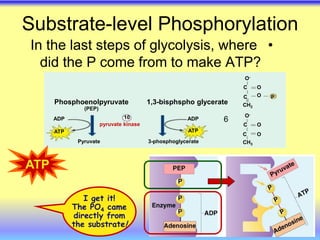
Substrate-level Phosphorylation
I get it!
The PO4 came
directly from
the substrate!
H2O
9
10
Phosphoenolpyruvate
(PEP)
1,3-bisphspho glycerate
Pyruvate 3-phosphoglycerate
enolase
pyruvate kinase
ADP
ATP
ADP
ATP
H2O
CH3
O-
O
C
O-
C
C
C
P
O
O
O
CH2
•
In the last steps of glycolysis, where
did the P come from to make ATP?
ATP
6
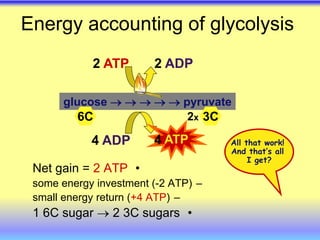
Energy accounting of glycolysis
•
Net gain = 2 ATP
–
some energy investment (-2 ATP)
–
small energy return (+4 ATP)
•
1 6C sugar  2 3C sugars
2 ATP 2 ADP
4 ADP
glucose      pyruvate
2x
6C 3C
All that work!
And that’s all
I get?
ATP
4
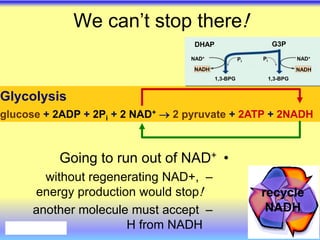
Glycolysis
glucose + 2ADP + 2Pi + 2 NAD+  2 pyruvate + 2ATP + 2NADH
We can’t stop there!
•
Going to run out of NAD+
–
without regenerating NAD+,
energy production would stop!
–
another molecule must accept
H from NADH
recycle
NADH
Pi
NAD+
G3P
1,3-BPG 1,3-BPG
NADH
NAD+
NADH
Pi
DHAP
NADH
pyruvate
acetyl-CoA
lactate
ethanol
NAD+
NAD+
NADH
NAD+
NADH
CO2
acetaldehyde
H2O
Krebs
cycle
O2
(lactic acid)
with oxygen
aerobic respiration
without oxygen
anaerobic respiration
fermentation
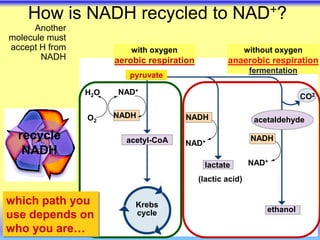
How is NADH recycled to NAD+?
Another
molecule must
accept H from
NADH
recycle
NADH
which path you
use depends on
who you are…
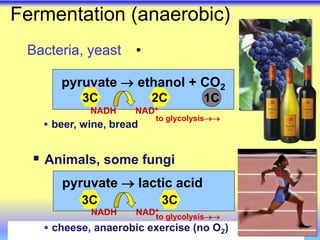
Fermentation (anaerobic)
•
Bacteria, yeast
1C
3C 2C
pyruvate  ethanol + CO2
 Animals, some fungi
pyruvate  lactic acid
3C 3C
 beer, wine, bread
 cheese, anaerobic exercise (no O2)
NADH NAD+
NADH NAD+
to glycolysis
to glycolysis
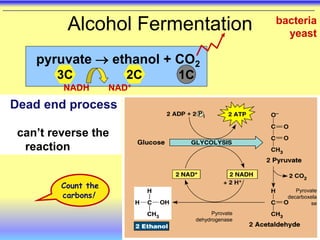
Alcohol Fermentation
1C
3C 2C
pyruvate  ethanol + CO2
NADH NAD+
Count the
carbons!
Dead end process
can’t reverse the
reaction
bacteria
yeast
Pyrovate
decarboxela
se
Pyrovate
dehydrogenase
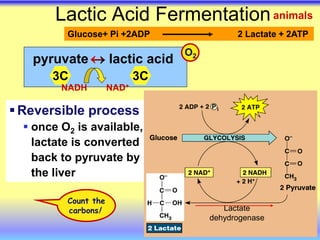
Reversible process
 once O2 is available,
lactate is converted
back to pyruvate by
the liver
Lactic Acid Fermentation
pyruvate  lactic acid
3C 3C
NADH NAD+

Count the
carbons!
O2
animals
Glucose+ Pi +2ADP 2 Lactate + 2ATP
Lactate
dehydrogenase
• Factors Regulating Glycolysis
• The required adjustment in the rate of glycolysis is achieved by:
• 1-A complex interplay among ATP consumption, NADH regeneration.
• 2- Concentration of key metabolites and allosteric regulation of several
glycolytic enzymes—including hexokinase, phosphofructokinase(PFK-
1), and pyruvate kinase (Steps 1, 3 and 10 are key enzymes; these
reactions are irreversible and considered the rate limiting reactions in
glycolysis ).
• 3-On a slightly longer time scale, glycolysis is regulated by the
hormones glucagon, epinephrine, and insulin, and by changes in the
expression of the genes for several glycolytic enzymes.
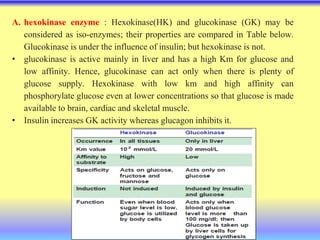
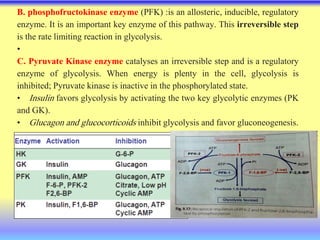
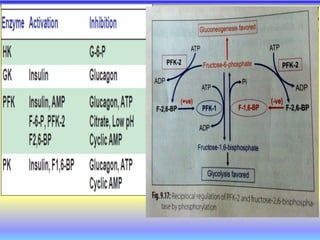
A. hexokinase enzyme : Hexokinase(HK) and glucokinase (GK) may be
considered as iso-enzymes; their properties are compared in Table below.
Glucokinase is under the influence of insulin; but hexokinase is not.
• glucokinase is active mainly in liver and has a high Km for glucose and
low affinity. Hence, glucokinase can act only when there is plenty of
glucose supply. Hexokinase with low km and high affinity can
phosphorylate glucose even at lower concentrations so that glucose is made
available to brain, cardiac and skeletal muscle.
• Insulin increases GK activity whereas glucagon inhibits it.
B. phosphofructokinase enzyme (PFK) :is an allosteric, inducible, regulatory
enzyme. It is an important key enzyme of this pathway. This irreversible step
is the rate limiting reaction in glycolysis.
•
C. Pyruvate Kinase enzyme catalyses an irreversible step and is a regulatory
enzyme of glycolysis. When energy is plenty in the cell, glycolysis is
inhibited; Pyruvate kinase is inactive in the phosphorylated state.
• Insulin favors glycolysis by activating the two key glycolytic enzymes (PK
and GK).
• Glucagon and glucocorticoids inhibit glycolysis and favor gluconeogenesis.
•
•
• Note: The phosphorylation of glucose to glucose-6-
phosphate traps it within the cells to be metabolized
• Enolase (step 9) requires Mg++. fluoride irreversibly
inhibit this enzyme by removing magnesium ions. Thus,
fluoride will stop the whole glycolysis. So when taking
blood for glucose estimation, fluoride must add to blood.
If not, glucose is continue to metabolize by the blood
cells and lower blood glucose values are obtained
(incorrect result).
•
• Significance of the Glycolysis Pathway
• 1. It is the only pathway that is taking place in all the cells (cytoplasm) of
the body.
• 2. Glycolysis is the only source of energy in erythrocytes.
• 3. In strenuous exercise, when muscle tissue lacks enough oxygen,
anaerobic glycolysis forms the major source of energy for muscles.
• 4. The glycolytic pathway may be considered as the preliminary step
before complete oxidation.
• 5. The glycolytic pathway provides carbon skeletons for synthesis of
non-essential amino acids as well as glycerol part of fat (glycerol which
can be derived from glucose through dihydroxyacetone phosphate
(DHAP) also glycerol portion of the neutral fat can enter into glycolytic
or gluconeogenic pathways at step 4).
• 6. Most of the reactions of the glycolytic pathway are reversible, which are
also used for gluconeogenesis.
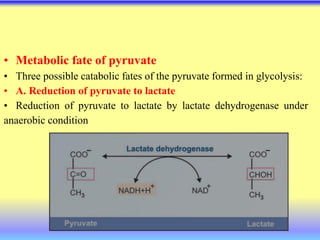
• Metabolic fate of pyruvate
• Three possible catabolic fates of the pyruvate formed in glycolysis:
• A. Reduction of pyruvate to lactate
• Reduction of pyruvate to lactate by lactate dehydrogenase under
anaerobic condition
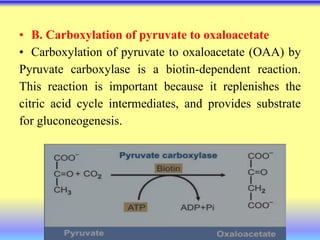
• B. Carboxylation of pyruvate to oxaloacetate
• Carboxylation of pyruvate to oxaloacetate (OAA) by
Pyruvate carboxylase is a biotin-dependent reaction.
This reaction is important because it replenishes the
citric acid cycle intermediates, and provides substrate
for gluconeogenesis.
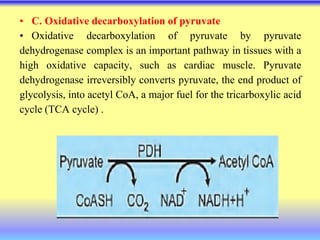
• C. Oxidative decarboxylation of pyruvate
• Oxidative decarboxylation of pyruvate by pyruvate
dehydrogenase complex is an important pathway in tissues with a
high oxidative capacity, such as cardiac muscle. Pyruvate
dehydrogenase irreversibly converts pyruvate, the end product of
glycolysis, into acetyl CoA, a major fuel for the tricarboxylic acid
cycle (TCA cycle) .
• Glycolysis is taking place in cytoplasm. So pyruvate is
generated in cytoplasm. pyruvate is transported into mitochondria
by a pyruvate transporter. Inside the mitochondria, pyruvate is
oxidatively decarboxylated to acetyl CoA by Pyruvate
Dehydrogenase (PDH). It is a multi-enzyme complex with 5 co-
enzymes, which are:
1. Thiamine pyrophosphate (TPP)
2. Co-enzyme A (CoA)
3. FAD
4. NAD+
5. lipoic acid
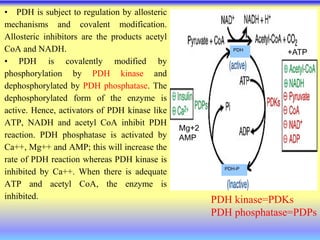
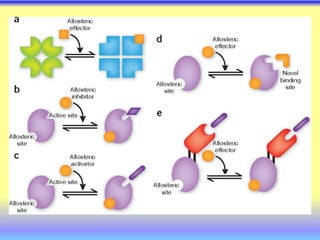
• PDH is subject to regulation by allosteric
mechanisms and covalent modification.
Allosteric inhibitors are the products acetyl
CoA and NADH.
• PDH is covalently modified by
phosphorylation by PDH kinase and
dephosphorylated by PDH phosphatase. The
dephosphorylated form of the enzyme is
active. Hence, activators of PDH kinase like
ATP, NADH and acetyl CoA inhibit PDH
reaction. PDH phosphatase is activated by
Ca++, Mg++ and AMP; this will increase the
rate of PDH reaction whereas PDH kinase is
inhibited by Ca++. When there is adequate
ATP and acetyl CoA, the enzyme is
inhibited.
Mg+2
AMP
+ATP
PDH
PDH-P
PDH kinase=PDKs
PDH phosphatase=PDPs
Importance of Pyruvate Dehydrogenase
1. PDH responsible on completely irreversible reaction. There is
no pathway available in the body to circumvent this step. Glucose
through this step is converted to acetyl CoA from which fatty acids
can be synthesized.
2. But the backward reaction is not possible, and so there is no net
synthesis of glucose from fat.
3. Pyruvate may be channeled back to glucose through
gluconeogenesis. But oxidative decarboxylation of pyruvate to
acetyl CoA is irreversible. Hence, PDH reaction is the committed
step towards complete oxidation of glucose. The NADH generated
in this reaction, enters the electron transport chain to produce 2.5
ATP.
• Clinical Applications of Glycolytic Enzymes
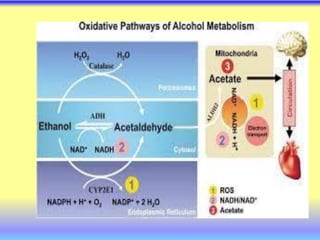
• 1. Lactic acidosis may be seen in hypoxia, shock, pulmonary
failure, alcohol abuse and diabetes mellitus ,mostly due to decrease oxygen .
•
• 2. Deficiency of glycolytic enzymes. These conditions are
rare, out of which pyruvate kinase deficiency and hexokinase deficiency are
comparatively common. These deficiency states can lead to hemolytic anemia,
because energy depleted so RBCs are destroyed. Inherited aldolase deficiency
also causes hemolysis. In PFK deficiency, muscle weakness is seen.
•
• 3. Pyruvate dehydrogenase deficiency: A deficiency in
the pyruvate dehydrogenase complex is the most common biochemical cause
of congenital lactic acidosis. This enzyme deficiency results in an inability to
convert pyruvate to acetyl CoA, causing pyruvate to be shunted to lactic acid
via lactate dehydrogenase .This causes particular problems for the brain, which
relies on the TCA cycle for most of its energy, and is particularly sensitive to
acidosis.
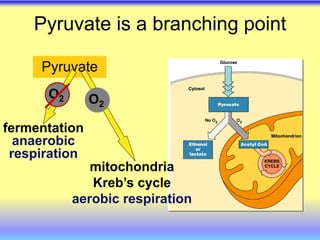
Pyruvate is a branching point
Pyruvate
O2
O2
mitochondria
Kreb’s cycle
aerobic respiration
fermentation
anaerobic
respiration
What’s the
point?
The point
is to make
ATP!
ATP
NO!
There’s still more
to my story!
Any Questions?

Glycolysis.pdf

  • 1.
    Cell Respiration is dividedinto 3 stages. (components) 1. Glycolysis 2. Krebs Cycle 3. Oxidative Phosphorylation Respiration is the process of extracting stored energy from glucose to make ATP. Dr.MAHA SMAISM
  • 2.
    Adenosine Triphosphate Molecule containinghigh-energy Phosphate bonds
  • 3.
  • 4.
  • 5.
    GLYCOLYSIS Glycolysis is aseries of reactions that takes place in the cytoplasm of all cells .In the pathway of glycolysis, glucose is split into two pyruvate molecules under aerobic conditions; or two lactate under anaerobic conditions, along with production of a small quantity of energy.
  • 6.
    Glycolysis Breaking down glucose glyco– lysis” (splitting sugar) Transfer energy from organic molecules to ATP still is starting point for all cellular respiration *but it’s inefficient glucose 1 for every ATP 2 generate only *occurs in cytosol glucose      pyruvate 2x 6C 3C In the cytosol? Why does that make? Or Lactate 2x 3C
  • 7.
    Importance of thepathway 1-Glucose is converted to pyruvate (aerobic condition) Or lactate(anaerobic condtion) 2-All the reaction steps take place in the cytoplasm. 3-Glycolysis is the only source of energy in erythrocytes 4-Glycolytic pathway provides carbon skeletons for synthesis certain non-essential amino acids as well as glycerol part of fat. 5-Most of the reactions of glycolytic path way are reversible which are also used for gluconeogenesis .
  • 8.
    10 reactions – convert to C) 6 glucose ( C) 3 pyruvate( 2 – produces: NADH 2 ATP & 4 – consumes: ATP 2 – net: NADH 2 ATP & 2 glucose C-C-C-C-C-C fructose-1,6bP P-C-C-C-C-C-C-P DHAP P-C-C-C G3P C-C-C-P pyruvate C-C-C Overview DHAP = dihydroxyacetone phosphate G3P = glyceraldehyde-3-phosphate ATP 2 ADP 2 ATP 4 ADP 4 NAD+ 2 2Pi enzyme enzyme enzyme enzyme enzyme enzyme enzyme enzyme 2Pi 2H NADH 2
  • 9.
    The breakdown ofthe six-carbon glucose into two molecules of the three-carbon pyruvate occurs in ten steps, the first five of which constitute the preparatory phase .In these reactions, glucose is first phosphorylated at the hydroxyl group on C-6 (step 1 ) by enzyme hexokinase or glucokinase. The glucose 6-phosphate thus formed is converted to fructose 6-phosphate (step 2 ) , which is again phosphorylated, this time at C-1, to yield D-fructose 1,6- bisphosphate (step 3 ). For both phosphorylations, ATP is the phosphoryl group donor. As all sugar derivatives in glycolysis are the D isomers, we will usually delete the D naming. Fructose 1,6- bisphosphate is split to yield two three- carbon molecules, dihydroxyacetone phosphate and glyceraldehyde 3-phosphate (step 4 ); this is the “lysis” step that gives the pathway its name. The dihydroxyacetone phosphate is isomerized to a second molecule of glyceraldehyde 3-phosphate (step 5 ), ending the first phase of glycolysis as figure reveal.
  • 10.
    The energy gaincomes in the payoff phase(energy producing phase) of glycolysis .Each molecule of glyceraldehyde 3-phosphate is oxidized and phosphorylated by inorganic phosphate (not provided from ATP) to form 1,3- bisphosphoglycerate (step 6 ). Energy is then released as the two molecules of 1,3- bisphosphoglycerate are converted to two molecules of pyruvate (steps 7 through 10). Much of this energy is conserved by the coupled phosphorylation of four molecules of ADP to ATP. The net yield is two molecules of ATP per molecule of glucose used, because two molecules of ATP were invested in the preparatory phase. Energy is also conserved in the payoff phase in the formation of two molecules of NADH per molecule of glucose.
  • 11.
    Substrate-level Phosphorylation I getit! The PO4 came directly from the substrate! H2O 9 10 Phosphoenolpyruvate (PEP) 1,3-bisphspho glycerate Pyruvate 3-phosphoglycerate enolase pyruvate kinase ADP ATP ADP ATP H2O CH3 O- O C O- C C C P O O O CH2 • In the last steps of glycolysis, where did the P come from to make ATP? ATP 6
  • 12.
    Energy accounting ofglycolysis • Net gain = 2 ATP – some energy investment (-2 ATP) – small energy return (+4 ATP) • 1 6C sugar  2 3C sugars 2 ATP 2 ADP 4 ADP glucose      pyruvate 2x 6C 3C All that work! And that’s all I get? ATP 4
  • 13.
    Glycolysis glucose + 2ADP+ 2Pi + 2 NAD+  2 pyruvate + 2ATP + 2NADH We can’t stop there! • Going to run out of NAD+ – without regenerating NAD+, energy production would stop! – another molecule must accept H from NADH recycle NADH Pi NAD+ G3P 1,3-BPG 1,3-BPG NADH NAD+ NADH Pi DHAP
  • 14.
    NADH pyruvate acetyl-CoA lactate ethanol NAD+ NAD+ NADH NAD+ NADH CO2 acetaldehyde H2O Krebs cycle O2 (lactic acid) with oxygen aerobicrespiration without oxygen anaerobic respiration fermentation How is NADH recycled to NAD+? Another molecule must accept H from NADH recycle NADH which path you use depends on who you are…
  • 15.
    Fermentation (anaerobic) • Bacteria, yeast 1C 3C2C pyruvate  ethanol + CO2  Animals, some fungi pyruvate  lactic acid 3C 3C  beer, wine, bread  cheese, anaerobic exercise (no O2) NADH NAD+ NADH NAD+ to glycolysis to glycolysis
  • 16.
    Alcohol Fermentation 1C 3C 2C pyruvate ethanol + CO2 NADH NAD+ Count the carbons! Dead end process can’t reverse the reaction bacteria yeast Pyrovate decarboxela se Pyrovate dehydrogenase
  • 17.
    Reversible process  onceO2 is available, lactate is converted back to pyruvate by the liver Lactic Acid Fermentation pyruvate  lactic acid 3C 3C NADH NAD+  Count the carbons! O2 animals Glucose+ Pi +2ADP 2 Lactate + 2ATP Lactate dehydrogenase
  • 18.
    • Factors RegulatingGlycolysis • The required adjustment in the rate of glycolysis is achieved by: • 1-A complex interplay among ATP consumption, NADH regeneration. • 2- Concentration of key metabolites and allosteric regulation of several glycolytic enzymes—including hexokinase, phosphofructokinase(PFK- 1), and pyruvate kinase (Steps 1, 3 and 10 are key enzymes; these reactions are irreversible and considered the rate limiting reactions in glycolysis ). • 3-On a slightly longer time scale, glycolysis is regulated by the hormones glucagon, epinephrine, and insulin, and by changes in the expression of the genes for several glycolytic enzymes.
  • 19.
    A. hexokinase enzyme: Hexokinase(HK) and glucokinase (GK) may be considered as iso-enzymes; their properties are compared in Table below. Glucokinase is under the influence of insulin; but hexokinase is not. • glucokinase is active mainly in liver and has a high Km for glucose and low affinity. Hence, glucokinase can act only when there is plenty of glucose supply. Hexokinase with low km and high affinity can phosphorylate glucose even at lower concentrations so that glucose is made available to brain, cardiac and skeletal muscle. • Insulin increases GK activity whereas glucagon inhibits it.
  • 20.
    B. phosphofructokinase enzyme(PFK) :is an allosteric, inducible, regulatory enzyme. It is an important key enzyme of this pathway. This irreversible step is the rate limiting reaction in glycolysis. • C. Pyruvate Kinase enzyme catalyses an irreversible step and is a regulatory enzyme of glycolysis. When energy is plenty in the cell, glycolysis is inhibited; Pyruvate kinase is inactive in the phosphorylated state. • Insulin favors glycolysis by activating the two key glycolytic enzymes (PK and GK). • Glucagon and glucocorticoids inhibit glycolysis and favor gluconeogenesis. •
  • 21.
  • 22.
    • Note: Thephosphorylation of glucose to glucose-6- phosphate traps it within the cells to be metabolized • Enolase (step 9) requires Mg++. fluoride irreversibly inhibit this enzyme by removing magnesium ions. Thus, fluoride will stop the whole glycolysis. So when taking blood for glucose estimation, fluoride must add to blood. If not, glucose is continue to metabolize by the blood cells and lower blood glucose values are obtained (incorrect result). •
  • 23.
    • Significance ofthe Glycolysis Pathway • 1. It is the only pathway that is taking place in all the cells (cytoplasm) of the body. • 2. Glycolysis is the only source of energy in erythrocytes. • 3. In strenuous exercise, when muscle tissue lacks enough oxygen, anaerobic glycolysis forms the major source of energy for muscles. • 4. The glycolytic pathway may be considered as the preliminary step before complete oxidation. • 5. The glycolytic pathway provides carbon skeletons for synthesis of non-essential amino acids as well as glycerol part of fat (glycerol which can be derived from glucose through dihydroxyacetone phosphate (DHAP) also glycerol portion of the neutral fat can enter into glycolytic or gluconeogenic pathways at step 4). • 6. Most of the reactions of the glycolytic pathway are reversible, which are also used for gluconeogenesis.
  • 24.
    • Metabolic fateof pyruvate • Three possible catabolic fates of the pyruvate formed in glycolysis: • A. Reduction of pyruvate to lactate • Reduction of pyruvate to lactate by lactate dehydrogenase under anaerobic condition
  • 25.
    • B. Carboxylationof pyruvate to oxaloacetate • Carboxylation of pyruvate to oxaloacetate (OAA) by Pyruvate carboxylase is a biotin-dependent reaction. This reaction is important because it replenishes the citric acid cycle intermediates, and provides substrate for gluconeogenesis.
  • 26.
    • C. Oxidativedecarboxylation of pyruvate • Oxidative decarboxylation of pyruvate by pyruvate dehydrogenase complex is an important pathway in tissues with a high oxidative capacity, such as cardiac muscle. Pyruvate dehydrogenase irreversibly converts pyruvate, the end product of glycolysis, into acetyl CoA, a major fuel for the tricarboxylic acid cycle (TCA cycle) .
  • 27.
    • Glycolysis istaking place in cytoplasm. So pyruvate is generated in cytoplasm. pyruvate is transported into mitochondria by a pyruvate transporter. Inside the mitochondria, pyruvate is oxidatively decarboxylated to acetyl CoA by Pyruvate Dehydrogenase (PDH). It is a multi-enzyme complex with 5 co- enzymes, which are: 1. Thiamine pyrophosphate (TPP) 2. Co-enzyme A (CoA) 3. FAD 4. NAD+ 5. lipoic acid
  • 28.
    • PDH issubject to regulation by allosteric mechanisms and covalent modification. Allosteric inhibitors are the products acetyl CoA and NADH. • PDH is covalently modified by phosphorylation by PDH kinase and dephosphorylated by PDH phosphatase. The dephosphorylated form of the enzyme is active. Hence, activators of PDH kinase like ATP, NADH and acetyl CoA inhibit PDH reaction. PDH phosphatase is activated by Ca++, Mg++ and AMP; this will increase the rate of PDH reaction whereas PDH kinase is inhibited by Ca++. When there is adequate ATP and acetyl CoA, the enzyme is inhibited. Mg+2 AMP +ATP PDH PDH-P PDH kinase=PDKs PDH phosphatase=PDPs
  • 30.
    Importance of PyruvateDehydrogenase 1. PDH responsible on completely irreversible reaction. There is no pathway available in the body to circumvent this step. Glucose through this step is converted to acetyl CoA from which fatty acids can be synthesized. 2. But the backward reaction is not possible, and so there is no net synthesis of glucose from fat. 3. Pyruvate may be channeled back to glucose through gluconeogenesis. But oxidative decarboxylation of pyruvate to acetyl CoA is irreversible. Hence, PDH reaction is the committed step towards complete oxidation of glucose. The NADH generated in this reaction, enters the electron transport chain to produce 2.5 ATP.
  • 32.
    • Clinical Applicationsof Glycolytic Enzymes • 1. Lactic acidosis may be seen in hypoxia, shock, pulmonary failure, alcohol abuse and diabetes mellitus ,mostly due to decrease oxygen . • • 2. Deficiency of glycolytic enzymes. These conditions are rare, out of which pyruvate kinase deficiency and hexokinase deficiency are comparatively common. These deficiency states can lead to hemolytic anemia, because energy depleted so RBCs are destroyed. Inherited aldolase deficiency also causes hemolysis. In PFK deficiency, muscle weakness is seen. • • 3. Pyruvate dehydrogenase deficiency: A deficiency in the pyruvate dehydrogenase complex is the most common biochemical cause of congenital lactic acidosis. This enzyme deficiency results in an inability to convert pyruvate to acetyl CoA, causing pyruvate to be shunted to lactic acid via lactate dehydrogenase .This causes particular problems for the brain, which relies on the TCA cycle for most of its energy, and is particularly sensitive to acidosis.
  • 33.
    Pyruvate is abranching point Pyruvate O2 O2 mitochondria Kreb’s cycle aerobic respiration fermentation anaerobic respiration
  • 34.
  • 35.
    NO! There’s still more tomy story! Any Questions?