GALACTOSE
METABOLISM
V.ARUNA- DEPARTMENT OF BIOCHEMISTRY
• Lactose, present in milk & milk products.
• Principal dietary source of galactose.
• Lactase ( β-galactosidase ) of intestinal
mucosal cells hydrolyses lactose to galactose
and glucose.
• Galactose is also produced from lysosomal
degradation of glycoproteins & glycolipids.
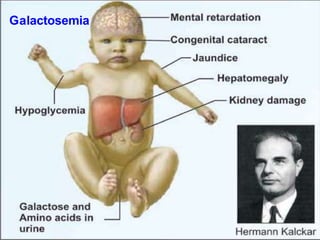
Galactosemia
• Galactose is metabolised almost exclusively
by the liver and therefore galactose
tolerance test is done to assess the functional
capacity of the liver

• UDP-galactose is the active donor of
galactose during synthetic reactions
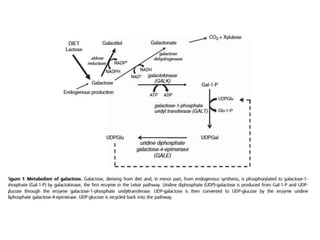
• Step: 1
• Galactokinase reaction:
• Galactose is first phosphorylated by
galactokinase to galactose -1- phosphate
• Step: 2
• Galactose -1- phosphate uridyl transferase
• This is the rate limiting enzyme.
• Galactose 1-phosphate reacts with UDP-
glucose to form UDP-galactose & glucose 1-
phosphate, in the presence of the enzyme
Galactose 1-phosphate uridyl transferase
• UDP-galactose is an active donor of galactose.
• UDP-galactose is essential for the formation of
compounds like lactose, glycosaminoglycans,
glycoproteins, cerebrosides & glycolipids.
• Step: 3
• Epimerase reaction:
• UDP-galactose can be converted to UDP-
glucose by UDP hexose 4-epimerase
• Galactose is channeled to the metabolism of
glucose.
• Galactose is not an essential nutrient since
UDP-glucose can be converted to UDP –
galactose by the enzyme UDP-hexose 4-
epimerase and requires NAD+
• Step: 4
• Alternate pathway:
• The galactose 1-phosphate
pyrophosphorylase in liver becomes active
only after 4or 5years of life
• The enzyme will produce UDP-galactose
directly which can be epimerized to UDP-
glucose.
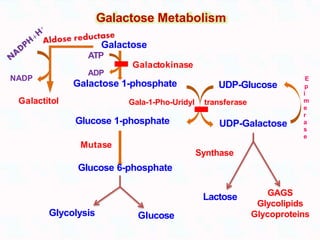
Galactose 1-phosphate
Glucose 1-phosphate
Glycolysis Glucose
Galactitol
UDP-Glucose
UDP-Galactose
Lactose GAGS
Glycolipids
Glycoproteins
NADP
ADP
Galactose
ATP
Galactokinase
Gala-1-Pho-Uridyl transferase
E
p
i
m
e
r
a
s
e
Mutase
Synthase
Glucose 6-phosphate
Galactose Metabolism
Disorders of galactose metabolism
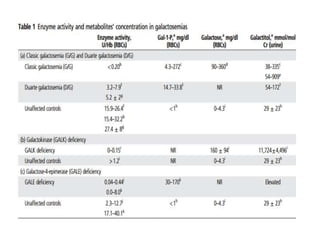
• Classical galactosemia:
• Due to deficiency of enzyme galactose 1-
phosphate uridyltransferase
• Rare congenital disease in infants
• Inherited as an autosomal recessive disorder
Salient features
• Due to the block in this enzyme, galactose 1-
phosphate will accumulate in liver.
• This will inhibit galactokinase as well as
glycogen phosphorylase
• It results in hypoglycemia.
• Galactose cannot be converted to glucose
• Increased galactose level increases insulin
secretion, which lowers blood glucose level.
• Galactose metabolism is impaired leading to
increased galactose levels in circulation
(galactosemia) & urine (galactosuria)
• Bilirubin uptake is less & bilirubin conjugation
is reduced.
• Unconjugated bilirubin level is increased.
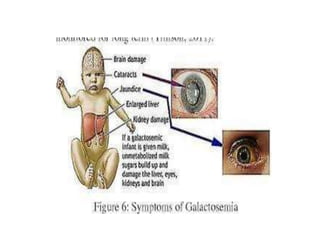
• There is enlargement of liver, jaundice &
severe mental retardation – due to
accumilation of galactose & galactose 1-
phosphate.
Development of cataracts
• Causes:
• Excess of galactose in lens is reduced to galactitol
(dulcitol) by the enzyme aldose reductase
• Galactitol cannot escape from lens cells
• Osmotic effect of the sugar alcohol contributes to
injury of lens proteins & development of cataracts.
Galactokinase deficiency
• The defect in the enzyme galactokinase.
• Results in galactosemia & galactosuria
• Dulcitol or galactitol is formed.
• Absence of hepatic and renal complications.
• Development of cataracts very rare.
• Treatment:
• Removal of galactose & lactose from the diet.
Fructose metabolism
• Fructose is present in fruit juices & honey.
• Chief dietary source is sucrose.
• Sucrose is hydrolyzed in the intestine by the
enzyme sucrase.
• Fructose is absorbed by facilitated transport
and taken by portal blood to liver.
• It is mostly converted to glucose.
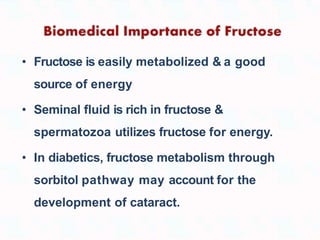
• Fructose is easily metabolized & a good
source of energy
• Seminal fluid is rich in fructose &
spermatozoa utilizes fructose for energy.
• In diabetics, fructose metabolism through
sorbitol pathway may account for the
development of cataract.
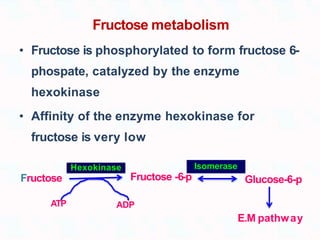
Fructose metabolism
• Fructose is phosphorylated to form fructose 6-
phospate, catalyzed by the enzyme
hexokinase
• Affinity of the enzyme hexokinase for
fructose is very low
Fructose Fructose -6-p Glucose-6-p
E.M pathway
ATP ADP
Hexokinase Isomerase
• Fructose is mostly phosphorylated by
fructokinase to fructose-1-phosphate
• Fructokinase is present in liver, kidney,
muscle and intestine.
• Hexokinase can also act on fructose to
produce fructose 1-phosphate.
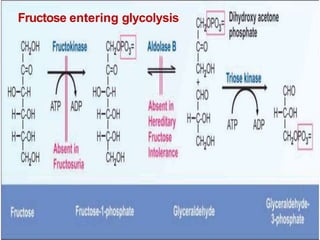
• Fructose-1-phosphate is cleaved to
glyceraldehyde & dihydroxy acetone
phosphate (DHAP) by aldolase B
• Glyceraldehyde is phosphorylated by
triokinase to glyceraldehyde 3-phosphate,
along with DHAP enters glycolysis or
gluconeogenesis.
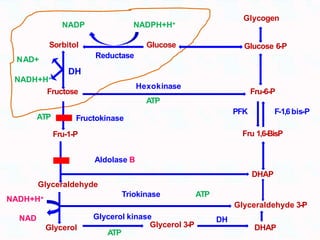
Fructose entering glycolysis
Fructose
Sorbitol
Fru-1-P
Glycerol
Glucose
Fru-6-P
DHAP
NADP NADPH+H+
Reductase
NAD+
NADH+H+
DH
Glucose 6-P
DHAP
Glyceraldehyde 3-P
PFK F-1,6bis-P
Fru 1,6-BisP
Hexokinase
ATP
Fructokinase
ATP
Aldolase B
Triokinase ATP
Glycerol kinase
Glycerol 3-P
ATP
DH
Glycogen
Glyceraldehyde
NADH+H+
NAD
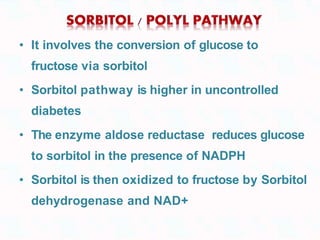
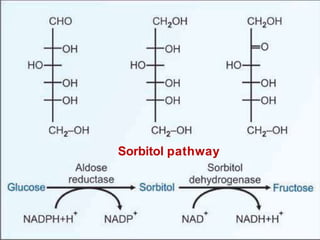
• It involves the conversion of glucose to
fructose via sorbitol
• Sorbitol pathway is higher in uncontrolled
diabetes
• The enzyme aldose reductase reduces glucose
to sorbitol in the presence of NADPH
• Sorbitol is then oxidized to fructose by Sorbitol
dehydrogenase and NAD+
Sorbitol pathway
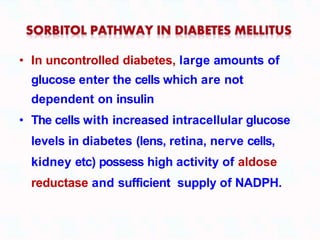
• In uncontrolled diabetes, large amounts of
glucose enter the cells which are not
dependent on insulin
• The cells with increased intracellular glucose
levels in diabetes (lens, retina, nerve cells,
kidney etc) possess high activity of aldose
reductase and sufficient supply of NADPH.
• Thisresults in a rapid &efficient conversion of
glucose to sorbitol
• The enzyme Sorbitol Dehydrogenase is either
low in activity or absent in these cells.
• Sorbitol is not converted to fructose.
• Sorbitol cannot freely pass through the cell
membrane and accumulate in the cells.
• Sorbitol-due to its hydrophilic nature-causes
osmotic effects leading to swelling of the cells.
• Pathological changes associated with
diabetes are due to accumulation of sorbitol.
• Essential fructosuria:
• Deficiency of the enzyme hepatic fructokinase.
• Fructose is not converted to fructose 1-
phosphate.
• Excretion of fructose in urine.
• Treatment: Restriction of dietary fructose
• Urine gives positive benedicts & seliwanoff’s
test
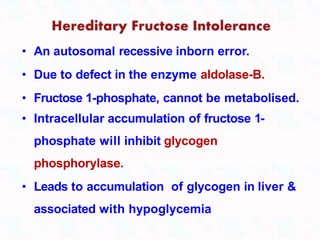
• An autosomal recessive inborn error.
• Due to defect in the enzyme aldolase-B.
• Fructose 1-phosphate, cannot be metabolised.
• Intracellular accumulation of fructose 1-
phosphate will inhibit glycogen
phosphorylase.
• Leads to accumulation of glycogen in liver &
associated with hypoglycemia
• Vomiting, loss of appetite, hepatomegaly &
jaundice.
• If liver damage progresses, death will occur.
• Fructose is excreted in urine.
• Restriction of dietary fructose.
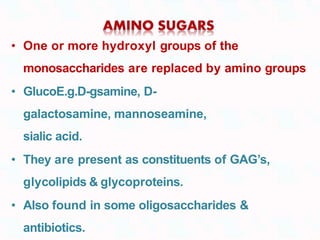
• One or more hydroxyl groups of the
monosaccharides are replaced by amino groups
• GlucoE.g.D-gsamine, D-
galactosamine, mannoseamine,
sialic acid.
• They are present as constituents of GAG’s,
glycolipids & glycoproteins.
• Also found in some oligosaccharides &
antibiotics.
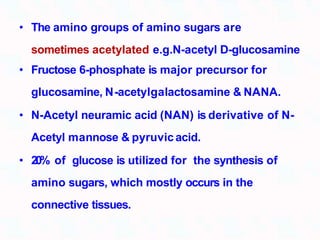
• The amino groups of amino sugars are
sometimes acetylated e.g.N-acetyl D-glucosamine
• Fructose 6-phosphate is major precursor for
glucosamine, N-acetylgalactosamine & NANA.
• N-Acetyl neuramic acid (NAN) is derivative of N-
Acetyl mannose & pyruvicacid.
• 20% of glucose is utilized for the synthesis of
amino sugars, which mostly occurs in the
connective tissues.
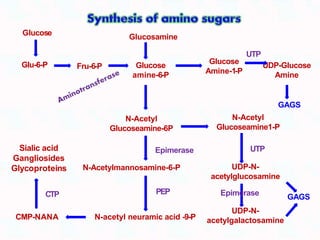
Glucose
Glu-6-P Fru-6-P Glucose
amine-6-P
Glucose
Amine-1-P
UDP-Glucose
Amine
N-Acetyl
Glucoseamine-6P
N-Acetyl
Glucoseamine1-P
GAGS
N-Acetylmannosamine-6-P
N-acetyl neuramic acid -9-P
UDP-N-
acetylglucosamine
UDP-N-
acetylgalactosamine
CMP-NANA
Sialic acid
Gangliosides
Glycoproteins
GAGS
Glucosamine
PEP
Epimerase
Epimerase
UTP
CTP
UTP
Thank you
GALACTOSE AND FRUCTOSE(2).pptx

GALACTOSE AND FRUCTOSE(2).pptx

  • 1.
  • 2.
    • Lactose, presentin milk & milk products. • Principal dietary source of galactose. • Lactase ( β-galactosidase ) of intestinal mucosal cells hydrolyses lactose to galactose and glucose. • Galactose is also produced from lysosomal degradation of glycoproteins & glycolipids.
  • 3.
  • 4.
    • Galactose ismetabolised almost exclusively by the liver and therefore galactose tolerance test is done to assess the functional capacity of the liver • UDP-galactose is the active donor of galactose during synthetic reactions
  • 5.
    • Step: 1 •Galactokinase reaction: • Galactose is first phosphorylated by galactokinase to galactose -1- phosphate • Step: 2 • Galactose -1- phosphate uridyl transferase • This is the rate limiting enzyme.
  • 6.
    • Galactose 1-phosphatereacts with UDP- glucose to form UDP-galactose & glucose 1- phosphate, in the presence of the enzyme Galactose 1-phosphate uridyl transferase
  • 8.
    • UDP-galactose isan active donor of galactose. • UDP-galactose is essential for the formation of compounds like lactose, glycosaminoglycans, glycoproteins, cerebrosides & glycolipids. • Step: 3 • Epimerase reaction: • UDP-galactose can be converted to UDP- glucose by UDP hexose 4-epimerase
  • 9.
    • Galactose ischanneled to the metabolism of glucose. • Galactose is not an essential nutrient since UDP-glucose can be converted to UDP – galactose by the enzyme UDP-hexose 4- epimerase and requires NAD+
  • 10.
    • Step: 4 •Alternate pathway: • The galactose 1-phosphate pyrophosphorylase in liver becomes active only after 4or 5years of life • The enzyme will produce UDP-galactose directly which can be epimerized to UDP- glucose.
  • 11.
    Galactose 1-phosphate Glucose 1-phosphate GlycolysisGlucose Galactitol UDP-Glucose UDP-Galactose Lactose GAGS Glycolipids Glycoproteins NADP ADP Galactose ATP Galactokinase Gala-1-Pho-Uridyl transferase E p i m e r a s e Mutase Synthase Glucose 6-phosphate Galactose Metabolism
  • 13.
    Disorders of galactosemetabolism • Classical galactosemia: • Due to deficiency of enzyme galactose 1- phosphate uridyltransferase • Rare congenital disease in infants • Inherited as an autosomal recessive disorder
  • 14.
    Salient features • Dueto the block in this enzyme, galactose 1- phosphate will accumulate in liver. • This will inhibit galactokinase as well as glycogen phosphorylase • It results in hypoglycemia. • Galactose cannot be converted to glucose • Increased galactose level increases insulin secretion, which lowers blood glucose level.
  • 15.
    • Galactose metabolismis impaired leading to increased galactose levels in circulation (galactosemia) & urine (galactosuria) • Bilirubin uptake is less & bilirubin conjugation is reduced. • Unconjugated bilirubin level is increased.
  • 16.
    • There isenlargement of liver, jaundice & severe mental retardation – due to accumilation of galactose & galactose 1- phosphate.
  • 19.
    Development of cataracts •Causes: • Excess of galactose in lens is reduced to galactitol (dulcitol) by the enzyme aldose reductase • Galactitol cannot escape from lens cells • Osmotic effect of the sugar alcohol contributes to injury of lens proteins & development of cataracts.
  • 22.
    Galactokinase deficiency • Thedefect in the enzyme galactokinase. • Results in galactosemia & galactosuria • Dulcitol or galactitol is formed. • Absence of hepatic and renal complications. • Development of cataracts very rare. • Treatment: • Removal of galactose & lactose from the diet.
  • 24.
    Fructose metabolism • Fructoseis present in fruit juices & honey. • Chief dietary source is sucrose. • Sucrose is hydrolyzed in the intestine by the enzyme sucrase. • Fructose is absorbed by facilitated transport and taken by portal blood to liver. • It is mostly converted to glucose.
  • 25.
    • Fructose iseasily metabolized & a good source of energy • Seminal fluid is rich in fructose & spermatozoa utilizes fructose for energy. • In diabetics, fructose metabolism through sorbitol pathway may account for the development of cataract.
  • 26.
    Fructose metabolism • Fructoseis phosphorylated to form fructose 6- phospate, catalyzed by the enzyme hexokinase • Affinity of the enzyme hexokinase for fructose is very low Fructose Fructose -6-p Glucose-6-p E.M pathway ATP ADP Hexokinase Isomerase
  • 27.
    • Fructose ismostly phosphorylated by fructokinase to fructose-1-phosphate • Fructokinase is present in liver, kidney, muscle and intestine. • Hexokinase can also act on fructose to produce fructose 1-phosphate.
  • 28.
    • Fructose-1-phosphate iscleaved to glyceraldehyde & dihydroxy acetone phosphate (DHAP) by aldolase B • Glyceraldehyde is phosphorylated by triokinase to glyceraldehyde 3-phosphate, along with DHAP enters glycolysis or gluconeogenesis.
  • 29.
  • 30.
    Fructose Sorbitol Fru-1-P Glycerol Glucose Fru-6-P DHAP NADP NADPH+H+ Reductase NAD+ NADH+H+ DH Glucose 6-P DHAP Glyceraldehyde3-P PFK F-1,6bis-P Fru 1,6-BisP Hexokinase ATP Fructokinase ATP Aldolase B Triokinase ATP Glycerol kinase Glycerol 3-P ATP DH Glycogen Glyceraldehyde NADH+H+ NAD
  • 32.
    • It involvesthe conversion of glucose to fructose via sorbitol • Sorbitol pathway is higher in uncontrolled diabetes • The enzyme aldose reductase reduces glucose to sorbitol in the presence of NADPH • Sorbitol is then oxidized to fructose by Sorbitol dehydrogenase and NAD+
  • 33.
  • 34.
    • In uncontrolleddiabetes, large amounts of glucose enter the cells which are not dependent on insulin • The cells with increased intracellular glucose levels in diabetes (lens, retina, nerve cells, kidney etc) possess high activity of aldose reductase and sufficient supply of NADPH.
  • 35.
    • Thisresults ina rapid &efficient conversion of glucose to sorbitol • The enzyme Sorbitol Dehydrogenase is either low in activity or absent in these cells. • Sorbitol is not converted to fructose. • Sorbitol cannot freely pass through the cell membrane and accumulate in the cells.
  • 36.
    • Sorbitol-due toits hydrophilic nature-causes osmotic effects leading to swelling of the cells. • Pathological changes associated with diabetes are due to accumulation of sorbitol.
  • 37.
    • Essential fructosuria: •Deficiency of the enzyme hepatic fructokinase. • Fructose is not converted to fructose 1- phosphate. • Excretion of fructose in urine. • Treatment: Restriction of dietary fructose • Urine gives positive benedicts & seliwanoff’s test
  • 38.
    • An autosomalrecessive inborn error. • Due to defect in the enzyme aldolase-B. • Fructose 1-phosphate, cannot be metabolised. • Intracellular accumulation of fructose 1- phosphate will inhibit glycogen phosphorylase. • Leads to accumulation of glycogen in liver & associated with hypoglycemia
  • 39.
    • Vomiting, lossof appetite, hepatomegaly & jaundice. • If liver damage progresses, death will occur. • Fructose is excreted in urine. • Restriction of dietary fructose.
  • 40.
    • One ormore hydroxyl groups of the monosaccharides are replaced by amino groups • GlucoE.g.D-gsamine, D- galactosamine, mannoseamine, sialic acid. • They are present as constituents of GAG’s, glycolipids & glycoproteins. • Also found in some oligosaccharides & antibiotics.
  • 41.
    • The aminogroups of amino sugars are sometimes acetylated e.g.N-acetyl D-glucosamine • Fructose 6-phosphate is major precursor for glucosamine, N-acetylgalactosamine & NANA. • N-Acetyl neuramic acid (NAN) is derivative of N- Acetyl mannose & pyruvicacid. • 20% of glucose is utilized for the synthesis of amino sugars, which mostly occurs in the connective tissues.
  • 42.
    Glucose Glu-6-P Fru-6-P Glucose amine-6-P Glucose Amine-1-P UDP-Glucose Amine N-Acetyl Glucoseamine-6P N-Acetyl Glucoseamine1-P GAGS N-Acetylmannosamine-6-P N-acetylneuramic acid -9-P UDP-N- acetylglucosamine UDP-N- acetylgalactosamine CMP-NANA Sialic acid Gangliosides Glycoproteins GAGS Glucosamine PEP Epimerase Epimerase UTP CTP UTP
  • 43.