Classification
Assigning Scientific Names
• We must be able to describe and name
  each species
• The name must refer to only one species
• Common names won’t work
Binomial Nomenclature
• Developed by Carolus Linnaeus
• Each species is assigned a two-part
  scientific name
• Written in Italic
• The first word (genus) begins with a
  Capitol letter, the second word is lower
  case.
• Ursus arctos – brown bear
Dichotomous Key
• Used to Identify Organisms
• A series of paired statements used to
  describe characteristics of an organism
  – Usually describe the presence or absence of
    a structure
  http://dnr.wi.gov/org/caer/ce/eek/critter/watercritter/a
• The science of naming and grouping
  organisms is systematics
• The goal of systematics is to organize living
  things into groups that have biological
  meaning or taxa.
• Examples are “teacher” or “bird”
Linnaean Classification System
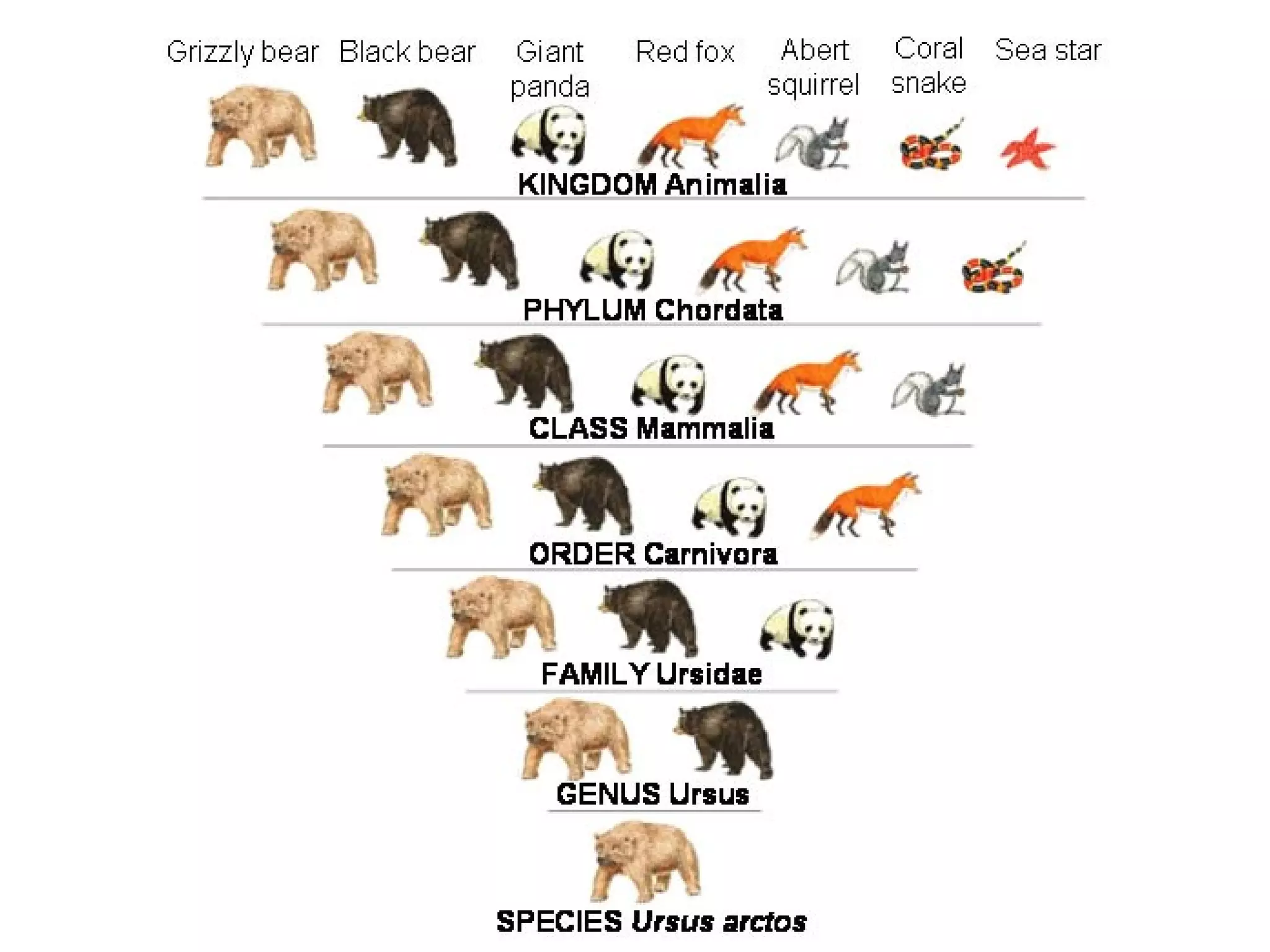
• Linnaeus developed a classification
  system that organized species into taxa
  that formed a hierarchy or set ordered
  ranks.
• It started with 4 levels but expanded to 8
  taxa (groups) with time
• Species are grouped according to
  anatomical similarities and differences
Evolutionary Classification
• The study of how living and extinct
  organisms are related to one another is
  phylogeny
• Phylogenetic systematics (evolutionary
  classification) groups species into larger
  categories that reflect lines of evolutionary
  descent.
• A clade is a group of species that includes
  a single common ancestor and all
  descendants of that ancestor
• Must be monophyletic
  – Include all species that are descended from a
    common ancestor
  – Does not include species that are not
    descended from a common ancestor
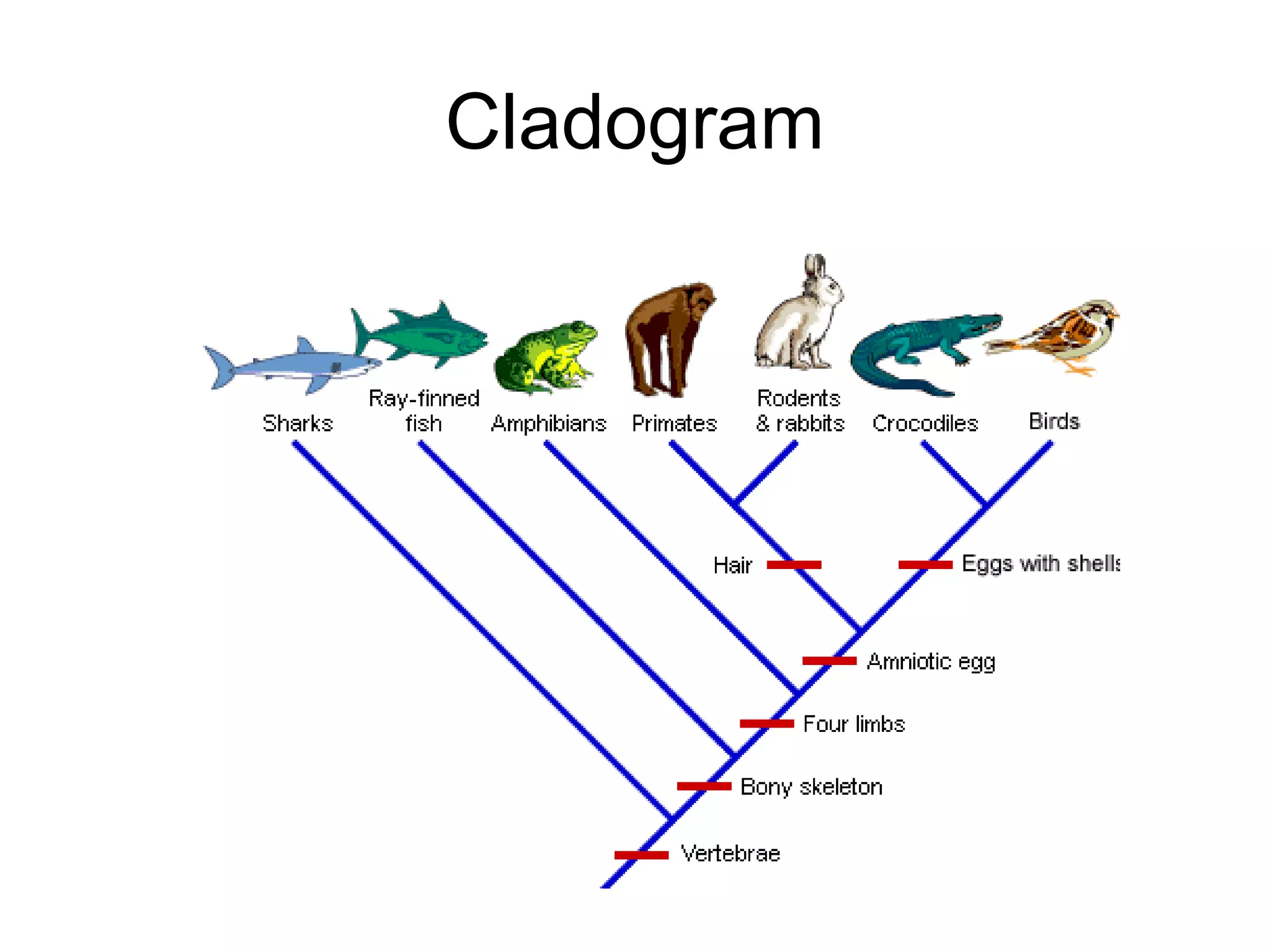
Cladogram
Cladogram
• Links groups of organisms by showing
  how evolutionary lines branched off of
  common ancestors
• Links Clades together
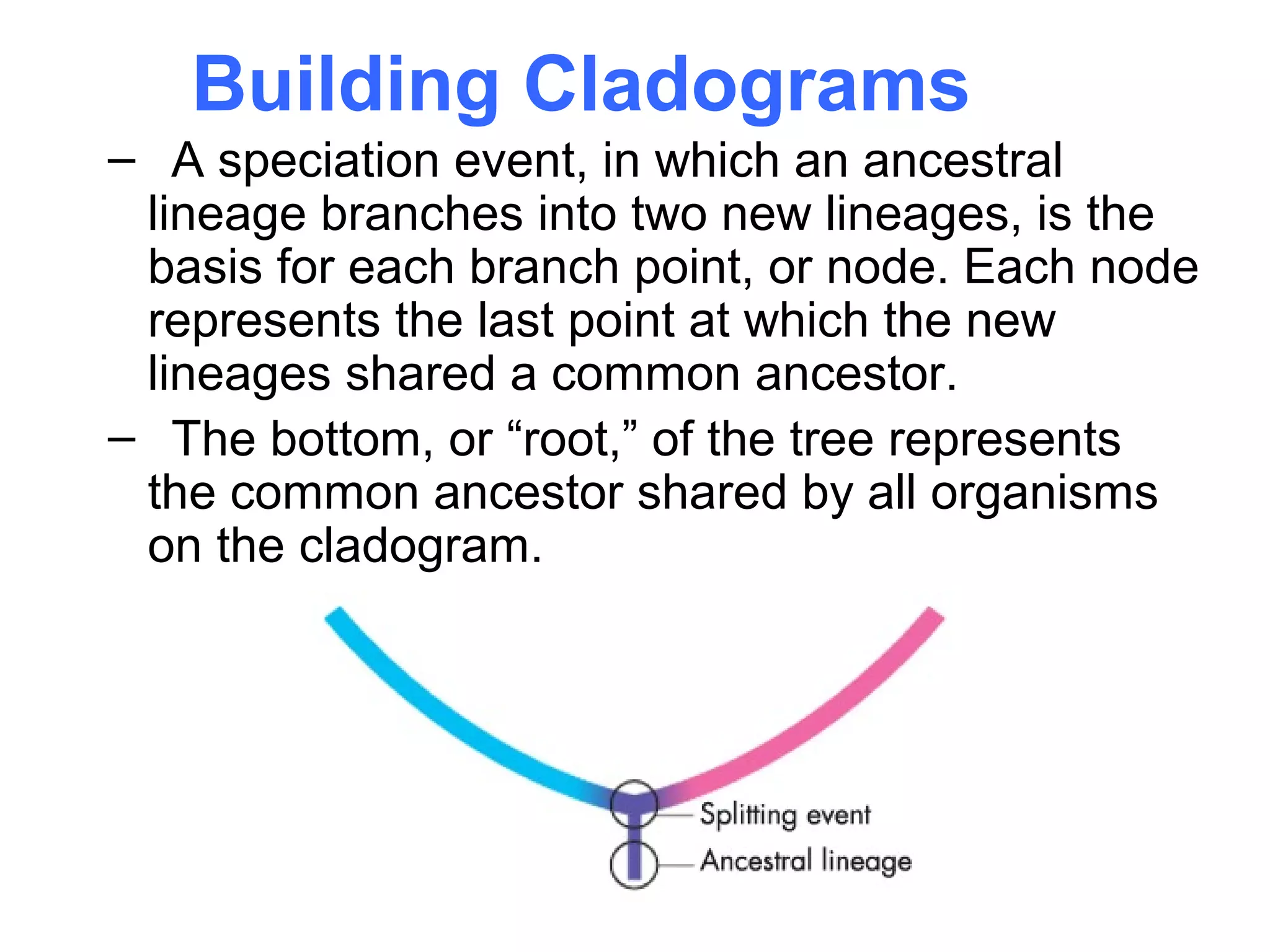
Building Cladograms
– A speciation event, in which an ancestral
 lineage branches into two new lineages, is the
 basis for each branch point, or node. Each node
 represents the last point at which the new
 lineages shared a common ancestor.
– The bottom, or “root,” of the tree represents
 the common ancestor shared by all organisms
 on the cladogram.
Building Cladograms
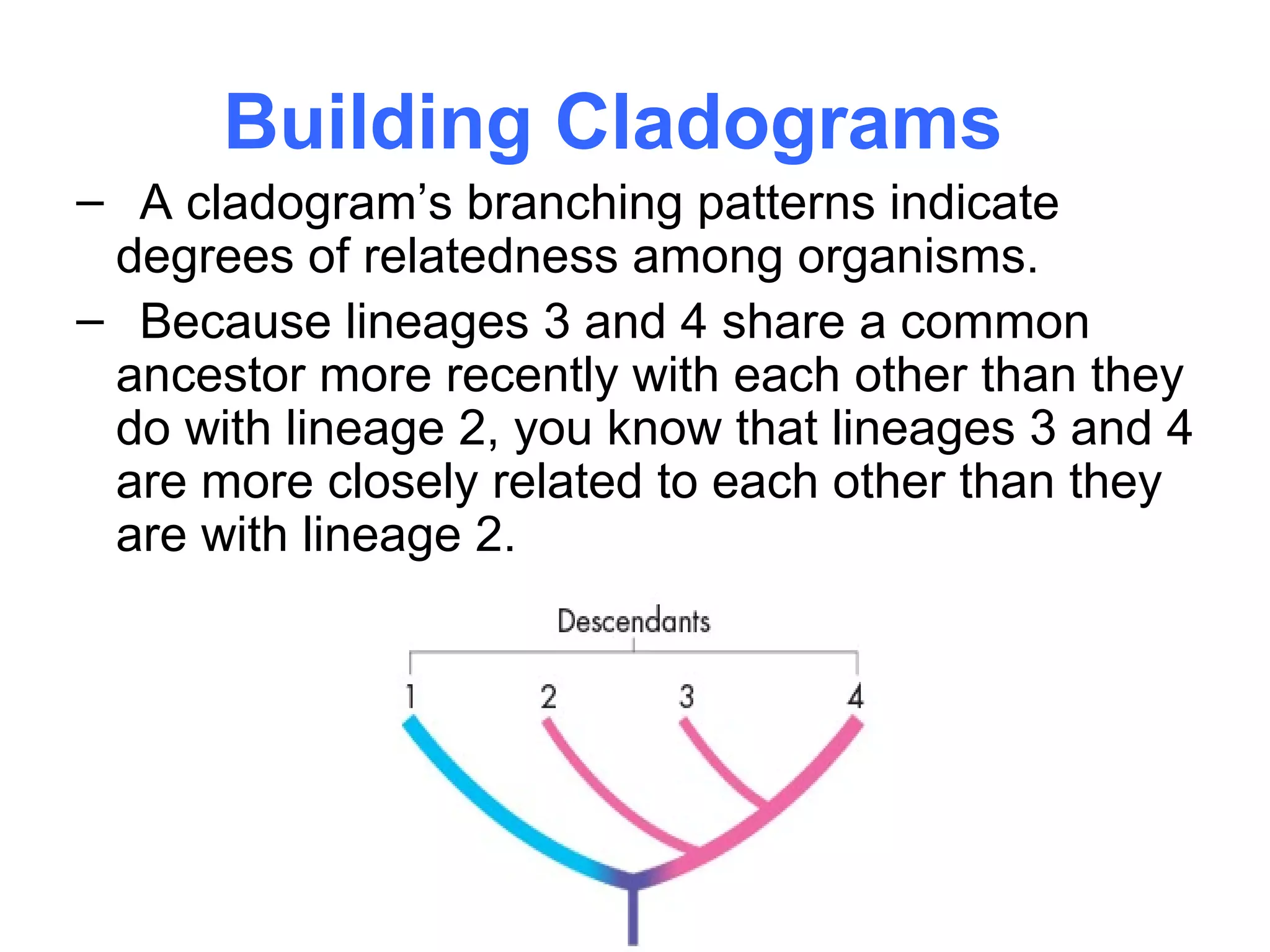
– A cladogram’s branching patterns indicate
 degrees of relatedness among organisms.
– Because lineages 3 and 4 share a common
 ancestor more recently with each other than they
 do with lineage 2, you know that lineages 3 and 4
 are more closely related to each other than they
 are with lineage 2.
Building Cladograms
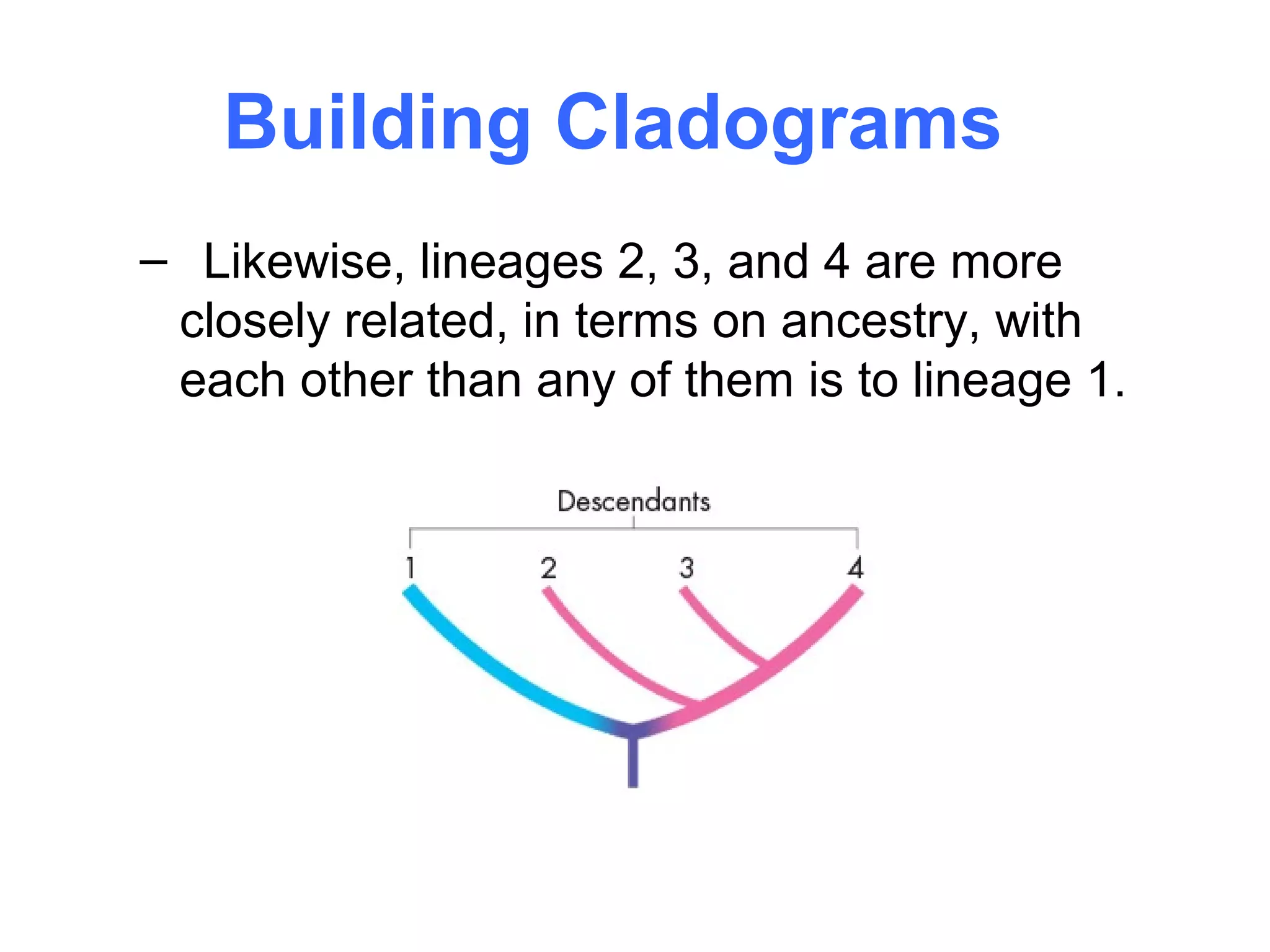
– Likewise, lineages 2, 3, and 4 are more
 closely related, in terms on ancestry, with
 each other than any of them is to lineage 1.
Building Cladograms
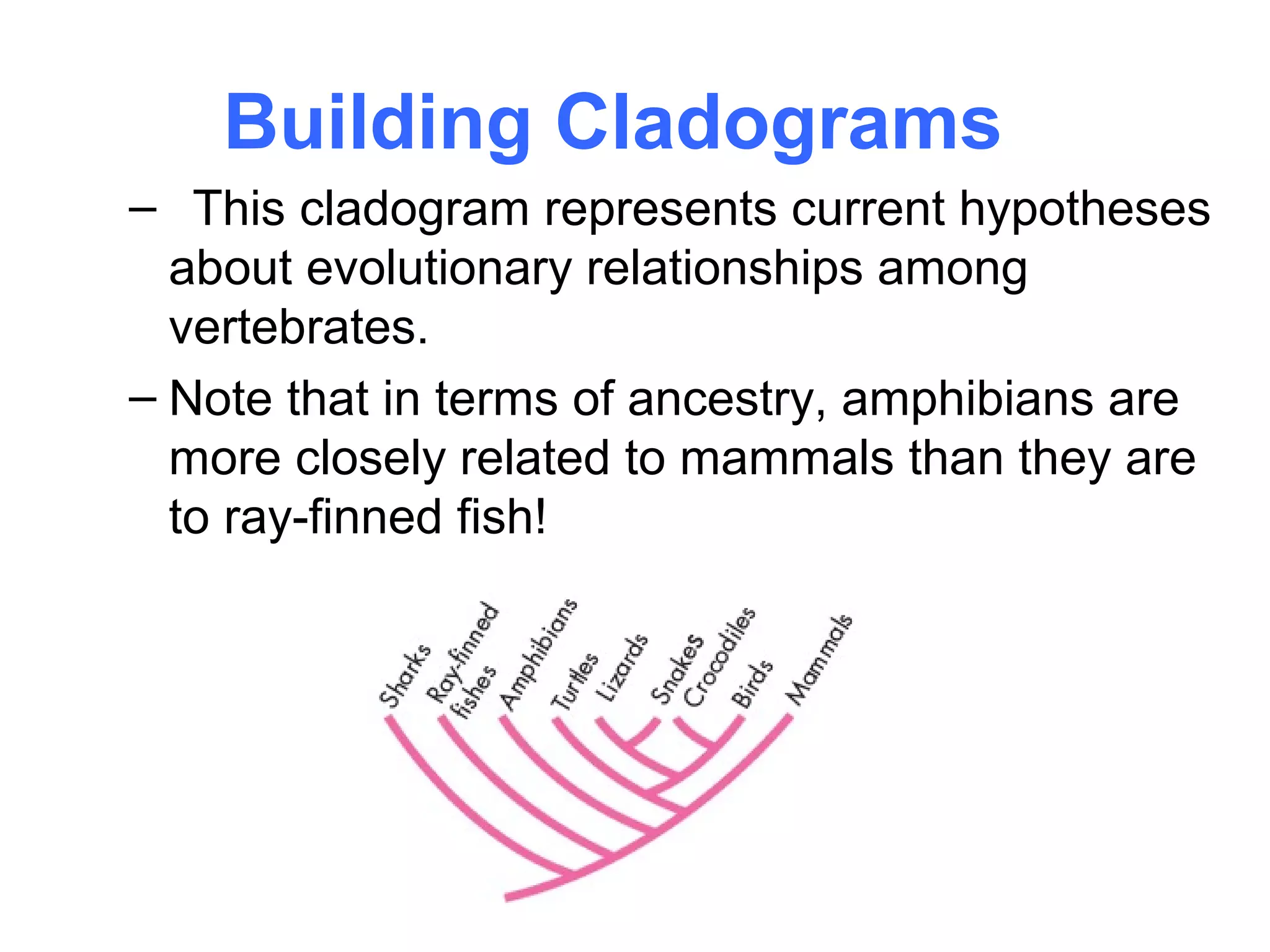
– This cladogram represents current hypotheses
  about evolutionary relationships among
  vertebrates.
– Note that in terms of ancestry, amphibians are
  more closely related to mammals than they are
  to ray-finned fish!
Reading Cladograms
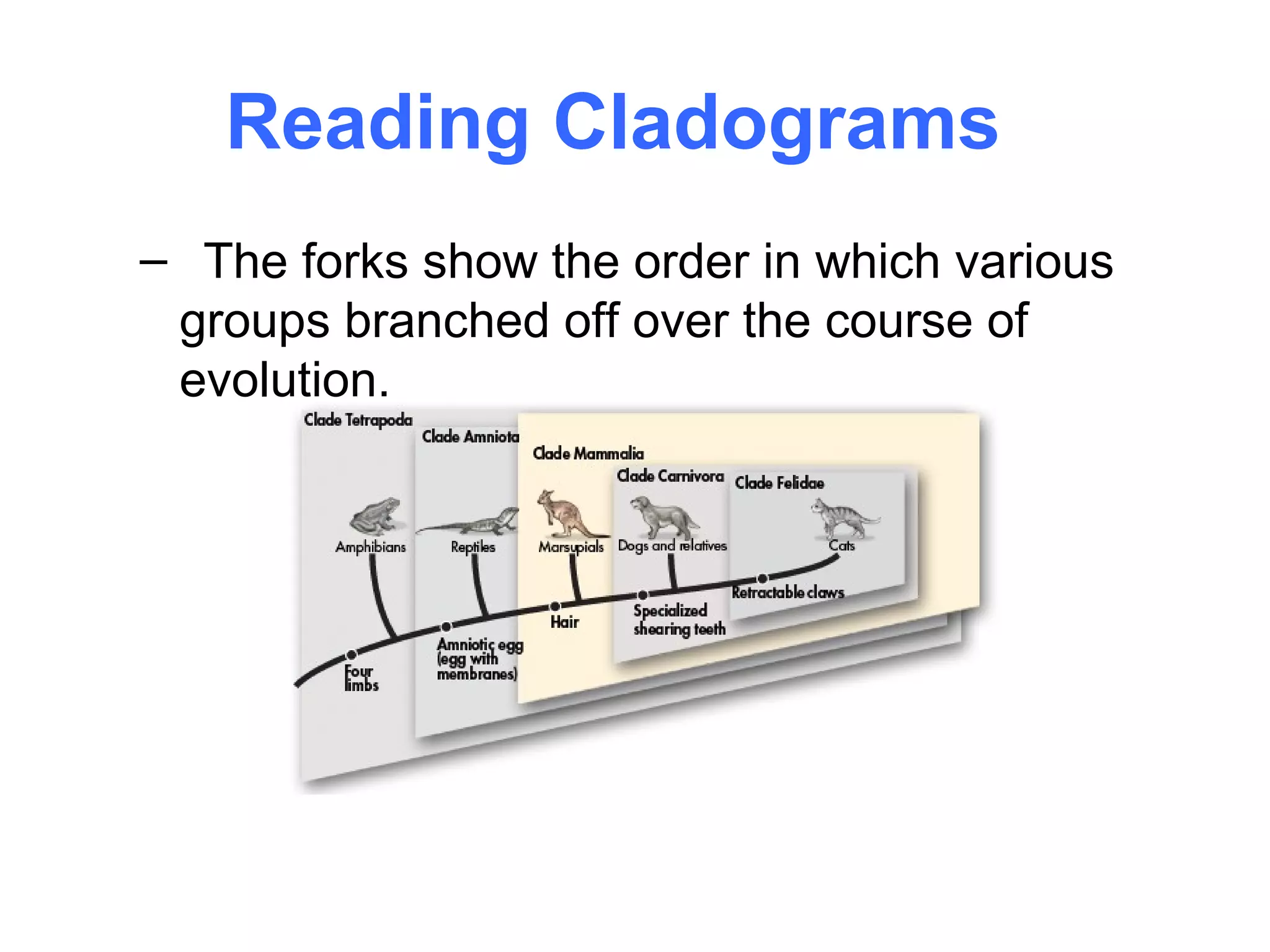
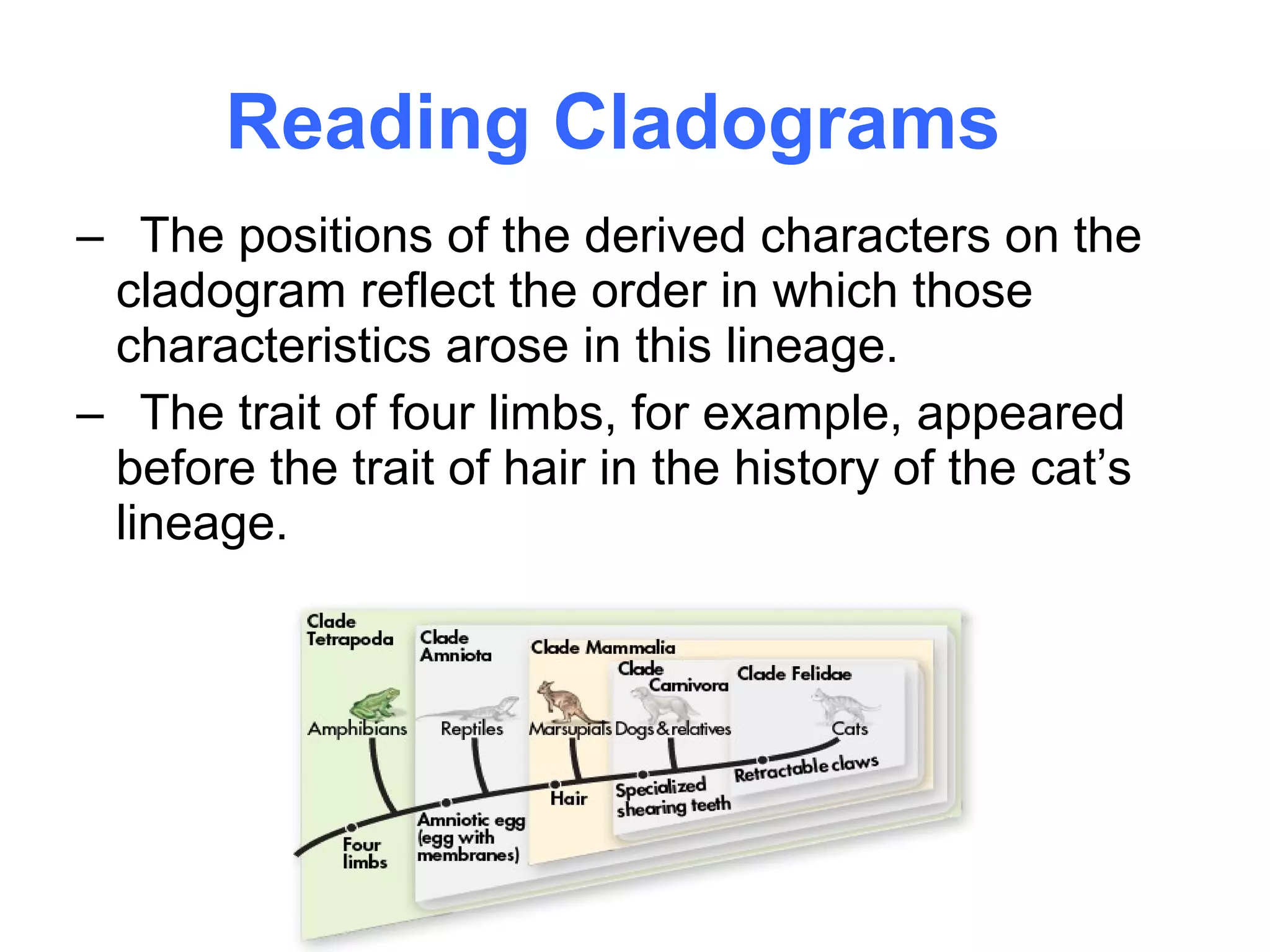
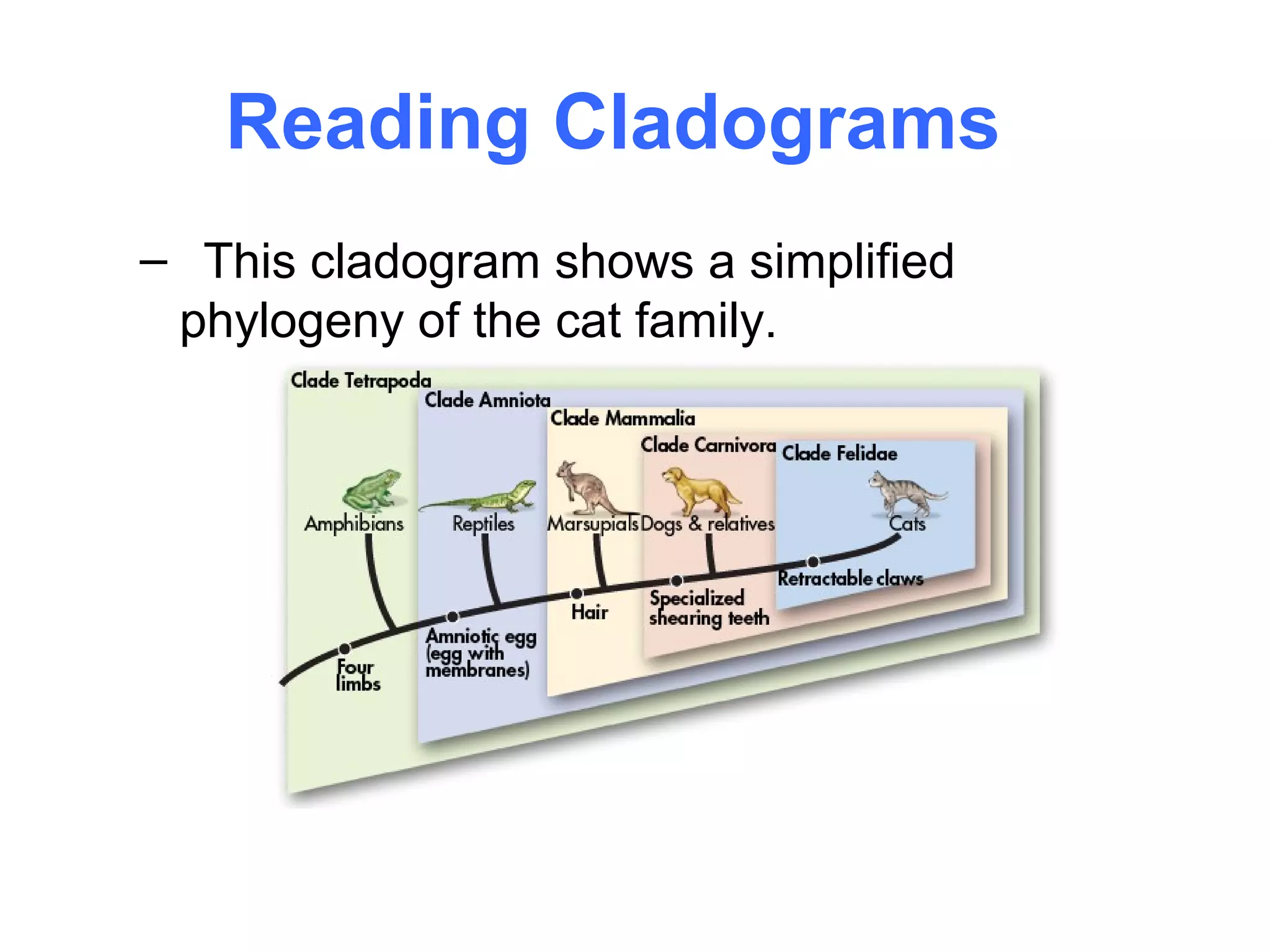
– This cladogram shows a simplified
 phylogeny of the cat family.
Reading Cladograms
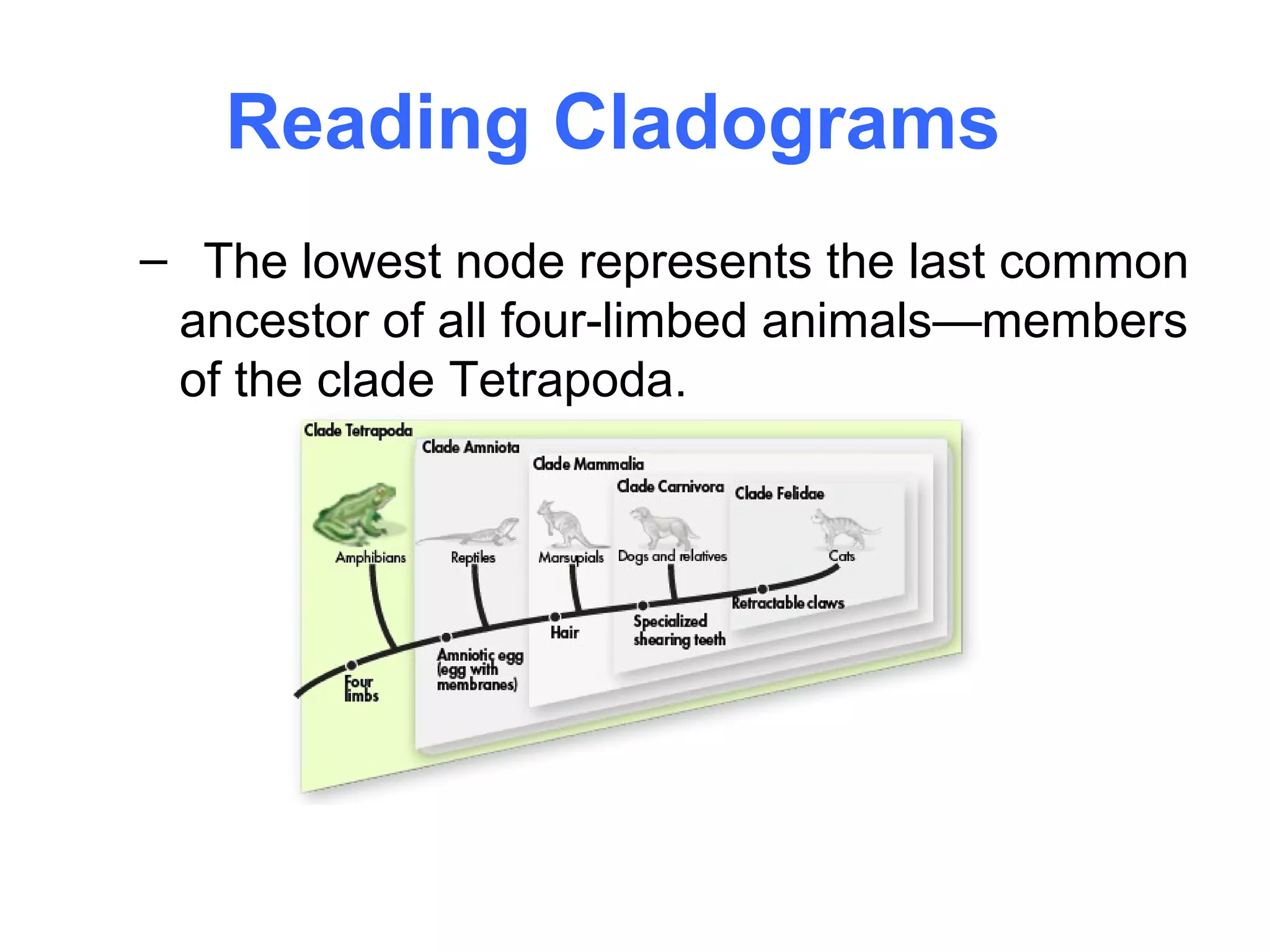
– The lowest node represents the last common
 ancestor of all four-limbed animals—members
 of the clade Tetrapoda.
Reading Cladograms
– The forks show the order in which various
 groups branched off over the course of
 evolution.
Reading Cladograms
– The positions of the derived characters on the
 cladogram reflect the order in which those
 characteristics arose in this lineage.
– The trait of four limbs, for example, appeared
 before the trait of hair in the history of the cat’s
 lineage.
Derived Characters
• A trait that arose in the most recent common
  ancestor of a particular lineage and was passed
  along to its descendants
• Whether or not a character is derived depends
  on the level at which you’re grouping organisms.
  Four limbs, for example, is a derived character
  for the clade tetrapoda. Hair is a derived
  character for the clade Mammalia, but four limbs
  is not derived for mammals. If it were, only
  mammals would have four limbs!
Derived Characters
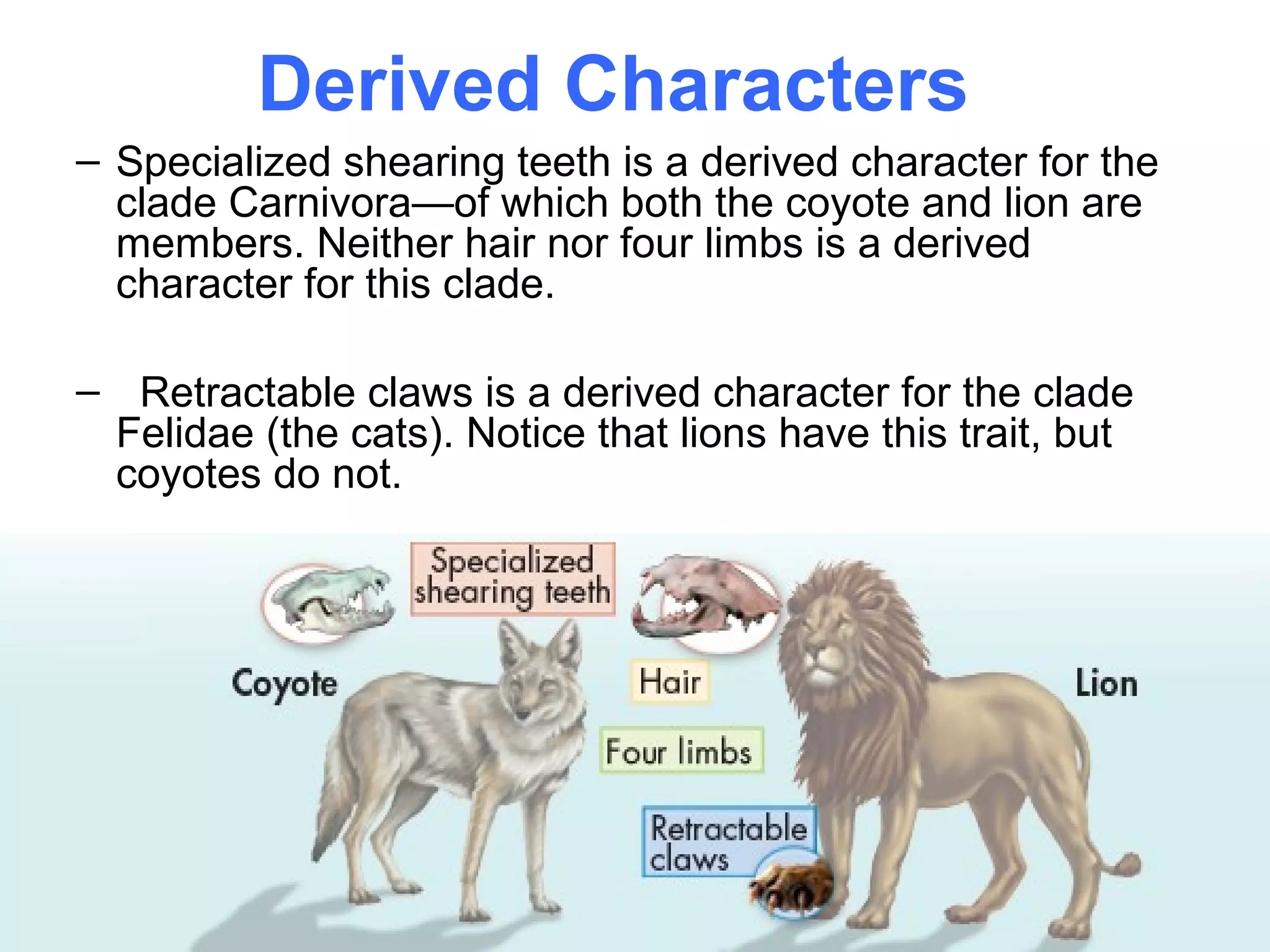
– Specialized shearing teeth is a derived character for the
  clade Carnivora—of which both the coyote and lion are
  members. Neither hair nor four limbs is a derived
  character for this clade.

– Retractable claws is a derived character for the clade
 Felidae (the cats). Notice that lions have this trait, but
 coyotes do not.
Losing Traits
– Because distantly related groups of
 organisms can lose the same character,
 systematists are cautious about using the
 absence of a trait as a derived character.

– For example, both whales and snakes have
 lost the tetrapod character of four limbs—but
 they are not very closely related. Snakes are
 members of the clade Reptilia, while whales
 are members of the clade Mammalia.
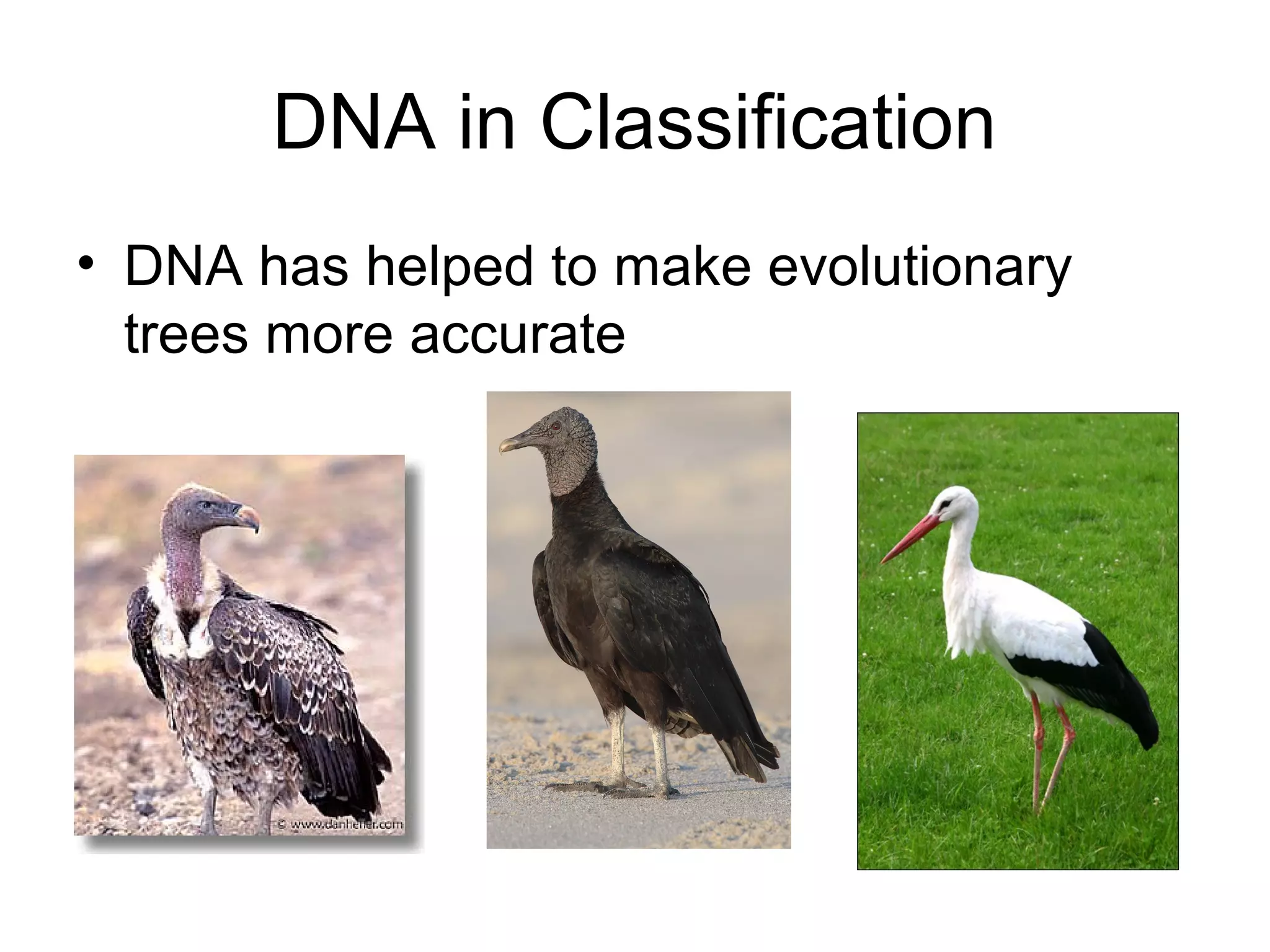
DNA in Classification
• DNA has helped to make evolutionary
  trees more accurate
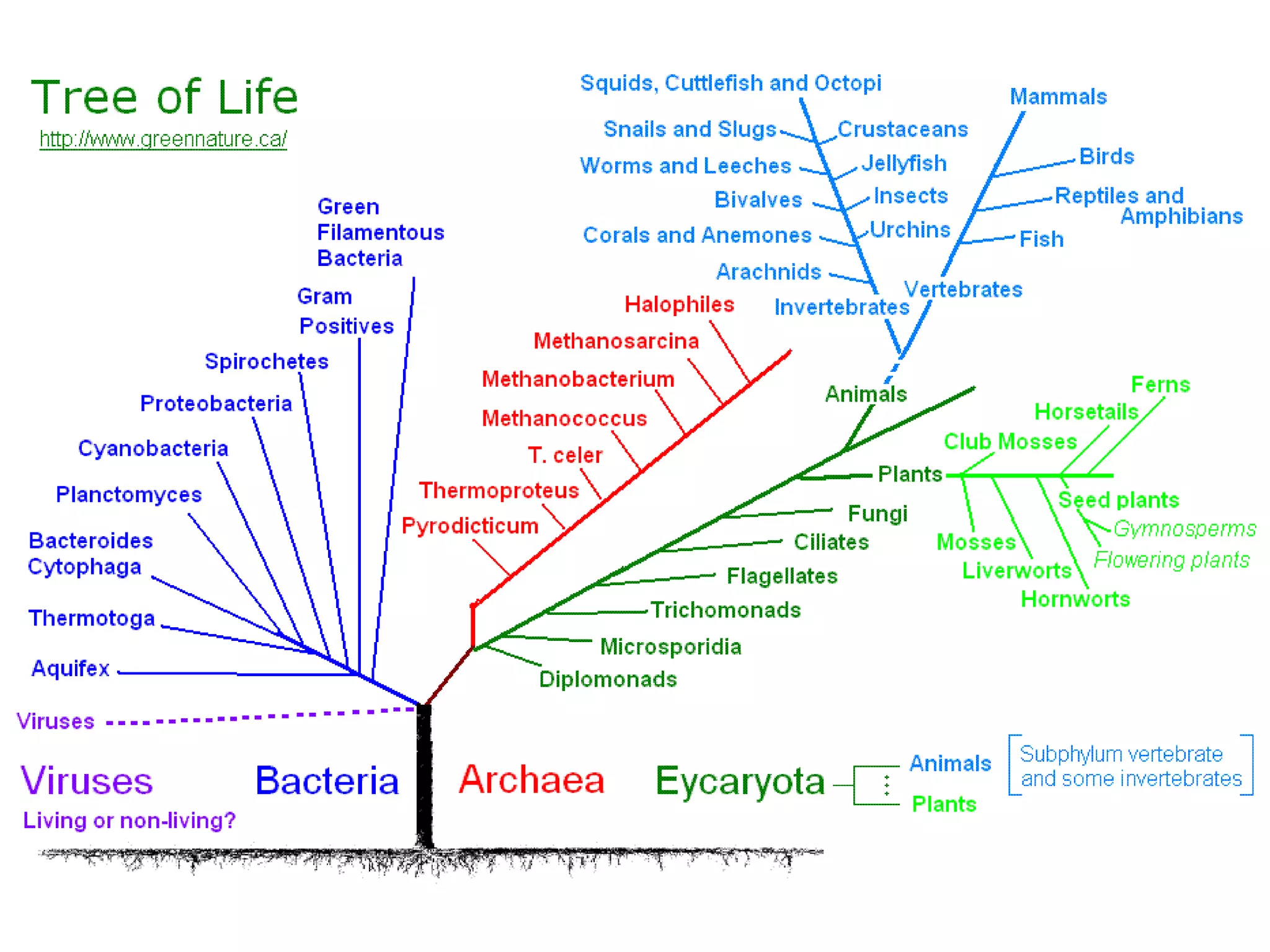
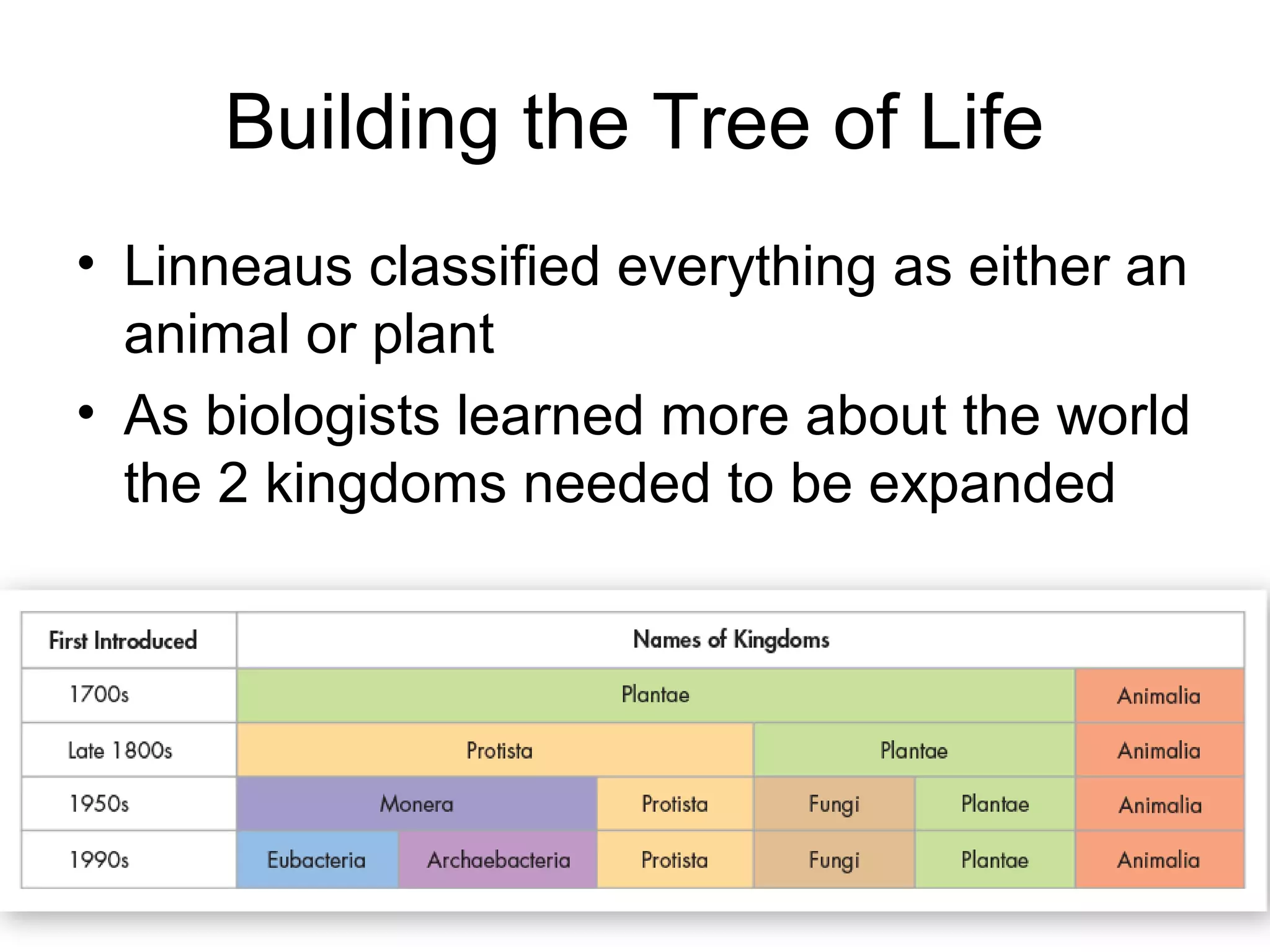
Building the Tree of Life
• Linneaus classified everything as either an
  animal or plant
• As biologists learned more about the world
  the 2 kingdoms needed to be expanded
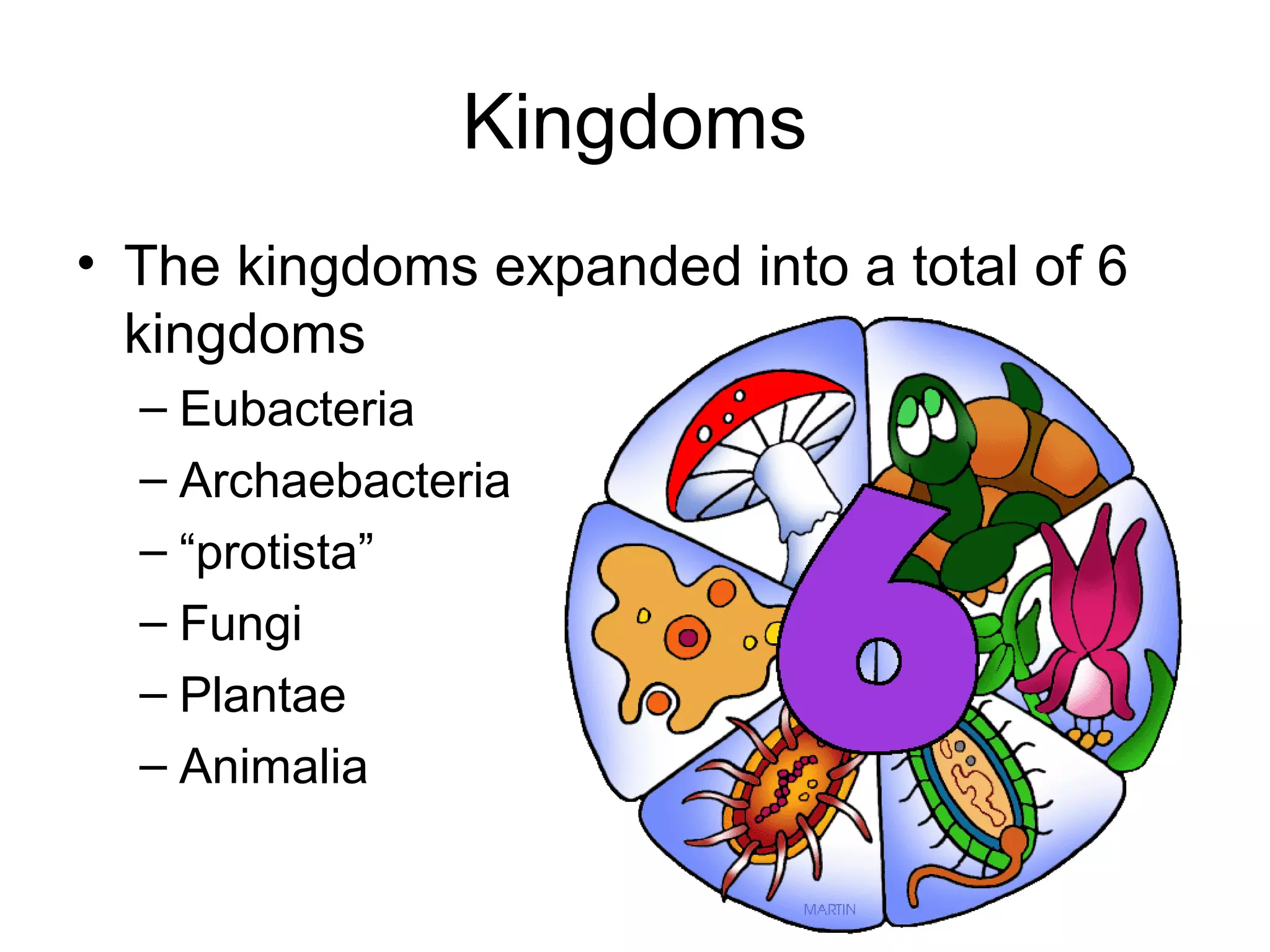
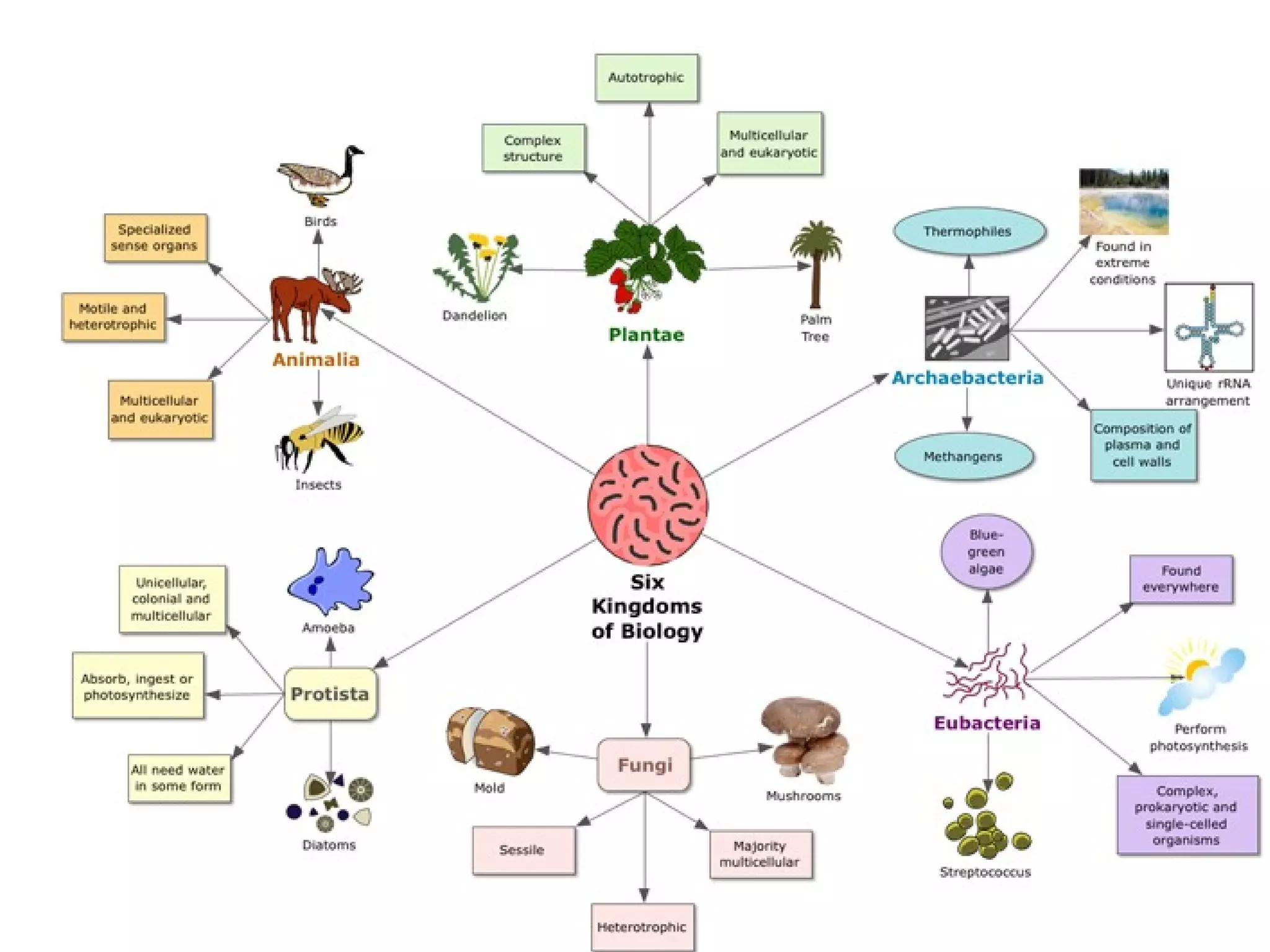
Kingdoms
• The kingdoms expanded into a total of 6
  kingdoms
  – Eubacteria
  – Archaebacteria
  – “protista”
  – Fungi
  – Plantae
  – Animalia
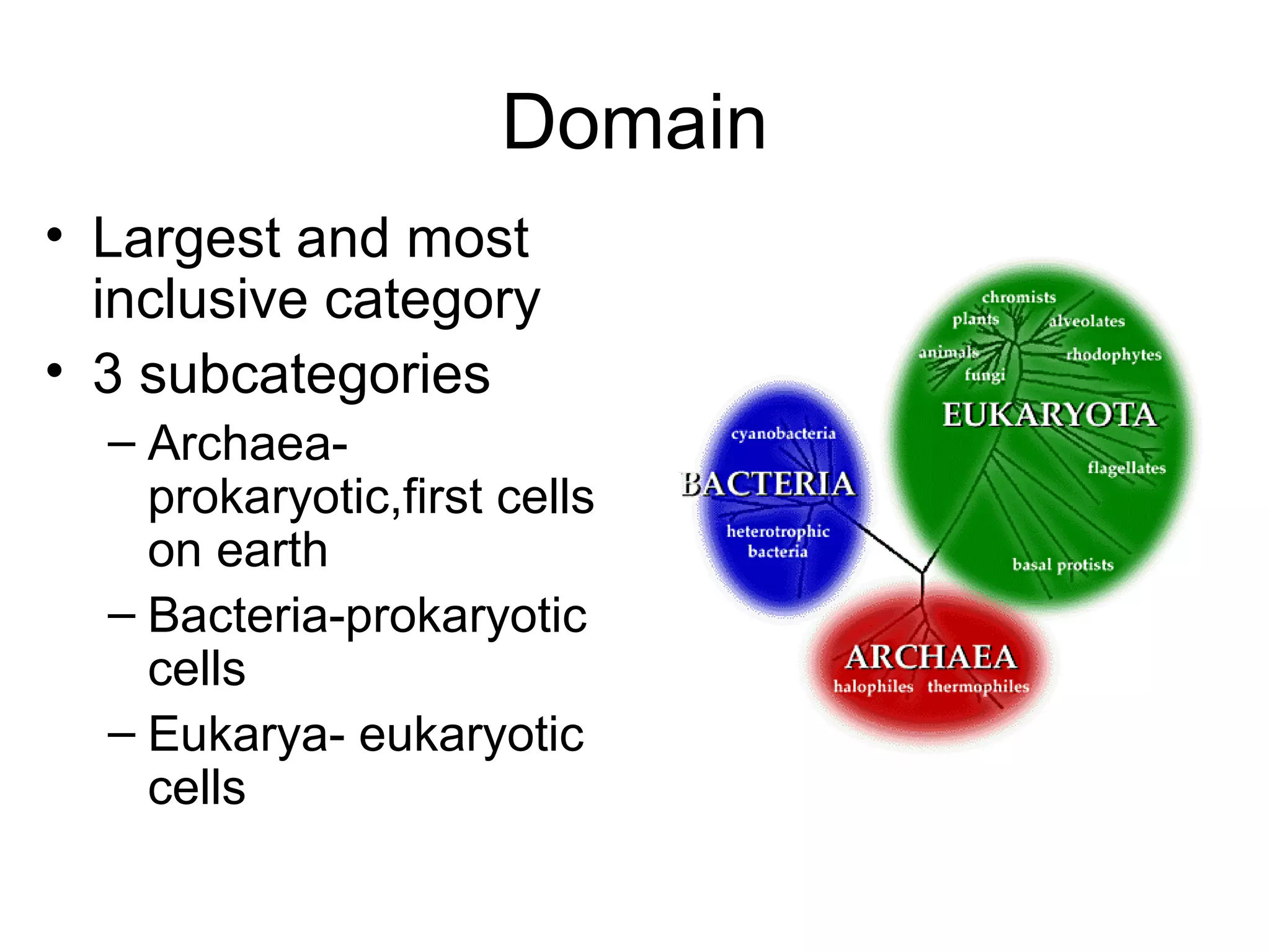
Domain
• Largest and most
  inclusive category
• 3 subcategories
  – Archaea-
    prokaryotic,first cells
    on earth
  – Bacteria-prokaryotic
    cells
  – Eukarya- eukaryotic
    cells
Domain Bacteria
•   Unicellular
•   Prokaryotic
•   Corresponds to kingdom Eukarya
•   Contain Peptidoglycan in their cell walls
Domain Archaea
•   Unicellular
•   Prokaryotic
•   Live in Extreme Environments
•   Lack Peptioglycan
Domain Eukarya
• All Organisms that have a nucleus
Problem “protists”
• Catchall group of eukaryotes
  – Everything that is not a fungi, plant or animal
• Do not form a single clade as they are not
  all from the same origin
  – Some are multicellular, some are unicellular,
    some are photosynthetic, some are
    heterotrophs
Fungi
•   Heterotrophs
•   Cell walls contain Chitin
•   Feed on dead or decaying organic matter
•   Can be unicellular or multicellular
Plantae
•   Multicellular
•   Heterotrophic
•   Cell walls contain cellulose
•   non-motile
•   Photosynthesize using chlorophyll
Animalia
• Multicellular
• Heterotrophic
• No cell walls
• Most can move about for some part of
  their life cycle
• Very diverse

Classification

  • 1.
  • 2.
    Assigning Scientific Names •We must be able to describe and name each species • The name must refer to only one species • Common names won’t work
  • 3.
    Binomial Nomenclature • Developedby Carolus Linnaeus • Each species is assigned a two-part scientific name • Written in Italic • The first word (genus) begins with a Capitol letter, the second word is lower case. • Ursus arctos – brown bear
  • 4.
    Dichotomous Key • Usedto Identify Organisms • A series of paired statements used to describe characteristics of an organism – Usually describe the presence or absence of a structure http://dnr.wi.gov/org/caer/ce/eek/critter/watercritter/a
  • 5.
    • The scienceof naming and grouping organisms is systematics • The goal of systematics is to organize living things into groups that have biological meaning or taxa. • Examples are “teacher” or “bird”
  • 6.
    Linnaean Classification System •Linnaeus developed a classification system that organized species into taxa that formed a hierarchy or set ordered ranks. • It started with 4 levels but expanded to 8 taxa (groups) with time • Species are grouped according to anatomical similarities and differences
  • 10.
    Evolutionary Classification • Thestudy of how living and extinct organisms are related to one another is phylogeny • Phylogenetic systematics (evolutionary classification) groups species into larger categories that reflect lines of evolutionary descent.
  • 11.
    • A cladeis a group of species that includes a single common ancestor and all descendants of that ancestor • Must be monophyletic – Include all species that are descended from a common ancestor – Does not include species that are not descended from a common ancestor
  • 12.
  • 13.
    Cladogram • Links groupsof organisms by showing how evolutionary lines branched off of common ancestors • Links Clades together
  • 14.
    Building Cladograms – Aspeciation event, in which an ancestral lineage branches into two new lineages, is the basis for each branch point, or node. Each node represents the last point at which the new lineages shared a common ancestor. – The bottom, or “root,” of the tree represents the common ancestor shared by all organisms on the cladogram.
  • 15.
    Building Cladograms – Acladogram’s branching patterns indicate degrees of relatedness among organisms. – Because lineages 3 and 4 share a common ancestor more recently with each other than they do with lineage 2, you know that lineages 3 and 4 are more closely related to each other than they are with lineage 2.
  • 16.
    Building Cladograms – Likewise,lineages 2, 3, and 4 are more closely related, in terms on ancestry, with each other than any of them is to lineage 1.
  • 17.
    Building Cladograms – Thiscladogram represents current hypotheses about evolutionary relationships among vertebrates. – Note that in terms of ancestry, amphibians are more closely related to mammals than they are to ray-finned fish!
  • 18.
    Reading Cladograms – Thiscladogram shows a simplified phylogeny of the cat family.
  • 19.
    Reading Cladograms – Thelowest node represents the last common ancestor of all four-limbed animals—members of the clade Tetrapoda.
  • 20.
    Reading Cladograms – Theforks show the order in which various groups branched off over the course of evolution.
  • 21.
    Reading Cladograms – Thepositions of the derived characters on the cladogram reflect the order in which those characteristics arose in this lineage. – The trait of four limbs, for example, appeared before the trait of hair in the history of the cat’s lineage.
  • 23.
    Derived Characters • Atrait that arose in the most recent common ancestor of a particular lineage and was passed along to its descendants • Whether or not a character is derived depends on the level at which you’re grouping organisms. Four limbs, for example, is a derived character for the clade tetrapoda. Hair is a derived character for the clade Mammalia, but four limbs is not derived for mammals. If it were, only mammals would have four limbs!
  • 24.
    Derived Characters – Specializedshearing teeth is a derived character for the clade Carnivora—of which both the coyote and lion are members. Neither hair nor four limbs is a derived character for this clade. – Retractable claws is a derived character for the clade Felidae (the cats). Notice that lions have this trait, but coyotes do not.
  • 25.
    Losing Traits – Becausedistantly related groups of organisms can lose the same character, systematists are cautious about using the absence of a trait as a derived character. – For example, both whales and snakes have lost the tetrapod character of four limbs—but they are not very closely related. Snakes are members of the clade Reptilia, while whales are members of the clade Mammalia.
  • 26.
    DNA in Classification •DNA has helped to make evolutionary trees more accurate
  • 28.
    Building the Treeof Life • Linneaus classified everything as either an animal or plant • As biologists learned more about the world the 2 kingdoms needed to be expanded
  • 29.
    Kingdoms • The kingdomsexpanded into a total of 6 kingdoms – Eubacteria – Archaebacteria – “protista” – Fungi – Plantae – Animalia
  • 31.
    Domain • Largest andmost inclusive category • 3 subcategories – Archaea- prokaryotic,first cells on earth – Bacteria-prokaryotic cells – Eukarya- eukaryotic cells
  • 32.
    Domain Bacteria • Unicellular • Prokaryotic • Corresponds to kingdom Eukarya • Contain Peptidoglycan in their cell walls
  • 33.
    Domain Archaea • Unicellular • Prokaryotic • Live in Extreme Environments • Lack Peptioglycan
  • 34.
    Domain Eukarya • AllOrganisms that have a nucleus
  • 35.
    Problem “protists” • Catchallgroup of eukaryotes – Everything that is not a fungi, plant or animal • Do not form a single clade as they are not all from the same origin – Some are multicellular, some are unicellular, some are photosynthetic, some are heterotrophs
  • 36.
    Fungi • Heterotrophs • Cell walls contain Chitin • Feed on dead or decaying organic matter • Can be unicellular or multicellular
  • 37.
    Plantae • Multicellular • Heterotrophic • Cell walls contain cellulose • non-motile • Photosynthesize using chlorophyll
  • 38.
    Animalia • Multicellular • Heterotrophic •No cell walls • Most can move about for some part of their life cycle • Very diverse