Evolutionary Biology: Phylogeny and
Cladistics
History
 Taxonomists have sought to construct a system that
would reflect evolutionary relationships.
 Use morphology to recognize and construct species
History
 Grande (2004)
 Proposes that we view morphology and morphological
variations in three ways
 Taxonomic
 Ontogenic
 Individual
 Ability to interbreed
 Biological species concept  Evolutionary species concept
Species Concept
 Morphological Species
 Generally used morphological criteria because this is how
most individuals have been compared.
 Biological Species
 Sexually interbreeding or potentially interbreeding group
of individuals normally separated from other species by
the absence of genetic exchange.
 Evolutionary Species
 species as an evolutionary entity.
Phylogeny
 Species evolve from existing species.
 Classification of species
 Homology
 2 species bearing the same phenotype caused by common
ancestry for the same genotype.
 Parallelism
 2 species with the same phenotype descended from a common
ancestor w/ different phenotype and genotype
 Convergence
 2 species with the same phenotype whose common ancestor is
very far in the distant past.
What is Cladistics?
 Method of hypothesizing evolutionary relationships
among organisms.
 Based upon the analysis of traits shared by
organisms.
 Cladogram: represents evolutionary relationships.
 Willi Hennig
 1950
 German zoologist
Assumptions of Cladistics
 The Characteristics of organisms change over time.
 All organisms are related by a descent from a
common ancestor
 There is a bifurcating or branching pattern of lineage
and splitting.
The Principle of Parsimony
 The principle of parsimony reasons that given
several solutions to a problem, the simplest one
should be accepted.
 The principle of parsimony does not:
 Provide absolute truth
 Necessarily reveal the true phylogeny
 The principle of parsimony does:
 Reduce conjecture
 Indicates those cladistic groupings best supported by the
available data
Understanding Cladogram
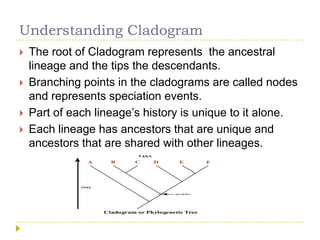
 The root of Cladogram represents the ancestral
lineage and the tips the descendants.
 Branching points in the cladograms are called nodes
and represents speciation events.
 Part of each lineage’s history is unique to it alone.
 Each lineage has ancestors that are unique and
ancestors that are shared with other lineages.
A B C D E F
TIME
speciation
Cladogram or Phylogenetic Tree
TAXA
Understanding Cladograms
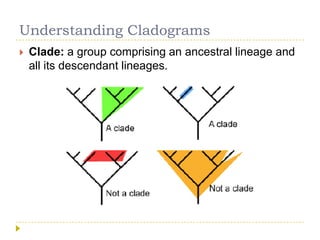
 Clade: a group comprising an ancestral lineage and
all its descendant lineages.
Characters
 Inheritable feature of an organism.
 Physical characteristics (morphology)
 Genetic sequences
 Behavioral traits
Characters
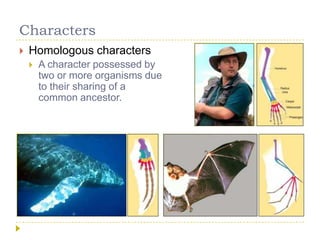
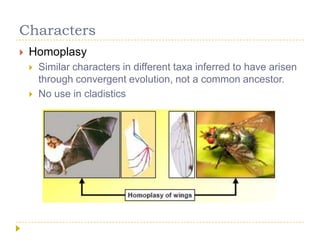
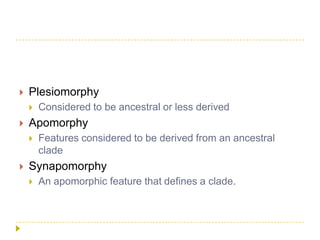
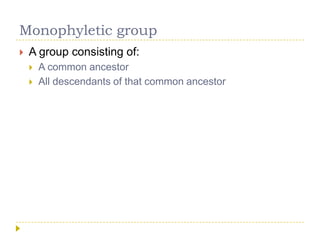
 Homologous characters
 A character possessed by
two or more organisms due
to their sharing of a
common ancestor.
Characters
 Homoplasy
 Similar characters in different taxa inferred to have arisen
through convergent evolution, not a common ancestor.
 No use in cladistics
euphorb
spines
cactus
spines
 Plesiomorphy
 Considered to be ancestral or less derived
 Apomorphy
 Features considered to be derived from an ancestral
clade
 Synapomorphy
 An apomorphic feature that defines a clade.
Monophyletic group
 A group consisting of:
 A common ancestor
 All descendants of that common ancestor
Paraphyletic group
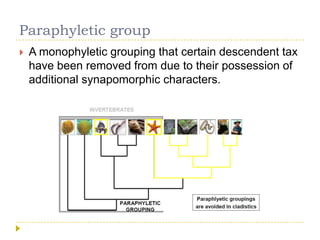
 A monophyletic grouping that certain descendent tax
have been removed from due to their possession of
additional synapomorphic characters.
Constructing a Cladogram
 Outgroup Method
 Works by identifying tow groups of taxa
 Ingroup: group being studies
 Outgroup: for the establishment of plesomorphic and
apomorphic character states in the ingroup
 The outgroup should comprise taxa closely related to the
ingroup so homologous characters can be established
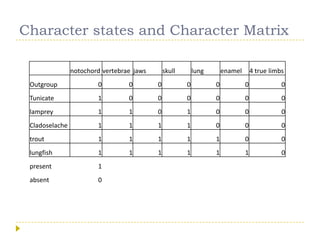
Character states and Character Matrix
notochord vertebrae jaws skull lung enamel 4 true limbs
Outgroup 0 0 0 0 0 0 0
Tunicate 1 0 0 0 0 0 0
lamprey 1 1 0 1 0 0 0
Cladoselache 1 1 1 1 0 0 0
trout 1 1 1 1 1 0 0
lungfish 1 1 1 1 1 1 0
present 1
absent 0
Evolutionary biology

Evolutionary biology

  • 1.
  • 2.
    History  Taxonomists havesought to construct a system that would reflect evolutionary relationships.  Use morphology to recognize and construct species
  • 3.
    History  Grande (2004) Proposes that we view morphology and morphological variations in three ways  Taxonomic  Ontogenic  Individual  Ability to interbreed  Biological species concept  Evolutionary species concept
  • 4.
    Species Concept  MorphologicalSpecies  Generally used morphological criteria because this is how most individuals have been compared.  Biological Species  Sexually interbreeding or potentially interbreeding group of individuals normally separated from other species by the absence of genetic exchange.  Evolutionary Species  species as an evolutionary entity.
  • 5.
    Phylogeny  Species evolvefrom existing species.  Classification of species  Homology  2 species bearing the same phenotype caused by common ancestry for the same genotype.  Parallelism  2 species with the same phenotype descended from a common ancestor w/ different phenotype and genotype  Convergence  2 species with the same phenotype whose common ancestor is very far in the distant past.
  • 6.
    What is Cladistics? Method of hypothesizing evolutionary relationships among organisms.  Based upon the analysis of traits shared by organisms.  Cladogram: represents evolutionary relationships.  Willi Hennig  1950  German zoologist
  • 8.
    Assumptions of Cladistics The Characteristics of organisms change over time.  All organisms are related by a descent from a common ancestor  There is a bifurcating or branching pattern of lineage and splitting.
  • 9.
    The Principle ofParsimony  The principle of parsimony reasons that given several solutions to a problem, the simplest one should be accepted.  The principle of parsimony does not:  Provide absolute truth  Necessarily reveal the true phylogeny  The principle of parsimony does:  Reduce conjecture  Indicates those cladistic groupings best supported by the available data
  • 10.
    Understanding Cladogram  Theroot of Cladogram represents the ancestral lineage and the tips the descendants.  Branching points in the cladograms are called nodes and represents speciation events.  Part of each lineage’s history is unique to it alone.  Each lineage has ancestors that are unique and ancestors that are shared with other lineages. A B C D E F TIME speciation Cladogram or Phylogenetic Tree TAXA
  • 11.
    Understanding Cladograms  Clade:a group comprising an ancestral lineage and all its descendant lineages.
  • 12.
    Characters  Inheritable featureof an organism.  Physical characteristics (morphology)  Genetic sequences  Behavioral traits
  • 13.
    Characters  Homologous characters A character possessed by two or more organisms due to their sharing of a common ancestor.
  • 14.
    Characters  Homoplasy  Similarcharacters in different taxa inferred to have arisen through convergent evolution, not a common ancestor.  No use in cladistics
  • 16.
  • 17.
     Plesiomorphy  Consideredto be ancestral or less derived  Apomorphy  Features considered to be derived from an ancestral clade  Synapomorphy  An apomorphic feature that defines a clade.
  • 18.
    Monophyletic group  Agroup consisting of:  A common ancestor  All descendants of that common ancestor
  • 24.
    Paraphyletic group  Amonophyletic grouping that certain descendent tax have been removed from due to their possession of additional synapomorphic characters.
  • 25.
    Constructing a Cladogram Outgroup Method  Works by identifying tow groups of taxa  Ingroup: group being studies  Outgroup: for the establishment of plesomorphic and apomorphic character states in the ingroup  The outgroup should comprise taxa closely related to the ingroup so homologous characters can be established
  • 26.
    Character states andCharacter Matrix notochord vertebrae jaws skull lung enamel 4 true limbs Outgroup 0 0 0 0 0 0 0 Tunicate 1 0 0 0 0 0 0 lamprey 1 1 0 1 0 0 0 Cladoselache 1 1 1 1 0 0 0 trout 1 1 1 1 1 0 0 lungfish 1 1 1 1 1 1 0 present 1 absent 0