CLADISTICS
TERMINOLOGY
• A clade (monophyletic
group or natural group ) is a
group of organisms that
are monophyletic – that is,
composed of a common ancestor
and all its lineal descendants
on a phylogenetic tree.
• Cladogenesis – Cladogenesis is
an evolutionary splitting of a
parent species into two distinct
species, forming a clade.
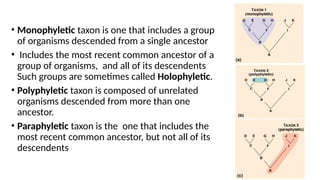
• Monophyletic taxon is one that includes a group
of organisms descended from a single ancestor
• Includes the most recent common ancestor of a
group of organisms, and all of its descendents
Such groups are sometimes called Holophyletic.
• Polyphyletic taxon is composed of unrelated
organisms descended from more than one
ancestor.
• Paraphyletic taxon is the one that includes the
most recent common ancestor, but not all of its
descendents
• Plesiomorphy (“close form”) or ancestral
state is a character state that a taxon has
retained from its ancestors.
• Symplesiomorphy (from syn-, “together”)
When two or more taxa that are not nested
within each other share a plesiomorphy, it is
a symplesiomorphy.
• Apomorphy (or derived trait) is a novel
character or character state that has evolved
from its ancestral form (or plesiomorphy).
Synapomorphy is an apomorphy shared
by two or more taxa and is therefore
hypothesized to have evolved in their most
recent common ancestor
A Homology is a character shared
between species that was also present in
their common ancestor.
• Homoplasy, which is a convergent
character shared between species but
not present in their common ancestor.
INTRODUCTION
• ‘Klados ‘(Ancient Greek) – “Branch “.
• Cladistics is the classification of organisms based on their
phylogenetic (evolutionary) relationship and the recency or
antiquity of common ancestor, rather than on their observable
similarities.
• The cladistic or phylogenic classification is based on phylogeny of
the involved organisms and depends on the phylogenetic
branching.
• According to it organisms are placed in to taxonomic groups
called Clades.
• Based on the possession of Synapomorphic characters.
• So organisms are classified based on the historical order of
their evolutionary descent.
• It does not consider the phenotypic differences between the
descendants of a common ancestor.
• Cladistic taxonomy upholds the monophyletic origin of
different groups from a common ancestor through
Cladogenesis.
HISTORY
• The original methods used in cladistic analysis
and the school of taxonomy derived from the
work of the German entomologist Willi Hennig,
who referred to it as phylogenetic systematics
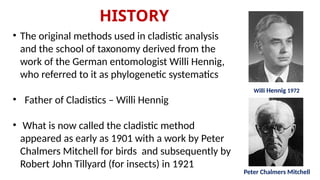
• Father of Cladistics – Willi Hennig
• What is now called the cladistic method
appeared as early as 1901 with a work by Peter
Chalmers Mitchell for birds and subsequently by
Robert John Tillyard (for insects) in 1921
Willi Hennig 1972
Peter Chalmers Mitchell
• The term “clade” was introduced in 1958 by Julian
Huxley.
• Cladistic analysis by Willi Henning is to determine
which character states are primitive and which are
derived based on common ancestry. Robert John Tillyard
CLADOGRAM
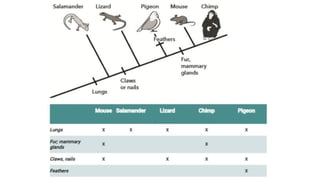
• A cladogram (from Greek clados “branch” and gramma “character”) is
a diagram used in cladistics to show relations among organisms.
• A cladogram is not, however, an evolutionary tree because it does not
show how ancestors are related to descendants, nor does it show
how much they have changed.
• A cladogram uses lines that branch off in different directions ending at
a clade, a group of organisms with a last common ancestor.
• There are many shapes of cladograms but they all have lines that
branch off from other lines. The lines can be traced back to where
they branch off.
These branching off points represent a hypothetical ancestor (not an
actual entity) which can be inferred to exhibit the traits shared among
the terminal taxa above it.
• This hypothetical ancestor might then provide clues about the order
of evolution of various features, adaptation, and other evolutionary
narratives about ancestors.
• Although traditionally such cladograms were generated largely on
the basis of morphological characters, DNA and RNA sequencing data
and computational phylogenetics are now very commonly used in
the generation of cladograms, either on their own or in combination
with morphology.
PARTS OF A CLADOGRAM
1. ROOT
The root is a common initial ancestor and is marked as the starting
point for the diagram. An incoming line represents that the root
comes from larger clades.
2. NODES
A node is a region that marks the point of divergence in cladograms
and represents the hypothetical ancestor that further divides to
bifurcate into two or more daughter taxa.
3. CLADES
A clade is a specific part of the cladogram that includes the recent
ancestor and its descendants. It can be indicated by marking out a
particular node and all of its associated branches.
4. BRANCHES
The branches indicate the bifurcation of the root into nodes. Links
between the organisms can be deduced via tracing out the branches.
5. TAXON/OUTGROUP
The taxon or the outgroup is the most distantly related organism in
the entire chart. This group doesn’t usually form a clade and instead
offers a point of comparison for the rest of the cladogram.
CLADISTIC CLASSIFICATION
• In the evolution of a taxon, a sequence of kinds can be seen at
different periods of time and this sequence of kinds is called a
‘Lineage’
• If we start from the recent taxon and trace it back through its
lineage we can see its history and this is known as Phylogeny.
• cladistic or phylogenic classification is based on phylogeny of
the involved organisms and depends on the phylogenetic
branching.
• Henning (1950) based his classification on genealogy (= history of
the descent of taxa).
• Mayr and Ashlock (1991) stated that “A cladistic classification
consists of a nested hierarchy of increasingly more inclusive
holophyletic taxa; this hierarchy corresponds to a hierarchy of
increasingly more inclusive synapomorphies.”
• In this type of classification the phylogeny is reconstructed
(cladistic analysis) by analyzing the synapomorphic characters.
• The sequence of branching events in the evolutionary history of
the group is determined and based on this, a cladogram is
constructed.
• The cladists who follow Hennigs believe that branching results
when speciation takes place and only two new phyletic groups
originate.
• Each of these groups can be recognized by its synapomorphic
characters.
• Each species ceases to exist when it splits into two daughter
species.
• The species form the base point of a cladistic analysis and each
holophyletic taxon (holophyletic means pertaining to a group that
consists of all the decendants of its most recent common ancestor)
is derived from a particular stem species (Mayr and Ashlock, 1991).
• Each character of a taxon must be evaluated to see whether it is
apormorphic (derived) or plesiomorphic (primitive).
• Since the plesiomorphic characters do not help in locating
branching points in a cladogram, they are usually ignored in
cladistic analysis.
• A character can be considered as apomorphic when it is found only
in a particular taxon.
Reference
• An Introduction to TAXONOMY - T. C. NARENDRAN.
• Basics of Cladistic Analysis - Diana Lipscomb George Washington
University
• PRINCIPLES AND METHODS OF PHYLOGENETIC SYSTEMATICS: The
University of Kansas - Museum of Natural History
• https://www.newworldencyclopedia.org/entry/Cladistics
• https://www.edrawsoft.com/article/what-is-cladogram.html
• https://en.m.wikipedia.org/wiki/Cladistics
THANKYOU

cladistics.pptx/////////////////////////////////////

  • 1.
  • 2.
    TERMINOLOGY • A clade(monophyletic group or natural group ) is a group of organisms that are monophyletic – that is, composed of a common ancestor and all its lineal descendants on a phylogenetic tree. • Cladogenesis – Cladogenesis is an evolutionary splitting of a parent species into two distinct species, forming a clade.
  • 3.
    • Monophyletic taxonis one that includes a group of organisms descended from a single ancestor • Includes the most recent common ancestor of a group of organisms, and all of its descendents Such groups are sometimes called Holophyletic. • Polyphyletic taxon is composed of unrelated organisms descended from more than one ancestor. • Paraphyletic taxon is the one that includes the most recent common ancestor, but not all of its descendents
  • 4.
    • Plesiomorphy (“closeform”) or ancestral state is a character state that a taxon has retained from its ancestors. • Symplesiomorphy (from syn-, “together”) When two or more taxa that are not nested within each other share a plesiomorphy, it is a symplesiomorphy. • Apomorphy (or derived trait) is a novel character or character state that has evolved from its ancestral form (or plesiomorphy).
  • 5.
    Synapomorphy is anapomorphy shared by two or more taxa and is therefore hypothesized to have evolved in their most recent common ancestor A Homology is a character shared between species that was also present in their common ancestor. • Homoplasy, which is a convergent character shared between species but not present in their common ancestor.
  • 6.
    INTRODUCTION • ‘Klados ‘(AncientGreek) – “Branch “. • Cladistics is the classification of organisms based on their phylogenetic (evolutionary) relationship and the recency or antiquity of common ancestor, rather than on their observable similarities. • The cladistic or phylogenic classification is based on phylogeny of the involved organisms and depends on the phylogenetic branching.
  • 7.
    • According toit organisms are placed in to taxonomic groups called Clades. • Based on the possession of Synapomorphic characters. • So organisms are classified based on the historical order of their evolutionary descent. • It does not consider the phenotypic differences between the descendants of a common ancestor. • Cladistic taxonomy upholds the monophyletic origin of different groups from a common ancestor through Cladogenesis.
  • 8.
    HISTORY • The originalmethods used in cladistic analysis and the school of taxonomy derived from the work of the German entomologist Willi Hennig, who referred to it as phylogenetic systematics • Father of Cladistics – Willi Hennig • What is now called the cladistic method appeared as early as 1901 with a work by Peter Chalmers Mitchell for birds and subsequently by Robert John Tillyard (for insects) in 1921 Willi Hennig 1972 Peter Chalmers Mitchell
  • 9.
    • The term“clade” was introduced in 1958 by Julian Huxley. • Cladistic analysis by Willi Henning is to determine which character states are primitive and which are derived based on common ancestry. Robert John Tillyard
  • 10.
    CLADOGRAM • A cladogram(from Greek clados “branch” and gramma “character”) is a diagram used in cladistics to show relations among organisms. • A cladogram is not, however, an evolutionary tree because it does not show how ancestors are related to descendants, nor does it show how much they have changed. • A cladogram uses lines that branch off in different directions ending at a clade, a group of organisms with a last common ancestor. • There are many shapes of cladograms but they all have lines that branch off from other lines. The lines can be traced back to where they branch off.
  • 11.
    These branching offpoints represent a hypothetical ancestor (not an actual entity) which can be inferred to exhibit the traits shared among the terminal taxa above it. • This hypothetical ancestor might then provide clues about the order of evolution of various features, adaptation, and other evolutionary narratives about ancestors. • Although traditionally such cladograms were generated largely on the basis of morphological characters, DNA and RNA sequencing data and computational phylogenetics are now very commonly used in the generation of cladograms, either on their own or in combination with morphology.
  • 12.
    PARTS OF ACLADOGRAM 1. ROOT The root is a common initial ancestor and is marked as the starting point for the diagram. An incoming line represents that the root comes from larger clades. 2. NODES A node is a region that marks the point of divergence in cladograms and represents the hypothetical ancestor that further divides to bifurcate into two or more daughter taxa. 3. CLADES A clade is a specific part of the cladogram that includes the recent ancestor and its descendants. It can be indicated by marking out a particular node and all of its associated branches.
  • 13.
    4. BRANCHES The branchesindicate the bifurcation of the root into nodes. Links between the organisms can be deduced via tracing out the branches. 5. TAXON/OUTGROUP The taxon or the outgroup is the most distantly related organism in the entire chart. This group doesn’t usually form a clade and instead offers a point of comparison for the rest of the cladogram.
  • 17.
    CLADISTIC CLASSIFICATION • Inthe evolution of a taxon, a sequence of kinds can be seen at different periods of time and this sequence of kinds is called a ‘Lineage’ • If we start from the recent taxon and trace it back through its lineage we can see its history and this is known as Phylogeny. • cladistic or phylogenic classification is based on phylogeny of the involved organisms and depends on the phylogenetic branching.
  • 18.
    • Henning (1950)based his classification on genealogy (= history of the descent of taxa). • Mayr and Ashlock (1991) stated that “A cladistic classification consists of a nested hierarchy of increasingly more inclusive holophyletic taxa; this hierarchy corresponds to a hierarchy of increasingly more inclusive synapomorphies.” • In this type of classification the phylogeny is reconstructed (cladistic analysis) by analyzing the synapomorphic characters. • The sequence of branching events in the evolutionary history of the group is determined and based on this, a cladogram is constructed.
  • 19.
    • The cladistswho follow Hennigs believe that branching results when speciation takes place and only two new phyletic groups originate. • Each of these groups can be recognized by its synapomorphic characters. • Each species ceases to exist when it splits into two daughter species. • The species form the base point of a cladistic analysis and each holophyletic taxon (holophyletic means pertaining to a group that consists of all the decendants of its most recent common ancestor) is derived from a particular stem species (Mayr and Ashlock, 1991).
  • 20.
    • Each characterof a taxon must be evaluated to see whether it is apormorphic (derived) or plesiomorphic (primitive). • Since the plesiomorphic characters do not help in locating branching points in a cladogram, they are usually ignored in cladistic analysis. • A character can be considered as apomorphic when it is found only in a particular taxon.
  • 21.
    Reference • An Introductionto TAXONOMY - T. C. NARENDRAN. • Basics of Cladistic Analysis - Diana Lipscomb George Washington University • PRINCIPLES AND METHODS OF PHYLOGENETIC SYSTEMATICS: The University of Kansas - Museum of Natural History • https://www.newworldencyclopedia.org/entry/Cladistics • https://www.edrawsoft.com/article/what-is-cladogram.html • https://en.m.wikipedia.org/wiki/Cladistics
  • 22.