Frameworks for
Collaboration
CR4YR August 27th, 2013
Vancouver Hilton Hotel
Faye Brownlie and Randy Cranston
Adapted for Surrey Primary Teachers
November 8th, 2013
Slideshare.net/fayebrownlie/surreycollaboration
Learning Intentions
  I have a better understanding of collaboration and coteaching.

  I have a plan of how to increase the effectiveness of my
collaboration and my co-teaching.

  I have applied Allington and Gabriel’s model of ‘what
works’ in reading for ALL students to my students

  I can create a class review and use it to plan for
instruction.
“Every Child, Every Day” – Richard Allington and
Rachael Gabriel
In Educational Leadership, March 2012

6 elements of instruction for ALL students!
1.  Every child reads something he or she chooses.
2.  Every child reads accurately.
3.  Every child reads something he or she
understands.

4.  Every child writes about something personally
meaningful.

5.  Every child talks with peers about reading and
writing.

6.  Every child listens to a fluent adult read aloud.
1. Every child reads something he or she chooses.
2.  Every child reads accurately.

-intensity and volume count!
-98% accuracy
-less than 90% accuracy, doesn’t improve reading at
all
98% on grade level at year end:
Mathes, et al (2004); Vellutino, et al
(1996); Phillips, et al (1998)
  Every successful intervention study used either 1-1
expert tutoring or 1-3 very small group expert
reading instruction.

  None of the studies used a scripted reading
program.

  All had students engaged in reading 2/3 of the
lesson.
3.  Every child reads something he or she
understands.

-at least 2/3 of time spent reading and
rereading NOT doing isolated skill practice or
worksheets
-build background knowledge before entering
the text
-read with questions in mind
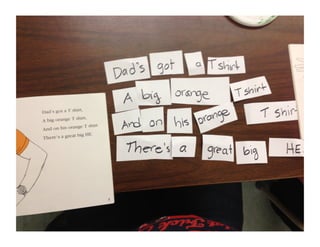
Shared Reading Lesson
Picture Book Strategy Lesson
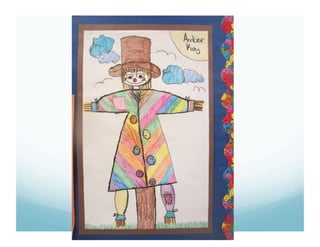
Gr 3
Joni Cunningham, Richmond
  Building vocabulary from pictures
  Establishing fiction/non-fiction
  Predicting
  Directed drawing
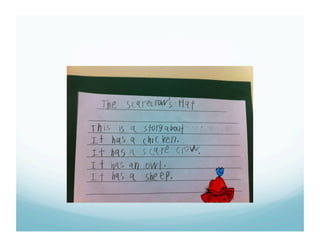
  Writing to retell and connect
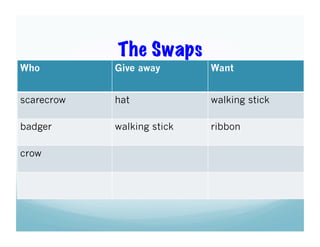
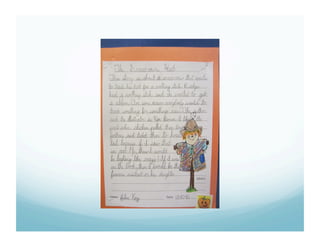
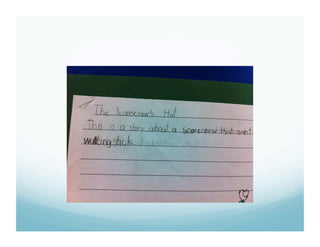
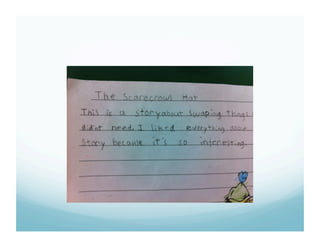
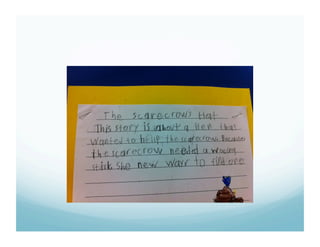
The Swaps
Who

Give away

Want

scarecrow

hat

walking stick

badger

walking stick

ribbon

crow
4.  Every child writes about something personally
meaningful.

-connected to text
-connected to themselves
-real purpose, real audience
youngreaders.ca
  http://www.youtube.com/watch?v=TTrPauOO4zA

  Opal School
  Portland, Oregon

  Founded on Reggio principles
  UDL, a school for inclusion of all students
5. Every child talks with peers about reading and
writing.
6.  Every child listens to a fluent adult read aloud.
-different kinds of text
-with some commentary
CR4YR

  One of the parameters of this project is

collaboration: a focus on support (LA/resource,
teacher-librarian, Aboriginal Support) teachers
working in the classroom, with the teacher.
Why Collaboration/Co-teaching?
  Based on the belief that collaborative planning,

teaching and assessing better addresses the diverse
needs of students by creating ongoing effective
programming in the classroom

  It allows more students to be reached

Learning in Safe Schools, page 102 Chapter 9
  Based on the belief that collaborative planning,

teaching and assessing better addresses the diverse
needs of students by creating ongoing effective
programming in the classroom

  It allows more students to be reached
  It focuses on the ongoing context for learning for the

students, not just the specific remediation of skills
removed from the learning context of the classroom

  It builds a repertoire of strategies for teachers to
support the range of students in classes

page 102 Chapter 9

Learning in Safe Schools,
Why Collaboration/Co-teaching?
  Based on the belief that collaborative planning, teaching

and assessing better addresses the diverse needs of
students by creating ongoing effective programming in the
classroom

  It allows more students to be reached
  It focuses on the ongoing context for learning for the

students, not just the specific remediation of skills
removed from the learning context of the classroom

  It builds a repertoire of strategies for teachers to support
the range of students in classes

  Imperative students with the highest needs have the most
consistent program

Learning in Safe Schools, page 102 Chapter 9
Rationale:

 By sharing our collective

knowledge about the whole class
and developing a plan of action
based on this, we can better meet
the needs of all students.
Goal:

  to support students to be successful

learners in the classroom environment
A Key Belief

  When intervention is focused on classroom

support it improves each student’s ability and
opportunity to learn effectively/successfully in the
classroom.
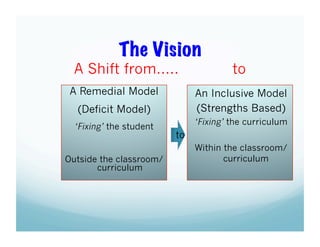
The Vision

A Shift from…..
A Remedial Model

An Inclusive Model
(Strengths Based)

(Deficit Model)
‘Fixing’ the student

Outside the classroom/
curriculum

to

‘Fixing’ the curriculum

to
Within the classroom/
curriculum
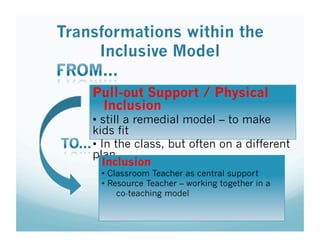
Transformations within the
Inclusive Model
Pull-out Support / Physical
Inclusion

• still a remedial model – to make
kids fit
• In the class, but often on a different
plan
Inclusion
• Classroom Teacher as central support
• Resource Teacher – working together in a
co-teaching model
No plan, No point
Co-teachers:
When two teachers are in the room, they can…
  Work from a plan based on students’ strengths and needs
  Differentiate instruction
  Use AFL strategies to assess understanding
  Increase participation of all students
  Decrease behavioral challenges
  Focus attention
  Increase student independence
  Teach self-regulation
  Model positive, strengths-based language
  Talk to each other about what they are learning about their students
Questions to Guide Co-Teaching
  Are all students actively engaged in meaningful
work?

  Are all students participating by answering and
asking questions?

  Are all students receiving individual feedback
during the learning sequence?

  How is evidence of learning from each day’s coteaching fueling the plan for the next day?
A Co-teaching Question:
Is this the best approach to maximize student
learning:
• at this time
• for this task
• for this student?
Co-Teaching Models
(Teaching in Tandem – Effective Co-Teaching in the Inclusive
Classroom – Wilson & Blednick, 2011, ASCD)

  1 teach, 1 support
  Parallel groups
  Station teaching
  1 large group; 1 small group
  Teaming
1 Teach, 1 Support
  most frequently done, least planning
  Advantage: focus, 1:1 feedback, if alternate roles,

no one has the advantage or looks like the ‘real’
teacher, can capitalize one 1’s strengths and build
professional capacity

  Possible pitfall: easiest to go off the rails and

have one teacher feel as an ‘extra pair of hands’,
no specific task (buzzing radiator)
1 Teach, 1 Support: Examples
  demonstrating a new strategy so BOTH teachers
can use it the next day – e.g., think aloud,
questioning from pictures, listen-sketch-draft

  Students independently working on a task, one

teacher working with a small group on this task,
other teacher supporting children working
independently
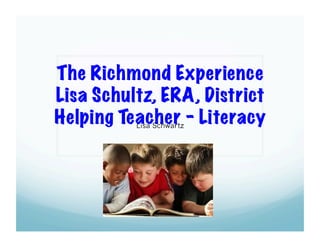
The Richmond Experience
Lisa Schultz, ERA, District
Helping Teacher - Literacy
Lisa Schwartz
First Steps
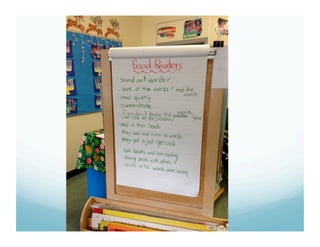
  Collecting baseline data (formative
assessment using EPRA)

  What do they know? What are their
strengths?

  What areas need further development?
  How will we support this development?
  Looked at the results as coded on the performance
standard

  Developed an inquiry question
  Made a plan
  Spent a term in each classroom. Two blocks each
week.
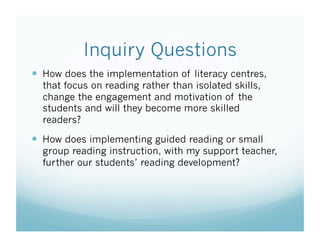
Inquiry Questions
  How does the implementation of literacy centres,
that focus on reading rather than isolated skills,
change the engagement and motivation of the
students and will they become more skilled
readers?

  How does implementing guided reading or small

group reading instruction, with my support teacher,
further our students’ reading development?
Parallel Groups
  both teachers take about half the class and teach
the same thing.

  Advantage: half class size - more personal
contact, more individual attention

  Possible pitfalls: more time to co-plan, requires
trust in each other, each must know the content
and the strategies.
Parallel Groups: Examples
  word work. At Woodward Elem, the primary worked together
3 X/week, with each teacher, the principal and the RT each
taking a group for word work. Some schools have used this
with math activities.

  Focus teaching from class assessment. Westwood

Elementary: Came about as a result of an action research
question: How do we better meet the needs of our students?:
  primary team used Standard Reading Assessment, highlight
on short form of Performance Standards, Resource, ESL,
principal involved, cross-graded groups 2X a week, for 6 to 8
weeks driven by information from the performance standards
(Text features, Oral Comprehension, Risk taking, Critical
thinking with words, Getting the big picture,… , repeat
process
  NOT paper and pencil practice groups…teaching/thinking
groups
Station Teaching
  mostly small groups
  can be heterogeneous stations or more homogeneous
reading groups

  each teacher has 2 groups, 1 working independently at
a station or writing, 1 working directly with the teacher.

  Advantage: more individual attention and personal
feedback, increased focus on self regulation

  Possible pitfall: self regulation (needs to be taught),
time to plan for meaningful engagement.
Station Teaching: Examples
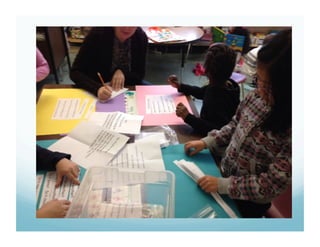
  Guided reading: 4 groups; RT has two and CT has
two

  math groups – Michelle’s patterning (1 direct

teaching, 2 guided practice, 1 guided practice with
observation)

  science stations: CT and RT each created two

stations; co-planning what they would look like to
ensure differentiation, teachers moved back and
forth between groups supporting self-monitoring,
independence on task
1 large group, 1 small group
  Advantage: either teacher can work with either
group, can provide tutorial, intensive, individual

  Possible pitfall: don’t want same kids always in
the ‘get help’ group
1 large group, 1 small group:
Examples
  Writing: 1 teacher works with whole class prewriting

and drafting, small groups of 3-4 students meet with 1
teacher to conference

  Reading: everyone’s reading. large group: teacher

moving from student to student listening to short oral
reads. Small group: 2 to 3 students being supported to
use specific reading strategies or
  small group is working on a Reader’s Theatre

  Math: large group using manipulatives to represent
shapes, small groups, rotating with other teacher,
using iPads to take pictures of shapes in the
environment
Teaming
  most seamless.
  co-planned
  teachers take alternate roles and lead-taking as the lesson
proceeds

  Most often in whole class instruction and could be followed
up with any of the other four co-teaching models

  Advantages: capitalizes on both teachers’ strengths, models
collaboration teaching/learning to students, can adjust
instruction readily based on student need, flexible

  Possible pitfalls: trust and skill
Teaming: Examples
  Brainstorm-categorize lesson – 1 teacher begins, other

teacher notices aspects the first teacher has missed or
sees confusion in children, adds in and assumes lead
role.

  Modeling reading strategies: two teachers model and

talk about the strategies they use to read, noting things
they do differently.

  Graphic organizer: Teachers model how to use a

semantic map as a post reading vocabulary building
activity, teacher most knowledgeable about semantic
mapping creates it as other teacher debriefs with
students; both flow back and forth
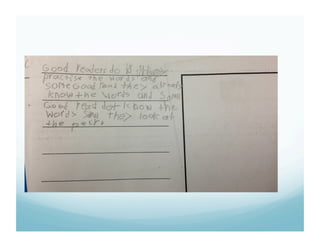
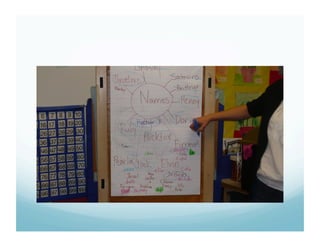
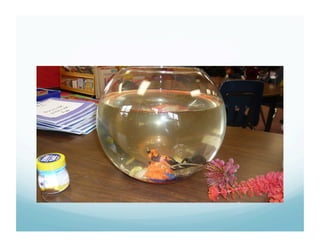
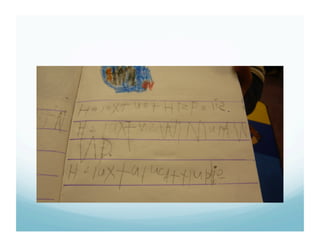
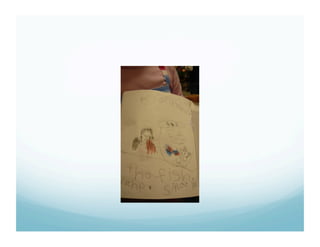
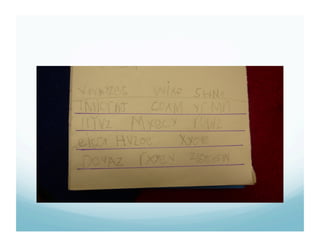
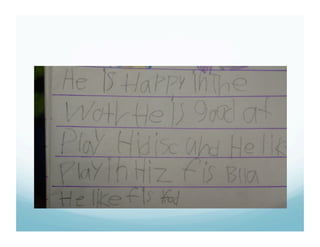
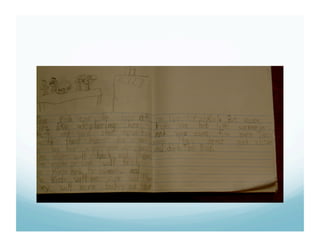
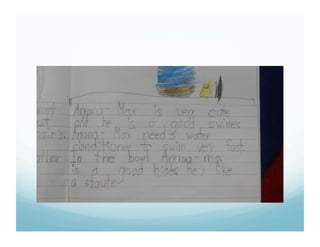
K/Grade 1 Writing
Commons & Jakovac
Samples from June 7th, 2012
  Trust your professional expertise
  Collaborate: 2 heads are better than 1
  Follow the lead of your children –their interests,
their needs

  NO program exists that can replace YOU!!!

Surrey collaboration primary

  • 1.
    Frameworks for Collaboration CR4YR August27th, 2013 Vancouver Hilton Hotel Faye Brownlie and Randy Cranston Adapted for Surrey Primary Teachers November 8th, 2013 Slideshare.net/fayebrownlie/surreycollaboration
  • 2.
    Learning Intentions   Ihave a better understanding of collaboration and coteaching.   I have a plan of how to increase the effectiveness of my collaboration and my co-teaching.   I have applied Allington and Gabriel’s model of ‘what works’ in reading for ALL students to my students   I can create a class review and use it to plan for instruction.
  • 3.
    “Every Child, EveryDay” – Richard Allington and Rachael Gabriel In Educational Leadership, March 2012 6 elements of instruction for ALL students!
  • 4.
    1.  Every childreads something he or she chooses. 2.  Every child reads accurately. 3.  Every child reads something he or she understands. 4.  Every child writes about something personally meaningful. 5.  Every child talks with peers about reading and writing. 6.  Every child listens to a fluent adult read aloud.
  • 5.
    1. Every childreads something he or she chooses.
  • 6.
    2.  Every childreads accurately. -intensity and volume count! -98% accuracy -less than 90% accuracy, doesn’t improve reading at all
  • 7.
    98% on gradelevel at year end: Mathes, et al (2004); Vellutino, et al (1996); Phillips, et al (1998)   Every successful intervention study used either 1-1 expert tutoring or 1-3 very small group expert reading instruction.   None of the studies used a scripted reading program.   All had students engaged in reading 2/3 of the lesson.
  • 8.
    3.  Every childreads something he or she understands. -at least 2/3 of time spent reading and rereading NOT doing isolated skill practice or worksheets -build background knowledge before entering the text -read with questions in mind
  • 9.
    Shared Reading Lesson PictureBook Strategy Lesson
  • 10.
    Gr 3 Joni Cunningham,Richmond   Building vocabulary from pictures   Establishing fiction/non-fiction   Predicting   Directed drawing   Writing to retell and connect
  • 17.
    The Swaps Who Give away Want scarecrow hat walkingstick badger walking stick ribbon crow
  • 24.
    4.  Every childwrites about something personally meaningful. -connected to text -connected to themselves -real purpose, real audience
  • 25.
    youngreaders.ca   http://www.youtube.com/watch?v=TTrPauOO4zA   OpalSchool   Portland, Oregon   Founded on Reggio principles   UDL, a school for inclusion of all students
  • 26.
    5. Every childtalks with peers about reading and writing.
  • 27.
    6.  Every childlistens to a fluent adult read aloud. -different kinds of text -with some commentary
  • 28.
    CR4YR   One ofthe parameters of this project is collaboration: a focus on support (LA/resource, teacher-librarian, Aboriginal Support) teachers working in the classroom, with the teacher.
  • 29.
    Why Collaboration/Co-teaching?   Basedon the belief that collaborative planning, teaching and assessing better addresses the diverse needs of students by creating ongoing effective programming in the classroom   It allows more students to be reached Learning in Safe Schools, page 102 Chapter 9
  • 30.
      Based onthe belief that collaborative planning, teaching and assessing better addresses the diverse needs of students by creating ongoing effective programming in the classroom   It allows more students to be reached   It focuses on the ongoing context for learning for the students, not just the specific remediation of skills removed from the learning context of the classroom   It builds a repertoire of strategies for teachers to support the range of students in classes page 102 Chapter 9 Learning in Safe Schools,
  • 31.
    Why Collaboration/Co-teaching?   Basedon the belief that collaborative planning, teaching and assessing better addresses the diverse needs of students by creating ongoing effective programming in the classroom   It allows more students to be reached   It focuses on the ongoing context for learning for the students, not just the specific remediation of skills removed from the learning context of the classroom   It builds a repertoire of strategies for teachers to support the range of students in classes   Imperative students with the highest needs have the most consistent program Learning in Safe Schools, page 102 Chapter 9
  • 32.
    Rationale:  By sharing ourcollective knowledge about the whole class and developing a plan of action based on this, we can better meet the needs of all students.
  • 33.
    Goal:   to supportstudents to be successful learners in the classroom environment
  • 34.
    A Key Belief  When intervention is focused on classroom support it improves each student’s ability and opportunity to learn effectively/successfully in the classroom.
  • 35.
    The Vision A Shiftfrom….. A Remedial Model An Inclusive Model (Strengths Based) (Deficit Model) ‘Fixing’ the student Outside the classroom/ curriculum to ‘Fixing’ the curriculum to Within the classroom/ curriculum
  • 36.
    Transformations within the InclusiveModel Pull-out Support / Physical Inclusion • still a remedial model – to make kids fit • In the class, but often on a different plan Inclusion • Classroom Teacher as central support • Resource Teacher – working together in a co-teaching model
  • 37.
  • 38.
    Co-teachers: When two teachersare in the room, they can…   Work from a plan based on students’ strengths and needs   Differentiate instruction   Use AFL strategies to assess understanding   Increase participation of all students   Decrease behavioral challenges   Focus attention   Increase student independence   Teach self-regulation   Model positive, strengths-based language   Talk to each other about what they are learning about their students
  • 39.
    Questions to GuideCo-Teaching   Are all students actively engaged in meaningful work?   Are all students participating by answering and asking questions?   Are all students receiving individual feedback during the learning sequence?   How is evidence of learning from each day’s coteaching fueling the plan for the next day?
  • 40.
    A Co-teaching Question: Isthis the best approach to maximize student learning: • at this time • for this task • for this student?
  • 41.
    Co-Teaching Models (Teaching inTandem – Effective Co-Teaching in the Inclusive Classroom – Wilson & Blednick, 2011, ASCD)   1 teach, 1 support   Parallel groups   Station teaching   1 large group; 1 small group   Teaming
  • 42.
    1 Teach, 1Support   most frequently done, least planning   Advantage: focus, 1:1 feedback, if alternate roles, no one has the advantage or looks like the ‘real’ teacher, can capitalize one 1’s strengths and build professional capacity   Possible pitfall: easiest to go off the rails and have one teacher feel as an ‘extra pair of hands’, no specific task (buzzing radiator)
  • 43.
    1 Teach, 1Support: Examples   demonstrating a new strategy so BOTH teachers can use it the next day – e.g., think aloud, questioning from pictures, listen-sketch-draft   Students independently working on a task, one teacher working with a small group on this task, other teacher supporting children working independently
  • 44.
    The Richmond Experience LisaSchultz, ERA, District Helping Teacher - Literacy Lisa Schwartz
  • 45.
    First Steps   Collectingbaseline data (formative assessment using EPRA)   What do they know? What are their strengths?   What areas need further development?   How will we support this development?
  • 46.
      Looked atthe results as coded on the performance standard   Developed an inquiry question   Made a plan   Spent a term in each classroom. Two blocks each week.
  • 47.
    Inquiry Questions   Howdoes the implementation of literacy centres, that focus on reading rather than isolated skills, change the engagement and motivation of the students and will they become more skilled readers?   How does implementing guided reading or small group reading instruction, with my support teacher, further our students’ reading development?
  • 52.
    Parallel Groups   bothteachers take about half the class and teach the same thing.   Advantage: half class size - more personal contact, more individual attention   Possible pitfalls: more time to co-plan, requires trust in each other, each must know the content and the strategies.
  • 53.
    Parallel Groups: Examples  word work. At Woodward Elem, the primary worked together 3 X/week, with each teacher, the principal and the RT each taking a group for word work. Some schools have used this with math activities.   Focus teaching from class assessment. Westwood Elementary: Came about as a result of an action research question: How do we better meet the needs of our students?:   primary team used Standard Reading Assessment, highlight on short form of Performance Standards, Resource, ESL, principal involved, cross-graded groups 2X a week, for 6 to 8 weeks driven by information from the performance standards (Text features, Oral Comprehension, Risk taking, Critical thinking with words, Getting the big picture,… , repeat process   NOT paper and pencil practice groups…teaching/thinking groups
  • 54.
    Station Teaching   mostlysmall groups   can be heterogeneous stations or more homogeneous reading groups   each teacher has 2 groups, 1 working independently at a station or writing, 1 working directly with the teacher.   Advantage: more individual attention and personal feedback, increased focus on self regulation   Possible pitfall: self regulation (needs to be taught), time to plan for meaningful engagement.
  • 55.
    Station Teaching: Examples  Guided reading: 4 groups; RT has two and CT has two   math groups – Michelle’s patterning (1 direct teaching, 2 guided practice, 1 guided practice with observation)   science stations: CT and RT each created two stations; co-planning what they would look like to ensure differentiation, teachers moved back and forth between groups supporting self-monitoring, independence on task
  • 56.
    1 large group,1 small group   Advantage: either teacher can work with either group, can provide tutorial, intensive, individual   Possible pitfall: don’t want same kids always in the ‘get help’ group
  • 57.
    1 large group,1 small group: Examples   Writing: 1 teacher works with whole class prewriting and drafting, small groups of 3-4 students meet with 1 teacher to conference   Reading: everyone’s reading. large group: teacher moving from student to student listening to short oral reads. Small group: 2 to 3 students being supported to use specific reading strategies or   small group is working on a Reader’s Theatre   Math: large group using manipulatives to represent shapes, small groups, rotating with other teacher, using iPads to take pictures of shapes in the environment
  • 58.
    Teaming   most seamless.  co-planned   teachers take alternate roles and lead-taking as the lesson proceeds   Most often in whole class instruction and could be followed up with any of the other four co-teaching models   Advantages: capitalizes on both teachers’ strengths, models collaboration teaching/learning to students, can adjust instruction readily based on student need, flexible   Possible pitfalls: trust and skill
  • 59.
    Teaming: Examples   Brainstorm-categorizelesson – 1 teacher begins, other teacher notices aspects the first teacher has missed or sees confusion in children, adds in and assumes lead role.   Modeling reading strategies: two teachers model and talk about the strategies they use to read, noting things they do differently.   Graphic organizer: Teachers model how to use a semantic map as a post reading vocabulary building activity, teacher most knowledgeable about semantic mapping creates it as other teacher debriefs with students; both flow back and forth
  • 60.
    K/Grade 1 Writing Commons& Jakovac Samples from June 7th, 2012
  • 70.
      Trust yourprofessional expertise   Collaborate: 2 heads are better than 1   Follow the lead of your children –their interests, their needs   NO program exists that can replace YOU!!!