Literate Environment
Analysis
PRESENTED BY: ALISHA WOOD
WALDEN UNIVERSITY
INSTRUCTOR: DR. MARTHA MOORE
EDUC-6706G-1,THE BEGINNING READER, PREK-3
Why is a literate environment
important?
 A literate environment is important in order to create a classroom of
successful and motivated readers and writers.
 Emergent Literacy is a child’s earliest reading and writing development
before conventional reading and writing** (Tompkins, 2010).
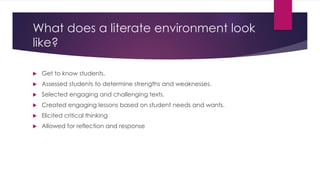
What does a literate environment look
like?
 Get to know students.
 Assessed students to determine strengths and weaknesses.
 Selected engaging and challenging texts.
 Created engaging lessons based on student needs and wants.
 Elicited critical thinking
 Allowed for reflection and response
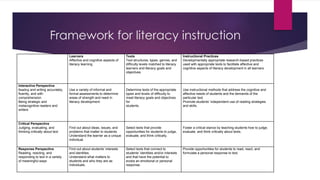
Framework for literacy instruction
Learners
Affective and cognitive aspects of
literacy learning
Texts
Text structures, types, genres, and
difficulty levels matched to literacy
learners and literacy goals and
objectives
Instructional Practices
Developmentally appropriate research-based practices
used with appropriate texts to facilitate affective and
cognitive aspects of literacy development in all learners
Interactive Perspective
Reading and writing accurately,
fluently, and with
comprehension
Being strategic and
metacognitive readers and
writers
Use a variety of informal and
formal assessments to determine
areas of strength and need in
literacy development.
Determine texts of the appropriate
types and levels of difficulty to
meet literacy goals and objectives
for
students.
Use instructional methods that address the cognitive and
affective needs of students and the demands of the
particular text.
Promote students’ independent use of reading strategies
and skills.
Critical Perspective
Judging, evaluating, and
thinking critically about text
Find out about ideas, issues, and
problems that matter to students.
Understand the learner as a unique
individual.
Select texts that provide
opportunities for students to judge,
evaluate, and think critically.
Foster a critical stance by teaching students how to judge,
evaluate, and think critically about texts.
Response Perspective
Reading, reacting, and
responding to text in a variety
of meaningful ways
Find out about students’ interests
and identities.
Understand what matters to
students and who they are as
individuals.
Select texts that connect to
students’ identities and/or interests
and that have the potential to
evoke an emotional or personal
response.
Provide opportunities for students to read, react, and
formulate a personal response to text.
Getting to Know Literacy Learners, P–3
 Any effort to plan lessons and activities for student learning, educators
must have an understanding of each students. Students’ interests and
background knowledge need to be determined as well as cultural and
linguistic backgrounds. Taking the time to learn about students is the first
step in creating a literate environment.
 In order to successfully learn about literacy learners, it is important to
gather data through both cognitive and non-cognitive assessments
 The steps taken to get to know students were:
 in a form of a questionnaire and a non-formal sight word assessment.
 also used were observations as well as conversation with students.
Selecting text, P–3
 Educators of early literacy have an important job, to find and utilize
appropriate and engaging texts for all students, regardless of their abilities.
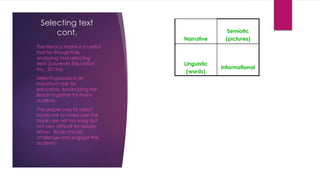
One resource to consider, that will help this job be successful, is the
Literacy Matrix described on the next slide. This resource will help us to
successfully choose appropriate books as well enhance our ability to
critically analyze our texts (Laureate Education, Inc, 2011 a).
Selecting text
cont.
• The literacy matrix is a useful
tool for thoughtfully
analyzing and selecting
texts (Laureate Education
Inc., 2015a).
• Selecting books is an
important task for
educators, books bring the
lesson together for many
students.
• The proper way to select
books are to make sure the
books are not too easy but
not very difficult for reader
either. Books should
challenge and engage the
students.
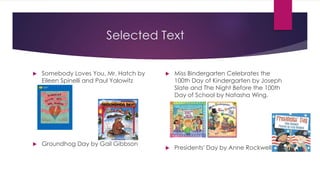
Selected Text
 Somebody Loves You, Mr. Hatch by
Eileen Spinelli and Paul Yalowitz
 Groundhog Day by Gail Gibbson
 Miss Bindergarten Celebrates the
100th Day of Kindergarten by Joseph
Slate and The Night Before the 100th
Day of School by Natasha Wing.
 Presidents' Day by Anne Rockwell
Literacy Lesson: Interactive
Perspective
 The goal of the interactive perspective is to help students become strategic
readers and writers (Laureate Education Inc., 2015d).
 Supporting students independent strategic use of the reading and writing
strategies is the goal.
 What have I taught the students and did they learn the concept or strategy
I taught?
 Activities to reinforce the interactive perspective:
Word Walls
Word Sorts
K-W-L Charts
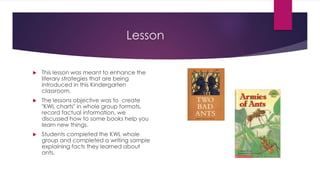
Lesson
 This lesson was meant to enhance the
literary strategies that are being
introduced in this Kindergarten
classroom.
 The lessons objective was to create
"KWL charts" in whole group formats,
record factual information, we
discussed how to some books help you
learn new things.
 Students completed the KWL whole
group and completed a writing sample
explaining facts they learned about
ants.
Feedback and questions
 What new ideas about literate emergent instruction did you gain after
viewing my presentation?
 Did the information presented change or enhance your own literacy
practices and interactions with students? Did your ideas about literacy
remain the same?
 In what ways can I support you in the literacy development of your
students or children? How might you support me in my work with students
or your children?
 Any questions?
Thank you for viewing
References
 Afflerbach, P. (2012). Understanding and using reading assessment, K–12. Newark, DE:
International Reading Association.
 Laureate Education, Inc. (Producer). (2015a). Analyzing and Selecting Text [Webcast]. The
beginning reader, prek-3. Baltimore, MD: Author.
 Laureate Education, Inc. (Executive Producer). (2015b). Changes in Literacy Education.
[Webcast]. The beginning reader, prek-3. Baltimore, MD: Author.
 Laureate Education, Inc. (Executive Producer). (2015c). Critical Perspective. [Webcast]. The
beginning reader, prek-3. Baltimore, MD: Author.
 Laureate Education Inc. (2015d). Getting to know your students. [Webcast]. The beginning
reader, prek-3. Baltimore, MD: Author.
 Tompkins, G. (2010). Literacy for the 21st century: A balanced approach (4th ed.). Upper Saddle
River, NJ: Pearson Education/Merrill/Prentice Hall.
 Walden University Lesson Plan Template [School Website]. (2015). Retrieved from
https://class.waldenu.edu/webapps/blackboard/content/listContent.jsp?course_id=_6530134_1
&content_id=_23104169_1

Fianl presentation

  • 1.
    Literate Environment Analysis PRESENTED BY:ALISHA WOOD WALDEN UNIVERSITY INSTRUCTOR: DR. MARTHA MOORE EDUC-6706G-1,THE BEGINNING READER, PREK-3
  • 2.
    Why is aliterate environment important?  A literate environment is important in order to create a classroom of successful and motivated readers and writers.  Emergent Literacy is a child’s earliest reading and writing development before conventional reading and writing** (Tompkins, 2010).
  • 3.
    What does aliterate environment look like?  Get to know students.  Assessed students to determine strengths and weaknesses.  Selected engaging and challenging texts.  Created engaging lessons based on student needs and wants.  Elicited critical thinking  Allowed for reflection and response
  • 4.
    Framework for literacyinstruction Learners Affective and cognitive aspects of literacy learning Texts Text structures, types, genres, and difficulty levels matched to literacy learners and literacy goals and objectives Instructional Practices Developmentally appropriate research-based practices used with appropriate texts to facilitate affective and cognitive aspects of literacy development in all learners Interactive Perspective Reading and writing accurately, fluently, and with comprehension Being strategic and metacognitive readers and writers Use a variety of informal and formal assessments to determine areas of strength and need in literacy development. Determine texts of the appropriate types and levels of difficulty to meet literacy goals and objectives for students. Use instructional methods that address the cognitive and affective needs of students and the demands of the particular text. Promote students’ independent use of reading strategies and skills. Critical Perspective Judging, evaluating, and thinking critically about text Find out about ideas, issues, and problems that matter to students. Understand the learner as a unique individual. Select texts that provide opportunities for students to judge, evaluate, and think critically. Foster a critical stance by teaching students how to judge, evaluate, and think critically about texts. Response Perspective Reading, reacting, and responding to text in a variety of meaningful ways Find out about students’ interests and identities. Understand what matters to students and who they are as individuals. Select texts that connect to students’ identities and/or interests and that have the potential to evoke an emotional or personal response. Provide opportunities for students to read, react, and formulate a personal response to text.
  • 5.
    Getting to KnowLiteracy Learners, P–3  Any effort to plan lessons and activities for student learning, educators must have an understanding of each students. Students’ interests and background knowledge need to be determined as well as cultural and linguistic backgrounds. Taking the time to learn about students is the first step in creating a literate environment.  In order to successfully learn about literacy learners, it is important to gather data through both cognitive and non-cognitive assessments  The steps taken to get to know students were:  in a form of a questionnaire and a non-formal sight word assessment.  also used were observations as well as conversation with students.
  • 6.
    Selecting text, P–3 Educators of early literacy have an important job, to find and utilize appropriate and engaging texts for all students, regardless of their abilities. One resource to consider, that will help this job be successful, is the Literacy Matrix described on the next slide. This resource will help us to successfully choose appropriate books as well enhance our ability to critically analyze our texts (Laureate Education, Inc, 2011 a).
  • 7.
    Selecting text cont. • Theliteracy matrix is a useful tool for thoughtfully analyzing and selecting texts (Laureate Education Inc., 2015a). • Selecting books is an important task for educators, books bring the lesson together for many students. • The proper way to select books are to make sure the books are not too easy but not very difficult for reader either. Books should challenge and engage the students.
  • 8.
    Selected Text  SomebodyLoves You, Mr. Hatch by Eileen Spinelli and Paul Yalowitz  Groundhog Day by Gail Gibbson  Miss Bindergarten Celebrates the 100th Day of Kindergarten by Joseph Slate and The Night Before the 100th Day of School by Natasha Wing.  Presidents' Day by Anne Rockwell
  • 9.
    Literacy Lesson: Interactive Perspective The goal of the interactive perspective is to help students become strategic readers and writers (Laureate Education Inc., 2015d).  Supporting students independent strategic use of the reading and writing strategies is the goal.  What have I taught the students and did they learn the concept or strategy I taught?  Activities to reinforce the interactive perspective: Word Walls Word Sorts K-W-L Charts
  • 10.
    Lesson  This lessonwas meant to enhance the literary strategies that are being introduced in this Kindergarten classroom.  The lessons objective was to create "KWL charts" in whole group formats, record factual information, we discussed how to some books help you learn new things.  Students completed the KWL whole group and completed a writing sample explaining facts they learned about ants.
  • 11.
    Feedback and questions What new ideas about literate emergent instruction did you gain after viewing my presentation?  Did the information presented change or enhance your own literacy practices and interactions with students? Did your ideas about literacy remain the same?  In what ways can I support you in the literacy development of your students or children? How might you support me in my work with students or your children?  Any questions? Thank you for viewing
  • 12.
    References  Afflerbach, P.(2012). Understanding and using reading assessment, K–12. Newark, DE: International Reading Association.  Laureate Education, Inc. (Producer). (2015a). Analyzing and Selecting Text [Webcast]. The beginning reader, prek-3. Baltimore, MD: Author.  Laureate Education, Inc. (Executive Producer). (2015b). Changes in Literacy Education. [Webcast]. The beginning reader, prek-3. Baltimore, MD: Author.  Laureate Education, Inc. (Executive Producer). (2015c). Critical Perspective. [Webcast]. The beginning reader, prek-3. Baltimore, MD: Author.  Laureate Education Inc. (2015d). Getting to know your students. [Webcast]. The beginning reader, prek-3. Baltimore, MD: Author.  Tompkins, G. (2010). Literacy for the 21st century: A balanced approach (4th ed.). Upper Saddle River, NJ: Pearson Education/Merrill/Prentice Hall.  Walden University Lesson Plan Template [School Website]. (2015). Retrieved from https://class.waldenu.edu/webapps/blackboard/content/listContent.jsp?course_id=_6530134_1 &content_id=_23104169_1