Looking Deeper into Literacy
Aug	
  31,	
  Sept	
  1,	
  2015	
  
FNSA	
  Schools	
  supported	
  by	
  Teresa	
  Blackstone	
  
Faye	
  Brownlie	
  
www.slideshare.net/fayebrownlie/FNSAliteracy	
  
Day	
  2	
  
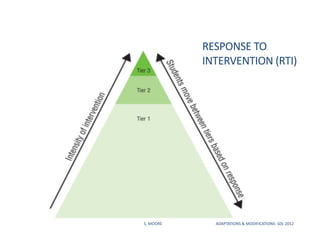
RESPONSE	
  TO	
  
INTERVENTION	
  (RTI)	
  
S,	
  MOORE	
   	
   	
  ADAPTATIONS	
  &	
  MODIFICATIONS-­‐	
  SDL	
  2012	
  
Only	
  1	
  out	
  of	
  153	
  beginning	
  reading	
  programs	
  
made	
  a	
  difference	
  in	
  achievement.	
  
*If	
  the	
  program	
  is	
  not	
  listed,	
  there	
  is	
  no	
  reliable	
  
research	
  to	
  support	
  it.	
  	
  R.	
  Allington,	
  2012	
  
What	
  Works	
  Clearinghouse,	
  as	
  quoted	
  in	
  
EducaXon	
  Week,	
  August	
  15,	
  2007	
  
The	
  struggling	
  reader,	
  no	
  maZer	
  what	
  grade	
  the	
  
child	
  is	
  in,	
  has	
  not	
  built	
  an	
  efficient	
  reading	
  
process	
  system	
  to	
  make	
  meaning	
  from	
  texts	
  or	
  
help	
  him	
  or	
  her	
  solve	
  problems	
  when	
  stuck…	
  
For	
  teachers,	
  that	
  means	
  learning	
  how	
  to	
  teach	
  
in	
  support	
  of	
  the	
  child	
  as	
  he	
  or	
  she	
  gains	
  more	
  
control	
  of	
  strategic	
  acXons.	


  -­‐Johnson	
  &	
  Keier	
  
Did	
  that	
  make	
  sense?	
  
How	
  did	
  you	
  figure	
  that	
  out?	
  
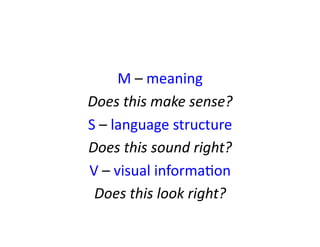
M	
  –	
  meaning	
  
Does	
  this	
  make	
  sense?	
  
S	
  –	
  language	
  structure	
  
Does	
  this	
  sound	
  right?	
  
V	
  –	
  visual	
  informaXon	
  
Does	
  this	
  look	
  right?	
  
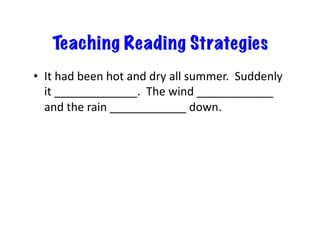
Teaching Reading Strategies
•  It	
  had	
  been	
  hot	
  and	
  dry	
  all	
  summer.	
  	
  Suddenly	
  
it	
  _____________.	
  	
  The	
  wind	
  ____________	
  	
  
and	
  the	
  rain	
  ____________	
  down.	
  
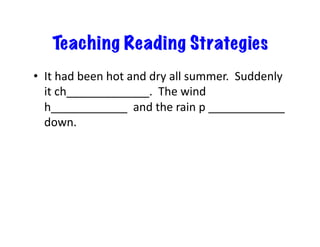
Teaching Reading Strategies
•  It	
  had	
  been	
  hot	
  and	
  dry	
  all	
  summer.	
  	
  Suddenly	
  
it	
  ch_____________.	
  	
  The	
  wind	
  
h____________	
  	
  and	
  the	
  rain	
  p	
  ____________	
  
down.	
  
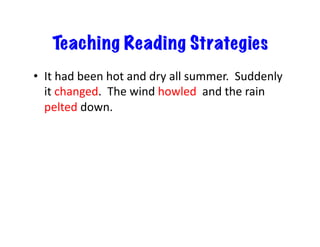
Teaching Reading Strategies
•  It	
  had	
  been	
  hot	
  and	
  dry	
  all	
  summer.	
  	
  Suddenly	
  
it	
  changed.	
  	
  The	
  wind	
  howled	
  	
  and	
  the	
  rain	
  	
  
pelted	
  down.	
  
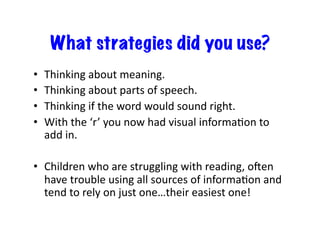
What strategies did you use?
•  Thinking	
  about	
  meaning.	
  
•  Thinking	
  about	
  parts	
  of	
  speech.	
  
•  Thinking	
  if	
  the	
  word	
  would	
  sound	
  right.	
  
•  With	
  the	
  ‘r’	
  you	
  now	
  had	
  visual	
  informaXon	
  to	
  
add	
  in.	
  
•  Children	
  who	
  are	
  struggling	
  with	
  reading,	
  ogen	
  
have	
  trouble	
  using	
  all	
  sources	
  of	
  informaXon	
  and	
  
tend	
  to	
  rely	
  on	
  just	
  one…their	
  easiest	
  one!	
  
•  How	
  can	
  you	
  integrate	
  the	
  flexible	
  use	
  of	
  
reading	
  strategies	
  throughout	
  the	
  day?	
  
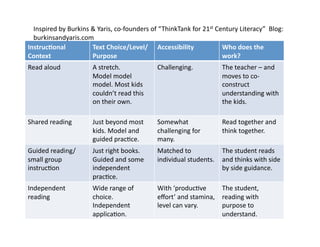
Instruc(onal	
  
Context	
  
Text	
  Choice/Level/
Purpose	
  
Accessibility	
   Who	
  does	
  the	
  
work?	
  
Read	
  aloud	
   A	
  stretch.	
  
Model	
  model	
  
model.	
  Most	
  kids	
  
couldn’t	
  read	
  this	
  
on	
  their	
  own.	
  
Challenging.	
   The	
  teacher	
  –	
  and	
  
moves	
  to	
  co-­‐
construct	
  
understanding	
  with	
  
the	
  kids.	
  
Shared	
  reading	
   Just	
  beyond	
  most	
  
kids.	
  Model	
  and	
  
guided	
  pracXce.	
  
Somewhat	
  
challenging	
  for	
  
many.	
  
Read	
  together	
  and	
  
think	
  together.	
  
Guided	
  reading/
small	
  group	
  
instrucXon	
  
Just	
  right	
  books.	
  
Guided	
  and	
  some	
  
independent	
  
pracXce.	
  
Matched	
  to	
  
individual	
  students.	
  
The	
  student	
  reads	
  
and	
  thinks	
  with	
  side	
  
by	
  side	
  guidance.	
  
Independent	
  
reading	
  
Wide	
  range	
  of	
  
choice.	
  	
  
Independent	
  
applicaXon.	
  
With	
  ‘producXve	
  
effort’	
  and	
  stamina,	
  
level	
  can	
  vary.	
  
The	
  student,	
  
reading	
  with	
  
purpose	
  to	
  
understand.	
  
Inspired	
  by	
  Burkins	
  &	
  Yaris,	
  co-­‐founders	
  of	
  “ThinkTank	
  for	
  21st	
  Century	
  Literacy”	
  	
  Blog:	
  	
  
burkinsandyaris.com	
  
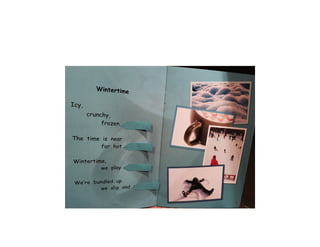
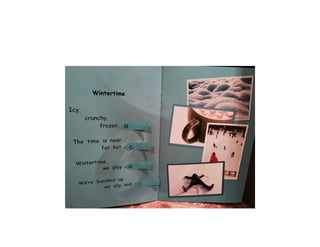
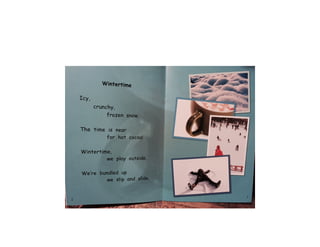
snow	
  
cocoa	
  
outside	
  
slide	
  
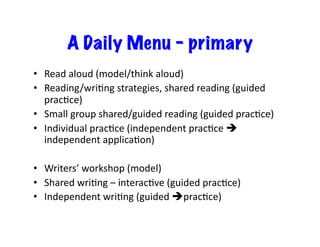
A Daily Menu - primary
•  Read	
  aloud	
  (model/think	
  aloud)	
  
•  Reading/wriXng	
  strategies,	
  shared	
  reading	
  (guided	
  
pracXce)	
  
•  Small	
  group	
  shared/guided	
  reading	
  (guided	
  pracXce)	
  
•  Individual	
  pracXce	
  (independent	
  pracXce	
  !
independent	
  applicaXon)	
  
•  Writers’	
  workshop	
  (model)	
  
•  Shared	
  wriXng	
  –	
  interacXve	
  (guided	
  pracXce)	
  
•  Independent	
  wriXng	
  (guided	
  !pracXce) 	
  
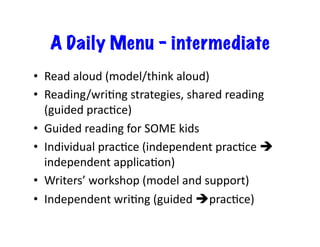
A Daily Menu - intermediate
•  Read	
  aloud	
  (model/think	
  aloud)	
  
•  Reading/wriXng	
  strategies,	
  shared	
  reading	
  
(guided	
  pracXce)	
  
•  Guided	
  reading	
  for	
  SOME	
  kids	
  
•  Individual	
  pracXce	
  (independent	
  pracXce	
  !
independent	
  applicaXon)	
  
•  Writers’	
  workshop	
  (model	
  and	
  support)	
  
•  Independent	
  wriXng	
  (guided	
  !pracXce) 	
  
Language Counts!	
  
…our	
  language	
  choices	
  have	
  serious	
  
consequences	
  for	
  children’s	
  learning	
  and	
  for	
  
who	
  they	
  become	
  as	
  individuals	
  and	
  as	
  a	
  
community.	
  
…the	
  language	
  we	
  choose	
  in	
  our	
  teaching	
  
changes	
  the	
  worlds	
  children	
  inhabit	
  now	
  and	
  
those	
  they	
  will	
  build	
  in	
  the	
  future.	


  -­‐Peter	
  H.	
  Johnston,	
  2012	
  
•  My	
  class	
  is	
  a	
  3-­‐4	
  reading	
  level	
  to	
  a	
  32.	
  
•  This	
  is	
  my	
  low	
  group.	
  
•  I	
  have	
  14	
  IEPs	
  in	
  my	
  class.	
  
•  I	
  have	
  a	
  behavior	
  class.	
  
•  How	
  many	
  special	
  needs	
  do	
  you	
  have?	
  
•  I’ve	
  a	
  split	
  class.	
  
Language Counts!
•  Thank	
  you	
  
•  What	
  are	
  you	
  reading	
  that	
  is	
  interesXng	
  to	
  
you?	
  
•  I	
  think	
  we	
  have	
  come	
  off	
  course.	
  	
  What	
  can	
  we	
  
do	
  to	
  get	
  back	
  on	
  course?	
  
•  We	
  only	
  get	
  to	
  write	
  for	
  4	
  minutes!	
  
•  I	
  don’t	
  think	
  I	
  was	
  clear	
  enough	
  with	
  my	
  
instrucXons.	
  	
  Can	
  we	
  stop	
  for	
  a	
  moment	
  and	
  
have	
  you	
  help	
  me	
  be	
  clearer?	
  
•  Brownlie,	
  Fullerton,	
  Schnellert	
  –	
  It’s	
  All	
  about	
  Thinking	
  –	
  
Collabora(ng	
  to	
  support	
  all	
  learners	
  in	
  Math	
  &	
  Science,	
  2011	
  
•  Brownlie,	
  King	
  -­‐	
  Learning	
  in	
  Safe	
  Schools	
  –	
  Crea(ng	
  classrooms	
  
where	
  all	
  students	
  belong,	
  2nd	
  ed,	
  Pembroke	
  Publishers,	
  2011	
  
•  Brownlie,	
  Schnellert	
  –	
  It’s	
  All	
  about	
  Thinking	
  –	
  Collabora(ng	
  to	
  
support	
  all	
  learners	
  in	
  English	
  &	
  Humani(es,	
  2009	
  
•  Brownlie,	
  Feniak,	
  Schnellert	
  -­‐	
  Student	
  Diversity,	
  2nd	
  ed.,	
  Pembroke	
  
Pub.,	
  2006	
  
•  Brownlie,	
  Jeroski	
  –	
  Reading	
  and	
  Responding,	
  grades	
  4-­‐6,	
  2nd	
  ediXon,	
  
Nelson,	
  2006	
  
•  Brownlie	
  -­‐	
  Grand	
  Conversa(ons,	
  Portage	
  and	
  Main	
  Press,	
  2005	
  
•  Brownlie,Feniak,	
  McCarthy	
  -­‐	
  Instruc(on	
  and	
  Assessment	
  of	
  ESL	
  
Learners,	
  Portage	
  and	
  Main	
  Press,	
  2004	
  

FNSA Literacy day 2

  • 1.
    Looking Deeper intoLiteracy Aug  31,  Sept  1,  2015   FNSA  Schools  supported  by  Teresa  Blackstone   Faye  Brownlie   www.slideshare.net/fayebrownlie/FNSAliteracy   Day  2  
  • 2.
    RESPONSE  TO   INTERVENTION  (RTI)   S,  MOORE      ADAPTATIONS  &  MODIFICATIONS-­‐  SDL  2012  
  • 3.
    Only  1  out  of  153  beginning  reading  programs   made  a  difference  in  achievement.   *If  the  program  is  not  listed,  there  is  no  reliable   research  to  support  it.    R.  Allington,  2012   What  Works  Clearinghouse,  as  quoted  in   EducaXon  Week,  August  15,  2007  
  • 4.
    The  struggling  reader,  no  maZer  what  grade  the   child  is  in,  has  not  built  an  efficient  reading   process  system  to  make  meaning  from  texts  or   help  him  or  her  solve  problems  when  stuck…   For  teachers,  that  means  learning  how  to  teach   in  support  of  the  child  as  he  or  she  gains  more   control  of  strategic  acXons.            -­‐Johnson  &  Keier  
  • 5.
    Did  that  make  sense?  
  • 6.
    How  did  you  figure  that  out?  
  • 7.
    M  –  meaning   Does  this  make  sense?   S  –  language  structure   Does  this  sound  right?   V  –  visual  informaXon   Does  this  look  right?  
  • 9.
    Teaching Reading Strategies • It  had  been  hot  and  dry  all  summer.    Suddenly   it  _____________.    The  wind  ____________     and  the  rain  ____________  down.  
  • 10.
    Teaching Reading Strategies • It  had  been  hot  and  dry  all  summer.    Suddenly   it  ch_____________.    The  wind   h____________    and  the  rain  p  ____________   down.  
  • 11.
    Teaching Reading Strategies • It  had  been  hot  and  dry  all  summer.    Suddenly   it  changed.    The  wind  howled    and  the  rain     pelted  down.  
  • 12.
    What strategies didyou use? •  Thinking  about  meaning.   •  Thinking  about  parts  of  speech.   •  Thinking  if  the  word  would  sound  right.   •  With  the  ‘r’  you  now  had  visual  informaXon  to   add  in.   •  Children  who  are  struggling  with  reading,  ogen   have  trouble  using  all  sources  of  informaXon  and   tend  to  rely  on  just  one…their  easiest  one!  
  • 13.
    •  How  can  you  integrate  the  flexible  use  of   reading  strategies  throughout  the  day?  
  • 14.
    Instruc(onal   Context   Text  Choice/Level/ Purpose   Accessibility   Who  does  the   work?   Read  aloud   A  stretch.   Model  model   model.  Most  kids   couldn’t  read  this   on  their  own.   Challenging.   The  teacher  –  and   moves  to  co-­‐ construct   understanding  with   the  kids.   Shared  reading   Just  beyond  most   kids.  Model  and   guided  pracXce.   Somewhat   challenging  for   many.   Read  together  and   think  together.   Guided  reading/ small  group   instrucXon   Just  right  books.   Guided  and  some   independent   pracXce.   Matched  to   individual  students.   The  student  reads   and  thinks  with  side   by  side  guidance.   Independent   reading   Wide  range  of   choice.     Independent   applicaXon.   With  ‘producXve   effort’  and  stamina,   level  can  vary.   The  student,   reading  with   purpose  to   understand.   Inspired  by  Burkins  &  Yaris,  co-­‐founders  of  “ThinkTank  for  21st  Century  Literacy”    Blog:     burkinsandyaris.com  
  • 19.
  • 20.
    A Daily Menu- primary •  Read  aloud  (model/think  aloud)   •  Reading/wriXng  strategies,  shared  reading  (guided   pracXce)   •  Small  group  shared/guided  reading  (guided  pracXce)   •  Individual  pracXce  (independent  pracXce  ! independent  applicaXon)   •  Writers’  workshop  (model)   •  Shared  wriXng  –  interacXve  (guided  pracXce)   •  Independent  wriXng  (guided  !pracXce)  
  • 21.
    A Daily Menu- intermediate •  Read  aloud  (model/think  aloud)   •  Reading/wriXng  strategies,  shared  reading   (guided  pracXce)   •  Guided  reading  for  SOME  kids   •  Individual  pracXce  (independent  pracXce  ! independent  applicaXon)   •  Writers’  workshop  (model  and  support)   •  Independent  wriXng  (guided  !pracXce)  
  • 22.
    Language Counts!   …our  language  choices  have  serious   consequences  for  children’s  learning  and  for   who  they  become  as  individuals  and  as  a   community.   …the  language  we  choose  in  our  teaching   changes  the  worlds  children  inhabit  now  and   those  they  will  build  in  the  future.            -­‐Peter  H.  Johnston,  2012  
  • 23.
    •  My  class  is  a  3-­‐4  reading  level  to  a  32.   •  This  is  my  low  group.   •  I  have  14  IEPs  in  my  class.   •  I  have  a  behavior  class.   •  How  many  special  needs  do  you  have?   •  I’ve  a  split  class.  
  • 24.
    Language Counts! •  Thank  you   •  What  are  you  reading  that  is  interesXng  to   you?   •  I  think  we  have  come  off  course.    What  can  we   do  to  get  back  on  course?   •  We  only  get  to  write  for  4  minutes!   •  I  don’t  think  I  was  clear  enough  with  my   instrucXons.    Can  we  stop  for  a  moment  and   have  you  help  me  be  clearer?  
  • 25.
    •  Brownlie,  Fullerton,  Schnellert  –  It’s  All  about  Thinking  –   Collabora(ng  to  support  all  learners  in  Math  &  Science,  2011   •  Brownlie,  King  -­‐  Learning  in  Safe  Schools  –  Crea(ng  classrooms   where  all  students  belong,  2nd  ed,  Pembroke  Publishers,  2011   •  Brownlie,  Schnellert  –  It’s  All  about  Thinking  –  Collabora(ng  to   support  all  learners  in  English  &  Humani(es,  2009   •  Brownlie,  Feniak,  Schnellert  -­‐  Student  Diversity,  2nd  ed.,  Pembroke   Pub.,  2006   •  Brownlie,  Jeroski  –  Reading  and  Responding,  grades  4-­‐6,  2nd  ediXon,   Nelson,  2006   •  Brownlie  -­‐  Grand  Conversa(ons,  Portage  and  Main  Press,  2005   •  Brownlie,Feniak,  McCarthy  -­‐  Instruc(on  and  Assessment  of  ESL   Learners,  Portage  and  Main  Press,  2004