Meeting The Double-Edged Challenges:
English Language Arts (ELA) key practices
Agenda
• 9:30 – 10 interactive discussion of the following:
Introduction to CCSS
Challenges that students and teachers face
key approaches and methods
significance of learning strategies
• 10 – 11 Listening, speaking, & vocabulary activities
• 11 – 12 speaking, vocabulary, reading, lesson planning activities
• 12- 1 Lunch
• 1-1:40 K-12 program by Ms. Julia lee
• 1:40 – 2:50 reading, grammar, writing activities
• 2:50 – 3:00 wrap up
“K-12 CCSS are designed to prepare all
students for success in college, career,
and life”
“The CCSS articulate a vision of what it
means to be a literate person who is
prepared for success in the 21st C.”
Write one idea in relation to each
quote on a post it and stick each on the
relevant flip chart .
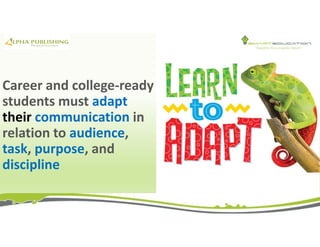
Career and college-ready
students must adapt
their communication in
relation to audience,
task, purpose, and
discipline
•CCSS call for all
students to develop
critical reading skills
necessary for deep
understanding of
complex texts, and
critical writing skills
to write about those
texts.
Double- Edged Challenge
Students
•ELLs need support because the curriculum might not
prepare them to meet this high bar
•ELLs in the region do not live in English speaking
countries; FLL not SLL
•ELLs need the appropriate textbooks
•ELLs need appropriate supplementary material
Teachers
Need to develop Instructional practices that align with CCSS
Need to develop teaching / learning tools that align with CCSS
Need to develop assessment tools that align with CCSS
Need professional development/ training that enables them to
help students achieve the goal.
Workshop learning outcomes
•Create lesson plans according to CALLA
•Design tools to enact the standards in their classes
•Develop tools that would give students ongoing
feedback through formative assessment
•Focus on the development of material that promotes
the integrated nature of literacy
•Focus on each of the domains articulated by the
standards (reading, writing, listening, speaking, and
language)
• Focus on “to inform”, “to persuade”, & “to convey
experiences”
• Focus on helping students learn how to transfer
knowledge
• Frontloading
• Differentiated Instruction
• Monitor progress
• Infuse 21st C skills into daily
lesson plan
• Learning strategies accelerate
standard academic language
learning for all students more
effectively and efficiently.
• They are particularly
important for students seeking
to master academic language
and content simultaneously.
•Learning strategy instruction can help students by:
- Showing them techniques for “how to learn”
-Developing their independence as learners
- Increasing their academic motivation
-Developing their awareness of their thinking &
learning processes
learning strategies that are especially helpful
to ELLs in acquiring standard academic English
and content are the following three meta-
cognitive strategies and a strategy for using
prior knowledge:
• Plan-Set goals and identify steps needed to accomplish a learning
task.
• Monitor/identify problems- While working on a learning task, check
your comprehension or production and identify any problems you are
having.
• Evaluate-After completing a learning task, assess how well you have
done.
• Use what you know- Use your own knowledge and experiences to
understand and learn something new; brainstorm words and ideas;
make associations and analogies; explain your prior knowledge about
a topic.
Introduce the Concept
How can we protect our environment?
• Watch the video:
https://www.youtube.com%2fwatch%3fv%3dF_O1Au8vZLA
•Discuss / answer the questions (questions
target purpose, audience, message, &
vocabulary)
1. Have you ever given a speech?
2. Can you share any personal experience?
3. Who is Severn Suzuki?
4. Whom is she addressing?
5. Why did she decide to travel long distance and
give such a speech?
6. Whom does she represent?
7. What is her main concern?
8. What issues does she talk about?
9. What is her main message?
10. What is the analogy she used to get her
message across.
11.What touched you the most in her speech?
12. What were the two polite requests she
addressed the audience with?
• Environmental Children’s
Organization
• Raised money
• Hidden agenda
• Fight for my future
• Speak for the generations to come /
on behalf of
• Starving children
• Cries go unheard
• Go extinct / vanish forever
• Herds of wild animals
• Rain forests
• Happen before our eyes
• Deforestation
• Species
• Waste
• Privileged life vs living on the streets
• Victim of war
• Water/ air pollution
• Oil spill
• Chemicals
• Holes in the ozone
• Find environmental answers
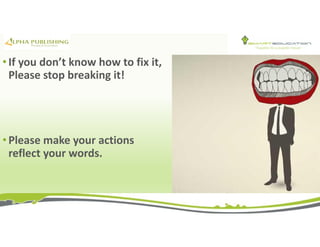
• If you don’t know how to fix it,
Please stop breaking it!
• Please make your actions
reflect your words.
Let’s reflect on what we did!
•Spark meaningful connections with prior learning
and personal experiences
•Explore and verify important concepts
•Get engaged in inquiry and reflection
•Target specific words and expressions the students
need to learn to use when they speak, read, write
about the concept.
•Record the words or phrases the students use in their
answers to the questions.
•Write above each expression the target word or
expression in a different color.
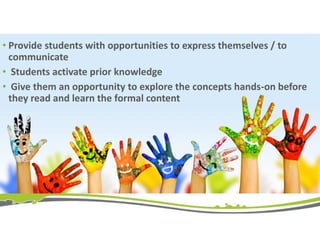
• Provide students with opportunities to express themselves / to
communicate
• Students activate prior knowledge
• Give them an opportunity to explore the concepts hands-on before
they read and learn the formal content
Speaking activity
• Each pair chooses a picture.
• Take turns to come up with around a minute impromptu
speech.
• Each one chooses the purpose of their speech.
• Each one chooses the audience of their speech.
• It is highly recommended that you use the helpful words and
phrases discussed earlier and posted on the flip chart.
• Share with the class
•Narratives are important in communicating real-
life experiences
•Create opportunities for transfer to other
situations and subjects.
Recap
• Assignments should have personal and social significance to
the students
• Extended practice in miniature
• Culturally relevant activities relating students’ lives through
talk and writing
• Multiple opportunities to practice new skills by working in
pairs and / or in small groups.
• Informational talk to write informational texts
• Use academic vocabulary before they apply it to their writing
Activity
Reading lesson plan
Informational text
Informative text Biodiversity
Teach through modeling
• Reading processes
• Text’s grammatical features and vocabulary
• Build upon their prior knowledge
• Inform the reader about a specific topic.
• Find key information and understand the main topic.
• Coherence and cohesion
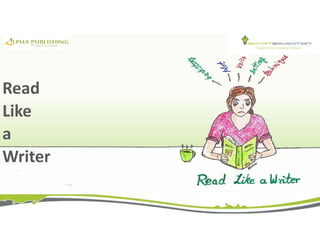
Read
Like
a
Writer
Informative text
• Conveys factual information
• Elements of the text: includes exposition, procedural text,
persuasive text etc
• Academic vocabulary
• Text structure: use cause- effect; definition; comparison –
contrast; classification..
• Use textual features like photos, graphs, maps, drawings, etc
readers need to experience the power of using skills and
strategies to make deep meaning from text
Activity
• Grammar in context; target grammar feature
contextualized in the same informative text
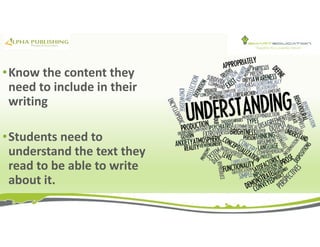
•Know the content they
need to include in their
writing
•Students need to
understand the text they
read to be able to write
about it.
Recap
•Standards stress the importance of regular
practice with academic texts and their
complex academic vocabulary.
•Modeling appropriate language use and
processes of reading and writing
•Establishment of cohesion and text-structure
knowledge.
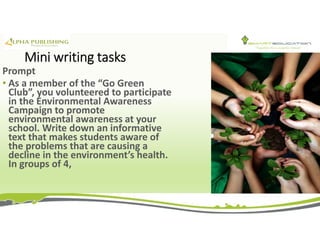
Mini writing tasks
Prompt
• As a member of the “Go Green
Club”, you volunteered to participate
in the Environmental Awareness
Campaign to promote
environmental awareness at your
school. Write down an informative
text that makes students aware of
the problems that are causing a
decline in the environment’s health.
In groups of 4,
1. Discuss the prompt
2. Decide on the main ideas
3. Each student chooses a main idea and develops
it in a paragraph
4. The group members discuss the different parts
and collaboratively put together the informative
text. Each member signs their name next to the
part they created.
•Model how to write comments that relate to
content and organization; comments that help
students write a better draft
•Use symbols to proofread the same writing.
(In class the teacher collects papers to comment on
and give feedback; students write another draft;
teacher checks the second draft before publishing
them in class.)
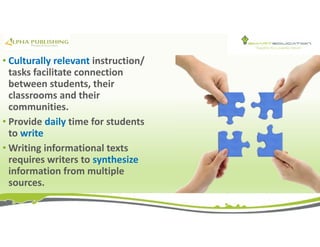
• Culturally relevant instruction/
tasks facilitate connection
between students, their
classrooms and their
communities.
• Provide daily time for students
to write
• Writing informational texts
requires writers to synthesize
information from multiple
sources.
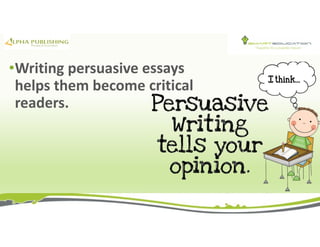
•Writing persuasive essays
helps them become critical
readers.
Persuasive text
• Use the script of the speech
• Teach through modeling
• What is her claim?
• What arguments does she present?
• Are they logical and convincing?
• What rhetorical devices
• (Aristotle’s appeals: logos, pathos, ethos)
• does she use?
• Which part affected you the most?
• Do you agree with her?
Recap
• Strategy instruction is important.
• Don’t describe the strategy, model it. Support strategy use by
practice
• Differentiate based on authentic assessment/ scaffolding
students who need additional conceptual, academic, and
linguistic support
• Through modeling / explicit instruction expose them to new
language features and teach them how to use these features in
academic contexts.
Practice
•Give them a persuasive text of a theme
related to the concept being discussed.
•Ask them to read the title and set a purpose
•Ask them to read an assigned part silently
•Ask them questions that relate to the vocabulary
strategy / vocabulary words
•Ask them questions that reflect their
understanding of the features of persuasive text.
•Continue the other parts to help all students
achieve the learning outcomes.
Activity
In pairs, choose one of the given situations and write a claim,
one argument that appeals to reason and another one that
appeals to emotions. Write each on a separate sheet of paper.
All pairs who worked on situation 1 are asked to post their
claims, arguments that appeal to logic and those that appeal to
emotions on the chart under the matching heading.
Discuss with the class / evaluate the claim and arguments.
•Write like a reporter
•Connect to texts
•Write in response to
multiple texts and cite
text-based evidence
Activity: Design a writing task
• Topic should relate to concept
•Task helps students consider alternatives, weigh
evidence, support their ideas, and justify their
answers.
• Task helps students synthesize and apply
information from different sources.
Activity continued
Task should give students the chance to:
• research their chosen topics
• Record interesting facts
• Sequence their ideas
• Share their findings with a partner
Sum Up
Effective instruction for ELLs to meet the new standards will
require opportunities for students to engage with texts, peers,
and teachers using language and literacy in all its complexity
Activities that create conducive climate and foster motivation:
- make connections to students’ lives
- acknowledge students’ voices
-engage students in collaboration
Choose instructional methods that best meet
students’ needs
Implement formative assessment to improve
instruction
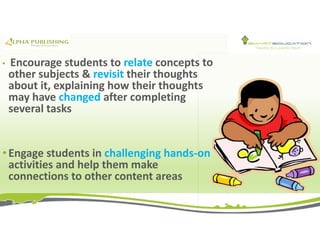
• Encourage students to relate concepts to
other subjects & revisit their thoughts
about it, explaining how their thoughts
may have changed after completing
several tasks
• Engage students in challenging hands-on
activities and help them make
connections to other content areas

Meeting the Double-Edged Challenges: ELA key practicies

  • 1.
    Meeting The Double-EdgedChallenges: English Language Arts (ELA) key practices
  • 2.
    Agenda • 9:30 –10 interactive discussion of the following: Introduction to CCSS Challenges that students and teachers face key approaches and methods significance of learning strategies • 10 – 11 Listening, speaking, & vocabulary activities • 11 – 12 speaking, vocabulary, reading, lesson planning activities • 12- 1 Lunch • 1-1:40 K-12 program by Ms. Julia lee • 1:40 – 2:50 reading, grammar, writing activities • 2:50 – 3:00 wrap up
  • 3.
    “K-12 CCSS aredesigned to prepare all students for success in college, career, and life” “The CCSS articulate a vision of what it means to be a literate person who is prepared for success in the 21st C.” Write one idea in relation to each quote on a post it and stick each on the relevant flip chart .
  • 4.
    Career and college-ready studentsmust adapt their communication in relation to audience, task, purpose, and discipline
  • 5.
    •CCSS call forall students to develop critical reading skills necessary for deep understanding of complex texts, and critical writing skills to write about those texts.
  • 6.
    Double- Edged Challenge Students •ELLsneed support because the curriculum might not prepare them to meet this high bar •ELLs in the region do not live in English speaking countries; FLL not SLL •ELLs need the appropriate textbooks •ELLs need appropriate supplementary material
  • 7.
    Teachers Need to developInstructional practices that align with CCSS Need to develop teaching / learning tools that align with CCSS Need to develop assessment tools that align with CCSS Need professional development/ training that enables them to help students achieve the goal.
  • 8.
    Workshop learning outcomes •Createlesson plans according to CALLA •Design tools to enact the standards in their classes •Develop tools that would give students ongoing feedback through formative assessment
  • 9.
    •Focus on thedevelopment of material that promotes the integrated nature of literacy •Focus on each of the domains articulated by the standards (reading, writing, listening, speaking, and language) • Focus on “to inform”, “to persuade”, & “to convey experiences” • Focus on helping students learn how to transfer knowledge
  • 10.
    • Frontloading • DifferentiatedInstruction • Monitor progress • Infuse 21st C skills into daily lesson plan
  • 11.
    • Learning strategiesaccelerate standard academic language learning for all students more effectively and efficiently. • They are particularly important for students seeking to master academic language and content simultaneously.
  • 12.
    •Learning strategy instructioncan help students by: - Showing them techniques for “how to learn” -Developing their independence as learners - Increasing their academic motivation -Developing their awareness of their thinking & learning processes
  • 13.
    learning strategies thatare especially helpful to ELLs in acquiring standard academic English and content are the following three meta- cognitive strategies and a strategy for using prior knowledge:
  • 14.
    • Plan-Set goalsand identify steps needed to accomplish a learning task. • Monitor/identify problems- While working on a learning task, check your comprehension or production and identify any problems you are having. • Evaluate-After completing a learning task, assess how well you have done. • Use what you know- Use your own knowledge and experiences to understand and learn something new; brainstorm words and ideas; make associations and analogies; explain your prior knowledge about a topic.
  • 15.
    Introduce the Concept Howcan we protect our environment? • Watch the video: https://www.youtube.com%2fwatch%3fv%3dF_O1Au8vZLA •Discuss / answer the questions (questions target purpose, audience, message, & vocabulary)
  • 16.
    1. Have youever given a speech? 2. Can you share any personal experience? 3. Who is Severn Suzuki? 4. Whom is she addressing? 5. Why did she decide to travel long distance and give such a speech?
  • 17.
    6. Whom doesshe represent? 7. What is her main concern? 8. What issues does she talk about? 9. What is her main message?
  • 18.
    10. What isthe analogy she used to get her message across. 11.What touched you the most in her speech? 12. What were the two polite requests she addressed the audience with?
  • 19.
    • Environmental Children’s Organization •Raised money • Hidden agenda • Fight for my future • Speak for the generations to come / on behalf of • Starving children • Cries go unheard • Go extinct / vanish forever • Herds of wild animals • Rain forests • Happen before our eyes • Deforestation • Species • Waste • Privileged life vs living on the streets • Victim of war • Water/ air pollution • Oil spill • Chemicals • Holes in the ozone • Find environmental answers
  • 20.
    • If youdon’t know how to fix it, Please stop breaking it! • Please make your actions reflect your words.
  • 21.
    Let’s reflect onwhat we did!
  • 22.
    •Spark meaningful connectionswith prior learning and personal experiences •Explore and verify important concepts •Get engaged in inquiry and reflection
  • 23.
    •Target specific wordsand expressions the students need to learn to use when they speak, read, write about the concept. •Record the words or phrases the students use in their answers to the questions. •Write above each expression the target word or expression in a different color.
  • 24.
    • Provide studentswith opportunities to express themselves / to communicate • Students activate prior knowledge • Give them an opportunity to explore the concepts hands-on before they read and learn the formal content
  • 25.
    Speaking activity • Eachpair chooses a picture. • Take turns to come up with around a minute impromptu speech. • Each one chooses the purpose of their speech. • Each one chooses the audience of their speech. • It is highly recommended that you use the helpful words and phrases discussed earlier and posted on the flip chart. • Share with the class
  • 26.
    •Narratives are importantin communicating real- life experiences •Create opportunities for transfer to other situations and subjects.
  • 27.
    Recap • Assignments shouldhave personal and social significance to the students • Extended practice in miniature • Culturally relevant activities relating students’ lives through talk and writing • Multiple opportunities to practice new skills by working in pairs and / or in small groups. • Informational talk to write informational texts • Use academic vocabulary before they apply it to their writing
  • 28.
  • 29.
    Informative text Biodiversity Teachthrough modeling • Reading processes • Text’s grammatical features and vocabulary • Build upon their prior knowledge • Inform the reader about a specific topic. • Find key information and understand the main topic. • Coherence and cohesion
  • 30.
  • 31.
    Informative text • Conveysfactual information • Elements of the text: includes exposition, procedural text, persuasive text etc • Academic vocabulary • Text structure: use cause- effect; definition; comparison – contrast; classification.. • Use textual features like photos, graphs, maps, drawings, etc readers need to experience the power of using skills and strategies to make deep meaning from text
  • 32.
    Activity • Grammar incontext; target grammar feature contextualized in the same informative text
  • 33.
    •Know the contentthey need to include in their writing •Students need to understand the text they read to be able to write about it.
  • 34.
    Recap •Standards stress theimportance of regular practice with academic texts and their complex academic vocabulary. •Modeling appropriate language use and processes of reading and writing •Establishment of cohesion and text-structure knowledge.
  • 35.
    Mini writing tasks Prompt •As a member of the “Go Green Club”, you volunteered to participate in the Environmental Awareness Campaign to promote environmental awareness at your school. Write down an informative text that makes students aware of the problems that are causing a decline in the environment’s health. In groups of 4,
  • 36.
    1. Discuss theprompt 2. Decide on the main ideas 3. Each student chooses a main idea and develops it in a paragraph 4. The group members discuss the different parts and collaboratively put together the informative text. Each member signs their name next to the part they created.
  • 37.
    •Model how towrite comments that relate to content and organization; comments that help students write a better draft •Use symbols to proofread the same writing. (In class the teacher collects papers to comment on and give feedback; students write another draft; teacher checks the second draft before publishing them in class.)
  • 38.
    • Culturally relevantinstruction/ tasks facilitate connection between students, their classrooms and their communities. • Provide daily time for students to write • Writing informational texts requires writers to synthesize information from multiple sources.
  • 39.
    •Writing persuasive essays helpsthem become critical readers.
  • 40.
    Persuasive text • Usethe script of the speech • Teach through modeling • What is her claim? • What arguments does she present? • Are they logical and convincing? • What rhetorical devices • (Aristotle’s appeals: logos, pathos, ethos) • does she use? • Which part affected you the most? • Do you agree with her?
  • 41.
    Recap • Strategy instructionis important. • Don’t describe the strategy, model it. Support strategy use by practice • Differentiate based on authentic assessment/ scaffolding students who need additional conceptual, academic, and linguistic support • Through modeling / explicit instruction expose them to new language features and teach them how to use these features in academic contexts.
  • 42.
    Practice •Give them apersuasive text of a theme related to the concept being discussed. •Ask them to read the title and set a purpose •Ask them to read an assigned part silently
  • 43.
    •Ask them questionsthat relate to the vocabulary strategy / vocabulary words •Ask them questions that reflect their understanding of the features of persuasive text. •Continue the other parts to help all students achieve the learning outcomes.
  • 44.
    Activity In pairs, chooseone of the given situations and write a claim, one argument that appeals to reason and another one that appeals to emotions. Write each on a separate sheet of paper. All pairs who worked on situation 1 are asked to post their claims, arguments that appeal to logic and those that appeal to emotions on the chart under the matching heading. Discuss with the class / evaluate the claim and arguments.
  • 45.
    •Write like areporter •Connect to texts •Write in response to multiple texts and cite text-based evidence
  • 46.
    Activity: Design awriting task • Topic should relate to concept •Task helps students consider alternatives, weigh evidence, support their ideas, and justify their answers. • Task helps students synthesize and apply information from different sources.
  • 47.
    Activity continued Task shouldgive students the chance to: • research their chosen topics • Record interesting facts • Sequence their ideas • Share their findings with a partner
  • 48.
    Sum Up Effective instructionfor ELLs to meet the new standards will require opportunities for students to engage with texts, peers, and teachers using language and literacy in all its complexity Activities that create conducive climate and foster motivation: - make connections to students’ lives - acknowledge students’ voices -engage students in collaboration
  • 49.
    Choose instructional methodsthat best meet students’ needs Implement formative assessment to improve instruction
  • 50.
    • Encourage studentsto relate concepts to other subjects & revisit their thoughts about it, explaining how their thoughts may have changed after completing several tasks • Engage students in challenging hands-on activities and help them make connections to other content areas