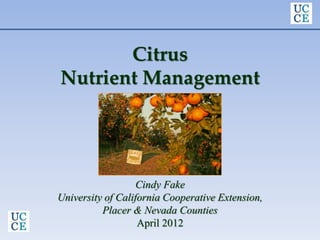
Citrus
Nutrient Management
Cindy Fake
University of California Cooperative Extension,
Placer & Nevada Counties
April 2012
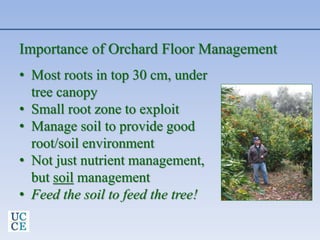
Importance of Orchard Floor Management
• Most roots in top 30 cm, under
tree canopy
• Small root zone to exploit
• Manage soil to provide good
root/soil environment
• Not just nutrient management,
but soil management
• Feed the soil to feed the tree!
Agenda
• Soil and tissue testing
• Benefits of soil organic matter
• No-till orchard management
• Cover crops and vegetated row middles
• Mulch
• Soil nutrient management
3
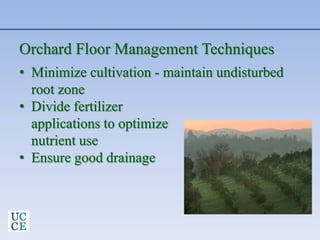
Orchard Floor Management Techniques
• Minimize cultivation - maintain undisturbed
root zone
• Divide fertilizer
applications to optimize
nutrient use
• Ensure good drainage
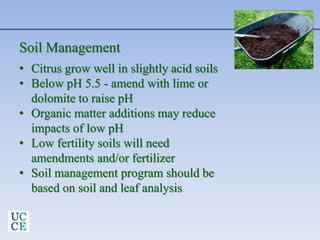
Soil Management
• Citrus grow well in slightly acid soils
• Below pH 5.5 - amend with lime or
dolomite to raise pH
• Organic matter additions may reduce
impacts of low pH
• Low fertility soils will need
amendments and/or fertilizer
• Soil management program should be
based on soil and leaf analysis
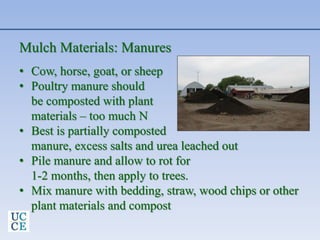
Mulch Materials: Manures
• Cow, horse, goat, or sheep
• Poultry manure should
be composted with plant
materials – too much N
• Best is partially composted
manure, excess salts and urea leached out
• Pile manure and allow to rot for
1-2 months, then apply to trees.
• Mix manure with bedding, straw, wood chips or other
plant materials and compost
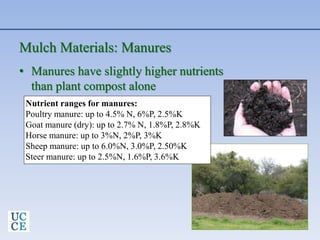
Mulch Materials: Manures
• Manures have slightly higher nutrients
than plant compost alone
Nutrient ranges for manures:
Poultry manure: up to 4.5% N, 6%P, 2.5%K
Goat manure (dry): up to 2.7% N, 1.8%P, 2.8%K
Horse manure: up to 3%N, 2%P, 3%K
Sheep manure: up to 6.0%N, 3.0%P, 2.50%K
Steer manure: up to 2.5%N, 1.6%P, 3.6%K
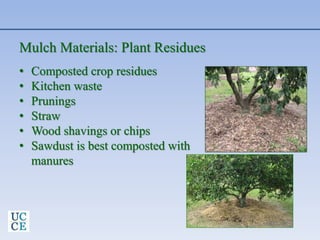
Mulch Materials: Plant Residues
• Composted crop residues
• Kitchen waste
• Prunings
• Straw
• Wood shavings or chips
• Sawdust is best composted with
manures
Soil Nutrient Management
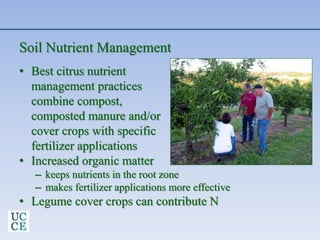
• Best citrus nutrient
management practices
combine compost,
composted manure and/or
cover crops with specific
fertilizer applications
• Increased organic matter
– keeps nutrients in the root zone
– makes fertilizer applications more effective
• Legume cover crops can contribute N
Soil Nutrient Applications
• Most orchards need annual applications of nitrogen
(N) and zinc (Zn)
• May need micronutrients such as manganese, boron,
or iron
• Phosphorus (P) may be needed in
acid soils
• Potassium (K) may also be needed
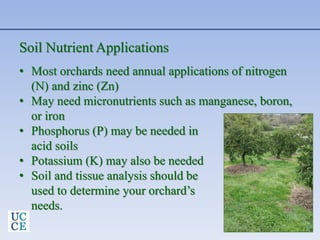
• Soil and tissue analysis should be
used to determine your orchard’s
needs.
Fertilizer Applications : Nitrogen
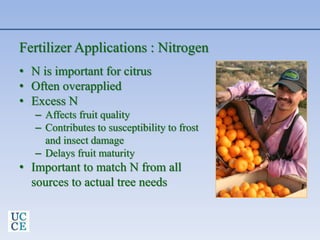
• N is important for citrus
• Often overapplied
• Excess N
– Affects fruit quality
– Contributes to susceptibility to frost
and insect damage
– Delays fruit maturity
• Important to match N from all
sources to actual tree needs
Timing of Nitrogen Applications
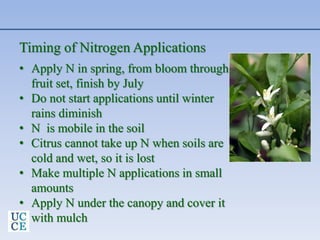
• Apply N in spring, from bloom through
fruit set, finish by July
• Do not start applications until winter
rains diminish
• N is mobile in the soil
• Citrus cannot take up N when soils are
cold and wet, so it is lost
• Make multiple N applications in small
amounts
• Apply N under the canopy and cover it
with mulch
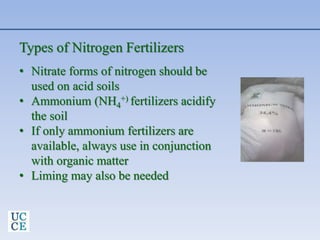
Types of Nitrogen Fertilizers
• Nitrate forms of nitrogen should be
used on acid soils
• Ammonium (NH4
+) fertilizers acidify
the soil
• If only ammonium fertilizers are
available, always use in conjunction
with organic matter
• Liming may also be needed
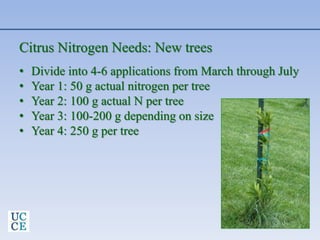
Citrus Nitrogen Needs: New trees
• Divide into 4-6 applications from March through July
• Year 1: 50 g actual nitrogen per tree
• Year 2: 100 g actual N per tree
• Year 3: 100-200 g depending on size
• Year 4: 250 g per tree
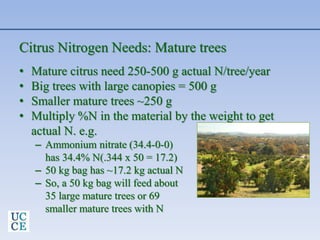
Citrus Nitrogen Needs: Mature trees
• Mature citrus need 250-500 g actual N/tree/year
• Big trees with large canopies = 500 g
• Smaller mature trees ~250 g
• Multiply %N in the material by the weight to get
actual N. e.g.
– Ammonium nitrate (34.4-0-0)
has 34.4% N(.344 x 50 = 17.2)
– 50 kg bag has ~17.2 kg actual N
– So, a 50 kg bag will feed about
35 large mature trees or 69
smaller mature trees with N
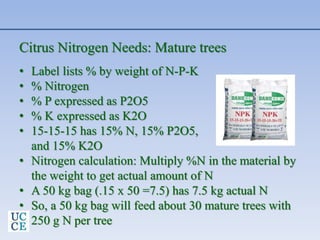
Citrus Nitrogen Needs: Mature trees
• Label lists % by weight of N-P-K
• % Nitrogen
• % P expressed as P2O5
• % K expressed as K2O
• 15-15-15 has 15% N, 15% P2O5,
and 15% K2O
• Nitrogen calculation: Multiply %N in the material by
the weight to get actual amount of N
• A 50 kg bag (.15 x 50 =7.5) has 7.5 kg actual N
• So, a 50 kg bag will feed about 30 mature trees with
250 g N per tree
Citrus Nitrogen Needs: Mature trees
• P is expressed as P2O5, which is only 43%P
• Calculation for P:
• 50 kg bag 15-15-15 has 7.5 kg P2O5 (.15 x 50 =7.5),
but P2O5 is only 43% p, so actual P is 7.5 kg x .43 =
3.2 kg P in bag
• K is expressed as K2O, which is 83% K
• Calculation for K:
• 50 kg bag 15-15-15 has 7.5 kg K2O (.15 x 50 =7.5),
but K2O is only 83% p, so actual K is 7.5 kg x .83 =
6.2 kg K in bag
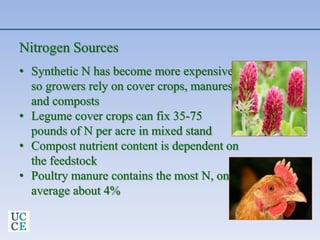
Nitrogen Sources
• Synthetic N has become more expensive
so growers rely on cover crops, manures,
and composts
• Legume cover crops can fix 35-75
pounds of N per acre in mixed stand
• Compost nutrient content is dependent on
the feedstock
• Poultry manure contains the most N, on
average about 4%
Phosphorus Fertilizers
• Acidic soils may contain enough phosphorus (P), but
it may not always be available to plants
• P fertilizer should not be applied unless a soil test
indicates need
• Excess P can contaminate surface and groundwater
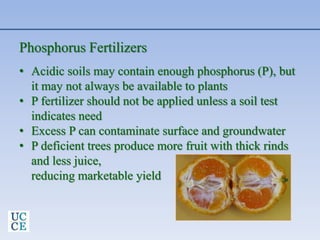
• P deficient trees produce more fruit with thick rinds
and less juice,
reducing marketable yield
Potassium
• Potassium may be leached out of
acid sandy soils, causing
deficiency, but in clay soils it is not
usually a problem
• Potassium helps maintain rind
integrity and improves sugar/acid
balance and flavor in fruit
• Foliar applications as fruit mature
may lengthen shelf life and
increase sugar content
Micronutrients
• Zinc (Zn) and manganese (Mn)
– Springtime foliar sprays at rates of 500 to 1,000
mg/L of Zn and 300 to 700 mg/L of Mn
• Iron is sometimes needed, especially in
areas with drainage issues
• Boron (B) should only be applied if soil and
tissue tests indicate a need. The range is
very narrow, and excess B can damage trees.
Nutrient Applications
• Some nutrient applications may be needed for optimal
production
• Soil depth, nutrient, and organic matter content vary
greatly
• Rootstock and soil conditions also influence nutrient
uptake
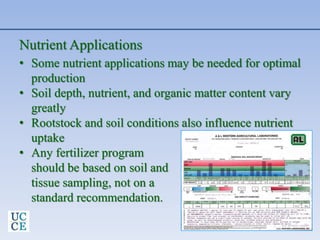
• Any fertilizer program
should be based on soil and
tissue sampling, not on a
standard recommendation.
Good Soil Management Practices
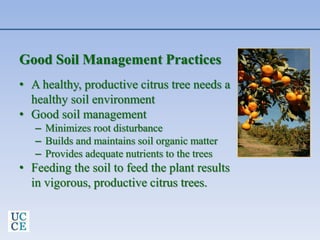
• A healthy, productive citrus tree needs a
healthy soil environment
• Good soil management
– Minimizes root disturbance
– Builds and maintains soil organic matter
– Provides adequate nutrients to the trees
• Feeding the soil to feed the plant results
in vigorous, productive citrus trees.
Nutrient Management?
Thank you!
Cindy Fake
University of California Cooperative Extension,
Placer & Nevada Counties
April 2012

Citrus Nutrient Management

  • 1.
    Citrus Nutrient Management Cindy Fake Universityof California Cooperative Extension, Placer & Nevada Counties April 2012
  • 2.
    Importance of OrchardFloor Management • Most roots in top 30 cm, under tree canopy • Small root zone to exploit • Manage soil to provide good root/soil environment • Not just nutrient management, but soil management • Feed the soil to feed the tree!
  • 3.
    Agenda • Soil andtissue testing • Benefits of soil organic matter • No-till orchard management • Cover crops and vegetated row middles • Mulch • Soil nutrient management 3
  • 4.
    Orchard Floor ManagementTechniques • Minimize cultivation - maintain undisturbed root zone • Divide fertilizer applications to optimize nutrient use • Ensure good drainage
  • 5.
    Soil Management • Citrusgrow well in slightly acid soils • Below pH 5.5 - amend with lime or dolomite to raise pH • Organic matter additions may reduce impacts of low pH • Low fertility soils will need amendments and/or fertilizer • Soil management program should be based on soil and leaf analysis
  • 6.
    Mulch Materials: Manures •Cow, horse, goat, or sheep • Poultry manure should be composted with plant materials – too much N • Best is partially composted manure, excess salts and urea leached out • Pile manure and allow to rot for 1-2 months, then apply to trees. • Mix manure with bedding, straw, wood chips or other plant materials and compost
  • 7.
    Mulch Materials: Manures •Manures have slightly higher nutrients than plant compost alone Nutrient ranges for manures: Poultry manure: up to 4.5% N, 6%P, 2.5%K Goat manure (dry): up to 2.7% N, 1.8%P, 2.8%K Horse manure: up to 3%N, 2%P, 3%K Sheep manure: up to 6.0%N, 3.0%P, 2.50%K Steer manure: up to 2.5%N, 1.6%P, 3.6%K
  • 8.
    Mulch Materials: PlantResidues • Composted crop residues • Kitchen waste • Prunings • Straw • Wood shavings or chips • Sawdust is best composted with manures
  • 9.
    Soil Nutrient Management •Best citrus nutrient management practices combine compost, composted manure and/or cover crops with specific fertilizer applications • Increased organic matter – keeps nutrients in the root zone – makes fertilizer applications more effective • Legume cover crops can contribute N
  • 10.
    Soil Nutrient Applications •Most orchards need annual applications of nitrogen (N) and zinc (Zn) • May need micronutrients such as manganese, boron, or iron • Phosphorus (P) may be needed in acid soils • Potassium (K) may also be needed • Soil and tissue analysis should be used to determine your orchard’s needs.
  • 11.
    Fertilizer Applications :Nitrogen • N is important for citrus • Often overapplied • Excess N – Affects fruit quality – Contributes to susceptibility to frost and insect damage – Delays fruit maturity • Important to match N from all sources to actual tree needs
  • 12.
    Timing of NitrogenApplications • Apply N in spring, from bloom through fruit set, finish by July • Do not start applications until winter rains diminish • N is mobile in the soil • Citrus cannot take up N when soils are cold and wet, so it is lost • Make multiple N applications in small amounts • Apply N under the canopy and cover it with mulch
  • 13.
    Types of NitrogenFertilizers • Nitrate forms of nitrogen should be used on acid soils • Ammonium (NH4 +) fertilizers acidify the soil • If only ammonium fertilizers are available, always use in conjunction with organic matter • Liming may also be needed
  • 14.
    Citrus Nitrogen Needs:New trees • Divide into 4-6 applications from March through July • Year 1: 50 g actual nitrogen per tree • Year 2: 100 g actual N per tree • Year 3: 100-200 g depending on size • Year 4: 250 g per tree
  • 15.
    Citrus Nitrogen Needs:Mature trees • Mature citrus need 250-500 g actual N/tree/year • Big trees with large canopies = 500 g • Smaller mature trees ~250 g • Multiply %N in the material by the weight to get actual N. e.g. – Ammonium nitrate (34.4-0-0) has 34.4% N(.344 x 50 = 17.2) – 50 kg bag has ~17.2 kg actual N – So, a 50 kg bag will feed about 35 large mature trees or 69 smaller mature trees with N
  • 16.
    Citrus Nitrogen Needs:Mature trees • Label lists % by weight of N-P-K • % Nitrogen • % P expressed as P2O5 • % K expressed as K2O • 15-15-15 has 15% N, 15% P2O5, and 15% K2O • Nitrogen calculation: Multiply %N in the material by the weight to get actual amount of N • A 50 kg bag (.15 x 50 =7.5) has 7.5 kg actual N • So, a 50 kg bag will feed about 30 mature trees with 250 g N per tree
  • 17.
    Citrus Nitrogen Needs:Mature trees • P is expressed as P2O5, which is only 43%P • Calculation for P: • 50 kg bag 15-15-15 has 7.5 kg P2O5 (.15 x 50 =7.5), but P2O5 is only 43% p, so actual P is 7.5 kg x .43 = 3.2 kg P in bag • K is expressed as K2O, which is 83% K • Calculation for K: • 50 kg bag 15-15-15 has 7.5 kg K2O (.15 x 50 =7.5), but K2O is only 83% p, so actual K is 7.5 kg x .83 = 6.2 kg K in bag
  • 18.
    Nitrogen Sources • SyntheticN has become more expensive so growers rely on cover crops, manures, and composts • Legume cover crops can fix 35-75 pounds of N per acre in mixed stand • Compost nutrient content is dependent on the feedstock • Poultry manure contains the most N, on average about 4%
  • 19.
    Phosphorus Fertilizers • Acidicsoils may contain enough phosphorus (P), but it may not always be available to plants • P fertilizer should not be applied unless a soil test indicates need • Excess P can contaminate surface and groundwater • P deficient trees produce more fruit with thick rinds and less juice, reducing marketable yield
  • 20.
    Potassium • Potassium maybe leached out of acid sandy soils, causing deficiency, but in clay soils it is not usually a problem • Potassium helps maintain rind integrity and improves sugar/acid balance and flavor in fruit • Foliar applications as fruit mature may lengthen shelf life and increase sugar content
  • 21.
    Micronutrients • Zinc (Zn)and manganese (Mn) – Springtime foliar sprays at rates of 500 to 1,000 mg/L of Zn and 300 to 700 mg/L of Mn • Iron is sometimes needed, especially in areas with drainage issues • Boron (B) should only be applied if soil and tissue tests indicate a need. The range is very narrow, and excess B can damage trees.
  • 22.
    Nutrient Applications • Somenutrient applications may be needed for optimal production • Soil depth, nutrient, and organic matter content vary greatly • Rootstock and soil conditions also influence nutrient uptake • Any fertilizer program should be based on soil and tissue sampling, not on a standard recommendation.
  • 23.
    Good Soil ManagementPractices • A healthy, productive citrus tree needs a healthy soil environment • Good soil management – Minimizes root disturbance – Builds and maintains soil organic matter – Provides adequate nutrients to the trees • Feeding the soil to feed the plant results in vigorous, productive citrus trees.
  • 24.
    Nutrient Management? Thank you! CindyFake University of California Cooperative Extension, Placer & Nevada Counties April 2012