Prepared by Mark Bell, Mark Henderson and
Frank Zalom with input from
Ehsan Ehsanullah
and Tom Brown
Course objectives
 Know key points in the application and safe use of
pesticides
 Note: At the end, participants will take a review quiz to
show they can recall all the key points.
 Support materials – fact sheets and check lists, review
quiz,
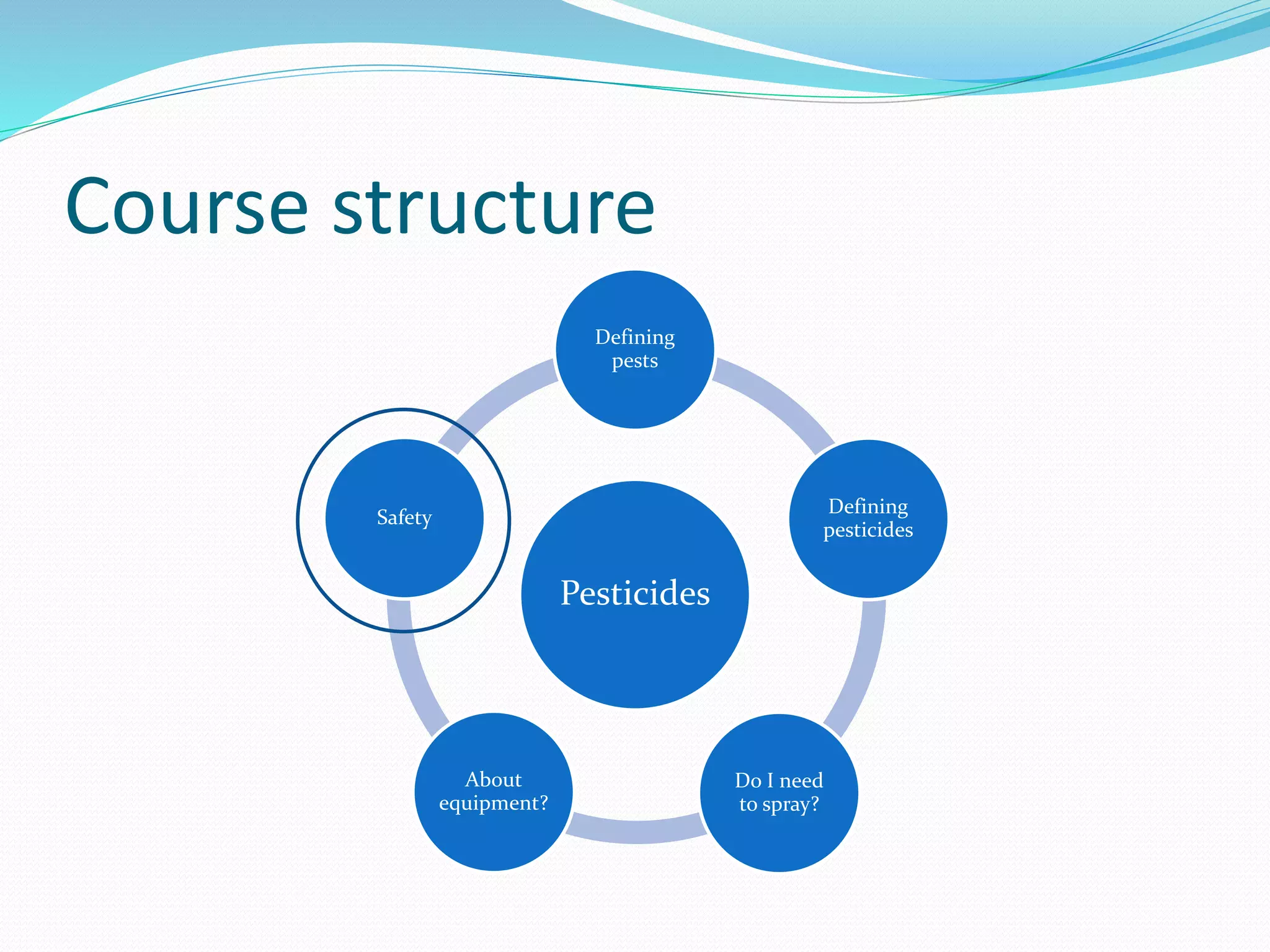
Course structure
Pesticides
Defining
pests
Defining
pesticides
Do I need
to spray?
About
equipment?
Safety
Safety – Pesticide Label
 Be sure
 Crop is on the label.
 Pest is on the label.
 To follow label directions for mixing.
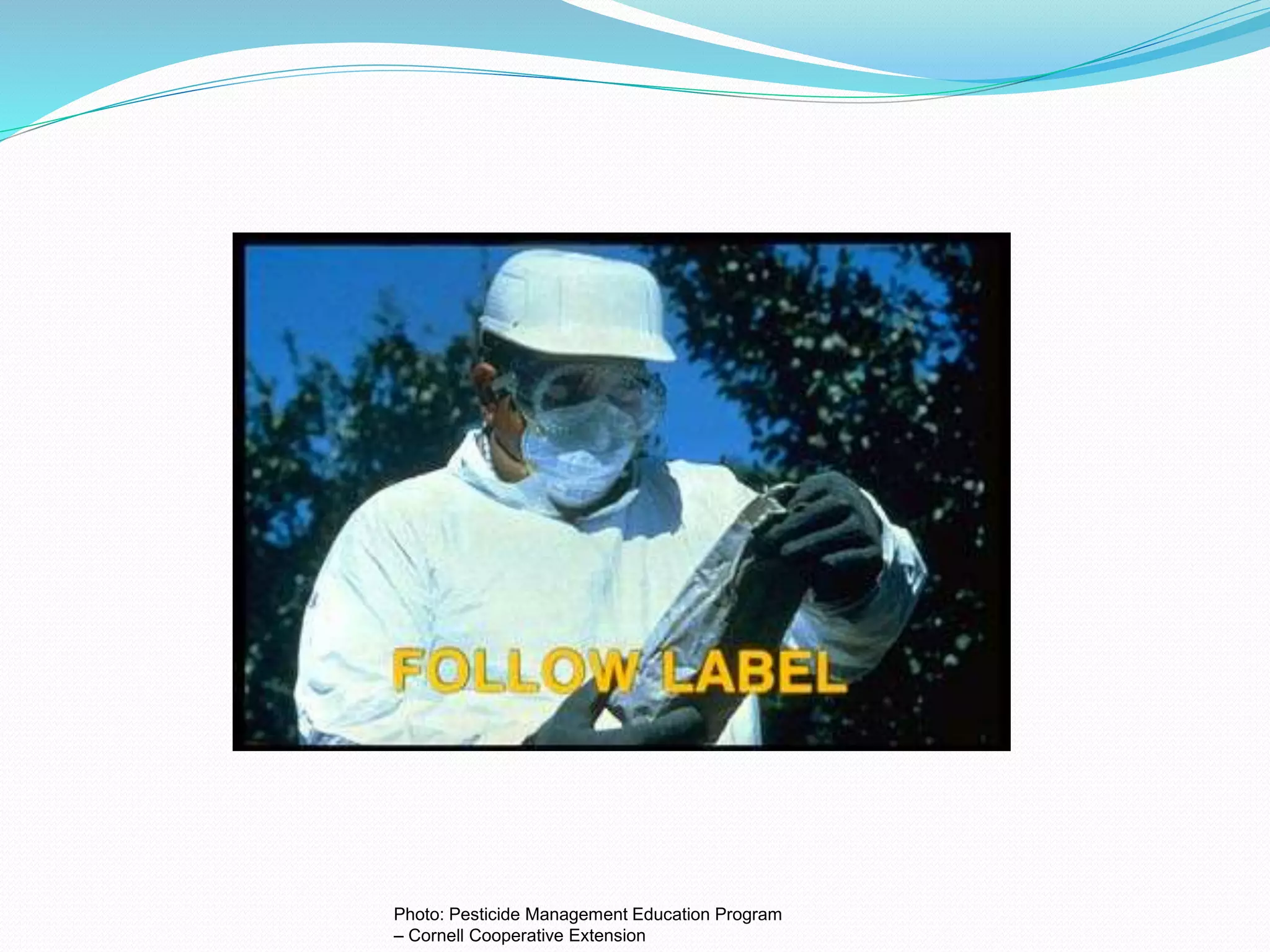
 To follow label directions for protective clothing.
 To check for other precautions (e.g., limitations on
harvested produce).
Safety – Pesticide Label
About the label
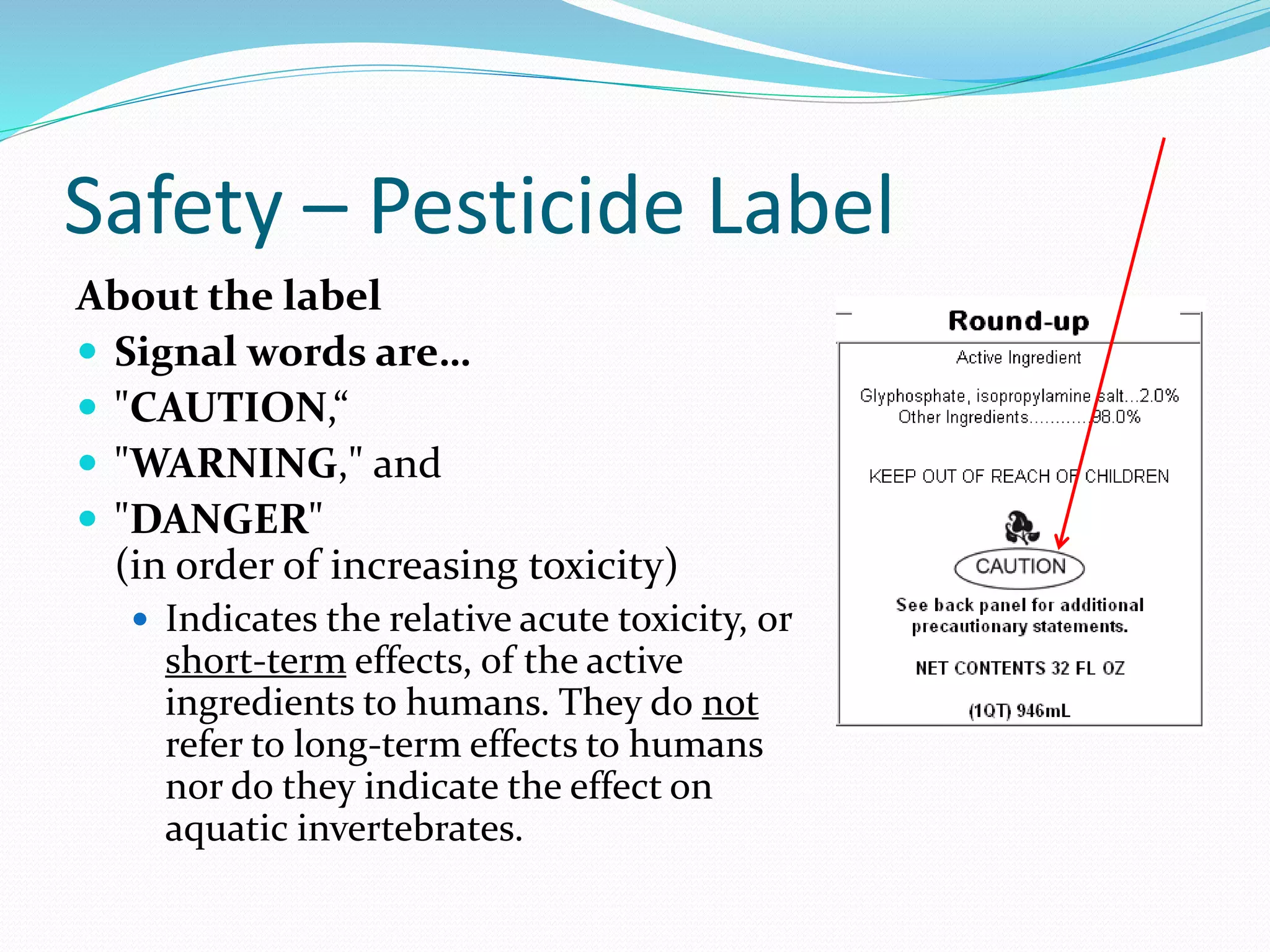
 Signal words are…
 "CAUTION,“
 "WARNING," and
 "DANGER"
(in order of increasing toxicity)
 Indicates the relative acute toxicity, or
short-term effects, of the active
ingredients to humans. They do not
refer to long-term effects to humans
nor do they indicate the effect on
aquatic invertebrates.
Safety – Pesticide Label
About the label
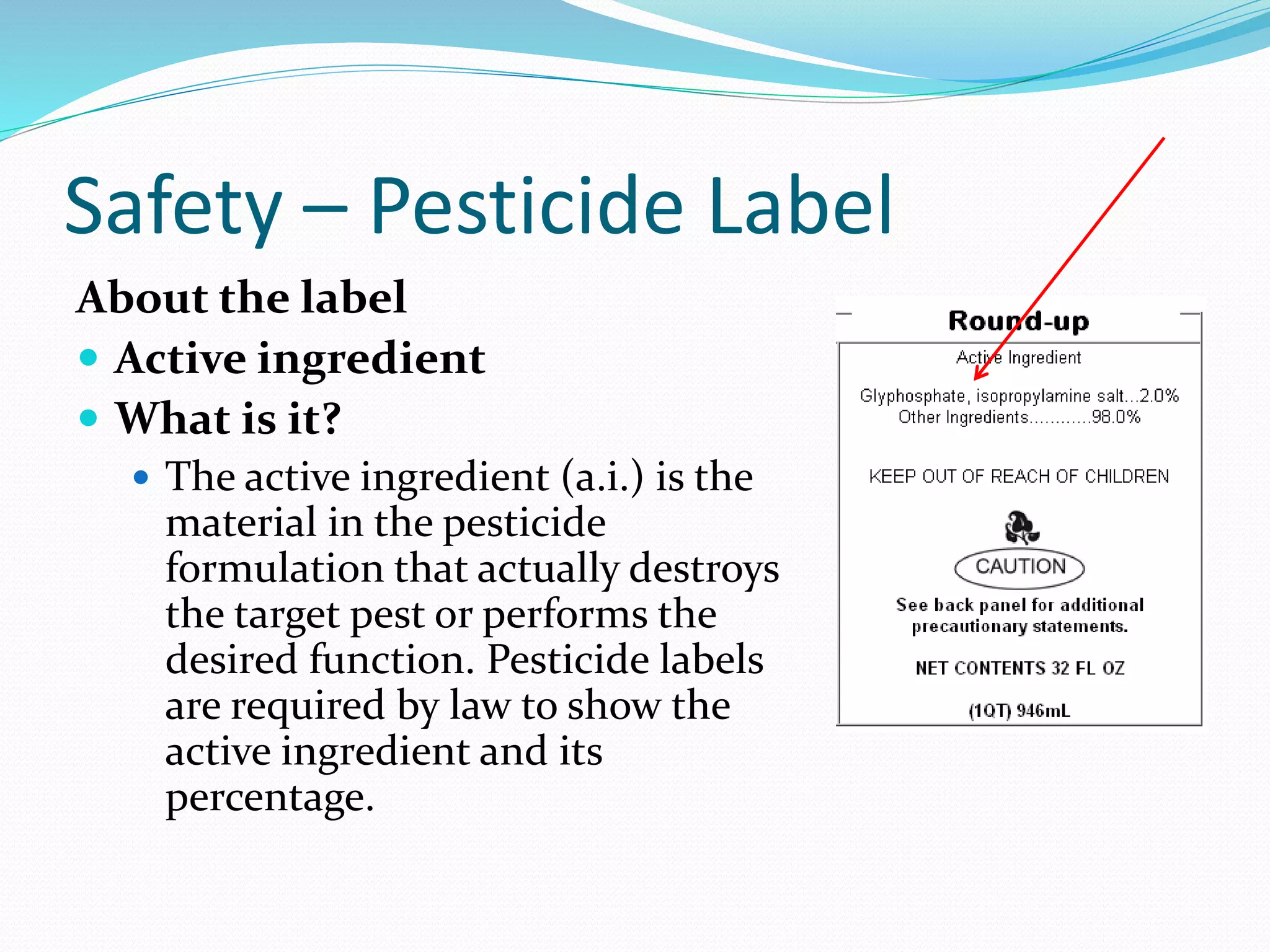
 Active ingredient
 What is it?
 The active ingredient (a.i.) is the
material in the pesticide
formulation that actually destroys
the target pest or performs the
desired function. Pesticide labels
are required by law to show the
active ingredient and its
percentage.
Safety – Pesticide Label
About the label
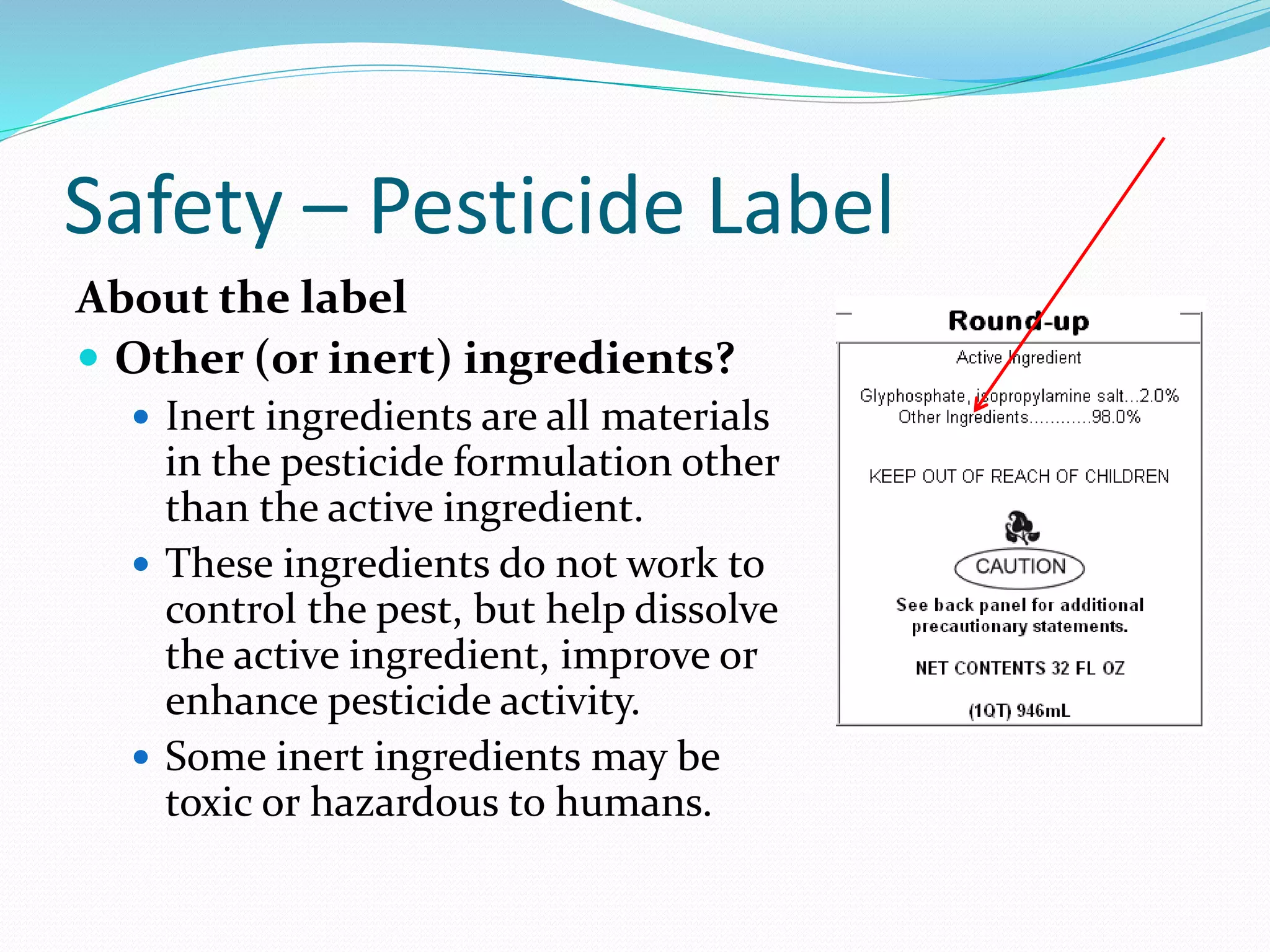
 Other (or inert) ingredients?
 Inert ingredients are all materials
in the pesticide formulation other
than the active ingredient.
 These ingredients do not work to
control the pest, but help dissolve
the active ingredient, improve or
enhance pesticide activity.
 Some inert ingredients may be
toxic or hazardous to humans.
Safety – Pesticide Label
About the label
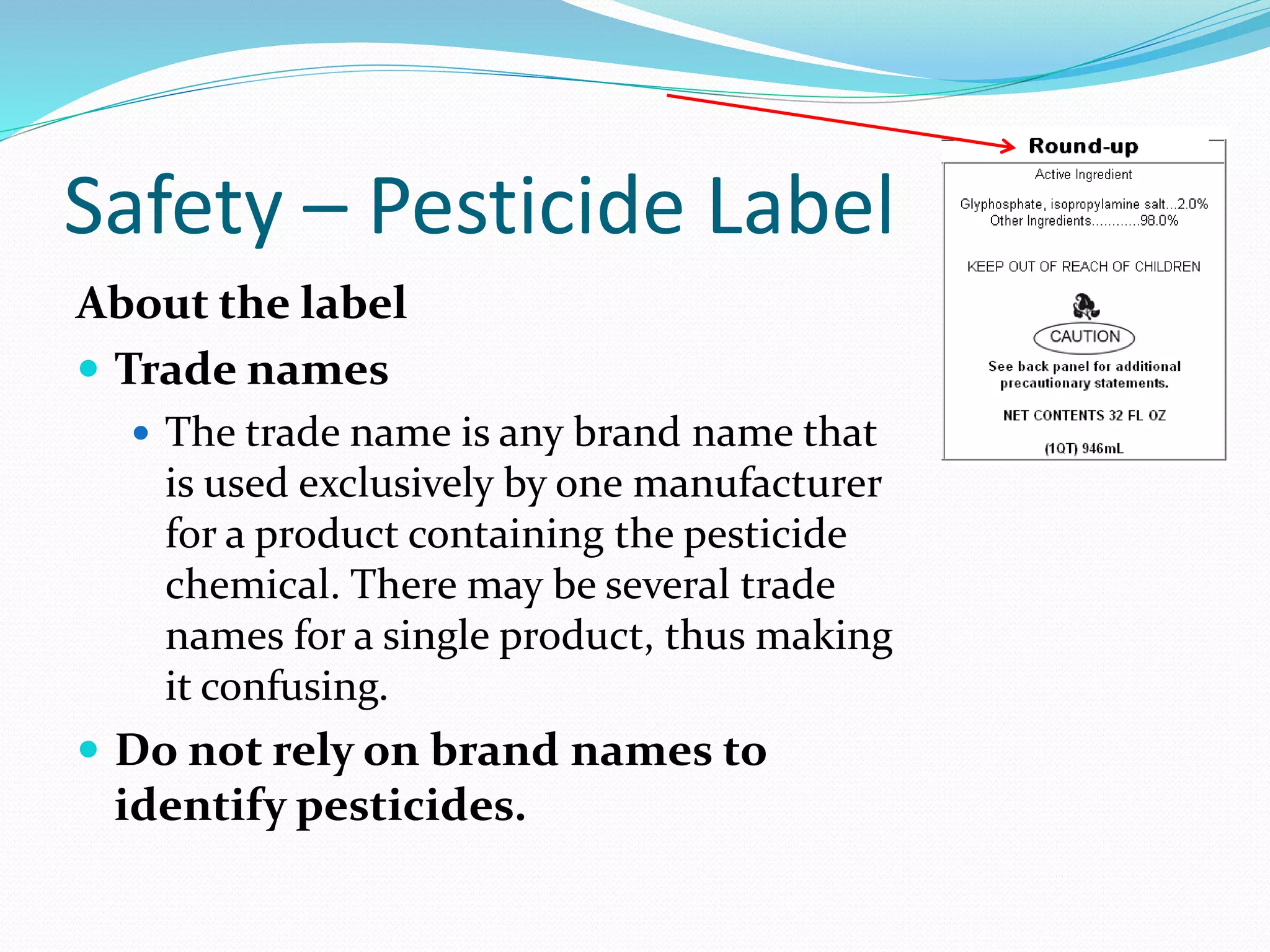
 Trade names
 The trade name is any brand name that
is used exclusively by one manufacturer
for a product containing the pesticide
chemical. There may be several trade
names for a single product, thus making
it confusing.
 Do not rely on brand names to
identify pesticides.
Safety – Pesticide Label
Surfactants
 What is a surfactant?
 Added to decrease surface tension of the applied liquid
to improve surface wetting and penetration of the
product.
 Check the label - surfactants may be added or may
come as already included in the product.
Photo: Pesticide Management Education Program
– Cornell Cooperative Extension
Safety – Exposure
Understand the dangers
 When can you be
contaminated?
 How can you or others be
contaminated?
 Where is absorption greatest?
 What does that mean for
protecting yourself and
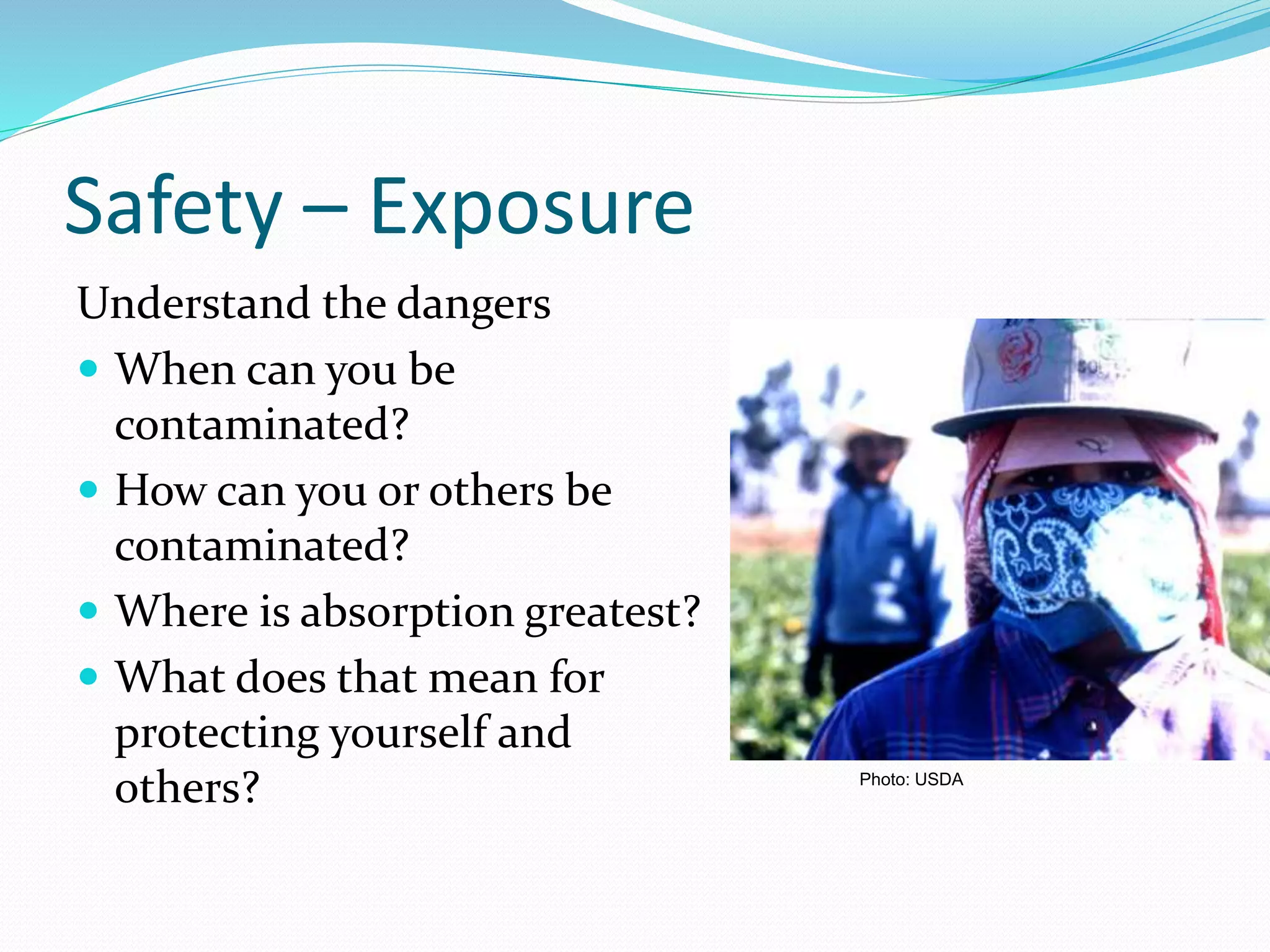
others? Photo: USDA
Safety – Dangers
 When are risks the highest for exposure?
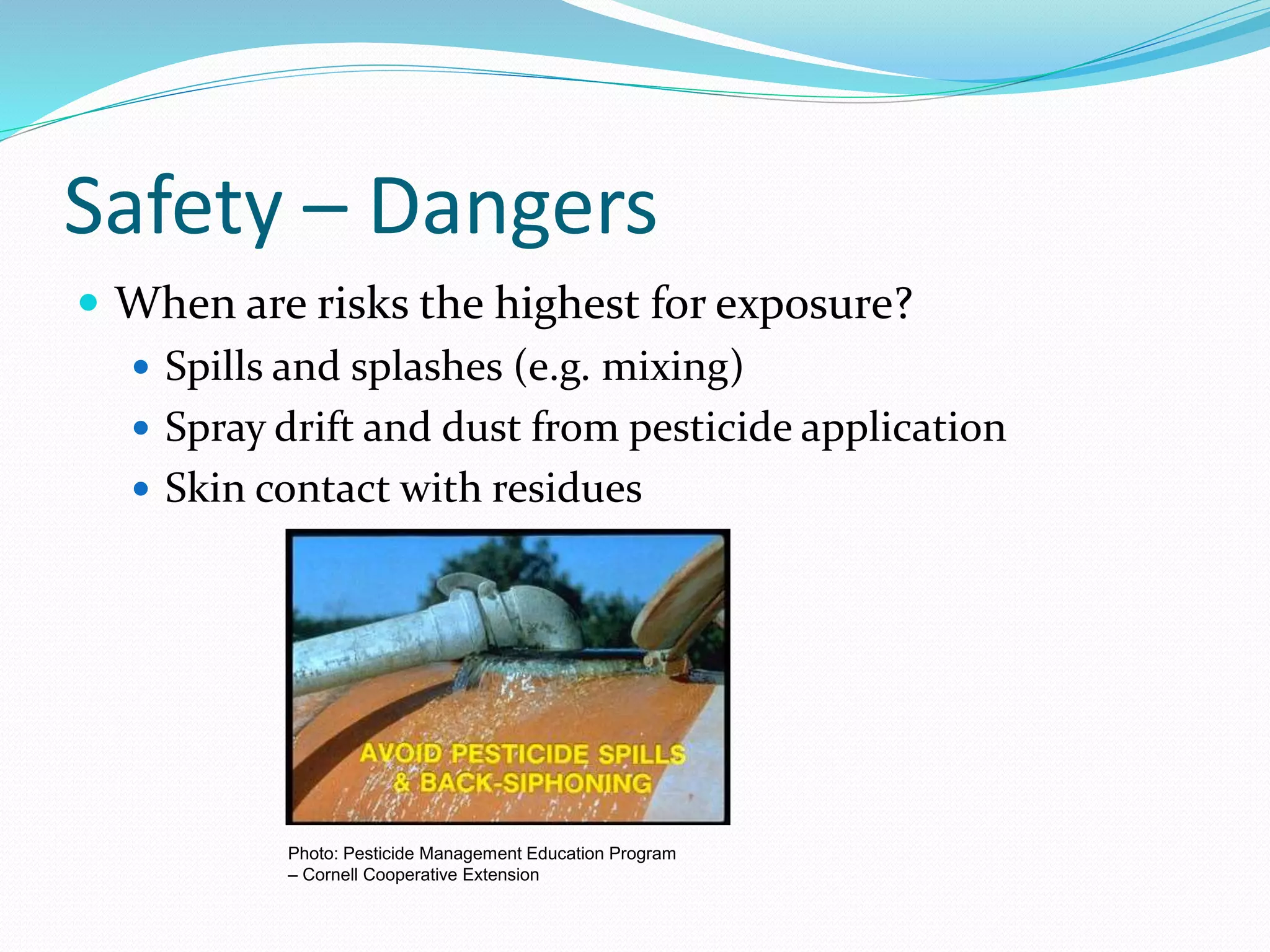
 Spills and splashes (e.g. mixing)
 Spray drift and dust from pesticide application
 Skin contact with residues
Photo: Pesticide Management Education Program
– Cornell Cooperative Extension
Safety – Dangers
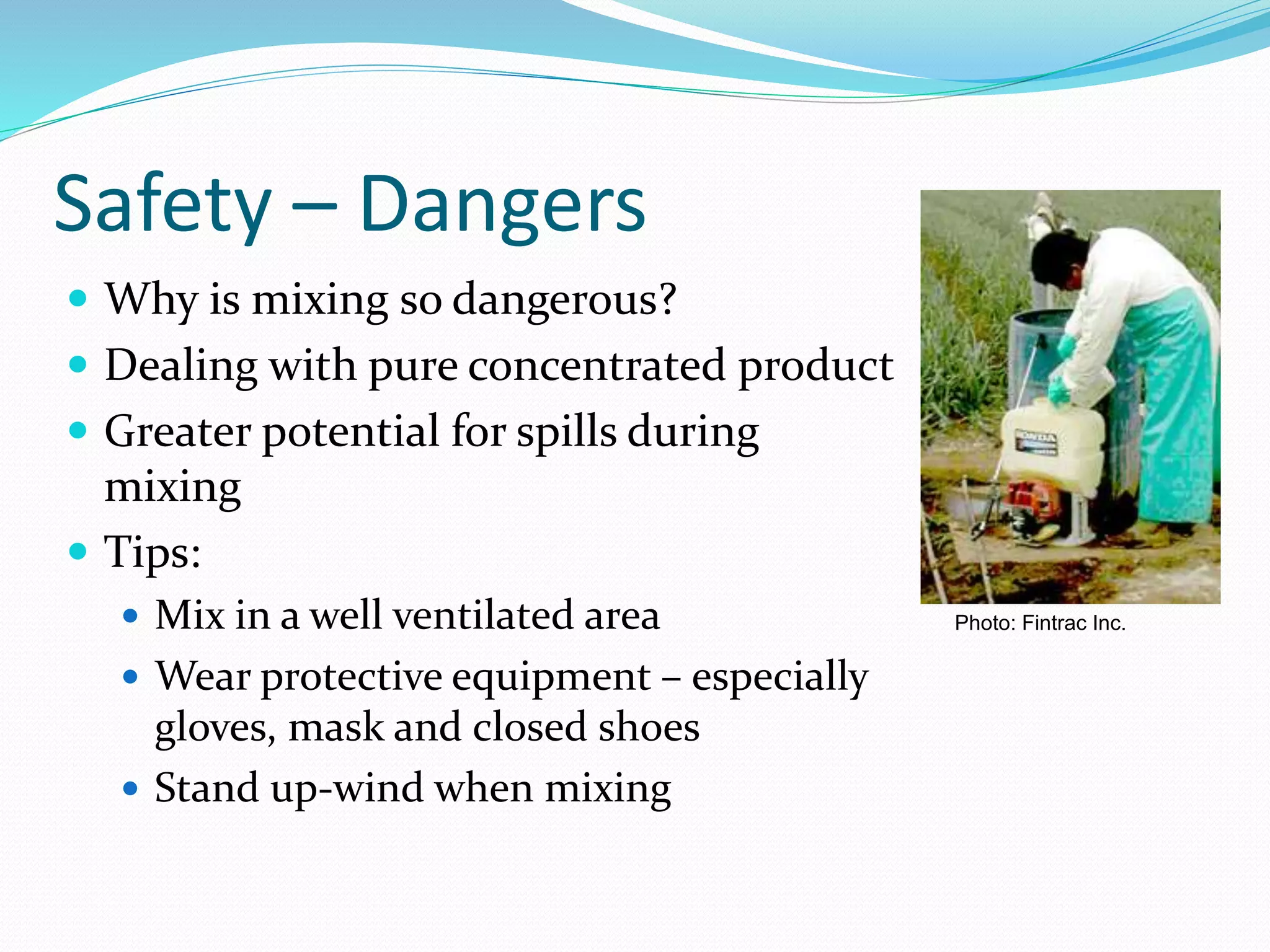
 Why is mixing so dangerous?
 Dealing with pure concentrated product
 Greater potential for spills during
mixing
 Tips:
 Mix in a well ventilated area
 Wear protective equipment – especially
gloves, mask and closed shoes
 Stand up-wind when mixing
Photo: Fintrac Inc.
Safety – Dangers
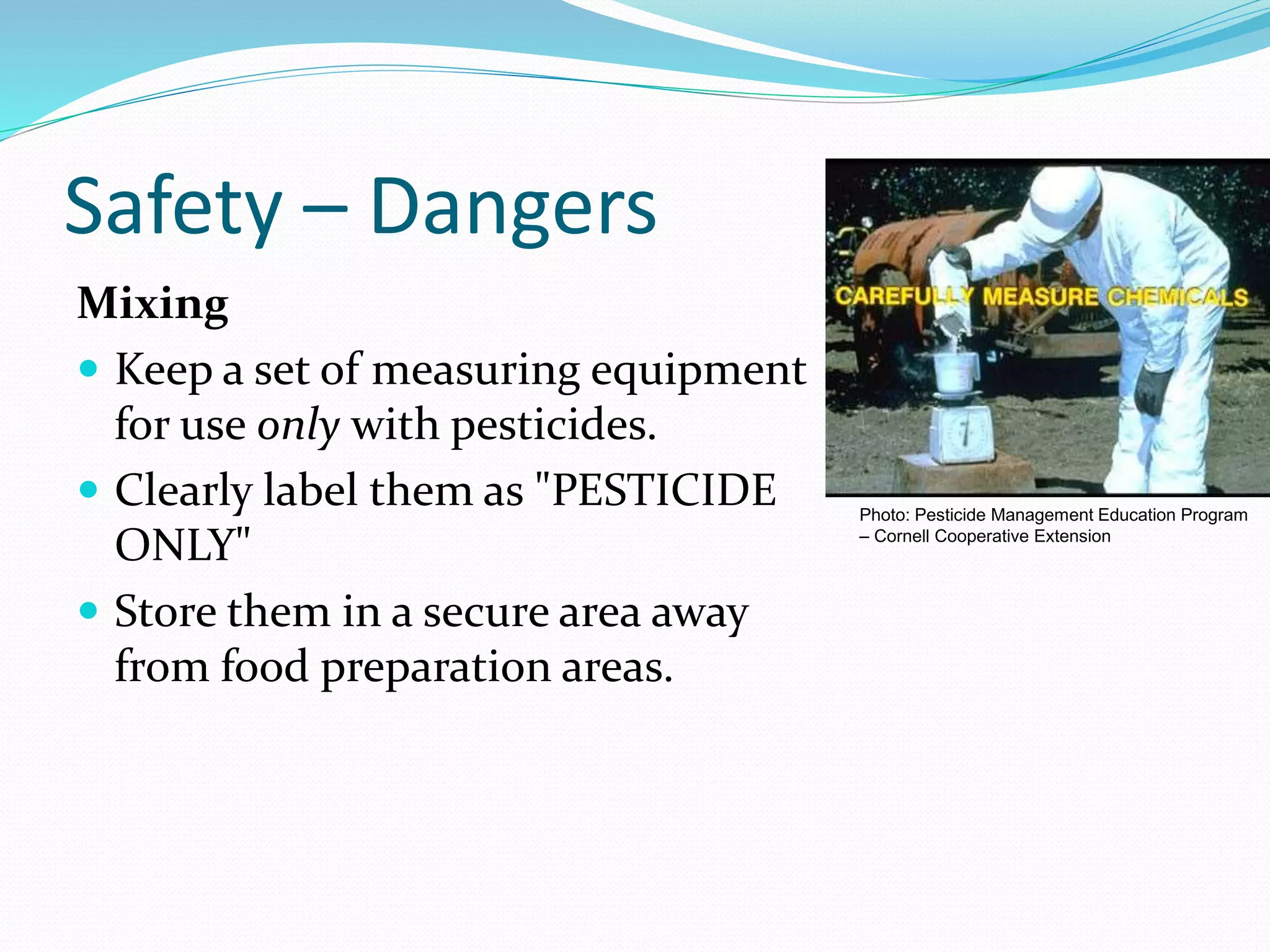
Mixing
 Keep a set of measuring equipment
for use only with pesticides.
 Clearly label them as "PESTICIDE
ONLY"
 Store them in a secure area away
from food preparation areas.
Photo: Pesticide Management Education Program
– Cornell Cooperative Extension
Safety – Exposure
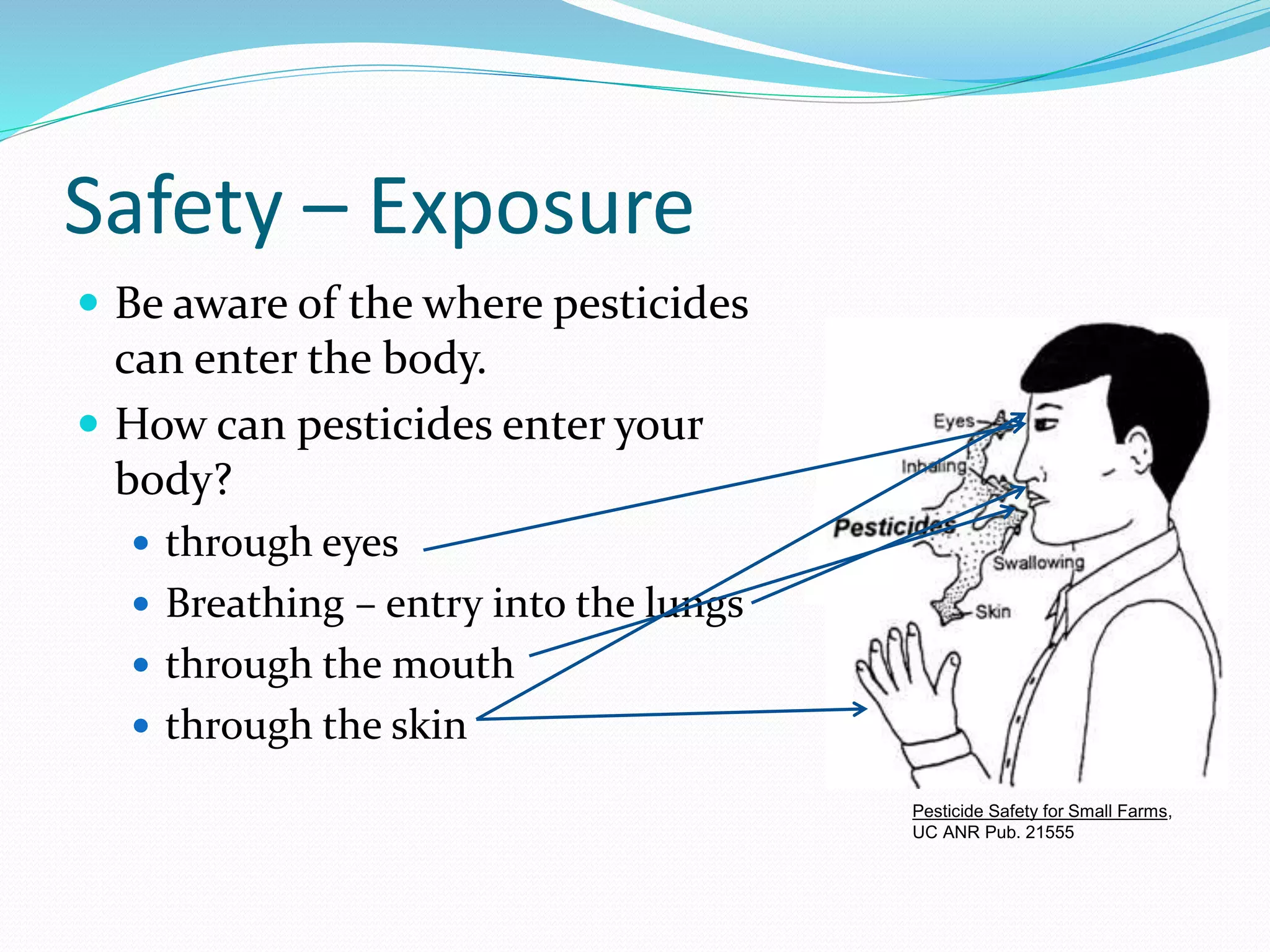
 Be aware of the where pesticides
can enter the body.
 How can pesticides enter your
body?
 through eyes
 Breathing – entry into the lungs
 through the mouth
 through the skin
Pesticide Safety for Small Farms,
UC ANR Pub. 21555
Safety - Exposure
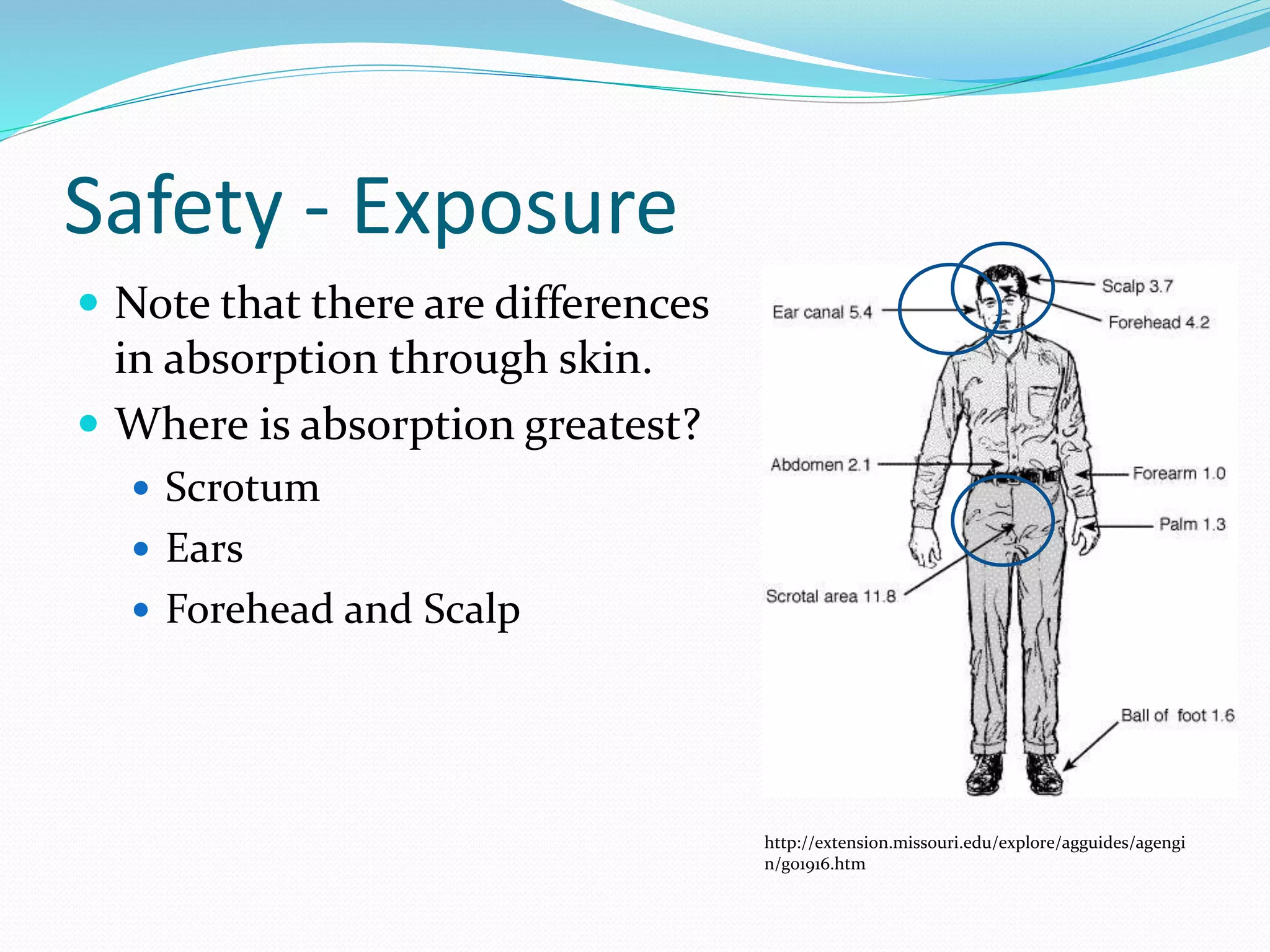
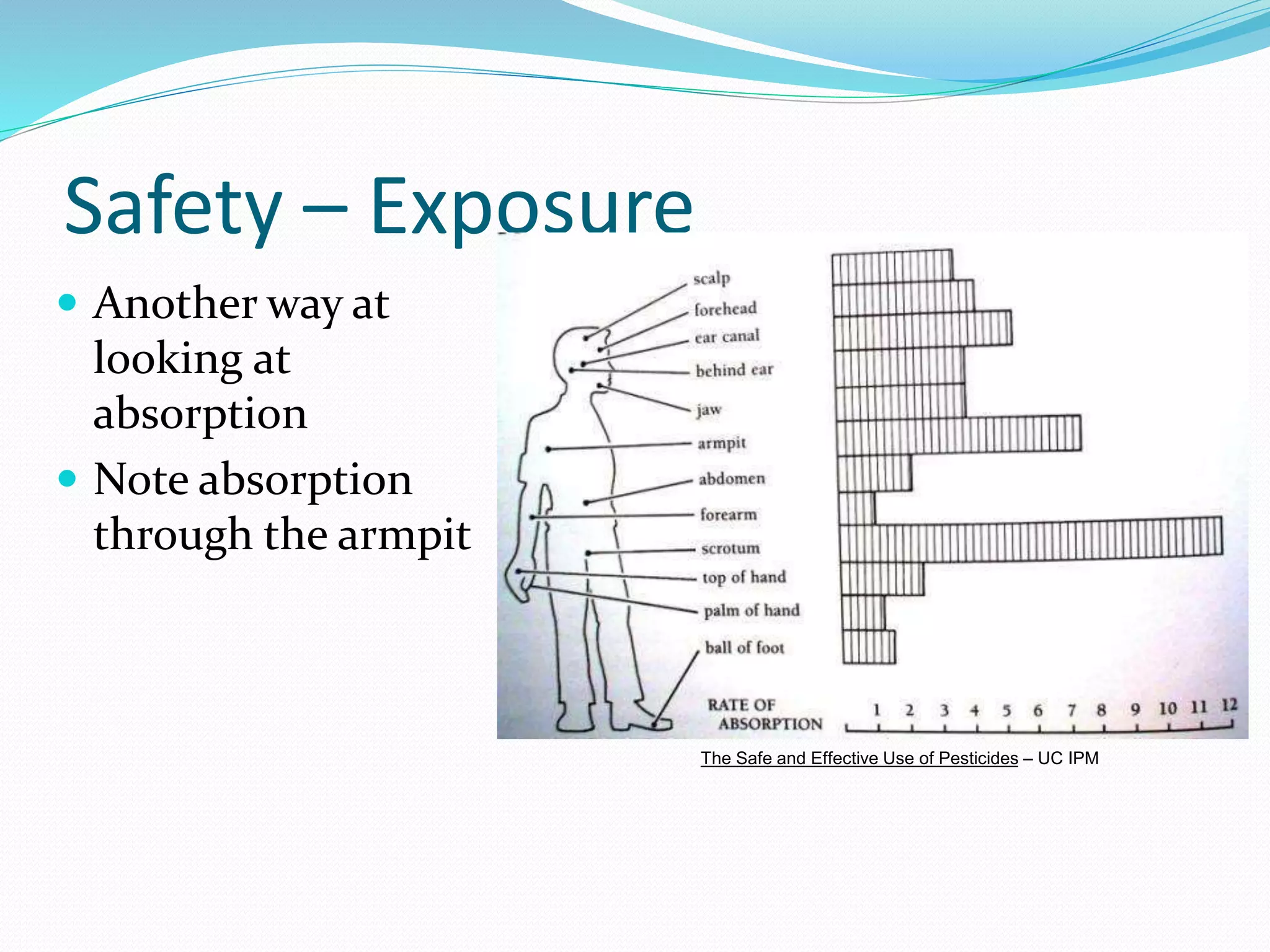
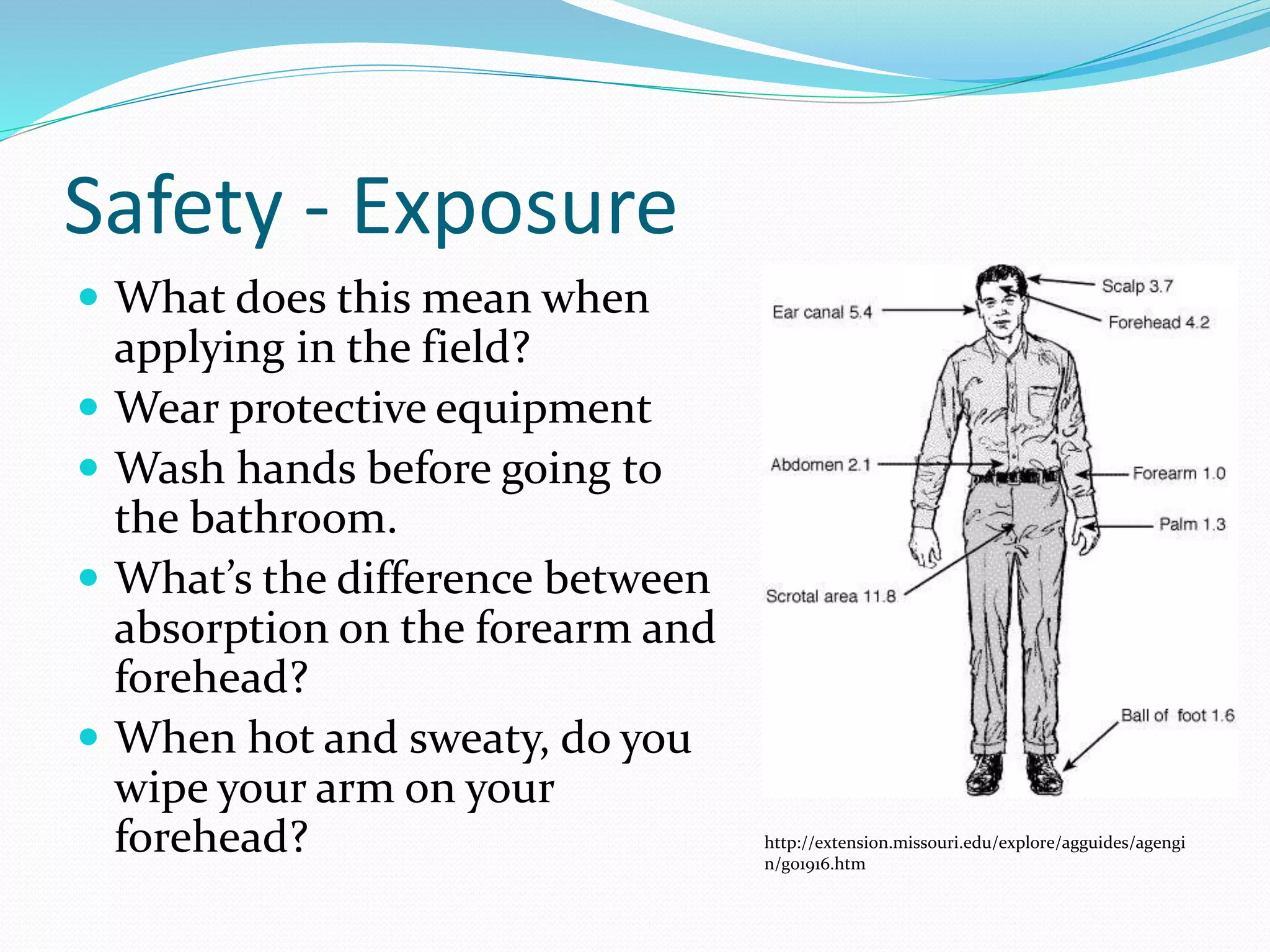
 Note that there are differences
in absorption through skin.
 Where is absorption greatest?
 Scrotum
 Ears
 Forehead and Scalp
http://extension.missouri.edu/explore/agguides/agengi
n/g01916.htm
Safety – Exposure
 Another way at
looking at
absorption
 Note absorption
through the armpit
The Safe and Effective Use of Pesticides – UC IPM
Safety - Exposure
 What does this mean when
applying in the field?
 Wear protective equipment
 Wash hands before going to
the bathroom.
 What’s the difference between
absorption on the forearm and
forehead?
 When hot and sweaty, do you
wipe your arm on your
forehead? http://extension.missouri.edu/explore/agguides/agengi
n/g01916.htm
Safety – Protective Gear
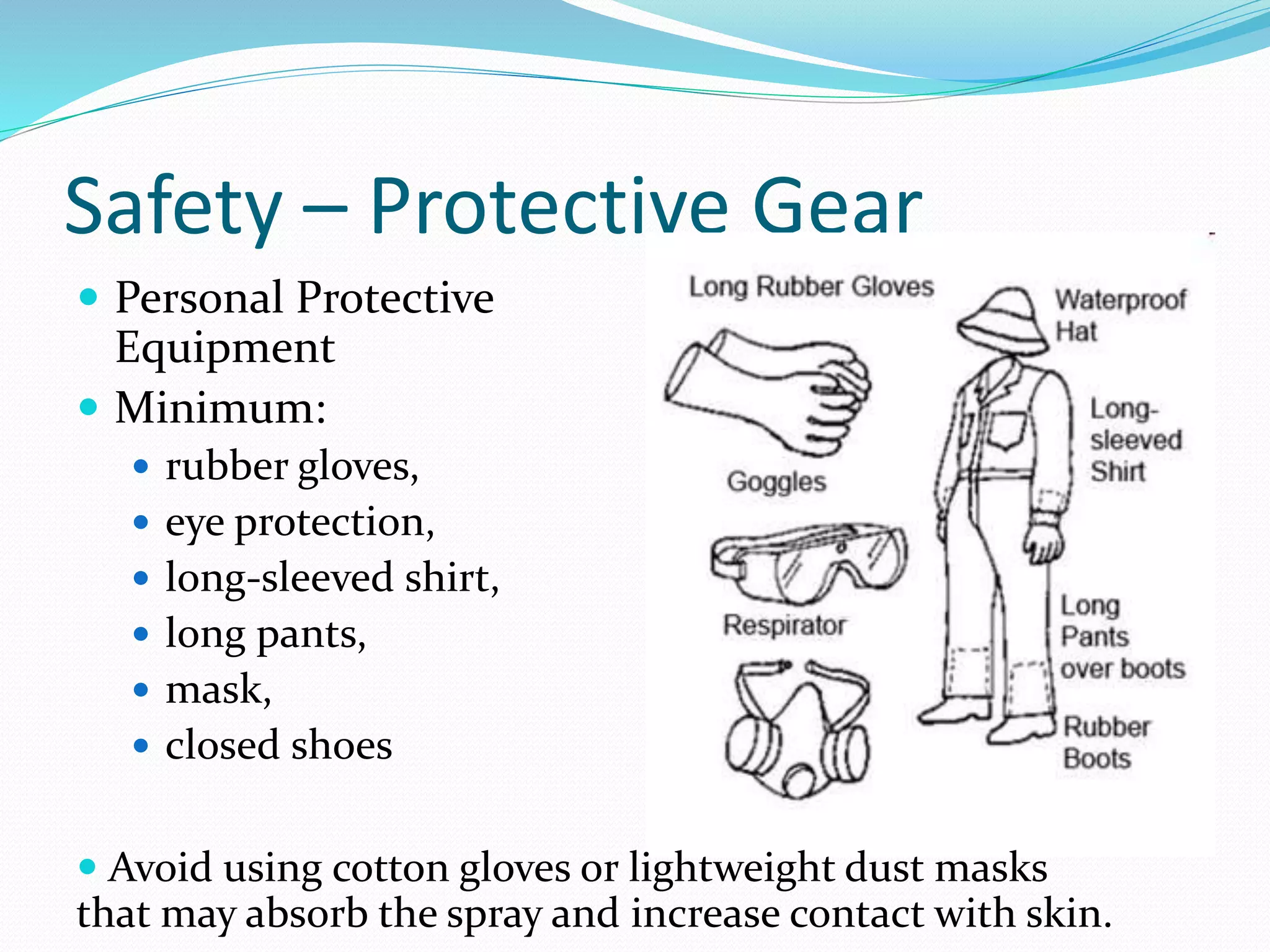
 Personal Protective
Equipment
 Minimum:
 rubber gloves,
 eye protection,
 long-sleeved shirt,
 long pants,
 mask,
 closed shoes
 Avoid using cotton gloves or lightweight dust masks
that may absorb the spray and increase contact with skin.
Safety – Protective Gear
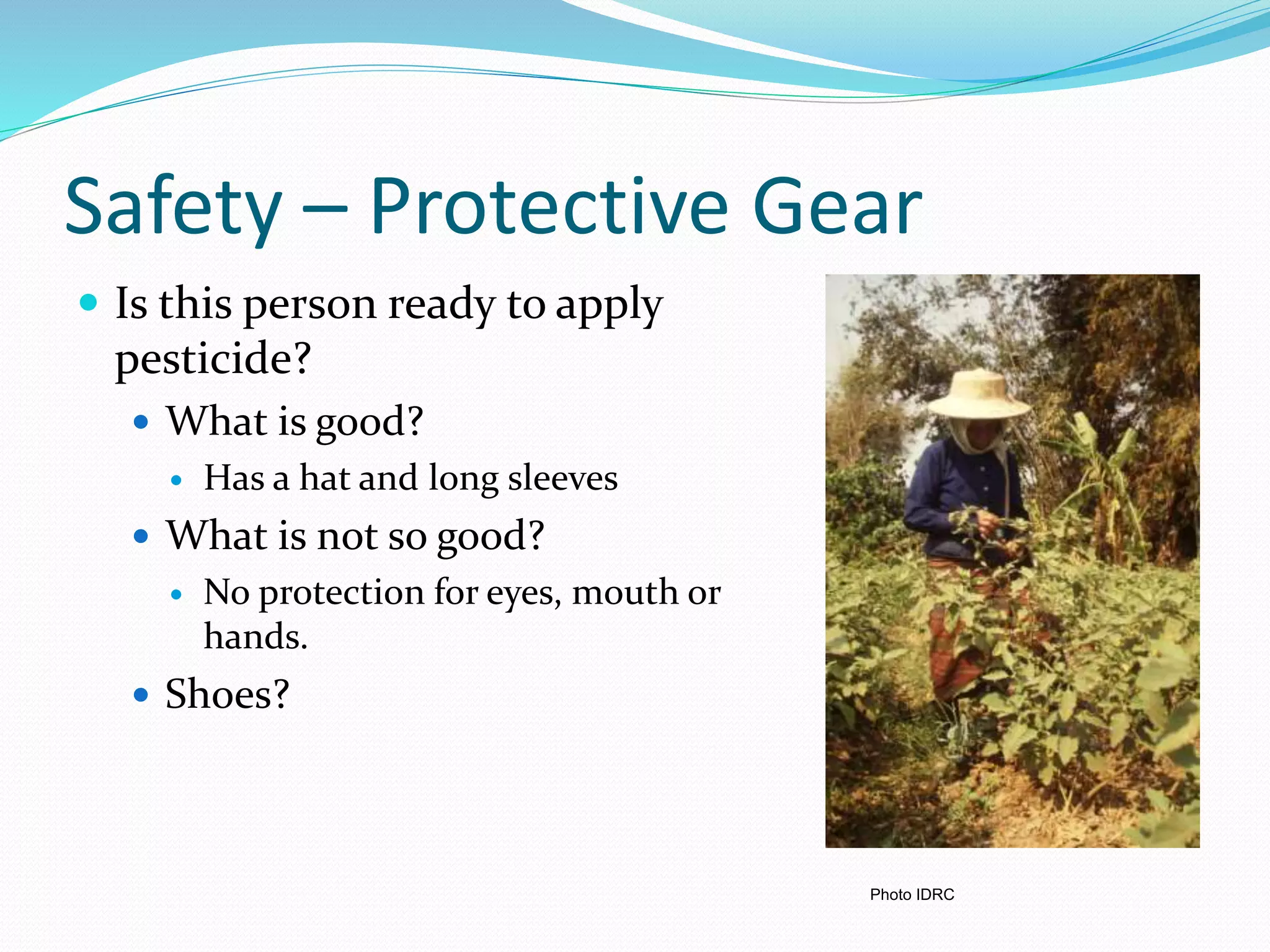
 Is this person ready to apply
pesticide?
 What is good?
 Has a hat and long sleeves
 What is not so good?
 No protection for eyes, mouth or
hands.
 Shoes?
Photo IDRC
Safety – Protective Gear
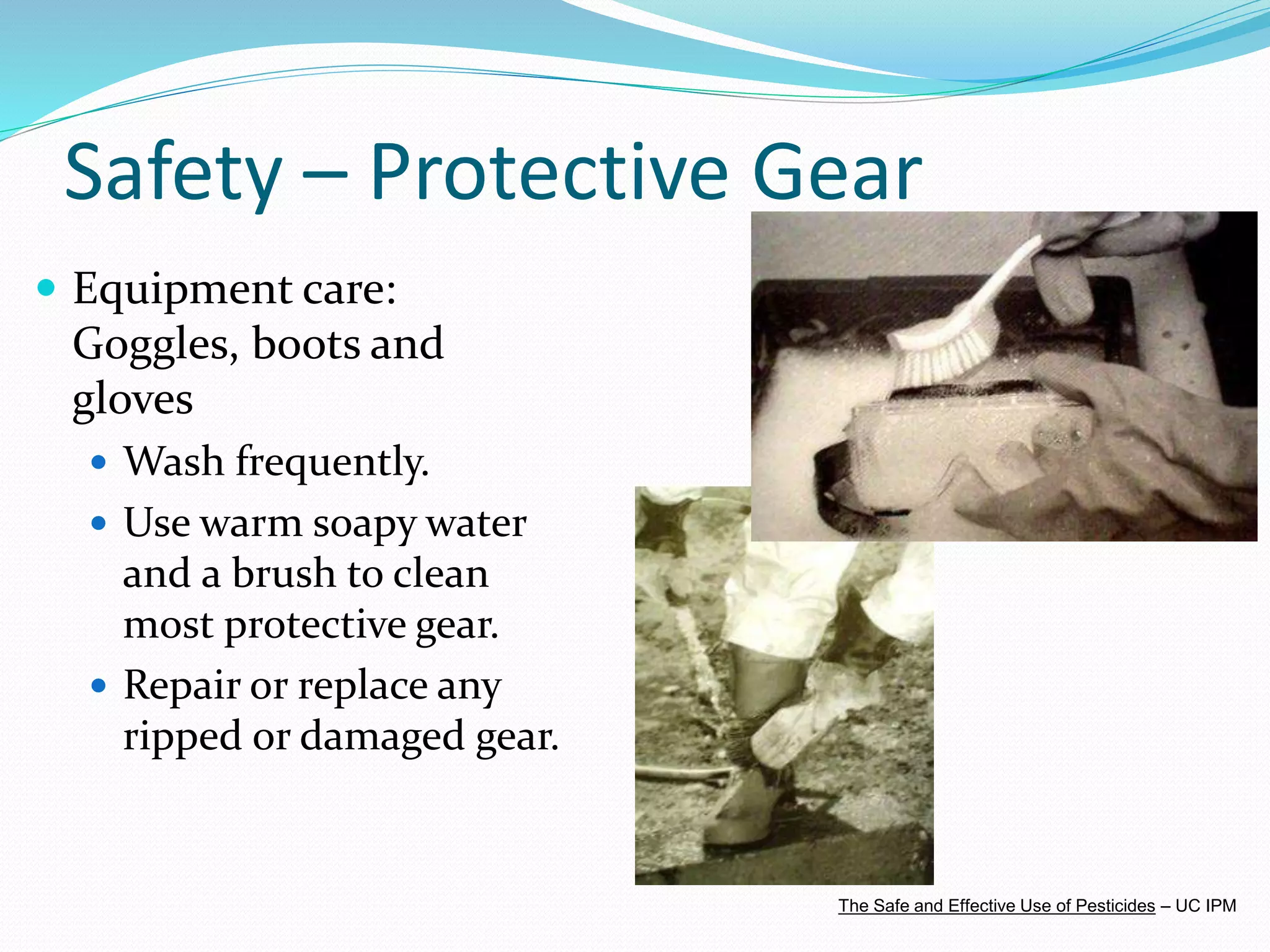
 Equipment care:
Goggles, boots and
gloves
 Wash frequently.
 Use warm soapy water
and a brush to clean
most protective gear.
 Repair or replace any
ripped or damaged gear.
The Safe and Effective Use of Pesticides – UC IPM
Safety – Protective Gear
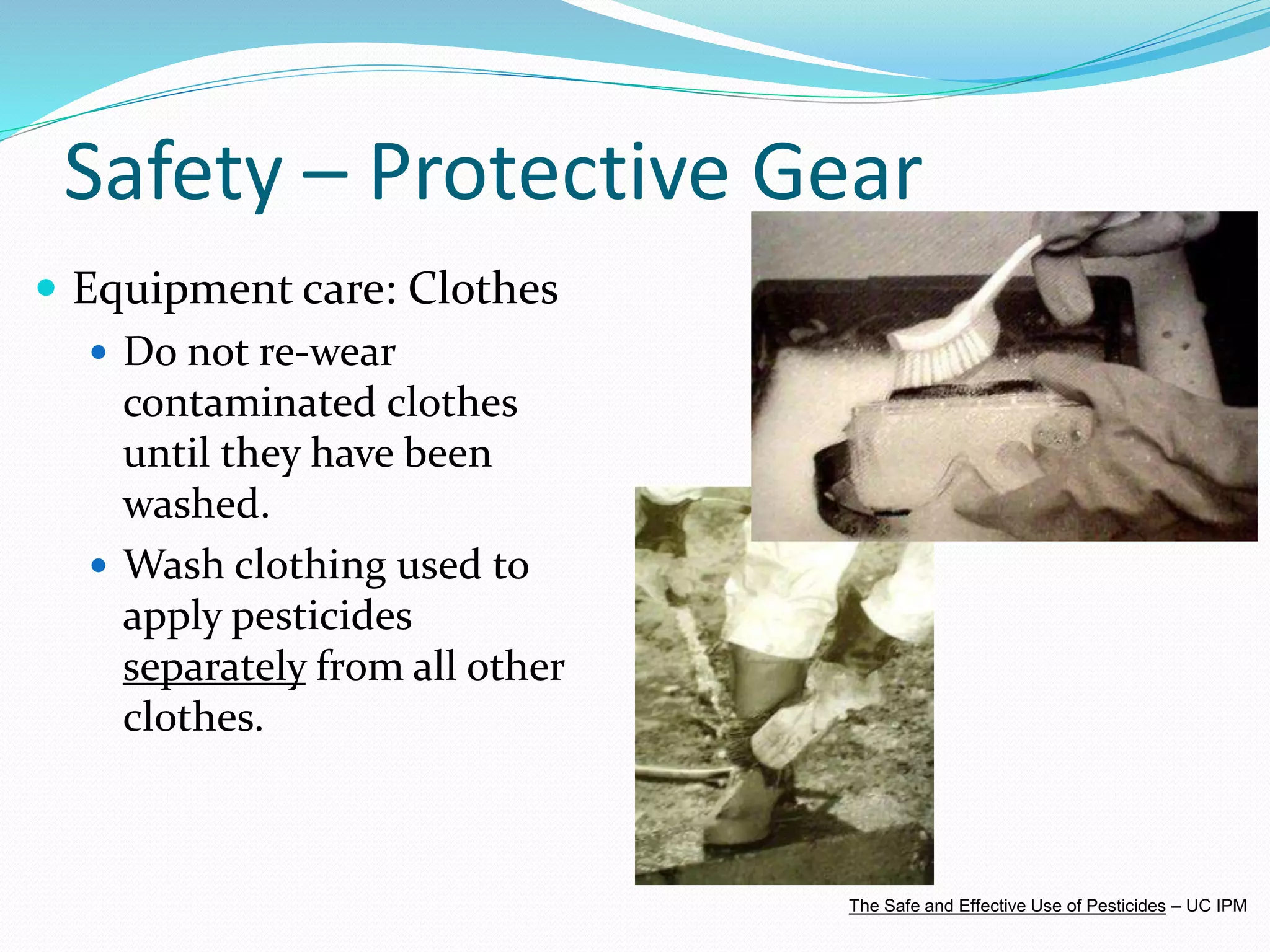
 Equipment care: Clothes
 Do not re-wear
contaminated clothes
until they have been
washed.
 Wash clothing used to
apply pesticides
separately from all other
clothes.
The Safe and Effective Use of Pesticides – UC IPM
Safety – Good Practices
 Before you spray…
 Check the label
 First put on all protective equipment
 Inspect sprayer and hose to ensure
there are no leaks
 Check area to make sure there are no:
 People
 Pets/Livestock
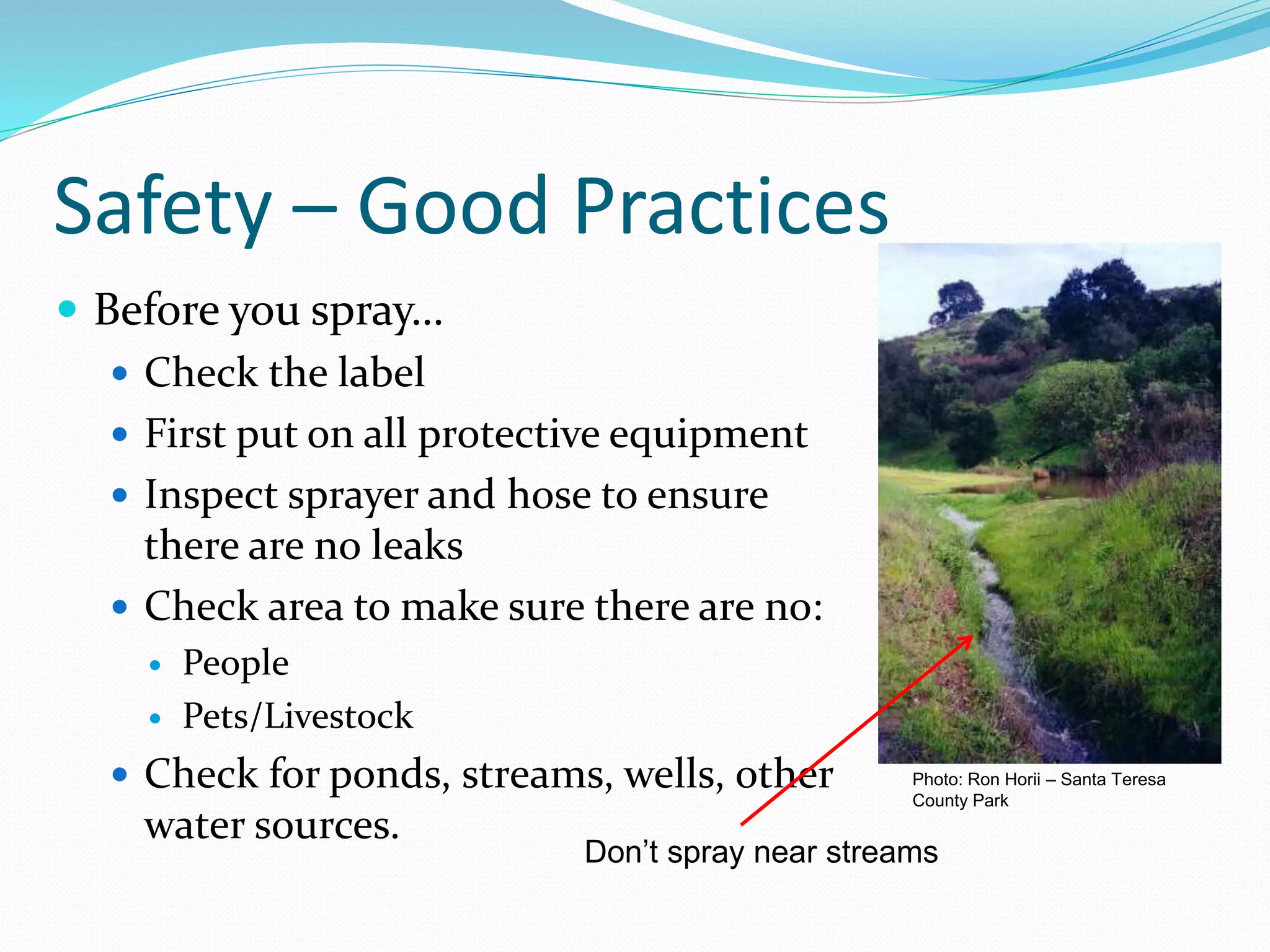
 Check for ponds, streams, wells, other
water sources.
Photo: Ron Horii – Santa Teresa
County Park
Don’t spray near streams
Safety – Good Practices
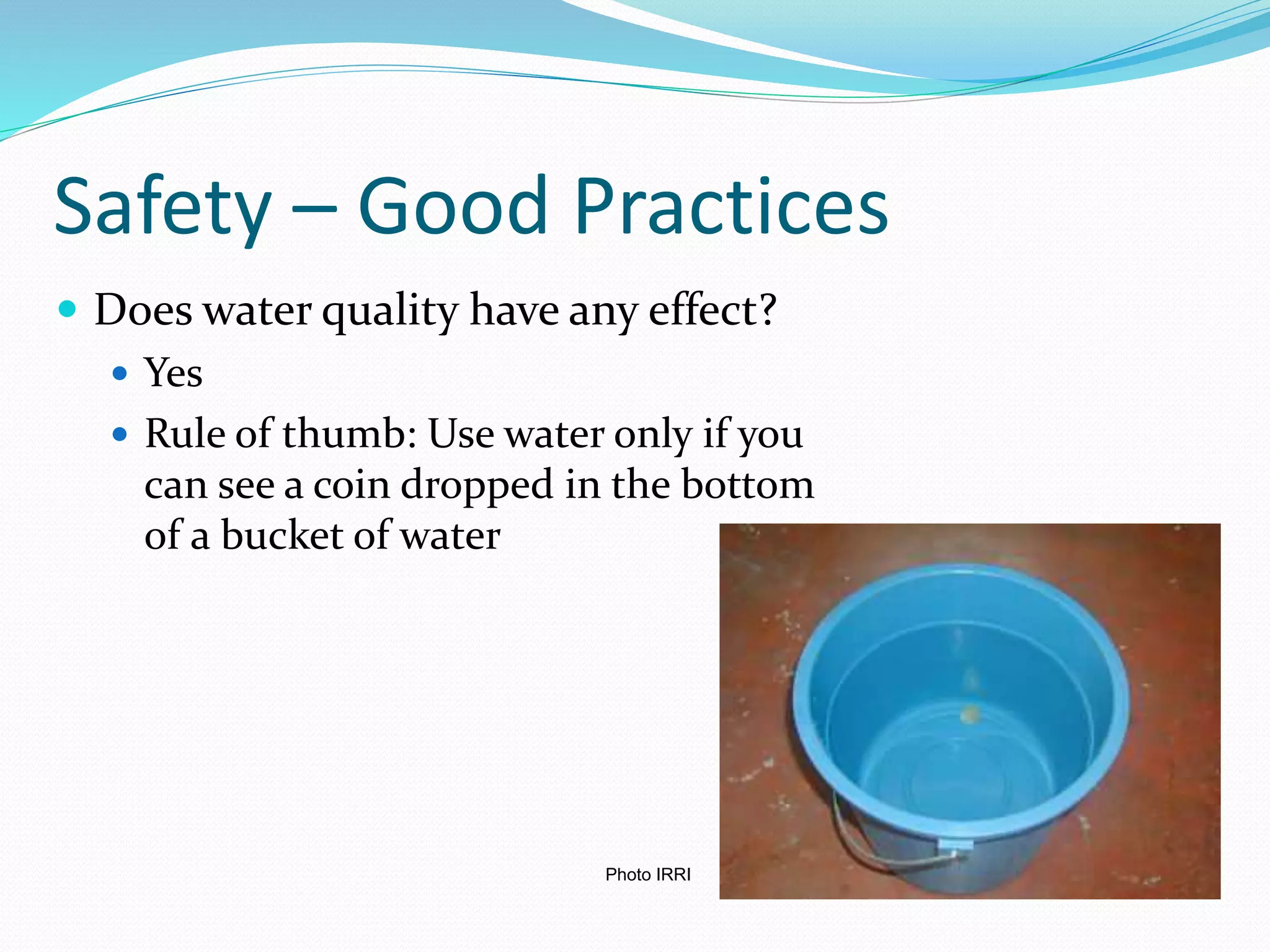
 Does water quality have any effect?
 Yes
 Rule of thumb: Use water only if you
can see a coin dropped in the bottom
of a bucket of water
Photo IRRI
Safety – Good Practices
 While Spraying…
As much as possible
 Spray away from the body
 Do not let yourself become soaked with pesticide
 Avoid walking through spray
 Stand upwind
 Avoid spraying straight overhead
 Be mindful of drift (wind carrying pesticide
droplets)
Safety – Good Practices
 Wash hands before:
 Eating
 Going to bathroom
 Smoking
 Do not wipe forearm on
forehead when sweaty.
 Keep foods away from
pesticides and sprayed
areas. Keep covered.
Pesticide Safety for Small Farms,
UC ANR Pub. 21555
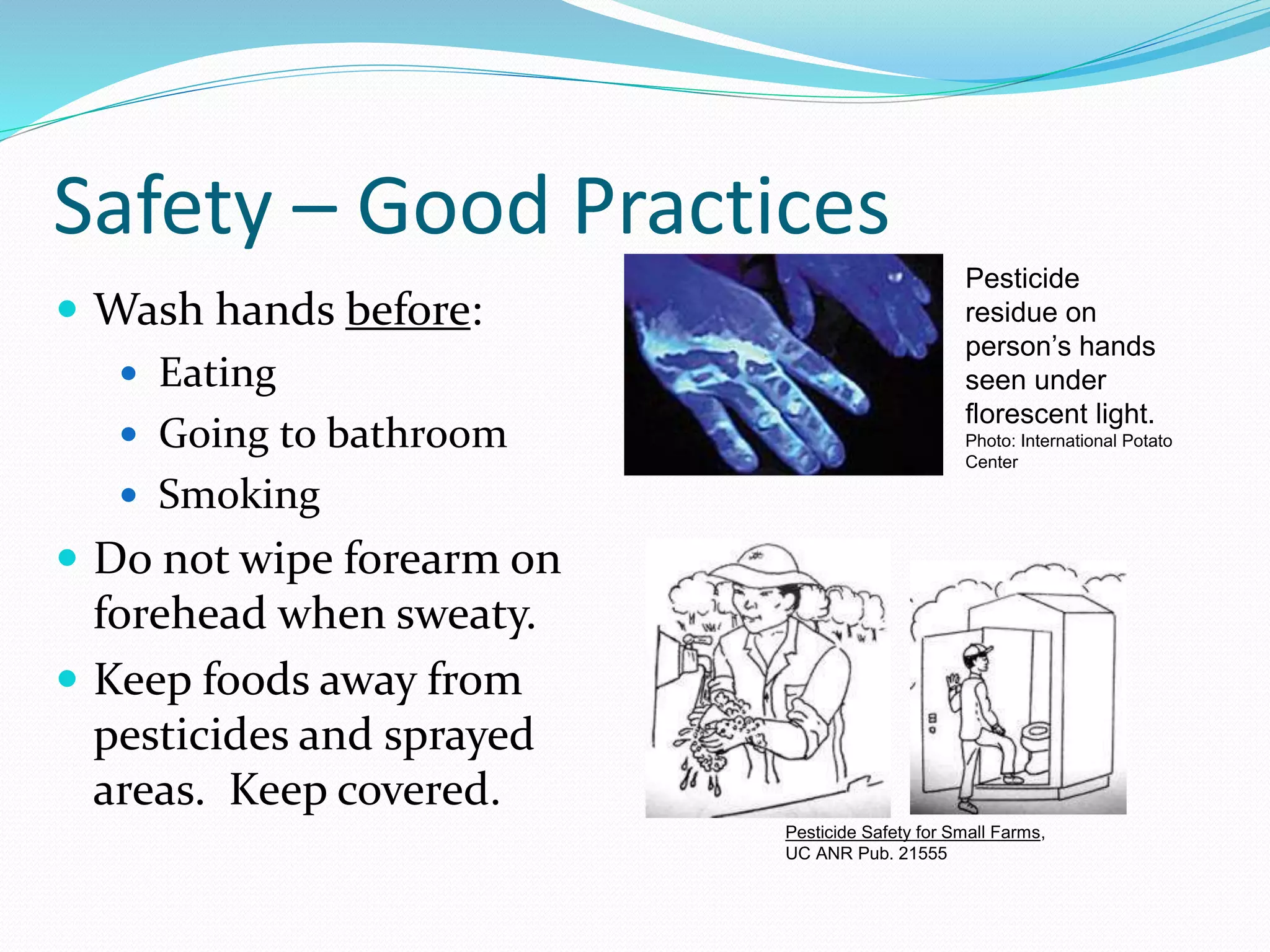
Pesticide
residue on
person’s hands
seen under
florescent light.
Photo: International Potato
Center
Safety – Good Practices
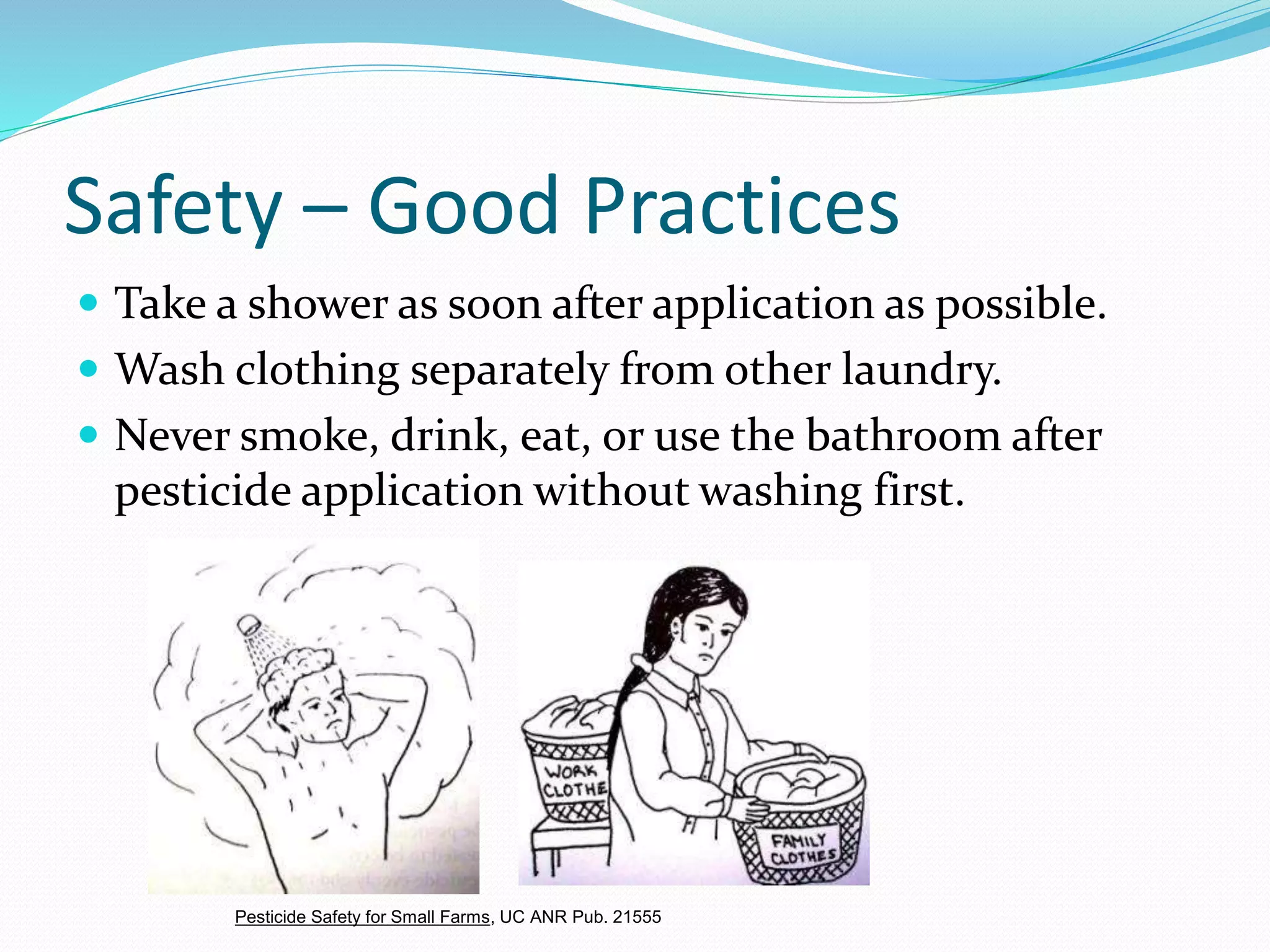
 Take a shower as soon after application as possible.
 Wash clothing separately from other laundry.
 Never smoke, drink, eat, or use the bathroom after
pesticide application without washing first.
Pesticide Safety for Small Farms, UC ANR Pub. 21555
Safety – Cleaning Equipment
 When finished using sprayer…
 Try to not have any excess
pesticide in the tank.
 Rinse tank by running fresh
water through the sprayers.
 Do not leave sprayer in the
field.
 Do not allow equipment to sit
for a long time with pesticide
in the tank. This may clog or
corrode the machine.
Safety – Cleaning Equipment
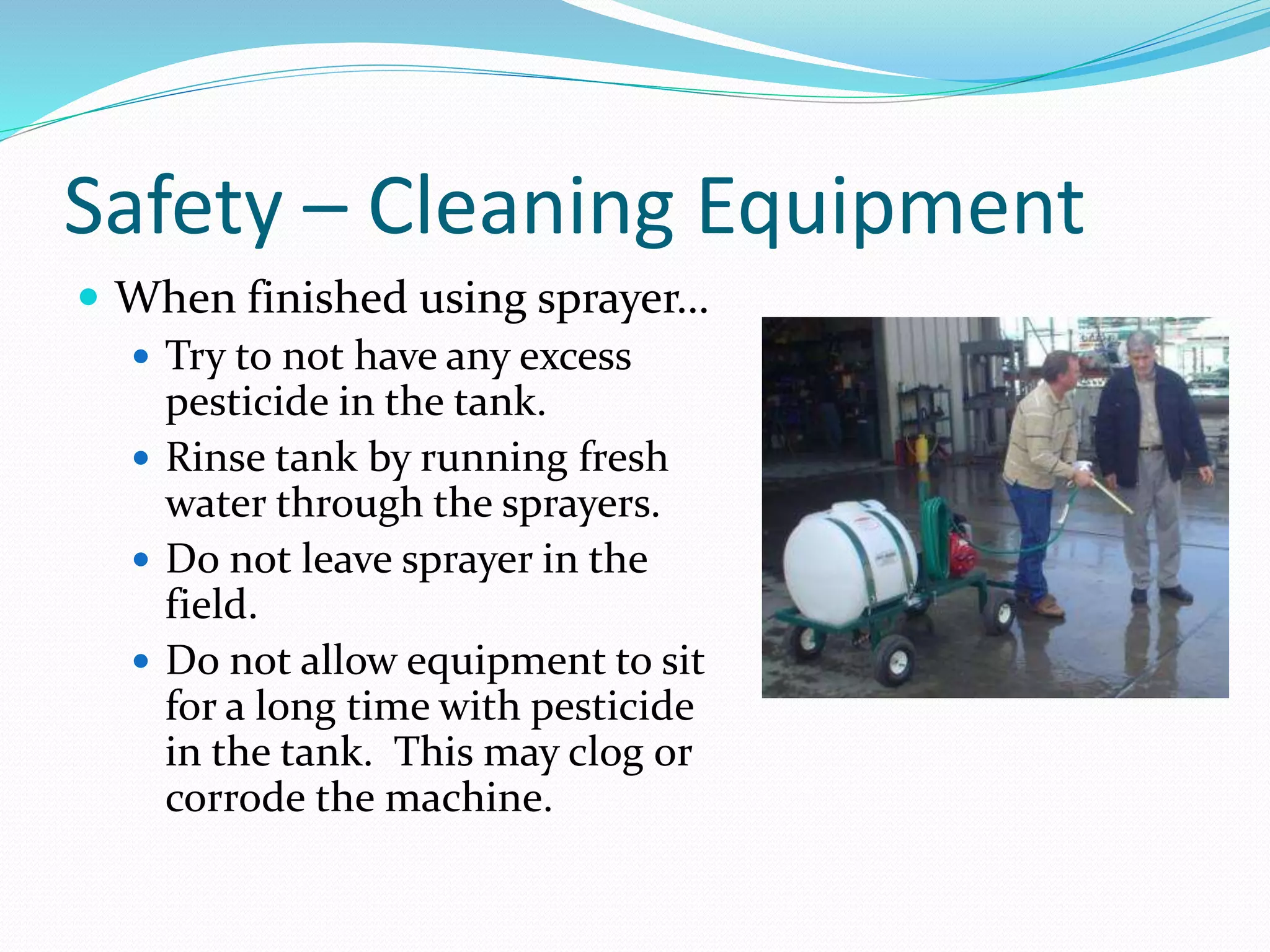
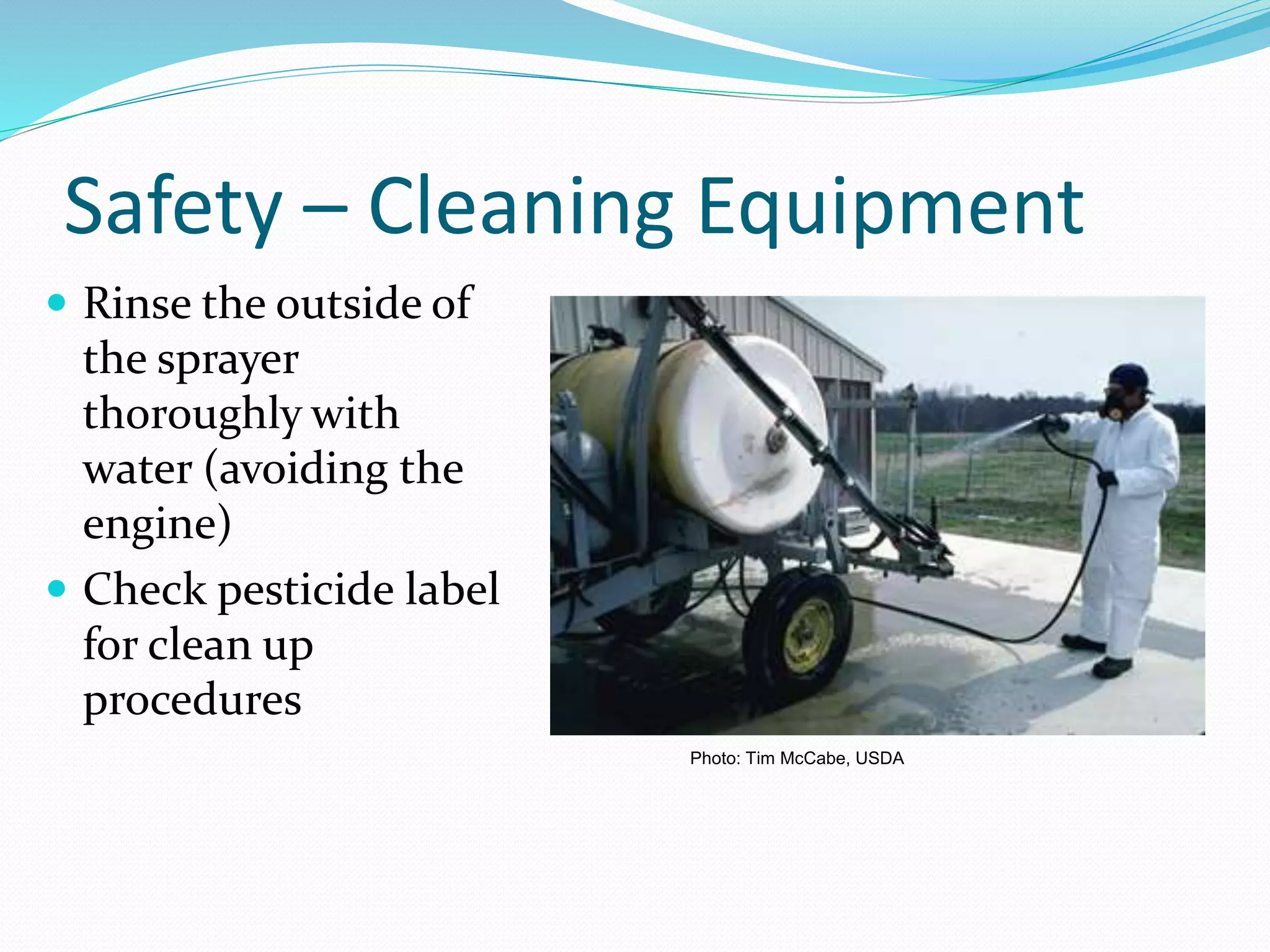
 Rinse the outside of
the sprayer
thoroughly with
water (avoiding the
engine)
 Check pesticide label
for clean up
procedures
Photo: Tim McCabe, USDA
Safety - Disposal
 What can be done about pesticide excess?
 Don’t create any excess!
 Only mix the amount of pesticide that you need for the job.
 If you make excess try to use the pesticide on another
appropriate site.
 Store in a clearly marked container for later use.
 Follow label guidelines for disposal.
Safety – Disposal
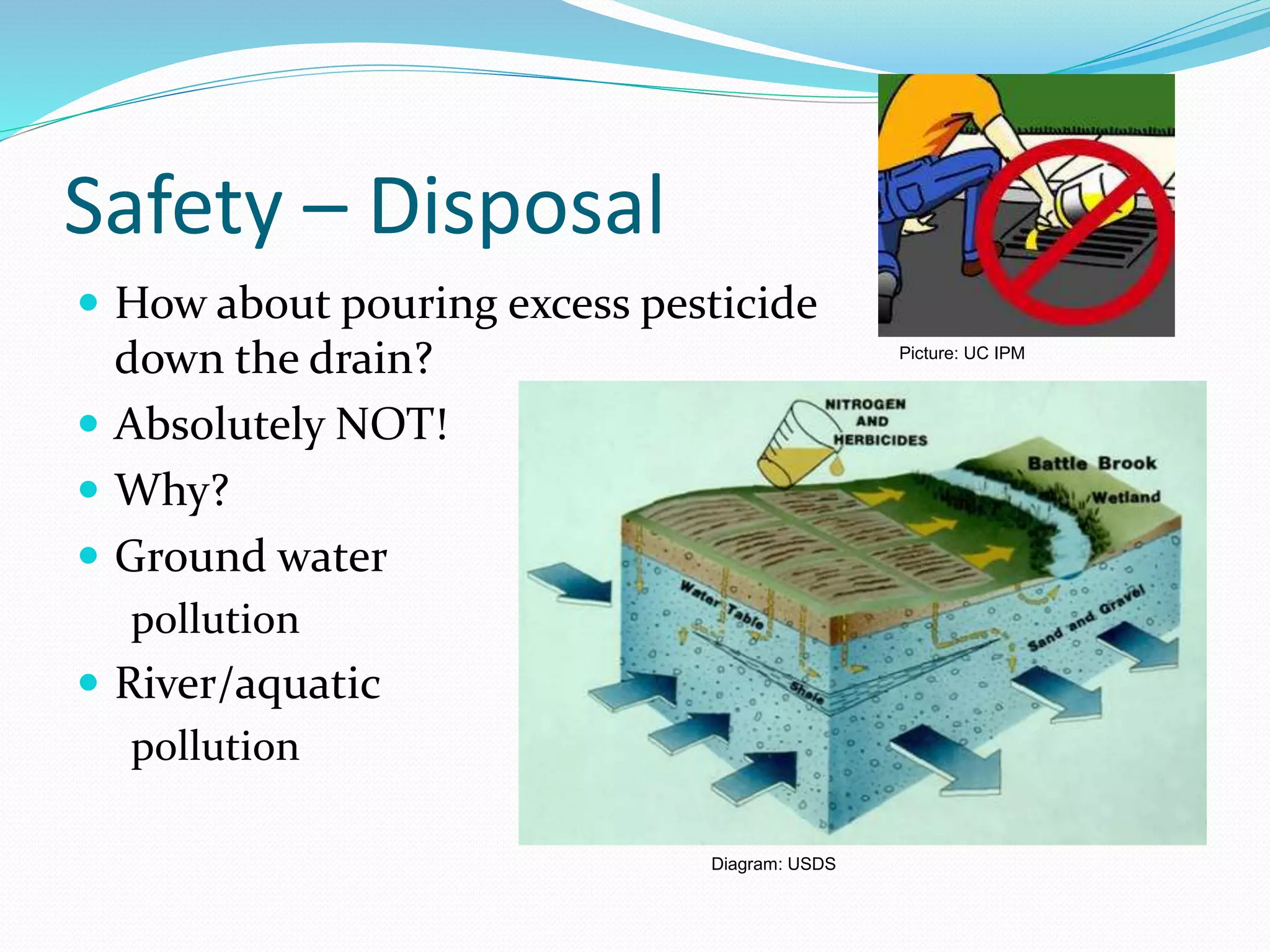
 How about pouring excess pesticide
down the drain?
 Absolutely NOT!
 Why?
 Ground water
pollution
 River/aquatic
pollution
Diagram: USDS
Picture: UC IPM
Safety - Disposal
 What to do about empty pesticide containers?
 Read the label
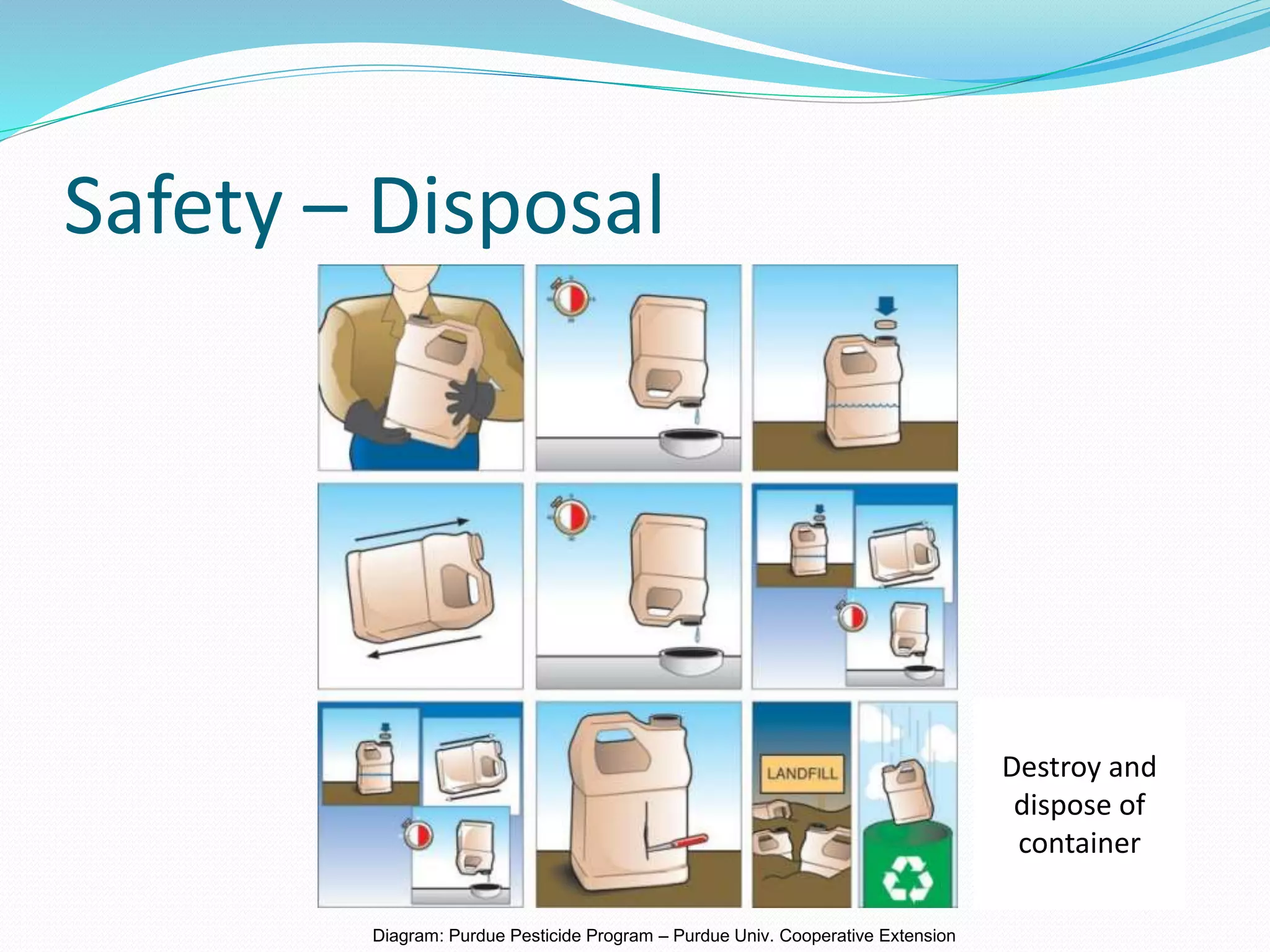
 Typically - Rinse 3 times
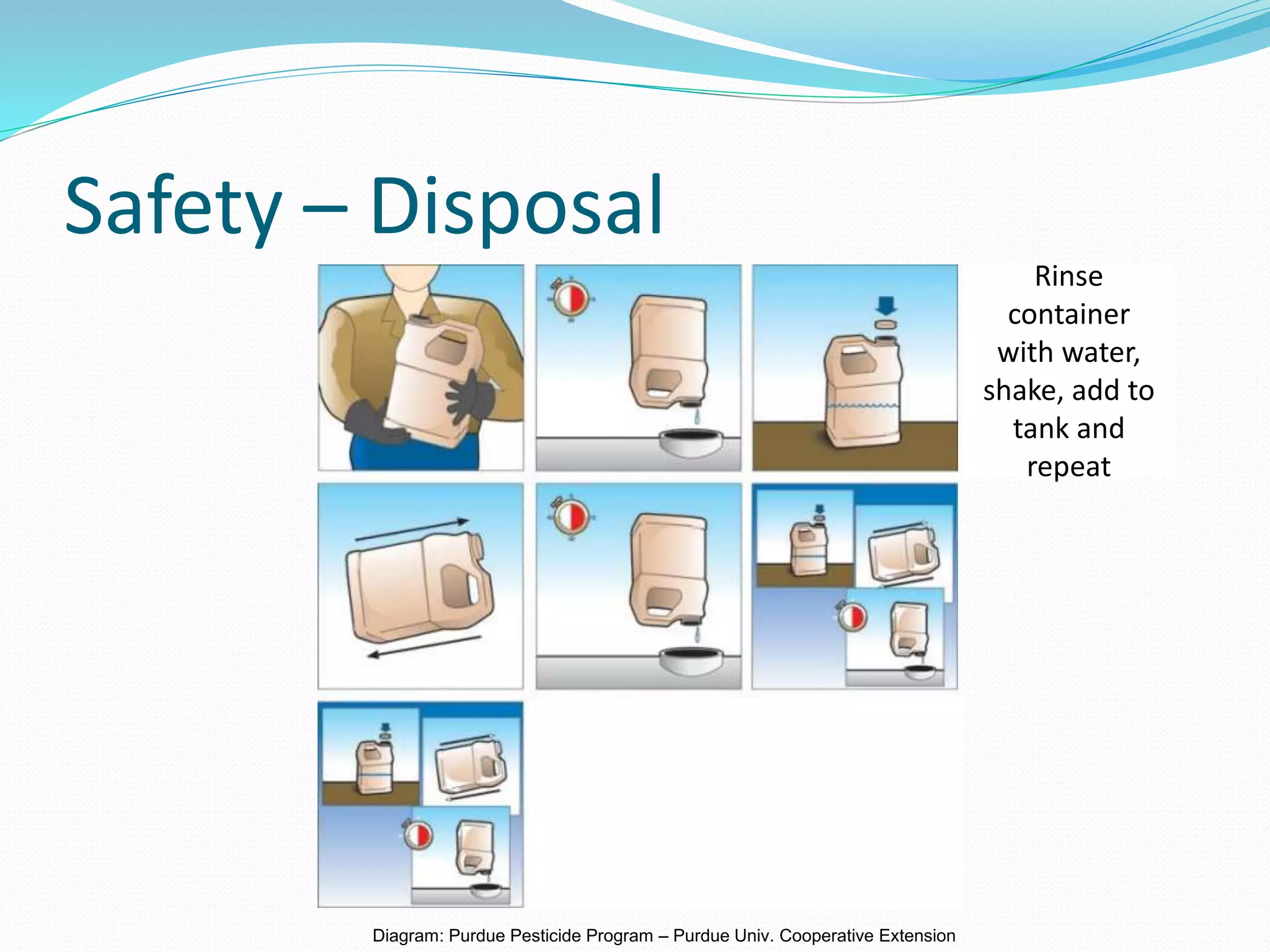
 Puncture the container (so it can not be reused)
 Dispose in a landfill or recycle
 Never use empty pesticide containers for other
purposes (e.g. storing water).
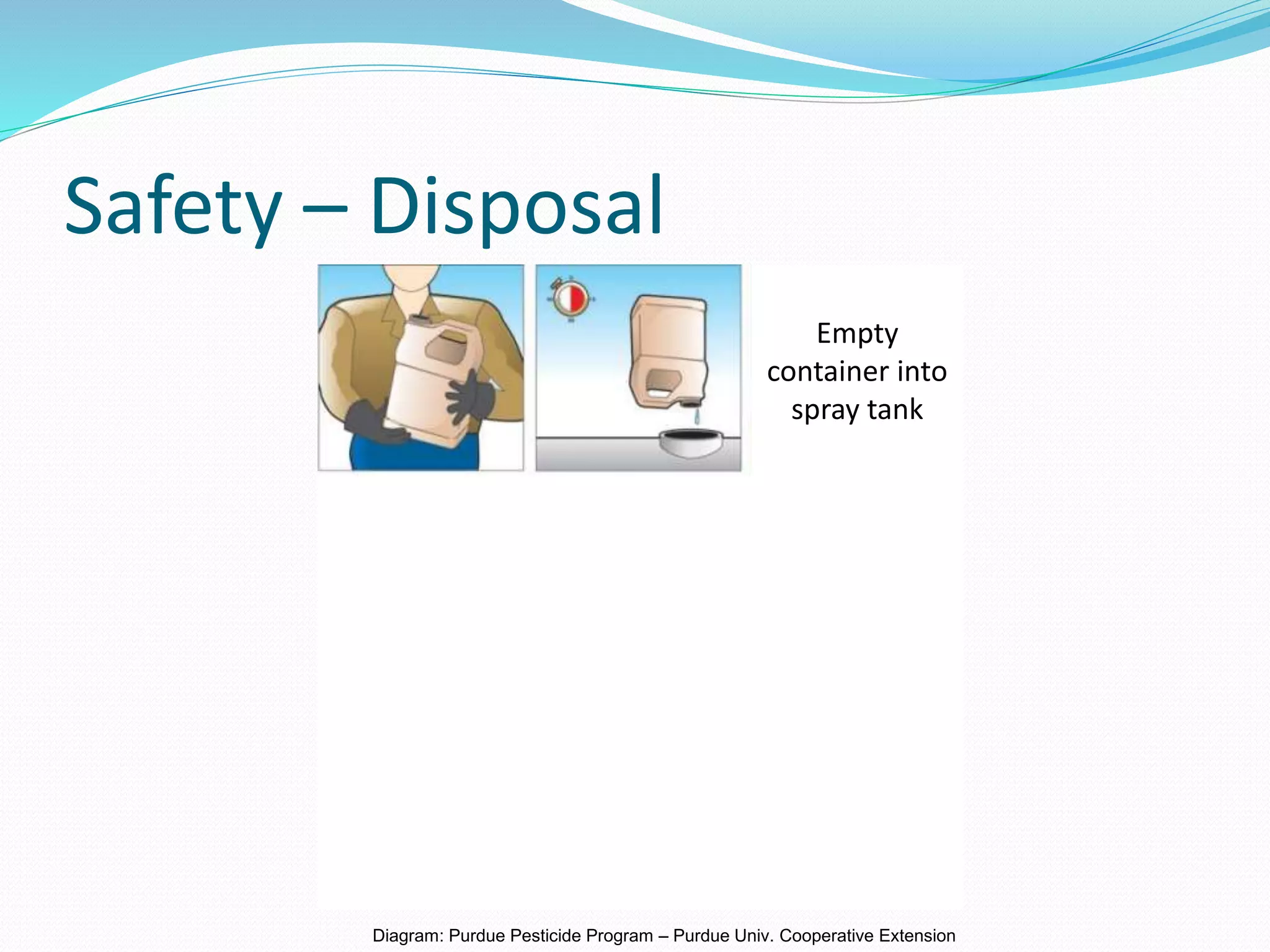
Safety – Disposal
Diagram: Purdue Pesticide Program – Purdue Univ. Cooperative Extension
Empty
container into
spray tank
Safety – Disposal
Diagram: Purdue Pesticide Program – Purdue Univ. Cooperative Extension
Rinse
container
with water,
shake, add to
tank and
repeat
Safety – Disposal
Diagram: Purdue Pesticide Program – Purdue Univ. Cooperative Extension
Destroy and
dispose of
container
Safety – Reentry into the field
 When is it safe to reenter the field after spraying
(without protective gear)?
 When the plants are dry?
 No
 Check the pesticide label?
 Yes
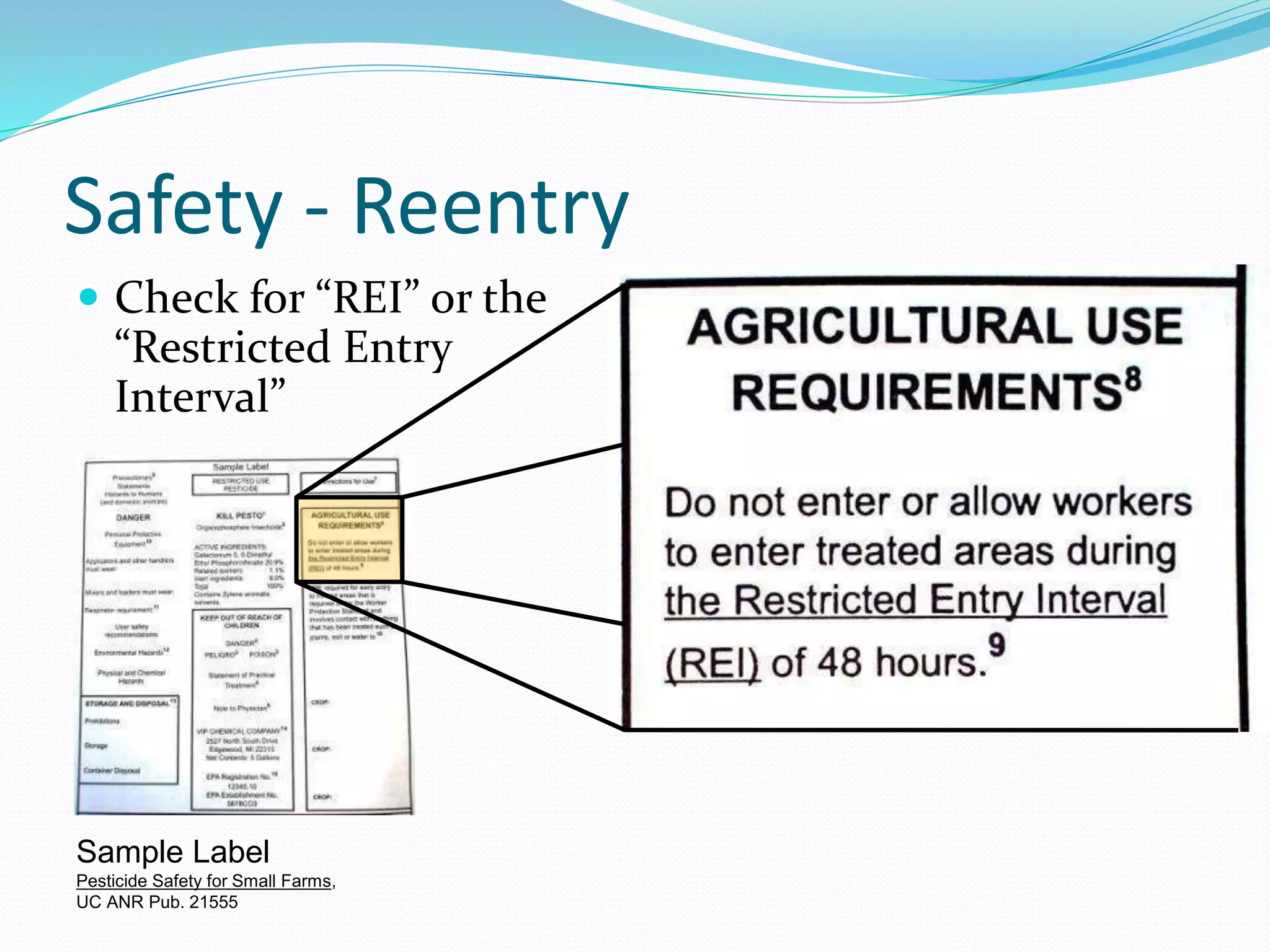
Safety - Reentry
 Check for “REI” or the
“Restricted Entry
Interval”
Sample Label
Pesticide Safety for Small Farms,
UC ANR Pub. 21555
Safety - Reentry
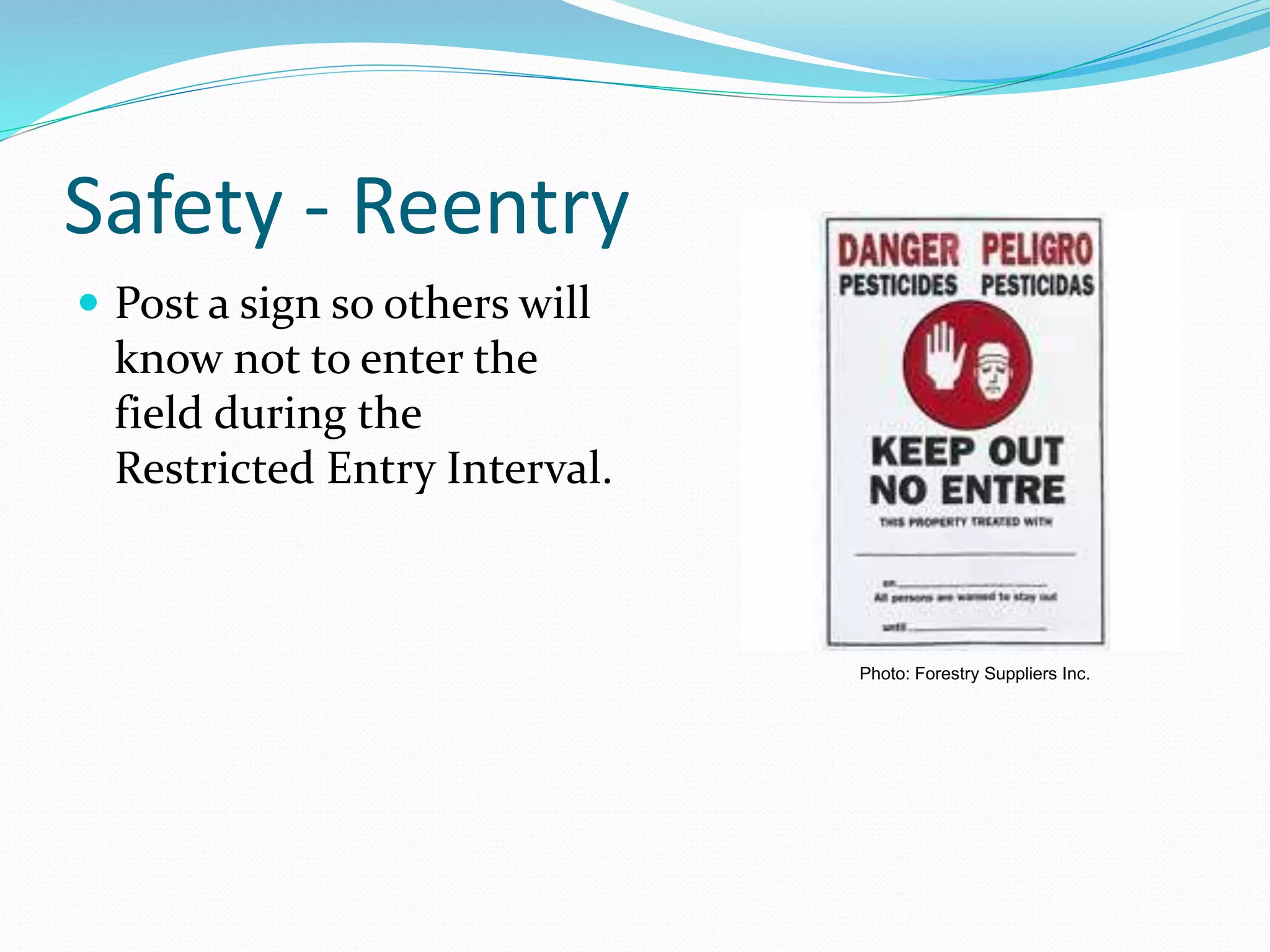
 Post a sign so others will
know not to enter the
field during the
Restricted Entry Interval.
Photo: Forestry Suppliers Inc.
Safety – Product marketing
 What may prevent you selling a product treated with
pesticide?
 Application is too close to sale date.
 How can you be sure if you are okay?
 Read the label!
 Note any limitations in the country importing your
product.
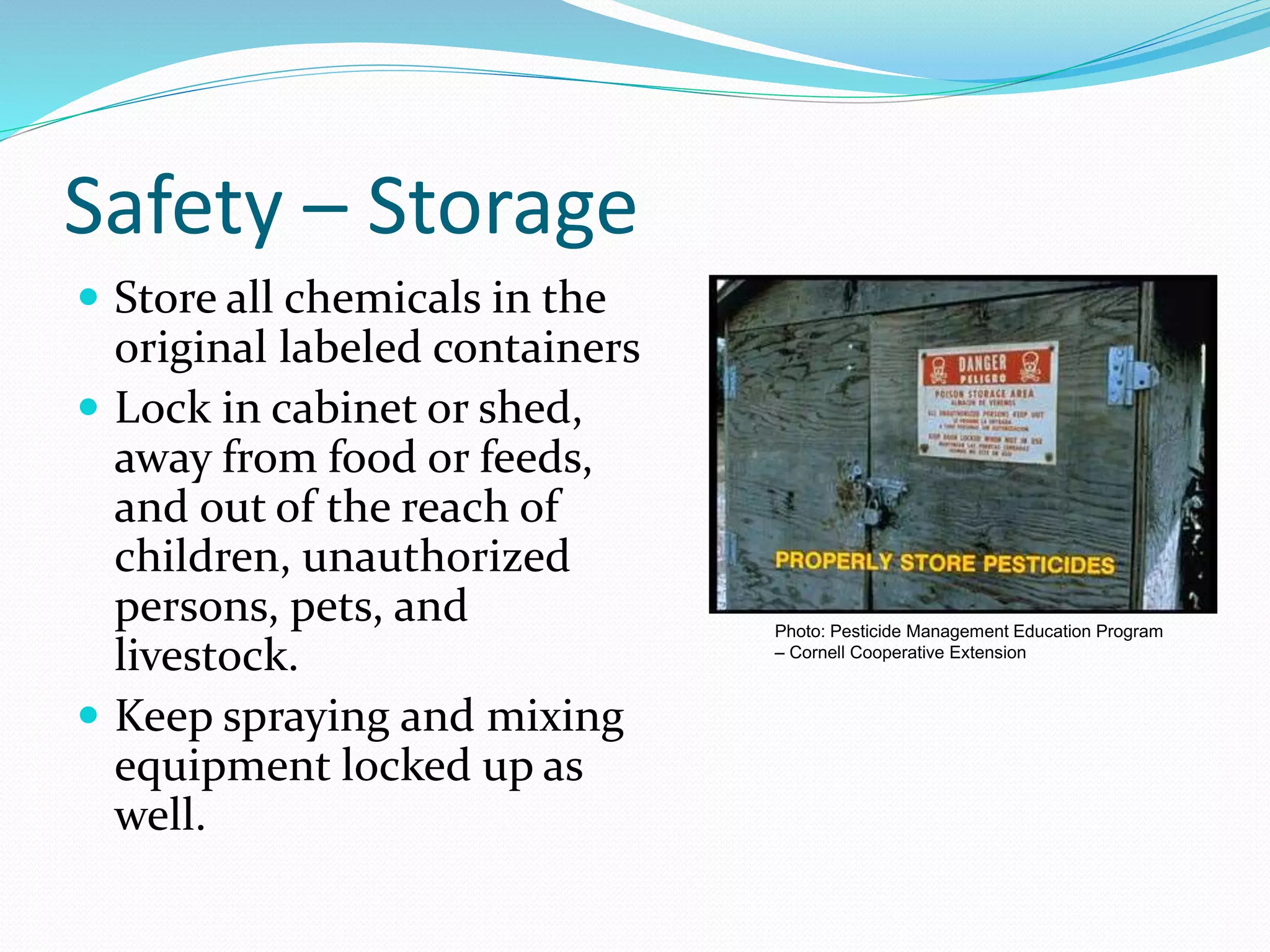
Safety – Storage
 Store all chemicals in the
original labeled containers
 Lock in cabinet or shed,
away from food or feeds,
and out of the reach of
children, unauthorized
persons, pets, and
livestock.
 Keep spraying and mixing
equipment locked up as
well.
Photo: Pesticide Management Education Program
– Cornell Cooperative Extension
Safety – Storage
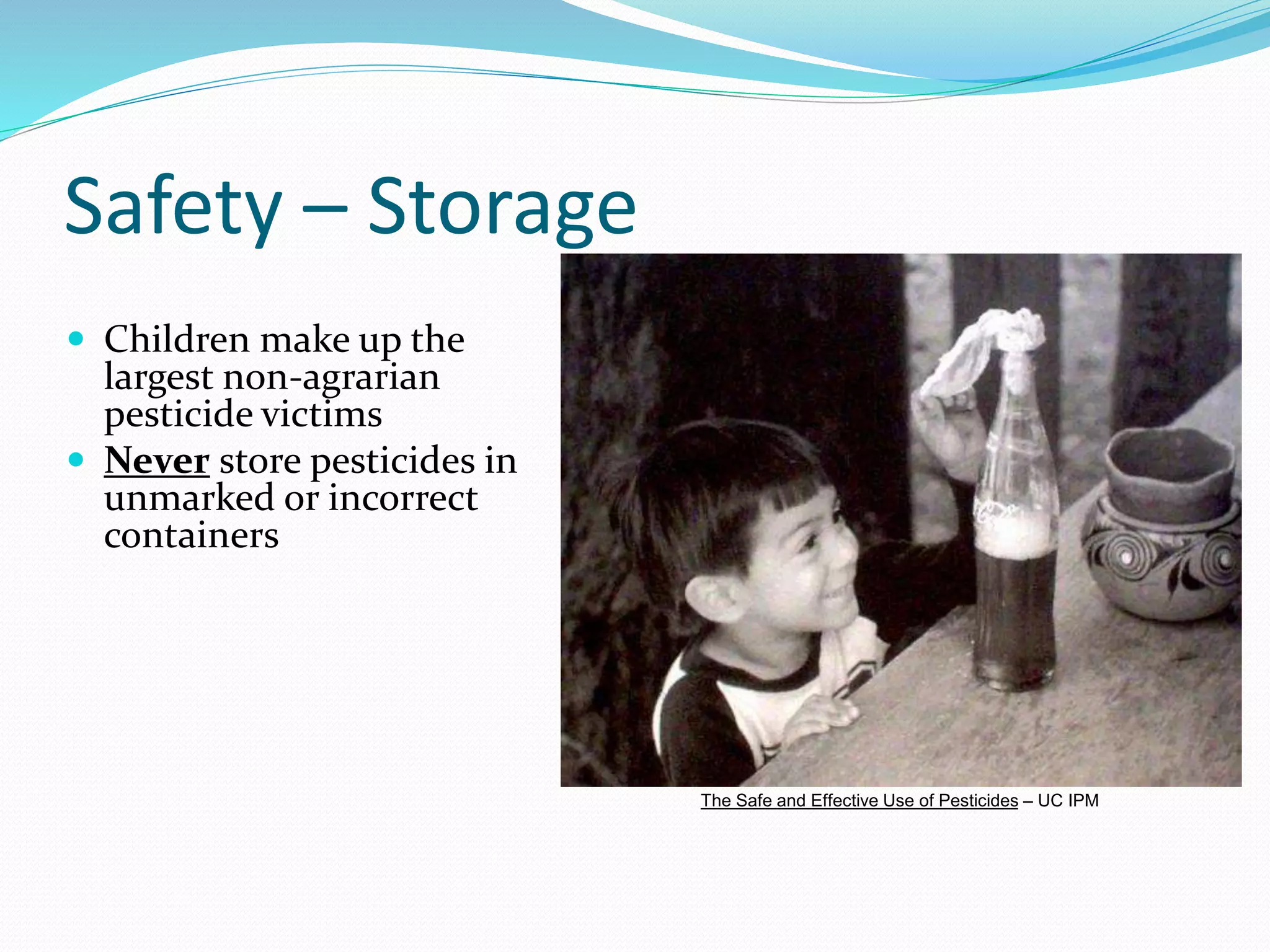
 Children make up the
largest non-agrarian
pesticide victims
 Never store pesticides in
unmarked or incorrect
containers
The Safe and Effective Use of Pesticides – UC IPM
Safety - Spills
 Pesticide spills can occur at any time
 First protect yourself, others, animals, and water sources
 Be sure to wear protective gear
 Control
 Stop the spill from continuing
 Contain
 Stop spill from spreading
 Use dirt to barricade a liquid pesticide
 Clean Up
 Do not hose down the spill. This will make the situation
worse.
 Soak up liquid with saw dust, dirt, clay, etc.
 Sweep spill into plastic containers for later disposal.
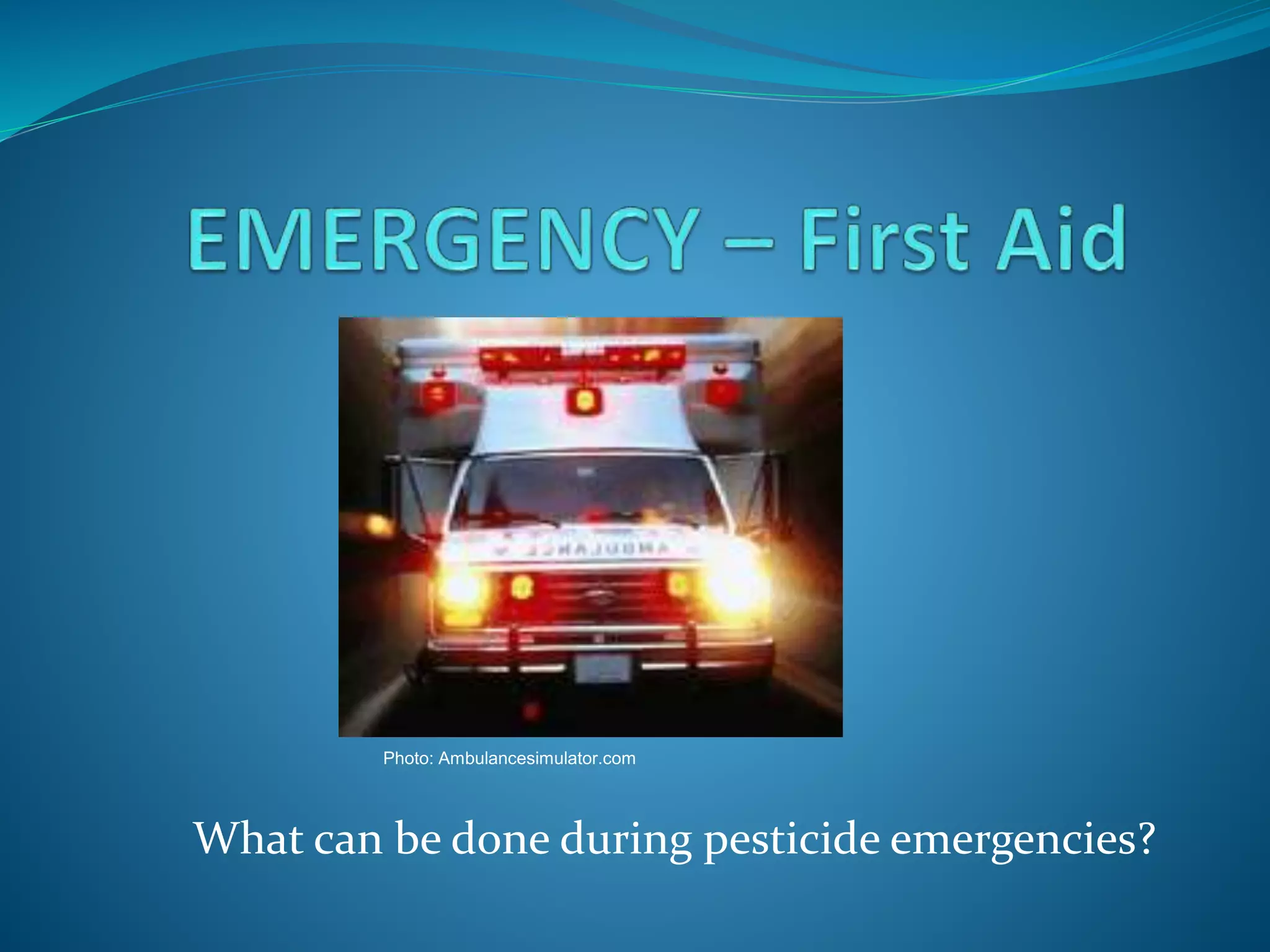
What can be done during pesticide emergencies?
Photo: Ambulancesimulator.com
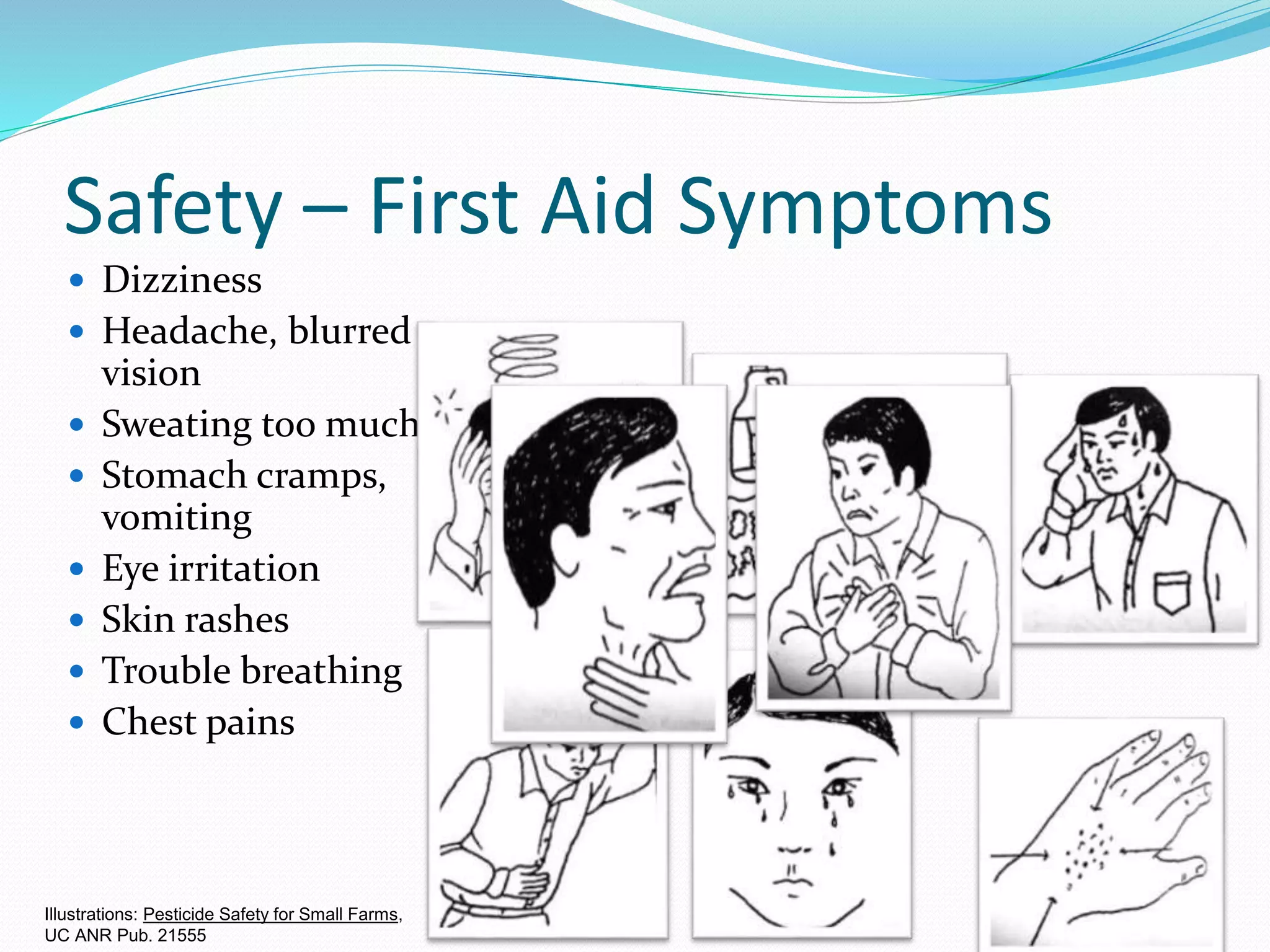
Safety – First Aid Symptoms
 Dizziness
 Headache, blurred
vision
 Sweating too much
 Stomach cramps,
vomiting
 Eye irritation
 Skin rashes
 Trouble breathing
 Chest pains
Illustrations: Pesticide Safety for Small Farms,
UC ANR Pub. 21555
Safety – First Aid
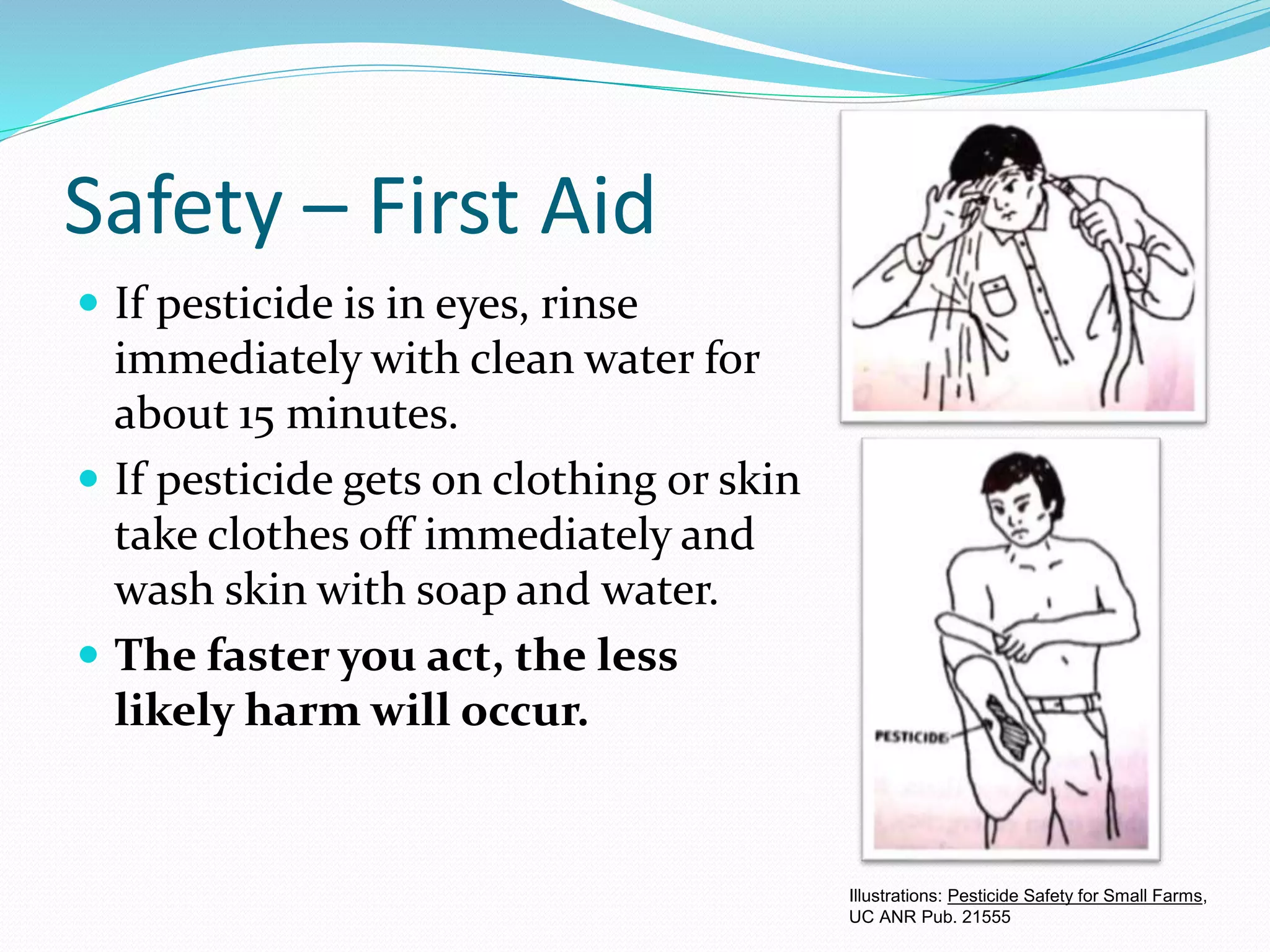
 If pesticide is in eyes, rinse
immediately with clean water for
about 15 minutes.
 If pesticide gets on clothing or skin
take clothes off immediately and
wash skin with soap and water.
 The faster you act, the less
likely harm will occur.
Illustrations: Pesticide Safety for Small Farms,
UC ANR Pub. 21555
Illustrations: Pesticide Safety for Small Farms,
UC ANR Pub. 21555
Safety – First Aid
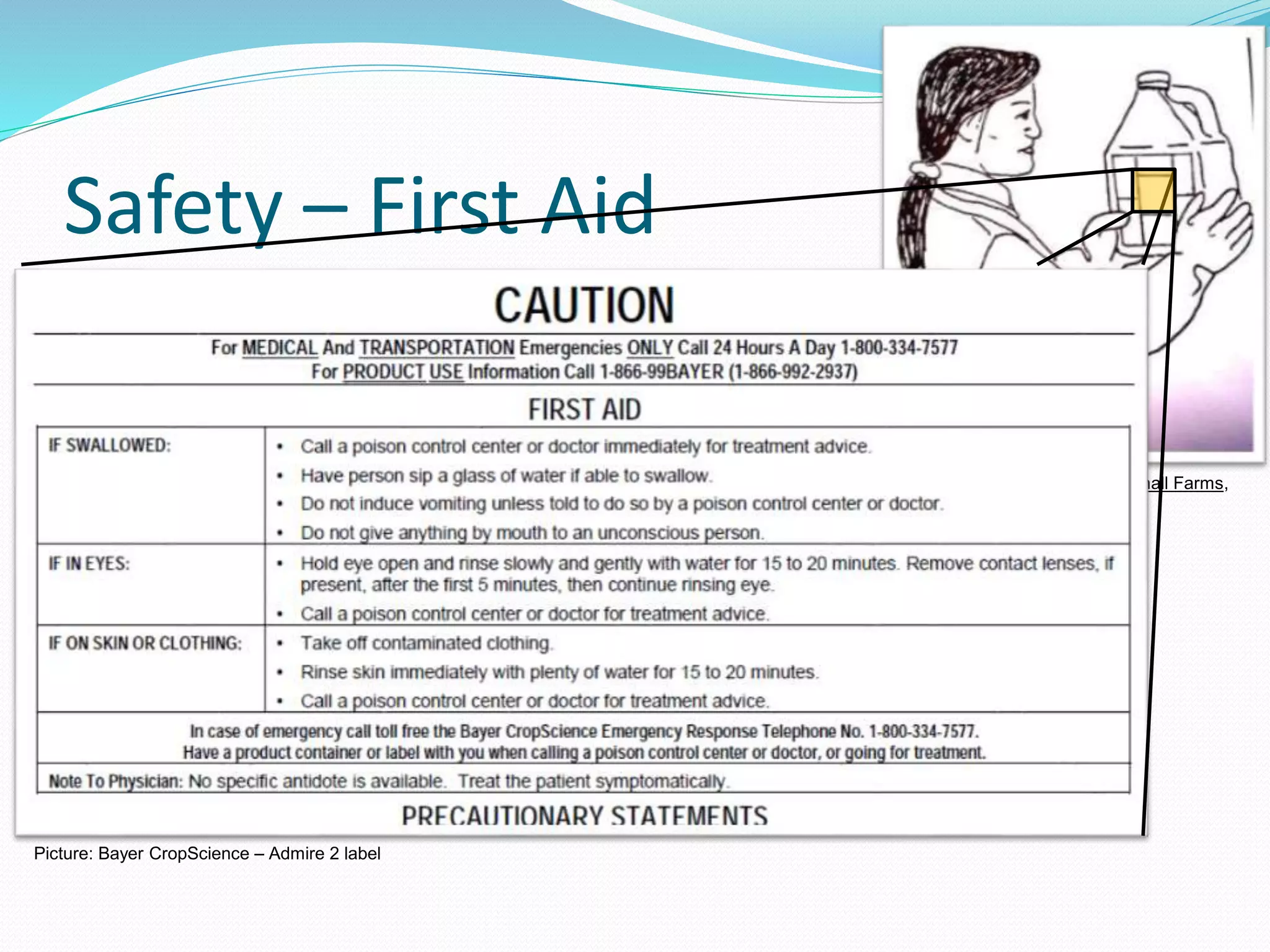
 Call the nearest place for
medical care.
 All pesticide labels have
emergency first aid information.
Picture: Bayer CropScience – Admire 2 label
Safety – First Aid
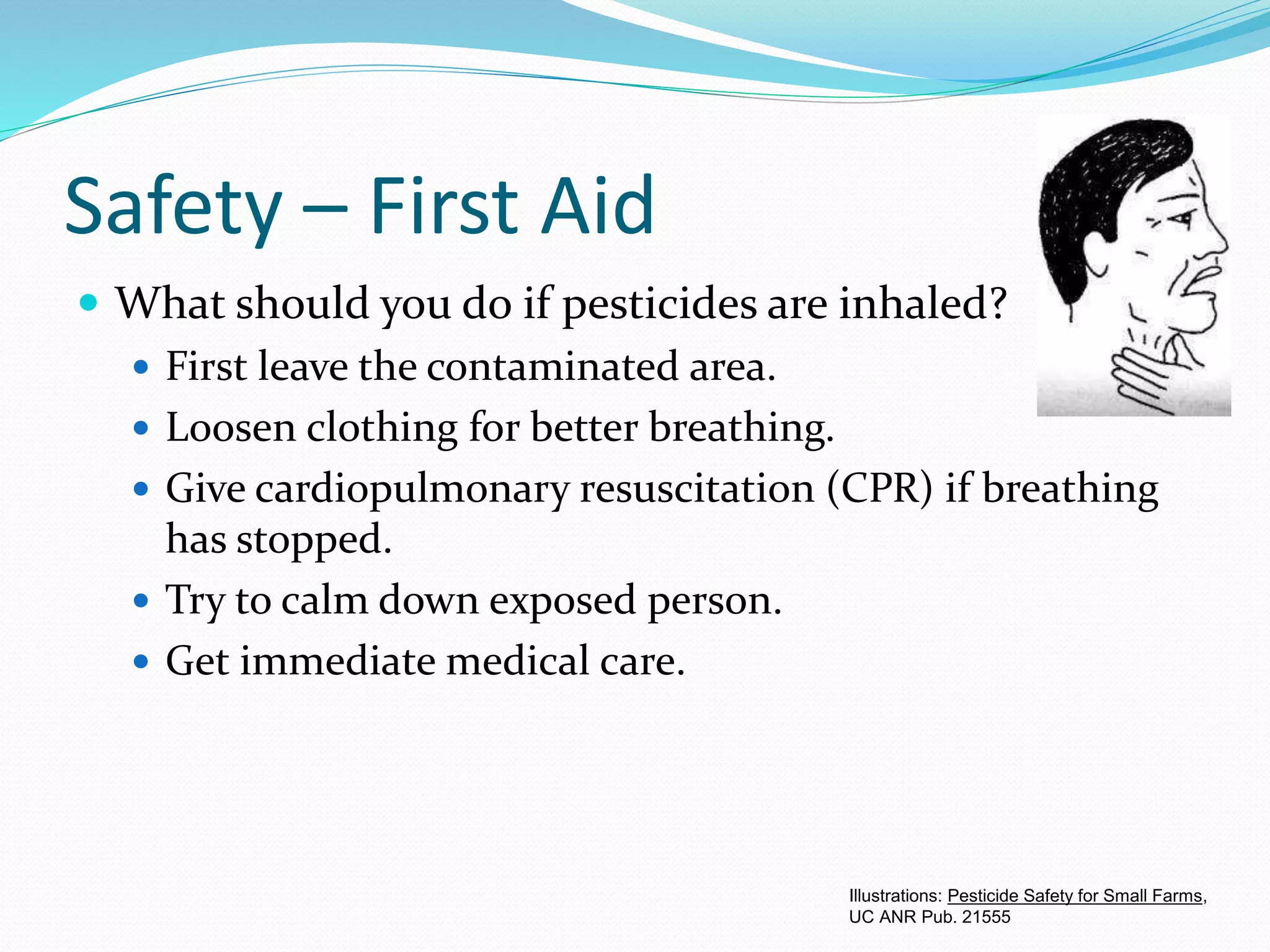
 What should you do if pesticides are inhaled?
 First leave the contaminated area.
 Loosen clothing for better breathing.
 Give cardiopulmonary resuscitation (CPR) if breathing
has stopped.
 Try to calm down exposed person.
 Get immediate medical care.
Illustrations: Pesticide Safety for Small Farms,
UC ANR Pub. 21555
Safety – First Aid
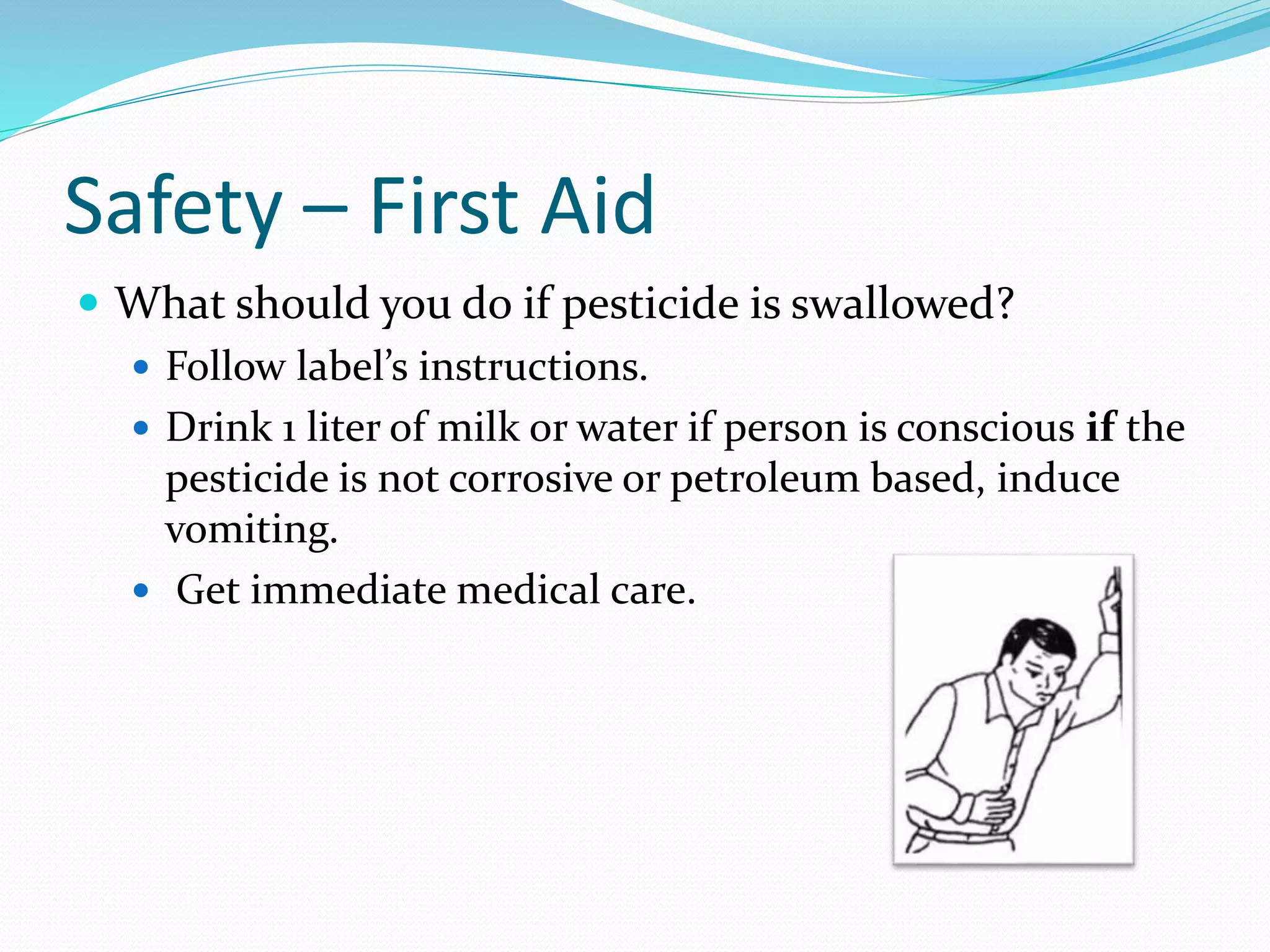
 What should you do if pesticide is swallowed?
 Follow label’s instructions.
 Drink 1 liter of milk or water if person is conscious if the
pesticide is not corrosive or petroleum based, induce
vomiting.
 Get immediate medical care.
References
 UC IPM http://www.ipm.ucdavis.edu/index.html
 Safe and Effective Use of Pesticides. UC IPM
 Pesticide Safety for Small Farmers. A Growers Guide to
Pesticide Safety. UC ANR
 Pesticide Safety: A Reference manual for Private
Applicators. UC IPM
Prepared by Mark Bell, Mark Henderson and
Frank Zalom with input from
Ehsan Ehsanullah
and Tom Brown

Pesticide Training Course UC Davis, Safety. Part 5 of 5

  • 1.
    Prepared by MarkBell, Mark Henderson and Frank Zalom with input from Ehsan Ehsanullah and Tom Brown
  • 2.
    Course objectives  Knowkey points in the application and safe use of pesticides  Note: At the end, participants will take a review quiz to show they can recall all the key points.  Support materials – fact sheets and check lists, review quiz,
  • 3.
  • 4.
    Safety – PesticideLabel  Be sure  Crop is on the label.  Pest is on the label.  To follow label directions for mixing.  To follow label directions for protective clothing.  To check for other precautions (e.g., limitations on harvested produce).
  • 5.
    Safety – PesticideLabel About the label  Signal words are…  "CAUTION,“  "WARNING," and  "DANGER" (in order of increasing toxicity)  Indicates the relative acute toxicity, or short-term effects, of the active ingredients to humans. They do not refer to long-term effects to humans nor do they indicate the effect on aquatic invertebrates.
  • 6.
    Safety – PesticideLabel About the label  Active ingredient  What is it?  The active ingredient (a.i.) is the material in the pesticide formulation that actually destroys the target pest or performs the desired function. Pesticide labels are required by law to show the active ingredient and its percentage.
  • 7.
    Safety – PesticideLabel About the label  Other (or inert) ingredients?  Inert ingredients are all materials in the pesticide formulation other than the active ingredient.  These ingredients do not work to control the pest, but help dissolve the active ingredient, improve or enhance pesticide activity.  Some inert ingredients may be toxic or hazardous to humans.
  • 8.
    Safety – PesticideLabel About the label  Trade names  The trade name is any brand name that is used exclusively by one manufacturer for a product containing the pesticide chemical. There may be several trade names for a single product, thus making it confusing.  Do not rely on brand names to identify pesticides.
  • 9.
    Safety – PesticideLabel Surfactants  What is a surfactant?  Added to decrease surface tension of the applied liquid to improve surface wetting and penetration of the product.  Check the label - surfactants may be added or may come as already included in the product.
  • 10.
    Photo: Pesticide ManagementEducation Program – Cornell Cooperative Extension
  • 11.
    Safety – Exposure Understandthe dangers  When can you be contaminated?  How can you or others be contaminated?  Where is absorption greatest?  What does that mean for protecting yourself and others? Photo: USDA
  • 12.
    Safety – Dangers When are risks the highest for exposure?  Spills and splashes (e.g. mixing)  Spray drift and dust from pesticide application  Skin contact with residues Photo: Pesticide Management Education Program – Cornell Cooperative Extension
  • 13.
    Safety – Dangers Why is mixing so dangerous?  Dealing with pure concentrated product  Greater potential for spills during mixing  Tips:  Mix in a well ventilated area  Wear protective equipment – especially gloves, mask and closed shoes  Stand up-wind when mixing Photo: Fintrac Inc.
  • 14.
    Safety – Dangers Mixing Keep a set of measuring equipment for use only with pesticides.  Clearly label them as "PESTICIDE ONLY"  Store them in a secure area away from food preparation areas. Photo: Pesticide Management Education Program – Cornell Cooperative Extension
  • 15.
    Safety – Exposure Be aware of the where pesticides can enter the body.  How can pesticides enter your body?  through eyes  Breathing – entry into the lungs  through the mouth  through the skin Pesticide Safety for Small Farms, UC ANR Pub. 21555
  • 16.
    Safety - Exposure Note that there are differences in absorption through skin.  Where is absorption greatest?  Scrotum  Ears  Forehead and Scalp http://extension.missouri.edu/explore/agguides/agengi n/g01916.htm
  • 17.
    Safety – Exposure Another way at looking at absorption  Note absorption through the armpit The Safe and Effective Use of Pesticides – UC IPM
  • 18.
    Safety - Exposure What does this mean when applying in the field?  Wear protective equipment  Wash hands before going to the bathroom.  What’s the difference between absorption on the forearm and forehead?  When hot and sweaty, do you wipe your arm on your forehead? http://extension.missouri.edu/explore/agguides/agengi n/g01916.htm
  • 19.
    Safety – ProtectiveGear  Personal Protective Equipment  Minimum:  rubber gloves,  eye protection,  long-sleeved shirt,  long pants,  mask,  closed shoes  Avoid using cotton gloves or lightweight dust masks that may absorb the spray and increase contact with skin.
  • 20.
    Safety – ProtectiveGear  Is this person ready to apply pesticide?  What is good?  Has a hat and long sleeves  What is not so good?  No protection for eyes, mouth or hands.  Shoes? Photo IDRC
  • 21.
    Safety – ProtectiveGear  Equipment care: Goggles, boots and gloves  Wash frequently.  Use warm soapy water and a brush to clean most protective gear.  Repair or replace any ripped or damaged gear. The Safe and Effective Use of Pesticides – UC IPM
  • 22.
    Safety – ProtectiveGear  Equipment care: Clothes  Do not re-wear contaminated clothes until they have been washed.  Wash clothing used to apply pesticides separately from all other clothes. The Safe and Effective Use of Pesticides – UC IPM
  • 23.
    Safety – GoodPractices  Before you spray…  Check the label  First put on all protective equipment  Inspect sprayer and hose to ensure there are no leaks  Check area to make sure there are no:  People  Pets/Livestock  Check for ponds, streams, wells, other water sources. Photo: Ron Horii – Santa Teresa County Park Don’t spray near streams
  • 24.
    Safety – GoodPractices  Does water quality have any effect?  Yes  Rule of thumb: Use water only if you can see a coin dropped in the bottom of a bucket of water Photo IRRI
  • 25.
    Safety – GoodPractices  While Spraying… As much as possible  Spray away from the body  Do not let yourself become soaked with pesticide  Avoid walking through spray  Stand upwind  Avoid spraying straight overhead  Be mindful of drift (wind carrying pesticide droplets)
  • 26.
    Safety – GoodPractices  Wash hands before:  Eating  Going to bathroom  Smoking  Do not wipe forearm on forehead when sweaty.  Keep foods away from pesticides and sprayed areas. Keep covered. Pesticide Safety for Small Farms, UC ANR Pub. 21555 Pesticide residue on person’s hands seen under florescent light. Photo: International Potato Center
  • 27.
    Safety – GoodPractices  Take a shower as soon after application as possible.  Wash clothing separately from other laundry.  Never smoke, drink, eat, or use the bathroom after pesticide application without washing first. Pesticide Safety for Small Farms, UC ANR Pub. 21555
  • 28.
    Safety – CleaningEquipment  When finished using sprayer…  Try to not have any excess pesticide in the tank.  Rinse tank by running fresh water through the sprayers.  Do not leave sprayer in the field.  Do not allow equipment to sit for a long time with pesticide in the tank. This may clog or corrode the machine.
  • 29.
    Safety – CleaningEquipment  Rinse the outside of the sprayer thoroughly with water (avoiding the engine)  Check pesticide label for clean up procedures Photo: Tim McCabe, USDA
  • 30.
    Safety - Disposal What can be done about pesticide excess?  Don’t create any excess!  Only mix the amount of pesticide that you need for the job.  If you make excess try to use the pesticide on another appropriate site.  Store in a clearly marked container for later use.  Follow label guidelines for disposal.
  • 31.
    Safety – Disposal How about pouring excess pesticide down the drain?  Absolutely NOT!  Why?  Ground water pollution  River/aquatic pollution Diagram: USDS Picture: UC IPM
  • 32.
    Safety - Disposal What to do about empty pesticide containers?  Read the label  Typically - Rinse 3 times  Puncture the container (so it can not be reused)  Dispose in a landfill or recycle  Never use empty pesticide containers for other purposes (e.g. storing water).
  • 33.
    Safety – Disposal Diagram:Purdue Pesticide Program – Purdue Univ. Cooperative Extension Empty container into spray tank
  • 34.
    Safety – Disposal Diagram:Purdue Pesticide Program – Purdue Univ. Cooperative Extension Rinse container with water, shake, add to tank and repeat
  • 35.
    Safety – Disposal Diagram:Purdue Pesticide Program – Purdue Univ. Cooperative Extension Destroy and dispose of container
  • 36.
    Safety – Reentryinto the field  When is it safe to reenter the field after spraying (without protective gear)?  When the plants are dry?  No  Check the pesticide label?  Yes
  • 37.
    Safety - Reentry Check for “REI” or the “Restricted Entry Interval” Sample Label Pesticide Safety for Small Farms, UC ANR Pub. 21555
  • 38.
    Safety - Reentry Post a sign so others will know not to enter the field during the Restricted Entry Interval. Photo: Forestry Suppliers Inc.
  • 39.
    Safety – Productmarketing  What may prevent you selling a product treated with pesticide?  Application is too close to sale date.  How can you be sure if you are okay?  Read the label!  Note any limitations in the country importing your product.
  • 40.
    Safety – Storage Store all chemicals in the original labeled containers  Lock in cabinet or shed, away from food or feeds, and out of the reach of children, unauthorized persons, pets, and livestock.  Keep spraying and mixing equipment locked up as well. Photo: Pesticide Management Education Program – Cornell Cooperative Extension
  • 41.
    Safety – Storage Children make up the largest non-agrarian pesticide victims  Never store pesticides in unmarked or incorrect containers The Safe and Effective Use of Pesticides – UC IPM
  • 42.
    Safety - Spills Pesticide spills can occur at any time  First protect yourself, others, animals, and water sources  Be sure to wear protective gear  Control  Stop the spill from continuing  Contain  Stop spill from spreading  Use dirt to barricade a liquid pesticide  Clean Up  Do not hose down the spill. This will make the situation worse.  Soak up liquid with saw dust, dirt, clay, etc.  Sweep spill into plastic containers for later disposal.
  • 43.
    What can bedone during pesticide emergencies? Photo: Ambulancesimulator.com
  • 44.
    Safety – FirstAid Symptoms  Dizziness  Headache, blurred vision  Sweating too much  Stomach cramps, vomiting  Eye irritation  Skin rashes  Trouble breathing  Chest pains Illustrations: Pesticide Safety for Small Farms, UC ANR Pub. 21555
  • 45.
    Safety – FirstAid  If pesticide is in eyes, rinse immediately with clean water for about 15 minutes.  If pesticide gets on clothing or skin take clothes off immediately and wash skin with soap and water.  The faster you act, the less likely harm will occur. Illustrations: Pesticide Safety for Small Farms, UC ANR Pub. 21555
  • 46.
    Illustrations: Pesticide Safetyfor Small Farms, UC ANR Pub. 21555 Safety – First Aid  Call the nearest place for medical care.  All pesticide labels have emergency first aid information. Picture: Bayer CropScience – Admire 2 label
  • 47.
    Safety – FirstAid  What should you do if pesticides are inhaled?  First leave the contaminated area.  Loosen clothing for better breathing.  Give cardiopulmonary resuscitation (CPR) if breathing has stopped.  Try to calm down exposed person.  Get immediate medical care. Illustrations: Pesticide Safety for Small Farms, UC ANR Pub. 21555
  • 48.
    Safety – FirstAid  What should you do if pesticide is swallowed?  Follow label’s instructions.  Drink 1 liter of milk or water if person is conscious if the pesticide is not corrosive or petroleum based, induce vomiting.  Get immediate medical care.
  • 49.
    References  UC IPMhttp://www.ipm.ucdavis.edu/index.html  Safe and Effective Use of Pesticides. UC IPM  Pesticide Safety for Small Farmers. A Growers Guide to Pesticide Safety. UC ANR  Pesticide Safety: A Reference manual for Private Applicators. UC IPM
  • 50.
    Prepared by MarkBell, Mark Henderson and Frank Zalom with input from Ehsan Ehsanullah and Tom Brown