SUBMITTED BY :-
SHUBHAM GARG
(2017A109BIV )
SUBMITTED TO:-
DR.A.K.DHAKA
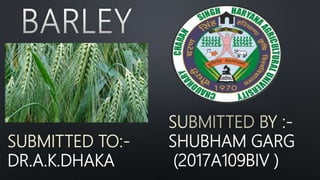
• Barley ( Hordium vulgare L.) commonly known as Jau .
• It is hardy crop,can be grown in adverse agroclimetic conditions like
drought,salinity,alkalinity etc. in plains and hilly areas under rainfed
and irrigated condtions.
• Carbohydrate present in barley help in regulation of glucose level
due to high fiber content(5 times of other whole grain).
• It is rich in Vit B, Vit E, folic acid.
• It help in reducing body weight.It is good source of protien.
• it contain about 15% water, 6.7% gum, 3.2% sugar, 60%
starch,2.2% fat.
• It is used for human consumption, used to prepare Alcoholic
beverages,animal feed,straw for bed of livestock ,making paper.
• According to Vovolov, two main centre of diversity i.e. 1st group in NE
Africa and Mountainous regions of Abussinia as principal centre for 6
row barley (occidental type) and 2nd group in SE Asia China, Japan,
Tibet and Nepal for 2 row barley (oriental type).
• All forms of barley are originated from a wild species Hordium
spontaneum similar as two rowed barley.
• The leading countries are USSR,China,France,Canada,USA & Spain.
• India is going down as are shifting to more remunerative crops like
wheat,gram or cash crops.
• Barley is mainly grown in Northen plains.
S.N. Based on arrangementof spikelets in rachis Character
1. Hordium vulgare L. Six row
2. Hordium distichon L. Two row
3. Hordium irreglare L. Two row
S.N. Based on Awns Charcter
1. Awned type Awns present
2. Awnless type Awns absent
S.N. Based on Adhereence of Chaff to grains Charcter
1. Hulled Chaff reamis attach to grain
2. Hull less Husk readily falls after threshing
S.N. Stage Charcteristics
1. Seedling • Coleptile emerge out of soil.
• Upto 20-25 days
2. Tillering • Start after establishment of crown roots
• Upto 30-35 DAS.
3. Jointing & Booting • Vegetative part start multiplying
• Upto 55-65 DAS
4. Heading • Flag leaf give rise to ear head
• Anthesis begins, result into milking stage
• Upto 75-85 DAS
5. Ripening • Grain filling & devlopment started
• Upto 90-100 DAS
6. Maturity & Drying • Plant turn yellowish,loose stiffness
• Become droopy & reday for harvest
SOIL
• It require cool weather during early growth andwarm & dry at
maturity.
• The optimum temperature at sowing is 22-24*C, 12-15*C during
growing peroid and 30*C at maturity.
• It is drought resistant,withstand in cool humid and dry climates.It
can not tolerate frost.
• Uniform moisture & bright sunshine at ripening are important for
production of clean bright kernels required by malting industry.
• Sandy to moderate loam soil having neutral to mild saline reaction
with well drainage system.
• It is more tolerant to alkali and saline condition such as
Rajsthan,Punjab,Haryana,UP and Bihar.
• 2-3 ploughings ,repeated harrowing,cultivation and planking is
required for compact seedbed.
• Under rainfed condition 2nd fortnight of october and for
Irrigated condition 15-30th November is best sowing time.
• Under rainfed 75kg/ha to avoid competition for moisture
while under irrigated 85-90 kg/ha seed is required .
• If moisture in top soil is sufficient than Kera method, otherwise
pora method is used.
• Row to row spacing is 22 cm in normal condition while for late
sown condition 18-20cm.
Type Varieties
HUSKLESS Karan 3, K16, K18, K19, K750, K757, DL487,K1155
Hulled Karan 15, K280, NH87, K392, DL472
Malting & brewing
purpose
Alfa 93, BCU 73,DWR 28,DWRUB 52,
RD 2668,DWRB 73
Feed purpose RD 2552, PL 751, BH 902,BH 393(IRRIGATED)
K560, K603, RD 2624, RD2660 (RAINFED)
DL88, RD2552, NDB1173, NDB1020, NDB209
(SALINE)
Nematode
resistant
Raj Kiran
Variety Durarion
(Days )
Yield
(q/ha)
Reaction to major pest
Diseases & insects
Other
Features
BG 25 136 34 Resistant to yellow
rust & aphids
Six rows,waxy suitable
to irrigated condition
BG 105 137 37 Susceptible to Yellow
rust,blight,aphids
For irrigated late condition
BH 75 136 38 Resistant to yellow rust For irrigated timely sowing
BH 393 121 46 Resistance to Yellow &
brown rust,Molya disease
Six rowearly maturity,
good malting traits
BH 331 127 43 Resistance to major
disease
Suitable for brackish
water,salted soils
BH 338 107 39 Tolerant to yellow rust Auitable for late sowing
BH 902 130 50 Resistant to yellow,
brpwn,black rust
Six row var. For feed
barley group
FERTILIZER IRRIGATION
• It needs 60kg N, 30kg P2O5 & 15 kg K2O/ha under irrigated
condition with FYM
• Apply full dose of phospores and potash with half nitrogen at
sowing & half at 1st irrigation.
• Under rainfed 30kg N, 15 kg P2O5 /ha.
• Avoid excess N, it cause lodging.
• Due to low water requirement it can be grown in rainfed
areas.It require 2 irrigation at active tillering stage (40-45 DAS)
and at anthesis (80-85 DAS).
• One extra irrigation in sandy soils.
• If only 1 irrigation is available than apply at tillering stage.
• It is a good cometitor of weeds due to ft growing habit and high
initial vigour.It has two type of weeds:-
• 1)Brodleaf (Chenoodium album)
• 2)Narrowleaf (Avena ludoviciana)
• To prevent losses , one hand weeding after irrigation is useful.
S.N. Broadleaf Weedicide Dose (/ha)
1. 2,4-D Sodium salt 1kg in 500l water
2. Algrip 20 WP 20g in 500ml surfacant
3. Affinity 40DF 50g in 500l water
S.N. Narrowleaf Weedicide Dose(/ha)
1. Axial 5 EC 1L in 500L of water at 40-45 DAS
S.N. Mixed weed flora control Dose (/ha
1. Axial 5EC & Algrip 20 WP 1L+20g with 500ml suffactant resp.
2. AXIAL 5 EC & AFFINITY 40 DF 1L+50g in 500L of water resp.
1. RUST (Puccinia spp.)
• Black,brown and yellow rust occur in
barley.
• There are some resistant varieties:-
Back rust :- Azad, BCU 73, BH 505, BH 508, HBL 113
Brown rust :-Alfa, BCU 73, HBL 113, BH 514, RD 2503, RD 2508, PL 419
Yellow rust :- BH 902, C 164, BH 75, Alfa 93, R 2503, PL 419 and BH 393.
CONTROL :-
• Seed treatment with Vitavax or Cabendazim @ 2g or
• Tebuconazol (Raxil 2DS) @ 1g/kg seed.
2.COVERED SMUT
(Ustilago hordei )
• It is observed at time of heading.All
ear of diseased plant become
infected & all grains in earhead turn
into smut sori.Each smut sorus plant
remains covered by a
white,shining,silvery membrane.
Control :-
• Seed treatment with Carbendazin (Bavistin) or Carboxin (Vitavax) @
0.2 g/Kg seed is quiet effective.
• Resistance varieties K 12, K 18, K 24 and BG 105 should be used.
3. Stripe disease (Dreschlera graminae )
• Flory spray of Dithane M 45 @ 0.2% at intial stages.
• Resistant varieties K 12, K 24, K 125, Vijya, C164, BG 105
and BH 87.
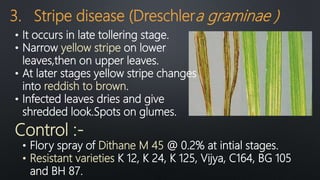
• It occurs in late tollering stage.
• Narrow yellow stripe on lower
leaves,then on upper leaves.
• At later stages yellow stripe changes
into reddish to brown.
• Infected leaves dries and give
shredded look.Spots on glumes.
Control :-
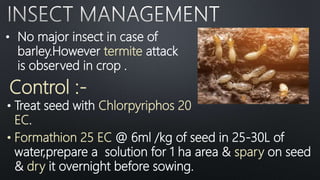
• No major insect in case of
barley.However termite attack
is observed in crop .
Control :-
• Treat seed with Chlorpyriphos 20
EC.
• Formathion 25 EC @ 6ml /kg of seed in 25-30L of
water,prepare a solution for 1 ha area & spary on seed
& dry it overnight before sowing.
THANKS

Barley Crop production

  • 1.
    SUBMITTED BY :- SHUBHAMGARG (2017A109BIV ) SUBMITTED TO:- DR.A.K.DHAKA
  • 2.
    • Barley (Hordium vulgare L.) commonly known as Jau . • It is hardy crop,can be grown in adverse agroclimetic conditions like drought,salinity,alkalinity etc. in plains and hilly areas under rainfed and irrigated condtions. • Carbohydrate present in barley help in regulation of glucose level due to high fiber content(5 times of other whole grain). • It is rich in Vit B, Vit E, folic acid. • It help in reducing body weight.It is good source of protien. • it contain about 15% water, 6.7% gum, 3.2% sugar, 60% starch,2.2% fat. • It is used for human consumption, used to prepare Alcoholic beverages,animal feed,straw for bed of livestock ,making paper.
  • 3.
    • According toVovolov, two main centre of diversity i.e. 1st group in NE Africa and Mountainous regions of Abussinia as principal centre for 6 row barley (occidental type) and 2nd group in SE Asia China, Japan, Tibet and Nepal for 2 row barley (oriental type). • All forms of barley are originated from a wild species Hordium spontaneum similar as two rowed barley. • The leading countries are USSR,China,France,Canada,USA & Spain. • India is going down as are shifting to more remunerative crops like wheat,gram or cash crops. • Barley is mainly grown in Northen plains.
  • 4.
    S.N. Based onarrangementof spikelets in rachis Character 1. Hordium vulgare L. Six row 2. Hordium distichon L. Two row 3. Hordium irreglare L. Two row S.N. Based on Awns Charcter 1. Awned type Awns present 2. Awnless type Awns absent S.N. Based on Adhereence of Chaff to grains Charcter 1. Hulled Chaff reamis attach to grain 2. Hull less Husk readily falls after threshing
  • 5.
    S.N. Stage Charcteristics 1.Seedling • Coleptile emerge out of soil. • Upto 20-25 days 2. Tillering • Start after establishment of crown roots • Upto 30-35 DAS. 3. Jointing & Booting • Vegetative part start multiplying • Upto 55-65 DAS 4. Heading • Flag leaf give rise to ear head • Anthesis begins, result into milking stage • Upto 75-85 DAS 5. Ripening • Grain filling & devlopment started • Upto 90-100 DAS 6. Maturity & Drying • Plant turn yellowish,loose stiffness • Become droopy & reday for harvest
  • 6.
    SOIL • It requirecool weather during early growth andwarm & dry at maturity. • The optimum temperature at sowing is 22-24*C, 12-15*C during growing peroid and 30*C at maturity. • It is drought resistant,withstand in cool humid and dry climates.It can not tolerate frost. • Uniform moisture & bright sunshine at ripening are important for production of clean bright kernels required by malting industry. • Sandy to moderate loam soil having neutral to mild saline reaction with well drainage system. • It is more tolerant to alkali and saline condition such as Rajsthan,Punjab,Haryana,UP and Bihar.
  • 7.
    • 2-3 ploughings,repeated harrowing,cultivation and planking is required for compact seedbed. • Under rainfed condition 2nd fortnight of october and for Irrigated condition 15-30th November is best sowing time. • Under rainfed 75kg/ha to avoid competition for moisture while under irrigated 85-90 kg/ha seed is required . • If moisture in top soil is sufficient than Kera method, otherwise pora method is used. • Row to row spacing is 22 cm in normal condition while for late sown condition 18-20cm.
  • 8.
    Type Varieties HUSKLESS Karan3, K16, K18, K19, K750, K757, DL487,K1155 Hulled Karan 15, K280, NH87, K392, DL472 Malting & brewing purpose Alfa 93, BCU 73,DWR 28,DWRUB 52, RD 2668,DWRB 73 Feed purpose RD 2552, PL 751, BH 902,BH 393(IRRIGATED) K560, K603, RD 2624, RD2660 (RAINFED) DL88, RD2552, NDB1173, NDB1020, NDB209 (SALINE) Nematode resistant Raj Kiran
  • 9.
    Variety Durarion (Days ) Yield (q/ha) Reactionto major pest Diseases & insects Other Features BG 25 136 34 Resistant to yellow rust & aphids Six rows,waxy suitable to irrigated condition BG 105 137 37 Susceptible to Yellow rust,blight,aphids For irrigated late condition BH 75 136 38 Resistant to yellow rust For irrigated timely sowing BH 393 121 46 Resistance to Yellow & brown rust,Molya disease Six rowearly maturity, good malting traits BH 331 127 43 Resistance to major disease Suitable for brackish water,salted soils BH 338 107 39 Tolerant to yellow rust Auitable for late sowing BH 902 130 50 Resistant to yellow, brpwn,black rust Six row var. For feed barley group
  • 10.
    FERTILIZER IRRIGATION • Itneeds 60kg N, 30kg P2O5 & 15 kg K2O/ha under irrigated condition with FYM • Apply full dose of phospores and potash with half nitrogen at sowing & half at 1st irrigation. • Under rainfed 30kg N, 15 kg P2O5 /ha. • Avoid excess N, it cause lodging. • Due to low water requirement it can be grown in rainfed areas.It require 2 irrigation at active tillering stage (40-45 DAS) and at anthesis (80-85 DAS). • One extra irrigation in sandy soils. • If only 1 irrigation is available than apply at tillering stage.
  • 11.
    • It isa good cometitor of weeds due to ft growing habit and high initial vigour.It has two type of weeds:- • 1)Brodleaf (Chenoodium album) • 2)Narrowleaf (Avena ludoviciana) • To prevent losses , one hand weeding after irrigation is useful. S.N. Broadleaf Weedicide Dose (/ha) 1. 2,4-D Sodium salt 1kg in 500l water 2. Algrip 20 WP 20g in 500ml surfacant 3. Affinity 40DF 50g in 500l water S.N. Narrowleaf Weedicide Dose(/ha) 1. Axial 5 EC 1L in 500L of water at 40-45 DAS S.N. Mixed weed flora control Dose (/ha 1. Axial 5EC & Algrip 20 WP 1L+20g with 500ml suffactant resp. 2. AXIAL 5 EC & AFFINITY 40 DF 1L+50g in 500L of water resp.
  • 12.
    1. RUST (Pucciniaspp.) • Black,brown and yellow rust occur in barley. • There are some resistant varieties:- Back rust :- Azad, BCU 73, BH 505, BH 508, HBL 113 Brown rust :-Alfa, BCU 73, HBL 113, BH 514, RD 2503, RD 2508, PL 419 Yellow rust :- BH 902, C 164, BH 75, Alfa 93, R 2503, PL 419 and BH 393. CONTROL :- • Seed treatment with Vitavax or Cabendazim @ 2g or • Tebuconazol (Raxil 2DS) @ 1g/kg seed.
  • 13.
    2.COVERED SMUT (Ustilago hordei) • It is observed at time of heading.All ear of diseased plant become infected & all grains in earhead turn into smut sori.Each smut sorus plant remains covered by a white,shining,silvery membrane. Control :- • Seed treatment with Carbendazin (Bavistin) or Carboxin (Vitavax) @ 0.2 g/Kg seed is quiet effective. • Resistance varieties K 12, K 18, K 24 and BG 105 should be used.
  • 14.
    3. Stripe disease(Dreschlera graminae ) • Flory spray of Dithane M 45 @ 0.2% at intial stages. • Resistant varieties K 12, K 24, K 125, Vijya, C164, BG 105 and BH 87. • It occurs in late tollering stage. • Narrow yellow stripe on lower leaves,then on upper leaves. • At later stages yellow stripe changes into reddish to brown. • Infected leaves dries and give shredded look.Spots on glumes. Control :-
  • 15.
    • No majorinsect in case of barley.However termite attack is observed in crop . Control :- • Treat seed with Chlorpyriphos 20 EC. • Formathion 25 EC @ 6ml /kg of seed in 25-30L of water,prepare a solution for 1 ha area & spary on seed & dry it overnight before sowing.
  • 16.