W
ELCOME
Methods of Fertilizer
Application
PRESENTED BY :
SHIVAJI RAVSAHEB SURYAVANSHI
(M. Sc. Agronomy)
Time of Fertilizer Application
1. Basal application
A. Before preparatory tillage:
Bulky organic manures, green manures, soil amendments and soil conditioners are
applied before preparatory tillage for thorough mixing with the soil.
B. Basal dressing:
Application of manures and fertilizers before last ploughing/puddling or before
sowing or planting.
C. At sowing or planting:
Concentrated organic manures, readily soluble and higher mobile fertilizers, slow
release fertilizers, starter dose of N fertilizer to legume crops and fertilizer for specific
nutrient deficient soil are applied during this time.
2. Top dressing:
It is the application of manures and fertilizers to the
established crop within crop duration. Top dressing may be
done to the soil or to the foliage. Split application of nitrogen
and potassium is done throughout the cropping period to
increase the fertilizer use efficiency.
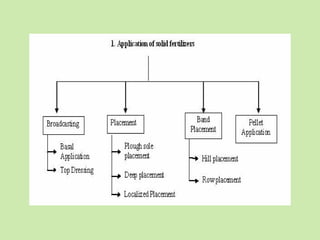
A) Broadcasting
Even and uniform spreading of manure or fertilizers by
hand over the entire surface of field while cultivation or after
the seed is sown in standing crop, termed as broad casting.
It is suitable for crops with dense stand, the plant roots
permeate the whole volume of the soil, large doses of fertilizers
are applied and insoluble phosphatic fertilizers such as rock
phosphate are used. Broadcasting of fertilizers is of two types.
a)Broadcasting at planting
Broadcasting of manure and fertilizers is done at planting or
sowing of the crops with the following objectives:
• To distribute the fertilizer evenly and to incorporate it with part of, or
throughout the plough layer and
• To apply larger quantities that can be safely applied at the time of
planting/sowing with a seed-cum-fertilizer driller.
b)Top dressing
B) Placement
It refers to the placement of fertilizers in soil at a specific place
with or without reference to the position of the seed.
Placement of fertilizers is normally recommended when the
quantity of fertilizers to apply is small, development of the root system is
poor, soil have a low level of fertility and to apply phosphatic and
potassic fertilizer.
i) Plough sole placement
In this method, fertilizer is
placed at the bottom of the
plough furrow in a
continuous band during
the process of ploughing.
ii) Deep placement
It is the placement of ammonical nitrogenous fertilizers in the
reduction zone of soil particularly in paddy fields, where
ammonical nitrogen remains available to the crop.
This method ensures better distribution of fertilizer in the root
zone soil and prevents loss of nutrients by run-off.
iii) Localized placement
It refers to the application of fertilizers into the soil close to the
seed or plant in order to supply the nutrients in adequate amounts
to the roots of growing plants.
The common methods to place fertilizers close to the seed or
plant are as follows:
a) Drilling
• In this method, the fertilizer is applied at the time of sowing by
means of a seed-cum-fertilizer drill.
• This places fertilizer and the seed in the same row but at different
depths.
• Although this method has been found suitable for the application
of Phosphotic and Potassic fertilizers in cereal crops, but sometimes
germination of seeds and young plants may get damaged due to
higher concentration of soluble salts.
b) Side dressing
It refers to the spread of fertilizer in between the rows and around
the plants. The common methods of side-dressing are
Placement of nitrogenous fertilizers by hand in between the rows of
crops like maize, sugarcane, cotton etc., to apply additional doses of
nitrogen to the growing crops and
Placement of fertilizers around the trees like mango, apple, grapes,
papaya etc.
c) Band placement
• If refers to the placement of fertilizer in bands.
• Band placement is of two types.
i) Hill placement
It is practiced for the application of fertilizers in orchards. In this
method, fertilizers are placed close to the plant in bands on one
or both sides of the plant.
The length and depth of the band varies with the nature of the
crop.
ii) Row placement
When the crops like sugarcane, potato, maize, cereals etc., are sown
close together in rows, the fertilizer is applied in continuous bands on one
or both sides of the row, which is known as row placement.
d) Pellet application
It refers to the placement of nitrogenous fertilizer in the form of pellets 2.5
to 5 cm deep between the rows of the paddy crop.
The fertilizer is mixed with the soil in the ratio of 1:10 and made small
pellets of convenient size to deposit in the mud of paddy fields.
 When the fertilizer is placed, there is minimum contact between the
soil and the fertilizer, and thus fixation of nutrients is greatly reduced.
 The weeds all over the field can not make use of the fertilizers.
 Residual response of fertilizers is usually higher.
 Utilization of fertilizers by the plants is higher.
 Loss of nitrogen by leaching is reduced
 Being immobile, phosphates are better utilized when placed.
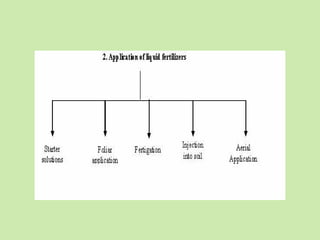
a) Starter solutions
It refers to the application of solution of N, P2O5 and K2O in the ratio
of 1:2:1 and 1:1:2 to young plants at the time of transplanting,
particularly for vegetables.
Starter solution helps in rapid establishment and quick growth of
seedlings.
The disadvantages of starter solutions are
• Extra labour is required, and
• the fixation of phosphate is higher
b) Foliar application
It refers to the spraying of fertilizer solutions containing one or more nutrients on
the foliage of growing plants.
Several nutrient elements are readily absorbed by leaves when they are dissolved
in water and sprayed on them.
The concentration of the spray solution has to be controlled, otherwise serious
damage may result due to scorching of the leaves.
Foliar application is effective for the application of minor nutrients like iron,
copper, boron, zinc and manganese. Sometimes insecticides are also applied along
with fertilizers.
c) Application through irrigation water (Fertigation)
• It refers to the application of water soluble fertilizers through
irrigation water.
• The nutrients are thus carried into the soil in solution.
• Generally nitrogenous fertilizers are applied through irrigation
water.
d) Injection into soil
 Liquid fertilizers for injection into the soil may be of either pressure
or non-pressure types.
 Non-pressure solutions may be applied either on the surface or in
furrows without appreciable loss of plant nutrients under most
conditions.
 Anhydrous ammonia must be placed in narrow furrows at a depth
of 12-15 cm and covered immediately to prevent loss of ammonia
e) Aerial application
In areas where ground application is not practicable, the fertilizer solutions are
applied by aircraft particularly in hilly areas, in forest lands, in grass lands or in
sugarcane fields etc.
Thank You…

Methods of fertilizer application

  • 1.
  • 2.
    Methods of Fertilizer Application PRESENTEDBY : SHIVAJI RAVSAHEB SURYAVANSHI (M. Sc. Agronomy)
  • 3.
    Time of FertilizerApplication 1. Basal application A. Before preparatory tillage: Bulky organic manures, green manures, soil amendments and soil conditioners are applied before preparatory tillage for thorough mixing with the soil. B. Basal dressing: Application of manures and fertilizers before last ploughing/puddling or before sowing or planting. C. At sowing or planting: Concentrated organic manures, readily soluble and higher mobile fertilizers, slow release fertilizers, starter dose of N fertilizer to legume crops and fertilizer for specific nutrient deficient soil are applied during this time.
  • 4.
    2. Top dressing: Itis the application of manures and fertilizers to the established crop within crop duration. Top dressing may be done to the soil or to the foliage. Split application of nitrogen and potassium is done throughout the cropping period to increase the fertilizer use efficiency.
  • 6.
    A) Broadcasting Even anduniform spreading of manure or fertilizers by hand over the entire surface of field while cultivation or after the seed is sown in standing crop, termed as broad casting. It is suitable for crops with dense stand, the plant roots permeate the whole volume of the soil, large doses of fertilizers are applied and insoluble phosphatic fertilizers such as rock phosphate are used. Broadcasting of fertilizers is of two types.
  • 7.
    a)Broadcasting at planting Broadcastingof manure and fertilizers is done at planting or sowing of the crops with the following objectives: • To distribute the fertilizer evenly and to incorporate it with part of, or throughout the plough layer and • To apply larger quantities that can be safely applied at the time of planting/sowing with a seed-cum-fertilizer driller. b)Top dressing
  • 8.
    B) Placement It refersto the placement of fertilizers in soil at a specific place with or without reference to the position of the seed. Placement of fertilizers is normally recommended when the quantity of fertilizers to apply is small, development of the root system is poor, soil have a low level of fertility and to apply phosphatic and potassic fertilizer.
  • 9.
    i) Plough soleplacement In this method, fertilizer is placed at the bottom of the plough furrow in a continuous band during the process of ploughing.
  • 10.
    ii) Deep placement Itis the placement of ammonical nitrogenous fertilizers in the reduction zone of soil particularly in paddy fields, where ammonical nitrogen remains available to the crop. This method ensures better distribution of fertilizer in the root zone soil and prevents loss of nutrients by run-off.
  • 11.
    iii) Localized placement Itrefers to the application of fertilizers into the soil close to the seed or plant in order to supply the nutrients in adequate amounts to the roots of growing plants. The common methods to place fertilizers close to the seed or plant are as follows:
  • 12.
    a) Drilling • Inthis method, the fertilizer is applied at the time of sowing by means of a seed-cum-fertilizer drill. • This places fertilizer and the seed in the same row but at different depths. • Although this method has been found suitable for the application of Phosphotic and Potassic fertilizers in cereal crops, but sometimes germination of seeds and young plants may get damaged due to higher concentration of soluble salts.
  • 13.
    b) Side dressing Itrefers to the spread of fertilizer in between the rows and around the plants. The common methods of side-dressing are Placement of nitrogenous fertilizers by hand in between the rows of crops like maize, sugarcane, cotton etc., to apply additional doses of nitrogen to the growing crops and Placement of fertilizers around the trees like mango, apple, grapes, papaya etc.
  • 14.
    c) Band placement •If refers to the placement of fertilizer in bands. • Band placement is of two types. i) Hill placement It is practiced for the application of fertilizers in orchards. In this method, fertilizers are placed close to the plant in bands on one or both sides of the plant. The length and depth of the band varies with the nature of the crop.
  • 15.
    ii) Row placement Whenthe crops like sugarcane, potato, maize, cereals etc., are sown close together in rows, the fertilizer is applied in continuous bands on one or both sides of the row, which is known as row placement. d) Pellet application It refers to the placement of nitrogenous fertilizer in the form of pellets 2.5 to 5 cm deep between the rows of the paddy crop. The fertilizer is mixed with the soil in the ratio of 1:10 and made small pellets of convenient size to deposit in the mud of paddy fields.
  • 16.
     When thefertilizer is placed, there is minimum contact between the soil and the fertilizer, and thus fixation of nutrients is greatly reduced.  The weeds all over the field can not make use of the fertilizers.  Residual response of fertilizers is usually higher.  Utilization of fertilizers by the plants is higher.  Loss of nitrogen by leaching is reduced  Being immobile, phosphates are better utilized when placed.
  • 18.
    a) Starter solutions Itrefers to the application of solution of N, P2O5 and K2O in the ratio of 1:2:1 and 1:1:2 to young plants at the time of transplanting, particularly for vegetables. Starter solution helps in rapid establishment and quick growth of seedlings. The disadvantages of starter solutions are • Extra labour is required, and • the fixation of phosphate is higher
  • 19.
    b) Foliar application Itrefers to the spraying of fertilizer solutions containing one or more nutrients on the foliage of growing plants. Several nutrient elements are readily absorbed by leaves when they are dissolved in water and sprayed on them. The concentration of the spray solution has to be controlled, otherwise serious damage may result due to scorching of the leaves. Foliar application is effective for the application of minor nutrients like iron, copper, boron, zinc and manganese. Sometimes insecticides are also applied along with fertilizers.
  • 20.
    c) Application throughirrigation water (Fertigation) • It refers to the application of water soluble fertilizers through irrigation water. • The nutrients are thus carried into the soil in solution. • Generally nitrogenous fertilizers are applied through irrigation water.
  • 21.
    d) Injection intosoil  Liquid fertilizers for injection into the soil may be of either pressure or non-pressure types.  Non-pressure solutions may be applied either on the surface or in furrows without appreciable loss of plant nutrients under most conditions.  Anhydrous ammonia must be placed in narrow furrows at a depth of 12-15 cm and covered immediately to prevent loss of ammonia
  • 22.
    e) Aerial application Inareas where ground application is not practicable, the fertilizer solutions are applied by aircraft particularly in hilly areas, in forest lands, in grass lands or in sugarcane fields etc.
  • 23.