SUBJECT : SPICES AND CONDIMENTS
PMA-201(1+1)
TOPIC: SMALL CARDAMOM
UNIVERSITY OF HORTICULTURAL
SCIENCES BAGALKOT
COLLEGE OF HORTICULTURE KOLAR
PRESENTED BY:
 YUVARAJ S
 TEJASWINI P
 SUSHMITHA T
 VIDYARANI N M
 SAHANA
INTRODUCTION
CARDAMOM
 Queen of spices
 Second most important national spice of India.
 Third most expensive spice after venilla and saffron.
 Pseophytic plant.
 Gutemala is the largest producer.
 Kerala is the largest growing state of cardamom in
India
 Idukki known as Cardamom hill reserve.
 Saudi arabia –Largest importer
CONSTITUENTS
 Cardamom oil: Produced by Steam distillation of
crushed seeds.
 Volatile oil in seeds is about 11% while in the husk
is 1%.
 Oleoresin: Produced by Solvent extraction method
and gives 10% oleoresin.
 Dried fruits contains
pigments,cellulose,pentosans,sugars,starch,silica
oxalate and minerals.
 Crude fibre(upto 31%)
 Fatty acids are the major constituents.
USES
 Flavouring foods
 Confectionaries
 Bevarages
 Perfumery and liquor.
 Making Cardamom flavoured coffee -Kahwa
SMALL CARDAMOM
 Small cardamom is also called as Lesser cardamom or
Malabar cardamom.
Scientific name: Elettaria cardamomum
Origin: Native to Evergreen rainy forest of western
ghats of South India
Family: Zingiberaceae
Plant part used: fruit,seed
SOIL AND CLIMATE
 Soil: Humus rich soils
 Rainfall: 1500-2000mm
 Temperature: 15-35ºc
 RH:75-90%
 pH: 5.5-6.5
 Altitude:600-1200m above mean sea level.
BOTANY
 Herbaceous perennial.
 Pseudostem is formed by the compact arrangement
of leaf sheaths on the clumps.
 Leaves are lanceolate ,acuminate ,highly
pubescent and glabrous.
 Shallow root system.
 Inflorescence –Panicle of cincinni.
 Flowers-Hermophrodite
 Fruit-Capsule
CLASSIFICATION
 Based on Adaptability,nature of panicle,shape and
size of the capsules.
1. Malabar
2. Mysore
3. Vazhukka
VARIETIES
1. Mudigere-1
2. Mudigere-2
3. PV-1
4. PV-2
5. ICRI-1
6. ICRI-2
7. ICRI-3
8. TDK-4
9. IISR-Suvasini
10. IISR-Vijetha
11. IISR-Avinash
12. Njallani green bold
PROPAGATION:
 2 methods
 a. sexual method(seeds)
 b.Asexual method(suckers)
 Micropropagation technique has also been
standardised and commercialized in cardamom
SEED PROPAGATION:
 Fully ripen seeds are extracted.
 Ssed capsule collection from sep-oct.
 Mother plant should be of 5 years old.
 Seed treatment:25%nitric acid or 25%acetic acid or
25%citric acid or 5% HCL foe 10 minutes.
 GA3 scarification.
 Seed storage in polythene gunny bags.
 Seed validity is lost in 15 days(20%),90% in 3-5
months.
PRIMARY NURSERY:
 Raised beds of 1m width and convient length(5-6m)and
20-30cm height.
 A layer of humus rich forest soil or FYM or compost
should be spread on nursery bed.
 Soil solarisation.
 Soil treatment with methyl bromide@45g/bed or
2%formalin(10lit/bed).
 Fumigation of soil.
 Seed sowing spacing:8-10cm*1-2cm.
 Seed rate:600g/ha.
 Overhead shade is provided.
 Mulching with paddy straw.
 Thinng is done at 6-7 leaf stage.
SECONDARY NURSERY:
 A.Bed Nursery:
seedling transplanted at 4-6 months old(4-5 leaf
stage) at 20*20cm in beds.
 Transplanting month :In kerala &TN june-july. In
karnataka Nov-jan.
 Apply 90:60:120g NPK/bed of 6*1m size in three
equal splits at 45days interval.
 Stages of transplanting to main field:
kerala:18-22 months old sedling
karnataka 10 month old seedling.
B.Polybag Nursery:
Poly bags of 20*20cm,100 guage thickness.
 Potting mixture:Humas rich top soil,cowdung and
sans(3:1:1)
 Seedling of 3-4 leaf stage are transplanted into
each bag.
 Advantages: uniform growth,more tillers,and good
established in the field.
VEGETATIVE PROPAGATION
 a.Clonal multiplication :
Propagated vegetatively through division of rhizome.
Propagation unit consist of rhizome with one old and
one young shoot consist of a planting unit.
Disadvantages:
Limited availability of planting material.
LAND PREPARATION:
 Land is cleared and terraces made across slopes at
suaitable planting distance.
 Trenches and furrows are advaisable.
 Spacing: Malabar:2m*2m;
 Mysore and Vazhukka:3m*3m
 Plant density:1600/ha for Malabar.
 For karnataka:1.8*1.8(3025plants/ha)
 In TN:2.7*2.7
PLANTING:
 Pit size:45*45*30cm dug during april-may.
 Filled with mixture of surgace soil and well rotten
FYM+100g of rock phosohate.
 Done 2 months in advance to planting.
 Best season for planting is kharif season.
 2 years old seedling is best for getting tillers and
higher yield.
HIGH DENSITY PLANTING:
 Malabar variety perform well for HDP.
 Spacing of 1.8*1.8m(3025 plant/ha) indicated early
and high yield in initial 3-4 years.
 Mudigere 1(malabar):1m*1m.
 Planting suckers at 1.8*0.9m gives high yield.
 Vazhukka varities are not suitable for HDP.
SHADE REGULATION:
 Cardamom is a pseophyte.
Shade trees having following characters;
1.wide canopy shade tree.
2.No shedding of leaves during flowering.
3.Medium size evergreen in nature.
4.Small leaves and well spread branching system.
5.Deep root system.
6.Fast growing.
 Shade trees:
Vernonia arborea-Karana
Cedrella toona-Red cedar
Cassia fistula-Kanikonna
Diospyros malabaricum-Vellakil
Terminalia tomentosa-Thempavu
Hopea parviflora-Thambakam
Artocarpus fraxinifolius-Balangi
Mesopsis eminii-Elangi
Artocarpus integrifolia-Jack
AFTER CARING:
 During the initial stages of growth period sickle
weeding and light forking followed by mulching in
may.
 Manures and fertiliizers:
 Applied in 2 doses,
 One in june-july and other in sep-oct.
 For irrigated Cardamom:75:75:150 kg NPK
(30:60:30 For rainifed)
 For HDP 120:120:240kg NPK
 FYM or leaf mould @10kg and Neem cake @1kg
per plant.
IRRIGATION:
 Necessary to irrigate crop to get maximum
production as it hepls in initiation of
panicle,flowering and fruit set.
 Irrigated at an interval of 10-15 days from
december till onset of monsoon.
 Sprinkler irrigation or drip irrigation
 In drip irrigation, at the rate of 4 litres per clump per
day during dry month.
MULCHING:
 Fallen leaves of the shade trees are utilized for
mulching.
 Sufficient mulch during November-December.
 Exposing the panicle above mulch is beneficial for the
pollination.
Weeding:In first year of planting
First round of weeding:May-june
Second in August- September
Third round before harvesting(Nov-Dec)
Weedicides:
Paraquat(1.25l/ha)
Atrazine(1kg/ha)
Glyphosate(8kg/ha)
Diuron(1kg/ha)
TRASHING:
 Removing old and drying,diseased shoots ,suckers
and leaves of the plant once in a year.
 Once in a year(march-may)
 2-3 Times for HDP.
 It helps to prevent spread of the disease.
 Facilitates the visit of honeybees to panicles.
Earthing up:
After monsoon is over,earthing up is done covering
collar region by scrapping between the rows.
USE OF GROWTH REGULATOR :
 Exogenous application of NAA(400ppm) or
2,4,D@4 ppm
 It increases plant height and panicle and flower
production,reduces the capsule drop and improves
yield.
 Application of 2,4 D(4ppm);2,4,5-T(6ppm)and
NAA(40 ppm) is effective to enhance total essential
oil content of capsule.
 Spraying NAA(25ppm) twice(june and july)reduced
fruit drop and increased fruit set.
 Application of Ethrel (250 ppm)under high light
intensity (15k lux)doubled the sucker production,
BEE KEEPING:
 Pollination in cardomom is entomophilous by 2
species of honey bee,
 Apis cerena
 Apis dorsata
Honey bee contributes over 90%pollination
 Number of visits of bee is directly proportional
number of seed formed in capsule.
 At least 4 bee hives per hectare is needed to
enhance pollination and fruit set.
 Increase in yield upto 9%.
PESTS
 Cardomom Thrips:
Sciothrips cardamomi
THRIPS: Sciothrips cardamom
SYMPTOMS OF DAMAGE:
Panicles become stunted
Shedding of flowers and immature capsules.
Infestation causes formation of malformed and
shriveled condition of pods.
Such pods lack their fine aroma and the seeds within
are also poorly developed.
MANAGEMENT
 Regulate shade in thickly shaded areas.
 Spray insecticides like quinalphos 0.025% or phosalone
0.07% during March, April, May, August andSeptember.
 Shoot and Capsule borer:
Conogathes punctiferalis
Shoot, panicle and capsule borer:
Dichocrocis (Conogethes) punctiferalis
SYMPTOMS OF DAMAGE:
 Larva bores the unopened leaf buds and feeds on the leaf tissue,bore the
pseudostem become its later stage.
 Produce characteristic 'dead heart' symptom.
 The incidence of this pest is December-January, March-April, May-Juneand
September-October
MANAGEMENT
 During day time adult moths rest on the lower surface
of the cardamom. They may be collected with insect net
and killed.
 The practice of removing the tillers showing 'dead
heart' symptoms.
 Once the late larvae bore and go deep inside the
pseudostem, the chemical spray even in its higher dose
becomes ineffective.
Hairy caterpillars: Eupterote cardamomi, E.
canarica, E. Fabia
SYMPTOMS OF DAMAGE:
 Caterpillars are congregate on the trunks of shade trees during
day time and feed at night time.
 They fed on leaves and defoliating the whole cardamom plants
 Usually the damage is observed during October-December
MANAGEMENT
 Caterpillars that congregate at the base of shade trees can
be collected and killed.
 Installing light traps, the moths can be collected and
killed.
 Spray monocrotophos or quinalphos 3ml/lit
 Aphids:
Pentalonia nigronervosa
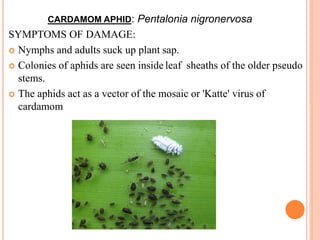
CARDAMOM APHID: Pentalonia nigronervosa
SYMPTOMS OF DAMAGE:
 Nymphs and adults suck up plant sap.
 Colonies of aphids are seen inside leaf sheaths of the older pseudo
stems.
 The aphids act as a vector of the mosaic or 'Katte' virus of
cardamom
Wingless aphid is dark brown.
Winged aphids have wings having
prominent black veins
MANAGEMENT
 Removal of Colocasia and other hosts in the vicinity of
cardamom plantation is recommended.
 Remove partly dried and decayed pseudostems which
harbour the colonies of aphids.
 Foliar spraying with dimethoate 2 ml/lit at an interval
of 2 weeks in November and April gives adequate
control.
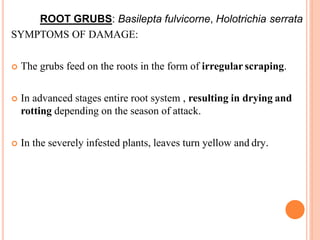
ROOT GRUBS: Basilepta fulvicorne, Holotrichia serrata
SYMPTOMS OF DAMAGE:
 The grubs feed on the roots in the form of irregular scraping.
 In advanced stages entire root system , resulting in drying and
rotting depending on the season of attack.
 In the severely infested plants, leaves turn yellow and dry.
 Root grub:
Basilepta fulvicorne
MANAGEMENT
 Collect the beetles using hand nets during peak period of
emergence i.e., during April-May and killthem.
 Applying chlorpyriphos 0.075% or phorate 2-4 g
a.i./plant in May and in September-October.
 Light raking of soil before the insecticide application is
essential for effective control of root grubs.
 Shoot fly:
Formosina flavipes
Shoot fly: Formosina flavipes
SYMPTOMS OF DAMAGE
 Larvae feed on the growing shoot of the
young cardamom suckers
 Dead heart.
 EGGS: cigar shaped and white colour
MANAGEMENT:
 Remove the affected shoots at ground
level and destroy them.
 Spray dimethoate or quinalphos (0.05%
each).
White flies: Dialeurodes cardamom
SYMPTOMS OF DAMAGE:
 Nymphs and adults remain in colonies on lower
leaf surface and suck the sap.
 Chlorotic patches appear on leaves,
 Gradual yellowing and get dried.
 Sooty mould development occurs due to
honeydew secretion.
MANAGEMENT:
 Spray methyl demeton or dimethoate (0.05%
each) on the foliage
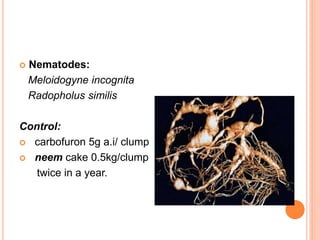
 Nematodes:
Meloidogyne incognita
Radopholus similis
Control:
 carbofuron 5g a.i/ clump
 neem cake 0.5kg/clump
twice in a year.
PROCESSED PRODUCTS
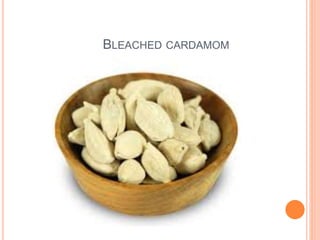
 Bleached cardamom
 Cardamom seed powder
 Essential oil/Cardamom oil:
Main flavor components of oil are
1,8 cineole, a-terpinyl acetate, linalyl acetate and
linalool.{Steam distillation method}
 Cardamom oleoresin:
{Solvent extraction /Super critical fluid
extraction method}
BLEACHED CARDAMOM
cardamom production technology

cardamom production technology

  • 1.
    SUBJECT : SPICESAND CONDIMENTS PMA-201(1+1) TOPIC: SMALL CARDAMOM UNIVERSITY OF HORTICULTURAL SCIENCES BAGALKOT COLLEGE OF HORTICULTURE KOLAR
  • 2.
    PRESENTED BY:  YUVARAJS  TEJASWINI P  SUSHMITHA T  VIDYARANI N M  SAHANA
  • 3.
    INTRODUCTION CARDAMOM  Queen ofspices  Second most important national spice of India.  Third most expensive spice after venilla and saffron.  Pseophytic plant.  Gutemala is the largest producer.  Kerala is the largest growing state of cardamom in India  Idukki known as Cardamom hill reserve.  Saudi arabia –Largest importer
  • 5.
    CONSTITUENTS  Cardamom oil:Produced by Steam distillation of crushed seeds.  Volatile oil in seeds is about 11% while in the husk is 1%.  Oleoresin: Produced by Solvent extraction method and gives 10% oleoresin.  Dried fruits contains pigments,cellulose,pentosans,sugars,starch,silica oxalate and minerals.  Crude fibre(upto 31%)  Fatty acids are the major constituents.
  • 6.
    USES  Flavouring foods Confectionaries  Bevarages  Perfumery and liquor.  Making Cardamom flavoured coffee -Kahwa
  • 7.
    SMALL CARDAMOM  Smallcardamom is also called as Lesser cardamom or Malabar cardamom. Scientific name: Elettaria cardamomum Origin: Native to Evergreen rainy forest of western ghats of South India Family: Zingiberaceae Plant part used: fruit,seed
  • 8.
    SOIL AND CLIMATE Soil: Humus rich soils  Rainfall: 1500-2000mm  Temperature: 15-35ºc  RH:75-90%  pH: 5.5-6.5  Altitude:600-1200m above mean sea level.
  • 9.
    BOTANY  Herbaceous perennial. Pseudostem is formed by the compact arrangement of leaf sheaths on the clumps.  Leaves are lanceolate ,acuminate ,highly pubescent and glabrous.  Shallow root system.  Inflorescence –Panicle of cincinni.  Flowers-Hermophrodite  Fruit-Capsule
  • 12.
    CLASSIFICATION  Based onAdaptability,nature of panicle,shape and size of the capsules. 1. Malabar 2. Mysore 3. Vazhukka
  • 13.
    VARIETIES 1. Mudigere-1 2. Mudigere-2 3.PV-1 4. PV-2 5. ICRI-1 6. ICRI-2 7. ICRI-3 8. TDK-4 9. IISR-Suvasini 10. IISR-Vijetha 11. IISR-Avinash 12. Njallani green bold
  • 15.
    PROPAGATION:  2 methods a. sexual method(seeds)  b.Asexual method(suckers)  Micropropagation technique has also been standardised and commercialized in cardamom
  • 16.
    SEED PROPAGATION:  Fullyripen seeds are extracted.  Ssed capsule collection from sep-oct.  Mother plant should be of 5 years old.  Seed treatment:25%nitric acid or 25%acetic acid or 25%citric acid or 5% HCL foe 10 minutes.  GA3 scarification.  Seed storage in polythene gunny bags.  Seed validity is lost in 15 days(20%),90% in 3-5 months.
  • 17.
    PRIMARY NURSERY:  Raisedbeds of 1m width and convient length(5-6m)and 20-30cm height.  A layer of humus rich forest soil or FYM or compost should be spread on nursery bed.  Soil solarisation.  Soil treatment with methyl bromide@45g/bed or 2%formalin(10lit/bed).  Fumigation of soil.  Seed sowing spacing:8-10cm*1-2cm.  Seed rate:600g/ha.  Overhead shade is provided.  Mulching with paddy straw.  Thinng is done at 6-7 leaf stage.
  • 18.
    SECONDARY NURSERY:  A.BedNursery: seedling transplanted at 4-6 months old(4-5 leaf stage) at 20*20cm in beds.  Transplanting month :In kerala &TN june-july. In karnataka Nov-jan.  Apply 90:60:120g NPK/bed of 6*1m size in three equal splits at 45days interval.  Stages of transplanting to main field: kerala:18-22 months old sedling karnataka 10 month old seedling. B.Polybag Nursery: Poly bags of 20*20cm,100 guage thickness.
  • 19.
     Potting mixture:Humasrich top soil,cowdung and sans(3:1:1)  Seedling of 3-4 leaf stage are transplanted into each bag.  Advantages: uniform growth,more tillers,and good established in the field.
  • 20.
    VEGETATIVE PROPAGATION  a.Clonalmultiplication : Propagated vegetatively through division of rhizome. Propagation unit consist of rhizome with one old and one young shoot consist of a planting unit. Disadvantages: Limited availability of planting material.
  • 21.
    LAND PREPARATION:  Landis cleared and terraces made across slopes at suaitable planting distance.  Trenches and furrows are advaisable.  Spacing: Malabar:2m*2m;  Mysore and Vazhukka:3m*3m  Plant density:1600/ha for Malabar.  For karnataka:1.8*1.8(3025plants/ha)  In TN:2.7*2.7
  • 22.
    PLANTING:  Pit size:45*45*30cmdug during april-may.  Filled with mixture of surgace soil and well rotten FYM+100g of rock phosohate.  Done 2 months in advance to planting.  Best season for planting is kharif season.  2 years old seedling is best for getting tillers and higher yield.
  • 23.
    HIGH DENSITY PLANTING: Malabar variety perform well for HDP.  Spacing of 1.8*1.8m(3025 plant/ha) indicated early and high yield in initial 3-4 years.  Mudigere 1(malabar):1m*1m.  Planting suckers at 1.8*0.9m gives high yield.  Vazhukka varities are not suitable for HDP.
  • 24.
    SHADE REGULATION:  Cardamomis a pseophyte. Shade trees having following characters; 1.wide canopy shade tree. 2.No shedding of leaves during flowering. 3.Medium size evergreen in nature. 4.Small leaves and well spread branching system. 5.Deep root system. 6.Fast growing.
  • 25.
     Shade trees: Vernoniaarborea-Karana Cedrella toona-Red cedar Cassia fistula-Kanikonna Diospyros malabaricum-Vellakil Terminalia tomentosa-Thempavu Hopea parviflora-Thambakam Artocarpus fraxinifolius-Balangi Mesopsis eminii-Elangi Artocarpus integrifolia-Jack
  • 26.
    AFTER CARING:  Duringthe initial stages of growth period sickle weeding and light forking followed by mulching in may.  Manures and fertiliizers:  Applied in 2 doses,  One in june-july and other in sep-oct.  For irrigated Cardamom:75:75:150 kg NPK (30:60:30 For rainifed)  For HDP 120:120:240kg NPK  FYM or leaf mould @10kg and Neem cake @1kg per plant.
  • 27.
    IRRIGATION:  Necessary toirrigate crop to get maximum production as it hepls in initiation of panicle,flowering and fruit set.  Irrigated at an interval of 10-15 days from december till onset of monsoon.  Sprinkler irrigation or drip irrigation  In drip irrigation, at the rate of 4 litres per clump per day during dry month.
  • 28.
    MULCHING:  Fallen leavesof the shade trees are utilized for mulching.  Sufficient mulch during November-December.  Exposing the panicle above mulch is beneficial for the pollination. Weeding:In first year of planting First round of weeding:May-june Second in August- September Third round before harvesting(Nov-Dec) Weedicides: Paraquat(1.25l/ha) Atrazine(1kg/ha) Glyphosate(8kg/ha) Diuron(1kg/ha)
  • 29.
    TRASHING:  Removing oldand drying,diseased shoots ,suckers and leaves of the plant once in a year.  Once in a year(march-may)  2-3 Times for HDP.  It helps to prevent spread of the disease.  Facilitates the visit of honeybees to panicles. Earthing up: After monsoon is over,earthing up is done covering collar region by scrapping between the rows.
  • 30.
    USE OF GROWTHREGULATOR :  Exogenous application of NAA(400ppm) or 2,4,D@4 ppm  It increases plant height and panicle and flower production,reduces the capsule drop and improves yield.  Application of 2,4 D(4ppm);2,4,5-T(6ppm)and NAA(40 ppm) is effective to enhance total essential oil content of capsule.  Spraying NAA(25ppm) twice(june and july)reduced fruit drop and increased fruit set.  Application of Ethrel (250 ppm)under high light intensity (15k lux)doubled the sucker production,
  • 31.
    BEE KEEPING:  Pollinationin cardomom is entomophilous by 2 species of honey bee,  Apis cerena  Apis dorsata Honey bee contributes over 90%pollination  Number of visits of bee is directly proportional number of seed formed in capsule.  At least 4 bee hives per hectare is needed to enhance pollination and fruit set.  Increase in yield upto 9%.
  • 32.
  • 33.
    THRIPS: Sciothrips cardamom SYMPTOMSOF DAMAGE: Panicles become stunted Shedding of flowers and immature capsules. Infestation causes formation of malformed and shriveled condition of pods. Such pods lack their fine aroma and the seeds within are also poorly developed.
  • 34.
    MANAGEMENT  Regulate shadein thickly shaded areas.  Spray insecticides like quinalphos 0.025% or phosalone 0.07% during March, April, May, August andSeptember.
  • 35.
     Shoot andCapsule borer: Conogathes punctiferalis
  • 36.
    Shoot, panicle andcapsule borer: Dichocrocis (Conogethes) punctiferalis SYMPTOMS OF DAMAGE:  Larva bores the unopened leaf buds and feeds on the leaf tissue,bore the pseudostem become its later stage.  Produce characteristic 'dead heart' symptom.  The incidence of this pest is December-January, March-April, May-Juneand September-October
  • 37.
    MANAGEMENT  During daytime adult moths rest on the lower surface of the cardamom. They may be collected with insect net and killed.  The practice of removing the tillers showing 'dead heart' symptoms.  Once the late larvae bore and go deep inside the pseudostem, the chemical spray even in its higher dose becomes ineffective.
  • 38.
    Hairy caterpillars: Eupterotecardamomi, E. canarica, E. Fabia SYMPTOMS OF DAMAGE:  Caterpillars are congregate on the trunks of shade trees during day time and feed at night time.  They fed on leaves and defoliating the whole cardamom plants  Usually the damage is observed during October-December
  • 39.
    MANAGEMENT  Caterpillars thatcongregate at the base of shade trees can be collected and killed.  Installing light traps, the moths can be collected and killed.  Spray monocrotophos or quinalphos 3ml/lit
  • 40.
  • 41.
    CARDAMOM APHID: Pentalonianigronervosa SYMPTOMS OF DAMAGE:  Nymphs and adults suck up plant sap.  Colonies of aphids are seen inside leaf sheaths of the older pseudo stems.  The aphids act as a vector of the mosaic or 'Katte' virus of cardamom
  • 42.
    Wingless aphid isdark brown. Winged aphids have wings having prominent black veins
  • 43.
    MANAGEMENT  Removal ofColocasia and other hosts in the vicinity of cardamom plantation is recommended.  Remove partly dried and decayed pseudostems which harbour the colonies of aphids.  Foliar spraying with dimethoate 2 ml/lit at an interval of 2 weeks in November and April gives adequate control.
  • 44.
    ROOT GRUBS: Basileptafulvicorne, Holotrichia serrata SYMPTOMS OF DAMAGE:  The grubs feed on the roots in the form of irregular scraping.  In advanced stages entire root system , resulting in drying and rotting depending on the season of attack.  In the severely infested plants, leaves turn yellow and dry.
  • 45.
  • 46.
    MANAGEMENT  Collect thebeetles using hand nets during peak period of emergence i.e., during April-May and killthem.  Applying chlorpyriphos 0.075% or phorate 2-4 g a.i./plant in May and in September-October.  Light raking of soil before the insecticide application is essential for effective control of root grubs.
  • 47.
  • 48.
    Shoot fly: Formosinaflavipes SYMPTOMS OF DAMAGE  Larvae feed on the growing shoot of the young cardamom suckers  Dead heart.  EGGS: cigar shaped and white colour MANAGEMENT:  Remove the affected shoots at ground level and destroy them.  Spray dimethoate or quinalphos (0.05% each).
  • 49.
    White flies: Dialeurodescardamom SYMPTOMS OF DAMAGE:  Nymphs and adults remain in colonies on lower leaf surface and suck the sap.  Chlorotic patches appear on leaves,  Gradual yellowing and get dried.  Sooty mould development occurs due to honeydew secretion. MANAGEMENT:  Spray methyl demeton or dimethoate (0.05% each) on the foliage
  • 50.
     Nematodes: Meloidogyne incognita Radopholussimilis Control:  carbofuron 5g a.i/ clump  neem cake 0.5kg/clump twice in a year.
  • 51.
    PROCESSED PRODUCTS  Bleachedcardamom  Cardamom seed powder  Essential oil/Cardamom oil: Main flavor components of oil are 1,8 cineole, a-terpinyl acetate, linalyl acetate and linalool.{Steam distillation method}  Cardamom oleoresin: {Solvent extraction /Super critical fluid extraction method}
  • 54.