Harvesting Quality Citrus
Cindy Fake
University of California Cooperative Extension
October 2012
Citrus Harvesting, Quality, & Maturity
1. Citrus Quality
• Factors & Standards
2. Field Practices
• Growing practices that promote quality
• Harvesting practices
3. Assessing Maturity & Quality
• Maturity tests
To receive the best prices in markets,
mandarins must be:
• Grown using good practices to produce good
tasting fruit of the right size
• Picked at maturity, using good harvest practices
• Free of major cosmetic defects
• Able to surpass minimum maturity standards for
juice content and sugar to acid ratio (TSS:TA)
• Packed and stored properly
to maintain quality
Terminology
• °Brix = “sugars” = Total Soluble Solids (TSS)
• Acidity = titratable acidity, Total Acidity (TA),
not the same as pH
• Maturity = having completed natural growth &
development
• Minimum maturity = standards fruit must
reach before treatment or shipping
• Defect = visual damage, such as cuts,
scars, dirt, decay or other foreign matter
Citrus Fruit Quality Factors
• Maturity
• Sugars/TSS (total
soluble solids ): acid
ratio
• Juice content
• Firmness
• Appearance: freedom
from defects or rot
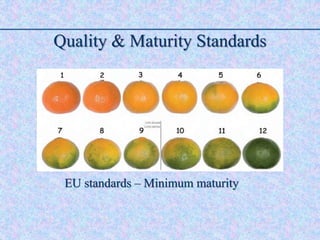
• Color : 75% of surface
• Size
• Shape
• Peel thickness
• Ease of peeling
• Seed content
• Flavor or taste
Quality & Maturity Standards
EU standards – Minimum maturity
1. Minimum juice content:
33%
2. Coloring: typical of the variety
>1/3 of fruit surface
3. Sugar: Acid ratio
TSS:1% acid
Moderate Maturity
• >8% Total Soluble Solids (°Brix):1 % acids
– Sugars rise as mature, acids decline
Quality & Maturity Standards
EU standards – Minimum maturity
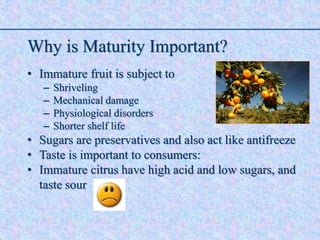
Why is Maturity Important?
• Immature fruit is subject to
– Shriveling
– Mechanical damage
– Physiological disorders
– Shorter shelf life
• Sugars are preservatives and also act like antifreeze
• Taste is important to consumers:
• Immature citrus have high acid and low sugars, and
taste sour
When is fruit mature enough to pick?
• Color: at least1/3 of fruit must be properly colored
• No longer rock hard; softening
• Fruit “gives” with finger pressure
• Peel has “give” = slightly loose
• Taste may still be slightly tart in early season, but
must be “sweet-tart” so is palatable
• Early picking should be
“picked to color” AND taste!
Quality Standards: Standard Pack
• Fruit fairly uniform in size
• EU minimum size =43 mm, 10% tolerance in size
range
• Packed in boxes or cartons and arranged according
to the approved and recognized methods
• Tightly packed and well filled but no “excessive
or unnecessary bruising” because of overfilling
• Container shall be at least level full
at time of packing
Defects: rough or thick skin
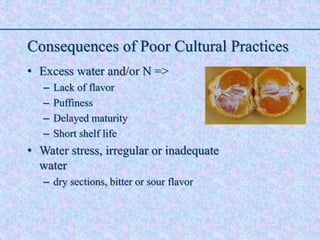
Consequences of Poor Cultural Practices
• Excess water and/or N =>
– Lack of flavor
– Puffiness
– Delayed maturity
– Short shelf life
• Water stress, irregular or inadequate
water
– dry sections, bitter or sour flavor
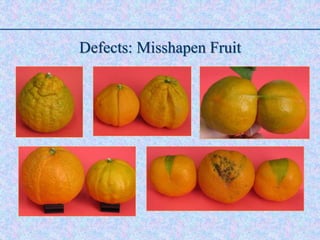
Defects: Misshapen Fruit
Defects:
Rind Breakdown and Decay/Rot
Defects: dirt or foreign material:
sooty mold & scale honeydew
Defects: Insect & Mite Damage
California red scale Citrus thripsRust mite damage
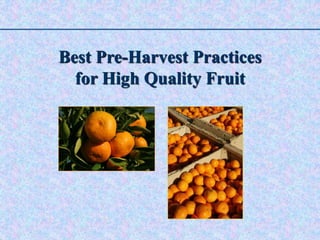
Best Pre-Harvest Practices
for High Quality Fruit
Best Production Practices for High Quality Fruit
Timely pruning
• Open up canopy to increase light & air
– Reduces scale pests and sooty mold
– Increases inside fruit which is protected
from hail
• Prune out overly vigorous branches that
produce ugly fruit (gourmands )
– Usually produce unattractive fruit
– Rough, misshapen fruit
– Thick skins
– Overly large fruit
• Prune out dead or crossing branches
that may damage fruit
Best Production Practices for High Quality Fruit
• Use mulch or compost to keep
tree roots healthy
• Do not dig soil around tree roots
• Use fertilizer to keep trees healthy and
productive
• Mature tree needs 0.2-0.5 kg actual Nitrogen per
year; depending on size of tree
• Reduce N applications after spring growth flush
• Stop N fertilization in July
• Too much N late in season leads to puffiness &
ugly fruit
Best Production Practices for High Quality Fruit
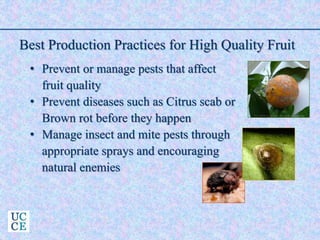
• Prevent or manage pests that affect
fruit quality
• Prevent diseases such as Citrus scab or
Brown rot before they happen
• Manage insect and mite pests through
appropriate sprays and encouraging
natural enemies
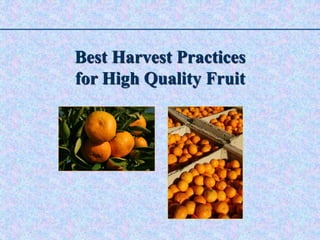
Best Harvest Practices
for High Quality Fruit
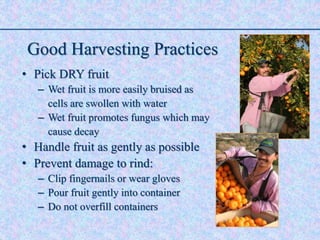
Good Harvesting Practices
• Pick DRY fruit
– Wet fruit is more easily bruised as
cells are swollen with water
– Wet fruit promotes fungus which may
cause decay
• Handle fruit as gently as possible
• Prevent damage to rind:
– Clip fingernails or wear gloves
– Pour fruit gently into container
– Do not overfill containers
Good Harvesting Practices
• Always cut fruit from tree
• Use sharp clippers and clip
stem as short as possible
These long stems will damage other fruit
These short stems will
minimize damage to other fruit
Good Harvesting Practices
• Cut and remove diseased fruit first
so fungal spores don’t scatter
• Do not pick fruit off the ground
• If branches are heavy with fruit,
prop them up off the ground at
least 1 month before harvest
• Sanitary practices
– Clean hands
– Use hand cleaner after touching
infected fruit
– Wash hands after using bathroom
Sorting Practices
• Do not expect to sell all your fruit – sort for quality!
• Cull any rind defects that will shorten shelf life
• Keep cull pile away from trees or packing area
• Handle diseased fruit carefully so spores do not spread
• Clean hands & equipment after any infected fruit
• Keep to a similar size range in each container
vs.
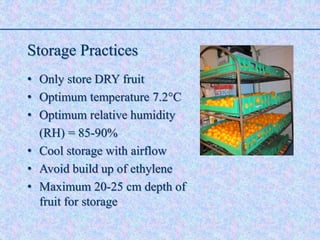
Storage Practices
• Only store DRY fruit
• Optimum temperature 7.2°C
• Optimum relative humidity
(RH) = 85-90%
• Cool storage with airflow
• Avoid build up of ethylene
• Maximum 20-25 cm depth of
fruit for storage
Packing Practices
• Do not squeeze the fruit into the box
• Do not stack bagged fruit more than 3 or 4 high
• Do not pack too much ahead of time
• Fingernails! - Wear gloves
Maturity Testing
• Important objective measures
of fruit maturity
• Must meet standards for exports or for high end
markets
• Fruit is judged by color standards and
• Maturity Testing : 3 major tests:
• Juice Content (%)
• Sugar: Acid Ratio, based on:
• Total Soluble Solids (TSS) = Sugars
• Titratable acidity (total acids)
• Most buyers will want to taste as well
Juice Content = % juice
• Weigh 10 mandarins, record weight.
• Weigh the juice container,
record weight.
• Juice the mandarins. Strain juice into container.
• Weigh the juice, then subtract the weight of the
container.
• Juice %=
Weight of juice ÷Total fruit weight x 100
Total Soluble Solids (TSS)
• °Brix, TSS = measurement of
sugar content or sweetness
• Measured with temperature-compensating
refractometer
• Be sure the glass surface is clean & dry
• Place a few drops of juice on the glass
• Close the lid
• Look through the eyepiece and read where the juice
sits on the scale
• Clean and dry the refractometer immediately
• Critical measurement for Georgian
mandarins
• Quality issue with fruit is high
acidity, not low sugars
• Measure of total acidity of the juice
• Not the same as pH
• Measured by using a measured amount of a base
(NaOH) and a color indicator to bring the juice
solution to neutrality
• The acidity is then calculated with a standard formula
ml NaOH x 0.064 = citric acid concentration
Titratable Acidity (TA)
• Sugar: Acid Ratio is the major component of
mandarin flavor
• Early in season, TSS:TA is low because sugar is low
and acid is high
• As fruit ripens, sugars increase and acid decreases
• Sugar: Acid ratio = °Brix ÷ Citric Acid Concentration
• Consumer preference for sugar content varies with
markets, so KNOW your market!
Sugar: Acid Ratio (TSS:TA)
Points to remember
• Quality fruit is mature fruit
• Quality standards are based on
size, color, and freedom from defects
• To the consumer, quality is all about flavor!
• Flavor preferences always favor sweetness
• Maturity standards are based on color, juice content,
sugar content and acid content.
• Good growing practices and good harvesting practices
will bring higher prices for fruit.
Harvesting for Quality
Thank you!
Cindy Fake
University of California Cooperative Extension
October 2012

Citrus-harvest-potharvest-quality

  • 1.
    Harvesting Quality Citrus CindyFake University of California Cooperative Extension October 2012
  • 2.
    Citrus Harvesting, Quality,& Maturity 1. Citrus Quality • Factors & Standards 2. Field Practices • Growing practices that promote quality • Harvesting practices 3. Assessing Maturity & Quality • Maturity tests
  • 3.
    To receive thebest prices in markets, mandarins must be: • Grown using good practices to produce good tasting fruit of the right size • Picked at maturity, using good harvest practices • Free of major cosmetic defects • Able to surpass minimum maturity standards for juice content and sugar to acid ratio (TSS:TA) • Packed and stored properly to maintain quality
  • 4.
    Terminology • °Brix =“sugars” = Total Soluble Solids (TSS) • Acidity = titratable acidity, Total Acidity (TA), not the same as pH • Maturity = having completed natural growth & development • Minimum maturity = standards fruit must reach before treatment or shipping • Defect = visual damage, such as cuts, scars, dirt, decay or other foreign matter
  • 5.
    Citrus Fruit QualityFactors • Maturity • Sugars/TSS (total soluble solids ): acid ratio • Juice content • Firmness • Appearance: freedom from defects or rot • Color : 75% of surface • Size • Shape • Peel thickness • Ease of peeling • Seed content • Flavor or taste
  • 6.
    Quality & MaturityStandards EU standards – Minimum maturity 1. Minimum juice content: 33% 2. Coloring: typical of the variety >1/3 of fruit surface 3. Sugar: Acid ratio TSS:1% acid Moderate Maturity • >8% Total Soluble Solids (°Brix):1 % acids – Sugars rise as mature, acids decline
  • 7.
    Quality & MaturityStandards EU standards – Minimum maturity
  • 8.
    Why is MaturityImportant? • Immature fruit is subject to – Shriveling – Mechanical damage – Physiological disorders – Shorter shelf life • Sugars are preservatives and also act like antifreeze • Taste is important to consumers: • Immature citrus have high acid and low sugars, and taste sour
  • 9.
    When is fruitmature enough to pick? • Color: at least1/3 of fruit must be properly colored • No longer rock hard; softening • Fruit “gives” with finger pressure • Peel has “give” = slightly loose • Taste may still be slightly tart in early season, but must be “sweet-tart” so is palatable • Early picking should be “picked to color” AND taste!
  • 10.
    Quality Standards: StandardPack • Fruit fairly uniform in size • EU minimum size =43 mm, 10% tolerance in size range • Packed in boxes or cartons and arranged according to the approved and recognized methods • Tightly packed and well filled but no “excessive or unnecessary bruising” because of overfilling • Container shall be at least level full at time of packing
  • 11.
  • 12.
    Consequences of PoorCultural Practices • Excess water and/or N => – Lack of flavor – Puffiness – Delayed maturity – Short shelf life • Water stress, irregular or inadequate water – dry sections, bitter or sour flavor
  • 13.
  • 14.
  • 15.
    Defects: dirt orforeign material: sooty mold & scale honeydew
  • 16.
    Defects: Insect &Mite Damage California red scale Citrus thripsRust mite damage
  • 17.
  • 18.
    Best Production Practicesfor High Quality Fruit Timely pruning • Open up canopy to increase light & air – Reduces scale pests and sooty mold – Increases inside fruit which is protected from hail • Prune out overly vigorous branches that produce ugly fruit (gourmands ) – Usually produce unattractive fruit – Rough, misshapen fruit – Thick skins – Overly large fruit • Prune out dead or crossing branches that may damage fruit
  • 19.
    Best Production Practicesfor High Quality Fruit • Use mulch or compost to keep tree roots healthy • Do not dig soil around tree roots • Use fertilizer to keep trees healthy and productive • Mature tree needs 0.2-0.5 kg actual Nitrogen per year; depending on size of tree • Reduce N applications after spring growth flush • Stop N fertilization in July • Too much N late in season leads to puffiness & ugly fruit
  • 20.
    Best Production Practicesfor High Quality Fruit • Prevent or manage pests that affect fruit quality • Prevent diseases such as Citrus scab or Brown rot before they happen • Manage insect and mite pests through appropriate sprays and encouraging natural enemies
  • 21.
    Best Harvest Practices forHigh Quality Fruit
  • 22.
    Good Harvesting Practices •Pick DRY fruit – Wet fruit is more easily bruised as cells are swollen with water – Wet fruit promotes fungus which may cause decay • Handle fruit as gently as possible • Prevent damage to rind: – Clip fingernails or wear gloves – Pour fruit gently into container – Do not overfill containers
  • 23.
    Good Harvesting Practices •Always cut fruit from tree • Use sharp clippers and clip stem as short as possible These long stems will damage other fruit These short stems will minimize damage to other fruit
  • 24.
    Good Harvesting Practices •Cut and remove diseased fruit first so fungal spores don’t scatter • Do not pick fruit off the ground • If branches are heavy with fruit, prop them up off the ground at least 1 month before harvest • Sanitary practices – Clean hands – Use hand cleaner after touching infected fruit – Wash hands after using bathroom
  • 25.
    Sorting Practices • Donot expect to sell all your fruit – sort for quality! • Cull any rind defects that will shorten shelf life • Keep cull pile away from trees or packing area • Handle diseased fruit carefully so spores do not spread • Clean hands & equipment after any infected fruit • Keep to a similar size range in each container vs.
  • 26.
    Storage Practices • Onlystore DRY fruit • Optimum temperature 7.2°C • Optimum relative humidity (RH) = 85-90% • Cool storage with airflow • Avoid build up of ethylene • Maximum 20-25 cm depth of fruit for storage
  • 27.
    Packing Practices • Donot squeeze the fruit into the box • Do not stack bagged fruit more than 3 or 4 high • Do not pack too much ahead of time • Fingernails! - Wear gloves
  • 28.
    Maturity Testing • Importantobjective measures of fruit maturity • Must meet standards for exports or for high end markets • Fruit is judged by color standards and • Maturity Testing : 3 major tests: • Juice Content (%) • Sugar: Acid Ratio, based on: • Total Soluble Solids (TSS) = Sugars • Titratable acidity (total acids) • Most buyers will want to taste as well
  • 29.
    Juice Content =% juice • Weigh 10 mandarins, record weight. • Weigh the juice container, record weight. • Juice the mandarins. Strain juice into container. • Weigh the juice, then subtract the weight of the container. • Juice %= Weight of juice ÷Total fruit weight x 100
  • 30.
    Total Soluble Solids(TSS) • °Brix, TSS = measurement of sugar content or sweetness • Measured with temperature-compensating refractometer • Be sure the glass surface is clean & dry • Place a few drops of juice on the glass • Close the lid • Look through the eyepiece and read where the juice sits on the scale • Clean and dry the refractometer immediately
  • 31.
    • Critical measurementfor Georgian mandarins • Quality issue with fruit is high acidity, not low sugars • Measure of total acidity of the juice • Not the same as pH • Measured by using a measured amount of a base (NaOH) and a color indicator to bring the juice solution to neutrality • The acidity is then calculated with a standard formula ml NaOH x 0.064 = citric acid concentration Titratable Acidity (TA)
  • 32.
    • Sugar: AcidRatio is the major component of mandarin flavor • Early in season, TSS:TA is low because sugar is low and acid is high • As fruit ripens, sugars increase and acid decreases • Sugar: Acid ratio = °Brix ÷ Citric Acid Concentration • Consumer preference for sugar content varies with markets, so KNOW your market! Sugar: Acid Ratio (TSS:TA)
  • 33.
    Points to remember •Quality fruit is mature fruit • Quality standards are based on size, color, and freedom from defects • To the consumer, quality is all about flavor! • Flavor preferences always favor sweetness • Maturity standards are based on color, juice content, sugar content and acid content. • Good growing practices and good harvesting practices will bring higher prices for fruit.
  • 34.
    Harvesting for Quality Thankyou! Cindy Fake University of California Cooperative Extension October 2012