By – Yuvraj Singh
Content
• Introduction
• Forage Quality
• Global and Indian
Scenario
• Taxonomy
• Types of Berseem
• Habit
• Floral Biology
• Origin
• Distribution
• Soil and Climate
• Breeding Objectives
• Limitations
• Future Prospects
Introduction
• Berseem or Egyptian clover is popularly known as the King of
fodder crops for irrigated condition of Northern India
• It is available for 6-7 month from November to May, gives 4 -
6 cuts during winter, spring and early summer
• The green forage can also be converted in to excellent hay and
utilized for enrichment of poor quality roughages like Kadbis
and straw
• Berseem also has soil building characteristics and improves
the physical, chemical and biological properties of the soil
resulting in better growth and yield of crops in rotation
• Hence, important for conservation farming and imparts
sustainability to soil productivity and crop production system
Origin
• Berseem originated in SW Asia (Syria)
• It was introduced into Egypt in the 6th century, into
India in the 19th century and into Pakistan, South
Africa, the USA and Australia in the 20th century
• Also grown in some areas of southern Europe
• Berseem has been one of the fastest spreading
fodder species in recent times, mainly under small-
scale farming conditions
Distribution
• It is cultivated from 35°N to the Tropics, from
sea level up to 750 m (1500 m in North West
Himalaya)
• Berseem is mainly valued as a winter crop in
the subtropics as it grows well in mild winter
and recovers strongly after cutting
• It does not grow well under hot summer
conditions
Forage quality
• Berseem is highly nutritious, succulent and palatable
forage for all types of livestock.
• It stimulates milk production of cows and buffaloes
• It is popular both for milch and draught animals.
• Berseem is a good source of crude protein, calcium,
phosphorus and ether extract.
• The green forage of Berseem (on dry matter basis)
contains 17-22% CP, 62% TDN includes 42-49%
neutral detergent fibre, 35-38% acid detergent fibre,
24-25% cellulose and 7-10% hemicellulose.
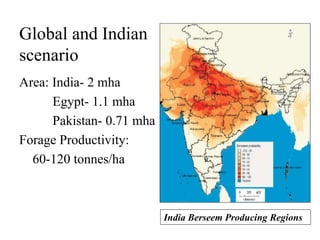
Global and Indian
scenario
Area: India- 2 mha
Egypt- 1.1 mha
Pakistan- 0.71 mha
Forage Productivity:
60-120 tonnes/ha
India Berseem Producing Regions
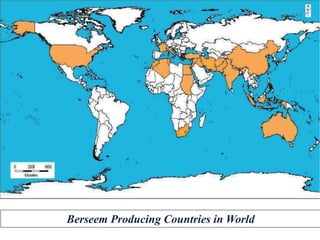
Berseem Producing Countries in World
Types of Berseem
• Berseem is a variable species that can be classified
into four cultivars groups according to their
branching behavior & subsequent productivity:
1. Highly branching and productive types -
a). Miscawi, b). Kahdrawi (can yield 4-6
cuttings/season)
2. Saidi can be cut only twice
3. Fahli berseem is a low branching cultivar and is
more adapted to dry areas
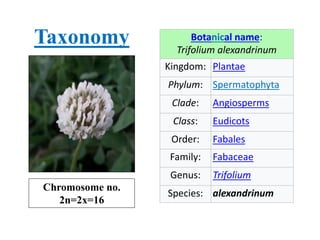
Botanical name:
Trifolium alexandrinum
Kingdom: Plantae
Phylum: Spermatophyta
Clade: Angiosperms
Class: Eudicots
Order: Fabales
Family: Fabaceae
Genus: Trifolium
Species: alexandrinum
Taxonomy
Chromosome no.
2n=2x=16
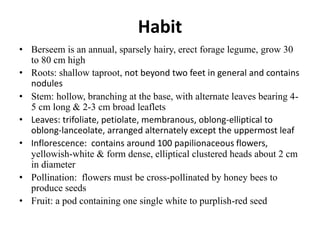
Habit
• Berseem is an annual, sparsely hairy, erect forage legume, grow 30
to 80 cm high
• Roots: shallow taproot, not beyond two feet in general and contains
nodules
• Stem: hollow, branching at the base, with alternate leaves bearing 4-
5 cm long & 2-3 cm broad leaflets
• Leaves: trifoliate, petiolate, membranous, oblong-elliptical to
oblong-lanceolate, arranged alternately except the uppermost leaf
• Inflorescence: contains around 100 papilionaceous flowers,
yellowish-white & form dense, elliptical clustered heads about 2 cm
in diameter
• Pollination: flowers must be cross-pollinated by honey bees to
produce seeds
• Fruit: a pod containing one single white to purplish-red seed
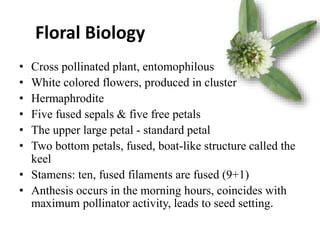
Floral Biology
• Cross pollinated plant, entomophilous
• White colored flowers, produced in cluster
• Hermaphrodite
• Five fused sepals & five free petals
• The upper large petal - standard petal
• Two bottom petals, fused, boat-like structure called the
keel
• Stamens: ten, fused filaments are fused (9+1)
• Anthesis occurs in the morning hours, coincides with
maximum pollinator activity, leads to seed setting.
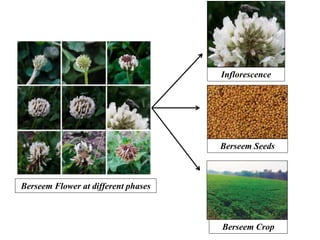
Berseem Flower at different phases
Inflorescence
Berseem Seeds
Berseem Crop
Soil and Climate
• Berseem is adapted to cool and moderately cold
climate
• Such conditions prevail during winter and spring
seasons in north India which is considered as
favorable and productive zone for this crop
• The optimum temperature at the time of sowing
Berseem is 250C
• For Iuxuriant vegetative growth temperature
range of 250C to 27oC has been found ideal
• Uniformly high temperature in south Indian
conditions limits the cultivation of Berseem.
Soil and Climate
• Berseem has some frost tolerance, down to -6°C and as
low as -15°C for some cultivars
• Berseem can grow in areas where annual rainfall ranges
between 550 mm and 750 mm
• It can withstand some drought and short periods of
waterlogging
• It does better than alfalfa in high moisture soils and is
very productive under irrigation
• It is moderately tolerant of salinity and can grow on a
wide range of soils, though it prefers fertile, loamy to
clay soils
• Prefers mildly acidic to slightly alkalinie pH (6.5-8)
Breeding objectives
(i) High dry matter yield
(ii) Better quality components– crude protein content,
in-vitro dry-matter digestibility, low percentage of
neutral detergent fibre and toxicity
(iii)High response to inputs
(iv) Tolerance to adverse soils- acidic/saline soils
(v) Tolerance to extreme weather conditions – high
rainfall/ low moisture regime
Breeding objectives
(i) Resistance to diseases and insect-pests
(ii) Greater persistence summer persistence in annual multi-
cut forages, e.g. berseem and exploitable regeneration
ability in perennial multi-cuts e.g. lucerne
(iii) Greater aggressiveness/ fast growth
(iv) Competing ability or complementation with the
companion crop, for example, oats competes well in an
intercropping of Oats + Berseem and yield better in
early cuts or first cut and subsequently it allows
berseem to flourish over and above its own production
potential.
Limitations
(i) Non-availability of sufficient quantity of quality
fodder seeds
(ii) Non-availability of dual-purpose varieties
(iii)Non-synchronous flowering /anthesis and spikelet
maturity
(iv) Abscission of spikelet after maturity and the
presence of large number of sterile glumes
(v) Overlapping of vegetative and reproductive growth
phases
(vi) Apomictic nature limits their genetic improvement
Forage yield
• Forge yield potential of Berseem crop is very high
• Yield potential : 1000 to 1200 q/ha green forage
• Mixed cropping: Japan rape or Chines cabbage 2.25
kg seed/ha increases the yield by 20-25 per cent in
first cut
Varieties
• CCSHAU Hisar: Mescavi, HFB 600
• PAU, Ludhiana: BL-1, Bl-2, BL-22, BL-42, BL-180
• JNKVV, Jabalpur: Jawahar Berseem-1, JB-2, JB-3
• IGFRI Jhansi: Wardan, Bundel Berseem2, BB-3,
JBSC-1
• GBPUA&T Pantnagar: UPB-110
• IARI – Pusa Giant
Future prospects
Berseem being an introduced crop in India, genetic
improvement in this crop is hampered by narrow
genetic base and lack of variability in desirable
traits. There is a scope to further strengthen the
genomic resources by developing more SSR
markers, molecular linkage map and mapping of
forage quality and biomass contributing traits which
could be utilized to speed up conventional breeding
programme going on in different research
institutes/universities.
Berseem: Fodder Crop

Berseem: Fodder Crop

  • 1.
  • 2.
    Content • Introduction • ForageQuality • Global and Indian Scenario • Taxonomy • Types of Berseem • Habit • Floral Biology • Origin • Distribution • Soil and Climate • Breeding Objectives • Limitations • Future Prospects
  • 3.
    Introduction • Berseem orEgyptian clover is popularly known as the King of fodder crops for irrigated condition of Northern India • It is available for 6-7 month from November to May, gives 4 - 6 cuts during winter, spring and early summer • The green forage can also be converted in to excellent hay and utilized for enrichment of poor quality roughages like Kadbis and straw • Berseem also has soil building characteristics and improves the physical, chemical and biological properties of the soil resulting in better growth and yield of crops in rotation • Hence, important for conservation farming and imparts sustainability to soil productivity and crop production system
  • 4.
    Origin • Berseem originatedin SW Asia (Syria) • It was introduced into Egypt in the 6th century, into India in the 19th century and into Pakistan, South Africa, the USA and Australia in the 20th century • Also grown in some areas of southern Europe • Berseem has been one of the fastest spreading fodder species in recent times, mainly under small- scale farming conditions
  • 5.
    Distribution • It iscultivated from 35°N to the Tropics, from sea level up to 750 m (1500 m in North West Himalaya) • Berseem is mainly valued as a winter crop in the subtropics as it grows well in mild winter and recovers strongly after cutting • It does not grow well under hot summer conditions
  • 6.
    Forage quality • Berseemis highly nutritious, succulent and palatable forage for all types of livestock. • It stimulates milk production of cows and buffaloes • It is popular both for milch and draught animals. • Berseem is a good source of crude protein, calcium, phosphorus and ether extract. • The green forage of Berseem (on dry matter basis) contains 17-22% CP, 62% TDN includes 42-49% neutral detergent fibre, 35-38% acid detergent fibre, 24-25% cellulose and 7-10% hemicellulose.
  • 7.
    Global and Indian scenario Area:India- 2 mha Egypt- 1.1 mha Pakistan- 0.71 mha Forage Productivity: 60-120 tonnes/ha India Berseem Producing Regions
  • 8.
  • 9.
    Types of Berseem •Berseem is a variable species that can be classified into four cultivars groups according to their branching behavior & subsequent productivity: 1. Highly branching and productive types - a). Miscawi, b). Kahdrawi (can yield 4-6 cuttings/season) 2. Saidi can be cut only twice 3. Fahli berseem is a low branching cultivar and is more adapted to dry areas
  • 10.
    Botanical name: Trifolium alexandrinum Kingdom:Plantae Phylum: Spermatophyta Clade: Angiosperms Class: Eudicots Order: Fabales Family: Fabaceae Genus: Trifolium Species: alexandrinum Taxonomy Chromosome no. 2n=2x=16
  • 11.
    Habit • Berseem isan annual, sparsely hairy, erect forage legume, grow 30 to 80 cm high • Roots: shallow taproot, not beyond two feet in general and contains nodules • Stem: hollow, branching at the base, with alternate leaves bearing 4- 5 cm long & 2-3 cm broad leaflets • Leaves: trifoliate, petiolate, membranous, oblong-elliptical to oblong-lanceolate, arranged alternately except the uppermost leaf • Inflorescence: contains around 100 papilionaceous flowers, yellowish-white & form dense, elliptical clustered heads about 2 cm in diameter • Pollination: flowers must be cross-pollinated by honey bees to produce seeds • Fruit: a pod containing one single white to purplish-red seed
  • 12.
    Floral Biology • Crosspollinated plant, entomophilous • White colored flowers, produced in cluster • Hermaphrodite • Five fused sepals & five free petals • The upper large petal - standard petal • Two bottom petals, fused, boat-like structure called the keel • Stamens: ten, fused filaments are fused (9+1) • Anthesis occurs in the morning hours, coincides with maximum pollinator activity, leads to seed setting.
  • 13.
    Berseem Flower atdifferent phases Inflorescence Berseem Seeds Berseem Crop
  • 14.
    Soil and Climate •Berseem is adapted to cool and moderately cold climate • Such conditions prevail during winter and spring seasons in north India which is considered as favorable and productive zone for this crop • The optimum temperature at the time of sowing Berseem is 250C • For Iuxuriant vegetative growth temperature range of 250C to 27oC has been found ideal • Uniformly high temperature in south Indian conditions limits the cultivation of Berseem.
  • 15.
    Soil and Climate •Berseem has some frost tolerance, down to -6°C and as low as -15°C for some cultivars • Berseem can grow in areas where annual rainfall ranges between 550 mm and 750 mm • It can withstand some drought and short periods of waterlogging • It does better than alfalfa in high moisture soils and is very productive under irrigation • It is moderately tolerant of salinity and can grow on a wide range of soils, though it prefers fertile, loamy to clay soils • Prefers mildly acidic to slightly alkalinie pH (6.5-8)
  • 16.
    Breeding objectives (i) Highdry matter yield (ii) Better quality components– crude protein content, in-vitro dry-matter digestibility, low percentage of neutral detergent fibre and toxicity (iii)High response to inputs (iv) Tolerance to adverse soils- acidic/saline soils (v) Tolerance to extreme weather conditions – high rainfall/ low moisture regime
  • 17.
    Breeding objectives (i) Resistanceto diseases and insect-pests (ii) Greater persistence summer persistence in annual multi- cut forages, e.g. berseem and exploitable regeneration ability in perennial multi-cuts e.g. lucerne (iii) Greater aggressiveness/ fast growth (iv) Competing ability or complementation with the companion crop, for example, oats competes well in an intercropping of Oats + Berseem and yield better in early cuts or first cut and subsequently it allows berseem to flourish over and above its own production potential.
  • 18.
    Limitations (i) Non-availability ofsufficient quantity of quality fodder seeds (ii) Non-availability of dual-purpose varieties (iii)Non-synchronous flowering /anthesis and spikelet maturity (iv) Abscission of spikelet after maturity and the presence of large number of sterile glumes (v) Overlapping of vegetative and reproductive growth phases (vi) Apomictic nature limits their genetic improvement
  • 19.
    Forage yield • Forgeyield potential of Berseem crop is very high • Yield potential : 1000 to 1200 q/ha green forage • Mixed cropping: Japan rape or Chines cabbage 2.25 kg seed/ha increases the yield by 20-25 per cent in first cut
  • 20.
    Varieties • CCSHAU Hisar:Mescavi, HFB 600 • PAU, Ludhiana: BL-1, Bl-2, BL-22, BL-42, BL-180 • JNKVV, Jabalpur: Jawahar Berseem-1, JB-2, JB-3 • IGFRI Jhansi: Wardan, Bundel Berseem2, BB-3, JBSC-1 • GBPUA&T Pantnagar: UPB-110 • IARI – Pusa Giant
  • 21.
    Future prospects Berseem beingan introduced crop in India, genetic improvement in this crop is hampered by narrow genetic base and lack of variability in desirable traits. There is a scope to further strengthen the genomic resources by developing more SSR markers, molecular linkage map and mapping of forage quality and biomass contributing traits which could be utilized to speed up conventional breeding programme going on in different research institutes/universities.