Submitted To –
Dept.of Biotechnology
Submitted By –
Sonika Chouhan
M.Sc. III Sem
Content:
Organic Acid
Citric Acid
Methods Of Citric Acid Production &
Raw materials
KOJI Fermentation Process
Submerged Culture Fermentation Process
Liquid Surface Culture Fermentation Process
Fermentation Of Citric Acid by Microbes
Recovery and Purification
Uses Of Citric Acid
Organic Acid
• Organic acid are the organic compound with acidic
properties.
• The most common organic acids are the carboxylic
acids.
• Acidity is associated with their acid groups like-
carboxylic group (-COOH)
• Organic acid are the terminal products of glycolysis.
• For eg. Lactic acid
• These are the products of incomplete oxidation of
sugar.
Such as, , gluconic acid.
Citric Acid
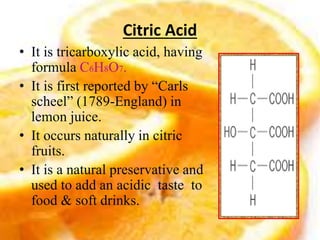
• It is tricarboxylic acid, having
formula C6H8O7.
• It is first reported by “Carls
scheel” (1789-England) in
lemon juice.
• It occurs naturally in citric
fruits.
• It is a natural preservative and
used to add an acidic taste to
food & soft drinks.
conti
• It exists in a variety of fruits and vegetables ,
most conc. In lemon ,orange (7-8%).
• It is an intermediate of citric acid cycle.
• Commercially production of citric acid is
generally by submerged fermentation of
sucrose or molasses using the filamentous
fungus Aspergillus niger.
History :
• 1789 – Carl Scheele
• 1893 – Wehmer
• 1916 – Currie
• 1930 – some unit implanted in England ,
Germany for the commercial
production.
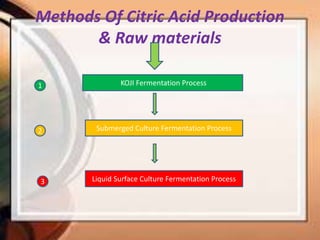
Methods Of Citric Acid Production
& Raw materials
Submerged Culture Fermentation Process
Liquid Surface Culture Fermentation Process
KOJI Fermentation Process1
2
3
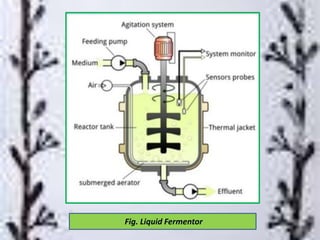
Submerged Culture Fermentation Process
(Liquid Fermention)
• This is commonly used for citric acid production.
• It estimate about 80% .
• Less prize
• Small size
• High yield
• Low labour cost
Two types of fermentor are used-
Conventional stirrer
Tower fermentation
Fig. Liquid Fermentor
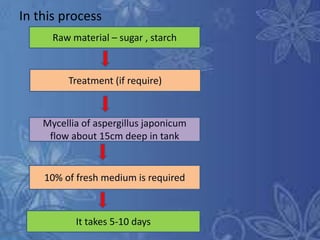
In this process
Raw material – sugar , starch
Treatment (if require)
Mycellia of aspergillus japonicum
flow about 15cm deep in tank
10% of fresh medium is required
It takes 5-10 days
Liquid Surface Culture Fermentation
Process
(surface fermentation)
• The first individual process for citric acid
production.
• It is introduce by “Des” in 1919
• Later “Chas” in 1923
• Sophisticated technique
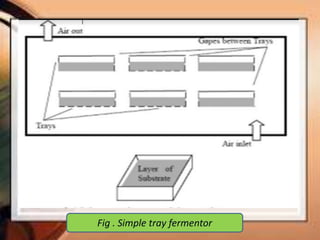
Fig . Simple tray fermentor
In this process
• Liquid culture are incubated with spores
• Mycellia mat developed on the surface of
medium.
• It takes 24hrs.
• Crude sucrose, cane syrup & beet molasses
are used as carbon source.
KOJI Fermentation Process
(Solid state fermentation)
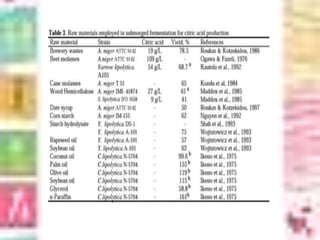
• It is an alternative method.
• This method is used first in JAPAN
• Aspergillus Niger Strain is used in this method.
• It is the simplest method .
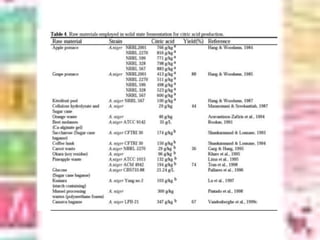
• It can carried out using several raw
material(Table).
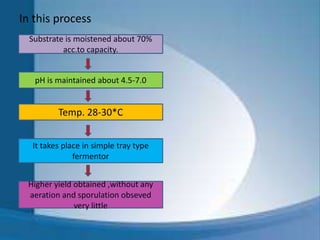
In this process
Substrate is moistened about 70%
acc.to capacity.
pH is maintained about 4.5-7.0
Temp. 28-30*C
It takes place in simple tray type
fermentor
Higher yield obtained ,without any
aeration and sporulation obseved
very little
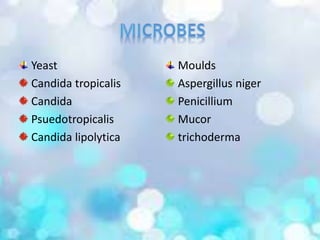
Yeast
Candida tropicalis
Candida
Psuedotropicalis
Candida lipolytica
Moulds
Aspergillus niger
Penicillium
Mucor
trichoderma
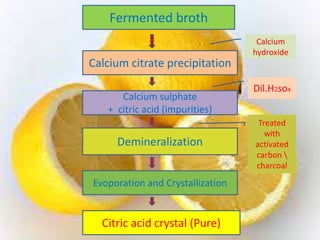
• Recovery refers – to the high utilization of
product or ingredients, eliminating waste.
Fermented broth
Calcium citrate precipitation
Calcium sulphate
+ citric acid (impurities)
Demineralization
Evoporation and Crystallization
Citric acid crystal (Pure)
Calcium
hydroxide
Dil.H2so4
Treated
with
activated
carbon 
charcoal
Uses Of Citric Acid
• In Food
Industries –
• It is used in fruits
• Jams
• Jellies
• Candies
• Packed food item
etc.
Cont…
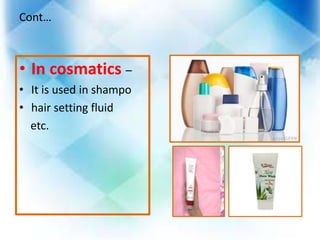
• In cosmatics –
• It is used in shampo
• hair setting fluid
etc.
Cont…
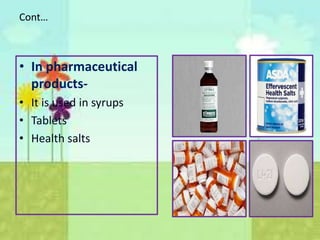
• In pharmaceutical
products-
• It is used in syrups
• Tablets
• Health salts
Other uses
• In pharmacy –Blood transfusion
• It is used in leather-tanning
• In is used in home for vinegar,dying and
cleaning purpose.
Citric acid

Citric acid

  • 1.
    Submitted To – Dept.ofBiotechnology Submitted By – Sonika Chouhan M.Sc. III Sem
  • 2.
    Content: Organic Acid Citric Acid MethodsOf Citric Acid Production & Raw materials KOJI Fermentation Process Submerged Culture Fermentation Process Liquid Surface Culture Fermentation Process Fermentation Of Citric Acid by Microbes Recovery and Purification Uses Of Citric Acid
  • 3.
    Organic Acid • Organicacid are the organic compound with acidic properties. • The most common organic acids are the carboxylic acids. • Acidity is associated with their acid groups like- carboxylic group (-COOH) • Organic acid are the terminal products of glycolysis. • For eg. Lactic acid • These are the products of incomplete oxidation of sugar. Such as, , gluconic acid.
  • 4.
    Citric Acid • Itis tricarboxylic acid, having formula C6H8O7. • It is first reported by “Carls scheel” (1789-England) in lemon juice. • It occurs naturally in citric fruits. • It is a natural preservative and used to add an acidic taste to food & soft drinks.
  • 5.
    conti • It existsin a variety of fruits and vegetables , most conc. In lemon ,orange (7-8%). • It is an intermediate of citric acid cycle. • Commercially production of citric acid is generally by submerged fermentation of sucrose or molasses using the filamentous fungus Aspergillus niger.
  • 6.
    History : • 1789– Carl Scheele • 1893 – Wehmer • 1916 – Currie • 1930 – some unit implanted in England , Germany for the commercial production.
  • 7.
    Methods Of CitricAcid Production & Raw materials Submerged Culture Fermentation Process Liquid Surface Culture Fermentation Process KOJI Fermentation Process1 2 3
  • 8.
    Submerged Culture FermentationProcess (Liquid Fermention) • This is commonly used for citric acid production. • It estimate about 80% . • Less prize • Small size • High yield • Low labour cost Two types of fermentor are used- Conventional stirrer Tower fermentation
  • 9.
  • 10.
    In this process Rawmaterial – sugar , starch Treatment (if require) Mycellia of aspergillus japonicum flow about 15cm deep in tank 10% of fresh medium is required It takes 5-10 days
  • 12.
    Liquid Surface CultureFermentation Process (surface fermentation) • The first individual process for citric acid production. • It is introduce by “Des” in 1919 • Later “Chas” in 1923 • Sophisticated technique
  • 13.
    Fig . Simpletray fermentor
  • 14.
    In this process •Liquid culture are incubated with spores • Mycellia mat developed on the surface of medium. • It takes 24hrs. • Crude sucrose, cane syrup & beet molasses are used as carbon source.
  • 15.
    KOJI Fermentation Process (Solidstate fermentation) • It is an alternative method. • This method is used first in JAPAN • Aspergillus Niger Strain is used in this method. • It is the simplest method . • It can carried out using several raw material(Table).
  • 17.
    In this process Substrateis moistened about 70% acc.to capacity. pH is maintained about 4.5-7.0 Temp. 28-30*C It takes place in simple tray type fermentor Higher yield obtained ,without any aeration and sporulation obseved very little
  • 19.
  • 20.
    • Recovery refers– to the high utilization of product or ingredients, eliminating waste.
  • 21.
    Fermented broth Calcium citrateprecipitation Calcium sulphate + citric acid (impurities) Demineralization Evoporation and Crystallization Citric acid crystal (Pure) Calcium hydroxide Dil.H2so4 Treated with activated carbon charcoal
  • 23.
    Uses Of CitricAcid • In Food Industries – • It is used in fruits • Jams • Jellies • Candies • Packed food item etc.
  • 24.
    Cont… • In cosmatics– • It is used in shampo • hair setting fluid etc.
  • 25.
    Cont… • In pharmaceutical products- •It is used in syrups • Tablets • Health salts
  • 26.
    Other uses • Inpharmacy –Blood transfusion • It is used in leather-tanning • In is used in home for vinegar,dying and cleaning purpose.