RIBOFLAVIN FRMENTATION
Occurrence and Economic
Significance
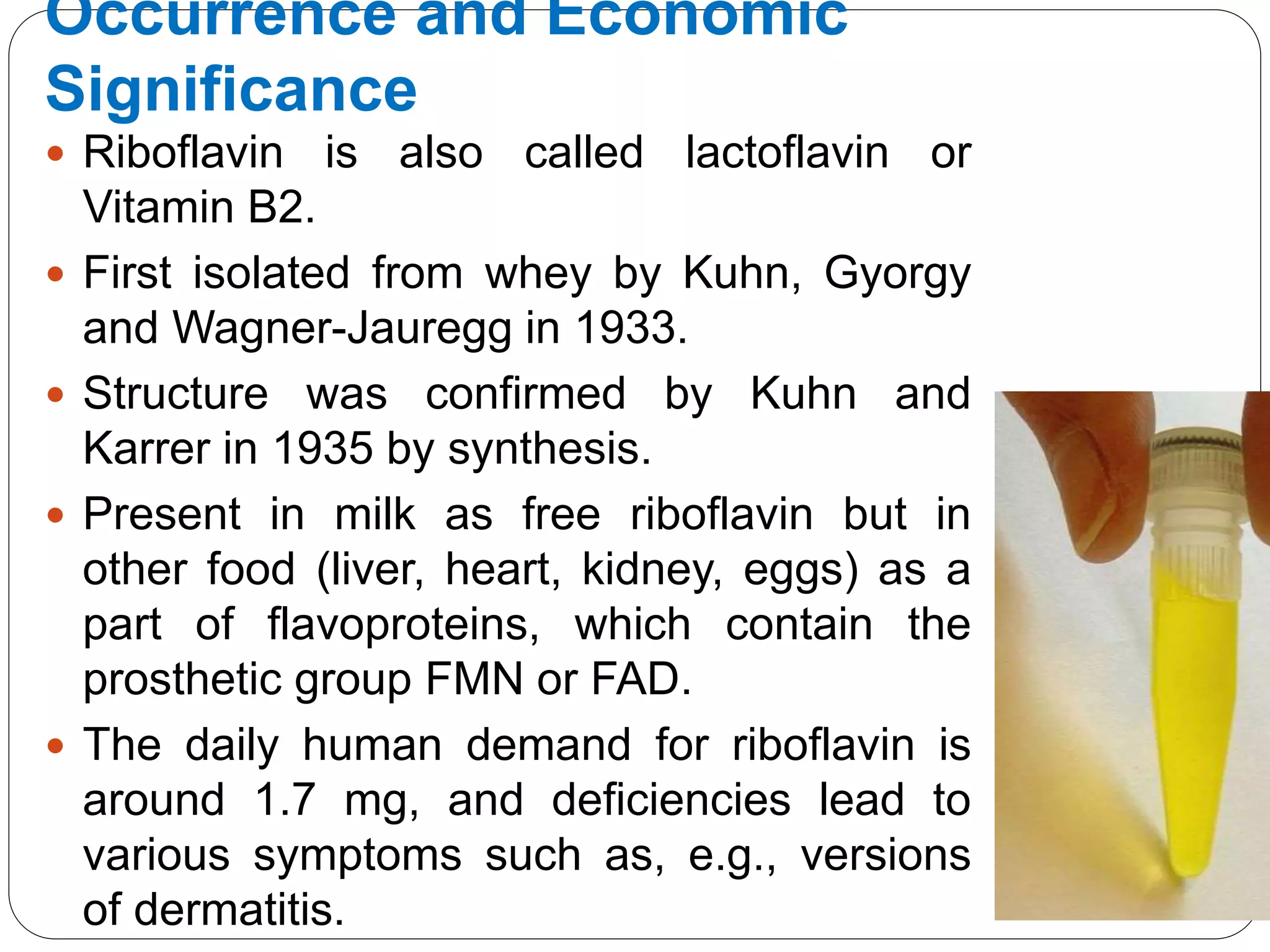
 Riboflavin is also called lactoflavin or
Vitamin B2.
 First isolated from whey by Kuhn, Gyorgy
and Wagner-Jauregg in 1933.
 Structure was confirmed by Kuhn and
Karrer in 1935 by synthesis.
 Present in milk as free riboflavin but in
other food (liver, heart, kidney, eggs) as a
part of flavoproteins, which contain the
prosthetic group FMN or FAD.
 The daily human demand for riboflavin is
around 1.7 mg, and deficiencies lead to
various symptoms such as, e.g., versions
of dermatitis.
 Deficiency in rats causes stunted growth, dermatitis
and eye damage.
 Ariboflavinosis-a kind of dermatitis is a disease is a
disease in humans caused by its deficiency.
 In USA riboflavin, thiamine and nicotinic acid frequently
added to flour to make vitamin enriched bread.
 There are 3 main production processes:
1. Chemical synthesis: primarily for pharmaceutical
use. (20%)
2. Biotransformation: here glucose is converted to D-
ribose and subsequently to riboflavin by Bacillus
pumilus. (50%)
3. Direct fermentation: more than 2000 tons per
annum on world wide basis. (30%)
Strains Used
 Synthesized by many microbes including bacteria, yeast
and fungi.
 Two Ascomycete fungi are industrially important.
1. Eremothecium ashbyii (yield: 2 g/l, initially used)
2. Ashbya gossypii (yield: 10-15 g/l, used since 1946)
 Despite this yield there is a tough competition between
all 3 processes.
 At present, three organisms are used for the
industrial production of riboflavin by fermentation:
 The filamentous fungus Ashbya gossypii (BASF,
Germany)
 The yeast Candida famata (ADM, USA)
 A genetically engineered strain of Bacillus subtilis
(DSM, Germany)
Structure
 It is an alloxazine derivative
consists of pteridine ring
condensed to a benzene ring.
 The side chain consists of aC5-
polyhydroxy group – a
derivative of ribitol.
 The IUPAC name of riboflavin
is [6,7- dimethyl-9-(d-1’- ribityl)
isoalloxazine].
 The isoalloxazine ring acts as a
reversible redox system.
Biosynthesis
 The biosynthetic pathway is derived from experiments
done on yeast and A. gossypii.
 In E. ashbyii and A. gossypii fermentation is not affected
by iron but in clostridia and yeast it is inhibited by very
low conc. of iron. In clostridia 1ppm iron causes 75%
inhibition.
 The intermediates of synthesis are as follows:
1. GTP: Guanosine triphosphate
2. PRP: Phosphoribosyl amino pyrimidine
3. ADRAP: Amino-Dioxy Phosphoribitylamio-Pyrimidine
4. Diaminouracil
5. MERL: Methyldihydroxyethyl ribityllumazine
6. DMRL: Dimethyl ribityllumazine
7. Riboflavin
Production process
 Production is carried out with Ashbya gossypii NRRL-
1056 strain.
 A careful sterilization of the culture medium is critical
for high yields, as inoculum size is small (0.75 to 2% of
a 24-48 hour old actively growing culture).
 Originally the fermentation used a medium with
glucose and corn steep liquor; sucrose and maltose
were other suitable carbon sources.
 Lipids were also used as an energy sources and yields
markedly found to increase.
 Riboflavin production (containing corn steep liquor
2.25%, commercial peptone 3.5%, soybean oil 4.5%)
has been further stimulated by the addition of different
peptones, glycine, distillers soluble or yeast extract.
 By simultaneous feeding of glucose and inositol the rate
of formation of riboflavin can be further increased.
 The fermentation takes 7 days with an aeration rate of
0.3vvm at 28 ˚C.
 For foam control, silicone antifoam is applied at first and
soybean oil, is added later (also metabolized).
 Riboflavin is present both in solution and bound to the
mycelium in the fermentation broth.
 The bound vitamin is released from the cells by heat
treatment (1hour at 120 ˚C) and the mycelium is
separated and discarded.
 The riboflavin is then further purified.
Production using other
organisms
 Production of riboflavin with and aliphatic
hydrocarbon as carbon source has been reported
using Pichia guilliermoendii.
 Using Pichia miso, 51mg/l riboflavin was obtained
on a medium with n-hexadecane, corn steep liquor
and urea.
 Production using Hansenula polymorpha is
reported using methanol.
 Crystalline high purity riboflavin is obtained from
Saccharomyces fermentation with acetate as sole
carbon source.

Riboflavin fermentation[1]

  • 1.
  • 2.
    Occurrence and Economic Significance Riboflavin is also called lactoflavin or Vitamin B2.  First isolated from whey by Kuhn, Gyorgy and Wagner-Jauregg in 1933.  Structure was confirmed by Kuhn and Karrer in 1935 by synthesis.  Present in milk as free riboflavin but in other food (liver, heart, kidney, eggs) as a part of flavoproteins, which contain the prosthetic group FMN or FAD.  The daily human demand for riboflavin is around 1.7 mg, and deficiencies lead to various symptoms such as, e.g., versions of dermatitis.
  • 3.
     Deficiency inrats causes stunted growth, dermatitis and eye damage.  Ariboflavinosis-a kind of dermatitis is a disease is a disease in humans caused by its deficiency.  In USA riboflavin, thiamine and nicotinic acid frequently added to flour to make vitamin enriched bread.  There are 3 main production processes: 1. Chemical synthesis: primarily for pharmaceutical use. (20%) 2. Biotransformation: here glucose is converted to D- ribose and subsequently to riboflavin by Bacillus pumilus. (50%) 3. Direct fermentation: more than 2000 tons per annum on world wide basis. (30%)
  • 4.
    Strains Used  Synthesizedby many microbes including bacteria, yeast and fungi.  Two Ascomycete fungi are industrially important. 1. Eremothecium ashbyii (yield: 2 g/l, initially used) 2. Ashbya gossypii (yield: 10-15 g/l, used since 1946)  Despite this yield there is a tough competition between all 3 processes.
  • 5.
     At present,three organisms are used for the industrial production of riboflavin by fermentation:  The filamentous fungus Ashbya gossypii (BASF, Germany)  The yeast Candida famata (ADM, USA)  A genetically engineered strain of Bacillus subtilis (DSM, Germany)
  • 6.
    Structure  It isan alloxazine derivative consists of pteridine ring condensed to a benzene ring.  The side chain consists of aC5- polyhydroxy group – a derivative of ribitol.  The IUPAC name of riboflavin is [6,7- dimethyl-9-(d-1’- ribityl) isoalloxazine].  The isoalloxazine ring acts as a reversible redox system.
  • 7.
    Biosynthesis  The biosyntheticpathway is derived from experiments done on yeast and A. gossypii.  In E. ashbyii and A. gossypii fermentation is not affected by iron but in clostridia and yeast it is inhibited by very low conc. of iron. In clostridia 1ppm iron causes 75% inhibition.  The intermediates of synthesis are as follows: 1. GTP: Guanosine triphosphate 2. PRP: Phosphoribosyl amino pyrimidine 3. ADRAP: Amino-Dioxy Phosphoribitylamio-Pyrimidine 4. Diaminouracil 5. MERL: Methyldihydroxyethyl ribityllumazine 6. DMRL: Dimethyl ribityllumazine 7. Riboflavin
  • 9.
    Production process  Productionis carried out with Ashbya gossypii NRRL- 1056 strain.  A careful sterilization of the culture medium is critical for high yields, as inoculum size is small (0.75 to 2% of a 24-48 hour old actively growing culture).  Originally the fermentation used a medium with glucose and corn steep liquor; sucrose and maltose were other suitable carbon sources.  Lipids were also used as an energy sources and yields markedly found to increase.  Riboflavin production (containing corn steep liquor 2.25%, commercial peptone 3.5%, soybean oil 4.5%) has been further stimulated by the addition of different peptones, glycine, distillers soluble or yeast extract.
  • 10.
     By simultaneousfeeding of glucose and inositol the rate of formation of riboflavin can be further increased.  The fermentation takes 7 days with an aeration rate of 0.3vvm at 28 ˚C.  For foam control, silicone antifoam is applied at first and soybean oil, is added later (also metabolized).  Riboflavin is present both in solution and bound to the mycelium in the fermentation broth.  The bound vitamin is released from the cells by heat treatment (1hour at 120 ˚C) and the mycelium is separated and discarded.  The riboflavin is then further purified.
  • 11.
    Production using other organisms Production of riboflavin with and aliphatic hydrocarbon as carbon source has been reported using Pichia guilliermoendii.  Using Pichia miso, 51mg/l riboflavin was obtained on a medium with n-hexadecane, corn steep liquor and urea.  Production using Hansenula polymorpha is reported using methanol.  Crystalline high purity riboflavin is obtained from Saccharomyces fermentation with acetate as sole carbon source.