INDUSTRIAL
MICROBIOLOGY
PRODUCTION OF ORGANIC ACID
: CITRIC ACID
Submitted to,
Ms. AMMU RAJ
Dept. Of Bioscience
7-10-24
Submitted by,
M S SETHULAKSHMY
BSC. Microbiology 3rd
sem
CONTENT
• Introduction
• History
• Strains used for citric acid production
• Production processes
• Steps for production
• Applications
• Conclusion
INTRODUCTION
• Citric acid is the most important organic acid produced in Tonnage
• extensively used from citrus fruits.
• It is a weak organic tricarboxylic acid.
• It is also good natural preservative, also used to give taste to food
and soft drinks .
• More than million tonnes are produced every year by fermentation.
• Citric acid is produced by three method;
1. Fermentation
2. chemical synthesis
3. extraction from citrus fruits.
HISTORY
In 1784 W. SCHEELE isolated citric acid
from lemon juice calcium sulphate
which treated with the sulphuric acid
give citric acid in the liquid phase.
ZAHORSKY in 1913 patented a new
strain - ASPERGILLUS NIGER
CURRIE , 1917 opened the way for
industrial citric acid fermentation using a
new microorganism.
• In 1960s practice of submerged
fermentation gained popularity.
Strains for
citric acid
production
• Many strains excrete traces of citric
acid as a metabolic of primary
metabolism.
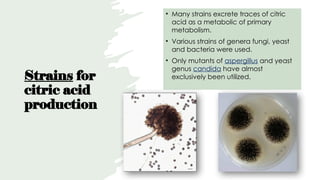
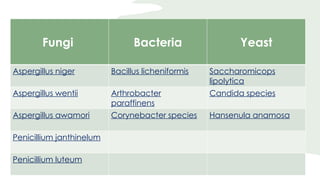
• Various strains of genera fungi, yeast
and bacteria were used.
• Only mutants of aspergillus and yeast
genus candida have almost
exclusively been utilized.
Fungi Bacteria Yeast
Aspergillus niger Bacillus licheniformis Saccharomicops
lipolytica
Aspergillus wentii Arthrobacter
paraffinens
Candida species
Aspergillus awamori Corynebacter species Hansenula anamosa
Penicillium janthinelum
Penicillium luteum
PRODUCTION PROCESSES
• Surface or submerged fermentation technique dominated over traditional
method of preparing citric acid by extraction from various juices.
• Promising result where obtained in fed-batch process and by continuous
fermentation.
• Microorganism : Aspergillus niger (mainly) , candida yeast .
• Citric acid production is mixed growth associated, mainly take place under
nitrogen and phosphate limitation after growth has ceased.
MEDIUM REQUIREMENT FOR HIGH PRODUCTION
• CARBON SOURCE: molasses or sugar solution
• HIGH DISSOLVED OXYGEN CONC.
• HIGH SUGAR CONC.
• pH<2
• 30°C
• BIOREACTOR
• AERATION Is provided
• TEMPARATURE is controlled by cooling coil.
• AGITATION is not needed, to avoid shear damage on molds.
SURFACE CULTURE PROCESS
In this process culture is inoculated across the surface of production medium
inaddition to culture remains on the surface throughout the fermentation. Since this
is a stationery fermentation.
STEPS OF PRODUCTION
Different steps of productions are;
1. Selection of microorganism
2. Formulation of medium
3. Production process
4. Recovery and purification
Selection of
microorganism
• Mutant strains of aspergillus niger have
been developed for improved
industrial production of citric acid.
• The strains that can tolerate high sugar
concentration and low PH with
reduced synthesis of undesirable by-
product ( oxalic acid ,Isocitric acid
and gluconic acid ) are Industrially
important .
• The spore of aspergillus niger are
produced by growing the fungus from
a stock culture on a suitable solid
sporulation medium at 25°C for 4 to 14
days.
FORMULATION OF MEDIUM
• Carbon sources
• Including molasses- sugar cane or sugar beet
• Starch from potatoes
• Banana extract
• Sweet potato pulp
• High sugar concentration induces increased glucose uptake and
consequently enhanced citric acid production.
• Nitrogen source
• Ammonium salt , nitrates and urea are used as good sources as long
as they do not adversely affect the pH of the medium.
• Exogenous addition of ammonium ions stimulate citric acid
production.
• Trace metals
• Certain trace elements ( Fe , Zn , Mn ,Cu , Mg, Co)essential for
growth of aspergillus niger.
• Manganese ions promote glycolysis and reduce respiration; both
the processes promote citric acid production.
• Fe concentration of 0.05-0.5 ppm is ideal.
PRODUCTION PROCESS
• The citric acid is produced by surface culture process. The
mold mycelium is cultured on shallow layers of medium in
trays or similar containers.
• This method utilized a sugar concentration between 14 and
20% , a fairly low pH that is more acidic for surface method
and temperature above 25 - 30°C is considered to be
satisfactory.
• It is necessary to supply air to the surface of the seeded
medium.
• With the shallow Pan method , the period required for the
progress and termination of the fermentation process is in the
range of 7 to 10 days.
RECOVERY AND PURIFICATION
• Start with the filtration of culture broth and washing of
mycelium.
• Oxalic acid is an unwanted by product and it can be
removed by precipitation by adding lime at pH < 3 .
• The culture broth is subjected to pH 7.2 and temperature
70 to 90° c for precipitation of citric acid.
• For further purification citric acid is dissolved in sulphuric
acid.
• The final steps for citric acid recovery are - treatment with
activated charcoal , cation and anion exchangers and
crystallization.
APPLICATIONS OF
CITRIC ACID
2. Some other citric
acid uses are;
• Used as a food
addictive.
• Used in cleaning.
• Used as cosmetics.
• Used in water
softener.
• Used in industries.
• Used as an antifoam
agent.
• Used as an
antioxidant.
POWDERED CITRIC ACID USES:
1. We get a citric acid powder
which is white. It helps in
improving kidney health,
throat infection, get rid of
acne , etc.
CONCLUSION
• Citric acid is produced industrially through fermentation
using the fungus aspergillus niger. The process involves;
1. Growing A.niger in large fermenter on a substrate like molasses
under controlled conditions of pH ,oxygen level and temperature.
2. After several days of fermentation citric acid is recovered from
the liquid through precipitation and crystallization.
3. Citric acid finds a wide variety of applications as a food
addictive, in cosmetics and for industrial uses due to its acidity
and ability to chelate metals.
• Worldwide production exceeds 1 million tons annually.
THANK YOU

citric acid production by fermentation process

  • 1.
    INDUSTRIAL MICROBIOLOGY PRODUCTION OF ORGANICACID : CITRIC ACID Submitted to, Ms. AMMU RAJ Dept. Of Bioscience 7-10-24 Submitted by, M S SETHULAKSHMY BSC. Microbiology 3rd sem
  • 2.
    CONTENT • Introduction • History •Strains used for citric acid production • Production processes • Steps for production • Applications • Conclusion
  • 3.
    INTRODUCTION • Citric acidis the most important organic acid produced in Tonnage • extensively used from citrus fruits. • It is a weak organic tricarboxylic acid. • It is also good natural preservative, also used to give taste to food and soft drinks . • More than million tonnes are produced every year by fermentation. • Citric acid is produced by three method; 1. Fermentation 2. chemical synthesis 3. extraction from citrus fruits.
  • 4.
    HISTORY In 1784 W.SCHEELE isolated citric acid from lemon juice calcium sulphate which treated with the sulphuric acid give citric acid in the liquid phase. ZAHORSKY in 1913 patented a new strain - ASPERGILLUS NIGER CURRIE , 1917 opened the way for industrial citric acid fermentation using a new microorganism. • In 1960s practice of submerged fermentation gained popularity.
  • 5.
    Strains for citric acid production •Many strains excrete traces of citric acid as a metabolic of primary metabolism. • Various strains of genera fungi, yeast and bacteria were used. • Only mutants of aspergillus and yeast genus candida have almost exclusively been utilized.
  • 6.
    Fungi Bacteria Yeast Aspergillusniger Bacillus licheniformis Saccharomicops lipolytica Aspergillus wentii Arthrobacter paraffinens Candida species Aspergillus awamori Corynebacter species Hansenula anamosa Penicillium janthinelum Penicillium luteum
  • 7.
  • 8.
    • Surface orsubmerged fermentation technique dominated over traditional method of preparing citric acid by extraction from various juices. • Promising result where obtained in fed-batch process and by continuous fermentation. • Microorganism : Aspergillus niger (mainly) , candida yeast . • Citric acid production is mixed growth associated, mainly take place under nitrogen and phosphate limitation after growth has ceased. MEDIUM REQUIREMENT FOR HIGH PRODUCTION • CARBON SOURCE: molasses or sugar solution • HIGH DISSOLVED OXYGEN CONC. • HIGH SUGAR CONC. • pH<2 • 30°C
  • 9.
    • BIOREACTOR • AERATIONIs provided • TEMPARATURE is controlled by cooling coil. • AGITATION is not needed, to avoid shear damage on molds. SURFACE CULTURE PROCESS In this process culture is inoculated across the surface of production medium inaddition to culture remains on the surface throughout the fermentation. Since this is a stationery fermentation.
  • 10.
    STEPS OF PRODUCTION Differentsteps of productions are; 1. Selection of microorganism 2. Formulation of medium 3. Production process 4. Recovery and purification
  • 11.
    Selection of microorganism • Mutantstrains of aspergillus niger have been developed for improved industrial production of citric acid. • The strains that can tolerate high sugar concentration and low PH with reduced synthesis of undesirable by- product ( oxalic acid ,Isocitric acid and gluconic acid ) are Industrially important . • The spore of aspergillus niger are produced by growing the fungus from a stock culture on a suitable solid sporulation medium at 25°C for 4 to 14 days.
  • 12.
    FORMULATION OF MEDIUM •Carbon sources • Including molasses- sugar cane or sugar beet • Starch from potatoes • Banana extract • Sweet potato pulp • High sugar concentration induces increased glucose uptake and consequently enhanced citric acid production. • Nitrogen source • Ammonium salt , nitrates and urea are used as good sources as long as they do not adversely affect the pH of the medium.
  • 13.
    • Exogenous additionof ammonium ions stimulate citric acid production. • Trace metals • Certain trace elements ( Fe , Zn , Mn ,Cu , Mg, Co)essential for growth of aspergillus niger. • Manganese ions promote glycolysis and reduce respiration; both the processes promote citric acid production. • Fe concentration of 0.05-0.5 ppm is ideal.
  • 14.
    PRODUCTION PROCESS • Thecitric acid is produced by surface culture process. The mold mycelium is cultured on shallow layers of medium in trays or similar containers. • This method utilized a sugar concentration between 14 and 20% , a fairly low pH that is more acidic for surface method and temperature above 25 - 30°C is considered to be satisfactory. • It is necessary to supply air to the surface of the seeded medium. • With the shallow Pan method , the period required for the progress and termination of the fermentation process is in the range of 7 to 10 days.
  • 15.
    RECOVERY AND PURIFICATION •Start with the filtration of culture broth and washing of mycelium. • Oxalic acid is an unwanted by product and it can be removed by precipitation by adding lime at pH < 3 . • The culture broth is subjected to pH 7.2 and temperature 70 to 90° c for precipitation of citric acid. • For further purification citric acid is dissolved in sulphuric acid. • The final steps for citric acid recovery are - treatment with activated charcoal , cation and anion exchangers and crystallization.
  • 17.
    APPLICATIONS OF CITRIC ACID 2.Some other citric acid uses are; • Used as a food addictive. • Used in cleaning. • Used as cosmetics. • Used in water softener. • Used in industries. • Used as an antifoam agent. • Used as an antioxidant. POWDERED CITRIC ACID USES: 1. We get a citric acid powder which is white. It helps in improving kidney health, throat infection, get rid of acne , etc.
  • 18.
    CONCLUSION • Citric acidis produced industrially through fermentation using the fungus aspergillus niger. The process involves; 1. Growing A.niger in large fermenter on a substrate like molasses under controlled conditions of pH ,oxygen level and temperature. 2. After several days of fermentation citric acid is recovered from the liquid through precipitation and crystallization. 3. Citric acid finds a wide variety of applications as a food addictive, in cosmetics and for industrial uses due to its acidity and ability to chelate metals. • Worldwide production exceeds 1 million tons annually.
  • 19.