SUBMITTED TO : Dr PL SHARMA
SUBMITTED BY : SIMRAN BHATIA
DR YSP UHF NAUNI SOLAN HP
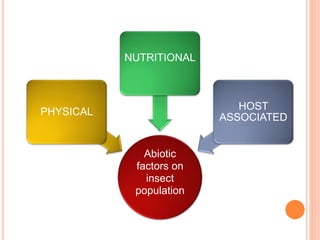
Abiotic
factors on
insect
population
PHYSICAL
NUTRITIONAL
HOST
ASSOCIATED
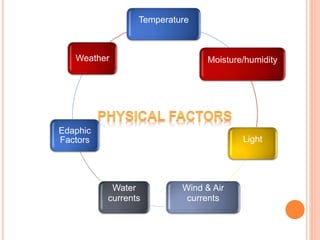
Temperature
Moisture/humidity
Light
Wind & Air
currents
Water
currents
Edaphic
Factors
Weather
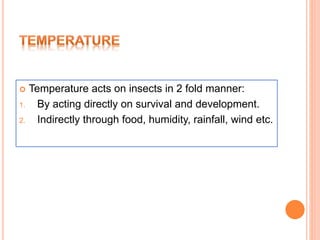
 Temperature acts on insects in 2 fold manner:
1. By acting directly on survival and development.
2. Indirectly through food, humidity, rainfall, wind etc.
 All insects are poikilothermic (cold blooded) - do not have
mechanism to regulate body temperature .
 Body temperature depends on environmental conditions
.
 Preferred or Optimum temperature is the temperature at
which normal physiological activities take place and
insects survive at this temperature.
 Upper lethal limit - 40-50oC (even upto 60 oC survival in
some stored product insects)
 Lower lethal limit - Below freezing point e.g. snow fleas .
The total heat required for completion of physiological
processes in life history is a constant - thermal constant.
 At low temperature (winter) insect takes more days to
complete a stage (larval or pupal stage)
 At high temperature (summer) it takes less than to
complete a stage.
 Some insects when exposed to extremes of temperature
 Undergo - Aestivation (during summer) or Hibernation
(during winter)
 During this period, there is a temporary developmental
arrest, metabolic activities suspended. When
temperature is favourable, they resume activity. Eggs
undergo aestivation in summer .
 Larva, pupa commonly undergo hibernation in winter
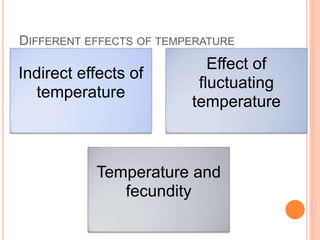
DIFFERENT EFFECTS OF TEMPERATURE
Indirect effects of
temperature
Effect of
fluctuating
temperature
Temperature and
fecundity
INDIRECT EFFECTS OF TEMPERATURE
Winter survival is by two ways :
a) Migration i.e. Complete avoidance of
temperature that pose a threat ex Monarch
butterfly.
b) Cold hardiness i.e. The ability of insect to
withstand the lower temperatures. It is of 2 types
Freeze avoidance & freeze tolerance Freeze
avoidance by keeping body fluids liquid ex. Wax
coated cuticle, hibernation. Freeze
tolerance by Ice Nucleated Proteins which control
ice formation in tissues.
Effect of fluctuating temperature
 Makes the insect to undergo diapause
 It is accelerating only when one temperature is below
threshold of development but not too low to be injurious.
Temperature and development
 Acc. to Van Hoff’s Law: when temperature is increased
by 10 degrees C the rate of development is doubled
INFLUENCE OF TEMPERATURE ON FECUNDITY
(EGG LAYING)
 Fecundity is maxx. Towards moderately high
temperature and declines as the upper and lower
limit is reached.
 Grasshopper lays 20-30 times more eggs at 32oC
compared to 22 oC and Oviposition of bed bug is
inhibited at 8-10oC.
 Other effects of temperature are:-
 Early shoot borer of sugarcane attacks more at high
temp.
 Larval period of sugarcane internode borer is very
short (16-24 days) in summer prolonged (141-171
days )in winter .
 Swarm migration of locust occurs at 17-20 oC.
 Water constitute 50-90% weight of insect.
 Moisture is required for metabolic reactions and transportation
of salts in insects
 Wax layer of cuticle prevents water loss .
 Moisture scarcity leads to dehydration and death of insects .
 Excessive moisture can be harmful in following ways
i . Affects normal development and activity of insect.
ii . Encourages disease causing pathogens on insects .
 Examples - White halo fungus Verticillium lecanii on coffee
green scale Coccus viridis requires high RH for multiplication
and spread - High RH induces BPH in rice and aphids in other
crops - Termites prefer high humidity 90-95% RH - Low RH in
rainfed groundnut crop induces leaf mines incidence
The rate of oviposition in insects increases greatly with
increasing humidity. Ex in Sitophilus oryzae fecundity
increases up to 70% RH but there is no decline in no. of
eggs if humidity is up to 90%.
•Effect of moisture on fecundity:
In cooler areas dark colour helps to absorb sunlight which
raises the body temperature and helps insects in getting rid
of excessive moisture in the body.In desert insects light
colour apparently helps to reflect sun rays and saves
excessive evaporation.
• Effect of humidity on coloration:
High humidity is more favourable for embryonic stages .
Survival is indirectly affected by high RH as it favour spread
of diseases.
•Humidity and survival
In order to escape very low moisture insects undergo
diapause or aestivation.
• Effect of extremes of moisture conditions
 Insects active at dawn are MATINAL INSECTS.
 Insects active at dusk are CREPSULAR INSECTS.
 Insects active at night are NOCTURNAL .
 In insects there is Phototrophism i.e. light directed
growth.
 Photo period influences induction of diapause (a resting
stage) in most of the insects e.g. Long day during
embryonic development causes adult to lay diapausing
eggs in Bombyx mori.
 Seasonal dimorphism occurs in aphids due to change in
photo period
 Short days leads to formation of Sexual forms.
 Long days leads to Asexual/Parthenogenetic forms.
 Lepidopterans like cotton bollworm, Red hairy caterpillar
(RHC) oviposit in dark.
 Ex short days in jassids forms INCISUS(small bodied)
whereas long days forms PLEBEJUS(large sized)
 Rainfall is essential for adult emergence of
cutworms and RHC
 Heavy rain washes aphids, diamond back moth
(DBM)
 Intermittent low rain increases BPH and thrips.
 Interferes with feeding, mating, oviposition .
 Wind aids in dispersal of insects .
 Aphids, mites (Eriophyid mites also) disperse
through wind .
 Helicoverpa flies upto 90 km with the aid of winds .
DIAPAUSE AND QUISCENCE
 Quiescence is a type of irregular dormancy (non-
seasonal) characterised by slowed metabolism and
directly resulting from unfavourable environmental
conditions, including low humidity and high
temperatures ,
 Soil Type
Wire worm, multiplies in clay soil with poor drainage
White grubs and cut worm - multiply in loose soil
with good drainage
 Water Current
Standing water aids in multiplication of mosquitoes
Running water is preferred by Odonata and
Caddish flies
 Insects are heterotrophic :-
- cannot synthesize their own food.
- depend on plants for food .
The quantity and quality of food/nutrition plays important
role in survival, longevity, distribution, reproduction and
speed of development
 a. Quantity of food
- Short supply of food causes intraspecific and interspecific
competition
- Also affects parasitoids and predators of insects hosts
whose food is of short supply
 b. Quality of food
- This depends on nutritional availability of plants - Crop
varieties/species differ in nutritional status which affects
insects
 Antixenosis or non preference Host plant not preferred by
insects for feeding, oviposition or shelter due to morphological
characters like thorns, wax, hairyness, etc. or done to
presence of some chemicals (called allelochemicals)
 Antibiosis This refers to adverse effect of the host plant on
biology (survival, dept, reprdn.) of insects and their progeny
due to
- Presence of toxic substance in plant
- Absence of essential substances
- Presence of enzymes which affect digestion of insects
 Example DIMBOA in corn leaves affects European corn borer
Ostrinia nubilalis AND Gossypol in cotton affects H. armigera
and S. litura
Ability of host plant to withstand insect population
sufficient to damage susceptible plants
- No adverse effect on insect infestation
- Tolerance by plant vigour, regrowth of damaged
tissues, etc.

insect ecology abiotoc factors.pptx

  • 1.
    SUBMITTED TO :Dr PL SHARMA SUBMITTED BY : SIMRAN BHATIA DR YSP UHF NAUNI SOLAN HP
  • 2.
  • 3.
  • 4.
     Temperature actson insects in 2 fold manner: 1. By acting directly on survival and development. 2. Indirectly through food, humidity, rainfall, wind etc.
  • 5.
     All insectsare poikilothermic (cold blooded) - do not have mechanism to regulate body temperature .  Body temperature depends on environmental conditions .  Preferred or Optimum temperature is the temperature at which normal physiological activities take place and insects survive at this temperature.  Upper lethal limit - 40-50oC (even upto 60 oC survival in some stored product insects)  Lower lethal limit - Below freezing point e.g. snow fleas . The total heat required for completion of physiological processes in life history is a constant - thermal constant.
  • 6.
     At lowtemperature (winter) insect takes more days to complete a stage (larval or pupal stage)  At high temperature (summer) it takes less than to complete a stage.  Some insects when exposed to extremes of temperature  Undergo - Aestivation (during summer) or Hibernation (during winter)  During this period, there is a temporary developmental arrest, metabolic activities suspended. When temperature is favourable, they resume activity. Eggs undergo aestivation in summer .  Larva, pupa commonly undergo hibernation in winter
  • 7.
    DIFFERENT EFFECTS OFTEMPERATURE Indirect effects of temperature Effect of fluctuating temperature Temperature and fecundity
  • 8.
    INDIRECT EFFECTS OFTEMPERATURE Winter survival is by two ways : a) Migration i.e. Complete avoidance of temperature that pose a threat ex Monarch butterfly. b) Cold hardiness i.e. The ability of insect to withstand the lower temperatures. It is of 2 types Freeze avoidance & freeze tolerance Freeze avoidance by keeping body fluids liquid ex. Wax coated cuticle, hibernation. Freeze tolerance by Ice Nucleated Proteins which control ice formation in tissues.
  • 9.
    Effect of fluctuatingtemperature  Makes the insect to undergo diapause  It is accelerating only when one temperature is below threshold of development but not too low to be injurious. Temperature and development  Acc. to Van Hoff’s Law: when temperature is increased by 10 degrees C the rate of development is doubled
  • 10.
    INFLUENCE OF TEMPERATUREON FECUNDITY (EGG LAYING)  Fecundity is maxx. Towards moderately high temperature and declines as the upper and lower limit is reached.  Grasshopper lays 20-30 times more eggs at 32oC compared to 22 oC and Oviposition of bed bug is inhibited at 8-10oC.  Other effects of temperature are:-  Early shoot borer of sugarcane attacks more at high temp.  Larval period of sugarcane internode borer is very short (16-24 days) in summer prolonged (141-171 days )in winter .  Swarm migration of locust occurs at 17-20 oC.
  • 11.
     Water constitute50-90% weight of insect.  Moisture is required for metabolic reactions and transportation of salts in insects  Wax layer of cuticle prevents water loss .  Moisture scarcity leads to dehydration and death of insects .  Excessive moisture can be harmful in following ways i . Affects normal development and activity of insect. ii . Encourages disease causing pathogens on insects .  Examples - White halo fungus Verticillium lecanii on coffee green scale Coccus viridis requires high RH for multiplication and spread - High RH induces BPH in rice and aphids in other crops - Termites prefer high humidity 90-95% RH - Low RH in rainfed groundnut crop induces leaf mines incidence
  • 12.
    The rate ofoviposition in insects increases greatly with increasing humidity. Ex in Sitophilus oryzae fecundity increases up to 70% RH but there is no decline in no. of eggs if humidity is up to 90%. •Effect of moisture on fecundity: In cooler areas dark colour helps to absorb sunlight which raises the body temperature and helps insects in getting rid of excessive moisture in the body.In desert insects light colour apparently helps to reflect sun rays and saves excessive evaporation. • Effect of humidity on coloration:
  • 13.
    High humidity ismore favourable for embryonic stages . Survival is indirectly affected by high RH as it favour spread of diseases. •Humidity and survival In order to escape very low moisture insects undergo diapause or aestivation. • Effect of extremes of moisture conditions
  • 14.
     Insects activeat dawn are MATINAL INSECTS.  Insects active at dusk are CREPSULAR INSECTS.  Insects active at night are NOCTURNAL .  In insects there is Phototrophism i.e. light directed growth.
  • 15.
     Photo periodinfluences induction of diapause (a resting stage) in most of the insects e.g. Long day during embryonic development causes adult to lay diapausing eggs in Bombyx mori.  Seasonal dimorphism occurs in aphids due to change in photo period  Short days leads to formation of Sexual forms.  Long days leads to Asexual/Parthenogenetic forms.  Lepidopterans like cotton bollworm, Red hairy caterpillar (RHC) oviposit in dark.  Ex short days in jassids forms INCISUS(small bodied) whereas long days forms PLEBEJUS(large sized)
  • 16.
     Rainfall isessential for adult emergence of cutworms and RHC  Heavy rain washes aphids, diamond back moth (DBM)  Intermittent low rain increases BPH and thrips.
  • 17.
     Interferes withfeeding, mating, oviposition .  Wind aids in dispersal of insects .  Aphids, mites (Eriophyid mites also) disperse through wind .  Helicoverpa flies upto 90 km with the aid of winds .
  • 18.
    DIAPAUSE AND QUISCENCE Quiescence is a type of irregular dormancy (non- seasonal) characterised by slowed metabolism and directly resulting from unfavourable environmental conditions, including low humidity and high temperatures ,
  • 19.
     Soil Type Wireworm, multiplies in clay soil with poor drainage White grubs and cut worm - multiply in loose soil with good drainage  Water Current Standing water aids in multiplication of mosquitoes Running water is preferred by Odonata and Caddish flies
  • 20.
     Insects areheterotrophic :- - cannot synthesize their own food. - depend on plants for food . The quantity and quality of food/nutrition plays important role in survival, longevity, distribution, reproduction and speed of development  a. Quantity of food - Short supply of food causes intraspecific and interspecific competition - Also affects parasitoids and predators of insects hosts whose food is of short supply  b. Quality of food - This depends on nutritional availability of plants - Crop varieties/species differ in nutritional status which affects insects
  • 21.
     Antixenosis ornon preference Host plant not preferred by insects for feeding, oviposition or shelter due to morphological characters like thorns, wax, hairyness, etc. or done to presence of some chemicals (called allelochemicals)  Antibiosis This refers to adverse effect of the host plant on biology (survival, dept, reprdn.) of insects and their progeny due to - Presence of toxic substance in plant - Absence of essential substances - Presence of enzymes which affect digestion of insects  Example DIMBOA in corn leaves affects European corn borer Ostrinia nubilalis AND Gossypol in cotton affects H. armigera and S. litura
  • 22.
    Ability of hostplant to withstand insect population sufficient to damage susceptible plants - No adverse effect on insect infestation - Tolerance by plant vigour, regrowth of damaged tissues, etc.