Introduction to the
Cardiovascular System
Y O G A L I F E A S A N A S A N D
M E D I T A T I O N
Introduction to
the
Cardiovascular
System
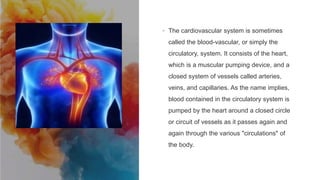
• The cardiovascular system is sometimes
called the blood-vascular, or simply the
circulatory, system. It consists of the heart,
which is a muscular pumping device, and a
closed system of vessels called arteries,
veins, and capillaries. As the name implies,
blood contained in the circulatory system is
pumped by the heart around a closed circle
or circuit of vessels as it passes again and
again through the various "circulations" of
the body.
Cardiovascular System
• The vital role of the cardiovascular system in maintaining
homeostasis depends on the continuous and controlled
movement of blood through the thousands of miles of
capillaries that permeate every tissue and reach every cell
in the body. It is in the microscopic capillaries that blood
performs its ultimate transport function. Nutrients and
other essential materials pass from capillary blood into
fluids surrounding the cells as waste products are
removed.
HEART
• The heart is a muscular pump that provides the force
necessary to circulate the blood to all the tissues in
the body. Its function is vital because, to survive, the
tissues need a continuous supply of oxygen and
nutrients, and metabolic waste products must be
removed. Deprived of these necessities, cells soon
undergo irreversible changes that lead to death.
While blood is the transport medium, the heart is the
organ that keeps the blood moving through the
vessels. The normal adult heart pumps about 5 liters
of blood every minute throughout life. If it loses its
pumping effectiveness for even a few minutes, the
individual's life is jeopardized.
STRUCTURE OF
HEART
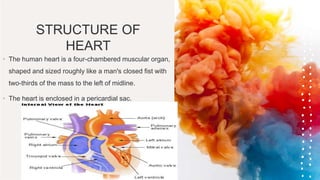
• The human heart is a four-chambered muscular organ,
shaped and sized roughly like a man's closed fist with
two-thirds of the mass to the left of midline.
• The heart is enclosed in a pericardial sac.
STRUCTURE OF
HEART
Layers of the Heart Wall,
Three layers of tissue form the heart wall. The outer layer of the
heart wall is the epicardium, the middle layer is the myocardium, and
the inner layer is the endocardium.
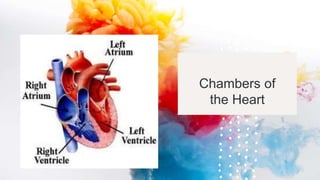
Chambers of the Heart,
The heart is divided into four chambers:-
• Right atrium
• Right ventricle
• Left atrium
• Left ventricle
Chambers of
the Heart
Chambers of the Heart
The two atria are thin-walled chambers that receive blood from the
veins. The two ventricles are thick-walled chambers that forcefully
pump blood out of the heart. Differences in thickness of the heart
chamber walls are due to variations in the amount of myocardium
present, which reflects the amount of force each chamber is required
to generate.
The right atrium receives deoxygenated blood from systemic veins;
the left atrium receives oxygenated blood from the pulmonary veins.
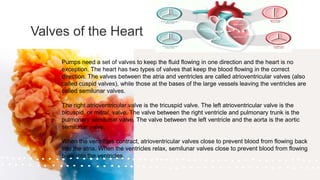
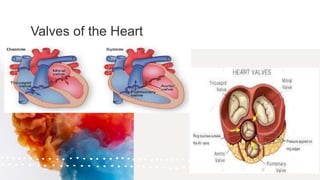
Valves of the Heart
Pumps need a set of valves to keep the fluid flowing in one direction and the heart is no
exception. The heart has two types of valves that keep the blood flowing in the correct
direction. The valves between the atria and ventricles are called atrioventricular valves (also
called cuspid valves), while those at the bases of the large vessels leaving the ventricles are
called semilunar valves.
The right atrioventricular valve is the tricuspid valve. The left atrioventricular valve is the
bicuspid, or mitral, valve. The valve between the right ventricle and pulmonary trunk is the
pulmonary semilunar valve. The valve between the left ventricle and the aorta is the aortic
semilunar valve.
When the ventricles contract, atrioventricular valves close to prevent blood from flowing back
into the atria. When the ventricles relax, semilunar valves close to prevent blood from flowing
back into the ventricles.
Valves of the Heart
The Conduction System
Electrical impulses from the heart muscle (the
myocardium) cause the heart to contract. This
electrical signal begins in the sinoatrial (SA) node,
located at the top of the right atrium. The SA node is
sometimes called the heart’s ‘natural pacemaker’. An
electrical impulse from this natural pacemaker travels
through the muscle fibers of the atria and ventricles,
causing them to contract. Although the SA node
sends electrical impulses at a certain rate, our heart
rate may still change depending on physical
demands, stress, and hormonal factors.
The Heartbeat
A heartbeat is a two-part pumping action that takes about a
second. As blood collects in the upper chambers (the right
and left atria), the heart’s natural pacemaker (the SA node)
sends out an electrical signal that causes the atria to
contract. This contraction pushes blood through the
tricuspid and mitral valves into the resting lower chambers
(the right and left ventricles). This part of the two-part
pumping phase (the longer of the two) is called diastole.
The second part of the pumping phase begins when the
ventricles are full of blood. The electrical signals from the
SA node travel along a pathway of cells to the ventricles,
causing them to contract. This is called systole. As the
tricuspid and mitral valves shut tight to prevent a back flow
of blood, the pulmonary and aortic valves are pushed open.
The Heartbeat
While blood is pushed from the right ventricle into the lungs
to pick up oxygen, oxygen-rich blood flows from the left
ventricle to the heart and other parts of the body. After
blood moves into the pulmonary artery and the aorta, the
ventricles relax, and the pulmonary and aortic valves close.
The lower pressure in the ventricles causes the tricuspid
and mitral valves to open, and the cycle begins again. This
series of contractions is repeated, increasing during times
of exertion, and decreasing while we are at rest.
The heart normally beats about 60 to 80 times a minute
when we are at rest, but this can vary. As we get older, our
resting heart rate rises. Also, it is usually lower in people
who are physically fit.
Our heart does not work alone. Our brain tracks the
conditions around us - climate, stress, and our level of
physical activity - and adjusts our cardiovascular system to
meet those conditions.
The human heart is a muscle designed to remain strong
and reliable for a hundred years or longer. By reducing our
risk factors for cardiovascular disease, we may help our
heart stay healthy longer.
Pathway of Blood through the Heart
While it is convenient to describe the flow of blood
through the right side of the heart and then through
the left side, it is important to realize that both atria
and ventricles contract at the same time. The heart
works as two pumps, one on the right and one on the
left, working simultaneously. Blood flows from the right
atrium to the right ventricle, and then is pumped to the
lungs to receive oxygen. From the lungs, the blood
flows to the left atrium, then to the left ventricle. From
there it is pumped to the systemic circulation.
Blood Supply to the Myocardium
The myocardium of the heart wall is a working
muscle that needs a continuous supply of
oxygen and nutrients to function efficiently. For
this reason, cardiac muscle has an extensive
network of blood vessels to bring oxygen to the
contracting cells and to remove waste
products.
Blood
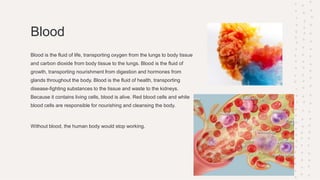
Blood is the fluid of life, transporting oxygen from the lungs to body tissue
and carbon dioxide from body tissue to the lungs. Blood is the fluid of
growth, transporting nourishment from digestion and hormones from
glands throughout the body. Blood is the fluid of health, transporting
disease-fighting substances to the tissue and waste to the kidneys.
Because it contains living cells, blood is alive. Red blood cells and white
blood cells are responsible for nourishing and cleansing the body.
Without blood, the human body would stop working.
Classification &
Structure of Blood
Vessels
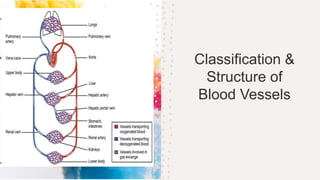
Blood vessels are the channels or conduits
through which blood is distributed to body
tissues. The vessels make up two closed
systems of tubes that begin and end at the
heart. One system, the pulmonary vessels,
transports blood from the right ventricle to
the lungs and back to the left atrium. The
other system, the systemic vessels, carries
blood from the left ventricle to the tissues in
all parts of the body and then returns the
blood to the right atrium. Based on their
structure and function, blood vessels are
classified as either arteries, capillaries, or
veins.
Classification &
Structure of
Blood Vessels
Classification &
Structure of Blood
Vessels
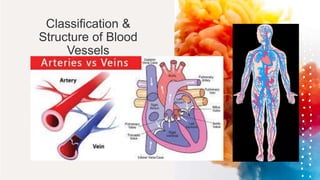
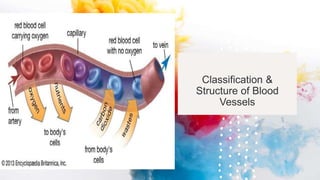
Blood is carried through the body via blood
vessels. An artery is a blood vessel that carries
blood away from the heart, where it branches into
ever-smaller vessels. Eventually, the smallest
arteries, vessels called arterioles, further branch
into tiny capillaries, where nutrients and wastes are
exchanged, and then combine with other vessels
that exit capillaries to form venules, small blood
vessels that carry blood to a vein, a larger blood
vessel that returns blood to the heart.
Classification &
Structure of Blood
Vessels
Arteries,
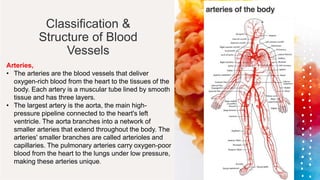
• The arteries are the blood vessels that deliver
oxygen-rich blood from the heart to the tissues of the
body. Each artery is a muscular tube lined by smooth
tissue and has three layers.
• The largest artery is the aorta, the main high-
pressure pipeline connected to the heart's left
ventricle. The aorta branches into a network of
smaller arteries that extend throughout the body. The
arteries' smaller branches are called arterioles and
capillaries. The pulmonary arteries carry oxygen-poor
blood from the heart to the lungs under low pressure,
making these arteries unique.
Classification &
Structure of Blood
Vessels
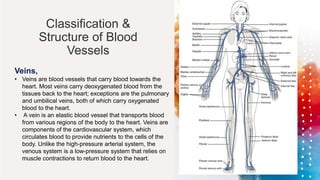
Veins,
• Veins are blood vessels that carry blood towards the
heart. Most veins carry deoxygenated blood from the
tissues back to the heart; exceptions are the pulmonary
and umbilical veins, both of which carry oxygenated
blood to the heart.
• A vein is an elastic blood vessel that transports blood
from various regions of the body to the heart. Veins are
components of the cardiovascular system, which
circulates blood to provide nutrients to the cells of the
body. Unlike the high-pressure arterial system, the
venous system is a low-pressure system that relies on
muscle contractions to return blood to the heart.
Classification &
Structure of Blood
Vessels
Classification &
Structure of Blood
Vessels
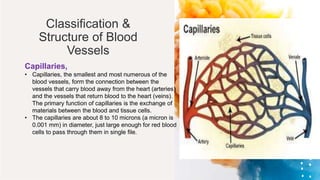
Capillaries,
• Capillaries, the smallest and most numerous of the
blood vessels, form the connection between the
vessels that carry blood away from the heart (arteries)
and the vessels that return blood to the heart (veins).
The primary function of capillaries is the exchange of
materials between the blood and tissue cells.
• The capillaries are about 8 to 10 microns (a micron is
0.001 mm) in diameter, just large enough for red blood
cells to pass through them in single file.
Classification &
Structure of Blood
Vessels
Circulatory Pathways
The blood vessels of the body are
functionally divided into two distinctive
circuits: pulmonary circuit and systemic
circuit. The pump for the pulmonary circuit,
which circulates blood through the lungs, is
the right ventricle. The left ventricle is the
pump for the systemic circuit, which
provides the blood supply for the tissue cells
of the body.
Circulatory Pathways
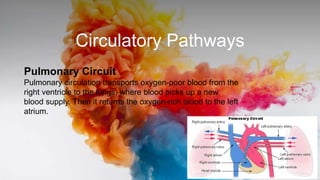
Pulmonary Circuit
Pulmonary circulation transports oxygen-poor blood from the
right ventricle to the lungs, where blood picks up a new
blood supply. Then it returns the oxygen-rich blood to the left
atrium.
Circulatory Pathways
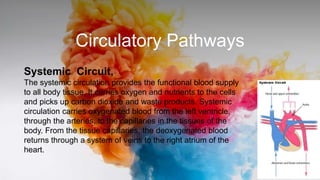
Systemic Circuit,
The systemic circulation provides the functional blood supply
to all body tissue. It carries oxygen and nutrients to the cells
and picks up carbon dioxide and waste products. Systemic
circulation carries oxygenated blood from the left ventricle,
through the arteries, to the capillaries in the tissues of the
body. From the tissue capillaries, the deoxygenated blood
returns through a system of veins to the right atrium of the
heart.
The Coronary Arteries & Circulation.
The heart muscle, like every other organ or tissue in your body, needs oxygen-rich
blood to survive. Blood is supplied to the heart by its own vascular system, called
the coronary circulation. The aorta (the main blood supplier to the body) branches
off into two main coronary blood vessels (also called arteries). These coronary
arteries branch off into smaller arteries, which supply oxygen-rich blood to the
entire heart muscle.
The right coronary artery supplies blood mainly to the right side of the heart. The
right side of the heart is smaller because it pumps blood only to the lungs. The left
coronary artery, which branches into the left anterior descending artery and the
circumflex artery, supplies blood to the left side of the heart. The left side of the
heart is larger and more muscular because it pumps blood to the rest of the body.
The Coronary Arteries & Circulation.
The one-way circulatory system carries blood to all parts of the body. This process
of blood flow is called circulation. Arteries carry oxygen-rich blood away from the
heart and veins carry oxygen-poor blood back to the heart.
In pulmonary circulation, the roles are switched. It is the pulmonary artery that
brings oxygen-poor blood into the lungs and the pulmonary vein that brings
oxygen-rich blood back to the heart.
The vessels that carry oxygen-rich blood are in darker color, and the vessels that
carry oxygen poor blood are in lighter color.
Review: Introduction to the
Cardiovascular System
Here is what we have learned from Introduction to the Cardiovascular System
• The cardiovascular system consists of the heart, which is a muscular pumping device, and a closed system of vessels called
arteries, veins, and capillaries.
• The vital role of the cardiovascular system in maintaining homeostasis depends on the continuous and controlled movement of
blood through the thousands of miles of capillaries that permeate every tissue and reach every cell in the body.
• The heart is a muscular pump that provides the force necessary to circulate the blood to all the tissues in the body.
• Three layers of the heart are: the epicardium, the myocardium, and the endocardium.
• The four chambers of the heart are: the right atrium, the right ventricle, the left atrium, and the left ventricle.
• Two types of valves of the heart are the atrioventricular valves and semilunar valves.
• Blood flows from the right atrium to the right ventricle and then is pumped to the lungs to receive oxygen. From the lungs, the
blood flows to the left atrium, then to the left ventricle. From there it is pumped to the systemic circulation.
• Specialized cardiac muscle cells that make up the conduction system of the heart coordinate contraction of the chambers.
• The pulmonary vessels transport blood from the right ventricle to the lungs and back to the left atrium.
• The systemic vessels carry blood from the left ventricle to the tissues in all parts of the body and then returns the blood to the
right atrium.

Cardiovascular system

  • 1.
    Introduction to the CardiovascularSystem Y O G A L I F E A S A N A S A N D M E D I T A T I O N
  • 2.
    Introduction to the Cardiovascular System • Thecardiovascular system is sometimes called the blood-vascular, or simply the circulatory, system. It consists of the heart, which is a muscular pumping device, and a closed system of vessels called arteries, veins, and capillaries. As the name implies, blood contained in the circulatory system is pumped by the heart around a closed circle or circuit of vessels as it passes again and again through the various "circulations" of the body.
  • 3.
    Cardiovascular System • Thevital role of the cardiovascular system in maintaining homeostasis depends on the continuous and controlled movement of blood through the thousands of miles of capillaries that permeate every tissue and reach every cell in the body. It is in the microscopic capillaries that blood performs its ultimate transport function. Nutrients and other essential materials pass from capillary blood into fluids surrounding the cells as waste products are removed.
  • 4.
    HEART • The heartis a muscular pump that provides the force necessary to circulate the blood to all the tissues in the body. Its function is vital because, to survive, the tissues need a continuous supply of oxygen and nutrients, and metabolic waste products must be removed. Deprived of these necessities, cells soon undergo irreversible changes that lead to death. While blood is the transport medium, the heart is the organ that keeps the blood moving through the vessels. The normal adult heart pumps about 5 liters of blood every minute throughout life. If it loses its pumping effectiveness for even a few minutes, the individual's life is jeopardized.
  • 5.
    STRUCTURE OF HEART • Thehuman heart is a four-chambered muscular organ, shaped and sized roughly like a man's closed fist with two-thirds of the mass to the left of midline. • The heart is enclosed in a pericardial sac.
  • 6.
    STRUCTURE OF HEART Layers ofthe Heart Wall, Three layers of tissue form the heart wall. The outer layer of the heart wall is the epicardium, the middle layer is the myocardium, and the inner layer is the endocardium. Chambers of the Heart, The heart is divided into four chambers:- • Right atrium • Right ventricle • Left atrium • Left ventricle
  • 7.
  • 8.
    Chambers of theHeart The two atria are thin-walled chambers that receive blood from the veins. The two ventricles are thick-walled chambers that forcefully pump blood out of the heart. Differences in thickness of the heart chamber walls are due to variations in the amount of myocardium present, which reflects the amount of force each chamber is required to generate. The right atrium receives deoxygenated blood from systemic veins; the left atrium receives oxygenated blood from the pulmonary veins.
  • 9.
    Valves of theHeart Pumps need a set of valves to keep the fluid flowing in one direction and the heart is no exception. The heart has two types of valves that keep the blood flowing in the correct direction. The valves between the atria and ventricles are called atrioventricular valves (also called cuspid valves), while those at the bases of the large vessels leaving the ventricles are called semilunar valves. The right atrioventricular valve is the tricuspid valve. The left atrioventricular valve is the bicuspid, or mitral, valve. The valve between the right ventricle and pulmonary trunk is the pulmonary semilunar valve. The valve between the left ventricle and the aorta is the aortic semilunar valve. When the ventricles contract, atrioventricular valves close to prevent blood from flowing back into the atria. When the ventricles relax, semilunar valves close to prevent blood from flowing back into the ventricles.
  • 10.
  • 11.
    The Conduction System Electricalimpulses from the heart muscle (the myocardium) cause the heart to contract. This electrical signal begins in the sinoatrial (SA) node, located at the top of the right atrium. The SA node is sometimes called the heart’s ‘natural pacemaker’. An electrical impulse from this natural pacemaker travels through the muscle fibers of the atria and ventricles, causing them to contract. Although the SA node sends electrical impulses at a certain rate, our heart rate may still change depending on physical demands, stress, and hormonal factors.
  • 12.
    The Heartbeat A heartbeatis a two-part pumping action that takes about a second. As blood collects in the upper chambers (the right and left atria), the heart’s natural pacemaker (the SA node) sends out an electrical signal that causes the atria to contract. This contraction pushes blood through the tricuspid and mitral valves into the resting lower chambers (the right and left ventricles). This part of the two-part pumping phase (the longer of the two) is called diastole. The second part of the pumping phase begins when the ventricles are full of blood. The electrical signals from the SA node travel along a pathway of cells to the ventricles, causing them to contract. This is called systole. As the tricuspid and mitral valves shut tight to prevent a back flow of blood, the pulmonary and aortic valves are pushed open.
  • 13.
    The Heartbeat While bloodis pushed from the right ventricle into the lungs to pick up oxygen, oxygen-rich blood flows from the left ventricle to the heart and other parts of the body. After blood moves into the pulmonary artery and the aorta, the ventricles relax, and the pulmonary and aortic valves close. The lower pressure in the ventricles causes the tricuspid and mitral valves to open, and the cycle begins again. This series of contractions is repeated, increasing during times of exertion, and decreasing while we are at rest. The heart normally beats about 60 to 80 times a minute when we are at rest, but this can vary. As we get older, our resting heart rate rises. Also, it is usually lower in people who are physically fit. Our heart does not work alone. Our brain tracks the conditions around us - climate, stress, and our level of physical activity - and adjusts our cardiovascular system to meet those conditions. The human heart is a muscle designed to remain strong and reliable for a hundred years or longer. By reducing our risk factors for cardiovascular disease, we may help our heart stay healthy longer.
  • 14.
    Pathway of Bloodthrough the Heart While it is convenient to describe the flow of blood through the right side of the heart and then through the left side, it is important to realize that both atria and ventricles contract at the same time. The heart works as two pumps, one on the right and one on the left, working simultaneously. Blood flows from the right atrium to the right ventricle, and then is pumped to the lungs to receive oxygen. From the lungs, the blood flows to the left atrium, then to the left ventricle. From there it is pumped to the systemic circulation.
  • 15.
    Blood Supply tothe Myocardium The myocardium of the heart wall is a working muscle that needs a continuous supply of oxygen and nutrients to function efficiently. For this reason, cardiac muscle has an extensive network of blood vessels to bring oxygen to the contracting cells and to remove waste products.
  • 16.
    Blood Blood is thefluid of life, transporting oxygen from the lungs to body tissue and carbon dioxide from body tissue to the lungs. Blood is the fluid of growth, transporting nourishment from digestion and hormones from glands throughout the body. Blood is the fluid of health, transporting disease-fighting substances to the tissue and waste to the kidneys. Because it contains living cells, blood is alive. Red blood cells and white blood cells are responsible for nourishing and cleansing the body. Without blood, the human body would stop working.
  • 17.
    Classification & Structure ofBlood Vessels Blood vessels are the channels or conduits through which blood is distributed to body tissues. The vessels make up two closed systems of tubes that begin and end at the heart. One system, the pulmonary vessels, transports blood from the right ventricle to the lungs and back to the left atrium. The other system, the systemic vessels, carries blood from the left ventricle to the tissues in all parts of the body and then returns the blood to the right atrium. Based on their structure and function, blood vessels are classified as either arteries, capillaries, or veins.
  • 18.
  • 19.
    Classification & Structure ofBlood Vessels Blood is carried through the body via blood vessels. An artery is a blood vessel that carries blood away from the heart, where it branches into ever-smaller vessels. Eventually, the smallest arteries, vessels called arterioles, further branch into tiny capillaries, where nutrients and wastes are exchanged, and then combine with other vessels that exit capillaries to form venules, small blood vessels that carry blood to a vein, a larger blood vessel that returns blood to the heart.
  • 20.
    Classification & Structure ofBlood Vessels Arteries, • The arteries are the blood vessels that deliver oxygen-rich blood from the heart to the tissues of the body. Each artery is a muscular tube lined by smooth tissue and has three layers. • The largest artery is the aorta, the main high- pressure pipeline connected to the heart's left ventricle. The aorta branches into a network of smaller arteries that extend throughout the body. The arteries' smaller branches are called arterioles and capillaries. The pulmonary arteries carry oxygen-poor blood from the heart to the lungs under low pressure, making these arteries unique.
  • 21.
    Classification & Structure ofBlood Vessels Veins, • Veins are blood vessels that carry blood towards the heart. Most veins carry deoxygenated blood from the tissues back to the heart; exceptions are the pulmonary and umbilical veins, both of which carry oxygenated blood to the heart. • A vein is an elastic blood vessel that transports blood from various regions of the body to the heart. Veins are components of the cardiovascular system, which circulates blood to provide nutrients to the cells of the body. Unlike the high-pressure arterial system, the venous system is a low-pressure system that relies on muscle contractions to return blood to the heart.
  • 22.
  • 23.
    Classification & Structure ofBlood Vessels Capillaries, • Capillaries, the smallest and most numerous of the blood vessels, form the connection between the vessels that carry blood away from the heart (arteries) and the vessels that return blood to the heart (veins). The primary function of capillaries is the exchange of materials between the blood and tissue cells. • The capillaries are about 8 to 10 microns (a micron is 0.001 mm) in diameter, just large enough for red blood cells to pass through them in single file.
  • 24.
  • 25.
    Circulatory Pathways The bloodvessels of the body are functionally divided into two distinctive circuits: pulmonary circuit and systemic circuit. The pump for the pulmonary circuit, which circulates blood through the lungs, is the right ventricle. The left ventricle is the pump for the systemic circuit, which provides the blood supply for the tissue cells of the body.
  • 26.
    Circulatory Pathways Pulmonary Circuit Pulmonarycirculation transports oxygen-poor blood from the right ventricle to the lungs, where blood picks up a new blood supply. Then it returns the oxygen-rich blood to the left atrium.
  • 27.
    Circulatory Pathways Systemic Circuit, Thesystemic circulation provides the functional blood supply to all body tissue. It carries oxygen and nutrients to the cells and picks up carbon dioxide and waste products. Systemic circulation carries oxygenated blood from the left ventricle, through the arteries, to the capillaries in the tissues of the body. From the tissue capillaries, the deoxygenated blood returns through a system of veins to the right atrium of the heart.
  • 28.
    The Coronary Arteries& Circulation. The heart muscle, like every other organ or tissue in your body, needs oxygen-rich blood to survive. Blood is supplied to the heart by its own vascular system, called the coronary circulation. The aorta (the main blood supplier to the body) branches off into two main coronary blood vessels (also called arteries). These coronary arteries branch off into smaller arteries, which supply oxygen-rich blood to the entire heart muscle. The right coronary artery supplies blood mainly to the right side of the heart. The right side of the heart is smaller because it pumps blood only to the lungs. The left coronary artery, which branches into the left anterior descending artery and the circumflex artery, supplies blood to the left side of the heart. The left side of the heart is larger and more muscular because it pumps blood to the rest of the body.
  • 29.
    The Coronary Arteries& Circulation. The one-way circulatory system carries blood to all parts of the body. This process of blood flow is called circulation. Arteries carry oxygen-rich blood away from the heart and veins carry oxygen-poor blood back to the heart. In pulmonary circulation, the roles are switched. It is the pulmonary artery that brings oxygen-poor blood into the lungs and the pulmonary vein that brings oxygen-rich blood back to the heart. The vessels that carry oxygen-rich blood are in darker color, and the vessels that carry oxygen poor blood are in lighter color.
  • 30.
    Review: Introduction tothe Cardiovascular System Here is what we have learned from Introduction to the Cardiovascular System • The cardiovascular system consists of the heart, which is a muscular pumping device, and a closed system of vessels called arteries, veins, and capillaries. • The vital role of the cardiovascular system in maintaining homeostasis depends on the continuous and controlled movement of blood through the thousands of miles of capillaries that permeate every tissue and reach every cell in the body. • The heart is a muscular pump that provides the force necessary to circulate the blood to all the tissues in the body. • Three layers of the heart are: the epicardium, the myocardium, and the endocardium. • The four chambers of the heart are: the right atrium, the right ventricle, the left atrium, and the left ventricle. • Two types of valves of the heart are the atrioventricular valves and semilunar valves. • Blood flows from the right atrium to the right ventricle and then is pumped to the lungs to receive oxygen. From the lungs, the blood flows to the left atrium, then to the left ventricle. From there it is pumped to the systemic circulation. • Specialized cardiac muscle cells that make up the conduction system of the heart coordinate contraction of the chambers. • The pulmonary vessels transport blood from the right ventricle to the lungs and back to the left atrium. • The systemic vessels carry blood from the left ventricle to the tissues in all parts of the body and then returns the blood to the right atrium.