CARDIOVASCULAR
        SYSTEM
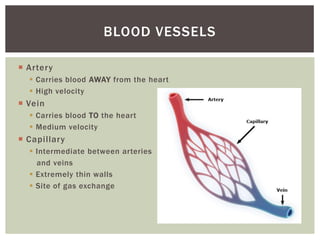
BLOOD VESSELS

 Artery
   Carries blood AWAY from the heart
   High velocity
 Vein
   Carries blood TO the heart
   Medium velocity
 Capillary
   Intermediate between arteries
    and veins
   Extremely thin walls
   Site of gas exchange
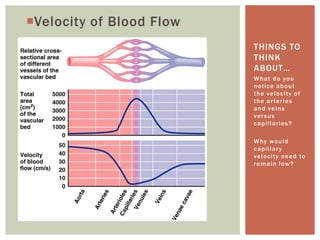
Velocity of Blood Flow
                          THINGS TO
                          THINK
                          ABOUT…
                          W h a t d o yo u
                          notice about
                          the velocity of
                          t h e a r te r i e s
                          and veins
                          versus
                          c a p i l l a r ie s ?

                          W hy w o u l d
                          c a p i l l ar y
                          v e l o c it y n e e d to
                          remain low?
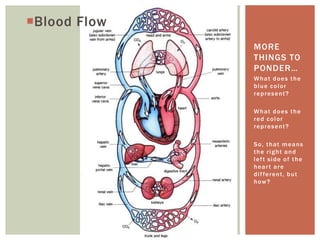
Blood Flow
              MORE
              THINGS TO
              PONDER…
              What does the
              blue color
              represent?

              What does the
              red color
              represent?

              So, that means
              the right and
              left side of the
              heart are
              d i f fe r e n t , b u t
              how?
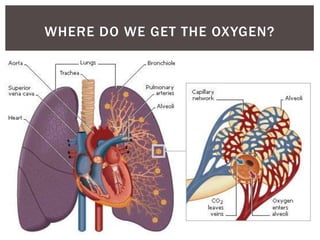
WHERE DO WE GET THE OXYGEN?
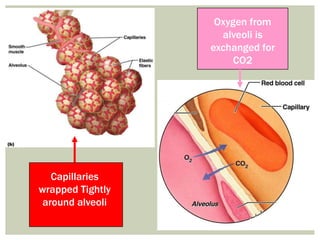
Oxygen from
                    alveoli is
                  exchanged for
                       CO2


   Capillaries
wrapped Tightly
 around alveoli
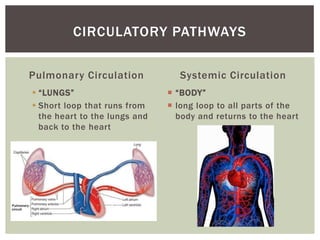
CIRCULATORY PATHWAYS

Pulmonary Circulation            Systemic Circulation
 “LUNGS”                       “BODY”
 Short loop that runs from     long loop to all parts of the
  the heart to the lungs and     body and returns to the heart
  back to the heart
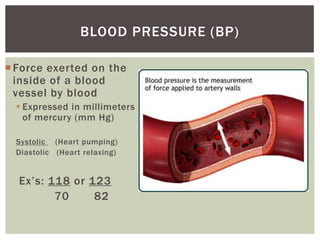
BLOOD PRESSURE (BP)

 Force exerted on the
  inside of a blood
  vessel by blood
   Expressed in millimeters
    of mercury (mm Hg)

  Systolic (Heart pumping)
  Diastolic (Heart relaxing)


  Ex’s: 118 or 123
         70     82
MEASURING BLOOD PRESSURE

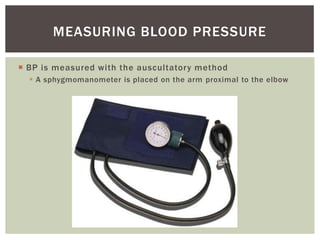
 BP is measured with the auscultatory method
   A sphygmomanometer is placed on the arm proximal to the elbow
MEASURING BLOOD PRESSURE


The first sound heard is recorded
 as the systolic pressure

The pressure when sound
 disappears is recorded as the
 diastolic pressure
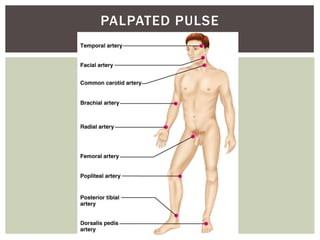
PALPATED PULSE
RESISTANCE

Peripheral Resistance – opposition to flow

The three important sources of resistance:
 blood viscosity – “stickiness” of the blood
 total blood vessel length
 blood vessel diameter
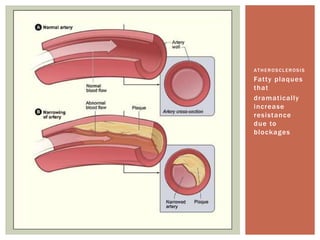
ATHEROSCLEROSIS
Fatty plaques
that
dramatically
increase
resistance
due to
blockages
BLOOD FLOW, BLOOD PRESSURE, AND RESISTANCE


 P=pressure
R=resistance

If P increases, blood flow speeds
 up; if P decreases, blood flow
 slows

If R increases, blood flow slows
MAINTAINING BLOOD PRESSURE

The main factors influencing blood pressure:
  Cardiac output (CO)-amount of blood being pumped
   out of heart per minute
  Peripheral resistance (PR)
  Blood volume
Blood pressure = CO x PR
Blood pressures can vary
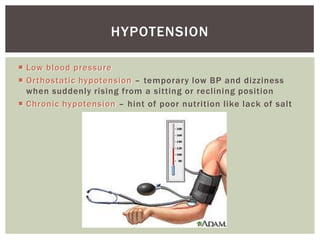
HYPOTENSION

 Low blood pressure
 Orthostatic hypotension – temporary low BP and dizziness
  when suddenly rising from a sitting or reclining position
 Chronic hypotension – hint of poor nutrition like lack of salt
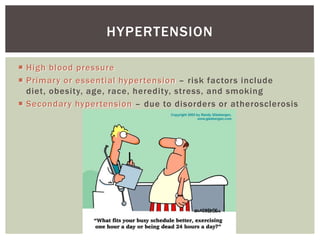
HYPERTENSION

 High blood pressure
 Primary or essential hypertension – risk factors include
  diet, obesity, age, race, heredity, stress, and smoking
 Secondary hypertension – due to disorders or atherosclerosis
SHOCK
A person in shock has extremely low blood pressure

Symptoms
 Anxiety or agitation/restlessness
 Bluish lips and fingernails
 Chest Pain
 Confusion
 Dizziness, lightheadedness, or faintness
 Pale, cool, clammy skin
 Low or no urine output
 Profuse sweating
 Rapid but weak pulse
 Shallow breathing
 Unconsciousness
CIRCULATORY SHOCK

Three types include:
 Hypovolemic shock – results from large-
  scale blood loss
 Vascular shock – poor circulation
  resulting from extreme vasodilation
 Cardiogenic shock – the heart cannot
  sustain adequate circulation
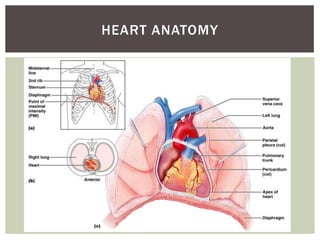
HEART ANATOMY
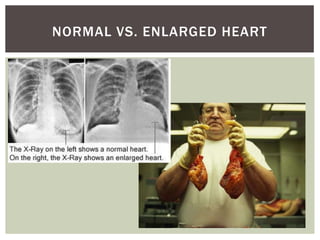
NORMAL VS. ENLARGED HEART
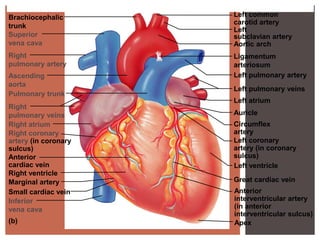
Brachiocephalic       Left common
                      carotid artery
trunk
                      Left
Superior              subclavian artery
vena cava             Aortic arch
Right                 Ligamentum
pulmonary artery      arteriosum
Ascending             Left pulmonary artery
aorta
                      Left pulmonary veins
Pulmonary trunk
                      Left atrium
Right
pulmonary veins       Auricle
Right atrium          Circumflex
Right coronary        artery
artery (in coronary   Left coronary
sulcus)               artery (in coronary
Anterior              sulcus)
cardiac vein          Left ventricle
Right ventricle
Marginal artery       Great cardiac vein
Small cardiac vein    Anterior
Inferior              interventricular artery
vena cava             (in anterior
                      interventricular sulcus)
(b)                   Apex
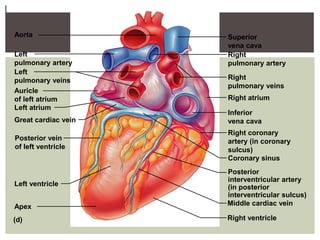
Aorta                Superior
                     vena cava
Left                 Right
pulmonary artery     pulmonary artery
Left
pulmonary veins      Right
                     pulmonary veins
Auricle
of left atrium       Right atrium
Left atrium
                     Inferior
Great cardiac vein   vena cava
                     Right coronary
Posterior vein       artery (in coronary
of left ventricle    sulcus)
                     Coronary sinus
                     Posterior
                     interventricular artery
Left ventricle       (in posterior
                     interventricular sulcus)
Apex                 Middle cardiac vein

(d)                  Right ventricle
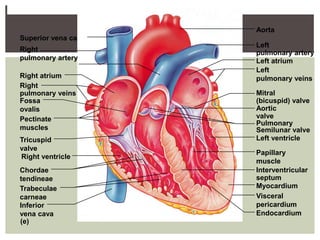
Aorta
Superior vena cava
                     Left
Right                pulmonary artery
pulmonary artery     Left atrium
                     Left
Right atrium         pulmonary veins
Right
pulmonary veins      Mitral
Fossa                (bicuspid) valve
ovalis               Aortic
Pectinate            valve
                     Pulmonary
muscles              Semilunar valve
Tricuspid            Left ventricle
valve
                     Papillary
Right ventricle
                     muscle
Chordae              Interventricular
tendineae            septum
Trabeculae           Myocardium
carneae              Visceral
Inferior             pericardium
vena cava            Endocardium
(e)
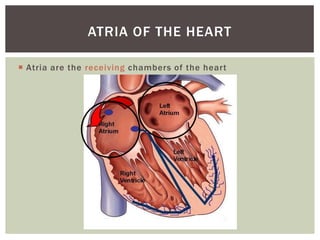
ATRIA OF THE HEART

 Atria are the receiving chambers of the heart
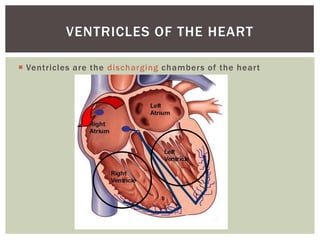
VENTRICLES OF THE HEART

 Ventricles are the discharging chambers of the heart
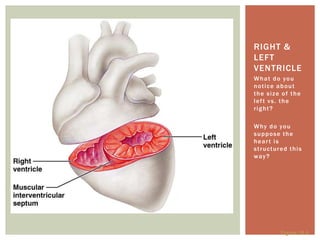
RIGHT &
LEFT
VENTRICLE
W h a t d o yo u
notice about
the size of the
left vs. the
right?

W hy d o yo u
suppose the
heart is
s t r uc t ur e d t h i s
w ay ?


              Figure 18.6
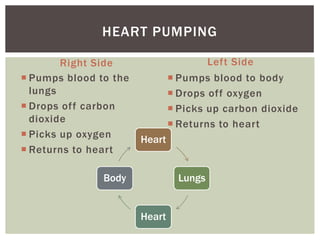
HEART PUMPING

        Right Side                       Left Side
 Pumps blood to the            Pumps blood to body
  lungs                         Drops off oxygen
 Drops off carbon              Picks up carbon dioxide
  dioxide                       Returns to heart
 Picks up oxygen      Heart
 Returns to heart

               Body              Lungs


                       Heart
PATHWAY OF BLOOD THROUGH THE
            HEART AND LUNGS

                          KNOW THIS!!!
  Right atrium  tricuspid valve  right ventricle
   pulmonary semilunar valve  pulmonary
  arteries  Lungs  pulmonary veins  left
  atrium  bicuspid valve  left ventricle 
  aortic semilunar valve  Aorta  systemic
  circulation


http://www.dnatube.com/video/4817/Heart-Structure--Biology--Anatomy
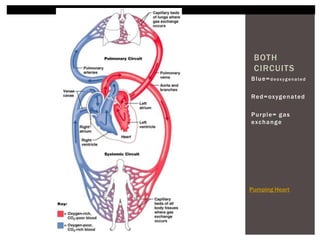
BOTH
 CIRCUITS
Blue=deoxygenated

Re d = ox yg e n a te d

Purple= gas
ex c h a n g e


Pumping Heart
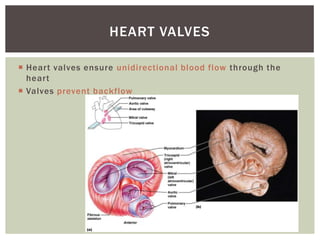
HEART VALVES

 Heart valves ensure unidirectional blood flow through the
  heart
 Valves prevent backflow
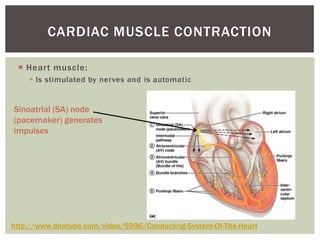
CARDIAC MUSCLE CONTRACTION

  Heart muscle:
     Is stimulated by nerves and is automatic


Sinoatrial (SA) node
(pacemaker) generates
impulses


http://www.dnatube.com/video/5996/Conducting-System-Of-The-Heart
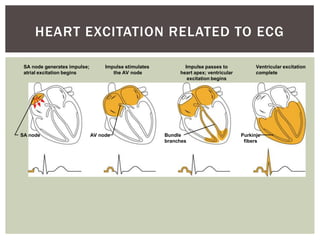
HEART EXCITATION RELATED TO ECG

 SA node generates impulse;        Impulse stimulates          Impulse passes to             Ventricular excitation
 atrial excitation begins             the AV node            heart apex; ventricular         complete
                                                                excitation begins


SA node                       AV node                   Bundle                         Purkinje
                                                        branches                        fibers
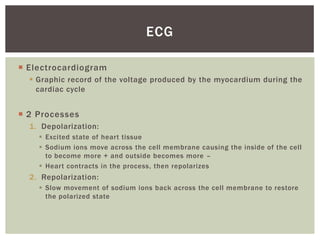
ECG

 Electrocardiogram
   Graphic record of the voltage produced by the myocardium during the
    cardiac cycle


 2 Processes
  1. Depolarization:
     Excited state of heart tissue
     Sodium ions move across the cell membrane causing the inside of the cell
      to become more + and outside becomes more –
     Heart contracts in the process, then repolarizes
  2. Repolarization:
     Slow movement of sodium ions back across the cell membrane to restore
      the polarized state
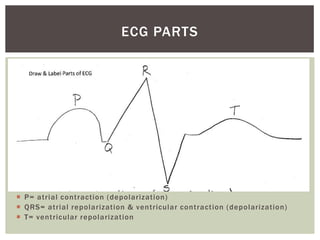
ECG PARTS


 P= atrial contraction (depolarization)
 QRS= atrial repolarization & ventricular contraction (depolarization)
 T= ventricular repolarization
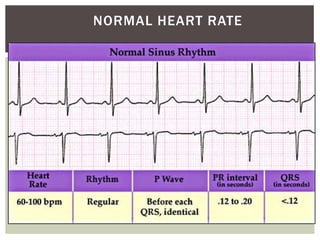
NORMAL HEART RATE
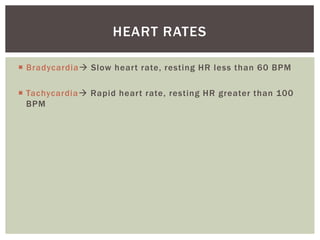
HEART RATES

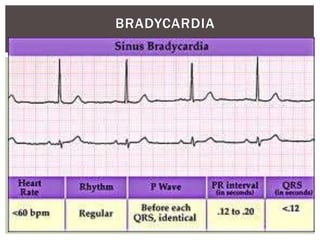
 Bradycardia Slow heart rate, resting HR less than 60 BPM

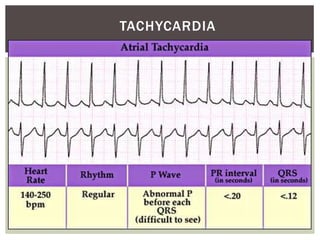
 Tachycardia Rapid heart rate, resting HR greater than 100
  BPM
BRADYCARDIA
TACHYCARDIA
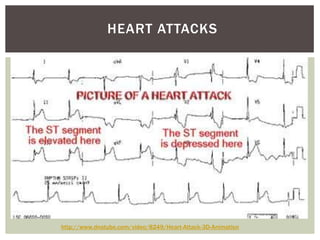
HEART ATTACKS


http://www.dnatube.com/video/8249/Heart-Attack-3D-Animation
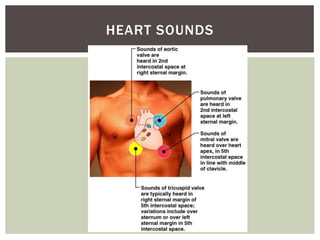
HEART SOUNDS
HEART SOUNDS

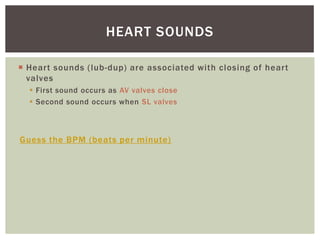
 Heart sounds (lub-dup) are associated with closing of heart
  valves
   First sound occurs as AV valves close
   Second sound occurs when SL valves


Guess the BPM (beats per minute)
CARDIAC CYCLE

 Cardiac cycle refers to all events associated with blood flow
  through the heart
   Systole – contraction of heart muscle
   Diastole – relaxation of heart muscle
CARDIAC OUTPUT (CO) AND RESERVE

Stroke Volume (SV) is the amount of blood
 pumped out by a ventricle with each beat

Heart Rate (HR) is the number of heart beats
 per minute

Cardiac Output (CO) is the amount of blood
 pumped by each ventricle in one minute

CO is the product of (HR) & (SV)
CHEMICAL REGULATION OF THE HEART

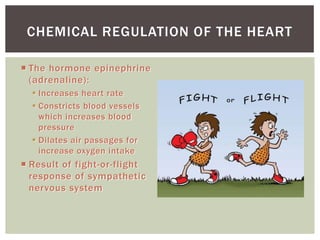
 The hormone epinephrine
  (adrenaline):
   Increases heart rate
   Constricts blood vessels
    which increases blood
    pressure
   Dilates air passages for
    increase oxygen intake
 Result of fight-or-flight
  response of sympathetic
  nervous system
Functions of blood:
                                     BLOOD
1. Transportation
 Nutrients, oxygen, wastes, hormo
  nes
2. Distribute heat
3. Protection against disease
FACTS ABOUT BLOOD

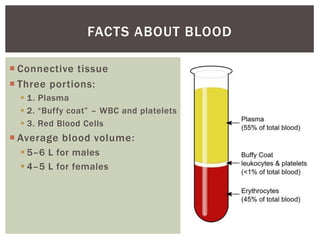
 Connective tissue
 Three portions:
   1. Plasma
   2. “Buffy coat” – WBC and platelets
   3. Red Blood Cells
 Average blood volume:
   5–6 L for males
   4–5 L for females
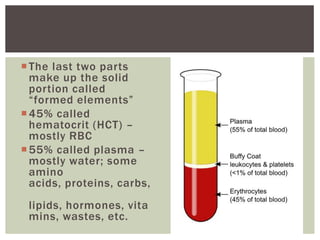
 The last two parts
  make up the solid
  portion called
  “formed elements”
 45% called
  hematocrit (HCT) –
  mostly RBC
 55% called plasma –
  mostly water; some
  amino
  acids, proteins, carbs,
 lipids, hormones, vita
 mins, wastes, etc.
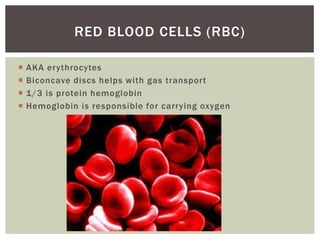
RED BLOOD CELLS (RBC)

   AKA erythrocytes
   Biconcave discs helps with gas transport
   1/3 is protein hemoglobin
   Hemoglobin is responsible for carrying oxygen
OTHER FACTS…


 No nuclei so can not synthesize proteins or divide.
 RBC count used to diagnosis disease
 Life span of RBC 120 days
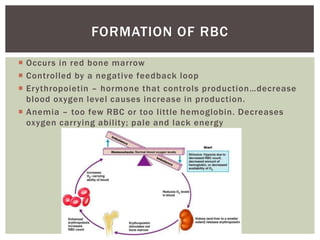
FORMATION OF RBC

 Occurs in red bone marrow
 Controlled by a negative feedback loop
 Erythropoietin – hormone that controls production…decrease
  blood oxygen level causes increase in production.
 Anemia – too few RBC or too little hemoglobin. Decreases
  oxygen carrying ability; pale and lack energy
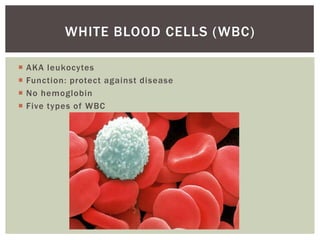
WHITE BLOOD CELLS (WBC)

   AKA leukocytes
   Function: protect against disease
   No hemoglobin
   Five types of WBC
WBC FLIP BOOK

 10 minutes to complete
 Title your Flip Book: White Blood Cells

 Label the next 5 tabs with the 5 types of WBC

 On the pages you need the following for each type of WBC:
     A Drawn Picture
     Description
     # in blood
     Life span
     Function


 You can get all of your information from textbook   pg. 658
T YPES OF WBC

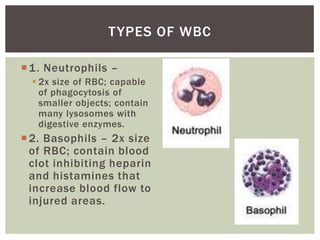
 1. Neutrophils –
   2x size of RBC; capable
    of phagocytosis of
    smaller objects; contain
    many lysosomes with
    digestive enzymes.
 2. Basophils – 2x size
  of RBC; contain blood
  clot inhibiting heparin
  and histamines that
  increase blood flow to
  injured areas.
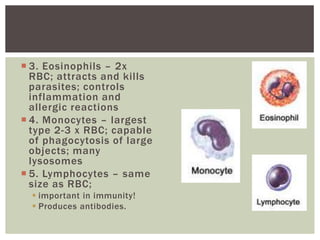
 3. Eosinophils – 2x
  RBC; attracts and kills
  parasites; controls
  inflammation and
  allergic reactions
 4. Monocytes – largest
  type 2-3 x RBC; capable
  of phagocytosis of large
  objects; many
  lysosomes
 5. Lymphocytes – same
  size as RBC;
   important in immunity!
   Produces antibodies.
FACTS ON WBC

 WBC count very important in diagnosing diseases
 Increase indicates infection
 Depending on the disease, dif ferent types of WBC will change
  numbers.


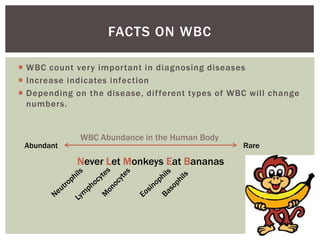
             WBC Abundance in the Human Body
 Abundant                                         Rare

             Never Let Monkeys Eat Bananas
PLATELETS


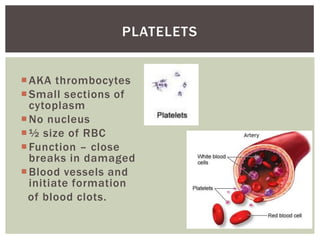
 AKA thrombocytes
 Small sections of
  cytoplasm
 No nucleus
 ½ size of RBC
 Function – close
  breaks in damaged
 Blood vessels and
  initiate formation
 of blood clots.
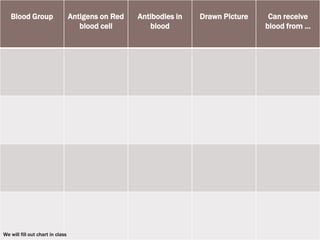
Blood Group                    Antigens on Red   Antibodies in   Drawn Picture    Can receive
                                     blood cell        blood                        blood from …


We will fill out chart in class
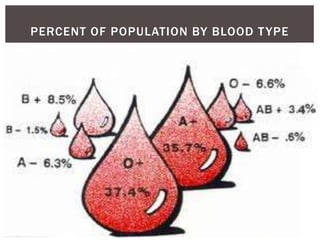
PERCENT OF POPULATION BY BLOOD T YPE
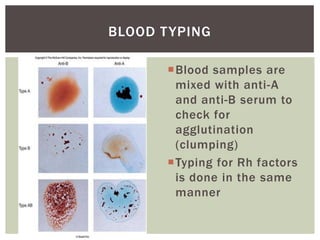
BLOOD T YPING

       Blood samples are
        mixed with anti-A
        and anti-B serum to
        check for
        agglutination
        (clumping)
       Typing for Rh factors
        is done in the same
        manner
A marker found on the red
 blood cells.
If you have the marker you
                                RH FACTOR
 are Rh-positive.               +or –
If you are missing the         blood
                                type
 marker, you are Rh-negative.   explained
HEMOLY TIC DISEASE OF THE NEWBORN

 Hemolytic disease of the newborn – Rh + antibodies of a
  sensitized Rh – mother cross the placenta and attack and
  destroy the RBCs of an Rh + baby

 The drug RhoGAM can prevent the Rh – mother from
  becoming sensitized
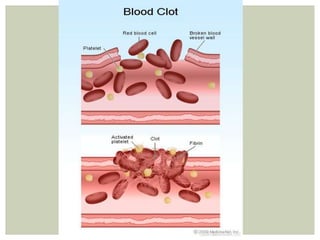
2 major factors
 1. Platelets
     Travel through bloodstream
                                                    BLOOD
     When bleeding happens, chemical
                                                    CLOTTING
      reaction occurs to make them “sticky”
     They adhere to the vessels of the
      bleeding site
     Within a minute, a “white clot” is
      formed
 2. Thrombin System
     Several proteins become activated
     Chemical reactions form fibrin (like a long
      sticky string)
      Fibrin sticks to broken vessel & forms a
      web
     RBC get caught in web & form a “red
      clot”
CLOTTING CONTINUED…


Mature clots contain both
 platelets and fibrin strands
 making them tight and stable
After about 10 days, the wound
 is healed & body disintegrates
 the clot.
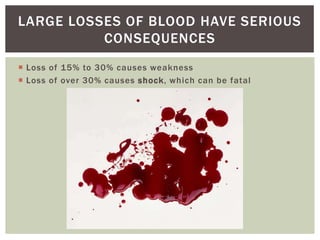
LARGE LOSSES OF BLOOD HAVE SERIOUS
          CONSEQUENCES
 Loss of 15% to 30% causes weakness
 Loss of over 30% causes shock, which can be fatal
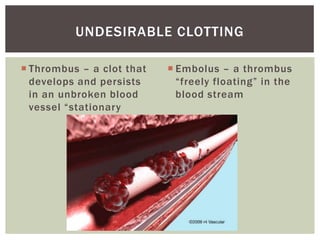
UNDESIRABLE CLOTTING

 Thrombus – a clot that    Embolus – a thrombus
  develops and persists      “freely floating” in the
  in an unbroken blood       blood stream
  vessel “stationary

Cardiovascular system

  • 1.
  • 2.
    BLOOD VESSELS  Artery  Carries blood AWAY from the heart  High velocity  Vein  Carries blood TO the heart  Medium velocity  Capillary  Intermediate between arteries and veins  Extremely thin walls  Site of gas exchange
  • 3.
    Velocity of BloodFlow THINGS TO THINK ABOUT… W h a t d o yo u notice about the velocity of t h e a r te r i e s and veins versus c a p i l l a r ie s ? W hy w o u l d c a p i l l ar y v e l o c it y n e e d to remain low?
  • 4.
    Blood Flow MORE THINGS TO PONDER… What does the blue color represent? What does the red color represent? So, that means the right and left side of the heart are d i f fe r e n t , b u t how?
  • 5.
    WHERE DO WEGET THE OXYGEN?
  • 6.
    Oxygen from alveoli is exchanged for CO2 Capillaries wrapped Tightly around alveoli
  • 7.
    CIRCULATORY PATHWAYS Pulmonary Circulation Systemic Circulation  “LUNGS”  “BODY”  Short loop that runs from  long loop to all parts of the the heart to the lungs and body and returns to the heart back to the heart
  • 8.
    BLOOD PRESSURE (BP) Force exerted on the inside of a blood vessel by blood  Expressed in millimeters of mercury (mm Hg) Systolic (Heart pumping) Diastolic (Heart relaxing) Ex’s: 118 or 123 70 82
  • 9.
    MEASURING BLOOD PRESSURE BP is measured with the auscultatory method  A sphygmomanometer is placed on the arm proximal to the elbow
  • 10.
    MEASURING BLOOD PRESSURE Thefirst sound heard is recorded as the systolic pressure The pressure when sound disappears is recorded as the diastolic pressure
  • 11.
  • 12.
    RESISTANCE Peripheral Resistance –opposition to flow The three important sources of resistance: blood viscosity – “stickiness” of the blood total blood vessel length blood vessel diameter
  • 13.
  • 14.
    BLOOD FLOW, BLOODPRESSURE, AND RESISTANCE  P=pressure R=resistance If P increases, blood flow speeds up; if P decreases, blood flow slows If R increases, blood flow slows
  • 15.
    MAINTAINING BLOOD PRESSURE Themain factors influencing blood pressure:  Cardiac output (CO)-amount of blood being pumped out of heart per minute  Peripheral resistance (PR)  Blood volume Blood pressure = CO x PR Blood pressures can vary
  • 16.
    HYPOTENSION  Low bloodpressure  Orthostatic hypotension – temporary low BP and dizziness when suddenly rising from a sitting or reclining position  Chronic hypotension – hint of poor nutrition like lack of salt
  • 17.
    HYPERTENSION  High bloodpressure  Primary or essential hypertension – risk factors include diet, obesity, age, race, heredity, stress, and smoking  Secondary hypertension – due to disorders or atherosclerosis
  • 18.
    SHOCK A person inshock has extremely low blood pressure Symptoms  Anxiety or agitation/restlessness  Bluish lips and fingernails  Chest Pain  Confusion  Dizziness, lightheadedness, or faintness  Pale, cool, clammy skin  Low or no urine output  Profuse sweating  Rapid but weak pulse  Shallow breathing  Unconsciousness
  • 19.
    CIRCULATORY SHOCK Three typesinclude: Hypovolemic shock – results from large- scale blood loss Vascular shock – poor circulation resulting from extreme vasodilation Cardiogenic shock – the heart cannot sustain adequate circulation
  • 20.
  • 21.
  • 22.
    Brachiocephalic Left common carotid artery trunk Left Superior subclavian artery vena cava Aortic arch Right Ligamentum pulmonary artery arteriosum Ascending Left pulmonary artery aorta Left pulmonary veins Pulmonary trunk Left atrium Right pulmonary veins Auricle Right atrium Circumflex Right coronary artery artery (in coronary Left coronary sulcus) artery (in coronary Anterior sulcus) cardiac vein Left ventricle Right ventricle Marginal artery Great cardiac vein Small cardiac vein Anterior Inferior interventricular artery vena cava (in anterior interventricular sulcus) (b) Apex
  • 23.
    Aorta Superior vena cava Left Right pulmonary artery pulmonary artery Left pulmonary veins Right pulmonary veins Auricle of left atrium Right atrium Left atrium Inferior Great cardiac vein vena cava Right coronary Posterior vein artery (in coronary of left ventricle sulcus) Coronary sinus Posterior interventricular artery Left ventricle (in posterior interventricular sulcus) Apex Middle cardiac vein (d) Right ventricle
  • 24.
    Aorta Superior vena cava Left Right pulmonary artery pulmonary artery Left atrium Left Right atrium pulmonary veins Right pulmonary veins Mitral Fossa (bicuspid) valve ovalis Aortic Pectinate valve Pulmonary muscles Semilunar valve Tricuspid Left ventricle valve Papillary Right ventricle muscle Chordae Interventricular tendineae septum Trabeculae Myocardium carneae Visceral Inferior pericardium vena cava Endocardium (e)
  • 25.
    ATRIA OF THEHEART  Atria are the receiving chambers of the heart
  • 26.
    VENTRICLES OF THEHEART  Ventricles are the discharging chambers of the heart
  • 27.
    RIGHT & LEFT VENTRICLE W ha t d o yo u notice about the size of the left vs. the right? W hy d o yo u suppose the heart is s t r uc t ur e d t h i s w ay ? Figure 18.6
  • 28.
    HEART PUMPING Right Side Left Side  Pumps blood to the  Pumps blood to body lungs  Drops off oxygen  Drops off carbon  Picks up carbon dioxide dioxide  Returns to heart  Picks up oxygen Heart  Returns to heart Body Lungs Heart
  • 29.
    PATHWAY OF BLOODTHROUGH THE HEART AND LUNGS KNOW THIS!!! Right atrium  tricuspid valve  right ventricle  pulmonary semilunar valve  pulmonary arteries  Lungs  pulmonary veins  left atrium  bicuspid valve  left ventricle  aortic semilunar valve  Aorta  systemic circulation http://www.dnatube.com/video/4817/Heart-Structure--Biology--Anatomy
  • 30.
    BOTH CIRCUITS Blue=deoxygenated Re d= ox yg e n a te d Purple= gas ex c h a n g e Pumping Heart
  • 31.
    HEART VALVES  Heartvalves ensure unidirectional blood flow through the heart  Valves prevent backflow
  • 32.
    CARDIAC MUSCLE CONTRACTION  Heart muscle:  Is stimulated by nerves and is automatic Sinoatrial (SA) node (pacemaker) generates impulses http://www.dnatube.com/video/5996/Conducting-System-Of-The-Heart
  • 33.
    HEART EXCITATION RELATEDTO ECG SA node generates impulse; Impulse stimulates Impulse passes to Ventricular excitation atrial excitation begins the AV node heart apex; ventricular complete excitation begins SA node AV node Bundle Purkinje branches fibers
  • 34.
    ECG  Electrocardiogram  Graphic record of the voltage produced by the myocardium during the cardiac cycle  2 Processes 1. Depolarization:  Excited state of heart tissue  Sodium ions move across the cell membrane causing the inside of the cell to become more + and outside becomes more –  Heart contracts in the process, then repolarizes 2. Repolarization:  Slow movement of sodium ions back across the cell membrane to restore the polarized state
  • 35.
    ECG PARTS  P=atrial contraction (depolarization)  QRS= atrial repolarization & ventricular contraction (depolarization)  T= ventricular repolarization
  • 36.
  • 37.
    HEART RATES  BradycardiaSlow heart rate, resting HR less than 60 BPM  Tachycardia Rapid heart rate, resting HR greater than 100 BPM
  • 38.
  • 39.
  • 40.
  • 41.
  • 42.
    HEART SOUNDS  Heartsounds (lub-dup) are associated with closing of heart valves  First sound occurs as AV valves close  Second sound occurs when SL valves Guess the BPM (beats per minute)
  • 43.
    CARDIAC CYCLE  Cardiaccycle refers to all events associated with blood flow through the heart  Systole – contraction of heart muscle  Diastole – relaxation of heart muscle
  • 44.
    CARDIAC OUTPUT (CO)AND RESERVE Stroke Volume (SV) is the amount of blood pumped out by a ventricle with each beat Heart Rate (HR) is the number of heart beats per minute Cardiac Output (CO) is the amount of blood pumped by each ventricle in one minute CO is the product of (HR) & (SV)
  • 45.
    CHEMICAL REGULATION OFTHE HEART  The hormone epinephrine (adrenaline):  Increases heart rate  Constricts blood vessels which increases blood pressure  Dilates air passages for increase oxygen intake  Result of fight-or-flight response of sympathetic nervous system
  • 46.
    Functions of blood: BLOOD 1. Transportation Nutrients, oxygen, wastes, hormo nes 2. Distribute heat 3. Protection against disease
  • 47.
    FACTS ABOUT BLOOD Connective tissue  Three portions:  1. Plasma  2. “Buffy coat” – WBC and platelets  3. Red Blood Cells  Average blood volume:  5–6 L for males  4–5 L for females
  • 48.
     The lasttwo parts make up the solid portion called “formed elements”  45% called hematocrit (HCT) – mostly RBC  55% called plasma – mostly water; some amino acids, proteins, carbs, lipids, hormones, vita mins, wastes, etc.
  • 49.
    RED BLOOD CELLS(RBC)  AKA erythrocytes  Biconcave discs helps with gas transport  1/3 is protein hemoglobin  Hemoglobin is responsible for carrying oxygen
  • 50.
    OTHER FACTS…  Nonuclei so can not synthesize proteins or divide.  RBC count used to diagnosis disease  Life span of RBC 120 days
  • 51.
    FORMATION OF RBC Occurs in red bone marrow  Controlled by a negative feedback loop  Erythropoietin – hormone that controls production…decrease blood oxygen level causes increase in production.  Anemia – too few RBC or too little hemoglobin. Decreases oxygen carrying ability; pale and lack energy
  • 52.
    WHITE BLOOD CELLS(WBC)  AKA leukocytes  Function: protect against disease  No hemoglobin  Five types of WBC
  • 53.
    WBC FLIP BOOK 10 minutes to complete  Title your Flip Book: White Blood Cells  Label the next 5 tabs with the 5 types of WBC  On the pages you need the following for each type of WBC:  A Drawn Picture  Description  # in blood  Life span  Function  You can get all of your information from textbook pg. 658
  • 54.
    T YPES OFWBC  1. Neutrophils –  2x size of RBC; capable of phagocytosis of smaller objects; contain many lysosomes with digestive enzymes.  2. Basophils – 2x size of RBC; contain blood clot inhibiting heparin and histamines that increase blood flow to injured areas.
  • 55.
     3. Eosinophils– 2x RBC; attracts and kills parasites; controls inflammation and allergic reactions  4. Monocytes – largest type 2-3 x RBC; capable of phagocytosis of large objects; many lysosomes  5. Lymphocytes – same size as RBC;  important in immunity!  Produces antibodies.
  • 56.
    FACTS ON WBC WBC count very important in diagnosing diseases  Increase indicates infection  Depending on the disease, dif ferent types of WBC will change numbers. WBC Abundance in the Human Body Abundant Rare Never Let Monkeys Eat Bananas
  • 57.
    PLATELETS  AKA thrombocytes Small sections of cytoplasm  No nucleus  ½ size of RBC  Function – close breaks in damaged  Blood vessels and initiate formation of blood clots.
  • 58.
    Blood Group Antigens on Red Antibodies in Drawn Picture Can receive blood cell blood blood from … We will fill out chart in class
  • 59.
    PERCENT OF POPULATIONBY BLOOD T YPE
  • 60.
    BLOOD T YPING Blood samples are mixed with anti-A and anti-B serum to check for agglutination (clumping) Typing for Rh factors is done in the same manner
  • 61.
    A marker foundon the red blood cells. If you have the marker you RH FACTOR are Rh-positive. +or – If you are missing the blood type marker, you are Rh-negative. explained
  • 62.
    HEMOLY TIC DISEASEOF THE NEWBORN  Hemolytic disease of the newborn – Rh + antibodies of a sensitized Rh – mother cross the placenta and attack and destroy the RBCs of an Rh + baby  The drug RhoGAM can prevent the Rh – mother from becoming sensitized
  • 63.
    2 major factors 1. Platelets  Travel through bloodstream BLOOD  When bleeding happens, chemical CLOTTING reaction occurs to make them “sticky”  They adhere to the vessels of the bleeding site  Within a minute, a “white clot” is formed 2. Thrombin System  Several proteins become activated  Chemical reactions form fibrin (like a long sticky string)  Fibrin sticks to broken vessel & forms a web  RBC get caught in web & form a “red clot”
  • 65.
    CLOTTING CONTINUED… Mature clotscontain both platelets and fibrin strands making them tight and stable After about 10 days, the wound is healed & body disintegrates the clot.
  • 66.
    LARGE LOSSES OFBLOOD HAVE SERIOUS CONSEQUENCES  Loss of 15% to 30% causes weakness  Loss of over 30% causes shock, which can be fatal
  • 67.
    UNDESIRABLE CLOTTING  Thrombus– a clot that  Embolus – a thrombus develops and persists “freely floating” in the in an unbroken blood blood stream vessel “stationary