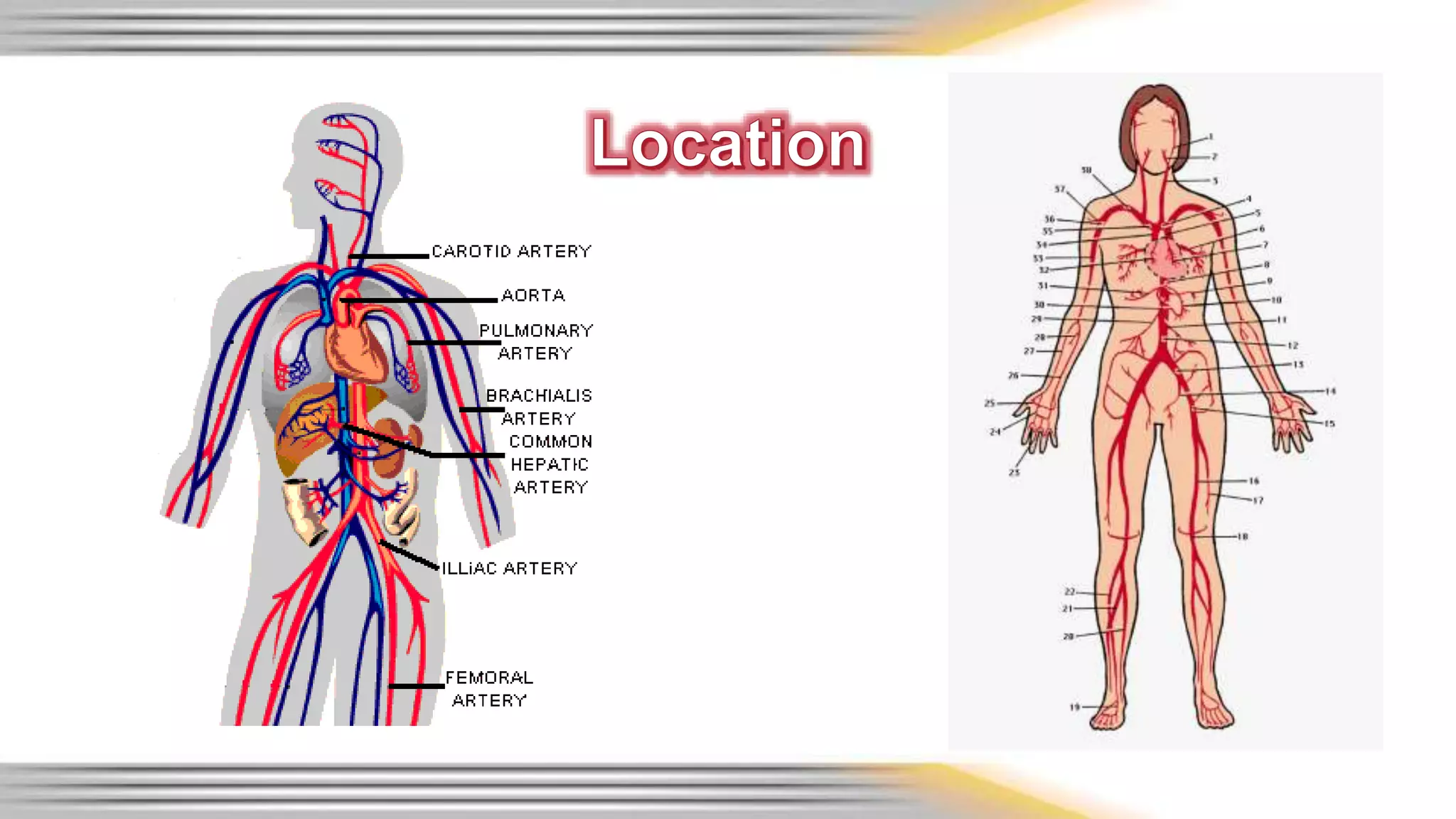
The Cardiovascular 
System 
By: Megh Shah, Kush Patel, Peter 
Attia, and Akshita Sanjay
• The meaning of the cardiovascular system 
• cardio- Greek word for Heart 
• vascular- Greek word for vessel 
• Responsible for pumping blood throughout the body 
–10 pints of blood a day travels throughout the 
blood 
• The HARDEST working system in the human body.
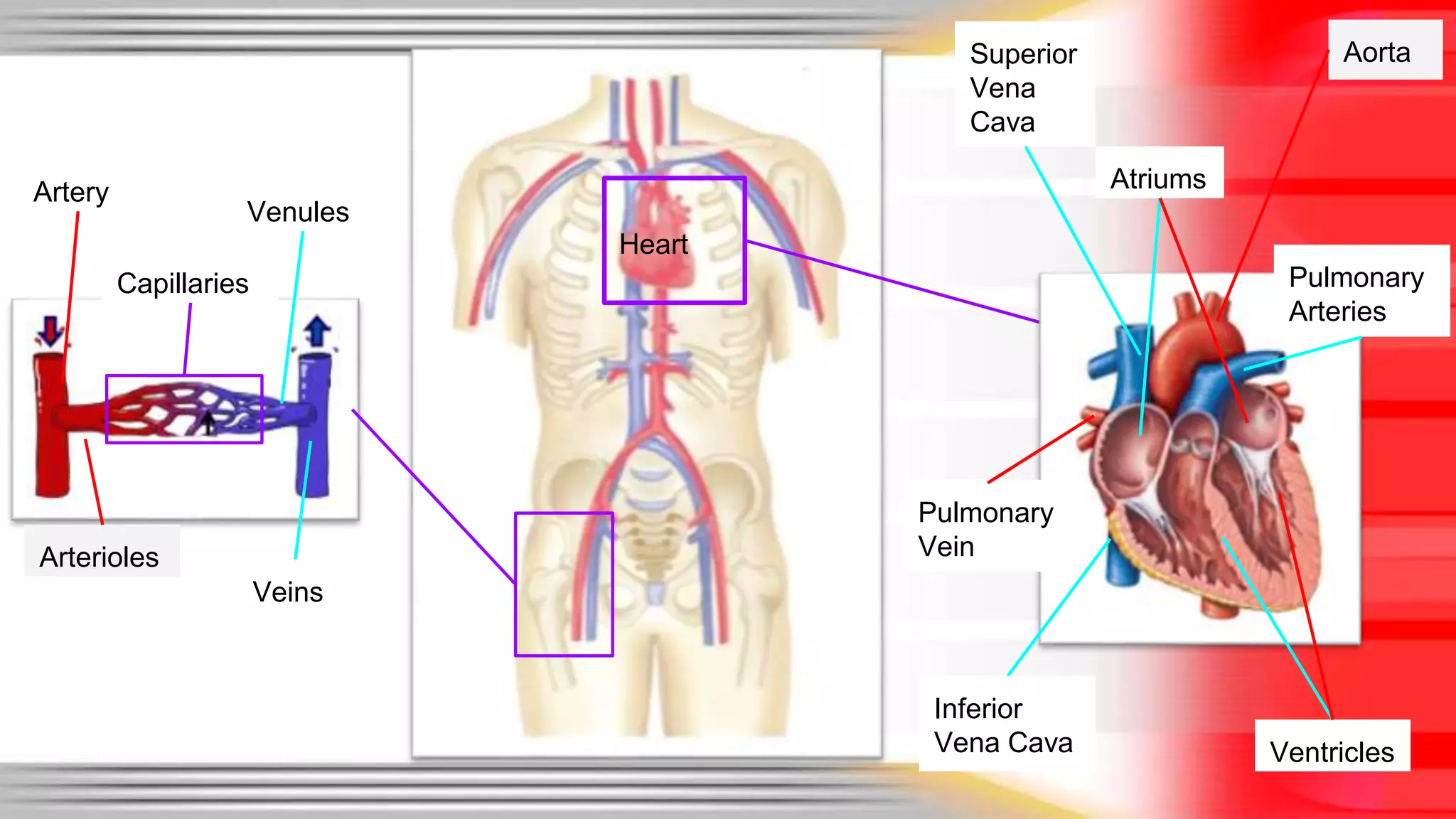
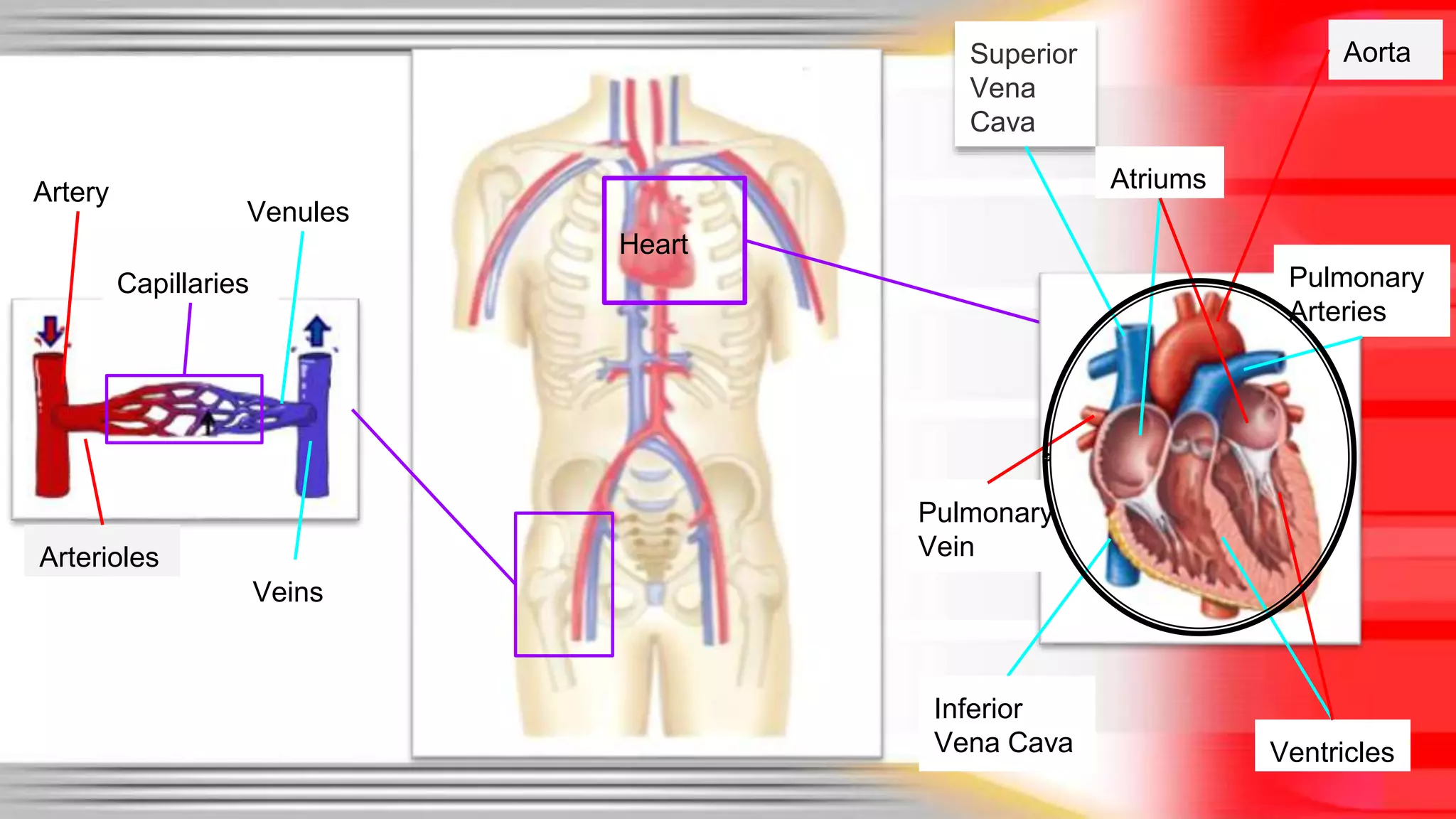
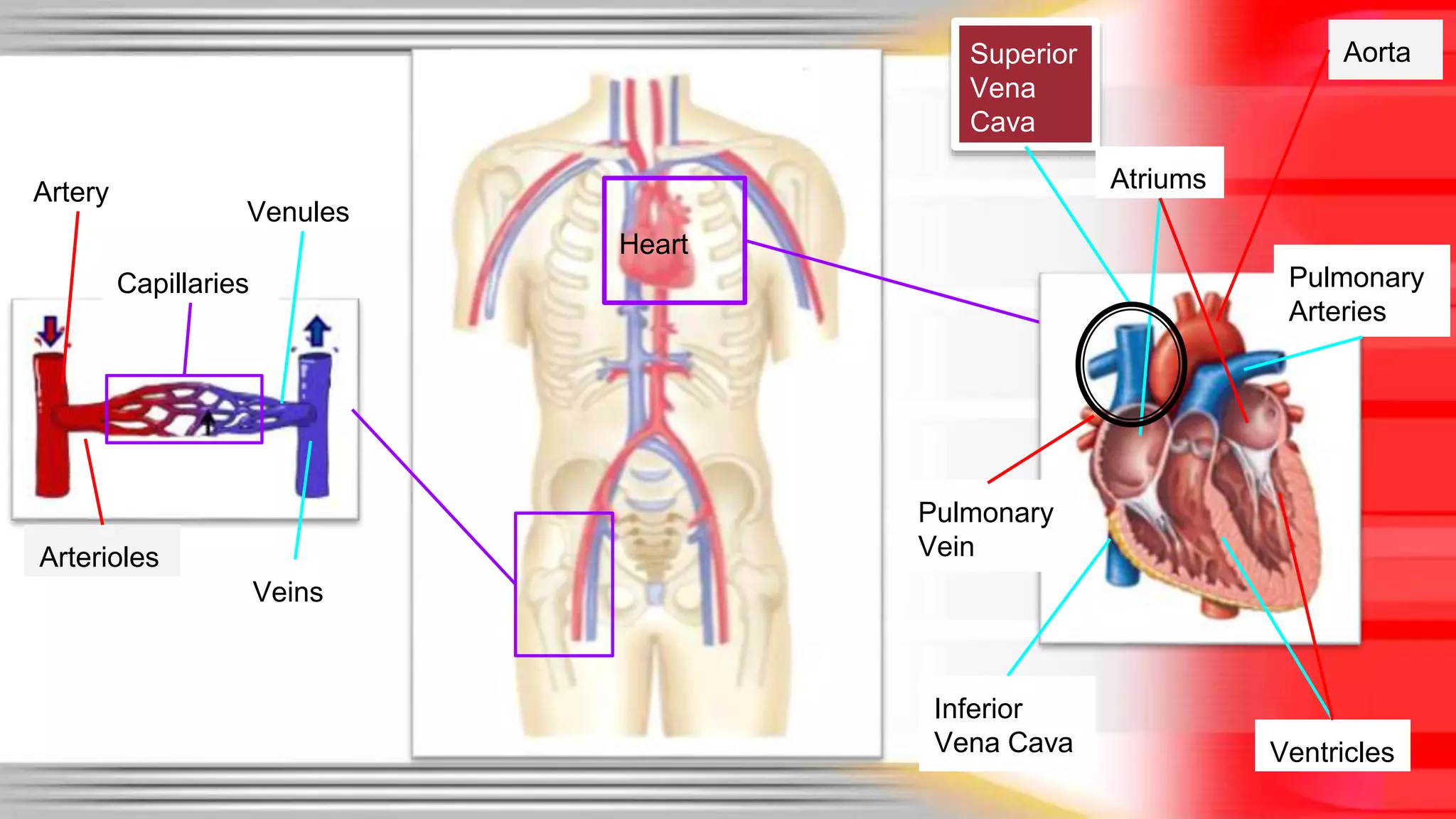
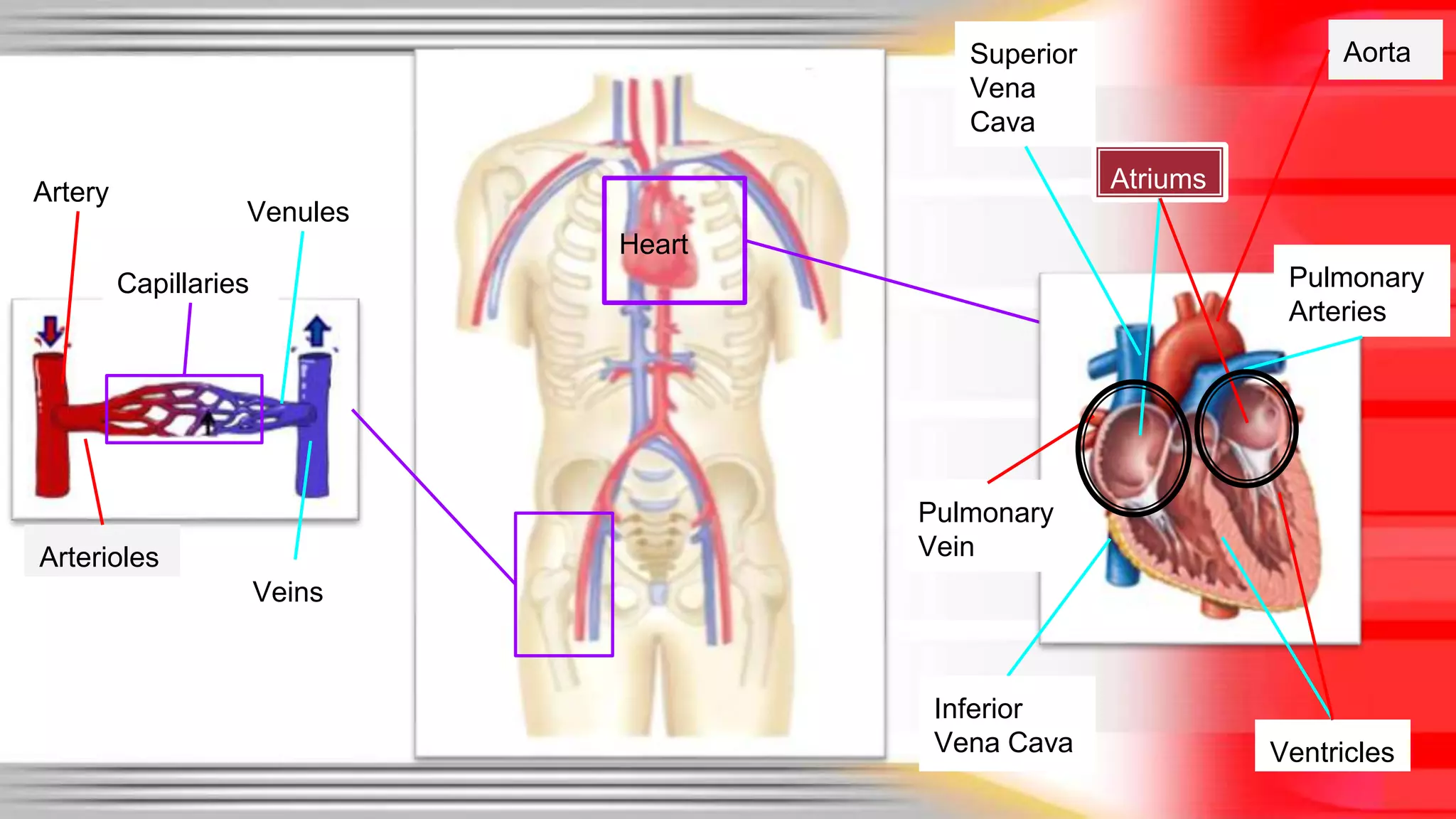
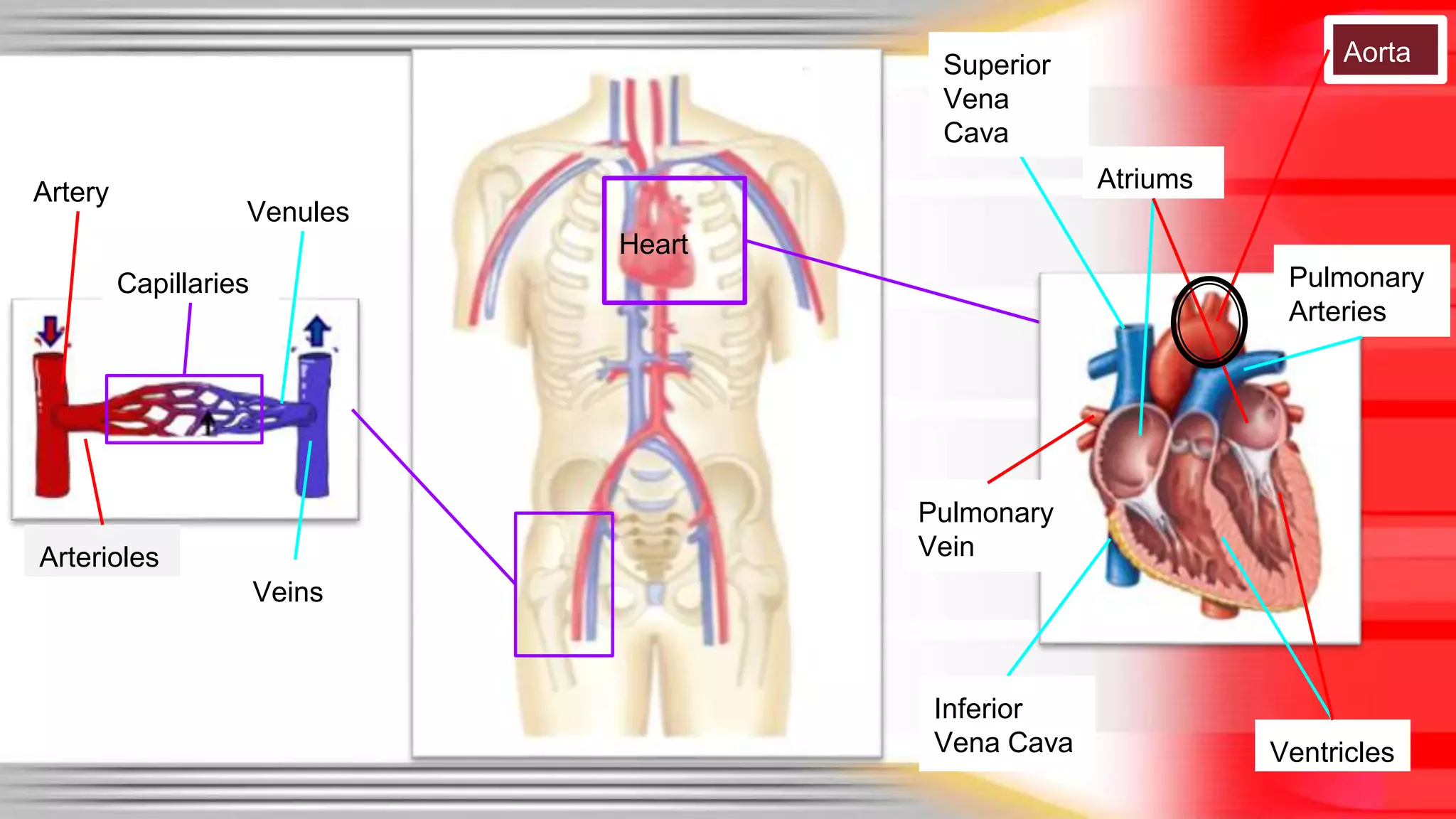
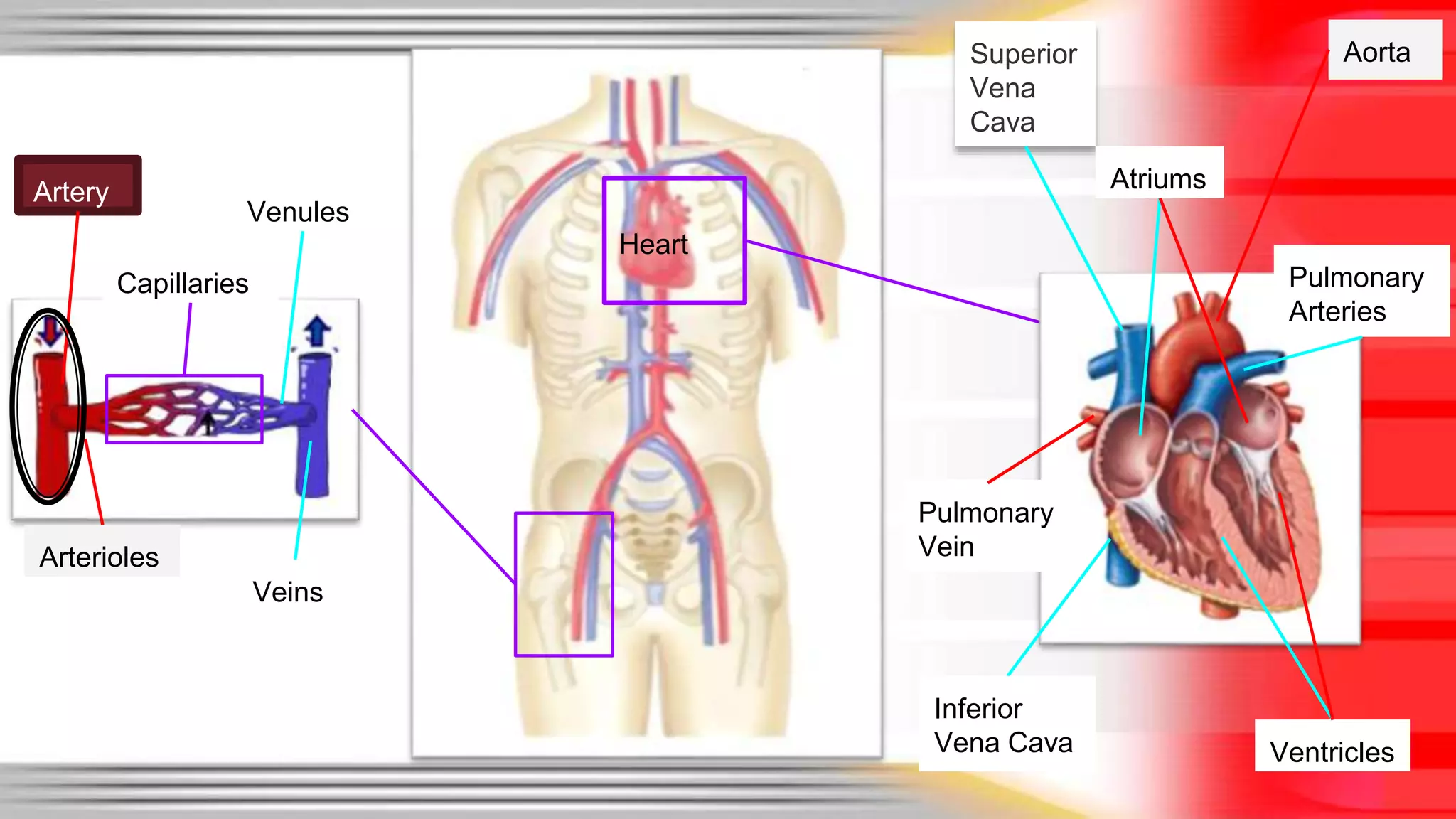
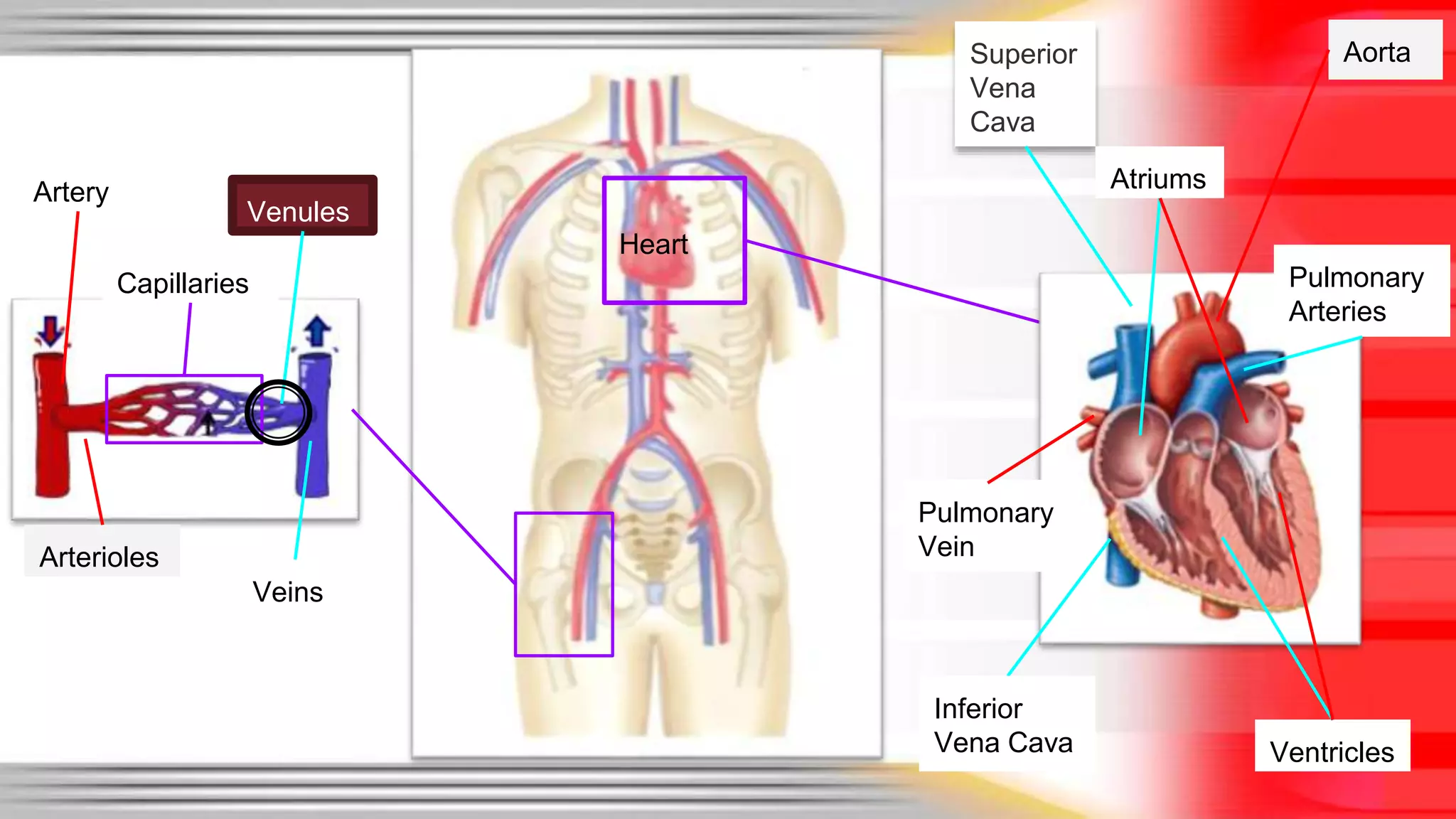
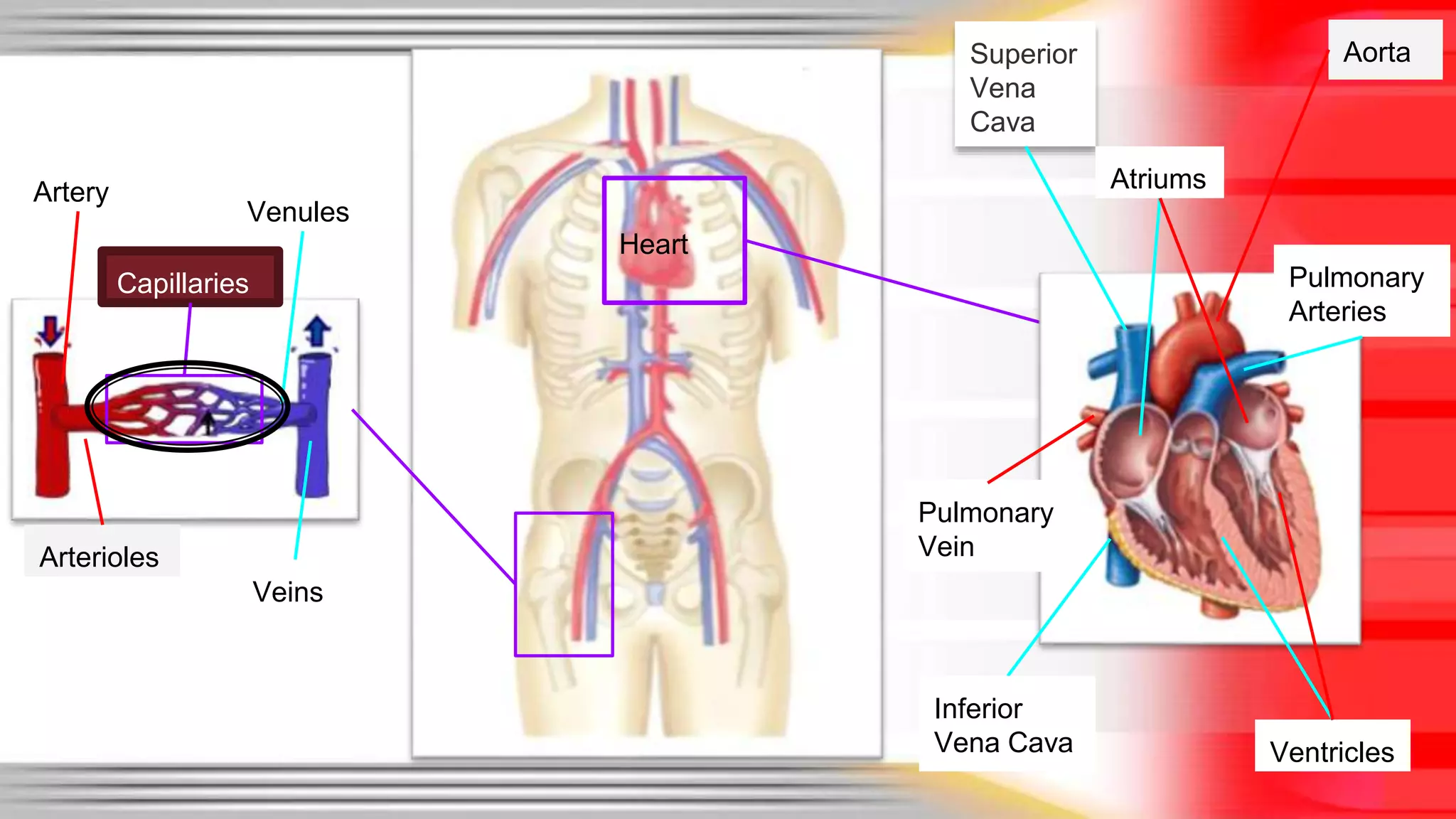
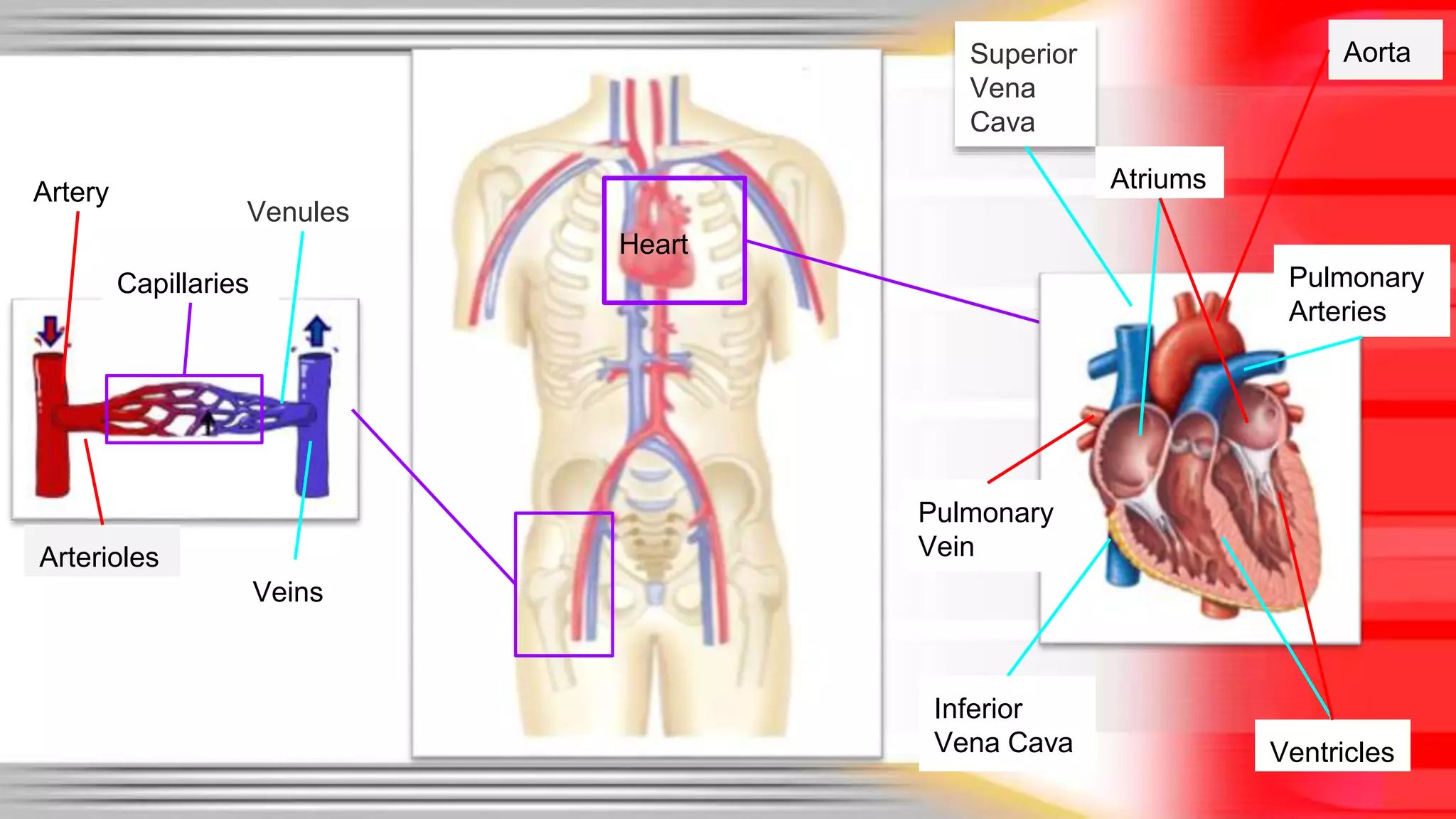
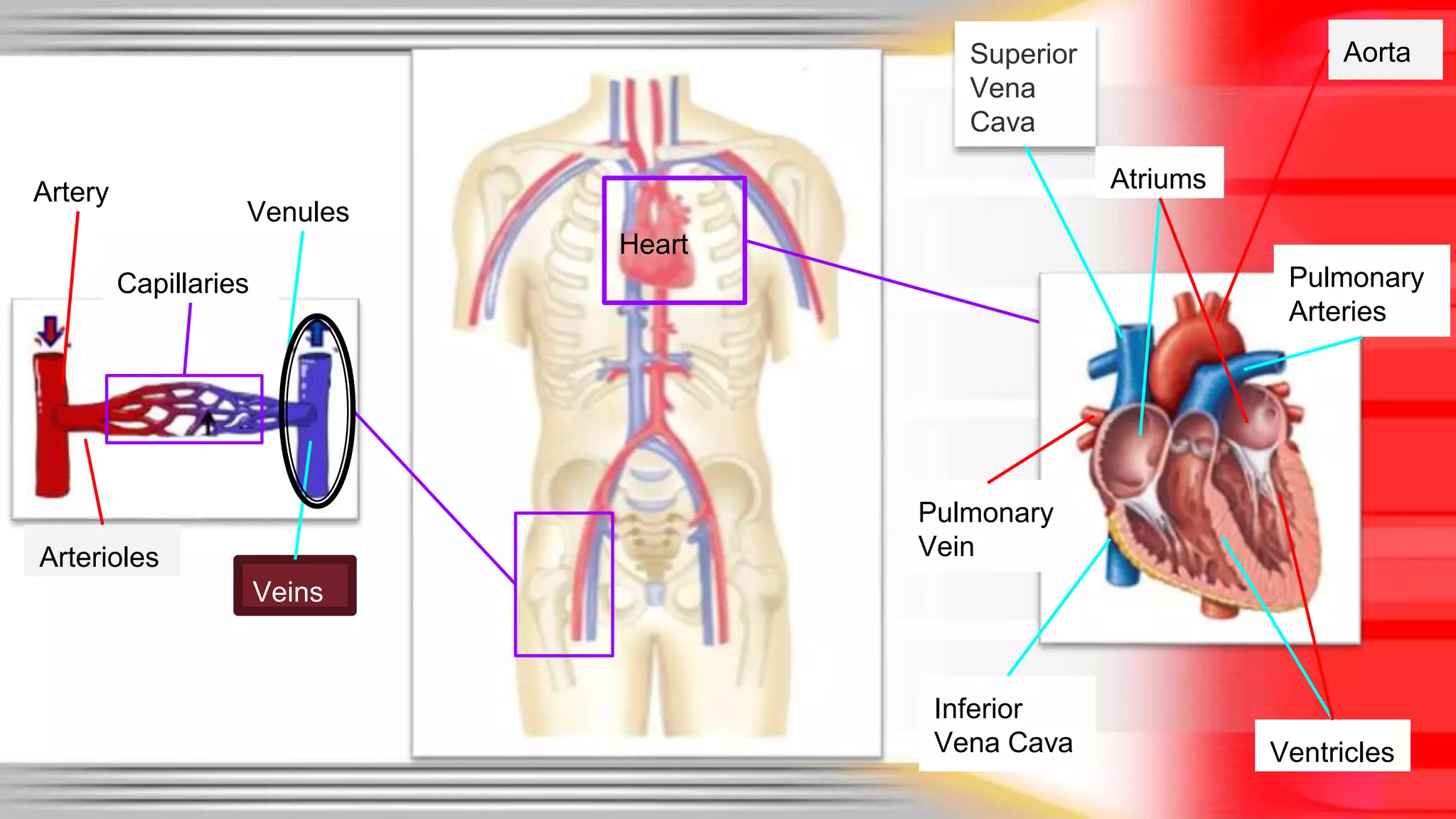
Heart 
Veins 
Arterioles 
Aorta 
Venules 
Superior 
Vena 
Cava 
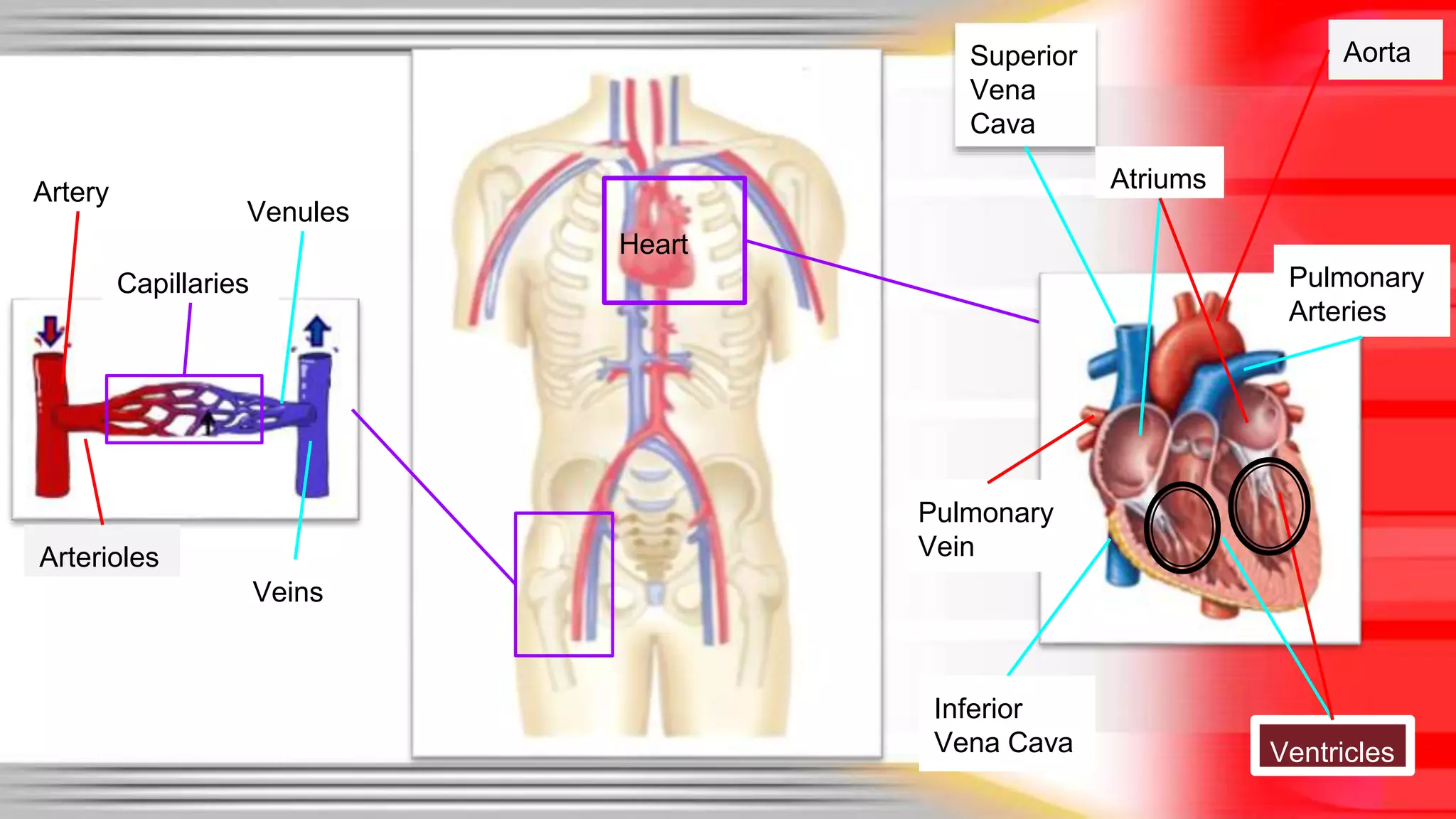
Ventricles 
Pulmonary 
Vein 
Atriums 
Pulmonary 
Arteries 
Artery 
Capillaries 
Inferior 
Vena Cava
Heart 
Veins 
Arterioles 
Aorta 
Venules 
Superior 
Vena 
Cava 
Ventricles 
Pulmonary 
Vein 
Atriums 
Pulmonary 
Arteries 
Artery 
Capillaries 
Inferior 
Vena Cava
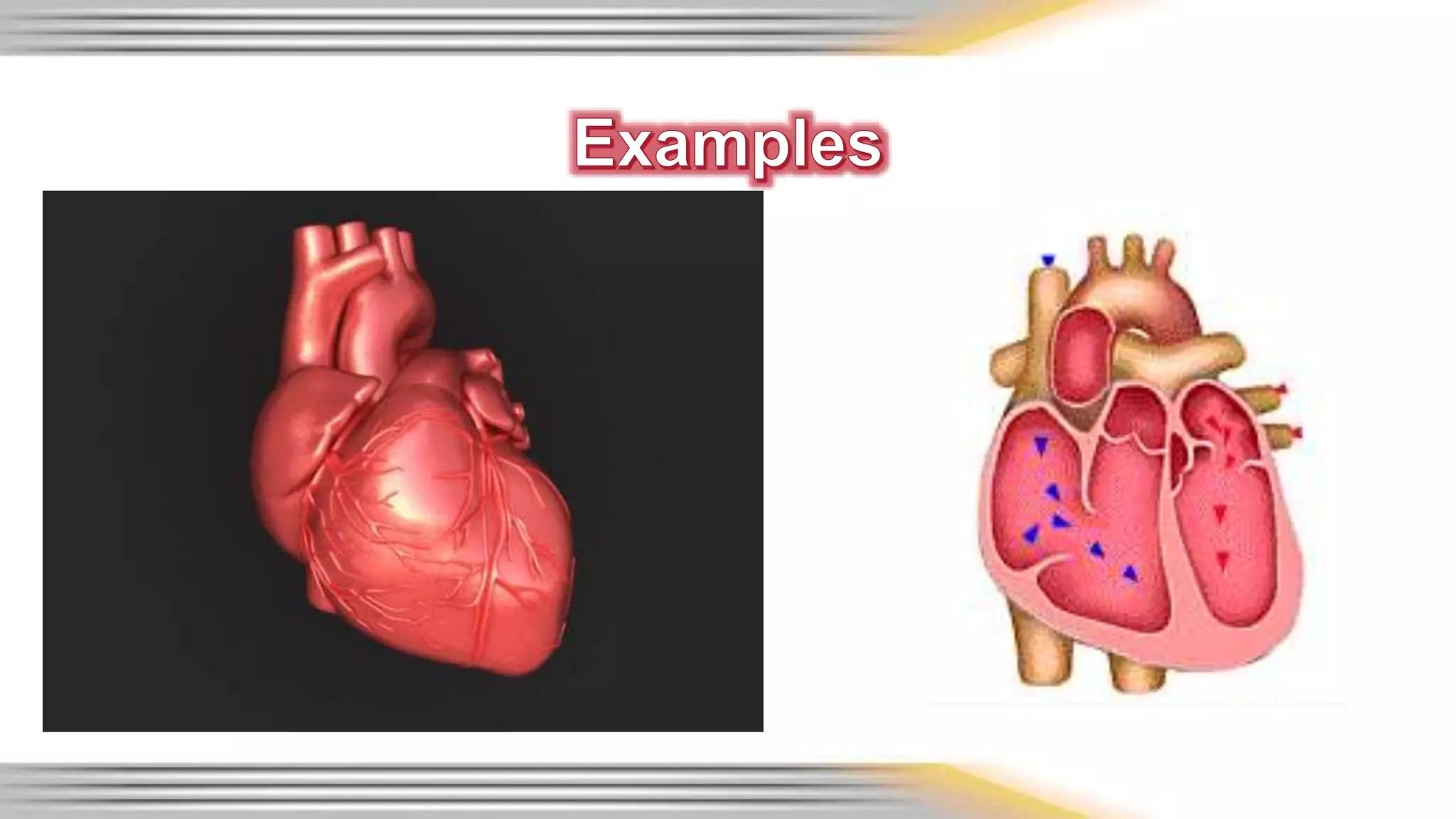
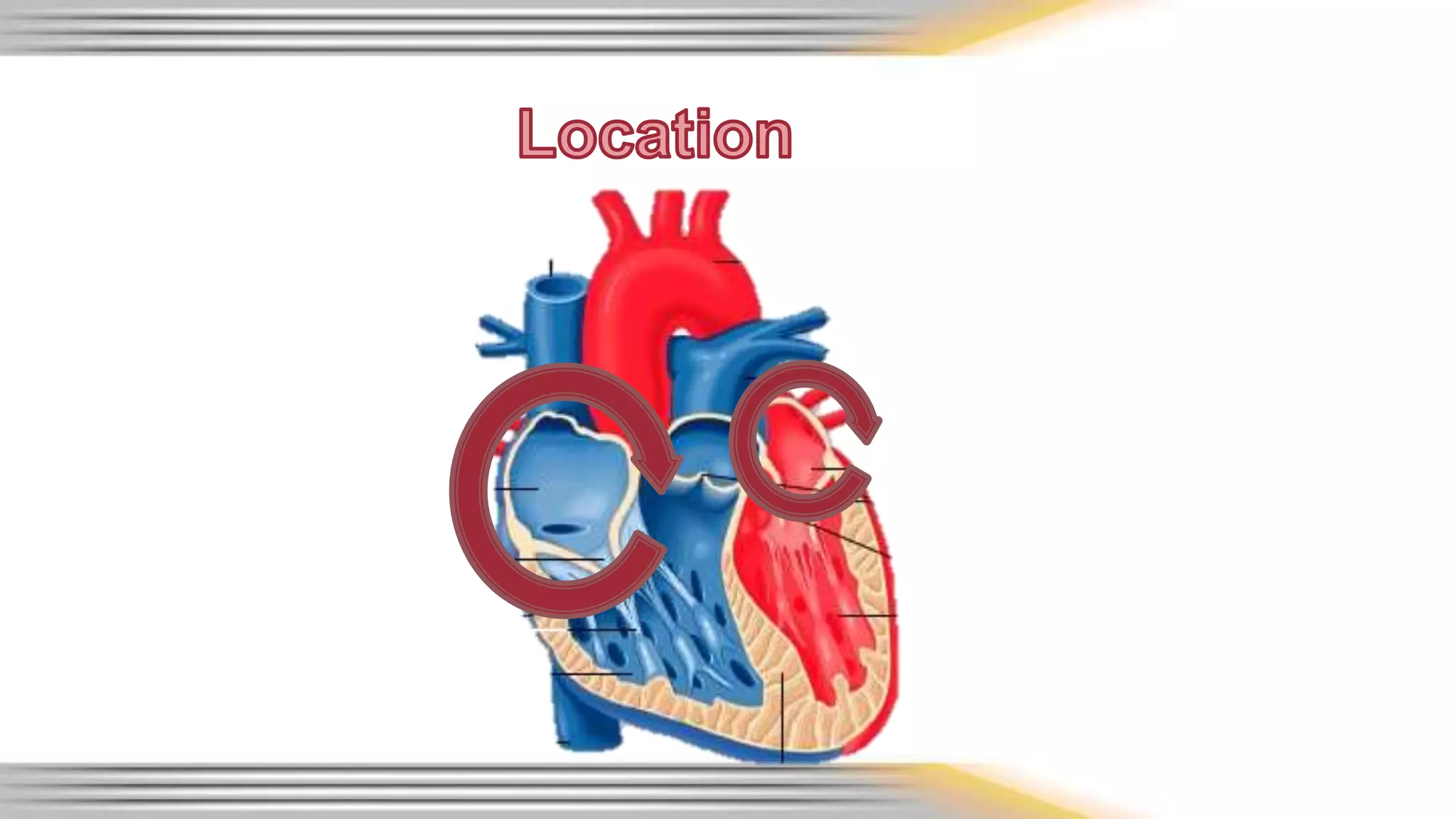
• It is made up of four muscular chambers which are 
the atria and the ventricles and is responsible for the 
movement of blood to and from the body. 
• The heart is muscular and is made up of three layers 
of muscle. Epicardium, endocardium, and 
myocardium. 
• It contains many blood vessels that it passes blood 
through to and from the body.
Heart 
Veins 
Arterioles 
Aorta 
Venules 
Superior 
Vena 
Cava 
Ventricles 
Pulmonary 
Vein 
Atriums 
Pulmonary 
Arteries 
Artery 
Capillaries 
Inferior 
Vena Cava
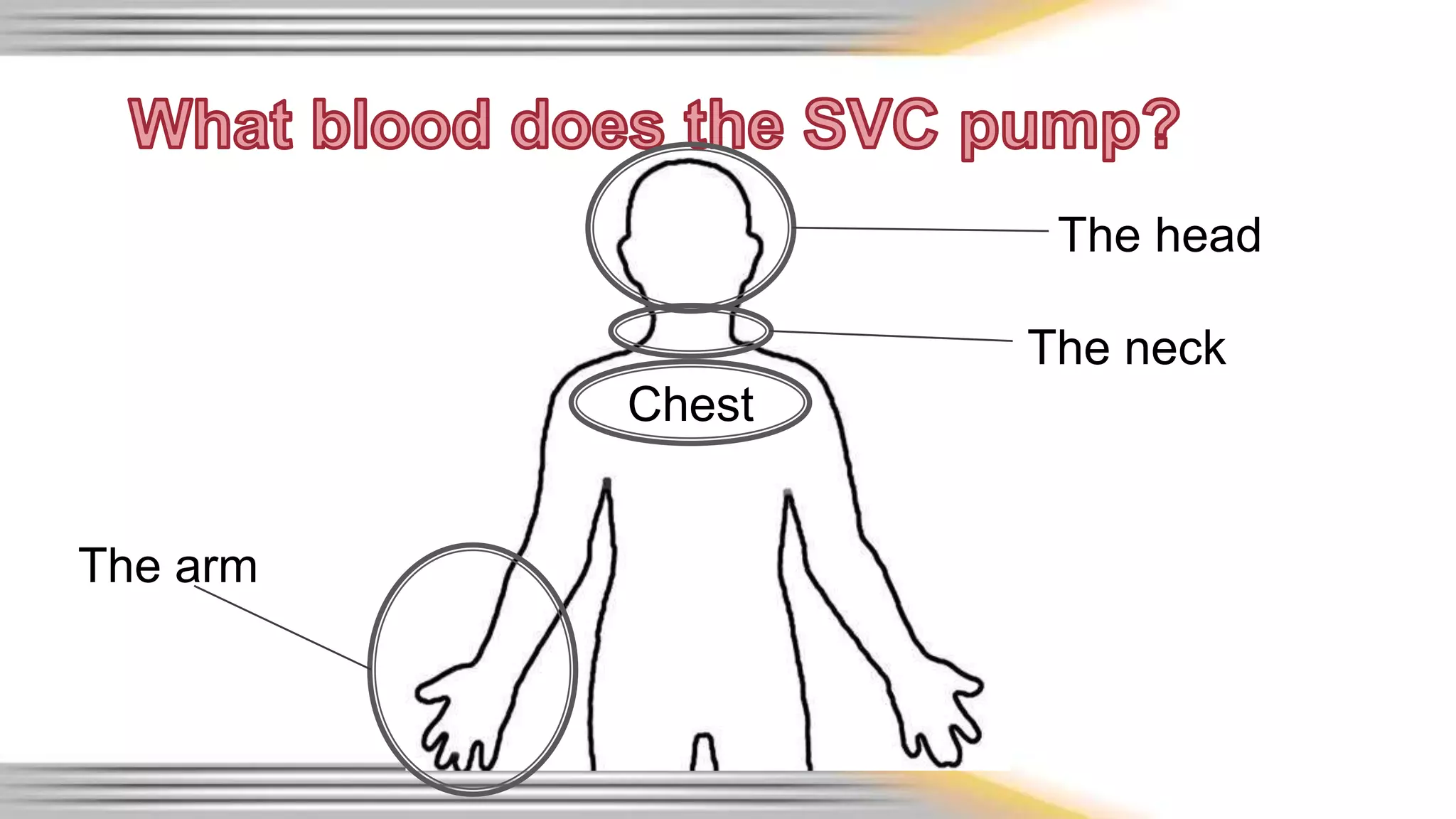
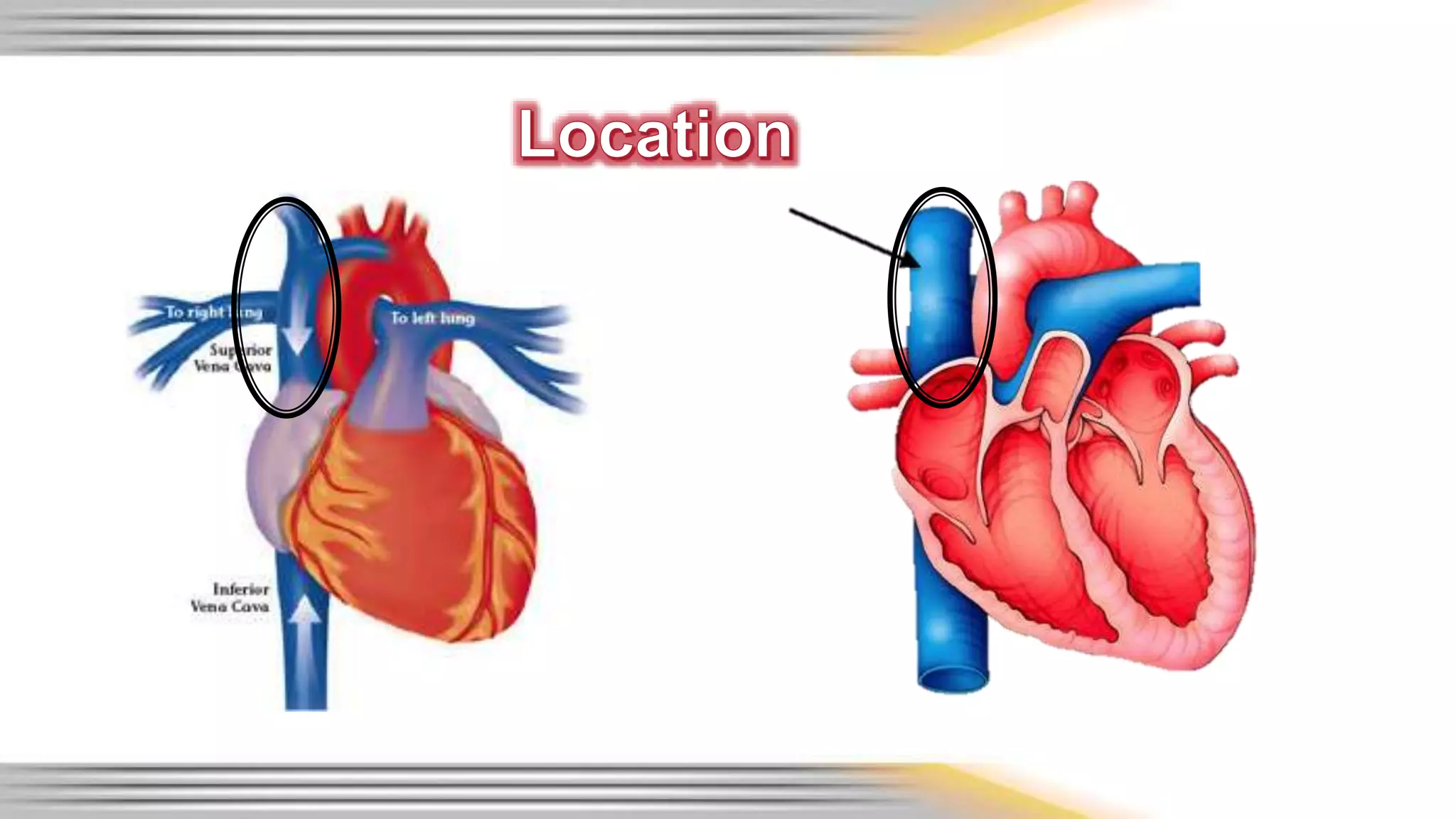
• One of the largest veins in the body 
–Carries deoxygenated blood from circulatory 
circulation into the right atrium 
–Specifically carries blood from the upper region 
of the body 
• Examples include 
– head, neck, arm and chest regions
The head 
Chest 
The arm 
The neck
Heart 
Veins 
Arterioles 
Aorta 
Venules 
Superior 
Vena 
Cava 
Ventricles 
Pulmonary 
Vein 
Atriums 
Pulmonary 
Arteries 
Artery 
Capillaries 
Inferior 
Vena Cava
• A hollow chamber in which blood flows through 
–Composed of 2 out of 4 chambers in the heart 
–Located at the top of the heart near the aorta. 
• Function 
–Receives blood from veins (pulmonary vein, 
superior/inferior venae cavae) 
–Pumps blood to ventricles
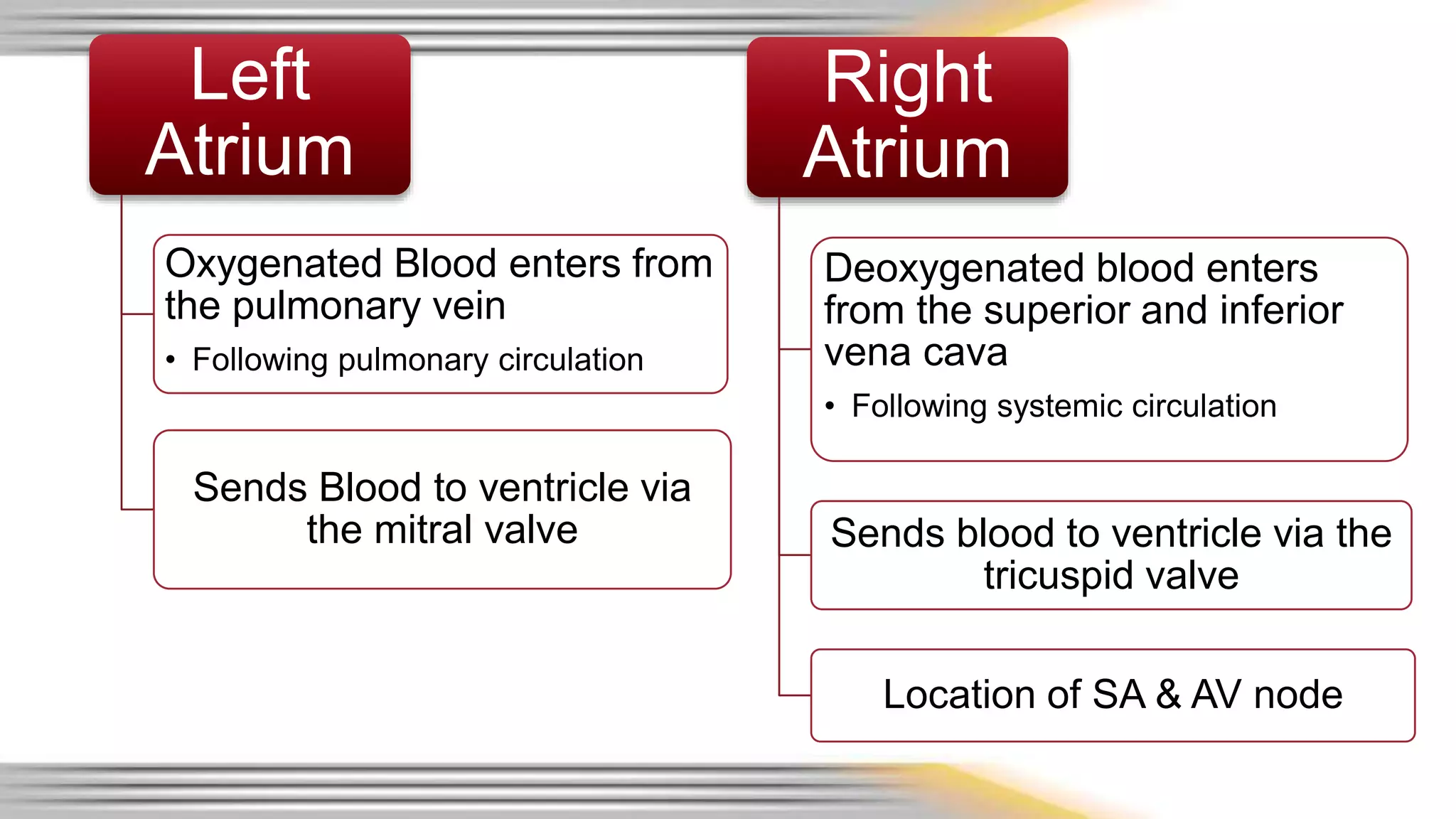
Left 
Atrium 
Oxygenated Blood enters from 
the pulmonary vein 
• Following pulmonary circulation 
Sends Blood to ventricle via 
the mitral valve 
Right 
Atrium 
Deoxygenated blood enters 
from the superior and inferior 
vena cava 
• Following systemic circulation 
Sends blood to ventricle via the 
tricuspid valve 
Location of SA & AV node
Heart 
Veins 
Arterioles 
Aorta 
Venules 
Superior 
Vena 
Cava 
Ventricles 
Pulmonary 
Vein 
Atriums 
Pulmonary 
Arteries 
Artery 
Capillaries 
Inferior 
Vena Cava
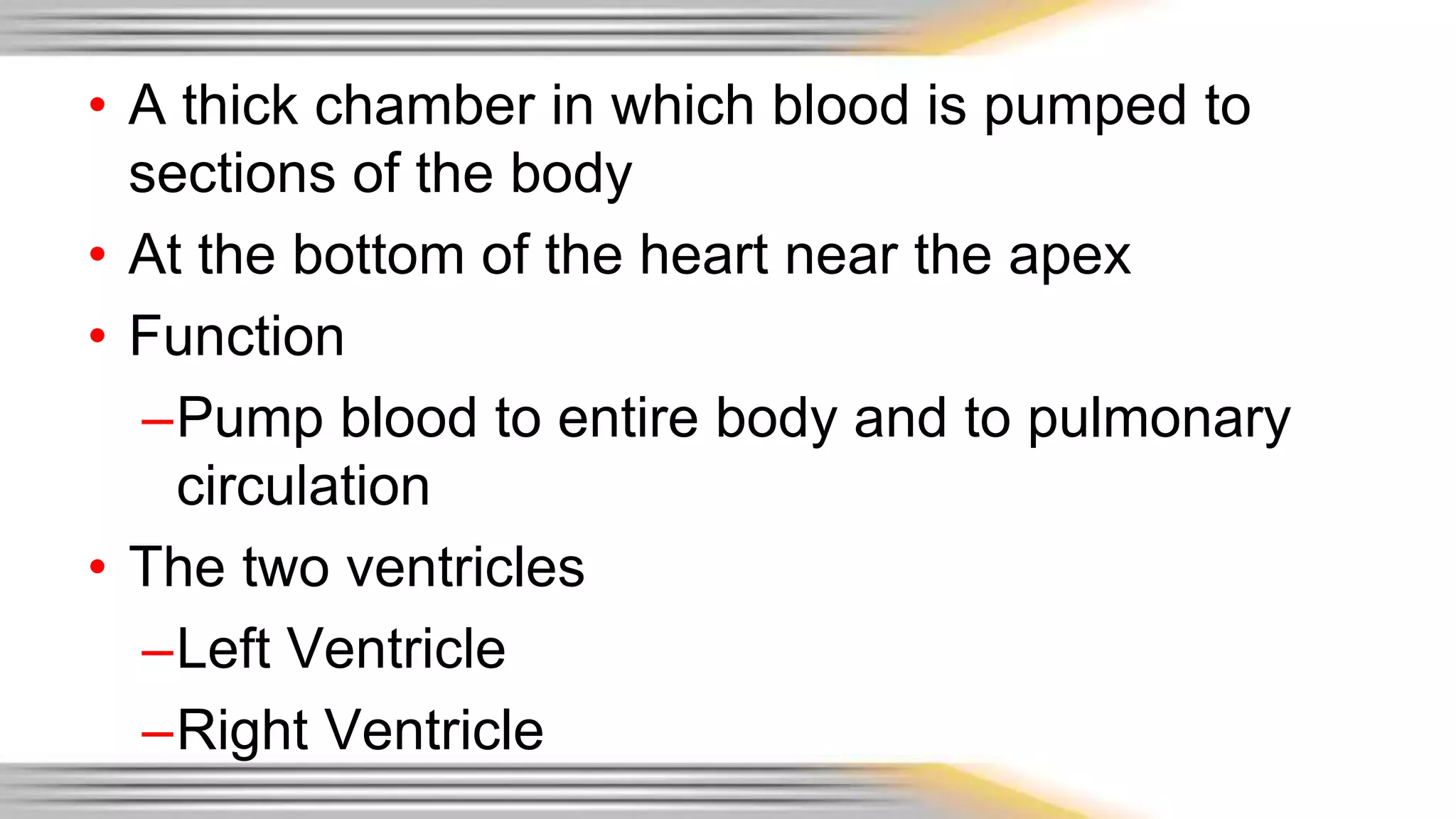
• A thick chamber in which blood is pumped to 
sections of the body 
• At the bottom of the heart near the apex 
• Function 
–Pump blood to entire body and to pulmonary 
circulation 
• The two ventricles 
–Left Ventricle 
–Right Ventricle
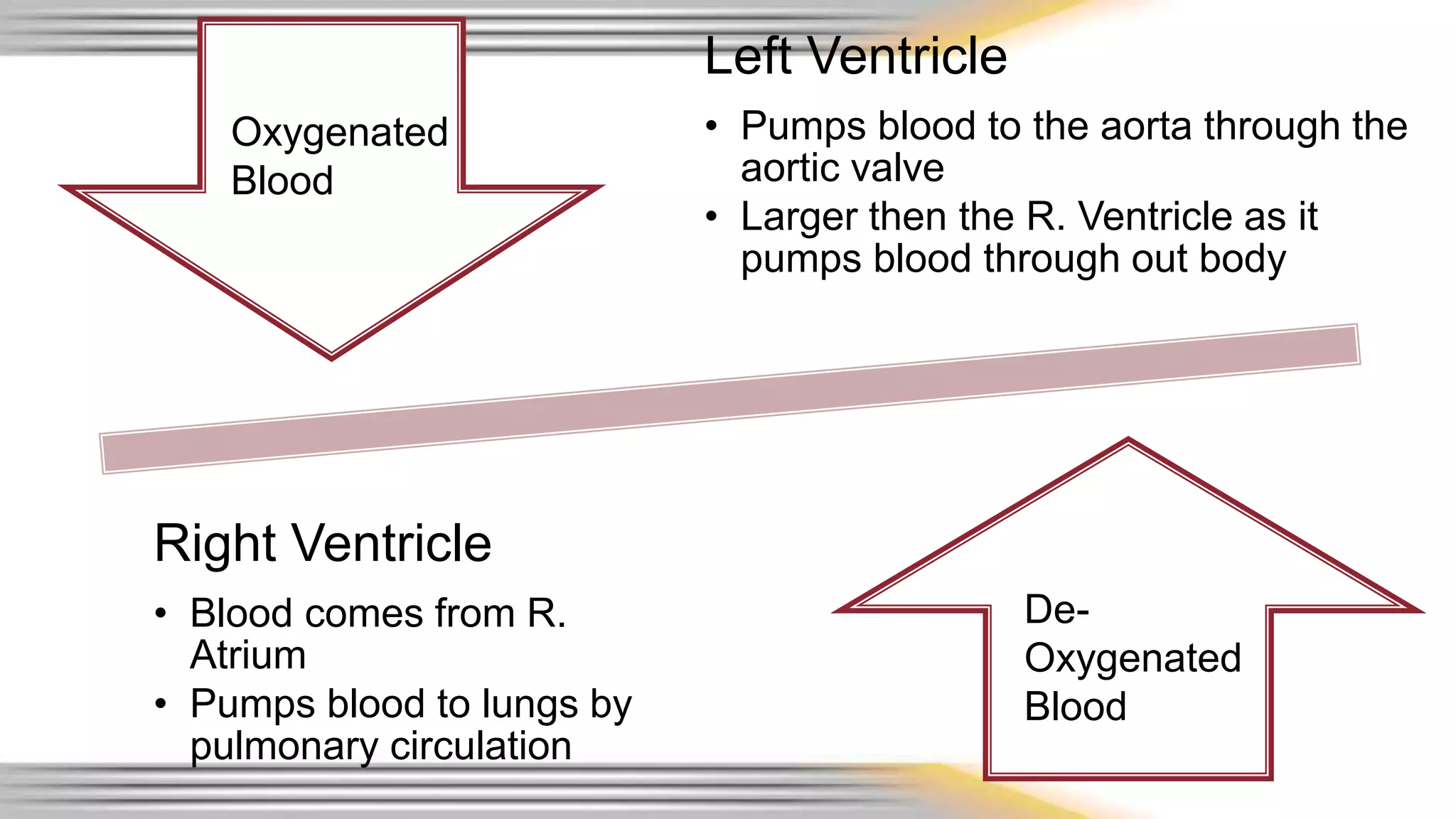
Left Ventricle 
• Pumps blood to the aorta through the 
aortic valve 
• Larger then the R. Ventricle as it 
pumps blood through out body 
Oxygenated 
Blood 
Right Ventricle 
• Blood comes from R. 
Atrium 
• Pumps blood to lungs by 
pulmonary circulation 
De- 
Oxygenated 
Blood
Heart 
Veins 
Arterioles 
Aorta 
Venules 
Ventricles 
Superior 
Vena 
Cava 
Pulmonary 
Vein 
Atriums 
Pulmonary 
Arteries 
Artery 
Capillaries 
Inferior 
Vena Cava
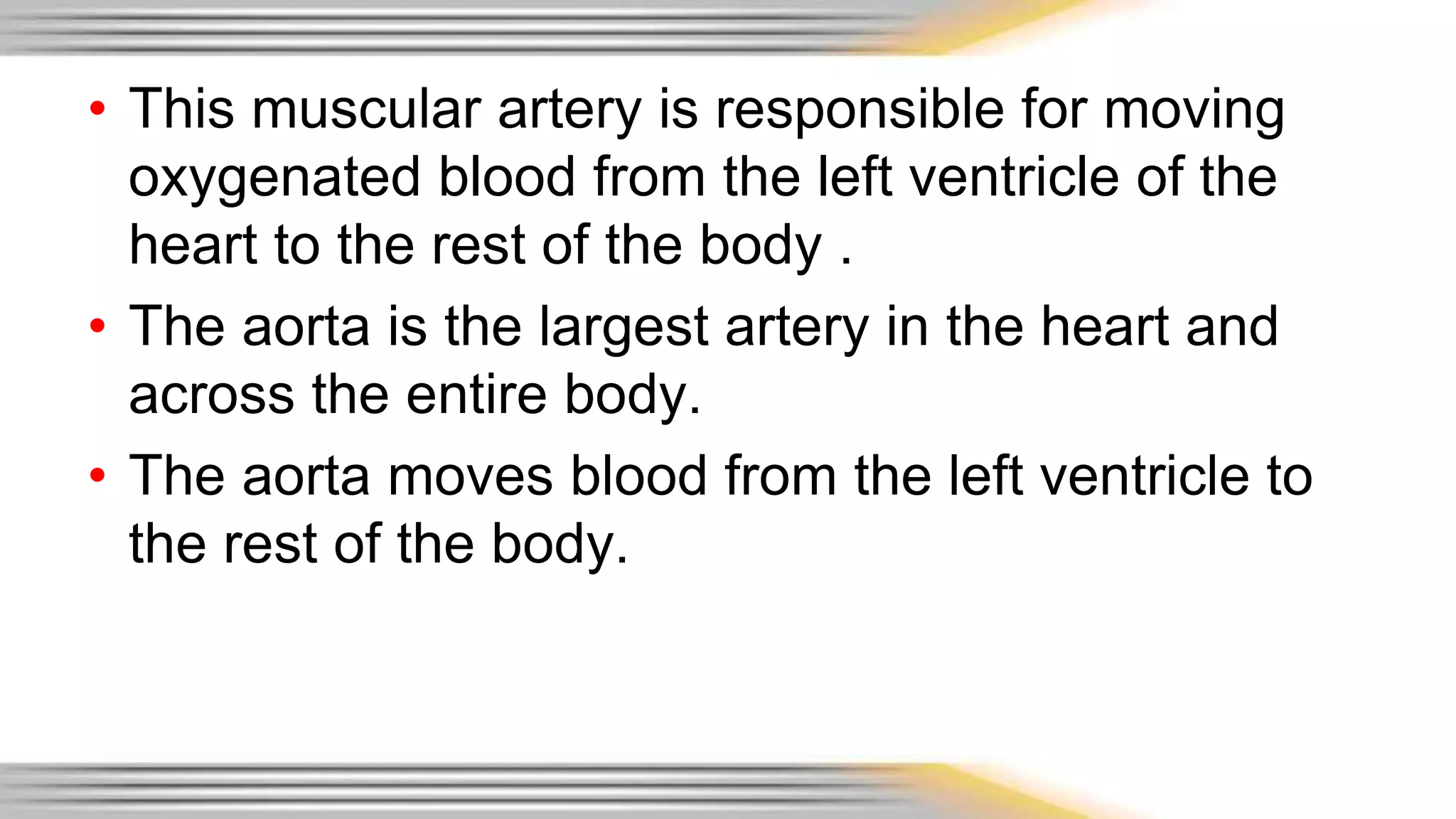
• This muscular artery is responsible for moving 
oxygenated blood from the left ventricle of the 
heart to the rest of the body . 
• The aorta is the largest artery in the heart and 
across the entire body. 
• The aorta moves blood from the left ventricle to 
the rest of the body.
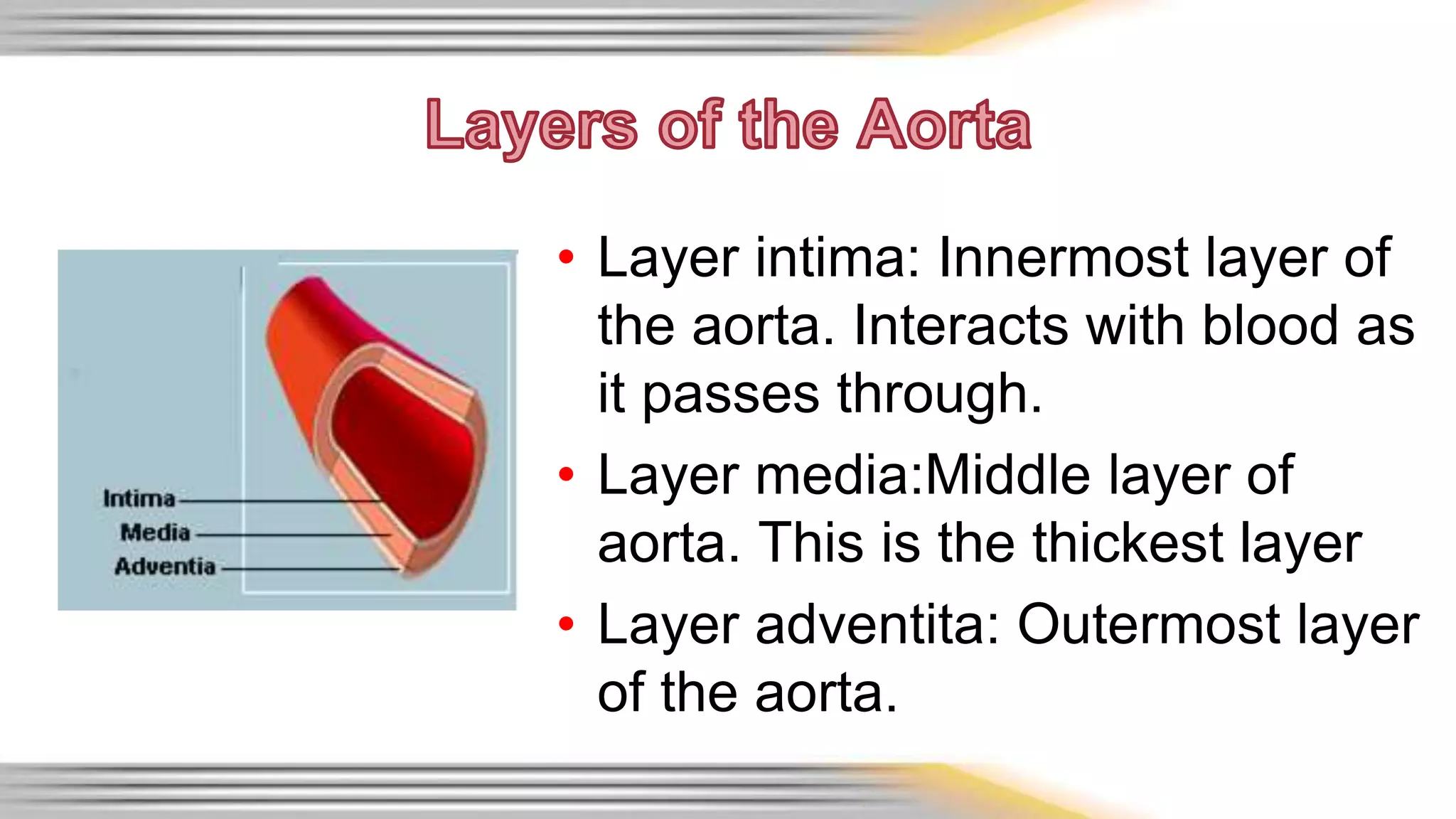
• Layer intima: Innermost layer of 
the aorta. Interacts with blood as 
it passes through. 
• Layer media:Middle layer of 
aorta. This is the thickest layer 
• Layer adventita: Outermost layer 
of the aorta.
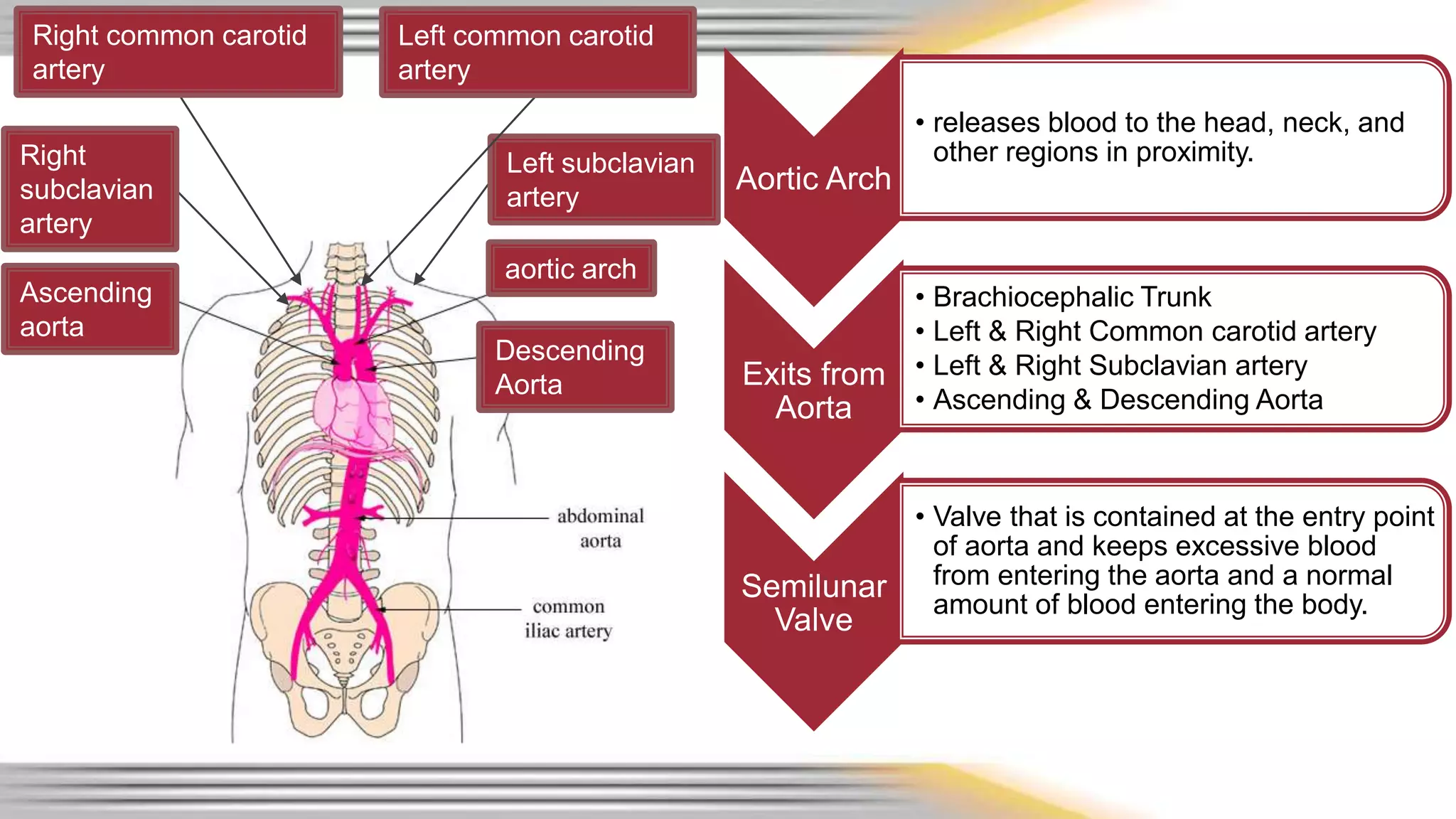
Aortic Arch 
• releases blood to the head, neck, and 
other regions in proximity. 
Exits from 
Aorta 
• Brachiocephalic Trunk 
• Left & Right Common carotid artery 
• Left & Right Subclavian artery 
• Ascending & Descending Aorta 
Semilunar 
Valve 
• Valve that is contained at the entry point 
of aorta and keeps excessive blood 
from entering the aorta and a normal 
amount of blood entering the body. 
aortic arch 
Descending 
Aorta 
Right common carotid 
artery 
Ascending 
aorta 
Left subclavian 
artery 
Right 
subclavian 
artery 
Left common carotid 
artery
Heart 
Veins 
Arterioles 
Aorta 
Venules 
Superior 
Vena 
Cava 
Ventricles 
Pulmonary 
Vein 
Atriums 
Pulmonary 
Arteries 
Artery 
Capillaries 
Inferior 
Vena Cava
• Arteries are blood vessels that bring blood from 
the heart to the rest of the body. 
• Arteries have a very strong outer layer and are 
soft on the inside 
• Arteries move blood from the heart to arterioles 
to capillaries and then to organs in the body. 
• Examples: Pulmonary artery and aorta
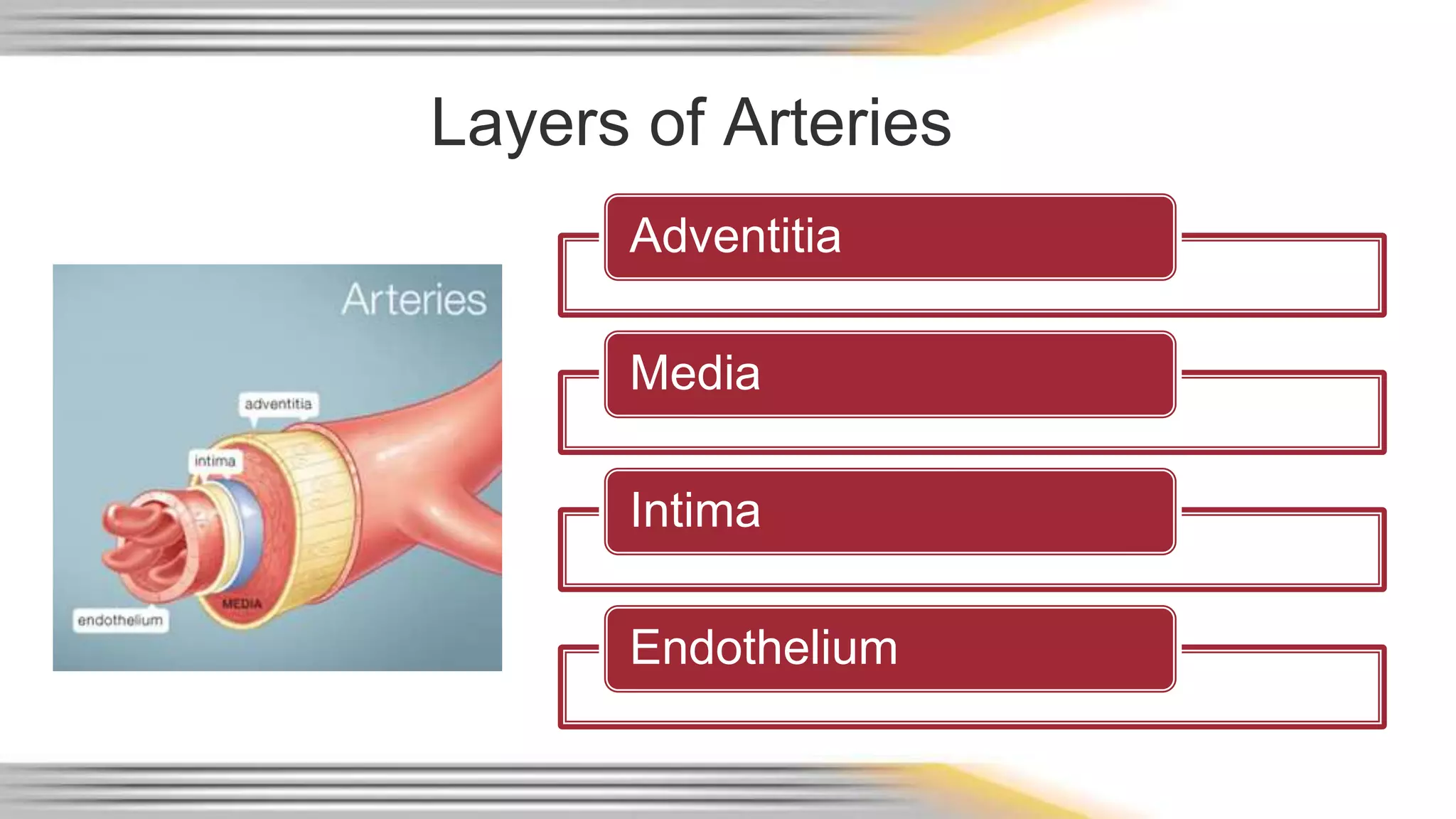
Layers of Arteries 
Adventitia 
Media 
Intima 
Endothelium
Heart 
Veins 
Arterioles 
Aorta 
Venules 
Superior 
Vena 
Cava 
Ventricles 
Pulmonary 
Vein 
Atriums 
Pulmonary 
Arteries 
Artery 
Capillaries 
Inferior 
Vena Cava
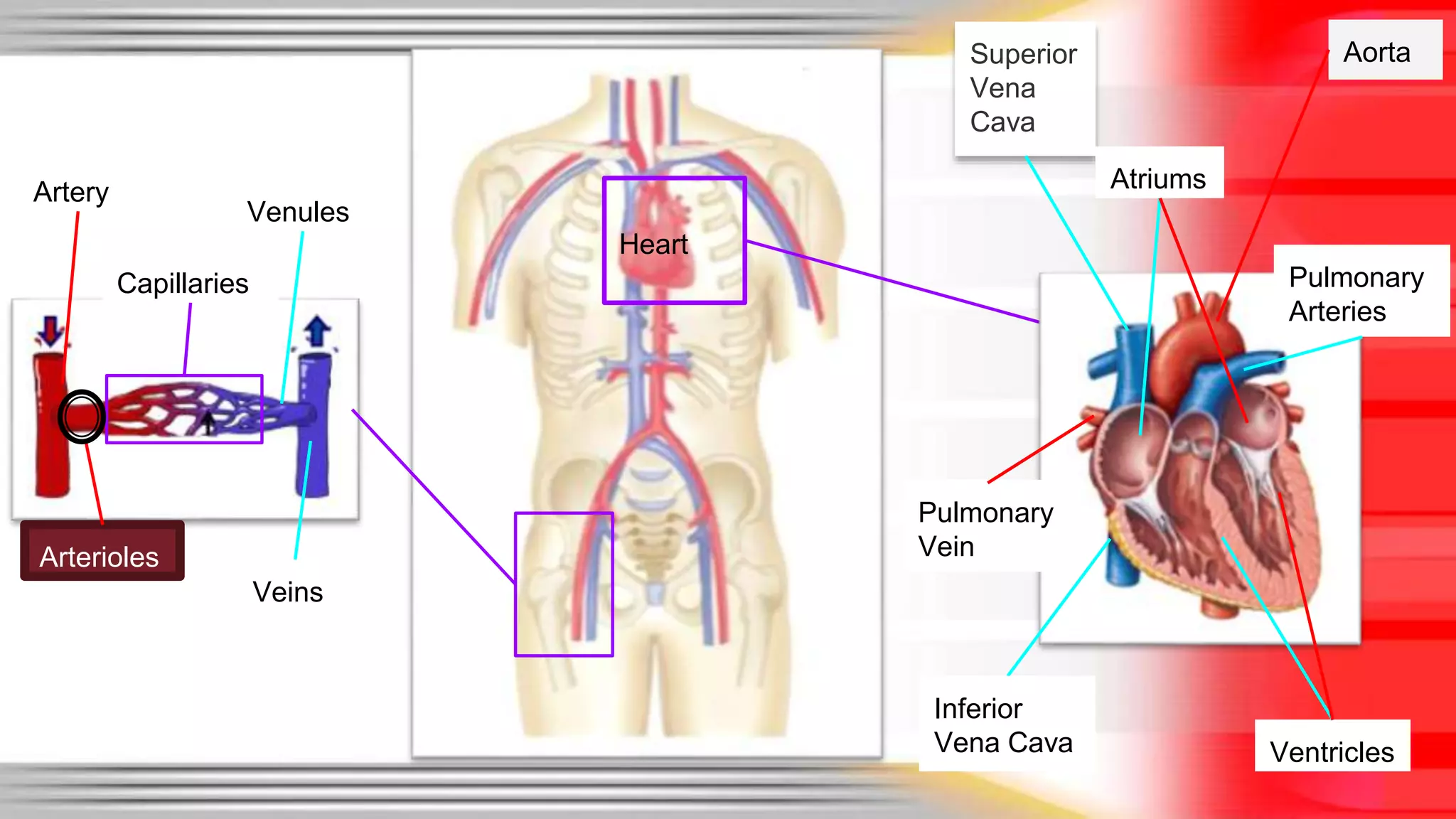
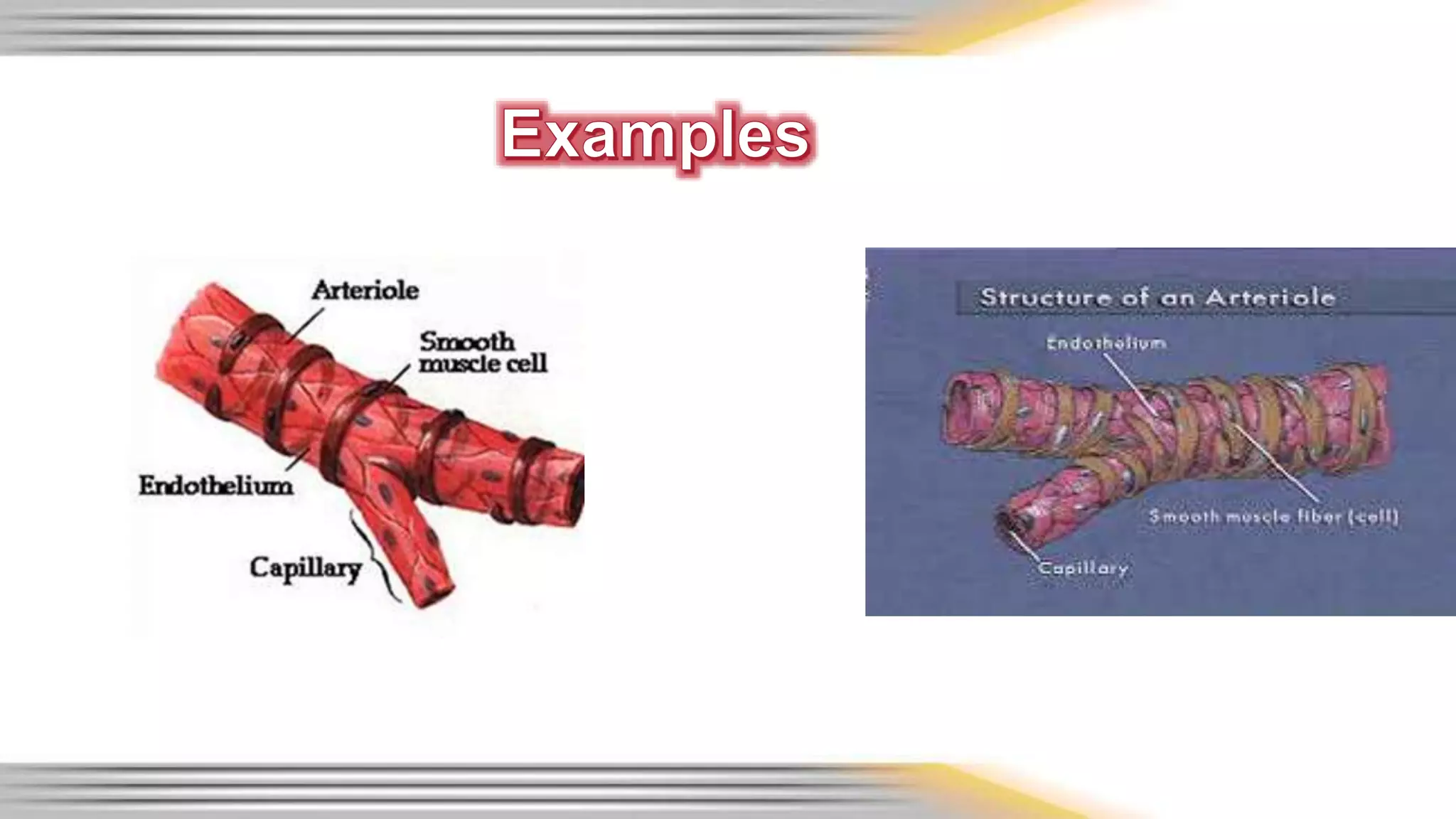
• They are small versions of arteries 
–Arterioles have similar functions to arteries but are 
smaller in size. 
–Arterioles are one layer thick and serve as a buffer 
between arteries and capillaries. 
–They are larger than capillaries which take blood to 
different parts of the body. 
–Provide blood pressure because of their small size 
and this controls the amount of blood flowing 
around the body.
Heart 
Veins 
Arterioles 
Aorta 
Venules 
Superior 
Vena 
Cava 
Ventricles 
Pulmonary 
Vein 
Atriums 
Pulmonary 
Arteries 
Artery 
Capillaries 
Inferior 
Vena Cava
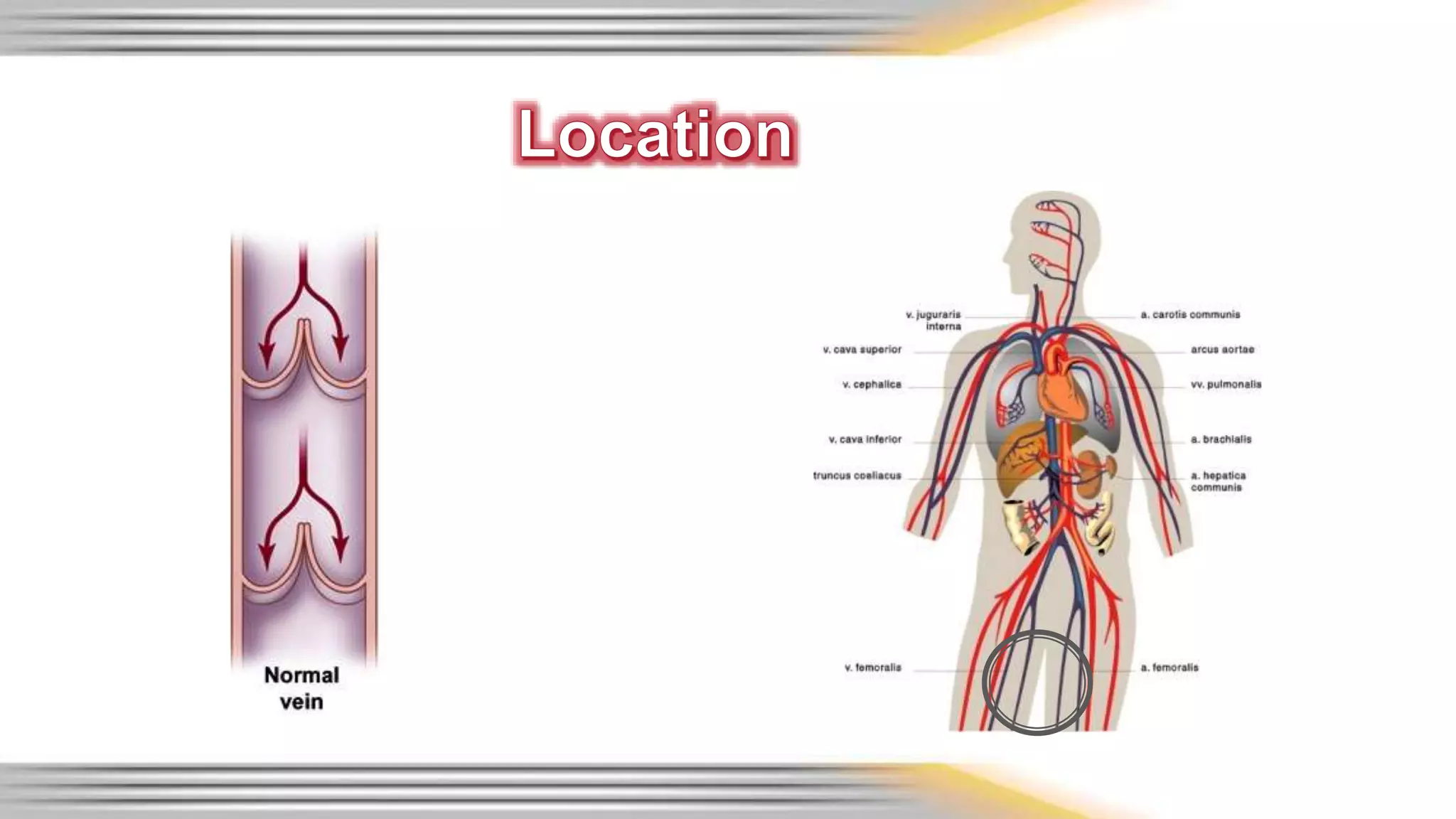
• Veins are blood vessels that move blood towards the 
heart. 
–They are not as strong as arteries. 
–They contain the same three layers as arteries but 
are not as strong 
–Veins contain valves that block blood flow 
backwards into the veins. 
–Veins can include the pulmonary veins , and bodily 
veins.
Heart 
Veins 
Arterioles 
Aorta 
Venules 
Superior 
Vena 
Cava 
Ventricles 
Pulmonary 
Vein 
Atriums 
Pulmonary 
Arteries 
Artery 
Capillaries 
Inferior 
Vena Cava
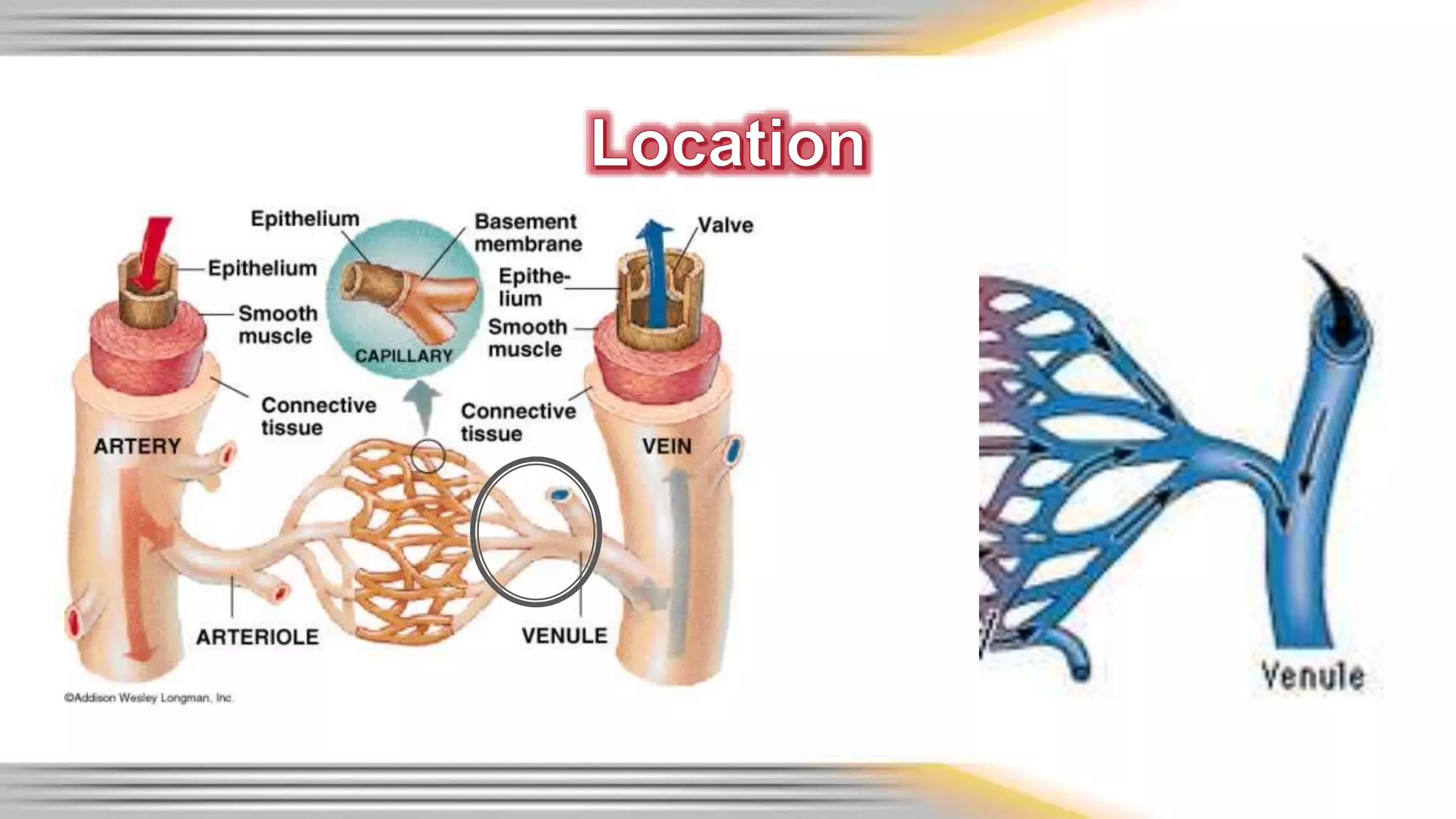
• Venules are small veins that emerge from 
capillaries and move blood into veins and to the 
heart. 
• They are an intermediate between capillaries and 
veins. 
• They are thin and small and are similar to 
arterioles.
Heart 
Veins 
Arterioles 
Aorta 
Venules 
Superior 
Vena 
Cava 
Ventricles 
Pulmonary 
Vein 
Atriums 
Pulmonary 
Arteries 
Artery 
Capillaries 
Inferior 
Vena Cava
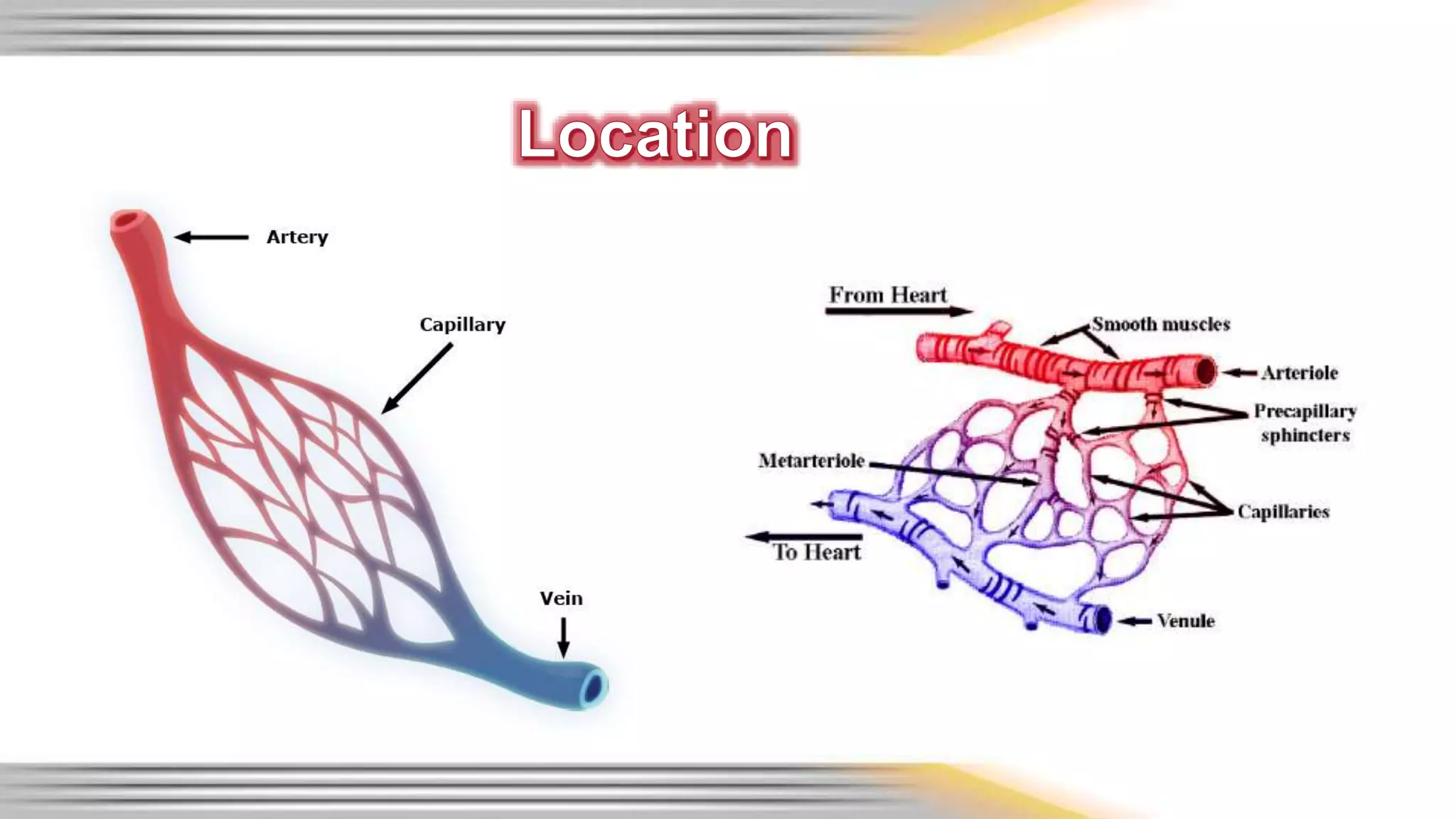
• Capillaries are the smallest blood vessels in the 
body. 
• They can move blood to and from the body 
organs and branch off of venules and arterioles. 
• Capillaries are extremely fragile. 
• Capillaries release heat and move deoxygenated 
blood to veins and take oxygenated blood from 
arteries.
Heart 
Veins 
Arterioles 
Aorta 
Venules 
Superior 
Vena 
Cava 
Ventricles 
Pulmonary 
Vein 
Atriums 
Pulmonary 
Arteries 
Artery 
Capillaries 
Inferior 
Vena Cava
• Function of blood is that it carries oxygen to the 
entire body and then returns to the heart to be re-oxygenated. 
• Blood is composed of four parts and is essential to 
normal function of the body as it provides the 
oxygen and nutrients necessary for the body to 
operate.
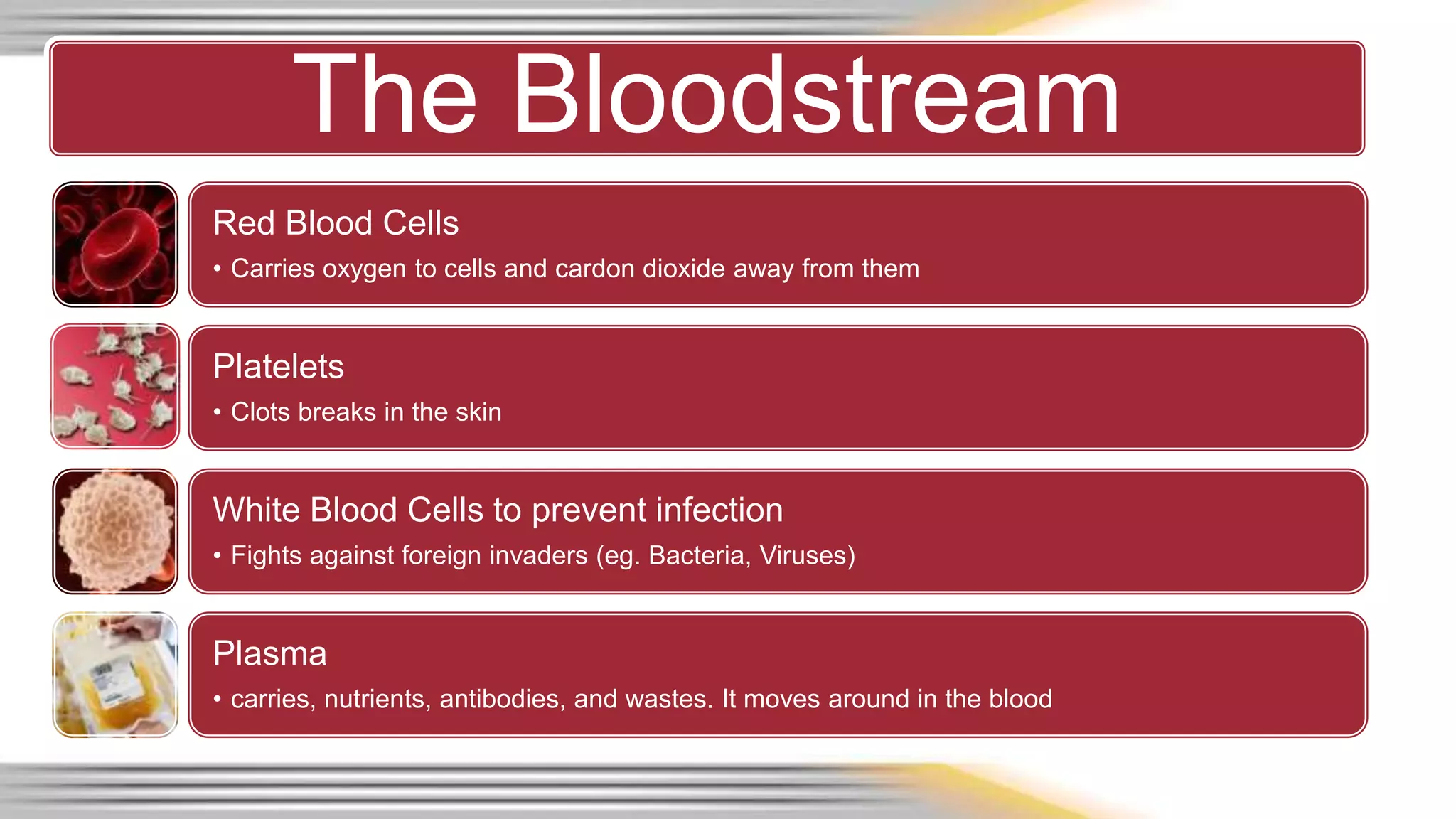
The Bloodstream 
Red Blood Cells 
• Carries oxygen to cells and cardon dioxide away from them 
Platelets 
• Clots breaks in the skin 
White Blood Cells to prevent infection 
• Fights against foreign invaders (eg. Bacteria, Viruses) 
Plasma 
• carries, nutrients, antibodies, and wastes. It moves around in the blood
• Heart disease is caused because for many 
reasons but one main reason is atherosclerosis. 
• Two well known types of heart disease are, 
coronary artery disease and heart attack. 
• Heart disease can affect various body systems.
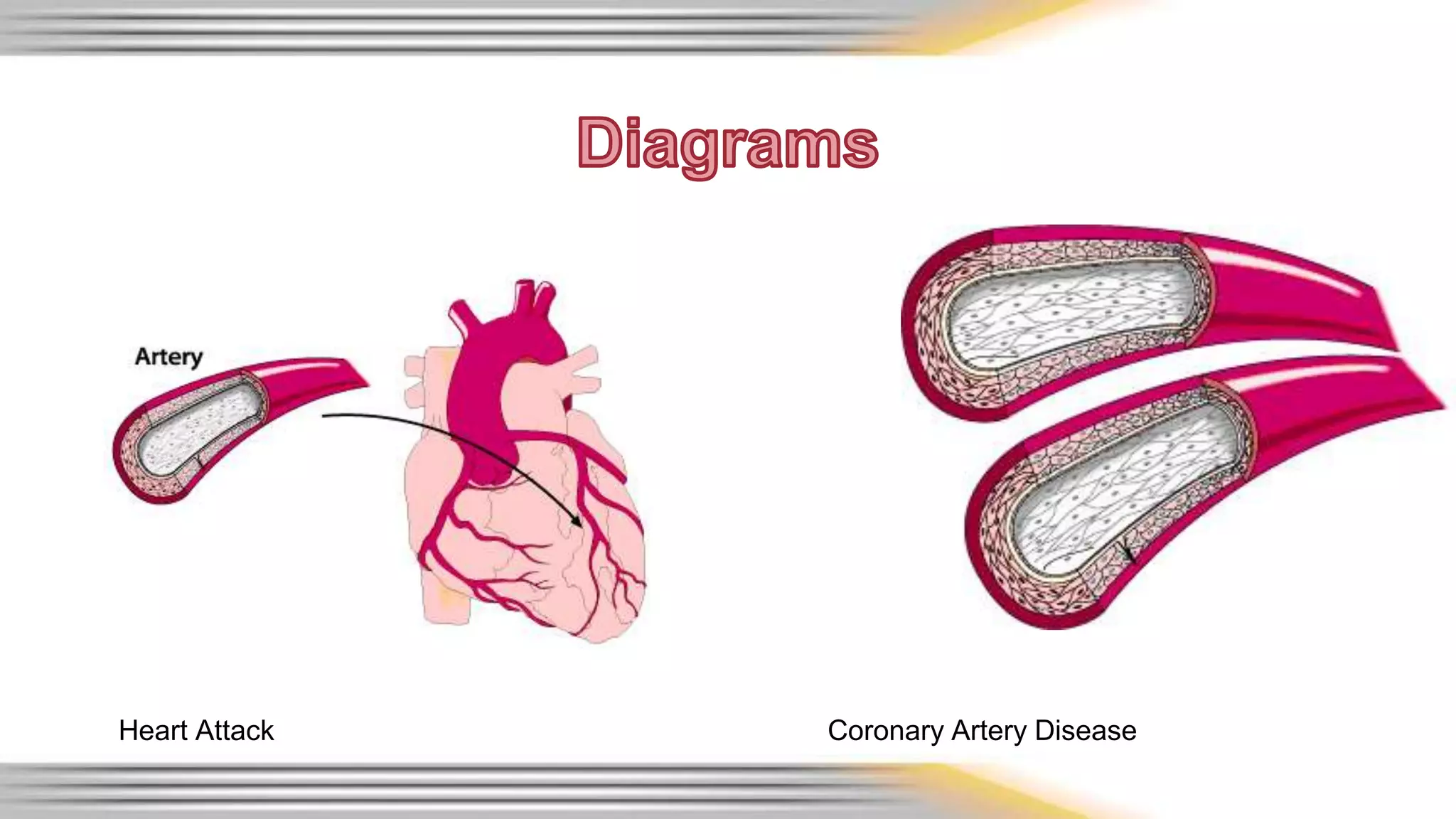
• Heart Attack (myocardial infarction): Heart attack is a 
condition where there is a blockage in artery like the 
coronary artery where blood flow to the heart or other 
parts of the body become blocked off. It causes heart 
cells to die 
• Coronary Artery Disease: Coronary artery disease is 
when the coronary arteries of an individual become 
blocked off very often and when completely blocked 
off, stop blood flow to heart muscle.
Heart Attack Coronary Artery Disease
• Heart diseases can affect many different body systems. 
Some of these systems include the digestive, immune, 
nervous, respiratory, and urinary system. 
• Heart disease affects the nervous system because it can 
cause a deficiency in the flow of blood to the brain and 
cause many issues. 
• Heart disease affects the immune system because it 
contains essential nutrients such as white blood cells 
that may not be present.
• Heart disease affects the digestive system because it can 
stop the process of cellular respiration in this vital organ 
and glucose cannot be broken down. 
• Heart disease affects the respiratory system because 
blood is essential for the movement of oxygen and carbon 
dioxide in the body. 
• Heart disease affects the urinary system because the 
kidneys need blood to function properly and the urinary 
system is dependent on the kidneys.
Works Cited 
• Blackburn, V., & Harris, B. (2013, December 20). 
What Are Venules?. WiseGeek. Retrieved January 18, 
2014, from http://www.wisegeek.com/what-are-venules. 
htm 
• The Flow of Blood through Blood Vessels. (1999, 
September 17). Blood Vessels. Retrieved January 18, 
2014, from 
http://www.biosbcc.net/doohan/sample/htm/vessel 
s.htm
Works Cited Continued 
• Heart Disease Health Center. (2014, January 2). 
WebMD. Retrieved January 18,2014 from 
www.webmd.com/heart-disease.default.htm 
• Heart Disease Center. (2013, September 4). Center 
for Disease Control. Retrieved January 18,2014 from 
www.cdc.gov/heart+disease.default.page_1.htm
Works Cited Continued 
• Arteries. (2011, November 29). Discovery. Retrieved 
From www.discovery.org/arteries/page?.htm 
• The Flow of Blood through Blood Vessels. (1999, 
September 17). Blood Vessels. Retrieved January 18, 
2014, from 
http://www.biosbcc.net/doohan/sample/htm/vessel 
s.htm
Works Cited Continued 
• Bailey, R. (n.d.). Atria of the Heart. About.com 
Biology. Retrieved February 2, 2014, from 
http://biology.about.com/od/anatomy/ss/Atria-Of-The- 
Heart.htm 
• Superior vena cava. (n.d.). Healthlines RSS 
News. Retrieved February 2, 2014, from 
http://www.healthline.com/human-body-maps/ 
superior-vena-cava#2/13

Principles of Biomedical Science- Final Presentation 2014

  • 1.
    The Cardiovascular System By: Megh Shah, Kush Patel, Peter Attia, and Akshita Sanjay
  • 2.
    • The meaningof the cardiovascular system • cardio- Greek word for Heart • vascular- Greek word for vessel • Responsible for pumping blood throughout the body –10 pints of blood a day travels throughout the blood • The HARDEST working system in the human body.
  • 3.
    Heart Veins Arterioles Aorta Venules Superior Vena Cava Ventricles Pulmonary Vein Atriums Pulmonary Arteries Artery Capillaries Inferior Vena Cava
  • 5.
    Heart Veins Arterioles Aorta Venules Superior Vena Cava Ventricles Pulmonary Vein Atriums Pulmonary Arteries Artery Capillaries Inferior Vena Cava
  • 6.
    • It ismade up of four muscular chambers which are the atria and the ventricles and is responsible for the movement of blood to and from the body. • The heart is muscular and is made up of three layers of muscle. Epicardium, endocardium, and myocardium. • It contains many blood vessels that it passes blood through to and from the body.
  • 9.
    Heart Veins Arterioles Aorta Venules Superior Vena Cava Ventricles Pulmonary Vein Atriums Pulmonary Arteries Artery Capillaries Inferior Vena Cava
  • 10.
    • One ofthe largest veins in the body –Carries deoxygenated blood from circulatory circulation into the right atrium –Specifically carries blood from the upper region of the body • Examples include – head, neck, arm and chest regions
  • 11.
    The head Chest The arm The neck
  • 14.
    Heart Veins Arterioles Aorta Venules Superior Vena Cava Ventricles Pulmonary Vein Atriums Pulmonary Arteries Artery Capillaries Inferior Vena Cava
  • 15.
    • A hollowchamber in which blood flows through –Composed of 2 out of 4 chambers in the heart –Located at the top of the heart near the aorta. • Function –Receives blood from veins (pulmonary vein, superior/inferior venae cavae) –Pumps blood to ventricles
  • 16.
    Left Atrium OxygenatedBlood enters from the pulmonary vein • Following pulmonary circulation Sends Blood to ventricle via the mitral valve Right Atrium Deoxygenated blood enters from the superior and inferior vena cava • Following systemic circulation Sends blood to ventricle via the tricuspid valve Location of SA & AV node
  • 19.
    Heart Veins Arterioles Aorta Venules Superior Vena Cava Ventricles Pulmonary Vein Atriums Pulmonary Arteries Artery Capillaries Inferior Vena Cava
  • 20.
    • A thickchamber in which blood is pumped to sections of the body • At the bottom of the heart near the apex • Function –Pump blood to entire body and to pulmonary circulation • The two ventricles –Left Ventricle –Right Ventricle
  • 21.
    Left Ventricle •Pumps blood to the aorta through the aortic valve • Larger then the R. Ventricle as it pumps blood through out body Oxygenated Blood Right Ventricle • Blood comes from R. Atrium • Pumps blood to lungs by pulmonary circulation De- Oxygenated Blood
  • 24.
    Heart Veins Arterioles Aorta Venules Ventricles Superior Vena Cava Pulmonary Vein Atriums Pulmonary Arteries Artery Capillaries Inferior Vena Cava
  • 25.
    • This muscularartery is responsible for moving oxygenated blood from the left ventricle of the heart to the rest of the body . • The aorta is the largest artery in the heart and across the entire body. • The aorta moves blood from the left ventricle to the rest of the body.
  • 26.
    • Layer intima:Innermost layer of the aorta. Interacts with blood as it passes through. • Layer media:Middle layer of aorta. This is the thickest layer • Layer adventita: Outermost layer of the aorta.
  • 27.
    Aortic Arch •releases blood to the head, neck, and other regions in proximity. Exits from Aorta • Brachiocephalic Trunk • Left & Right Common carotid artery • Left & Right Subclavian artery • Ascending & Descending Aorta Semilunar Valve • Valve that is contained at the entry point of aorta and keeps excessive blood from entering the aorta and a normal amount of blood entering the body. aortic arch Descending Aorta Right common carotid artery Ascending aorta Left subclavian artery Right subclavian artery Left common carotid artery
  • 30.
    Heart Veins Arterioles Aorta Venules Superior Vena Cava Ventricles Pulmonary Vein Atriums Pulmonary Arteries Artery Capillaries Inferior Vena Cava
  • 31.
    • Arteries areblood vessels that bring blood from the heart to the rest of the body. • Arteries have a very strong outer layer and are soft on the inside • Arteries move blood from the heart to arterioles to capillaries and then to organs in the body. • Examples: Pulmonary artery and aorta
  • 32.
    Layers of Arteries Adventitia Media Intima Endothelium
  • 35.
    Heart Veins Arterioles Aorta Venules Superior Vena Cava Ventricles Pulmonary Vein Atriums Pulmonary Arteries Artery Capillaries Inferior Vena Cava
  • 36.
    • They aresmall versions of arteries –Arterioles have similar functions to arteries but are smaller in size. –Arterioles are one layer thick and serve as a buffer between arteries and capillaries. –They are larger than capillaries which take blood to different parts of the body. –Provide blood pressure because of their small size and this controls the amount of blood flowing around the body.
  • 39.
    Heart Veins Arterioles Aorta Venules Superior Vena Cava Ventricles Pulmonary Vein Atriums Pulmonary Arteries Artery Capillaries Inferior Vena Cava
  • 40.
    • Veins areblood vessels that move blood towards the heart. –They are not as strong as arteries. –They contain the same three layers as arteries but are not as strong –Veins contain valves that block blood flow backwards into the veins. –Veins can include the pulmonary veins , and bodily veins.
  • 43.
    Heart Veins Arterioles Aorta Venules Superior Vena Cava Ventricles Pulmonary Vein Atriums Pulmonary Arteries Artery Capillaries Inferior Vena Cava
  • 44.
    • Venules aresmall veins that emerge from capillaries and move blood into veins and to the heart. • They are an intermediate between capillaries and veins. • They are thin and small and are similar to arterioles.
  • 47.
    Heart Veins Arterioles Aorta Venules Superior Vena Cava Ventricles Pulmonary Vein Atriums Pulmonary Arteries Artery Capillaries Inferior Vena Cava
  • 48.
    • Capillaries arethe smallest blood vessels in the body. • They can move blood to and from the body organs and branch off of venules and arterioles. • Capillaries are extremely fragile. • Capillaries release heat and move deoxygenated blood to veins and take oxygenated blood from arteries.
  • 51.
    Heart Veins Arterioles Aorta Venules Superior Vena Cava Ventricles Pulmonary Vein Atriums Pulmonary Arteries Artery Capillaries Inferior Vena Cava
  • 52.
    • Function ofblood is that it carries oxygen to the entire body and then returns to the heart to be re-oxygenated. • Blood is composed of four parts and is essential to normal function of the body as it provides the oxygen and nutrients necessary for the body to operate.
  • 54.
    The Bloodstream RedBlood Cells • Carries oxygen to cells and cardon dioxide away from them Platelets • Clots breaks in the skin White Blood Cells to prevent infection • Fights against foreign invaders (eg. Bacteria, Viruses) Plasma • carries, nutrients, antibodies, and wastes. It moves around in the blood
  • 56.
    • Heart diseaseis caused because for many reasons but one main reason is atherosclerosis. • Two well known types of heart disease are, coronary artery disease and heart attack. • Heart disease can affect various body systems.
  • 57.
    • Heart Attack(myocardial infarction): Heart attack is a condition where there is a blockage in artery like the coronary artery where blood flow to the heart or other parts of the body become blocked off. It causes heart cells to die • Coronary Artery Disease: Coronary artery disease is when the coronary arteries of an individual become blocked off very often and when completely blocked off, stop blood flow to heart muscle.
  • 58.
    Heart Attack CoronaryArtery Disease
  • 59.
    • Heart diseasescan affect many different body systems. Some of these systems include the digestive, immune, nervous, respiratory, and urinary system. • Heart disease affects the nervous system because it can cause a deficiency in the flow of blood to the brain and cause many issues. • Heart disease affects the immune system because it contains essential nutrients such as white blood cells that may not be present.
  • 60.
    • Heart diseaseaffects the digestive system because it can stop the process of cellular respiration in this vital organ and glucose cannot be broken down. • Heart disease affects the respiratory system because blood is essential for the movement of oxygen and carbon dioxide in the body. • Heart disease affects the urinary system because the kidneys need blood to function properly and the urinary system is dependent on the kidneys.
  • 61.
    Works Cited •Blackburn, V., & Harris, B. (2013, December 20). What Are Venules?. WiseGeek. Retrieved January 18, 2014, from http://www.wisegeek.com/what-are-venules. htm • The Flow of Blood through Blood Vessels. (1999, September 17). Blood Vessels. Retrieved January 18, 2014, from http://www.biosbcc.net/doohan/sample/htm/vessel s.htm
  • 62.
    Works Cited Continued • Heart Disease Health Center. (2014, January 2). WebMD. Retrieved January 18,2014 from www.webmd.com/heart-disease.default.htm • Heart Disease Center. (2013, September 4). Center for Disease Control. Retrieved January 18,2014 from www.cdc.gov/heart+disease.default.page_1.htm
  • 63.
    Works Cited Continued • Arteries. (2011, November 29). Discovery. Retrieved From www.discovery.org/arteries/page?.htm • The Flow of Blood through Blood Vessels. (1999, September 17). Blood Vessels. Retrieved January 18, 2014, from http://www.biosbcc.net/doohan/sample/htm/vessel s.htm
  • 64.
    Works Cited Continued • Bailey, R. (n.d.). Atria of the Heart. About.com Biology. Retrieved February 2, 2014, from http://biology.about.com/od/anatomy/ss/Atria-Of-The- Heart.htm • Superior vena cava. (n.d.). Healthlines RSS News. Retrieved February 2, 2014, from http://www.healthline.com/human-body-maps/ superior-vena-cava#2/13