Circulatory System
Dr. Pooja Walia
Assistant Professor
Dept. of Education
MIzoram University
Outline of the Presentation
• What is Circulatory System?
• Composition of Blood
• Components of Circulatory System
• What is Lymphatic System?
• Types of Cardiovascular System
• Functions of Circulatory System
• Disease related to Circulatory System
The Circulatory System
The cardiovascular (from Latin words
meaning "heart" and "vessel") system
comprises the blood, heart, and blood
vessels.The circulatory system, also called
the cardiovascular system or the vascular
system, is an organ system that permits
blood to circulate and transport nutrients
(such as amino acids and electrolytes),
oxygen, carbon dioxide, hormones, and
blood cells to and from the cells in the body.
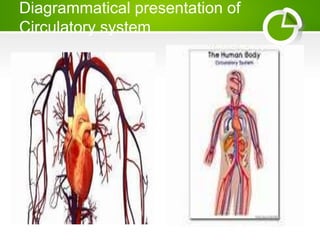
Diagrammatical presentation of
Circulatory system
Composition of Blood
Blood is a fluid consisting of plasma, red
blood cells, white blood cells, and platelets
that is circulated by the heart through the
vertebrate vascular system, carrying
oxygen and nutrients to and waste
materials away from all body tissues.
Components of Circulatory System
The circulatory system of the blood is seen
as having two components:
•Pulmonary circulation
•Systemic circulation
Pulmonary circulation is a "loop" where
blood is oxygenated through the lungs; and
the systemic circulation is , a "loop" where
oxygenated blood is provided to rest of the
body.
Lymphatic System
The circulatory system includes the lymphatic
system, which circulates lymph.
•The lymph, lymph nodes, and lymph vessels
form the lymphatic system, which returns
filtered blood plasma from the interstitial fluid
(between cells) as lymph.
•Lymph is essentially recycled excess blood
plasma after it has been filtered from the
interstitial fluid (between cells) and returned to
the lymphatic system. The passage of lymph
takes much longer time than that of blood.
Types of Cardiovascular System
Humans, as well as other vertebrates, have
a closed cardiovascular system (meaning
that the blood never leaves the network of
arteries, veins and capillaries).
Some invertebrate groups have an open
cardiovascular system.
The lymphatic system, on the other hand, is
an open system providing an accessory
route for excess interstitial fluid to be
returned to the blood.
Functions of Circulatory System
• Provide nourishment to whole body
• Help in fighting diseases
• Stabilize temperature & PH
• Maintain homeostasis
Disease related to Circulatory System
Many diseases affect the circulatory system.
This includes cardiovascular disease and
lymphatic disease.
Cardiologists are medical professionals which
specialise in the heart, and cardiothoracic
surgeons specialise in operating on the heart
and its surrounding areas.
Vascular surgeons focus on other parts of the
circulatory system.
.
Thanks for Watching.
Please Like, share and Comment.
poojawaliakuk@gmail.com

Circular system

  • 1.
    Circulatory System Dr. PoojaWalia Assistant Professor Dept. of Education MIzoram University
  • 2.
    Outline of thePresentation • What is Circulatory System? • Composition of Blood • Components of Circulatory System • What is Lymphatic System? • Types of Cardiovascular System • Functions of Circulatory System • Disease related to Circulatory System
  • 3.
    The Circulatory System Thecardiovascular (from Latin words meaning "heart" and "vessel") system comprises the blood, heart, and blood vessels.The circulatory system, also called the cardiovascular system or the vascular system, is an organ system that permits blood to circulate and transport nutrients (such as amino acids and electrolytes), oxygen, carbon dioxide, hormones, and blood cells to and from the cells in the body.
  • 4.
  • 5.
    Composition of Blood Bloodis a fluid consisting of plasma, red blood cells, white blood cells, and platelets that is circulated by the heart through the vertebrate vascular system, carrying oxygen and nutrients to and waste materials away from all body tissues.
  • 6.
    Components of CirculatorySystem The circulatory system of the blood is seen as having two components: •Pulmonary circulation •Systemic circulation Pulmonary circulation is a "loop" where blood is oxygenated through the lungs; and the systemic circulation is , a "loop" where oxygenated blood is provided to rest of the body.
  • 7.
    Lymphatic System The circulatorysystem includes the lymphatic system, which circulates lymph. •The lymph, lymph nodes, and lymph vessels form the lymphatic system, which returns filtered blood plasma from the interstitial fluid (between cells) as lymph. •Lymph is essentially recycled excess blood plasma after it has been filtered from the interstitial fluid (between cells) and returned to the lymphatic system. The passage of lymph takes much longer time than that of blood.
  • 8.
    Types of CardiovascularSystem Humans, as well as other vertebrates, have a closed cardiovascular system (meaning that the blood never leaves the network of arteries, veins and capillaries). Some invertebrate groups have an open cardiovascular system. The lymphatic system, on the other hand, is an open system providing an accessory route for excess interstitial fluid to be returned to the blood.
  • 9.
    Functions of CirculatorySystem • Provide nourishment to whole body • Help in fighting diseases • Stabilize temperature & PH • Maintain homeostasis
  • 10.
    Disease related toCirculatory System Many diseases affect the circulatory system. This includes cardiovascular disease and lymphatic disease. Cardiologists are medical professionals which specialise in the heart, and cardiothoracic surgeons specialise in operating on the heart and its surrounding areas. Vascular surgeons focus on other parts of the circulatory system.
  • 11.
    . Thanks for Watching. PleaseLike, share and Comment. poojawaliakuk@gmail.com