P.T.S.S. Dasanayaka 
S.L.R. Jayanayake 
R.M.P.S.N. Rajapakshe 
Department of Food Science and Technology 
University of Peradeniya
Content 
 Introduction 
 Cultivation methods 
 Processing and products 
 Domestic and export market 
 Laws and regulations 
 Conclusion 
Department of Food Science and Technology 
University of Peradeniya
Introduction 
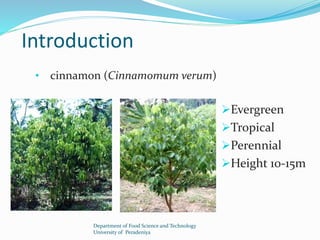
• cinnamon (Cinnamomum verum) 
Evergreen 
Tropical 
Perennial 
Height 10-15m 
Department of Food Science and Technology 
University of Peradeniya
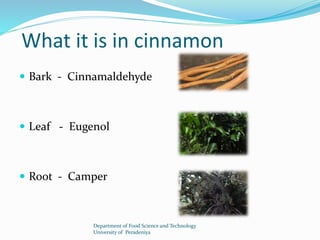
What it is in cinnamon 
 Bark - Cinnamaldehyde 
 Leaf - Eugenol 
 Root - Camper 
Department of Food Science and Technology 
University of Peradeniya
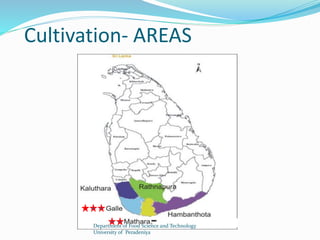
Cultivation- AREAS 
Department of Food Science and Technology 
University of Peradeniya
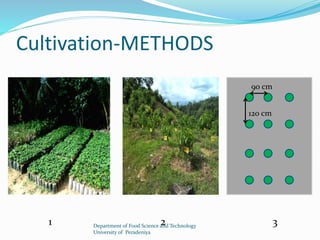
Cultivation-METHODS 
90 cm 
120 cm 
1 2 3 
Department of Food Science and Technology 
University of Peradeniya
Cultivation-CLIMATIC 
REQUIRMENTS 
 Temp – 25-30 C 
 Rainfall- 1875- 3750 mm 
 Humidity- 75- 85% 
 Land - slope 
 Optimum light conditions 
 Wet soil 
Department of Food Science and Technology 
University of Peradeniya
Harvesting 
 Takes 2- 2.5 years for harvesting. 
 New germ takes 1.5 years for next harvesting. 
 Bare lots of new twigs after harvesting. 
 Flowering and budding periods should be avoided . 
 Wet season is used to harvesting. 
Department of Food Science and Technology 
University of Peradeniya
Department of Food Science and Technology 
University of Peradeniya
Main Products 
 Cinnamon sticks/ quills 
 Cinnamon oils 
 Oleoresin 
 Other value added products 
Department of Food Science and Technology 
University of Peradeniya
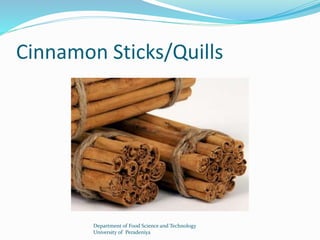
Cinnamon Sticks/Quills 
Department of Food Science and Technology 
University of Peradeniya
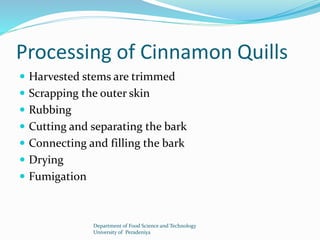
Processing of Cinnamon Quills 
 Harvested stems are trimmed 
 Scrapping the outer skin 
 Rubbing 
 Cutting and separating the bark 
 Connecting and filling the bark 
 Drying 
 Fumigation 
Department of Food Science and Technology 
University of Peradeniya
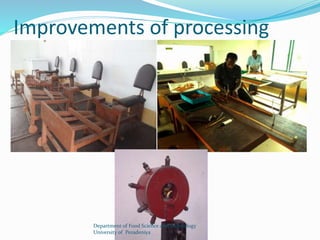
Improvements of processing 
Department of Food Science and Technology 
University of Peradeniya
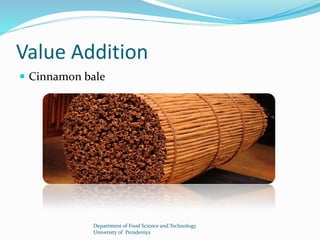
Value Addition 
 Cinnamon bale 
Department of Food Science and Technology 
University of Peradeniya
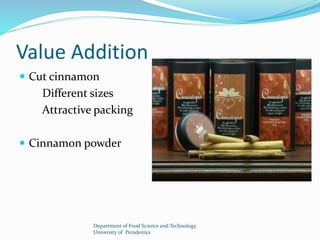
Value Addition 
 Cut cinnamon 
Different sizes 
Attractive packing 
 Cinnamon powder 
Department of Food Science and Technology 
University of Peradeniya
Cinnamon Oils 
Cinnamon bark oil Cinnamon leaf oil 
 Produced using bark chips 
 Bark contain 0.5- 4% oil 
 Mainly cinnamaldehyde 
 Used in perfume and food 
flavorent production 
 Produced using leaf 
 Leaf contain up to 4.8% oil 
 Mainly eugenol 
 Used in perfume production 
and medicinal purposes 
 Cinnamon seed and root also 
used to produce oils. But they are 
not common 
Department of Food Science and Technology 
University of Peradeniya
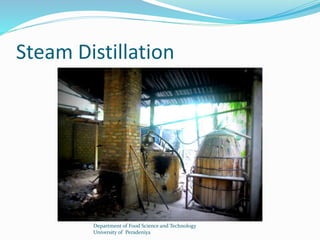
Steam Distillation 
Department of Food Science and Technology 
University of Peradeniya
 Bark chips or leaves are fed in to the stainless steal still 
 Steamed for 6h 
 Good bark pats are not used 
 Leaves are allowed to dry in fields for 3-5 days before 
processing 
 Left-over leaves used to produce energy for the boiler 
Department of Food Science and Technology 
University of Peradeniya
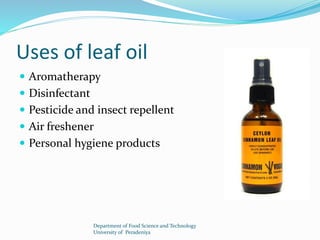
Uses of leaf oil 
 Aromatherapy 
 Disinfectant 
 Pesticide and insect repellent 
 Air freshener 
 Personal hygiene products 
Department of Food Science and Technology 
University of Peradeniya
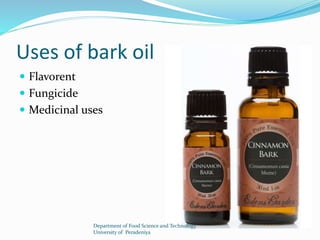
Uses of bark oil 
 Flavorent 
 Fungicide 
 Medicinal uses 
Department of Food Science and Technology 
University of Peradeniya
Cinnamon Oleoresin 
 Combination of oil and resin components 
 Oil – aroma 
 Resin – flavor 
 Oleoresin can be used instead of cinnamon bark 
products 
 Reduce space, easy to use 
Department of Food Science and Technology 
University of Peradeniya
Processing of oleoresin 
CO2 extraction Solvent extraction 
 High pressure CO2 
 CO2 act as a solvent for 
oleoresin 
 CO2 removed and oleoresin is 
recovered 
 Advanced and expensive 
equipments are used 
 Quality and efficiency is high 
 Organic solvents are used 
 Methanol, acetone and 
hexane is mostly used 
 Conventional solvent 
extraction method is used 
 Simple equipments are used 
 Efficiency of extraction is low 
Department of Food Science and Technology 
University of Peradeniya
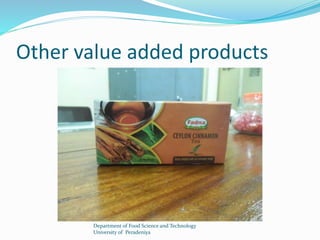
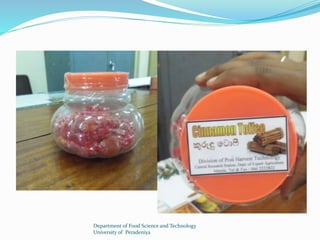
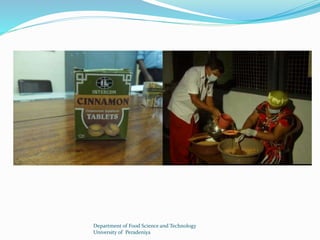
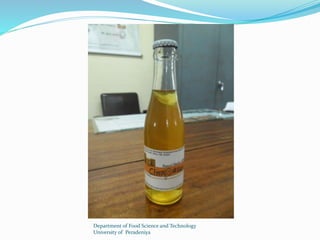
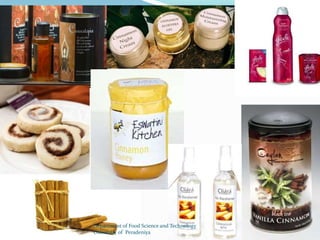
Other value added products 
Department of Food Science and Technology 
University of Peradeniya
Department of Food Science and Technology 
University of Peradeniya
Department of Food Science and Technology 
University of Peradeniya
Department of Food Science and Technology 
University of Peradeniya
Department of Food Science and Technology 
University of Peradeniya
Department of Food Science and Technology 
University of Peradeniya
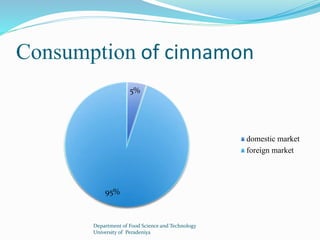
Consumption of cinnamon 
5% 
95% 
domestic market 
foreign market 
Department of Food Science and Technology 
University of Peradeniya
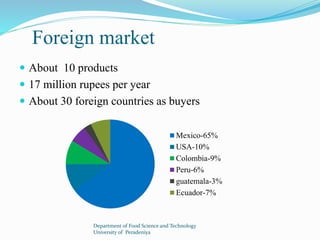
Foreign market 
 About 10 products 
 17 million rupees per year 
 About 30 foreign countries as buyers 
Mexico-65% 
USA-10% 
Colombia-9% 
Peru-6% 
guatemala-3% 
Ecuador-7% 
Department of Food Science and Technology 
University of Peradeniya
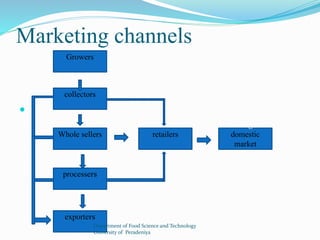
Marketing channels 
 
Growers 
collectors 
Whole sellers 
processers 
exporters 
retailers 
Selling in 
domestic 
market 
Department of Food Science and Technology 
University of Peradeniya
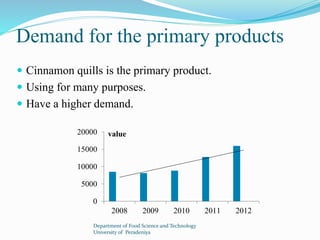
Demand for the primary products 
 Cinnamon quills is the primary product. 
 Using for many purposes. 
 Have a higher demand. 
20000 
15000 
10000 
5000 
0 
value 
2008 2009 2010 2011 2012 
Department of Food Science and Technology 
University of Peradeniya
Demand for the processed products 
 About 07 main products 
 main exporters 
- G.P. De Silva & sons 
- Rathna exporters 
- Randima exporters 
- Premawardhana exporters 
 Higher demand is appearing in premium market 
Department of Food Science and Technology 
University of Peradeniya
Export marketing potential 
 Higher quality products for domestic market 
- hotels 
- super markets 
- shopping complexes 
 Opportunities for products in export market 
- value added products 
 Trust on product quality confine the expansion. 
Department of Food Science and Technology 
University of Peradeniya
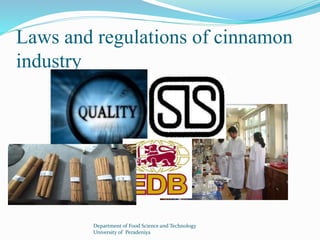
Laws and regulations of cinnamon 
industry 
Department of Food Science and Technology 
University of Peradeniya
Regulations on cinnamon 
processing 
 Any vegetative part can’t be given to another country. 
 Grading of quills– under special requirements 
- diameter and length 
- level of foxing 
- moisture content - 14-15 % 
- ash content - 5-7 % 
- volatile oil - 0.7-1 % 
- levels of heavy metals 
Department of Food Science and Technology 
University of Peradeniya
Regulations on marketing 
 Relevant Sri Lanka standards 
- SLS 81:2010 
- SLS 1327:2008 
- SLS 143: 1999 
 Relevant foreign standards 
- ISO standard 
- joint FAO/WHO food standard program 
- labeling requirements and regulations 
- quality requirements on contaminants 
Department of Food Science and Technology 
University of Peradeniya
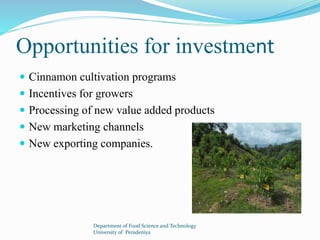
Opportunities for investment 
 Cinnamon cultivation programs 
 Incentives for growers 
 Processing of new value added products 
 New marketing channels 
 New exporting companies. 
Department of Food Science and Technology 
University of Peradeniya
Acknowledgement 
 Export agriculture department- Gatambe 
 Export agriculture search unit - Mathale 
 Cinnamon research centre - Thihagoda 
 Randima exporters - Batapola 
 Rathna exporters -Kamburupitiya 
 Cultivators(large,small scale) -Galle, 
- Ambalangoda 
 Cinnamon oil extractors - Ambalangoda 
 Cinnamon whole sellers & collectors in Galle 
Department of Food Science and Technology 
University of Peradeniya

Processing potential of cinnamon

  • 1.
    P.T.S.S. Dasanayaka S.L.R.Jayanayake R.M.P.S.N. Rajapakshe Department of Food Science and Technology University of Peradeniya
  • 2.
    Content  Introduction  Cultivation methods  Processing and products  Domestic and export market  Laws and regulations  Conclusion Department of Food Science and Technology University of Peradeniya
  • 3.
    Introduction • cinnamon(Cinnamomum verum) Evergreen Tropical Perennial Height 10-15m Department of Food Science and Technology University of Peradeniya
  • 4.
    What it isin cinnamon  Bark - Cinnamaldehyde  Leaf - Eugenol  Root - Camper Department of Food Science and Technology University of Peradeniya
  • 5.
    Cultivation- AREAS Departmentof Food Science and Technology University of Peradeniya
  • 6.
    Cultivation-METHODS 90 cm 120 cm 1 2 3 Department of Food Science and Technology University of Peradeniya
  • 7.
    Cultivation-CLIMATIC REQUIRMENTS Temp – 25-30 C  Rainfall- 1875- 3750 mm  Humidity- 75- 85%  Land - slope  Optimum light conditions  Wet soil Department of Food Science and Technology University of Peradeniya
  • 8.
    Harvesting  Takes2- 2.5 years for harvesting.  New germ takes 1.5 years for next harvesting.  Bare lots of new twigs after harvesting.  Flowering and budding periods should be avoided .  Wet season is used to harvesting. Department of Food Science and Technology University of Peradeniya
  • 9.
    Department of FoodScience and Technology University of Peradeniya
  • 10.
    Main Products Cinnamon sticks/ quills  Cinnamon oils  Oleoresin  Other value added products Department of Food Science and Technology University of Peradeniya
  • 11.
    Cinnamon Sticks/Quills Departmentof Food Science and Technology University of Peradeniya
  • 12.
    Processing of CinnamonQuills  Harvested stems are trimmed  Scrapping the outer skin  Rubbing  Cutting and separating the bark  Connecting and filling the bark  Drying  Fumigation Department of Food Science and Technology University of Peradeniya
  • 13.
    Improvements of processing Department of Food Science and Technology University of Peradeniya
  • 14.
    Value Addition Cinnamon bale Department of Food Science and Technology University of Peradeniya
  • 15.
    Value Addition Cut cinnamon Different sizes Attractive packing  Cinnamon powder Department of Food Science and Technology University of Peradeniya
  • 16.
    Cinnamon Oils Cinnamonbark oil Cinnamon leaf oil  Produced using bark chips  Bark contain 0.5- 4% oil  Mainly cinnamaldehyde  Used in perfume and food flavorent production  Produced using leaf  Leaf contain up to 4.8% oil  Mainly eugenol  Used in perfume production and medicinal purposes  Cinnamon seed and root also used to produce oils. But they are not common Department of Food Science and Technology University of Peradeniya
  • 17.
    Steam Distillation Departmentof Food Science and Technology University of Peradeniya
  • 18.
     Bark chipsor leaves are fed in to the stainless steal still  Steamed for 6h  Good bark pats are not used  Leaves are allowed to dry in fields for 3-5 days before processing  Left-over leaves used to produce energy for the boiler Department of Food Science and Technology University of Peradeniya
  • 19.
    Uses of leafoil  Aromatherapy  Disinfectant  Pesticide and insect repellent  Air freshener  Personal hygiene products Department of Food Science and Technology University of Peradeniya
  • 20.
    Uses of barkoil  Flavorent  Fungicide  Medicinal uses Department of Food Science and Technology University of Peradeniya
  • 21.
    Cinnamon Oleoresin Combination of oil and resin components  Oil – aroma  Resin – flavor  Oleoresin can be used instead of cinnamon bark products  Reduce space, easy to use Department of Food Science and Technology University of Peradeniya
  • 22.
    Processing of oleoresin CO2 extraction Solvent extraction  High pressure CO2  CO2 act as a solvent for oleoresin  CO2 removed and oleoresin is recovered  Advanced and expensive equipments are used  Quality and efficiency is high  Organic solvents are used  Methanol, acetone and hexane is mostly used  Conventional solvent extraction method is used  Simple equipments are used  Efficiency of extraction is low Department of Food Science and Technology University of Peradeniya
  • 23.
    Other value addedproducts Department of Food Science and Technology University of Peradeniya
  • 24.
    Department of FoodScience and Technology University of Peradeniya
  • 25.
    Department of FoodScience and Technology University of Peradeniya
  • 26.
    Department of FoodScience and Technology University of Peradeniya
  • 27.
    Department of FoodScience and Technology University of Peradeniya
  • 28.
    Department of FoodScience and Technology University of Peradeniya
  • 29.
    Consumption of cinnamon 5% 95% domestic market foreign market Department of Food Science and Technology University of Peradeniya
  • 30.
    Foreign market About 10 products  17 million rupees per year  About 30 foreign countries as buyers Mexico-65% USA-10% Colombia-9% Peru-6% guatemala-3% Ecuador-7% Department of Food Science and Technology University of Peradeniya
  • 31.
    Marketing channels  Growers collectors Whole sellers processers exporters retailers Selling in domestic market Department of Food Science and Technology University of Peradeniya
  • 32.
    Demand for theprimary products  Cinnamon quills is the primary product.  Using for many purposes.  Have a higher demand. 20000 15000 10000 5000 0 value 2008 2009 2010 2011 2012 Department of Food Science and Technology University of Peradeniya
  • 33.
    Demand for theprocessed products  About 07 main products  main exporters - G.P. De Silva & sons - Rathna exporters - Randima exporters - Premawardhana exporters  Higher demand is appearing in premium market Department of Food Science and Technology University of Peradeniya
  • 34.
    Export marketing potential  Higher quality products for domestic market - hotels - super markets - shopping complexes  Opportunities for products in export market - value added products  Trust on product quality confine the expansion. Department of Food Science and Technology University of Peradeniya
  • 35.
    Laws and regulationsof cinnamon industry Department of Food Science and Technology University of Peradeniya
  • 36.
    Regulations on cinnamon processing  Any vegetative part can’t be given to another country.  Grading of quills– under special requirements - diameter and length - level of foxing - moisture content - 14-15 % - ash content - 5-7 % - volatile oil - 0.7-1 % - levels of heavy metals Department of Food Science and Technology University of Peradeniya
  • 37.
    Regulations on marketing  Relevant Sri Lanka standards - SLS 81:2010 - SLS 1327:2008 - SLS 143: 1999  Relevant foreign standards - ISO standard - joint FAO/WHO food standard program - labeling requirements and regulations - quality requirements on contaminants Department of Food Science and Technology University of Peradeniya
  • 38.
    Opportunities for investment  Cinnamon cultivation programs  Incentives for growers  Processing of new value added products  New marketing channels  New exporting companies. Department of Food Science and Technology University of Peradeniya
  • 39.
    Acknowledgement  Exportagriculture department- Gatambe  Export agriculture search unit - Mathale  Cinnamon research centre - Thihagoda  Randima exporters - Batapola  Rathna exporters -Kamburupitiya  Cultivators(large,small scale) -Galle, - Ambalangoda  Cinnamon oil extractors - Ambalangoda  Cinnamon whole sellers & collectors in Galle Department of Food Science and Technology University of Peradeniya