Advances in Spice Processing
Technologies
A.Poshadri
M.Tech (Food Tech.)
Assistant Professor
Department of Food Technology
Prof. Jayashankar Telangana State Agriculture University
Email: poshadri_fst@yahoo.co.in
Cell No: +919492828965
Introduction
• Indian spices are known for its flavours
• India is known as ‘Home of Spices and also Land of
spices
• India- Largest producer, consumer and exporter of
spices
• China - second largest producer
• >90% for domestic consumption
• 109 spices- all over world
• India- 52 spices
• India is producing 5.95 million tonnes of spices from
an area of about 3.21 million ha
• Share of spices in total agricultural export- 6%
• India’s share of world spice trade- 45-50% by volume
and 25-30% by value
• Major spice, producing states are Andhra Pradesh
(19%), Gujarat (15%), Rajasthan (14.7%), Karnataka
(8%), Madhya Pradesh (7.7%) and Tamil Nadu (7%)
• Chilli is the major spice crop occupying about 25% of
area under cultivation and contributing 22% of total
spice production in the country
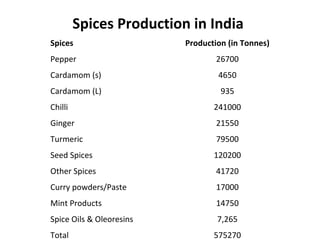
Spices Production in India
Spices Production (in Tonnes)
Pepper 26700
Cardamom (s) 4650
Cardamom (L) 935
Chilli 241000
Ginger 21550
Turmeric 79500
Seed Spices 120200
Other Spices 41720
Curry powders/Paste 17000
Mint Products 14750
Spice Oils & Oleoresins 7,265
Total 575270
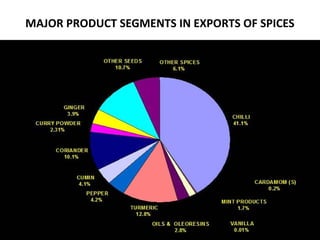
MAJOR PRODUCT SEGMENTS IN EXPORTS OF SPICES
Scope and importance
• India has diverse soil and climate & several agro-
ecological regions which provides the opportunity to
grow a variety of spice crops.
• It is low volume and high value crop.
• spice crops play a unique role in India’s economy by
improving the income of the rural people
• Labor intensive so generate lot of employment
opportunities for the rural population.
• The demand of Indian spice is very much in other
countries . Hence we have very much scope to meet
that demand by huge production.
• Spices can improve the palatability and the appeal of
dull diets.
• Flavors stimulate salivation and promote digestion
• Improve health, by affecting the humors & moods
• Having antibacterial and preservative action Ex-
pickles
• The strong preservative quality of many spices made
them ideal for embalming.
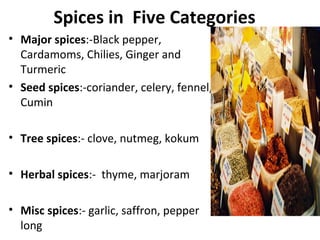
• Major spices:-Black pepper,
Cardamoms, Chilies, Ginger and
Turmeric
• Seed spices:-coriander, celery, fennel,
Cumin
• Tree spices:- clove, nutmeg, kokum
• Herbal spices:- thyme, marjoram
• Misc spices:- garlic, saffron, pepper
long
Spices in Five Categories
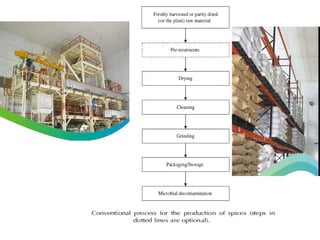
Processing of Spices and Valueaddition
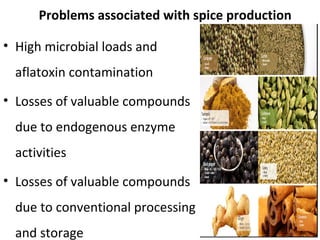
Problems associated with spice production
• High microbial loads and
aflatoxin contamination
• Losses of valuable compounds
due to endogenous enzyme
activities
• Losses of valuable compounds
due to conventional processing
and storage
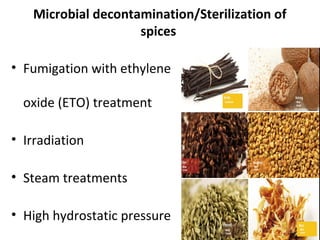
Microbial decontamination/Sterilization of
spices
• Fumigation with ethylene
oxide (ETO) treatment
• Irradiation
• Steam treatments
• High hydrostatic pressure
Fumigation with ethylene oxide (Eto)
• Ethylene Oxide (Eto) serves as a disinfectant, fumigant,
sterilizing agent, and insecticide
• Ethylene Oxide (EtO-prevent human microbial contaminants
such as Salmonella and E.coli in spices.
• EtO is extremely effective in eliminating pathogens as well as
reducing bacterial loads, yeast and mold, coliforms and other
pathogens.
• The main advantage of EtO is that its use on spice generally
has no significant impact on the appearance or flavor of the
spice
• Appearance and taste are essential for spices,
thus EtO treatment can resolve the potential
public health issues without negatively
effecting the marketability of the spice
• Ethylene oxide is most commonly used and for
practical and safety purposes, is normally
diluted with carbon dioxide (80%)
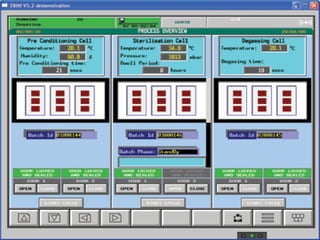
Gas sterilization involves the following steps
• Loading the spices, in suitable bags, into a specially
designed retort
• Evacuation of the chamber
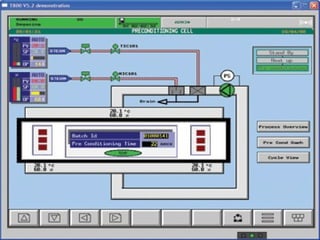
• Raising the temperature of the material to about 35°C
(maximum 60°C) and then add humidity
• Introduction of a predetermined quantity of the
sterilant gas
• Maintenance of conditions to affect sterilization; and
• Removal of the gas and sparging of the retort with air
several times to remove all residuals
Disadvantages of Eto
• Ethylene oxide (ETO) is banned in many
countries (e.g., Japan, and some European
countries) due to its reaction with spice
components to form ethylene chlorohydrin
and ethylene bromohydrin
• Ethylene chlorohydrin is a known carcinogen
that persists in the spice for many months.
• Ethylene oxide also has been labeled as a
carcinogen by the W.H.O.
Irradiation of spices
• Gamma rays, electron beam and X-rays are effective methods
for spice decontamination
• Doses of 3-10 kGy are used for improving microbial safety of
spice products
• Irradiation is allowed for the decontamination of dried
aromatic herbs, spices and vegetable seasonings
• Irradiation of spices, which are usually pre-packaged to
prevent secondary contamination, may cause the formation
of low-molecular-weight volatile or non-volatile radiolysis
products emanating from the packaging material
Steam treatments
• Usually high temperature steam is used to whole
spices before grinding
• The moisture condensed on the surface of the
particles needs to be removed after treatment to
prevent unwanted mould growth.
• The treatment may affect the volatile profile, color,
functionality, and physical state (caking may occur)
High hydrostatic pressure
• High hydrostatic pressures ranging from 100
to 1000 Mpa is used for fruit and vegetable
products
• The inactivation of microorganisms is strongly
dependent on water activity
• Spice samples with water activities below 0.66
showed no reduction in the microbial count.
Milling of Spices or Grinding of Spices
• Spices are produced from a large variety of
plant parts such as rhizomes, barks, leaves,
fruits, seeds, etc
• Few spices can be incorporated directly into
food products
• The degree of fineness of the processed spice is
determined by its ultimate use (e.g., distillation,
extraction, blended seasonings)
Applications
• Straight spice powders (eg. Chilli powder, Turmeric
powder, Coriander powder, Pepper powder, Cumin
Powder, etc.,)
• Culinary Powders (eg. Samabr Powder, Rasam
Powder etc)
• Masala blends (eg. Garama Masala, Chicken Masala,
Meat masala etc)
• Seasonings and Tastemakers (eg. Snacks seasonings
(Masala munch, Green chilli masala, sour cream
onion, mint etc., and Pasta and noodles tastemakers
etc.,)
• Soup mixes blends ( Soup powders)
Advantages and Disadvantages of Traditional
Ground Spices
Advantages Disadvantages
Slow flavor release in high temperature
processing
Variable flavor strength and profile and ready
adulteration with less valuable materials
Easy to handle and weigh accurately
Unhygienic — Often contaminated by filth
(microorganisms)
No labeling declaration problems Presence of lipase enzymes
Presence of natural antioxidants in many
herbs
Flavor distribution poor and flavor loss and
degradation on Storage
Dusty and unpleasant to handle in bulk
Discoloration due to tannins
Dried herbs usually have unacceptable hay-like
aroma
Undesirable appearance characteristics in end
products
Cryogenic Grinding
• Cryogenic grinding is a method of powdering
spices at sub-zero temperature ranging from 0
to minus 70°F
• The herbs and spices are frozen with liquid
nitrogen as they are being ground.
• Normal grinding processes which do not use a
cooling system can reach up to 200°F
• Solid materials are ground or pulverized by
way of hammer mills, attrition mills,
granulators or other equipment’s
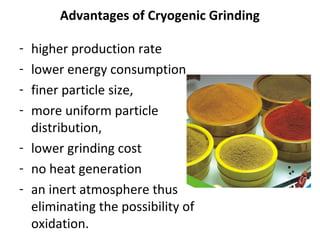
- higher production rate
- lower energy consumption
- finer particle size,
- more uniform particle
distribution,
- lower grinding cost
- no heat generation
- an inert atmosphere thus
eliminating the possibility of
oxidation.
Advantages of Cryogenic Grinding
Spice Oleoresins
• Ground herbs and spices lack the full, rounded
flavour profiles
• Spice oleoresins are a liquid, semi-solid or
solid residue obtained by solvent extraction
and possessing the full character of natural
spices
• Components of an oleoresin - essential oils,
fixed oils, pigments, pungent constituents and
natural antioxidants
Manufacture of Oleoresins
• Preparation of the raw material: Dried herbs and
spices must first be ground to ensure solvent penetration.
• Exposure of the material to solvent:
• -addition of solvent to ensure even wetting of the dry mass
- period of maceration to allow absorption of the solvent and
equilibration between solutes and solvent
- continuous replacement of the miscella
• Separation of miscella from extracted material and
removal of solvent
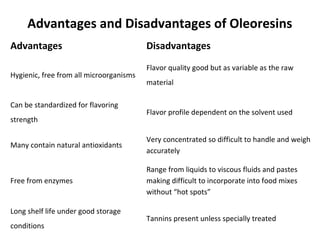
Advantages and Disadvantages of Oleoresins
Advantages Disadvantages
Hygienic, free from all microorganisms
Flavor quality good but as variable as the raw
material
Can be standardized for flavoring
strength
Flavor profile dependent on the solvent used
Many contain natural antioxidants
Very concentrated so difficult to handle and weigh
accurately
Free from enzymes
Range from liquids to viscous fluids and pastes
making difficult to incorporate into food mixes
without “hot spots”
Long shelf life under good storage
conditions
Tannins present unless specially treated
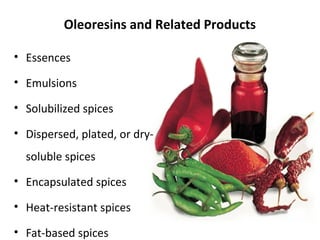
Oleoresins and Related Products
• Essences
• Emulsions
• Solubilized spices
• Dispersed, plated, or dry-
soluble spices
• Encapsulated spices
• Heat-resistant spices
• Fat-based spices
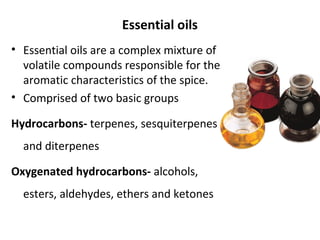
Essential oils
• Essential oils are a complex mixture of
volatile compounds responsible for the
aromatic characteristics of the spice.
• Comprised of two basic groups
Hydrocarbons- terpenes, sesquiterpenes
and diterpenes
Oxygenated hydrocarbons- alcohols,
esters, aldehydes, ethers and ketones
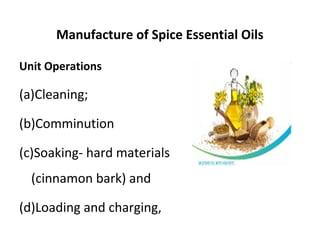
Manufacture of Spice Essential Oils
Unit Operations
(a)Cleaning;
(b)Comminution
(c)Soaking- hard materials
(cinnamon bark) and
(d)Loading and charging,
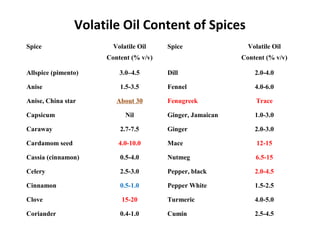
Volatile Oil Content of Spices
Spice Volatile Oil
Content (% v/v)
Spice Volatile Oil
Content (% v/v)
Allspice (pimento) 3.0–4.5 Dill 2.0-4.0
Anise 1.5-3.5 Fennel 4.0-6.0
Anise, China star About 30 Fenugreek Trace
Capsicum Nil Ginger, Jamaican 1.0-3.0
Caraway 2.7-7.5 Ginger 2.0-3.0
Cardamom seed 4.0-10.0 Mace 12-15
Cassia (cinnamon) 0.5-4.0 Nutmeg 6.5-15
Celery 2.5-3.0 Pepper, black 2.0-4.5
Cinnamon 0.5-1.0 Pepper White 1.5-2.5
Clove 15-20 Turmeric 4.0-5.0
Coriander 0.4-1.0 Cumin 2.5-4.5
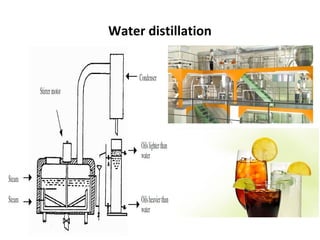
Water distillation
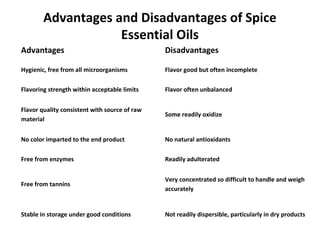
Advantages and Disadvantages of Spice
Essential Oils
Advantages Disadvantages
Hygienic, free from all microorganisms Flavor good but often incomplete
Flavoring strength within acceptable limits Flavor often unbalanced
Flavor quality consistent with source of raw
material
Some readily oxidize
No color imparted to the end product No natural antioxidants
Free from enzymes Readily adulterated
Free from tannins
Very concentrated so difficult to handle and weigh
accurately
Stable in storage under good conditions Not readily dispersible, particularly in dry products
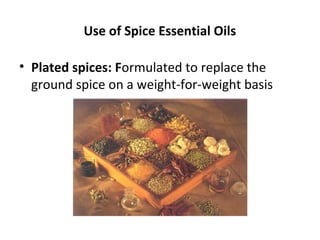
Use of Spice Essential Oils
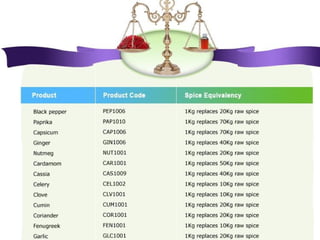
• Plated spices: Formulated to replace the
ground spice on a weight-for-weight basis
Extrusion technology
- Reduces microbial loads
- Prevents mycotoxin
contamination
- Inhibits the action of
endogenous enzymes
- Improves the safety
- Enhances the quality of
intermediate and final
products
Enzyme-assisted liquefaction of spice materials
• Enzymatic hydrolysis of plant materials
- To improve yields in juice processing to
enhance the release of secondary plant
metabolites
- For the recovery of functional food
ingredients
- For peeling purposes
- For the extraction of oleoresins
- Decortication of green pepper
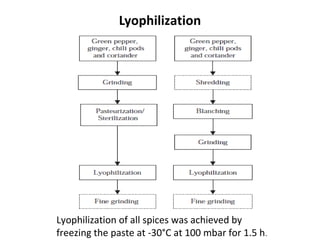
Lyophilization
Lyophilization of all spices was achieved by
freezing the paste at -30°C at 100 mbar for 1.5 h.
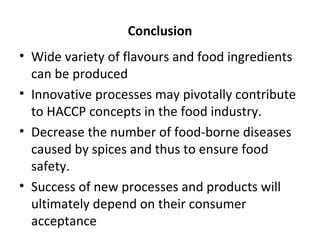
Conclusion
• Wide variety of flavours and food ingredients
can be produced
• Innovative processes may pivotally contribute
to HACCP concepts in the food industry.
• Decrease the number of food-borne diseases
caused by spices and thus to ensure food
safety.
• Success of new processes and products will
ultimately depend on their consumer
acceptance
References
• www.trademap.com
• www.macmap.com
• www.indianspices.com
• www.commodityonlines.com
• www.aisef.com
• Hindubusiness.com
• www.synthite.com
• www.mccormick.com
• www.plantlipids.com
• U. Schweiggert ,Reinhold Carle and Andreas Schieber ( 2007).
Conventional and alternative processes for spice production -a review.
Trends in Food Science & Technology 18 , 260-268
• Ute Schweiggert, Klaus Mix, Andreas Schieber and Reinhold Carle (2005).
An innovative process for the production of spices through immediate
thermal treatment of the plant material. Innovative Food Science and
Emerging Technologies 6 , 143– 153
Advances in spice processing

Advances in spice processing

  • 1.
    Advances in SpiceProcessing Technologies A.Poshadri M.Tech (Food Tech.) Assistant Professor Department of Food Technology Prof. Jayashankar Telangana State Agriculture University Email: poshadri_fst@yahoo.co.in Cell No: +919492828965
  • 2.
    Introduction • Indian spicesare known for its flavours • India is known as ‘Home of Spices and also Land of spices • India- Largest producer, consumer and exporter of spices • China - second largest producer • >90% for domestic consumption • 109 spices- all over world • India- 52 spices • India is producing 5.95 million tonnes of spices from an area of about 3.21 million ha
  • 3.
    • Share ofspices in total agricultural export- 6% • India’s share of world spice trade- 45-50% by volume and 25-30% by value • Major spice, producing states are Andhra Pradesh (19%), Gujarat (15%), Rajasthan (14.7%), Karnataka (8%), Madhya Pradesh (7.7%) and Tamil Nadu (7%) • Chilli is the major spice crop occupying about 25% of area under cultivation and contributing 22% of total spice production in the country
  • 4.
    Spices Production inIndia Spices Production (in Tonnes) Pepper 26700 Cardamom (s) 4650 Cardamom (L) 935 Chilli 241000 Ginger 21550 Turmeric 79500 Seed Spices 120200 Other Spices 41720 Curry powders/Paste 17000 Mint Products 14750 Spice Oils & Oleoresins 7,265 Total 575270
  • 5.
    MAJOR PRODUCT SEGMENTSIN EXPORTS OF SPICES
  • 6.
    Scope and importance •India has diverse soil and climate & several agro- ecological regions which provides the opportunity to grow a variety of spice crops. • It is low volume and high value crop. • spice crops play a unique role in India’s economy by improving the income of the rural people • Labor intensive so generate lot of employment opportunities for the rural population. • The demand of Indian spice is very much in other countries . Hence we have very much scope to meet that demand by huge production.
  • 7.
    • Spices canimprove the palatability and the appeal of dull diets. • Flavors stimulate salivation and promote digestion • Improve health, by affecting the humors & moods • Having antibacterial and preservative action Ex- pickles • The strong preservative quality of many spices made them ideal for embalming.
  • 8.
    • Major spices:-Blackpepper, Cardamoms, Chilies, Ginger and Turmeric • Seed spices:-coriander, celery, fennel, Cumin • Tree spices:- clove, nutmeg, kokum • Herbal spices:- thyme, marjoram • Misc spices:- garlic, saffron, pepper long Spices in Five Categories
  • 9.
    Processing of Spicesand Valueaddition
  • 10.
    Problems associated withspice production • High microbial loads and aflatoxin contamination • Losses of valuable compounds due to endogenous enzyme activities • Losses of valuable compounds due to conventional processing and storage
  • 11.
    Microbial decontamination/Sterilization of spices •Fumigation with ethylene oxide (ETO) treatment • Irradiation • Steam treatments • High hydrostatic pressure
  • 12.
    Fumigation with ethyleneoxide (Eto) • Ethylene Oxide (Eto) serves as a disinfectant, fumigant, sterilizing agent, and insecticide • Ethylene Oxide (EtO-prevent human microbial contaminants such as Salmonella and E.coli in spices. • EtO is extremely effective in eliminating pathogens as well as reducing bacterial loads, yeast and mold, coliforms and other pathogens. • The main advantage of EtO is that its use on spice generally has no significant impact on the appearance or flavor of the spice
  • 13.
    • Appearance andtaste are essential for spices, thus EtO treatment can resolve the potential public health issues without negatively effecting the marketability of the spice • Ethylene oxide is most commonly used and for practical and safety purposes, is normally diluted with carbon dioxide (80%)
  • 14.
    Gas sterilization involvesthe following steps • Loading the spices, in suitable bags, into a specially designed retort • Evacuation of the chamber • Raising the temperature of the material to about 35°C (maximum 60°C) and then add humidity • Introduction of a predetermined quantity of the sterilant gas • Maintenance of conditions to affect sterilization; and • Removal of the gas and sparging of the retort with air several times to remove all residuals
  • 17.
    Disadvantages of Eto •Ethylene oxide (ETO) is banned in many countries (e.g., Japan, and some European countries) due to its reaction with spice components to form ethylene chlorohydrin and ethylene bromohydrin • Ethylene chlorohydrin is a known carcinogen that persists in the spice for many months. • Ethylene oxide also has been labeled as a carcinogen by the W.H.O.
  • 18.
    Irradiation of spices •Gamma rays, electron beam and X-rays are effective methods for spice decontamination • Doses of 3-10 kGy are used for improving microbial safety of spice products • Irradiation is allowed for the decontamination of dried aromatic herbs, spices and vegetable seasonings • Irradiation of spices, which are usually pre-packaged to prevent secondary contamination, may cause the formation of low-molecular-weight volatile or non-volatile radiolysis products emanating from the packaging material
  • 19.
    Steam treatments • Usuallyhigh temperature steam is used to whole spices before grinding • The moisture condensed on the surface of the particles needs to be removed after treatment to prevent unwanted mould growth. • The treatment may affect the volatile profile, color, functionality, and physical state (caking may occur)
  • 20.
    High hydrostatic pressure •High hydrostatic pressures ranging from 100 to 1000 Mpa is used for fruit and vegetable products • The inactivation of microorganisms is strongly dependent on water activity • Spice samples with water activities below 0.66 showed no reduction in the microbial count.
  • 21.
    Milling of Spicesor Grinding of Spices • Spices are produced from a large variety of plant parts such as rhizomes, barks, leaves, fruits, seeds, etc • Few spices can be incorporated directly into food products • The degree of fineness of the processed spice is determined by its ultimate use (e.g., distillation, extraction, blended seasonings)
  • 23.
    Applications • Straight spicepowders (eg. Chilli powder, Turmeric powder, Coriander powder, Pepper powder, Cumin Powder, etc.,) • Culinary Powders (eg. Samabr Powder, Rasam Powder etc) • Masala blends (eg. Garama Masala, Chicken Masala, Meat masala etc) • Seasonings and Tastemakers (eg. Snacks seasonings (Masala munch, Green chilli masala, sour cream onion, mint etc., and Pasta and noodles tastemakers etc.,) • Soup mixes blends ( Soup powders)
  • 24.
    Advantages and Disadvantagesof Traditional Ground Spices Advantages Disadvantages Slow flavor release in high temperature processing Variable flavor strength and profile and ready adulteration with less valuable materials Easy to handle and weigh accurately Unhygienic — Often contaminated by filth (microorganisms) No labeling declaration problems Presence of lipase enzymes Presence of natural antioxidants in many herbs Flavor distribution poor and flavor loss and degradation on Storage Dusty and unpleasant to handle in bulk Discoloration due to tannins Dried herbs usually have unacceptable hay-like aroma Undesirable appearance characteristics in end products
  • 25.
    Cryogenic Grinding • Cryogenicgrinding is a method of powdering spices at sub-zero temperature ranging from 0 to minus 70°F • The herbs and spices are frozen with liquid nitrogen as they are being ground. • Normal grinding processes which do not use a cooling system can reach up to 200°F • Solid materials are ground or pulverized by way of hammer mills, attrition mills, granulators or other equipment’s
  • 26.
    - higher productionrate - lower energy consumption - finer particle size, - more uniform particle distribution, - lower grinding cost - no heat generation - an inert atmosphere thus eliminating the possibility of oxidation. Advantages of Cryogenic Grinding
  • 27.
    Spice Oleoresins • Groundherbs and spices lack the full, rounded flavour profiles • Spice oleoresins are a liquid, semi-solid or solid residue obtained by solvent extraction and possessing the full character of natural spices • Components of an oleoresin - essential oils, fixed oils, pigments, pungent constituents and natural antioxidants
  • 28.
    Manufacture of Oleoresins •Preparation of the raw material: Dried herbs and spices must first be ground to ensure solvent penetration. • Exposure of the material to solvent: • -addition of solvent to ensure even wetting of the dry mass - period of maceration to allow absorption of the solvent and equilibration between solutes and solvent - continuous replacement of the miscella • Separation of miscella from extracted material and removal of solvent
  • 29.
    Advantages and Disadvantagesof Oleoresins Advantages Disadvantages Hygienic, free from all microorganisms Flavor quality good but as variable as the raw material Can be standardized for flavoring strength Flavor profile dependent on the solvent used Many contain natural antioxidants Very concentrated so difficult to handle and weigh accurately Free from enzymes Range from liquids to viscous fluids and pastes making difficult to incorporate into food mixes without “hot spots” Long shelf life under good storage conditions Tannins present unless specially treated
  • 30.
    Oleoresins and RelatedProducts • Essences • Emulsions • Solubilized spices • Dispersed, plated, or dry- soluble spices • Encapsulated spices • Heat-resistant spices • Fat-based spices
  • 31.
    Essential oils • Essentialoils are a complex mixture of volatile compounds responsible for the aromatic characteristics of the spice. • Comprised of two basic groups Hydrocarbons- terpenes, sesquiterpenes and diterpenes Oxygenated hydrocarbons- alcohols, esters, aldehydes, ethers and ketones
  • 32.
    Manufacture of SpiceEssential Oils Unit Operations (a)Cleaning; (b)Comminution (c)Soaking- hard materials (cinnamon bark) and (d)Loading and charging,
  • 33.
    Volatile Oil Contentof Spices Spice Volatile Oil Content (% v/v) Spice Volatile Oil Content (% v/v) Allspice (pimento) 3.0–4.5 Dill 2.0-4.0 Anise 1.5-3.5 Fennel 4.0-6.0 Anise, China star About 30 Fenugreek Trace Capsicum Nil Ginger, Jamaican 1.0-3.0 Caraway 2.7-7.5 Ginger 2.0-3.0 Cardamom seed 4.0-10.0 Mace 12-15 Cassia (cinnamon) 0.5-4.0 Nutmeg 6.5-15 Celery 2.5-3.0 Pepper, black 2.0-4.5 Cinnamon 0.5-1.0 Pepper White 1.5-2.5 Clove 15-20 Turmeric 4.0-5.0 Coriander 0.4-1.0 Cumin 2.5-4.5
  • 34.
  • 35.
    Advantages and Disadvantagesof Spice Essential Oils Advantages Disadvantages Hygienic, free from all microorganisms Flavor good but often incomplete Flavoring strength within acceptable limits Flavor often unbalanced Flavor quality consistent with source of raw material Some readily oxidize No color imparted to the end product No natural antioxidants Free from enzymes Readily adulterated Free from tannins Very concentrated so difficult to handle and weigh accurately Stable in storage under good conditions Not readily dispersible, particularly in dry products
  • 37.
    Use of SpiceEssential Oils • Plated spices: Formulated to replace the ground spice on a weight-for-weight basis
  • 38.
    Extrusion technology - Reducesmicrobial loads - Prevents mycotoxin contamination - Inhibits the action of endogenous enzymes - Improves the safety - Enhances the quality of intermediate and final products
  • 39.
    Enzyme-assisted liquefaction ofspice materials • Enzymatic hydrolysis of plant materials - To improve yields in juice processing to enhance the release of secondary plant metabolites - For the recovery of functional food ingredients - For peeling purposes - For the extraction of oleoresins - Decortication of green pepper
  • 40.
    Lyophilization Lyophilization of allspices was achieved by freezing the paste at -30°C at 100 mbar for 1.5 h.
  • 41.
    Conclusion • Wide varietyof flavours and food ingredients can be produced • Innovative processes may pivotally contribute to HACCP concepts in the food industry. • Decrease the number of food-borne diseases caused by spices and thus to ensure food safety. • Success of new processes and products will ultimately depend on their consumer acceptance
  • 42.
    References • www.trademap.com • www.macmap.com •www.indianspices.com • www.commodityonlines.com • www.aisef.com • Hindubusiness.com • www.synthite.com • www.mccormick.com • www.plantlipids.com • U. Schweiggert ,Reinhold Carle and Andreas Schieber ( 2007). Conventional and alternative processes for spice production -a review. Trends in Food Science & Technology 18 , 260-268 • Ute Schweiggert, Klaus Mix, Andreas Schieber and Reinhold Carle (2005). An innovative process for the production of spices through immediate thermal treatment of the plant material. Innovative Food Science and Emerging Technologies 6 , 143– 153