Plantation crop
Presented by,
Dhanya.A.J
ID No:5472
Year : 2011-12
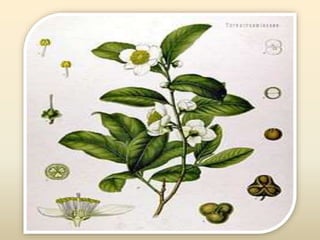
Tea plant (Camellia sinensis)
Tea is the agricultural product of the leaves, leaf buds, and
internodes of various cultivars and sub-varieties of the
Camellia sinensis plant, processed and cured using various
methods. "Tea" also refers to the aromatic beverage
prepared from the cured leaves by combination with hot or
boiling water, and is the common name for the Camellia
sinensis plant itself. After water, tea is the most widely
consumed beverage in the world. It has a cooling, slightly
bitter, astringent flavour which many enjoy. The term herbal
tea usually refers to infusions of fruit or herbs containing no
actual tea, such as rosehip tea or chamomile tea. Alternative
terms for this are tisane or herbal infusion, both bearing an
implied contrast with tea.
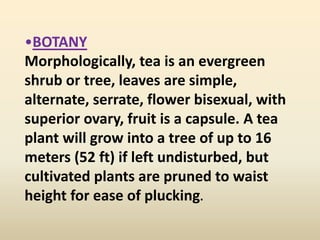
•BOTANY
Morphologically, tea is an evergreen
shrub or tree, leaves are simple,
alternate, serrate, flower bisexual, with
superior ovary, fruit is a capsule. A tea
plant will grow into a tree of up to 16
meters (52 ft) if left undisturbed, but
cultivated plants are pruned to waist
height for ease of plucking.
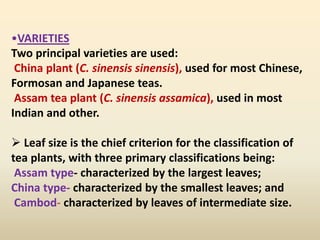
•VARIETIES
Two principal varieties are used:
China plant (C. sinensis sinensis), used for most Chinese,
Formosan and Japanese teas.
Assam tea plant (C. sinensis assamica), used in most
Indian and other.
 Leaf size is the chief criterion for the classification of
tea plants, with three primary classifications being:
Assam type- characterized by the largest leaves;
China type- characterized by the smallest leaves; and
Cambod- characterized by leaves of intermediate size.
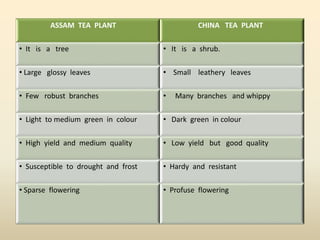
ASSAM TEA PLANT CHINA TEA PLANT
• It is a tree • It is a shrub.
• Large glossy leaves • Small leathery leaves
• Few robust branches • Many branches and whippy
• Light to medium green in colour • Dark green in colour
• High yield and medium quality • Low yield but good quality
• Susceptible to drought and frost • Hardy and resistant
• Sparse flowering • Profuse flowering
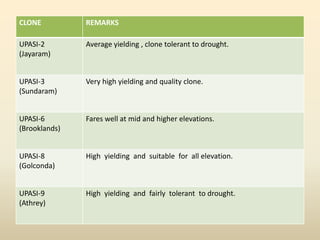
CLONE REMARKS
UPASI-2
(Jayaram)
Average yielding , clone tolerant to drought.
UPASI-3
(Sundaram)
Very high yielding and quality clone.
UPASI-6
(Brooklands)
Fares well at mid and higher elevations.
UPASI-8
(Golconda)
High yielding and suitable for all elevation.
UPASI-9
(Athrey)
High yielding and fairly tolerant to drought.
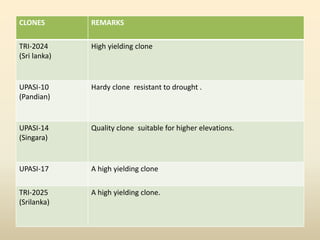
CLONES REMARKS
TRI-2024
(Sri lanka)
High yielding clone
UPASI-10
(Pandian)
Hardy clone resistant to drought .
UPASI-14
(Singara)
Quality clone suitable for higher elevations.
UPASI-17 A high yielding clone
TRI-2025
(Srilanka)
A high yielding clone.
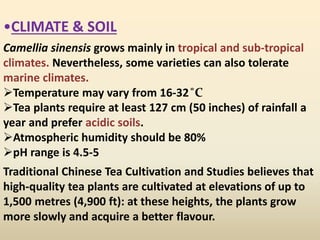
•CLIMATE & SOIL
Camellia sinensis grows mainly in tropical and sub-tropical
climates. Nevertheless, some varieties can also tolerate
marine climates.
Temperature may vary from 16-32 ̊C
Tea plants require at least 127 cm (50 inches) of rainfall a
year and prefer acidic soils.
Atmospheric humidity should be 80%
pH range is 4.5-5
Traditional Chinese Tea Cultivation and Studies believes that
high-quality tea plants are cultivated at elevations of up to
1,500 metres (4,900 ft): at these heights, the plants grow
more slowly and acquire a better flavour.
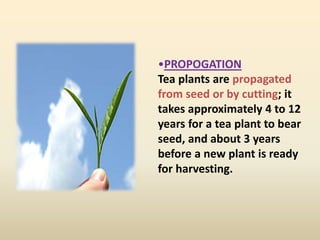
•PROPOGATION
Tea plants are propagated
from seed or by cutting; it
takes approximately 4 to 12
years for a tea plant to bear
seed, and about 3 years
before a new plant is ready
for harvesting.
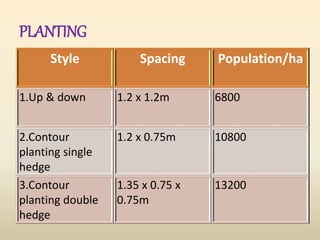
PLANTING
Style Spacing Population/ha
1.Up & down 1.2 x 1.2m 6800
2.Contour
planting single
hedge
1.2 x 0.75m 10800
3.Contour
planting double
hedge
1.35 x 0.75 x
0.75m
13200
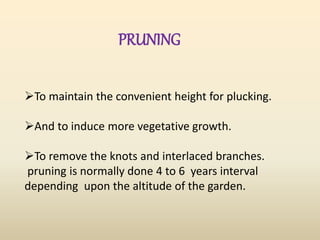
To maintain the convenient height for plucking.
And to induce more vegetative growth.
To remove the knots and interlaced branches.
pruning is normally done 4 to 6 years interval
depending upon the altitude of the garden.
PRUNING
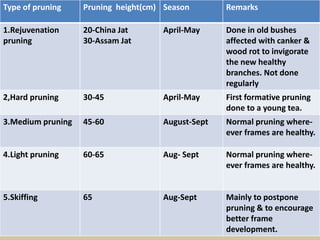
Type of pruning Pruning height(cm) Season Remarks
1.Rejuvenation
pruning
20-China Jat
30-Assam Jat
April-May Done in old bushes
affected with canker &
wood rot to invigorate
the new healthy
branches. Not done
regularly
2,Hard pruning 30-45 April-May First formative pruning
done to a young tea.
3.Medium pruning 45-60 August-Sept Normal pruning where-
ever frames are healthy.
4.Light pruning 60-65 Aug- Sept Normal pruning where-
ever frames are healthy.
5.Skiffing 65 Aug-Sept Mainly to postpone
pruning & to encourage
better frame
development.
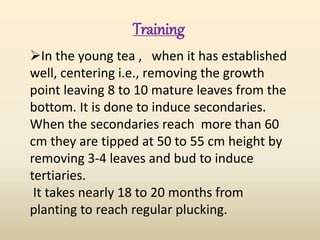
In the young tea , when it has established
well, centering i.e., removing the growth
point leaving 8 to 10 mature leaves from the
bottom. It is done to induce secondaries.
When the secondaries reach more than 60
cm they are tipped at 50 to 55 cm height by
removing 3-4 leaves and bud to induce
tertiaries.
It takes nearly 18 to 20 months from
planting to reach regular plucking.
Training
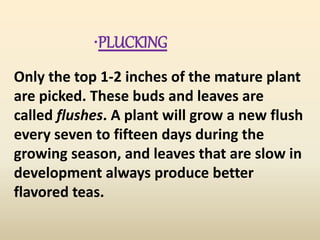
•PLUCKING
Only the top 1-2 inches of the mature plant
are picked. These buds and leaves are
called flushes. A plant will grow a new flush
every seven to fifteen days during the
growing season, and leaves that are slow in
development always produce better
flavored teas.
Manuring to the tea in the field depends on
many factors viz.,
Young or mature tea
 Organic and nutrient status of the soil
 soil ph
nature of pruning and yield potential of the
tea bushes.
Manuring
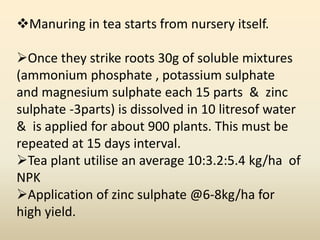
Manuring in tea starts from nursery itself.
Once they strike roots 30g of soluble mixtures
(ammonium phosphate , potassium sulphate
and magnesium sulphate each 15 parts & zinc
sulphate -3parts) is dissolved in 10 litresof water
& is applied for about 900 plants. This must be
repeated at 15 days interval.
Tea plant utilise an average 10:3.2:5.4 kg/ha of
NPK
Application of zinc sulphate @6-8kg/ha for
high yield.
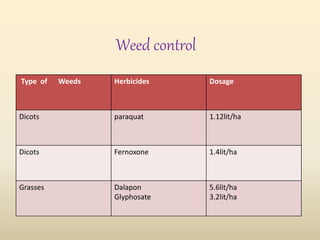
Type of Weeds Herbicides Dosage
Dicots paraquat 1.12lit/ha
Dicots Fernoxone 1.4lit/ha
Grasses Dalapon
Glyphosate
5.6lit/ha
3.2lit/ha
Weed control
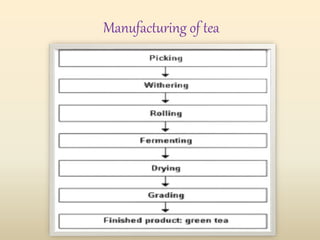
Manufacturing of tea
withering
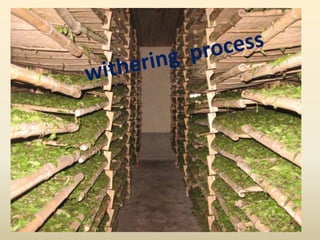
• Withering is to reduce the moisture content of
leaves by spreading them in troughs which
receive artificial air from fan fitted on one
end.
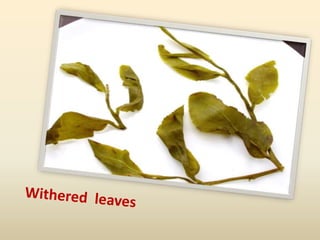
• At the end of withering the leaves attain a
flaccid condition for which it may take 12-18
hours depending upon weather condition.
Rolling
• This operation is carried on by a series of
machines or in a single roller during which
the cells of the leaves are broken to liberate
the sap containing the poly phenol oxidase ,
an enzyme , which in the presence of oxygen ,
oxidises the poly phenols to produce
theaflavins and thearubigens . These are the
responsible for colouring of the tea.
• Rolling takes place for 30-40 minutes .
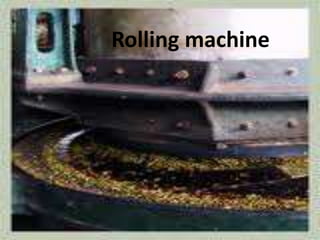
Rolling machine
Fermentation
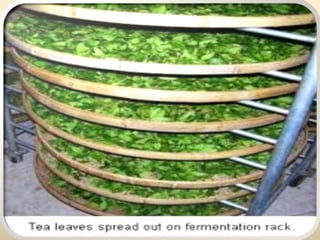
• Rolled tea materials are either spread in concrete
floors in the presence of high humidity and
proper temperature , the properly fermented tea
will take golden red colour.
• This steps decides the quality ie. Strength, colour
, briskness of tea .
• Fermentation requires 1-2 hours depending upon
the environmental conditions.
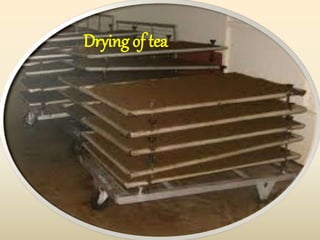
DRYING
• This step aims at stopping the fermentation
process and slowly removing the moisture
content without a burnt smell but preserving
the inherent quality. This is achieved by
passing the fermented tea in thin layers
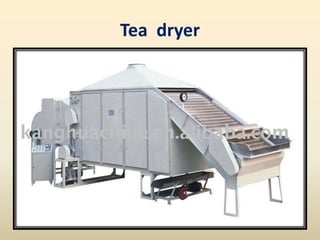
through conveyors into a drier .
• in which the inlet temperature is maintained
around 250-280 ̊F And outlet temperature is
around 150-200 ̊F .
• Proper drying takes 30-40minutes
Drying of tea
Tea dryer
GRADING
• Before drying the dried tea is
removed of the stalk fibers, which
affect the quality , by passing
through fiber separator
machines.
• The tea is passed through
different sized meshes which aid
in separation into different grades
ie Orthodox grades & CTC grades
(cutting tearing and curling).
DISEASES
• Blister blight(Exobasidium vexans): spray
copper oxychloride 350gm in 67lit. Of water
In pruned field.
• Black root disease(Rosellinia arcuata) : the
soil may be drenched with Diethane @30gm.
• Brown root disease(Fomes noxius):
Rehabilitate soil with gautemala grass.
• Root splitting disease(Armillaria mellea): soil
fumigation with methyl bromide.
Tea

Tea

  • 1.
  • 2.
    Tea plant (Camelliasinensis) Tea is the agricultural product of the leaves, leaf buds, and internodes of various cultivars and sub-varieties of the Camellia sinensis plant, processed and cured using various methods. "Tea" also refers to the aromatic beverage prepared from the cured leaves by combination with hot or boiling water, and is the common name for the Camellia sinensis plant itself. After water, tea is the most widely consumed beverage in the world. It has a cooling, slightly bitter, astringent flavour which many enjoy. The term herbal tea usually refers to infusions of fruit or herbs containing no actual tea, such as rosehip tea or chamomile tea. Alternative terms for this are tisane or herbal infusion, both bearing an implied contrast with tea.
  • 4.
    •BOTANY Morphologically, tea isan evergreen shrub or tree, leaves are simple, alternate, serrate, flower bisexual, with superior ovary, fruit is a capsule. A tea plant will grow into a tree of up to 16 meters (52 ft) if left undisturbed, but cultivated plants are pruned to waist height for ease of plucking.
  • 5.
    •VARIETIES Two principal varietiesare used: China plant (C. sinensis sinensis), used for most Chinese, Formosan and Japanese teas. Assam tea plant (C. sinensis assamica), used in most Indian and other.  Leaf size is the chief criterion for the classification of tea plants, with three primary classifications being: Assam type- characterized by the largest leaves; China type- characterized by the smallest leaves; and Cambod- characterized by leaves of intermediate size.
  • 6.
    ASSAM TEA PLANTCHINA TEA PLANT • It is a tree • It is a shrub. • Large glossy leaves • Small leathery leaves • Few robust branches • Many branches and whippy • Light to medium green in colour • Dark green in colour • High yield and medium quality • Low yield but good quality • Susceptible to drought and frost • Hardy and resistant • Sparse flowering • Profuse flowering
  • 7.
    CLONE REMARKS UPASI-2 (Jayaram) Average yielding, clone tolerant to drought. UPASI-3 (Sundaram) Very high yielding and quality clone. UPASI-6 (Brooklands) Fares well at mid and higher elevations. UPASI-8 (Golconda) High yielding and suitable for all elevation. UPASI-9 (Athrey) High yielding and fairly tolerant to drought.
  • 8.
    CLONES REMARKS TRI-2024 (Sri lanka) Highyielding clone UPASI-10 (Pandian) Hardy clone resistant to drought . UPASI-14 (Singara) Quality clone suitable for higher elevations. UPASI-17 A high yielding clone TRI-2025 (Srilanka) A high yielding clone.
  • 9.
    •CLIMATE & SOIL Camelliasinensis grows mainly in tropical and sub-tropical climates. Nevertheless, some varieties can also tolerate marine climates. Temperature may vary from 16-32 ̊C Tea plants require at least 127 cm (50 inches) of rainfall a year and prefer acidic soils. Atmospheric humidity should be 80% pH range is 4.5-5 Traditional Chinese Tea Cultivation and Studies believes that high-quality tea plants are cultivated at elevations of up to 1,500 metres (4,900 ft): at these heights, the plants grow more slowly and acquire a better flavour.
  • 10.
    •PROPOGATION Tea plants arepropagated from seed or by cutting; it takes approximately 4 to 12 years for a tea plant to bear seed, and about 3 years before a new plant is ready for harvesting.
  • 11.
    PLANTING Style Spacing Population/ha 1.Up& down 1.2 x 1.2m 6800 2.Contour planting single hedge 1.2 x 0.75m 10800 3.Contour planting double hedge 1.35 x 0.75 x 0.75m 13200
  • 12.
    To maintain theconvenient height for plucking. And to induce more vegetative growth. To remove the knots and interlaced branches. pruning is normally done 4 to 6 years interval depending upon the altitude of the garden. PRUNING
  • 13.
    Type of pruningPruning height(cm) Season Remarks 1.Rejuvenation pruning 20-China Jat 30-Assam Jat April-May Done in old bushes affected with canker & wood rot to invigorate the new healthy branches. Not done regularly 2,Hard pruning 30-45 April-May First formative pruning done to a young tea. 3.Medium pruning 45-60 August-Sept Normal pruning where- ever frames are healthy. 4.Light pruning 60-65 Aug- Sept Normal pruning where- ever frames are healthy. 5.Skiffing 65 Aug-Sept Mainly to postpone pruning & to encourage better frame development.
  • 14.
    In the youngtea , when it has established well, centering i.e., removing the growth point leaving 8 to 10 mature leaves from the bottom. It is done to induce secondaries. When the secondaries reach more than 60 cm they are tipped at 50 to 55 cm height by removing 3-4 leaves and bud to induce tertiaries. It takes nearly 18 to 20 months from planting to reach regular plucking. Training
  • 15.
    •PLUCKING Only the top1-2 inches of the mature plant are picked. These buds and leaves are called flushes. A plant will grow a new flush every seven to fifteen days during the growing season, and leaves that are slow in development always produce better flavored teas.
  • 16.
    Manuring to thetea in the field depends on many factors viz., Young or mature tea  Organic and nutrient status of the soil  soil ph nature of pruning and yield potential of the tea bushes. Manuring
  • 17.
    Manuring in teastarts from nursery itself. Once they strike roots 30g of soluble mixtures (ammonium phosphate , potassium sulphate and magnesium sulphate each 15 parts & zinc sulphate -3parts) is dissolved in 10 litresof water & is applied for about 900 plants. This must be repeated at 15 days interval. Tea plant utilise an average 10:3.2:5.4 kg/ha of NPK Application of zinc sulphate @6-8kg/ha for high yield.
  • 18.
    Type of WeedsHerbicides Dosage Dicots paraquat 1.12lit/ha Dicots Fernoxone 1.4lit/ha Grasses Dalapon Glyphosate 5.6lit/ha 3.2lit/ha Weed control
  • 19.
  • 20.
    withering • Withering isto reduce the moisture content of leaves by spreading them in troughs which receive artificial air from fan fitted on one end. • At the end of withering the leaves attain a flaccid condition for which it may take 12-18 hours depending upon weather condition.
  • 23.
    Rolling • This operationis carried on by a series of machines or in a single roller during which the cells of the leaves are broken to liberate the sap containing the poly phenol oxidase , an enzyme , which in the presence of oxygen , oxidises the poly phenols to produce theaflavins and thearubigens . These are the responsible for colouring of the tea. • Rolling takes place for 30-40 minutes .
  • 24.
  • 25.
    Fermentation • Rolled teamaterials are either spread in concrete floors in the presence of high humidity and proper temperature , the properly fermented tea will take golden red colour. • This steps decides the quality ie. Strength, colour , briskness of tea . • Fermentation requires 1-2 hours depending upon the environmental conditions.
  • 27.
    DRYING • This stepaims at stopping the fermentation process and slowly removing the moisture content without a burnt smell but preserving the inherent quality. This is achieved by passing the fermented tea in thin layers through conveyors into a drier . • in which the inlet temperature is maintained around 250-280 ̊F And outlet temperature is around 150-200 ̊F . • Proper drying takes 30-40minutes
  • 28.
  • 29.
  • 30.
    GRADING • Before dryingthe dried tea is removed of the stalk fibers, which affect the quality , by passing through fiber separator machines. • The tea is passed through different sized meshes which aid in separation into different grades ie Orthodox grades & CTC grades (cutting tearing and curling).
  • 31.
    DISEASES • Blister blight(Exobasidiumvexans): spray copper oxychloride 350gm in 67lit. Of water In pruned field. • Black root disease(Rosellinia arcuata) : the soil may be drenched with Diethane @30gm. • Brown root disease(Fomes noxius): Rehabilitate soil with gautemala grass. • Root splitting disease(Armillaria mellea): soil fumigation with methyl bromide.