PRESENT STATUS, FUTURE PROSPECT AND
POTENTIAL OF POST HARVEST PROCESSING
OF MANGO
Presented by: ANJALI SUDHAKAR
(01PFE/15)
Outlines
 Introduction
 Production
 Post harvest processing
 Value- added products
 Unit operations
 By-product utilization
 Problems in mango industries
 Potential
 Conclusion
 References
Introduction
Scientific
name
Magnifera indicia
Distribution Tropical and sub-
tropical region
Size Length: 5-15 cm
Width: 4-10 cm
Shape Round, ovate, obovate
Weight 150-750 g
Colour Green,
yellow,red,purple or
combination of all
these
Varieties Over 1000
Known as: King of fruits
PRODUCTION OF MANGO IN
INDIA
 India is the 1st major mango producing country in all over
the world.
 In the year 2014-15 India produces 188.32 lakh tonnes
over 22.18 lakh hectare area.
 Mango season in India starts from last week of April to first
week of August.
 India produces over hundreds of commercially grown
mango varieties some of them are alphonso, banganpalli,
chausa, dashehri, langra, totapuri, kesar.
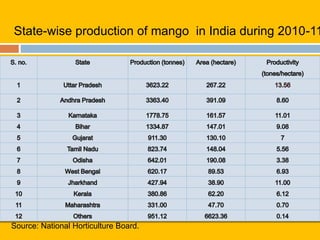
 Odisha ranks 7th position in mango producing state in the
growing belts of Sonepur, Bolangir, Gajapati, Koraput,
Rayagada, Gunpur, Malkanpuri, Dhenkanal, Ganjam, Puri.
 Baneshan, Langra, Neelum, Suvarnarekha and mostly
seedling types varities are grown in Odisha.
Source: National Horticulture Board.
State-wise production of mango in India during 2010-11
POST HARVEST PROCESSING OF
MANGO
Cleaning
Grading and sorting
Packaging
Storage
Transportation
Marketing
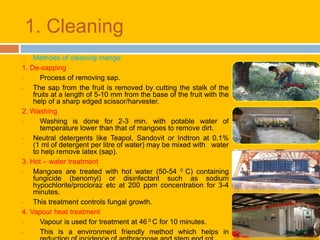
1. Cleaning
 Methods of cleaning mango:
1. De-sapping
 Process of removing sap.
 The sap from the fruit is removed by cutting the stalk of the
fruits at a length of 5-10 mm from the base of the fruit with the
help of a sharp edged scissor/harvester.
2. Washing
 Washing is done for 2-3 min. with potable water of
temperature lower than that of mangoes to remove dirt.
 Neutral detergents like Teapol, Sandovit or Indtron at 0.1%
(1 ml of detergent per litre of water) may be mixed with water
to help remove latex (sap).
3. Hot – water treatment
 Mangoes are treated with hot water (50-54 0 C) containing
fungicide (benomyl) or disinfectant such as sodium
hypochlorite/procloraz etc at 200 ppm concentration for 3-4
minutes.
 This treatment controls fungal growth.
4. Vapour heat treatment
 Vapour is used for treatment at 46 0 C for 10 minutes.
 This is a environment friendly method which helps in
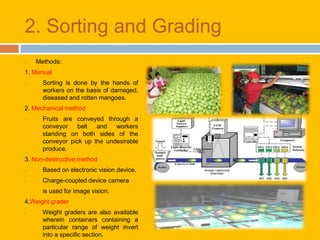
2. Sorting and Grading
 Methods:
1. Manual
 Sorting is done by the hands of
workers on the basis of damaged,
diseased and rotten mangoes.
2. Mechanical method
 Fruits are conveyed through a
conveyor belt and workers
standing on both sides of the
conveyor pick up the undesirable
produce.
3. Non-destructive method
 Based on electronic vision device.
 Charge-coupled device camera
is used for image vision.
4.Weight grader
 Weight graders are also available
wherein containers containing a
particular range of weight invert
into a specific section.
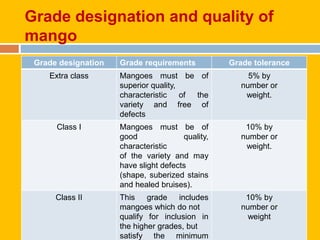
Grade designation and quality of
mango
Grade designation Grade requirements Grade tolerance
Extra class Mangoes must be of
superior quality,
characteristic of the
variety and free of
defects
5% by
number or
weight.
Class I Mangoes must be of
good quality,
characteristic
of the variety and may
have slight defects
(shape, suberized stains
and healed bruises).
10% by
number or
weight.
Class II This grade includes
mangoes which do not
qualify for inclusion in
the higher grades, but
satisfy the minimum
10% by
number or
weight
3. Packaging
Packaging
material
Merits Demerits
Bamboo or plastic
baskets
Cheap, easy
available
Mechanical
damage
Jute or plastic
sacks
Cheap, easy
available
Mechanical
damage
Wooden and
plastic crates
Large capacity Heavy, skin
damage
Fibreboard boxes Light weight Affected by water
Plastic boxes Light weight,
transparency
Low capacity
Pallets Large capacity Heavy
Foam net Low thermal
conductivity,recycla
ble
Poor strength,
toxicCushioning material and wrap:
Dry grass, paddy straw, leaves, saw dust, paper shreds
etc
Shrink wrapping
BASKET
SACKS
FIBREBOARD FOAM NET
PLASTIC BOXE
PALLETS
4. Storage
Storage type Storage condition Storage duration
Ambient Below 33°C,
RH- 45-60%
4 days
Cold storage 4-9°C,
RH-85-90%
4-7 weeks
Modified atmosphere 8-10°C,
RH-85-90%,
5%O2+10%CO2
4-6 weeks
Controlled
atmosphere
12-15°C,
2kPa O2
2-3 weeks
Vacuum packaging
in LDPE
17°C,
70-80% RH
33 days
Hypoboric 100-75 mm Hg 25-35 days
AMBIENT
COLD STORAGE
CONTROLLED
ATMOSPHERE
MODIFIED
ATMOSPHERE
VACUUM
PACKAGING
HYPOBORIC
5. Transportation
 Optimum carrying temperature: 8-10°C.
 Optimum humidity: 85-90%.
 Ventilation setting for containers: 25m3/hr.
 Acceptable product temperature at loading into container should be maximum 2°C
above carrying temperature.
 The good advice is that to transport mangoes during the cooler part of the day to
protect the fruits from the direct rays of the sun to reduce fresh weight loss,
shriveling and deterioration of fruit quality.
 Trucks are mostly preferred for transportation because losses during transit is very
small about 1%.
 Table below explains the status of transportation in India:
Transportation
mode
Important facts
Road transport Tractors, auto rikshaw for 10-20 kmand Trucks for above 100
km
Rail transport Coaches maintain a temp. of 12.8-15.6°C maintaining RH at
60%
Air transport Not popular due to high expense, Pre-cooling is essential.
6. Marketing
 India supplies 5.9% to fulfill whole world
demand.
 Annually 50 crores currency is earned from
foreign exchange.
 For marketing, normal tradition is followed that
maximum mango gardens are auctioned to
traders and are marketed by them.
 Co-operative societies are very less in number
which take up this work and members have
gat very good income.
Minimum quality standard for export of
mango
 whole, firm, sound and fresh in appearance;
 clean, practically free of any visible foreign matter;
 free of marked bruising,
 free from damage caused by low/or high temperature;
 free of any foreign smell and/or taste;
 free of damage caused by pests;
 sufficiently developed and display satisfactory
ripeness;
 when a peduncle is present, it shall not be no longer
than 1.0 cm.
 Mangoes shall comply with the residue levels of heavy
metals, pesticides and other food safety parameters
as laid down by the Codex Alimentarius Commission
for exports.
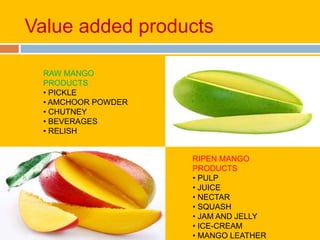
Value added products
RAW MANGO
PRODUCTS
• PICKLE
• AMCHOOR POWDER
• CHUTNEY
• BEVERAGES
• RELISH
RIPEN MANGO
PRODUCTS
• PULP
• JUICE
• NECTAR
• SQUASH
• JAM AND JELLY
• ICE-CREAM
• MANGO LEATHER
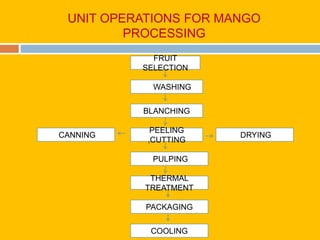
UNIT OPERATIONS FOR MANGO
PROCESSING
WASHING
BLANCHING
PEELING
,CUTTING
THERMAL
TREATMENT
PACKAGING
COOLING
DRYING
FRUIT
SELECTION
PULPING
CANNING
Fruit selection : The requirements need to be
met
 Lack of insect infestation
 Lack of mechanical injuries
 Stage of maturity
 Uniform colour and texture
 Minimum soluble solids of 13 ° Brix
 pH value of 3.5 to 4.0.
Alphanso, totapuri, bangainpalli are
important mango varieties used for
processed product from mango.
Washing
 First washing involves water containing 15
ppm chlorine in order to reduce microbial
load.
 Second washing is with clean water to
eliminate residual chlorine.
Blanching
 Fruit is blanched unpeeled.
 The thermal treatment is applied such that
the internal temperature reaches 75 °C.
 Two methods of blanching are:
1. boiling water blanching
2. steam blanching Basket type blancher
Cost- 28lakh
 Peeling
Peeling can be done by two ways:
o Manually
Hand Slicer Glass
 Hand peeling can cause a reduction of up to 5.6% in the recovery
of slices compared with machine peeling.
Steam peeling/lye peeling is also used sometimes.
o Mechanically
Model: Blue international group pvt.
Ltd.
Capacity 1500pcs/hr
Cost : 15 lakh
Powder: 600 W
Model : solon mango peeler(SL)
Capacity: 0.12 tonne/hr
Cost: $3000-9000
Power : 2.5 kW
 Cutting
o Manually
o Mechanically
Mango should be cut down 1/4th inches from the widest centre line.
 Pulping
 India is also a major exporter of Mango Pulp in the world. The
country has exported 1,28,866.01 MT of Mango Pulp to the world
for the worth of Rs. 796.17 crores during the year 2015-16.
Model no.: kewei mango pulper (MDJ)
Cost : 25 lakh
Capacity : 1000-2500 kg/hr
 Drying
Drying methods Advantage
Osmotic dehydration (40° Brix sugar,
8mm slices at 60% sugar for 2hrs)
Best dehydrated product
Electric cabinet dryer (60°C) No browning after 1 year storage
Drum drying Efficient, economical process for
producing dried mango powder and
flakes.
Freeze drying (-25°C for 24 hrs at
4Pa)
Best for ripen mango slices
Spray drying (165°C, 2800 rpm) Good quality mango powder
 Thermal treatment
 Normally 90°C for 1 minute is recommended
for sterilization for mango pulp.
 Cooling
 Mango pulp after thermal processing is
cooled at 30-32°C.
Losses in mango processing
TYPE OF LOSSES LOSSES (%)
Harvesting loss 1-15
Grading 3-11
Packaging 6-19
Storage 3-12
Marketing 1-5
Source: National Horticulture Board
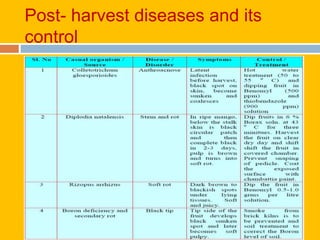
Post- harvest diseases and its
control
 Chemicals that accelerate ripening
 Ethylene and ethylene releasing compound like 2,4-
chlorophenythio triethyl amine hrdrochloride (CEPTA).
 Abscisin
 Ascorbic acid and hydroxyethyl hydrazine (BDH), cupric ethylene
diamine tetracetate (Cu-EDTA).
 Acetylene and calcium carbide
 Alcohol – ethanol, hexanol, octanol, heptanol etc.
 Fatty acid
 Chemicals that delay in ripening
 Growth retardants like malic hydrazide
 Maleic acid
 Ethylene oxide
 Ethylene absorbents like KMNO4.
By-product utilization
Waste from
mango
processing
plant
PEEL(7-24%)
[pectin, biogas,
alcohol,]
KERNEL(9-40%)
[oil, tannis, flour]
POMACE (5-
10%)
[juice,wine,
vinegar]
Flow chart of mango vinegar
preparation
Preparation of mango peel wine
c
Cut into small piece
(3*5 cm, 200gm)
Sterilized
( 121°C for 15 min)
Transferred transferred
into 1000 ml glass
cylinder
Added 400 ml saccharomyces
cerevisiae yeast with optical
density of 1 at 590nm
Bangainpalli mango
cFerment for 12 hrs at 15-30°C
 Good quality jelly grade pectin (6.1%) and edible
fibre (5.4%) vinegar (5.2% acetic acid) and citric
acid (20 g / kg) can be extracted from ripe
mango peel.
 In India, mango production = 6987.7 tones
approx waste = 45%
potential quantities of waste = 3144.4
tones
Problems in Indian mango
industries
1) Complex supply chain
2) Weather fluctuations
3) Lack of supply of Mangoes.
4) Ethylene production causes over-ripening after harvesting also.
5) Inconsistent supply of quality and quantity of Mangoes.
6) Disaggregate and multi-layered marketing channels, resulting in
inefficiencies in procuring of raw material.
7) Highly perishable (short storage life and susceptible to diseases)
resulting in high post-harvest losses
8) High freight cost and inadequate transport facilities
Potential of mango processing
 Mango has high medicinal values as it can be
used to fight against bronchitis, heartburn, mental
depression, inflammation of the throat.
 Mango is a good source of vitamin A and C, beta-
carotene, potassium, selenium, copper, zinc.
 High fragrance of mango flower can used to
extract essential oil.
 High amount of fat and starch in mango kernel
have good potential to replace other starch food
for alcohol production.
 The oil extracted from kernel is of good quality
and could be used in cosmetic and soap
industries.
Conclusion
Though India is the major producing country of
mango but still our country suffers from 20-
25% losses. These losses can be overcome
by improving post-harvest management and
practices like better packaging and storage,
preventing ripening, thermal treatment, proper
marketing chain.
References
 Patil, Singh, Gupta. 2009. Post harvest management of horticultural
produce. (pg.- 16-23). Daya publishing house, New Delhi.
 Chadha , Pal. (2015). Managing post harvest quality and losses in
horticultural crops (volume 2. Pg- 461-484). Daya publishing house,
New Delhi.
 Narendra Bhusan. 2013. Post harvest profile of mango. Department
of agriculture and cooperation.
 www.apeda.org
 www.indianhorticulturedatabase.org
 www.kisan.com
 FAOSTAT. 2010. area and production of mango.
http://faostat.fao.org
Pht on mango

Pht on mango

  • 1.
    PRESENT STATUS, FUTUREPROSPECT AND POTENTIAL OF POST HARVEST PROCESSING OF MANGO Presented by: ANJALI SUDHAKAR (01PFE/15)
  • 2.
    Outlines  Introduction  Production Post harvest processing  Value- added products  Unit operations  By-product utilization  Problems in mango industries  Potential  Conclusion  References
  • 3.
    Introduction Scientific name Magnifera indicia Distribution Tropicaland sub- tropical region Size Length: 5-15 cm Width: 4-10 cm Shape Round, ovate, obovate Weight 150-750 g Colour Green, yellow,red,purple or combination of all these Varieties Over 1000 Known as: King of fruits
  • 4.
    PRODUCTION OF MANGOIN INDIA  India is the 1st major mango producing country in all over the world.  In the year 2014-15 India produces 188.32 lakh tonnes over 22.18 lakh hectare area.  Mango season in India starts from last week of April to first week of August.  India produces over hundreds of commercially grown mango varieties some of them are alphonso, banganpalli, chausa, dashehri, langra, totapuri, kesar.  Odisha ranks 7th position in mango producing state in the growing belts of Sonepur, Bolangir, Gajapati, Koraput, Rayagada, Gunpur, Malkanpuri, Dhenkanal, Ganjam, Puri.  Baneshan, Langra, Neelum, Suvarnarekha and mostly seedling types varities are grown in Odisha.
  • 5.
    Source: National HorticultureBoard. State-wise production of mango in India during 2010-11
  • 6.
    POST HARVEST PROCESSINGOF MANGO Cleaning Grading and sorting Packaging Storage Transportation Marketing
  • 7.
    1. Cleaning  Methodsof cleaning mango: 1. De-sapping  Process of removing sap.  The sap from the fruit is removed by cutting the stalk of the fruits at a length of 5-10 mm from the base of the fruit with the help of a sharp edged scissor/harvester. 2. Washing  Washing is done for 2-3 min. with potable water of temperature lower than that of mangoes to remove dirt.  Neutral detergents like Teapol, Sandovit or Indtron at 0.1% (1 ml of detergent per litre of water) may be mixed with water to help remove latex (sap). 3. Hot – water treatment  Mangoes are treated with hot water (50-54 0 C) containing fungicide (benomyl) or disinfectant such as sodium hypochlorite/procloraz etc at 200 ppm concentration for 3-4 minutes.  This treatment controls fungal growth. 4. Vapour heat treatment  Vapour is used for treatment at 46 0 C for 10 minutes.  This is a environment friendly method which helps in
  • 8.
    2. Sorting andGrading  Methods: 1. Manual  Sorting is done by the hands of workers on the basis of damaged, diseased and rotten mangoes. 2. Mechanical method  Fruits are conveyed through a conveyor belt and workers standing on both sides of the conveyor pick up the undesirable produce. 3. Non-destructive method  Based on electronic vision device.  Charge-coupled device camera is used for image vision. 4.Weight grader  Weight graders are also available wherein containers containing a particular range of weight invert into a specific section.
  • 9.
    Grade designation andquality of mango Grade designation Grade requirements Grade tolerance Extra class Mangoes must be of superior quality, characteristic of the variety and free of defects 5% by number or weight. Class I Mangoes must be of good quality, characteristic of the variety and may have slight defects (shape, suberized stains and healed bruises). 10% by number or weight. Class II This grade includes mangoes which do not qualify for inclusion in the higher grades, but satisfy the minimum 10% by number or weight
  • 10.
    3. Packaging Packaging material Merits Demerits Bambooor plastic baskets Cheap, easy available Mechanical damage Jute or plastic sacks Cheap, easy available Mechanical damage Wooden and plastic crates Large capacity Heavy, skin damage Fibreboard boxes Light weight Affected by water Plastic boxes Light weight, transparency Low capacity Pallets Large capacity Heavy Foam net Low thermal conductivity,recycla ble Poor strength, toxicCushioning material and wrap: Dry grass, paddy straw, leaves, saw dust, paper shreds etc Shrink wrapping BASKET SACKS FIBREBOARD FOAM NET PLASTIC BOXE PALLETS
  • 11.
    4. Storage Storage typeStorage condition Storage duration Ambient Below 33°C, RH- 45-60% 4 days Cold storage 4-9°C, RH-85-90% 4-7 weeks Modified atmosphere 8-10°C, RH-85-90%, 5%O2+10%CO2 4-6 weeks Controlled atmosphere 12-15°C, 2kPa O2 2-3 weeks Vacuum packaging in LDPE 17°C, 70-80% RH 33 days Hypoboric 100-75 mm Hg 25-35 days AMBIENT COLD STORAGE CONTROLLED ATMOSPHERE MODIFIED ATMOSPHERE VACUUM PACKAGING HYPOBORIC
  • 12.
    5. Transportation  Optimumcarrying temperature: 8-10°C.  Optimum humidity: 85-90%.  Ventilation setting for containers: 25m3/hr.  Acceptable product temperature at loading into container should be maximum 2°C above carrying temperature.  The good advice is that to transport mangoes during the cooler part of the day to protect the fruits from the direct rays of the sun to reduce fresh weight loss, shriveling and deterioration of fruit quality.  Trucks are mostly preferred for transportation because losses during transit is very small about 1%.  Table below explains the status of transportation in India: Transportation mode Important facts Road transport Tractors, auto rikshaw for 10-20 kmand Trucks for above 100 km Rail transport Coaches maintain a temp. of 12.8-15.6°C maintaining RH at 60% Air transport Not popular due to high expense, Pre-cooling is essential.
  • 13.
    6. Marketing  Indiasupplies 5.9% to fulfill whole world demand.  Annually 50 crores currency is earned from foreign exchange.  For marketing, normal tradition is followed that maximum mango gardens are auctioned to traders and are marketed by them.  Co-operative societies are very less in number which take up this work and members have gat very good income.
  • 14.
    Minimum quality standardfor export of mango  whole, firm, sound and fresh in appearance;  clean, practically free of any visible foreign matter;  free of marked bruising,  free from damage caused by low/or high temperature;  free of any foreign smell and/or taste;  free of damage caused by pests;  sufficiently developed and display satisfactory ripeness;  when a peduncle is present, it shall not be no longer than 1.0 cm.  Mangoes shall comply with the residue levels of heavy metals, pesticides and other food safety parameters as laid down by the Codex Alimentarius Commission for exports.
  • 15.
    Value added products RAWMANGO PRODUCTS • PICKLE • AMCHOOR POWDER • CHUTNEY • BEVERAGES • RELISH RIPEN MANGO PRODUCTS • PULP • JUICE • NECTAR • SQUASH • JAM AND JELLY • ICE-CREAM • MANGO LEATHER
  • 16.
    UNIT OPERATIONS FORMANGO PROCESSING WASHING BLANCHING PEELING ,CUTTING THERMAL TREATMENT PACKAGING COOLING DRYING FRUIT SELECTION PULPING CANNING
  • 17.
    Fruit selection :The requirements need to be met  Lack of insect infestation  Lack of mechanical injuries  Stage of maturity  Uniform colour and texture  Minimum soluble solids of 13 ° Brix  pH value of 3.5 to 4.0. Alphanso, totapuri, bangainpalli are important mango varieties used for processed product from mango.
  • 18.
    Washing  First washinginvolves water containing 15 ppm chlorine in order to reduce microbial load.  Second washing is with clean water to eliminate residual chlorine. Blanching  Fruit is blanched unpeeled.  The thermal treatment is applied such that the internal temperature reaches 75 °C.  Two methods of blanching are: 1. boiling water blanching 2. steam blanching Basket type blancher Cost- 28lakh
  • 19.
     Peeling Peeling canbe done by two ways: o Manually Hand Slicer Glass  Hand peeling can cause a reduction of up to 5.6% in the recovery of slices compared with machine peeling. Steam peeling/lye peeling is also used sometimes.
  • 20.
    o Mechanically Model: Blueinternational group pvt. Ltd. Capacity 1500pcs/hr Cost : 15 lakh Powder: 600 W Model : solon mango peeler(SL) Capacity: 0.12 tonne/hr Cost: $3000-9000 Power : 2.5 kW
  • 21.
     Cutting o Manually oMechanically Mango should be cut down 1/4th inches from the widest centre line.
  • 22.
     Pulping  Indiais also a major exporter of Mango Pulp in the world. The country has exported 1,28,866.01 MT of Mango Pulp to the world for the worth of Rs. 796.17 crores during the year 2015-16. Model no.: kewei mango pulper (MDJ) Cost : 25 lakh Capacity : 1000-2500 kg/hr
  • 23.
     Drying Drying methodsAdvantage Osmotic dehydration (40° Brix sugar, 8mm slices at 60% sugar for 2hrs) Best dehydrated product Electric cabinet dryer (60°C) No browning after 1 year storage Drum drying Efficient, economical process for producing dried mango powder and flakes. Freeze drying (-25°C for 24 hrs at 4Pa) Best for ripen mango slices Spray drying (165°C, 2800 rpm) Good quality mango powder
  • 24.
     Thermal treatment Normally 90°C for 1 minute is recommended for sterilization for mango pulp.  Cooling  Mango pulp after thermal processing is cooled at 30-32°C.
  • 25.
    Losses in mangoprocessing TYPE OF LOSSES LOSSES (%) Harvesting loss 1-15 Grading 3-11 Packaging 6-19 Storage 3-12 Marketing 1-5 Source: National Horticulture Board
  • 26.
    Post- harvest diseasesand its control
  • 27.
     Chemicals thataccelerate ripening  Ethylene and ethylene releasing compound like 2,4- chlorophenythio triethyl amine hrdrochloride (CEPTA).  Abscisin  Ascorbic acid and hydroxyethyl hydrazine (BDH), cupric ethylene diamine tetracetate (Cu-EDTA).  Acetylene and calcium carbide  Alcohol – ethanol, hexanol, octanol, heptanol etc.  Fatty acid  Chemicals that delay in ripening  Growth retardants like malic hydrazide  Maleic acid  Ethylene oxide  Ethylene absorbents like KMNO4.
  • 28.
    By-product utilization Waste from mango processing plant PEEL(7-24%) [pectin,biogas, alcohol,] KERNEL(9-40%) [oil, tannis, flour] POMACE (5- 10%) [juice,wine, vinegar]
  • 29.
    Flow chart ofmango vinegar preparation
  • 30.
    Preparation of mangopeel wine c Cut into small piece (3*5 cm, 200gm) Sterilized ( 121°C for 15 min) Transferred transferred into 1000 ml glass cylinder Added 400 ml saccharomyces cerevisiae yeast with optical density of 1 at 590nm Bangainpalli mango cFerment for 12 hrs at 15-30°C
  • 31.
     Good qualityjelly grade pectin (6.1%) and edible fibre (5.4%) vinegar (5.2% acetic acid) and citric acid (20 g / kg) can be extracted from ripe mango peel.  In India, mango production = 6987.7 tones approx waste = 45% potential quantities of waste = 3144.4 tones
  • 32.
    Problems in Indianmango industries 1) Complex supply chain 2) Weather fluctuations 3) Lack of supply of Mangoes. 4) Ethylene production causes over-ripening after harvesting also. 5) Inconsistent supply of quality and quantity of Mangoes. 6) Disaggregate and multi-layered marketing channels, resulting in inefficiencies in procuring of raw material. 7) Highly perishable (short storage life and susceptible to diseases) resulting in high post-harvest losses 8) High freight cost and inadequate transport facilities
  • 33.
    Potential of mangoprocessing  Mango has high medicinal values as it can be used to fight against bronchitis, heartburn, mental depression, inflammation of the throat.  Mango is a good source of vitamin A and C, beta- carotene, potassium, selenium, copper, zinc.  High fragrance of mango flower can used to extract essential oil.  High amount of fat and starch in mango kernel have good potential to replace other starch food for alcohol production.  The oil extracted from kernel is of good quality and could be used in cosmetic and soap industries.
  • 34.
    Conclusion Though India isthe major producing country of mango but still our country suffers from 20- 25% losses. These losses can be overcome by improving post-harvest management and practices like better packaging and storage, preventing ripening, thermal treatment, proper marketing chain.
  • 35.
    References  Patil, Singh,Gupta. 2009. Post harvest management of horticultural produce. (pg.- 16-23). Daya publishing house, New Delhi.  Chadha , Pal. (2015). Managing post harvest quality and losses in horticultural crops (volume 2. Pg- 461-484). Daya publishing house, New Delhi.  Narendra Bhusan. 2013. Post harvest profile of mango. Department of agriculture and cooperation.  www.apeda.org  www.indianhorticulturedatabase.org  www.kisan.com  FAOSTAT. 2010. area and production of mango. http://faostat.fao.org