AT 2201
Production and Management of Export Agriculture
Crops
Cinnamon
Harvesting/post harvesting practices
and value added products
Content
 Introduction
 Harvesting period/interval
 Harvesting practices - technique
 Post harvesting practices – important
 Steps require in details
 Value added product
 i. Different value-added products
 ii. Medicinal/chemical properties – major uses
 iii. By products - industries
Introduction
 Scientific name : Cinnamomum zeylanicum
 Family : lauraceae
 Cultivated area : coastal belt from Negombo to Matara,
Kalutara and Ratnapura. Wild species can be seen in
Kandy, Matale, Belihull oya, horton planes and the
sinharaja forest range.
 Commercially cultivated variety: Cinnamomum zeylanicum
Blume
 Cultivation extend: 33589ha(2018)
 Production : 23019MT(2018)
 Export quantity: 17860MT(2018)
Harvesting practices
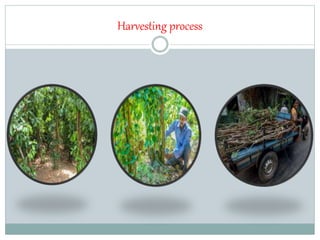
 Cinnamon harvesting period : September to November
 Harvesting is done in the morning
 First harvest of cinnamon can be taken after three years
of planting.
 Harvesting is done when the bark color of the stem turn
in to brown and stick diameter is around 3-5cm.
 When separating the branches from the bush, the
cutting bevel should be applied so that it is inside the
bush.
 Branches and leaves are removed from harvested sticks
before peeling.
Harvesting process
Post harvest practices
 Post harvest practices…
post harvest handling is the stage of crop production
immediately following harvest, including cooling, cleaning,
sorting and packing…..
 Purpose of post harvest…
 To maintain quality.(appearance, texture, flavor & nutritive
value)
 To protect food safety.
 To reduce losses between harvest and consumption.
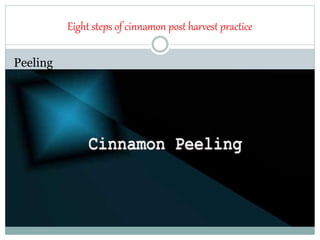
Eight steps of cinnamon post harvest practice
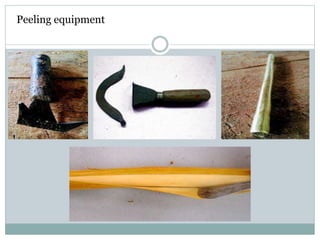
Peeling
Peeling equipment
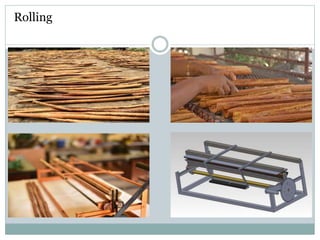
Rolling
Piping
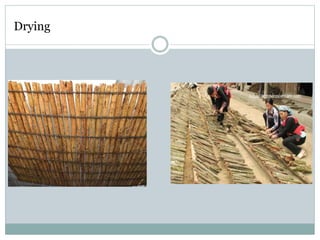
Drying
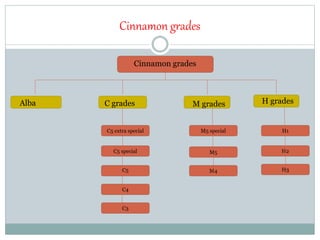
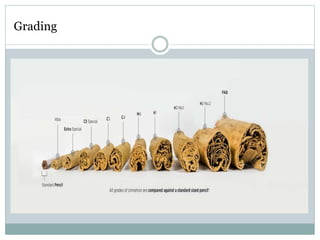
Cinnamon grades
Cinnamon grades
Alba C grades M grades H grades
C5 extra special
C5 special
C3
C4
C5
M5
M4
M5 special
H2
H3
H1
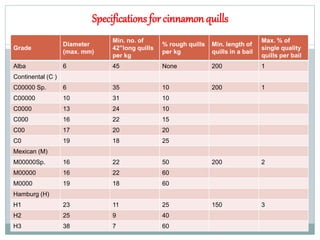
Specifications for cinnamon quills
Grade
Diameter
(max. mm)
Min. no. of
42”long quills
per kg
% rough quills
per kg
Min. length of
quills in a bail
Max. % of
single quality
quills per bail
Alba 6 45 None 200 1
Continental (C )
C00000 Sp. 6 35 10 200 1
C00000 10 31 10
C0000 13 24 10
C000 16 22 15
C00 17 20 20
C0 19 18 25
Mexican (M)
M00000Sp. 16 22 50 200 2
M00000 16 22 60
M0000 19 18 60
Hamburg (H)
H1 23 11 25 150 3
H2 25 9 40
H3 38 7 60
Grading
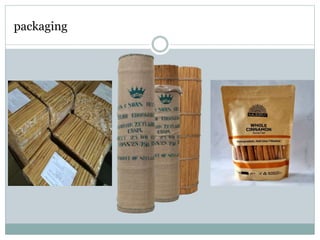
packaging
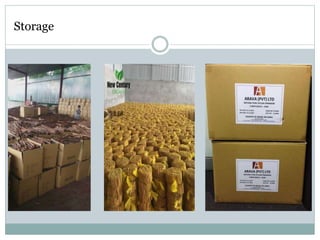
Storage
Making
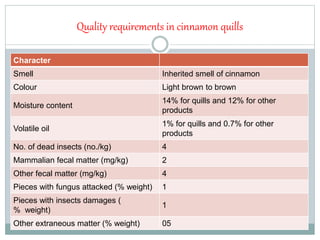
Quality requirements in cinnamon quills
Character
Smell Inherited smell of cinnamon
Colour Light brown to brown
Moisture content
14% for quills and 12% for other
products
Volatile oil
1% for quills and 0.7% for other
products
No. of dead insects (no./kg) 4
Mammalian fecal matter (mg/kg) 2
Other fecal matter (mg/kg) 4
Pieces with fungus attacked (% weight) 1
Pieces with insects damages (
% weight)
1
Other extraneous matter (% weight) 05
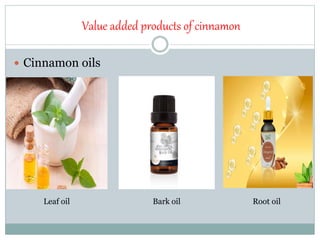
Value added products of cinnamon
 Cinnamon oils
Leaf oil Bark oil Root oil
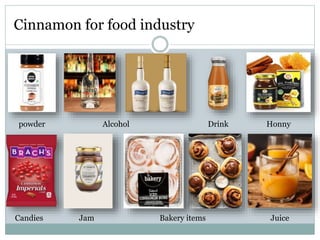
Cinnamon for food industry
powder Alcohol Drink Honny
Candies Jam Bakery items Juice
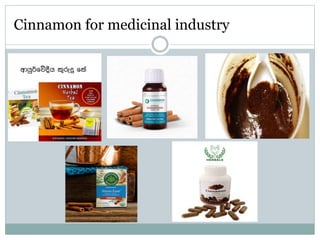
Cinnamon for medicinal industry
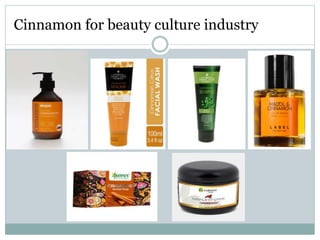
Cinnamon for beauty culture industry
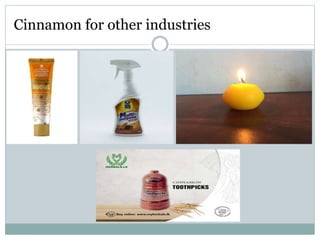
Cinnamon for other industries
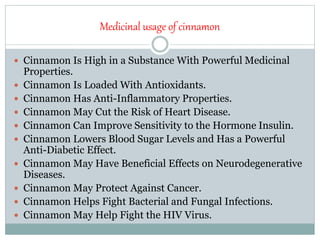
Medicinal usage of cinnamon
 Cinnamon Is High in a Substance With Powerful Medicinal
Properties.
 Cinnamon Is Loaded With Antioxidants.
 Cinnamon Has Anti-Inflammatory Properties.
 Cinnamon May Cut the Risk of Heart Disease.
 Cinnamon Can Improve Sensitivity to the Hormone Insulin.
 Cinnamon Lowers Blood Sugar Levels and Has a Powerful
Anti-Diabetic Effect.
 Cinnamon May Have Beneficial Effects on Neurodegenerative
Diseases.
 Cinnamon May Protect Against Cancer.
 Cinnamon Helps Fight Bacterial and Fungal Infections.
 Cinnamon May Help Fight the HIV Virus.
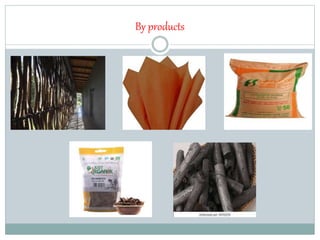
By products